Biomechanical characteristics of the knee joint in female athletes during tasks
associated with anterior cruciate ligament injury
Yasuharu Nagano
a,⁎
, Hirofumi Ida
b, Masami Akai
c, Toru Fukubayashi
da
Waseda University Graduate School of Sports Sciences, Saitama, Japan
bKanagawa Institute of Technology, Kanagawa, Japan c
National Rehabilitation Center for Persons with Disabilities, Saitama, Japan
d
Waseda University Faculty of Sports Sciences, Saitama, Japan
a b s t r a c t
a r t i c l e i n f o
Article history:
Received 22 May 2008
Received in revised form 20 October 2008 Accepted 26 October 2008 Keywords: ACL injury Risk factor Knee kinematics Injury mechanism Prevention
This study was designed to compare biomechanical characteristics of the knee joint for several athletic tasks to elucidate their effects and to examine what tasks pose a risk for ACL injury.
Three athletic tasks were performed by 24 female athletes: single-limb landing, plant and cutting, and both-limb jump landing. Angular displacements offlexion/extension, abduction/adduction, and external/internal tibial rotation were calculated. Angular excursion and the rate of excursion of abduction and internal tibial rotation were also calculated.
During plant and cutting, from foot contact, subjects rotated the tibia more rapidly and to a greater degree toward internal tibial rotation. Moreover, excursion of knee abduction is greater than that during single-limb landing. During both-limb jump landing, the kneeflexion at foot contact was greater than for either single-limb landing or plant and cutting; peak knee abduction was greater than for either single-single-limb landing or plant and cutting.
In plant and cutting, the risk of ACL injury is increased by greater excursion and more rapid knee abduction than that which occurs in limb landing, in addition to greater internal tibial rotation. Although single-limb tasks apparently pose a greater risk for ACL injury than bilateral landings, both-single-limb landing with greater knee abduction might also risk ACL injury.
© 2008 Elsevier B.V. All rights reserved.
1. Introduction
Anterior cruciate ligament (ACL) injury is a serious injury in sports activities. After ACL injury, most athletes must undergo ligament reconstruction and continue rehabilitation for 6 months to a year before returning to sports activities [1]. The rate of ACL injury is reportedly much higher for female athletes than for males [2,3]. Additionally, almost 70% of situations causing ACL injury are noncontact situations: landing from a jump, stopping after fast running, and cutting to a different direction[2,4].
Understanding the mechanisms of ACL injury is important for its prevention. Olsen et al.[5]described ACL injury mechanisms from viewing videotapes of ACL injuries. They concluded that the main injury mechanism for ACL injuries is a forceful valgus collapse with the knee close to full extension, combined with external or internal rotation of the tibia. However, ACL injuries occur rapidly during games and practice sessions. In most cases, it is difficult to determine the mechanisms of ACL injury from videotapes or pictures recording the
injury situation because of the image quality. Therefore, many researchers have examined injury mechanisms from motion capture images taken in laboratory conditions.
Numerous studies using motion capture systems have examined the mechanism and risk factors of ACL injury during athletic tasks according to gender differences. As described previously, female athletes are more prone to sustaining ACL injury than male athletes. Therefore, female characteristic kinematics and kinetics are thought to be risk factors related to ACL injury mechanisms. Earlier studies have shown that female athletes demonstrate larger knee valgus than male athletes during landing or many other athletic tasks[6–12]. Hewett et al.[13] measured kinematics and joint loads using kinetics during a jump-landing task prospectively: results showed that female athletes with increased dynamic valgus and high abduction loads are at increased risk of anterior cruciate ligament injury. Therefore, knee valgus has been recognized as a risk factor and one mechanism of ACL injury. Tibial rotation during athletic tasks has been examined recently: we examined gender differences of tibial rotation during single-limb drop landing and estimated that the risk factor and mechanism of ACL injury would be greater for tibial internal rotation combined with knee valgus[14].
Another approach to examination of the mechanism of ACL injury using motion capture systems is analysis of biomechanical character-istics during tasks that pose a high injury risk for ACL injury. In fact, ACL ⁎Corresponding author. Yasuharu Nagano, Waseda University Graduate School of
Sports Sciences, Sports Orthopedic Lab Mikajima 2-579-15, Tokorozawa, Saitama 359-1192, Japan. Tel.: +81 4 2947 7031; fax: +81 4 2947 6879.
E-mail address:[email protected](Y. Nagano).
0968-0160/$–see front matter © 2008 Elsevier B.V. All rights reserved. doi:10.1016/j.knee.2008.10.012
Contents lists available atScienceDirect
The Knee
injuries often occur in plant and cutting movements while leaning on one leg and forcing a knee valgus[4,5]. Sell et al.[15]examined the effects of direction during a two-legged stop-jump task and concluded that lateral jumps are the most risky manoeuvres for ACL injury. Pappas et al.[16]compared bilateral and unilateral landings and found that, in unilateral landings, subjects performed high-risk kinematics with increased knee valgus, decreased kneeflexion, and decreased relative hip adduction. However, they only analyzed knee valgus at initial contact during landings and did not examine the plant and cutting manoeuvre, which is thought to pose greater risk for ACL injuries. The characteristics of plant and cutting and several athletic tasks have never been well established.
This study was intended to compare biomechanical characteristics of the knee joint between plant and cutting tasks and normal single-limb landing, and to compare characteristics between both-single-limb jump landing and single-limb tasks. Comparison of kinematics among tasks can elucidate the characteristics of these tasks, and enable examina-tion of what tasks pose a risk for ACL injury. Understanding risky tasks and movements can help prevent ACL injury because team trainers and coaches might thereby be better able to instruct their athletes to avoid such movements. Our hypotheses were two. During a plant and cutting manoeuvre, subjects demonstrate riskier kinematics for ACL injury than during normal single-limb landing because of greater knee valgus and greater internal tibial rotation. In addition, during
limb tasks, subjects demonstrate riskier kinematics than during both-limb tasks.
2. Materials and methods 2.1. Subjects
A power analysis conducted during a pilot study revealed that at least 24 subjects were necessary to achieve 80% statistical power with anα level of 0.05. In all, 24 female athletes were recruited for the experiment. Half were basketball players; others were lacrosse players. Subjects were excluded from the study if they had a history of serious musculoskeletal injury, any musculoskeletal injury within the past 6 months, or any disorder that interfered with sensory input, musculoskeletal function, or motor function. Before participation, all subjects provided written informed consent in accordance with approval by the Institutional
Review Board of National Rehabilitation Center for Persons with Disabilities. The average age of subjects was 21.1 (1.3) yr (Mean (SD)); their average height was 166.1 (8.3) cm and their average weight was 59.3 (8.2) kg. All subjects were right-leg dominant. The dominant leg was determined as the leg used to kick a ball.
2.2. Experimental task
All subjects were measured in a static standing position and during performance of three athletic tasks: single-limb landing, plant and cutting, and both-limb jump landing. For the single-limb landing, subjects stood on a 30-cm-high platform with the left limb, and landed on a platform 30 cm away with the right limb (Fig. 1a). They were required to unyoke their left foot from a platform, and, when they start a landing motion, not to land the right limb along with their left limb on a platform. A trial was considered successful if they retained the landing position. For the plant and cutting, subjects stood on a platform, as in the single-limb landing. They were required to land with their right foot 45 abducted from the original direction and to push off their foot perpendicularly (to the left) with the right foot to make a cut (Fig. 1b). They also were required to make three steps after the cut. A trial was considered successful if they landed with their foot at the prescribed angle and made a cut to the prescribed direction. For both-limb jump landing, subjects performed vertical jumpsfive times using both legs with maximum effort [17] (Fig. 1c). They were instructed to stand with their feet shoulder-width apart and face the frontal plane during testing. The subjects were given verbal instruc-tion to shorten their foot contact time as much as they were able and to jump as high as they were able. The landings from the second to fourth time of their dominant limb were measured for analysis. Throughout the experiment, the subjects were barefoot and kept their hands on their lower torso. The subjects were allowed to perform several preparation trials. Measurements were continued for three successful trials: each was conducted consecutively.
2.3. Data collection
All experiments were performed at the National Rehabilitation Center for Persons with Disabilities in Saitama, Japan. A seven-camera high-speed motion analysis system (Hawk; Motion Analysis Corp., Santa Rosa, CA) was used to record the lower-limb movements three-dimensionally. The motion and force data were recorded at 200 Hz. The laboratory was equipped with six force plates (9287A; Kistler Japan Co., Ltd., Tokyo, Japan). Vertical ground-reaction force was used to signal the initial contact to determine the data capture period.
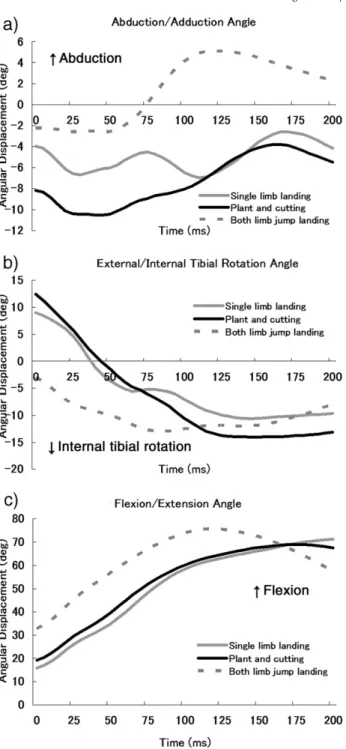
Fig 2.Comparisons of joint motion. Data are presented for knee abduction/adduction (a), external/internal tibial rotation (b), and kneeflexion/extension (c).
Table 1
Mean (SD) for tasks observed power of joint angle at the time of foot contact
*:pb0.05, **:pb0.0l.
Table 2
Mean (SD) for tasks observed power of peak joint angle
To each subject, 25 reflective markers of 9 mm diameter were secured to the lower limb using double-sided adhesive tape, as described in a previous study[14]. The markers were used to implement the Point Cluster Technique (PCT)[18]. We calculated knee kinematics using the joint coordinate system proposed by Grood and Suntay[19]. For PCT, the skin markers are classified into two groups: a cluster of points representing a segment and points representing bony landmarks. For a cluster of points, 10 and 6 markers were attached respectively to the thigh and shank segments. The bony landmarks were the great trochanter, the lateral and medial epicondyles of the femur, the lateral and medial edges of the tibia plateau, the lateral (fibula) and medial malleoli, and thefifth metatarsophalangeal joint.
2.4. Data analysis
The coordinate data obtained from the markers were not smoothed because of the expected noise-cancelling property of the PCT. In each trial, we calculated the angular displacements offlexion/extension, abduction/adduction, and external/internal tibial rotation using the PCT. The reference position for these measurements was obtained during the static trial. We analyzed each variable at the time of foot contact and the peak value from the foot contact to 200 ms thereafter. Additionally, angular excursion for knee abduction and internal tibial rotation was calculated. A rate of excursion for knee abduction and internal tibial rotation was also calculated.
All dependent variables were calculated for each trial, then averaged across the three trials. A repeated measures one-way ANOVA was used to test for task differences in joint angle at the foot contact and peak joint angle. The alpha level was set atpb0.05. A post hoc Bonferroni multiple comparison test was performed for each variable to determine differences among tasks. Intraclass correlation coefficients (ICC (1, 3)) were calculated to determine the measurement consistency.
3. Results
Acceptable ICC (1, 3) values at the time of foot contact and a peak value were established for knee abduction/adduction (0.98, 0.97), external/internal tibial rotation (0.93, 0.98), and flexion/extension (0.96, 0.89). Fig. 2portrays mean time course comparisons across tasks for the three angular displacements of the knee (abduction/ adduction, external/internal tibial rotation, andflexion/extension).
Means, standard deviations and observed power for all variables at the time of foot contact are presented inTable 1. The adduction angle in plant and cutting was significantly larger than that for either single-limb landing or both-limb jump landing (pb0.01, respectively); that in single-limb landing was significantly larger than that of both-limb jump landing (pb0.05). The external tibial rotation angle in plant and cutting was significantly larger than for either single-limb landing or both-limb jump landing (pb0.01); that in single-limb landing was significantly larger than that of both-limb jump landing (pb0.01). Theflexion angle in both-limb jump landing was significantly larger than that of either single-limb landing or plant and cutting (pb0.01); that in plant and cutting was significantly larger than that of single-limb landing (pb0.01).
Means and standard deviations of peak values for all variables are presented inTable 2. The peak abduction angle in both-limb jump landing was significantly larger than that of either single-limb landing or plant and cutting (pb0.01 andpb0.05, respectively). During single-limb landing or plant and cutting, their knee was abducted from foot contact with time. However, even at their peak, it is adducted. The peak internal tibial rotation angles in plant and cutting and both-limb jump landing were significantly larger than that of single-limb landing (pb0.05 andpb0.01, respectively). The peakflexion angle in plant and cutting was significantly smaller than both-limb jump landing (pb0.05).
The angular excursion and velocity for knee abduction and internal tibial rotation are presented inTable 3. The excursion for knee abduction in plant and cutting and
both-limb jump landing was significantly larger than that for either single-limb landing (pb0.01, respectively). The rates of excursion for knee abduction among three tasks were not significantly different. The excursion for internal tibial rotation in plant and cutting was significantly larger than for either single-limb landing or both-limb jump landing (pb0.01, respectively), whereas that in single-limb landing was significantly larger than that of both-limb jump landing (pb0.01). The rate of excursion for internal tibial rotation in plant and cutting was significantly faster than that for either single-limb landing or both-single-limb jump landing (pb0.01, respectively).
4. Discussion
The primary purpose of this study was to analyze the biomechanical characteristics of the knee joint during several athletic tasks, and to examine what tasks present a risk for ACL injury. A plant and cutting manoeuvre is a movement that commonly causes ACL injury, of which most situations were single-foot push-offs[5]. However, biomechanical characteristics of plant and cutting and several athletic tasks are unknown. Therefore, to compare a plant and cutting and normal single-limb landing as well as both limb landing, we can understand these athletic tasks and examine what tasks are risky for ACL injury. The results of this study showed that greater excursion and more rapid knee abduction occur in plant and cutting than that which occurs in single-limb landing, in addition to greater internal tibial rotation. Furthermore, compared to similar single-limb tasks, both-limb jump landing kneeflexion and knee abduction were greater; external tibial rotation at the foot contact was smaller.
4.1. Plant and cutting versus single-limb landing
Some recent studies have compared biomechanical characteristics across different athletic tasks [8,15,20]. Nevertheless, these studies present some limitations. Although Chappell et al.[8]compared knee kinematics of forward, vertical, and backward stop-jump tasks, they did not examine lateral movement. Sell et al.[15]compared two-legged stop-jump tasks in three different directions. Although their results indicate that lateral jumps are the most dangerous of the stop-jumps, all tasks were two-legged tasks, not single-leg tasks. Besier et al.[20] compared the joint load during running, sidestep cutting, and crossover cutting. They inferred that external moments applied to the knee joint during the stance phase of the cutting tasks place the ACL and collateral ligaments at risk of injury, but they did not analyze joint kinematics and the frequency of the motion analysis system was too slow to support examination of high-speed athletic tasks. Therefore, the results of this study, along with those of the prior study, provide some implications of mechanisms causing ACL injury.
The results of this study showed that, during plant and cutting, external tibial rotation at the foot contact and peak internal tibial rotation were greater than during single-limb landing. During plant and cutting, from foot contact, subjects rotated the tibia more rapidly and to a greater degree toward internal tibial rotation than during single-limb landing. Previous studies[8,15,16]that examined the mechanism of ACL injury have not analyzed tibial rotation during high-risk movement, probably because of technical issues. In this study, we analyzed tibial rotation using PCT. An anatomical study has demonstrated that internal tibial rotation increases the strain of ACL[21]. Therefore, biomechanically and anatomically, plant and cutting presents a high risk for ACL injury.
During plant and cutting, subjects demonstrated more increased knee adduction at foot contact than during single-limb landing. After foot contact, during single-limb landing, subjects showed twin peaks of knee abduction. During plant and cutting, subjects moved toward knee abduction with time, although subjects did not exhibit a great magnitude of knee abduction. Consequently, during plant and cutting, excursion of knee abduction was greater than during single-limb landing. Therefore, during plant and cutting, greater excursion of knee abduction occurred than during single-limb landing combined with greater internal tibial rotation to push off their body to the other side and change direction.
Table 3
Mean (SD) for angular excursion (deg) and rate of excursion (deg/ms)
4.2. Both-limb jump landing versus single-limb tasks
Some studies have analyzed kinematics or kinetics during bilateral landing to examine ACL injury mechanisms[11,12,22]; other studies have screened risks for ACL injury[13]or lower limb injury[23,24]. However, few studies have examined the characteristics of bilateral landing in comparison to single-limb landing. Only Pappas et al.[16] compared bilateral and unilateral landings. Their results indicated that, in unilateral landings, subjects performed high-risk kinematics with increased knee valgus, decreased kneeflexion, and decreased relative hip adduction. However, they showed no peak knee valgus or tibial rotation during landing.
The results of this study demonstrated that, during both-limb jump landing, kneeflexion at foot contact was greater than for single-limb landing and plant and cutting, and that peak kneeflexion was greater than plant and cutting. These results were consistent with those of a previous study[16]. Pappas et al.[16]speculated that subjects might attempt to prevent falls by limiting excessive kneeflexion during unilateral landing compared to bilateral landing, while simultaneously increasing the forces in ACL. Additionally, in slight kneeflexion, i.e. less than 30 , contraction of the quadriceps strains the ACL[21,25,26]. For that reason, slight knee flexion is inferred as a risk factor of ACL injury. During a process of prevention training leading athletes to increased knee flexion can decrease the incidence of ACL injury. On the other hand, during both-limb landing, external tibial rotation at the foot contact was less than that during single-limb landing and plant and cutting, while peak internal tibial rotation was not significantly different with plant and cutting. Unilateral landing has a greater excursion of tibial internal rotation than bilateral landing. As described above, an anatomical study has demon-strated that internal tibial rotation increases the ACL strain [21]. Consequently, characteristics of unilateral landing that have less knee flexion and greater internal tibial rotation present a higher risk for ACL injury than bilateral landings.
During both-limb jump landing, peak knee abduction was greater than for either single-limb landing or plant and cutting, while knee adduction at foot contact was smaller. These results did not support our hypothesis. We speculate that knee abduction was limited compensatory for greater internal tibial rotation and smaller kneeflexion to prevent ACL injury during single-limb tasks. The possibility of ACL injury arose when subjects allowed greater knee abduction during single-limb tasks. Another reason might be that, because ACL injury occurs not only in single-limb situations but also in both-limb jump landing, the latter also poses a risk for ACL injury. Krosshaug et al.[27]analyzed videos of ACL injury situations and reported that ACL injury occurred during two-legged landing in 9 of 22 cases of female player situations, although it occurred in only four cases of one-legged landing. Therefore, it is thought that both-limb landing with greater knee abduction might also pose a risk for ACL injury.
Greater knee abduction was apparent during a both-limb jump landing task. For screening of ACL injuries, we detected knee abduction well in this task. It is difficult to detect a risk demonstrating greater knee abduction during single-limb tasks because of these characteristics, which demon-strate limited knee abduction. Moreover, knee abduction during both-limb landing can be evaluated using a two-dimensional approach, which uses a video recorder and analyzes a frontal projected knee valgus angle[17]. Some studies have been conducted using comparable methods[23,28]. Consequently, considering convenience and efficiency, both-limb jump landing is thought to be valuable for screening the risk of ACL injury. 4.3. Limitations
This study has important limitations. Influences of the hip and ankle have recently been suggested [9,29]. However, the present study analyzed the kinematics of the knee only. Additionally, although joint kinetics holds great importance for analyses of athletic tasks and for examination of the mechanisms of injuries, we only analyzed knee kinematics because we have not developed a joint-moment calculation
system corresponding to PCT. Future studies should examine the relation between kinematic data and kinetics data to assess the ACL injury mechanism.
5. Conclusion
We compare the biomechanical characteristics of the knee joint for several athletic tasks to elucidate the characteristics of single-limb landing, plant and cutting and both-limb landing, and to examine what tasks present a risk for ACL injury. The results indicate that, in plant and cutting, knee abduction combined with internal tibial rotation poses a risk of causing ACL injury. Both-limb landing with greater knee abduc-tion might also pose risks for ACL injury.
6. Conflict of Interest
No author of this manuscript has any conflict of interst. Acknowledgements
This work was supported by Grants-in-Aid for Scientific Research (B) (18300219) in 2006, 2007, and 2008.
References
[1] Kvist J. Rehabilitation following anterior cruciate ligament injury: current recom-mendations for sports participation. Sports Med 2004;34:269–80.
[2] Agel J, Arendt EA, Bershadsky B. Anterior cruciate ligament injury in national collegiate athletic association basketball and soccer: a 13-year review. Am J Sports Med 2005;33:524–30.
[3] Arendt EA. Anterior cruciate ligament injury patterns among collegiate men and women. J Athl Train 1999;34:86–92.
[4] Boden BP, Dean GS, Feagin Jr JA, Garrett Jr WE. Mechanisms of anterior cruciate ligament injury. Orthopedics 2000;23:573–8.
[5] Olsen OE, Myklebust G, Engebretsen L, Bahr R. Injury mechanisms for anterior cruciate ligament injuries in team handball: a systematic video analysis. Am J Sports Med 2004;32:1002–12.
[6] McLean SG, Huang X, van den Bogert AJ. Association between lower extremity posture at contact and peak knee valgus moment during sidestepping: implications for ACL injury. Clin Biomech (Bristol, Avon) 2005;20:863–70.
[7] Malinzak RA, Colby SM, Kirkendall DT, Yu B, Garrett WE. A comparison of knee joint motion patterns between men and women in selected athletic tasks. Clin Biomech (Bristol, Avon) 2001;16:438–45.
[8] Chappell JD, Yu B, Kirkendall DT, Garrett WE. A comparison of knee kinetics between male and female recreational athletes in stop-jump tasks. Am J Sports Med 2002;30:261–7.
[9] McLean SG, Lipfert SW, van den Bogert AJ. Effect of gender and defensive opponent on the biomechanics of sidestep cutting. Med Sci Sports Exerc 2004;36:1008–16. [10] Ford KR, Myer GD, Toms HE, Hewett TE. Gender differences in the kinematics of
unanticipated cutting in young athletes. Med Sci Sports Exerc 2005;37:124–9. [11] McLean SG, Felin RE, Suedekum N, Calabrese G, Passerallo A, Joy S. Impact of fatigue on
gender-based high-risk landing strategies. Med Sci Sports Exerc 2007;39:502–14. [12] Ford KR, Myer GD, Hewett TE. Valgus knee motion during landing in high school
female and male basketball players. Med Sci Sports Exerc 2003;35:1745–50. [13] Hewett TE, Myer GD, Ford KR, Heidt Jr RS, Colosimo AJ, McLean SG, et al. Biomechanical
measures of neuromuscular control and valgus loading of the knee predict anterior cruciate ligament injury risk in female athletes. Am J Sports Med 2005;33:492–501. [14] Nagano Y, Ida H, Akai M, Fukubayashi T. Gender differences in knee kinematics and
muscle activity during single limb drop landing. Knee 2007;14:218–23.
[15] Sell TC, Ferris CM, Abt JP, Tsai YS, Myers JB, Fu FH, et al. The effect of direction and reaction on the neuromuscular and biomechanical characteristics of the knee during tasks that simulate the noncontact anterior cruciate ligament injury mechanism. Am J Sports Med 2006;34:43–54.
[16] Pappas E, Hagins M, Sheikhzadeh A, Nordin M, Rose D. Biomechanical differences between unilateral and bilateral landings from a jump: gender differences. Clin J Sport Med 2007;17:263–8.
[17] Nagano Y, Ida H, Akai M, Fukubayashi T. Statistical modeling of knee valgus during a continuous jump test. Sports Biomech 2008;7:342–50.
[18] Andriacchi TP, Alexander EJ, Toney MK, Dyrby C, Sum J. A point cluster method for in vivo motion analysis: applied to a study of knee kinematics. J Biomech Eng 1998;120:743–9.
[19] Grood ES, Suntay WJ. A joint coordinate system for the clinical description of three-dimensional motions: application to the knee. J Biomech Eng 1983;105:136–44. [20] Besier TF, Lloyd DG, Cochrane JL, Ackland TR. External loading of the knee joint during
running and cutting maneuvers. Med Sci Sports Exerc 2001;33:1168–75. [21] Arms SW, Pope MH, Johnson RJ, Fischer RA, Arvidsson I, Eriksson E. The biomechanics
of anterior cruciate ligament rehabilitation and reconstruction. Am J Sports Med 1984;12:8–18.
[22] Hewett TE, Myer GD, Ford KR. Decrease in neuromuscular control about the knee with maturation in female athletes. J Bone Joint Surg Am 2004;86-A:1601–8.
[23] Noyes FR, Barber-Westin SD, Fleckenstein C, Walsh C, West J. The drop-jump screening test: difference in lower limb control by gender and effect of neuromuscular training in female athletes. Am J Sports Med 2005;33:197–207. [24] Barber-Westin SD, Galloway M, Noyes FR, Corbett G, Walsh C. Assessment of lower
limb neuromuscular control in prepubescent athletes. Am J Sports Med 2005;33:1853–60.
[25] Beynnon BD, Fleming BC, Johnson RJ, Nichols CE, Renstrom PA, Pope MH. Anterior cruciate ligament strain behavior during rehabilitation exercises in vivo. Am J Sports Med 1995;23:24–34.
[26] Renstrom P, Arms SW, Stanwyck TS, Johnson RJ, Pope MH. Strain within the anterior cruciate ligament during hamstring and quadriceps activity. Am J Sports Med 1986;14:83–7.
[27] Krosshaug T, Nakamae A, Boden BP, Engebretsen L, Smith G, Slauterbeck JR, et al. Mechanisms of anterior cruciate ligament injury in basketball: video analysis of 39 cases. Am J Sports Med 2007;35:359–67.
[28] Barber-Westin SD, Noyes FR, Galloway M. Jump-land characteristics and muscle strength development in young athletes: a gender comparison of 1140 athletes 9 to 17 years of age. Am J Sports Med 2006;34:375–84.
[29] Quatman CE, Ford KR, Myer GD, Hewett TE. Maturation engenders gender differences in landing force and vertical jump performance: a longitudinal study. Am J Sports Med 2006;34:806–13.