261
STUDIES ON THE ALLOCATION OF FUNDS FROM THE NATIONAL
RURAL DEVELOPMENT PROGRAMME,
THROUGH THE MEASURE 112 "YOUNG FARMER"
IN OLTENIA REGION
VLADU MARIUS
Universty of Craiova, Faculty of Agriculture and Horticulture
Keywords: allocation, funds, farmers, youngsters.
ABSTRACT
The National Rural Development Programme is a complex programme prepared by the representatives of the Ministry of Agriculture and Rural Development following the consultations with the representatives of the bodies, organizations and social partners who activate in this sector and approved, after more rounds of negotiation by the European Commission.
One of the most important elements of PNDR (NRDP- the National Rural Develpment Programme) is related to the implementation of the measures stipulated within the European Agricultural Fund for Rural Development (FEADR- EAFRD the European Agricultural Fund for Rural Development).
This Fund continues to support the rural development by means of the european funds started through the SAPARD programme, having a similar structure and implementation method.
The measure 112 „The Young Farmers Installation” frames within Axis I – „Increasing competitiveness of agricultural and forestry sectors” and has as general objective increasing competitiveness of the agricultural sector through a better use of the human resources and of the production factors as well as metting the national and community standards.
During 2012, Region 4 Oltenia got above 40% within the selection process in the session organized during 2012.
INTRODUCTION
The excessive fragmentation of the property in agriculture together with the reduced degree of association led to the appearance of a duality, accounted for on the one hand by the large number of the subsistence and semi-subsistence exploitations, and on the other hand by the small number of the commercial exploitations, integrally entered on the market. The subsistence exploitations hold in exploitation 45,24% of the agricultural used surface, the semi-subsistence exploitations 16,09 % and the commercial exploitations 38,67% (the National Institute of Statistics, 2005).
For the main cultures, the production is not permanent and lies below its potential.
Approximately two-thirds (69%) of the cultivated surface (INS – the National
Institute of Statistics, 2006) is destined for cereals and in particular for the wheat and maize cultures. During the period 2000-2005 the production obtained reflects only 40% of the agricultural potential of the wheat and, respectively, 39,4 % of that of maize.
262
MATERIAL AND METHOD
The current study has been prepared related to the projects submitted by the private beneficiaries within the Measure 112 of PNDR (the National Rural Development Programme) in the region 4 South-West Oltenia - the Dolj, Gorj, Olt, Mehedinţi and Vâlcea counties - during 2012.
During 2012 within the Measure 112 „The Young Farmers Installation”, a session
for the submission of the projects was organized, respectively June 1 – July 6, this being
one of the measures financed through the FEADR launched by APDRP (the Payments Agency for Rural Development and Fishing) within PNDR 2007-2013.
The results of the selection for this session was published on the web page www.apdrp.ro of the Payments Agency, Rural Development and Fishing (APDRP).
The following indicators: the selected projects for financing and their distribution according to priority sectors have been analyzed within the study from the numerical, value and percentage point of view per counties.
The results have been processed statistically being presented under graphical and/or tabular form.
RESULTS AND DISCUSSIONS
The current study was prepared on the projects submitted by the beneficiaries from the region 4 Oltenia, selected for financing within the session for the submission of projects carried out during the period June 1 – July 6, 2012.
Each county has a County Office for Payments, Rural Development and Fishing (OJPDRP), located in the municipality residence, the Regional Center for Payments, Rural Development and Fishing (CRPDRP) being located in Craiova.
The applicant’s guide for the measure 112 was published for public consultation during March 2013 and was drawn up based on the Sheet of Measure included in PNDR and negotiated with the representatives of the European Commission. The final form of the guide was published on the APDRP web page in May 2012, the session for projects submission being opened starting with June 1.
The numerical situation of the selected projects within the session of measure 112 during 2012 in Oltenia region is presented in figure 1.
Figure1 – The numerical situation of the selected projects within the sessions of Measure 112 during 2012 in Oltenia region
0
100
200
300
400
500
Dolj Olt Gorj Valcea Mehedi
nti
Nr. proiecte 470 285 164 60 255
263
More than a third of the beneficiaries of the EU non-reimbursable funds come from Dolj. They must prove that all the assumed criteria have been fulfilled, in order to get the second installment - 40% of the value of the granted funds.
About 1.200 young farmers from South-West Oltenia Region, who benefited from
non-reimbursable financing from EU through the Measure 112 - „The Installation of the
Young Farmers” – of the National Rural Development Programme (PNDR), must prove they met the obligations assumed through the financing contract in order to get the second installment. The Payments Agency for Rural Development and Fishing (APDRP) recently announced that the second payment installment, amounting to 40% of the value of the support for installation, shall be granted after the verification of the actions provided in the business plan. In Oltenia, 1.234 financing requests have been submitted on the Measure 112. Most of the applications have been in Dolj - 470, followed by Olt - 285, Mehedinţi - 255, Gorj - 164 and Vâlcea - 60. APDRP warns that the beneficiaries who no longer meet the obligations assumed through the financing contract and the eligibility criteria risk to pay back integrally all the money received, to which all the legal related interests shall be added.
According to the financing contract, one of the eligibility criteria assumed by the beneficiaries stipulates that, in maximum three years since the support has been granted,
the beneficiary must pursue a training through the Measure 111 - „Professional training,
information and knowledge dissemination”, in at least one of the sectors: the management of the agricultural exploitation, the farm bookkeeping, the protection of the environment, ecoagriculture, etc. Consequently, the moment of applying for the last installment, the beneficiaries must prove that they graduated those curses.
Another eligibility condition assumed through the acceptance of the non-reimbursable financing is the one that more than 50% of the working time of the beneficiary of European non-reimbursable funds will have to be spent for his own farm.
The installation support for the young farmers is granted in two installments, of 60% and 40% of the total value. It’s value is of Εuro 12.000 for an agricultural exploitation of 6 UDE1 (unit of ecomic dimension). Above this dimension, the support can increase with 4.000 euro/1 UDE, but can’t exceed 40.000 euro/exploitation.
According to law, in maximum three years since the first financing installment was received, the beneficiaries must prove that they meet all the conditions assumed through the contract.
264
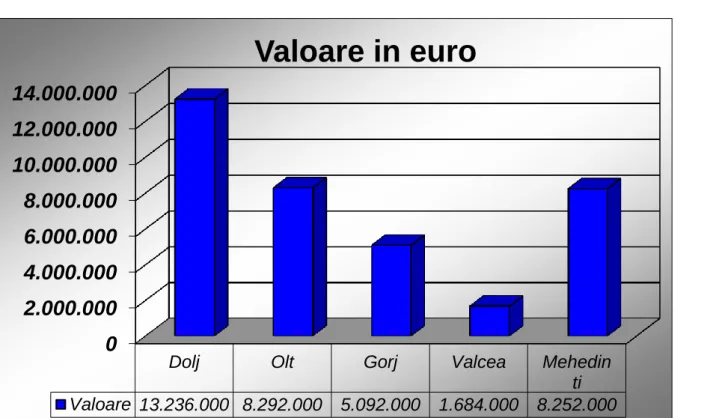
Figure 2 – The value situation of the selected projects within the sessions of Measure 112 during 2012
At the level of the eligible value of the selected projects, the situation is similar to the numerical one, the lowest value attracted by region 4 Oltenia being recorded within the third session.
Within the organized session of projects, 5308 projects have been submitted at the national level, 2695 of them being selected for contracting. Of them, 1234 belonged to some beneficiaries from Oltenia region.
As it can be noticed in figure 3, Dolj county recorded the highest number of selected projects, the highest eligible average values being recorded in Mehedinţi county.
Figure 3 – The situation of the selected projects within the session March 2012 of Measure 112 from the region 4 Oltenia
0
2.000.000
4.000.000
6.000.000
8.000.000
10.000.000
12.000.000
14.000.000
Dolj Olt Gorj Valcea Mehedin
ti Valoare 13.236.000 8.292.000 5.092.000 1.684.000 8.252.000
Valoare in euro
25.000 26.000 27.000 28.000 29.000 30.000 31.000 32.000 33.000
Dolj Olt Gorj Valcea Mehedinti Medie/proiect 28.162 29.095 31.049 28.067 32.361
265
Figure 4 showcases the average values per project for each county of Oltenia region in 2012 session.
We can notice that Olt and Mehedinţi counties occupy concurrent positions in terms
of the number of projects as well as from the point of vue of value.
Figure 4 – The situation of the number of selected projects within the 2012 session of the Measure 112 from the region 4 Oltenia
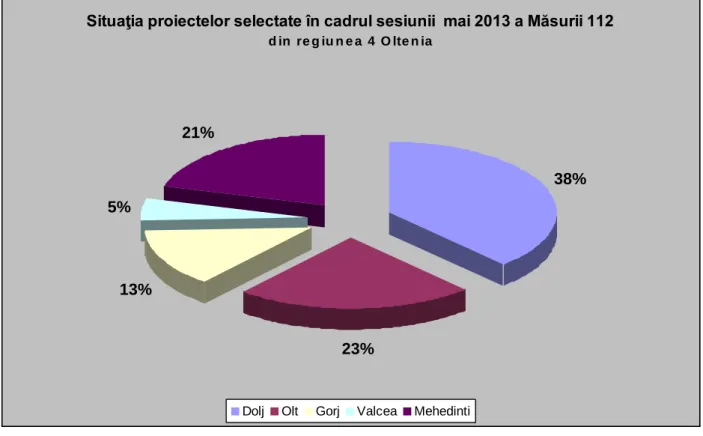
During 2012, Dolj county showcased the best indicators from the region in terms of the number of selected projects accounting for also 38% of the total number of projects of the region, as well as from the point of view of the eligible value of the projects.
The Olt county ranks second with 23% and Mehedinţi county with 21% of the number of selected projects within this measure in the region, followed by Gorj county with 13%.
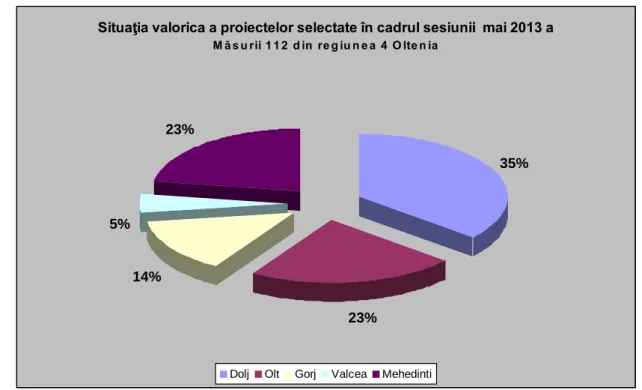
From the point of view of the eligible value and of the public contribution, the situation of the selected projects in Oltenia region is similar to the situation of the number of the projects submitted (figure 5).
Situaţia proiectelor selectate în cadrul sesiunii mai 2013 a Măsurii 112
d in re g iu n e a 4 O lte n ia
38%
23% 5%
21%
13%
266
Figure 5 – The value situation of the selected projects within the 2012 session of the Measure 112 from the region 4 Oltenia
Thus, Dolj county ranks first in the region with 35% of the eligible value of the
selected projects in the region, followed by Olt and Mehedinţi counties with 23%, Vâlcea
14% and Gorj 5%.
CONCLUSIONS
During 2012, the Region 4 Oltenia got above 40% within the selection process in the session organized during 2012.
The total value of these applications for European funds from the Payments Agency for Rural Development and Fishing (APDRP) amounts to Euro 272,3 millions. Hence, the allocation of Euro 120.886.096 millions for this session was exceeded for more than 2 times. Thus, grant financing will be decided after the selection of the financing requests according to the percentages obtained by each project.
The session for the receiving of the projects was opened during the period June 1 – July 6, 2012, being allocated all the funds for this financing measure. Practically, in order to respond to the applications of the young farmers and taking into account the high demand of non-reimbursable funds, all the amounts available have been put at the disposal of the applicants up to the end of the financing period, respectively 2013.
In order to obtain the European non-reimbursable financing, the young farmers drew up investment projects for the establishment or modernization of the vegetable, apiary but also husbandry farms.
Most of the financing requests have been submitted by the applicants for non-reimbursable funds, from the Region 6 North-Vest. Thus, they submitted, at the head offices of the County Offices of APDRP, a number of 1.457 projects, with a total value of about Euro 50 millions. The Region 4 South-West follows the Region 6 North-West, with 1.415 submitted projects, with a total value of Euro 47,2 millions. The Region 2 South-East ranks third with 1.214 submitted projects, cumulating Euro 43,2 millions.
Up to this moment, within this investment measure, financing contracts have been signed for 8.044 projects, having a total non-reimbursable value above Euro 162 millions.
Situaţia valorica a proiectelor selectate în cadrul sesiunii mai 2013 a
M ă s u rii 1 1 2 d in re g iu n e a 4 O lte n ia
35%
23% 5%
23%
14%
267
The payments made up to this moment towards the beneficiaries of Measure 112, amount to Euro 106,8 millions.
587 projects have been finished for the installation of young farmers, amounting to Euro 12,8 millions till the beginning of May 2012. Most of them, respectively 230 projects, envisage mixed investments (vegetable cultures and husbandry), being followed by 191 projects that point to investments in land cultures. Also, investments in horticulture have been carried out through 133 projects. Other finished projects point to the wine sector,
permanent cultures (fruit – growing plantation, fruit- bearing shrubs, nurseries, wine,
orchards, etc.) milk and dairy products, as well as pig rearing, herbivores and fowls.
BIBLIOGRAPHY
Vladu Marius, ş.a., 2009 - ,,Studies on structural funds absorption trough 121 EAFRD Measures in Region 4- Oltenia", Annales of the University, of Craiova, vol. XXXIX/B
*** Programul Naţional de Dezvoltare Rurală 2007 – 2013, versiunea III consolidată 2012, Număr CCI: 2007RO06RPO001, MADR, Bucureşti, 2012;
*** GHIDUL SOLICITANTULUI pentru Măsura 112 versiunea finală 06 mai 2012, MADR, Bucureşti, 2012;
*** Selection report for Measure 112;