ANALYSIS OF INTERVAL CENSORED DATA USING A
LONGITUDINAL BIOMARKER
Noorie Hyun
A dissertation submitted to the faculty of the University of North Carolina at Chapel
Hill in partial fulfillment of the requirements for the degree of Doctor of Philosophy in
the Department of Biostatistics in the Gillings School of Global Public Health.
Chapel Hill
2014
Approved by:
Dr. Donglin Zeng
Dr. David J. Couper
Dr. Jianwen Cai
c
○ 2014
Noorie Hyun
ABSTRACT
NOORIE HYUN: Analysis of Interval Censored Data Using a
Longitudinal Biomarker
(Under the direction of Dr. Donglin Zeng and Dr. David J. Couper)
In many medical studies, interest focuses on studying the effects of potential risk
factors on some disease events, where the occurrence time of disease events may be
defined in terms of the behavior of a biomarker. For example, in diabetic studies,
diabetes is defined in terms of fasting plasma glucose being 126
mg
/
dl
or higher. In
practice, several issues complicate determining the exact time-to-disease occurrence.
First, due to discrete study follow-up times, the exact time when a biomarker crosses
a given threshold is unobservable, yielding so-called interval censored events. Second,
most biomarker values are subject to measurement error due to imperfect technologies,
so the observed biomarker values may not reflect the actual underlying biomarker levels.
Third, using a common threshold for defining a disease event may not be appropriate
due to patient heterogeneity. Finally, informative diagnosis and subsequent treatment
outside of observational studies may alter observations after the diagnosis. It is well
known that the complete case analysis excluding the externally diagnosed subjects can
be biased when diagnosis does not occur completely at random.
defined for any given threshold value. Second, we extend the marginal likelihood to a
pseudo-likelihood by multiplying the likelihoods over all observation times. Finally, to
adjust for externally diagnosed cases, we consider a weighted pseudo-likelihood
estima-tor by incorporating inverse probability weights into the pseudo-likelihood by assuming
that external diagnosis depends on observed data rather than unobserved data. We
estimate the three model parameters using the nonparametric EM, pseudo-EM and
weighted-pseudo-EM algorithm, respectively.
ACKNOWLEDGMENTS
I am extremely grateful to my advisors, Drs. Donglin Zeng and David J. Couper
for their thoughtful guidance, insightful advice, and sincere encouragement during my
dissertation research period. I know I would not be able to reach the end of this long
journey without their help. The hands-on experience under supervision of my advisors
have made me more confident as a researcher. I would also like to thank Drs. Donglin
Zeng and David J. Couper for their financial support as well.
I would like to express my sincere gratitude to my committee members,Drs. Jianwen
Cai, Michael G. Hudgens, and M. Alan Brookhart for their constructive and perceptive
comments on my dissertation papers.
TABLE OF CONTENTS
LIST OF TABLES
. . . ix
LIST OF FIGURES
. . . x
1 INTRODUCTION
. . . .
1
2 Literature Review . . . .
5
2.1 Interval Censored Data . . . 6
2.1.1 Current Status Data . . . 6
2.1.2 Case 2 Interval Censored Data . . . 14
2.1.3 Panel Count Data . . . 19
2.1.4 Mixed Case of Interval Censored Data . . . 23
2.2 Measurement Error in Data . . . 26
2.2.1 Linear Regression with Response Error . . . 28
2.2.2 Logistic Regression with Response Error . . . 29
2.2.3 Semiparametric Methods for Validation Data . . . 30
2.3 Weighted Estimating Equations Accounting for
MAR Data . . . 31
3 Threshold-Dependent Proportional Hazards Model
for Analyzing Time-to-Event Defined by Biomarker
with Subject to Measurement Error . . . 35
3.1 Introduction . . . 35
3.2 The ARIC Study . . . 38
3.3.1 Model . . . 39
3.3.2 Inference Procedure . . . 42
3.3.3 Variance Estimation . . . 44
3.4 Asymptotic Results . . . 45
3.5 Simulation Study . . . 48
3.6 Analysis of the ARIC Study Data . . . 50
3.7 Concluding Remarks . . . 53
4 Semiparametric Regression Model for
Analyz-ing Time-to-Event Defined by Extreme
Longi-tudinal Biomarkers . . . 60
4.1 Introduction . . . 60
4.2 Method . . . 62
4.2.1 Model . . . 62
4.2.2 Inference Procedure . . . 64
4.2.3 Variance Estimation . . . 65
4.3 Asymptotic Results . . . 69
4.4 Simulation Study . . . 71
4.5 Application . . . 74
4.6 Concluding Remarks . . . 76
5 Weighted Pseudo-Likelihood for Adjusting
In-formative Diagnosis: an Application to
Time-to-Hypercholesterolemia in the ARIC study . . . 81
5.1 Introduction . . . 81
5.2 Method . . . 83
5.2.1 Weighted Pseudo-Likelihood . . . 83
5.2.2 Inference Procedure . . . 85
5.3 Asymptotic Results . . . 89
5.4 Simulation Study . . . 92
5.5 Application . . . 94
5.6 Concluding Remarks . . . 97
6 Summary and Future Work . . . 101
Appendix A: Technical Details for Chapter
3
. . . 104
A.1 Identifiability and Derivation of Efficient Score Functions . . . 104
A.2 Proof of Asymptotic Results . . . 108
Appendix B: Technical Details for Chapter
4
. . . 119
B.1 Identifiability and Derivation of Pseudo-Efficient
Score Functions . . . 119
B.2 Proof of Asymptotic Results . . . 121
Appendix C: Technical Details for Chapter
5
. . . 133
C.1 Proof of Asymptotic Results . . . 133
LIST OF TABLES
3.1 Baseline Characteristics of the Study Participants . . . 57
3.2 Simulation Result in the Scenario with
Contin-uous Random Time Points . . . 58
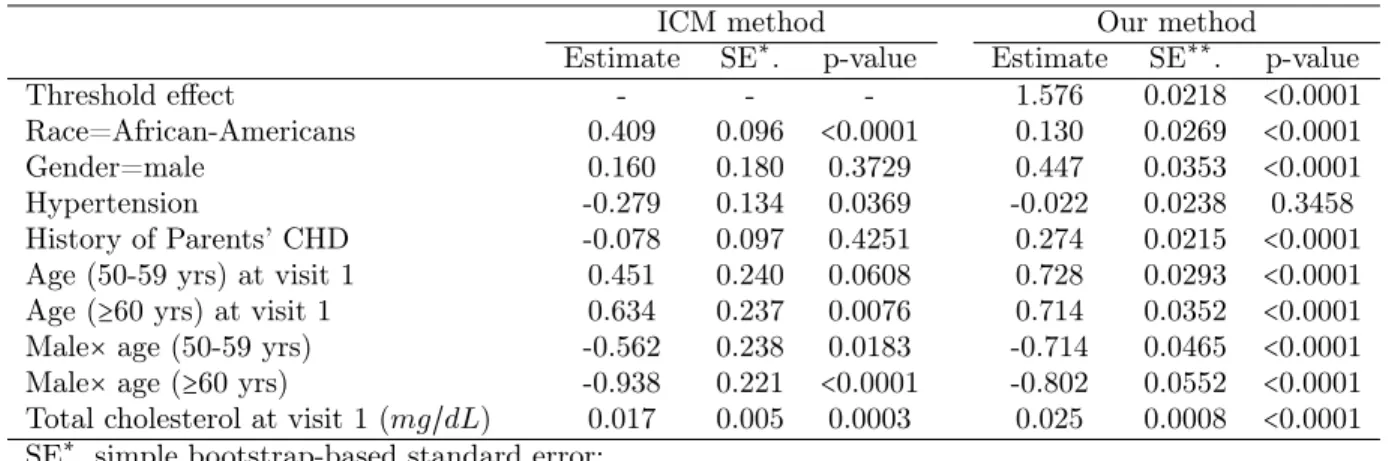
3.3 Analysis of Time to Diabetes Occurrence from
the ARIC Study Data . . . 59
4.1 Simulation Result . . . 79
4.2 Application to the ARIC Study Data . . . 80
5.1 Prevalence of Externally Diagnosed Hypercholesterolemia . . . 98
5.2 Simulation Result When Missing Rate is 13% . . . 99
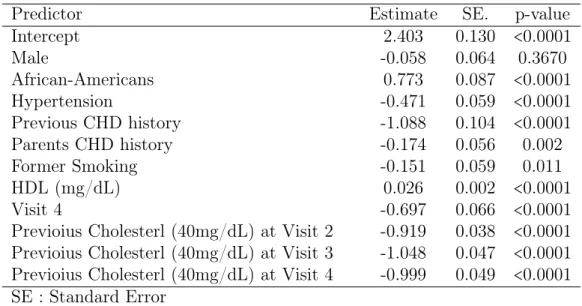
5.3 Logistic Regression for the Probability of No
Ex-ternal Diagnosis as Hypercholesterolemia . . . 99
5.4 Application to the ARIC Study Data . . . 100
LIST OF FIGURES
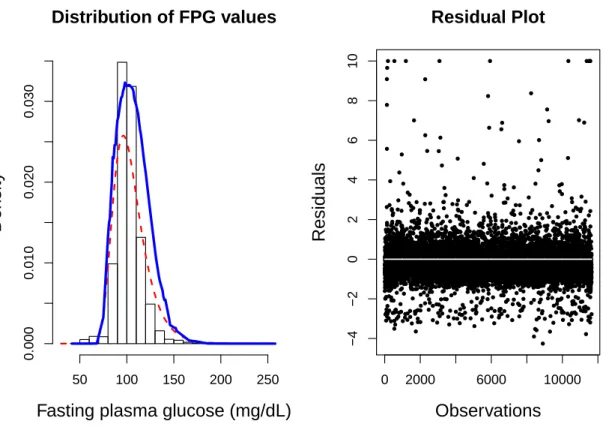
3.1 Distribution of Fasting Blood Glucose Values . . . 55
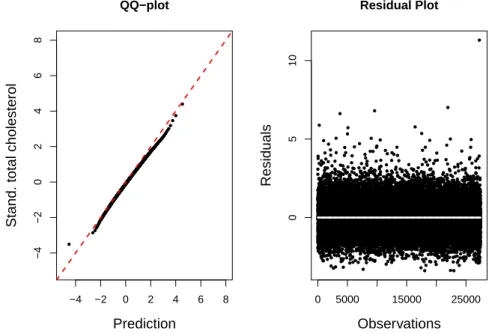
3.2 Quantile-Quantile and Residual Plots . . . 56
4.1 Quantile-Quantile and Residual Plots . . . 78
5.1 Mean Trend of Total Cholesterol Levels in
CHAPTER1: INTRODUCTION
Many longitudinal studies of chronic disease such as cancer, AIDS, and diabetes
monitor patients for biomarkers, as an indicator of disease occurrence, in order to
investigate potential associations between risk exposures and time to disease occurrence.
For disease events determined by some biomarker and threshold, when interval between
visits is long or patients miss visits, the exact date of the event that an individual’s
biomarker value crosses the threshold is unobservable. Instead, what is usually known
are the latest and earliest visit dates at which an individual’s biomarker value crosses
a given threshold. Such data is called interval censored data. Using the interval rather
than the exact date of event occurrence may lead to invalid inferences (Lindsey and
Ryan 1998).
Most biomarkers measurement has variation and the variation consists of short-term
intra-individual variability and measurement error. Assay variability and within-person
effects complicate determination of whether an individual’s biomarker has actually
exceeded the threshold. In clinical practice,
ad hoc
approaches that are used to take
into account biomarker variability include taking two or more measurements over a
period of time. Regarding measurement error, for example, the National Institute of
Standards and Technology maintains the blood sample materials as the gold standard
and provides guidelines for instrument manufactures to determine the accuracy of their
measurement devices. If measurement error is non-ignorable but ignored in the analysis,
the analysis may yield an inaccurate conclusion.
threshold that are usually ignored in practice. The threshold is generally regarded
as a fixed constant that is appropriate for everyone; however, this may not be
appropri-ate to all biomarkers. For instance, hypercholesterolemia does not cause symptoms but
can significantly increase risk of developing coronary heart disease (CHD). To reduce
risk, including that of CHD, people with substantially elevated cholesterol levels are
advised to start therapeutic lifestyle changes or drug therapy. The cholesterol level at
which to consider therapeutic intervention varies across different risk categories such
as smoking, hypertension, age, etc. (the National Cholesterol Education Program
Ex-pert Panel 2001)
Finally, informative diagnosis outside of observational studies, which causes alter
observations after the diagnosis. It is well known that the complete case analysis
excluding the externally diagnosed subjects can be biased when diagnosis does not
occur completely at random (Ibrahim et al. 2005).
We are motivated by the Atherosclerosis Risk in Communities (ARIC) study and
an ancillary ARIC study, which present the problems described above. The ARIC
Study recruited a population-based cohort from four U.S. communities, namely, Forsyth
County, NC, Jackson, MS, suburbs of Minneapolis, MN, and Washington County, MD.
Participants underwent a baseline examination in 1987-1989 had three follow-up
exam-inations at approximately three-year intervals, and a further examination in 2011-2013.
The ARIC Study was designed to investigate the causes of atherosclerosis, and
hyper-cholesterolemia is a crucial risk factor for atherosclerosis. Hence, assessing risk factors
associated with time-to-hypercholesterolemia is of interest. An ancillary study of the
ARIC study investigated type 2 diabetes mellitus The standard ARIC definition of
diabetes is having a fasting plasma glucose (FPG)
≥
126
mg
/
dL
, non-fasting glucose
≥
200
mg
/
dL
, a self-reported physician diagnosis of diabetes, or use of diabetes medication
time-to-disease occurrence, diabetes or hypercholesterolemia, and in the dissertation,
we focus on the time until the biomarkers reach the corresponding threshold levels.
To resolve these four issues, we consider a semiparametric model for analyzing
threshold-dependent time-to-event defined by extreme-value-distributed and
longitudi-nal biomarkers and break down the problems into the three steps:
(1)
Threshold-Dependent Proportional Hazards Model for Analyzing Time-to-Event
Defined by Biomarker with Subject to Measurement Error
: to mitigate the
prob-lems, we concentrate on the first follow-up visit after baseline and ignore the
infor-mative external diagnosis altogether. We propose a semiparametric model based
on a generalized extreme value distribution for the time-to-disease occurrence.
By assuming the latent error-free biomarkers to be non-decreasing, the proposed
model has a natural class of proportional hazards models for the time-to-event
defined for any given threshold value. To account for the additive measurement
errors, we estimate the model parameters using the nonparametric maximum
likelihood approach.
(2)
Semiparametric Regression Model for Analyzing Time-to-Event Defined by
Ex-treme Longitudinal Biomarkers
: the model proposed in the first step is extended
to model the longitudinal biomarkers at follow-ups by constructing a
pseudo-likelihood, which is multiplying the marginal likelihoods at follow-ups.
than unobserved data. We employ a marginal structure model based on
auxil-iary information and subject’s status at the previous visits to predict an external
diagnosis.
We estimate the three model parameters via the nonparametric Expectation
Maxi-mization (EM), pseudo-EM, and weighted-pseudo-EM algorithm, respectively. In this
dissertation, we theoretically investigate the models and estimation methods. We
pro-vide a series of simulations, to examine each model and estimation method comparing
them with the existing methods. Consistency, convergence rates, and asymptotic
dis-tribution of estimators are investigated using the empirical process techniques. We
illustrate the first marginal model by applying it to data from the diabetes ancillary
ARIC study and the other two models by applying those to data from the ARIC study.
In Chapter
2
, existing methods to address each problem, interval censored data,
CHAPTER2: LITERATURE REVIEW
Interval censoring in survival analysis is a generalized scheme of left or right
censor-ing. Observed exact failure times practically correspond to narrow intervals (Turnbull
1976, Kalbfleisch and Prentice 2002). In left or right censoring, the probability that
exact failure time is observed is positive; however, we are unable to observe it at all in
interval censored data. Therefore, statistical methods and inferences for interval
cen-sored data are more complicated than left or right cencen-sored data (Huang and Wellner
1997).
2.1
Interval Censored Data
2.1.1
Current Status Data
When only one observation time is applied and each patient is known to experience
the onset of the event either before or after the observation time, the data are called as
case 1
interval censored data or
current status data
. Current status data often occur
in cross-sectional studies when the outcome is a mile-stone event such as the onset of
chronic disease. Also, current status data are easily found in animal studies such as
tumorigenicity experiments on nonlethal tumors (Hoel and Walburg 1991).
For the subject
i
with a vector of covariates
X
i, let
T
ibe the unobservable failure
time and
V
ibe the examination or observation time. Then the observed data of the
subject
i
are
(
V
i, δ
i,
X
i)
denote as
W
1,i, where
δ
i=
I
(
T
i≤
V
i)
. It is assumed that
T
is independent of
V
given
X
. In addition, the joint distribution of
(
V,
X
)
is assumed
to be independent on
θ
-that is a vector of coefficients for the covariate
X
-and any
unspecified non-decreasing baseline function of
T
.
Survival Estimation with Current Status Data
In this section, nonparametric maximum likelihood estimators (NPMLEs) for the
survival or distribution function of current status data are reviewed. Denote the ordered
observed times by
{
V
(i)∣
i
=
1
, . . . , n
}
, that is,
V
(i)≤
V
(i+1)for
i
=
1
, . . . , n
−
1
.
The observed log likelihood function for current status data
{(
V
i, δ
i)∣
i
=
1
, . . . , n
}
is
l
n(
F
) =
n
∑
i=1
{
δ
ilog
F
(
V
i) + (
1
−
δ
i)
log
(
1
−
F
(
V
i))}
,
(2.1)
where
F
(⋅)
is the distribution function of
T
.
minimizing
n
∑
i=1
n
i[
δ
in
i−
F
(
V(
i))]
2
,
subject to
F
(
V(
1)) ≤
. . .
≤
F
(
V(
n))
,
(2.2)
where
n
1=
n
and
n
i=
n
−
i
+
1
(Robertson et al. 1988). The NPMLE for
F
are determined
only at the observation times
{
V
i}
with
δ
i=
1
,
1
≤
i
≤
n
. Let
{
s
j}
mj=1
be the uniquely
ordered observation times at which
δ
i=
1
for
1
≤
i
≤
n
. The set of values of
{
F
(
s
j)}
mj=1
that minimizes (
2
.
2
) is referred to as the isotonic regression of
{
1
/
n
1, . . . ,
1
/
n
m}
with
weights
{
n
1, . . . , n
m}
We can find a NPMLE for
F
minimizing (
2
.
2
) by various approaches. Using the
max-min formula for isotonic regression, Ayer et al. (1955) obtained the explicit forms
for
{
F
ˆ
(
s
j)}
mj=1as
ˆ
F
(
s
j) =
max
u≤j
min
v≥j∑
vl=uδ
lv
−
u
+
1
.
(2.3)
They also introduced the pool adjacent violators algorithm (PAVA) and recommended
this algorithm rather than direct calculation of the formula in (
2
.
3
) to facilitate the
computation.
Huang and Wellner (1997) proposed an algorithm: after plotting
(
i,
∑
ij=1δ(
j))
, i
=
1
, . . . , n
and forming the Greatest Convex Minorant (GCM),
G
∗of the points in the
plot, then left-derivative of
G
∗at
i
is calculated for
F
ˆ
n
(
V(
i))
,
i
=
1
, . . . , n
. This algorithm
obtains the same NPMLE as the max-min formula in
(
2
.
3
)
. The GCM algorithm is
faster than the PAVA algorithm from a small to a large sample size except when the
left truncation probability is over 0.85 (Zhang and Newton 1997).
Regression Model with Current Status Data
Regression analysis of survival data is used to quantify the effect of some covariates
on the survival time or to predict the survival probabilities for new individuals. In this
section, we review commonly used regression models for current status data such as
the Cox proportional hazards (PH) models, proportional odds models, additive hazard
models, and accelerated failure time (AFT) models, etc.
The observed log likelihood for current status data is given by
l
n(
F
∣
W
1) =
n
∑
i=1
{
δ
ilog
F
(
V
i∣
W
1,i) + (
1
−
δ
i)
log
(
1
−
F
(
V
i∣
W
1,i))}
,
(2.4)
where
F
(
t
∣
W
1)
is the distribution function of
T
given the observed data.
Current status data almost allows us to obtain explicit forms of the efficient influence
function and semiparametric efficient variance for regression parameters.
Each regression model is the special case of the following transformation model. The
transformation model postulates that the conditional distribution
F
(
t
∣
x
)
of
T
given the
covariates
X
=
x
satisfies
g
(
F
(
t
∣
x
)) =
h
(
t
) +
θ
Tx,
(2.5)
where
g
is a specified function;
h
(
t
)
is an unknown non-decreasing function;
θ
is the
unknown finite d-dimensional regression parameter.
First, if we take
g
(
s
) =
log
[−
log
(
1
−
s
)]
,
0
<
s
<
1
, then (
2
.
5
) results in the
propor-tional hazards model by Cox (1972). The Cox proporpropor-tional hazards model has been
the most commonly used for survival analysis due to the availability of efficient
infer-ence procedures that are implemented in all statistical software packages. The model
postulates
λ
(
t
∣
X
=
x
) =
λ
0(
t
)
e
θTx
for the hazard function of the survival time
T
given the covariate
x
, where
λ
0(
t
)
denotes
an unknown baseline hazard function. The regression parameter of
θ
provides the log
hazard ratio of
x
on time to the event. Between two levels of the covariate
X
, the PH
model constrains the ratio of the hazards to be constant over time. The model in (
2
.
6
)
can be cast as a transformed linear model of
log
´
0tλ
(
u
)
du
=
−
θ
TX
+
, where
follows
the extreme value distribution of
1
−
exp
(−
e
)
(Dabrowska and Doksum 1988).
The observed log likelihood under the model in
(
2
.
6
)
is
l
n(
θ,
Λ
∣
W
1) =
n
∑
i=1
{
δ
ilog
[
1
−
exp
(−
Λ
(
V
i)
exp
(
θ
TX
i)) ] − (
1
−
δ
i)
exp
(
θ
TX
i)
Λ
(
V
i)}
,
where
Λ
(
t
) =
´
t0
λ
(
u
)
du
.
Related to PH regression models for current status data, Huang (1996) provided very
influential and thorough study. He obtained a maximum profile likelihood estimator
(profile-MLE) for
(
θ,
Λ
)
by the iterative convex minorant algorithm (this algorithm
will be reviewed in detail in section
2
.
1
.
2
). The consistency, asymptotic normality, and
semiparametric efficiency of the profile-MLE for regression parameters were established
under certain regularity conditions. The convergence rate of the estimators
Λ
̂
dominates
the convergence rate of (
θ,
̂
Λ
̂
) by
n
1/3. Nonetheless, it was shown that the regression
parameter estimates asymptotically converges to normal distribution in the rate of
√
n
. The profile likelihood method requires intensive computation for data with large
covariates.
Second, if we take
g
(
s
) =
logit
(
s
) ≡
log
[
s
/(
1
−
s
)]
for
0
<
s
<
1
in the regression
model of (
2
.
5
), then we obtain a proportional odds regression model:
logit
[
F
(
t
∣
X
=
x
)] =
h
(
t
) +
θ
Tx.
(2.7)
is the log odds ratio for two samples with unit difference in the
k
th covariate. In
the proportional odds model, the hazard ratio for two samples is not constant over
time but converges to unity as time
t
increases. The model (
2
.
7
) can be described
as a transformed linear model of
h
(
t
)
=
θ
TX
+
, where
has the logistic distribution
of
[
1
+
exp
(−
)]
−1(Dabrowska and Doksum 1988). For right censored data, Bennett
(1983a;b) provided a proportional odds model and a log-logistic regression model.
Pet-titt (1984) suggested several levels of specification about
h
(
t
)
in the proportional odds
model (
2
.
7
).
The observed log likelihood function under the model (
2
.
7
) is
l
n(
θ, h
∣
W
1) =
n
∑
i=1
δ
i{
h
(
V
i) +
θ
TX
i} −
log
[
1
+
exp
{
h
(
V
i) +
θ
TX
i} ]
.
(2.8)
Rossini and Tsiatis (1996) suggested a semiparametric proportional odds model for
current status data using an approximate maximum likelihood. The approximate
like-lihood is replacing
h
(
t
)
in the likelihood (
2
.
8
) with a non-decreasing step function. The
maximum likelihood estimator (MLE) maximizing the approximate likelihood can be
viewed as a sieve MLE based on the sieve of non-decreasing continuous piecewise
con-stant functions. They showed consistency, asymptotic normality, and semiparametric
efficiency of the regression parameters estimates under certain regularity conditions and
provided the explicit form of the asymptotic variance for the estimates.
Third, we consider an accelerated failure time model:
log
(
T
) =
θ
TX
+
,
(2.9)
model can be written as
F
{
log
(
T
)∣
X
} =
F
{
log
(
T
) −
θ
TX
}
in terms of a conditional
distribution.
The observed log likelihood under the model (
2
.
9
) is
l
n(
F
∣
W
1) =
n
∑
i=1
[
δ
ilog
F
(
log
V
i−
θ
TX
i) + (
1
−
δ
i)
log
{
1
−
F
(
log
V
i−
θ
TX
i)} ]
.
(2.10)
Huang and Wellner (1997) proposed a profile-MLE under the AFT model. They
showed consistency of the profile-MLE and provided the information bound for
θ
under
certain regularity conditions; however, left an open problem about the convergence rate
of
θ
̂
. The estimated MLE of
F
(⋅∣
θ
)
for each fixed
θ
is not smooth, and it results in the
non-smooth profile likelihood with respect to
θ
, so the convergence rate is unspecified
yet.
Tian and Cai (2006) constructed an estimator under the AFT model by inverting a
Wald-type statistics for testing a null proportional hazards. Due to the equivalence
be-tween two assumptions: residual in
(
2
.
9
)
is independent of
X
;
S
(
t
∣
X
) =
S
0(
t
)
exp(γTX),
the regression parameters can be estimated by solving the estimating equation,
γ
̂
(
θ
) =
o
p(
n
−1/2)
, where
̂
γ
is the NPMLE of Huang (1996). Using the semiparametric efficient
variance of
γ
,
B
calculated by Huang (1996), the asymptotic variance of
θ
̂
can be
approximated by sandwich variance,
D
−1B
(
D
T)
−1, where
D
=
dγ
0(
θ
)/
dθ
∣
θ=θ0. The
estimator was proved to be consistent under certain regularity conditions.
Finally, if we take
g
(
s
) = −
log
(
1
−
s
)
,
0
<
s
<
1
, in the regression model of (
2
.
5
),
then we have an additive hazard regression model:
λ
(
t
∣
X
=
x
) =
λ
0(
t
) +
θ
Tx
(
t
)
,
(2.11)
where
λ
0(
t
)
is an unspecified baseline hazard function. This model describes the
Lin et al. (1998) proposed an additive hazard model based on a counting process
and martingale theory for current status data. When the counting process is defined
as
N
i(
t
) = (
1
−
δ
i)
I
(
V
i≤
t
)
, which jumps by unit whenever the subject
i
is observed at
time t and found still to be failure-free, the probability that the counting process has
one is: under the assumption that
T
and
V
are independent
dH
i(
t
) =
e
−θTX∗
(t)
dH
0(
t
)
,
(2.12)
where
dH
0(
t
) =
e
−Λ0(t)d
Λ
V
(
t
)
and
X
i∗(
t
) =
´
t0
X
i(
s
)
ds
. This form is the Cox
propor-tional hazards model and this mediates using the partial likelihood principle to estimate
the regression parameters. When the assumption-that is independence of
V
and
T
-is
changed to the more flexible assumption that
V
is independent of
T
given
X
, they
formulated the association through the proportional hazards model. The latter model
improves efficiency but does not achieve the semiparametric efficiency.
Related to other regression models for current status data, Shen (2000) proposed
a linear regression model using a constructed random-sieve likelihood and constraints
that combine benefits of a semiparametric likelihood with estimating equations. It was
assumed that
in the linear model,
T
=
θ
TX
+
, is independent of
(
V,
X
)
;
has zero
mean and a finite variance; the true residual (
=
T
−
θ
TX
) and the observed residual
(
(
θ
) =
V
−
θ
TX
) have the same support. For inference, the asymptotic distribution for
the regression parameter estimates and the profile likelihood ratio test statistics were
obtained. Graphical tools for model diagnostics were proposed.
Ma and Kosorok (2005) extended Huang (1996)’s model for current status data
by adding a smooth nonparametric covariate effect:
λ
(
t
∣
X
) =
λ
0(
t
)
e
θTX
+a(u)
, where
a
(
u
)
is an unknown smooth function of a continuous variable
u
. To resolve issues
log likelihood,
l
pn(
θ, a, H
) ≡
n
∑
i=1
l
(
θ, a, H
∣
W
1,i) −
λ
2nJ
2(
a
)
,
where the log likelihood
l
(
θ, a, H
∣
W
1,i)
is the log likelihood in
(
2
.
4
)
with the
condi-tional distribution function
F
(
V
i∣
W
1,i)
=
F
{
θ
TX
i+
a
(
u
) +
H
(
V
i)}
and
H
is an unknown
non-decreasing transformation. They suggested a sieve approximation for the
nonpara-metric covariate effect
a
(
u
)
and showed that the cumulative sum diagram approach as
discussed by Groeneboom and Wellner (1992) works for general transformation
mod-els. For the convergence rate, the estimator for the nonparametric transformation
H
achieves the optimal rate of
n
1/3, but it slows down the convergence of
̂
a
in ordinary
spline settings. The penalized MLE for
θ
̂
is asymptotically normal in the convergence
rate of
√
n
and is efficient. The semiparametric efficient variance for
θ
̂
was obtained,
and the block jackknife method was suggested for the asymptotic variance estimation.
Ma (2009) applied Ma and Kosorok (2005)’s approach to current status data from
heterogeneous mixture population such as the mixture population of a cured subgroup
and a disease susceptibility subgroup. A generalized linear model for the cure
probabil-ity is applied. For subjects not cured, both of the linear Cox model and the partly
linear Cox model were considered to model the survival risk. Under the
assump-tions and the partly linear model, the conditional survival function is
S
(
t
∣
X,
Z
, u
) =
p
(
Z
) + {
1
−
p
(
Z
)}
exp
{−
Λ
0(
t
)
e
θTX+a(u)}
, where the cure probability
p
(
Z
) =
g
−1(
α
TZ
)
;
g
(⋅)
is a known link function;
α
and
Z
are the unknown regression parameter and
2.1.2
Case 2 Interval Censored Data
When more than one observation time is applied and each patient is known to
ex-perience the onset of the event of interest either before the first observed time, between
the two observation times, or after the last observation time, such data are called
case
2
interval-censored data. Longitudinal studies with periodic follow-up often produce
case 2 interval censored data. For the subject
i
with a vector of covariates
X
i, let
two observation times be given by
V
Liand
V
U i, where
V
Li<
V
U i. The observed data
of the subject
i
are
(
δ
1i, δ
2i, V
Li, V
U i,
X
i)
denote as
W
2,i, where
δ
1i=
I
(
T
i≤
V
Li)
and
δ
2i=
I
(
V
Li<
T
i≤
V
U i)
.
We assume that
T
is independent of (
V
L, V
U) given
X
and that
(
V
L, V
U)
are random
variables from a distribution with support
{(
v
L, v
U)∣
0
<
τ
L≤
v
L, v
U≤
τ
U< ∞
,
v
U≥
v
L+
c
}
, where
c
is a positive constant. In addition, the joint distribution of
(
V,
X
)
is
assumed to be independent of
θ
and any unspecified non-decreasing baseline function
of
T
.
Survival Estimation with Case 2 Interval Censored Data
Unlike current status data, the NPMLE for the distribution function of case 2
or general interval censored data has no explicit form available, so using of iterative
algorithm is inevitable.
Turnbull (1976) used the expectation maximization (EM) algorithm for incomplete
data due to grouping, general censoring and/or truncation, and this corresponds to
the self-consistency introduced by Efron (1967). For case 2 interval censored data,
{[
V
Li, V
U i]∣
i
=
1
, . . . , n
}
, when
T
iis truncated by
B
i⊆
R
and
[
V
Li, V
U i] ⊂
B
ifor the
subject
i
, the likelihood is proportional to
l
n(
F
) =
n
∏
i=1
If
T
iis not truncated, then
B
i=
R
with
P
(
B
i) =
1
.
Let
{
l
j}
mj=1
and
{
r
j}
m
j=1
denote the unique ordered elements of
{
V
U i∣
i
=
1
, . . . , n
}
and
{
V
Li∣
i
=
1
, . . . , n
}
respectively and satisfy
l
1≤
r
1<
l
2≤
r
2<
. . .
<
l
m≤
r
m. That is, for
each
j,
1
≤
j
≤
m
,
l
j=
L
ifor some
i
,
1
≤
i
≤
n
and
r
j=
R
kfor some
k
,
1
≤
k
≤
n
. Hence,
two or more intervals of
{[
V
Li, V
U i]}
in=1include
[
l
j, r
j]
. Define
p
j=
F
(
r
j) −
F
(
l
j) ≥
0
for
1
≤
j
≤
m
and
∑
mj=1p
j=
1
.
Using the fact that any distribution function increasing outside
⋃
mj=1[
l
j, r
j]
cannot
be a maximum likelihood estimate of
F
except in the trivial case when
[
V
Li, V
U i] ⋂
⋃
mj=1[
l
j, r
j]
=
B
i⋂ ⋃
m
j=1
[
l
j, r
j]
for all
i
, the problem maximizing (
2
.
13
) reduces to
max-imizing the following likelihood with respect to the vector of
p
= (
p
1, . . . , p
m)
L
n(
p
1, . . . , p
m) =
n
∏
i=1
∑
mj=1α
ijp
j∑
mj=1β
ijp
j,
subject to
m
∑
j=1
p
j=
1
, p
j≥
0
,
(2.14)
where
α
ij=
I
([
l
j, r
j] ⊂ [
V
Li, V
U i])
and
β
ij=
I
([
l
j, r
j] ⊂
B
i)
for
1
≤
i
≤
n
and
1
≤
j
≤
m
.
The proportion of observations in interval
[
l
j, r
j]
to be used in the EM algorithm is
given by
∑
ni=1(
µ
ij+
ν
ij)
∑
ni=1∑
m
j=1
(
µ
ij+
ν
ij)
=
π
j(
p
)
,
(2.15)
where
µ
ij(
p
)
and
ν
ij(
p
)
are the probabilities that the exact time is in
[
l
j, r
j]
and that
the interval
[
l
j, r
j]
is truncated respectively. Hence,
µ
ij(
p
) =
α
ijp
j/ ∑
mk=1α
ikp
kand
ν
ij(
p
) = (
1
−
β
ij)
p
j/ ∑
mk=1β
ikp
k.
The vector of probabilities
p
is called
self-consistent
if
p
j=
π
j(
p
)
,
1
≤
j
≤
m
. The
self-consistent algorithm is an example of the EM algorithm. It was shown that the
self-consistent algorithm converges monotonically.
also provided sufficient conditions for the uniqueness of the NPMLE. This result is
similar to the approach of Peto (1973) for interval censoring with no truncation using
the constrained Newton-Raphson (NR) method.
Groeneboom (1991) characterized the NPMLE for case 2 interval censored data
even though the NPMLE has no closed form. Groeneboom and Wellner (1992)
intro-duced the iterative convex minorant (ICM) algorithm for NPMLEs. Jongbloed (1998)
described the ICM algorithm in its general form and showed that it does not converge
under mild regularity conditions and proposed a modified version by adding a line
search into the algorithm so that it achieves global convergence.
Compared with the ICM algorithm, the EM algorithm converges rather slowly to the
solution of the optimization problem; however, global convergence of the EM algorithm
under certain regularity conditions was proved by Dempster et al. (1977) and Wu (1983).
For censoring problems, a combination of the EM and ICM algorithm was proposed in
Zhan and Wellner (1995). Simulation results indicate this hybrid algorithm to behave
very well for the double censoring model.
Hudgens et al. (2001) extended Turnbull (1976)’s NPMLE to the general setting
of competing risks allowing for any number of failure types and for each failure time
to be subject to interval censoring and truncation. The cumulative incidence function
NPMLE gives rise to an estimate of the survival function that can be undefined over
a potentially larger set of regions than the NPMLE of the marginal survival function.
Alternatively, a pseudo-likelihood estimator was considered. Without truncation, the
pseudo-likelihood estimate of the cumulative incidence function has fewer undefined
regions than the NPMLE of the cumulative incidence function. However, when
trun-cation is included, the result has trade-off. Consistency of the NPMLEs of cumulative
incidence functions was proved by Hudgens et al. (2007).
NPMLE of a survival function and derived conditions for the existence of the NPMLE
when data are interval censored and left-truncated. These results help to explain the
NPMLEs’ underestimation of survival functions in practice.
Regression Model with Case 2 Interval Censored Data
The observed log likelihood function for case 2 interval censored data is
l
n(
F
∣
W
2)
=
n
∑
i=1
[
δ
1ilog
{
F
(
V
Li∣
W
2,i)} +
δ
2log
{
F
(
V
U i∣
W
2,i) −
F
(
V
L∣
W
2,i)}
+(
1
−
δ
1i−
δ
2i)
log
{
1
−
F
(
V
U i∣
W
2,i)} ]
,
(2.16)
where
F
(
t
∣
W
2)
is a conditional distribution function of
T
given the data.
First, for the Cox PH model with case 2 interval censored data, Finkelstein (1986)
proposed a MLE based on the approach of Turnbull (1976) discarding truncation. By
replacing
p
jin (
2
.
14
) with
exp
(−
exp
(
θ
TX
+
γ
lj)) −
exp
(−
exp
(
θ
TX
+
γ
rj))
, where
γ
lj=
log
{
Λ
(
l
j)}
and
γ
rj=
log
{
Λ
(
r
j)}
, the log likelihood (
2
.
14
) is re-expressed in terms of
the Cox PH model. Then the MLE is calculated by treating the log likelihood function
as the one arising from a parametric model, that is, considering the observation time
as a discrete random variable. The score function and the information bound for the
MLE are easily obtained; however, the relevant asymptotic property was not figured
out.
Huang and Wellner (1997) proposed a MLE under the Cox PH model using the
log likelihood in (
2
.
16
), where
F
(
t
∣
X
) =
1
−
exp
{−
Λ
(
t
)
exp
(
θ
TX
)}
. The consistency,
asymptotic normality, and efficiency of the MLE were established under certain
reg-ularity conditions. They suggested the use of the observed Fisher information or the
curvature of the profile likelihood to estimate the asymptotic variance of
θ
̂
(Murphy
Second, in the proportional odds model for case 2 interval censored data, Huang
and Rossini (1997) presented a sieve maximum likelihood estimator for the regression
parameter based on the observed log likelihood in (
2
.
16
) with
F
(
t
∣
W
2) =
exp
{
h
(
t
) +
θ
TX
}/{
1
+
exp
(
h
(
t
) +
θ
TX
)}
. The sieve used by Huang and Rossini (1997) is the
col-lection of non-decreasing continuous piecewise linear functions. Asymptotic properties
the estimator were thoroughly established. The form of semiparametric efficient
vari-ance of
θ
̂
is intractable since the efficient score function has no closed form. Instead,
they proposed an alternative to estimate the variance matrix of
θ
̂
by the inverse of the
curvature of the profile likelihood at the estimate of the regression parameter.
Third, for the AFT model with case 2 interval censored data, Huang and Wellner
(1997) proposed a profile MLE, which is similar to the approach for current status data
by Huang and Rossini (1997). The MLE is based on the log likelihood (
2
.
16
) by letting
F
(
t
∣
X
)
be
F
(
t
−
θ
TX
)
. In contrast to current status data, the information bound for
the regression parameter has no explicit expression. Moreover, since the information
calculation includes an integral equation with a singular kernel, the Fredholm theory of
integral equations cannot be directly applied. Instead, this equation is similar to the one
encountered in calculating the information for smooth functionals of the distribution
function in the NPMLE setting, and this is solved by Geksus and Groeneboom (1996a;b;
1999).
Tian and Cai (2006) extended their approach explained in section
2
.
1
.
1
to case 2
interval censored data using Huang and Wellner (1997)’s MLE based on the PH model
for case 2 interval censored data.
Finally, Zeng et al. (2006) provided an additive model using the log likelihood
in (
2
.
16
) in which
F
(
t
∣
X
)
is replaced with
1
−
exp
{−
Λ
(
t
) −
θ
TX
(
t
)}
, where
X
(
t
) =
´
t0
X
(
u
)
du
. The MLE can be derived by maximizing the log likelihood under the
times. Since the information bound for the regression parameter has no explicit form,
alternatively, Zeng et al. (2006) proposed to use the curvature of the profile likelihood for
the information estimation. The consistency, asymptotic normality, and semiparametric
efficiency of the estimator were shown.
2.1.3
Panel Count Data
For recurrent event data such as tumor or disease symptoms, if the occurrence
process is observed only at discrete time points, what is only known are the
num-bers of the event occurrences between observation times. Such data are referred to
panel count data
(Sun 2006). The observation data for the subject
i
consist of
W
3,i=
(
K
i,
V
i,Ki,
N
i,Ki,
X
i)
,
where
K
iis a random number of random times
0
≡
V
i,Ki,0<
V
i,Ki,1<
. . .
<
V
i,Ki,Ki,
V
i,Ki= (
V
i,Ki,1, . . . , V
i,Ki,Ki)
, and
N
i,Ki= (
N
(
V
i,Ki,1)
, . . . ,
N
(
V
i,Ki,Ki))
for a
univariate counting process
N
(
t
)
, t
>
0
. It is assume that
K
and
V
Kis conditionally
independent of the counting process
N
given a covariate vector
X
.
Survival Estimation with Panel Count Data
For panel count data, a non-homogeneous Poisson process for the counting process is
often assumed. The marginal distributions of
N
is
P
(
N
(
t
) =
k
) =
exp
{−
Λ
0(
t
)}
Λ
0(
t
)
k/
k
!
,
where
Λ
0(
t
) =
E
{
N
(
t
)}
the mean function of the counting process of
N
. Then the log
pseudo-likelihood function ignoring the dependence is
l
nps(
Λ
) =
n
∑
i=1
Kj
∑
j=1
{
N
(
V
i,Ki,j)
log Λ
(
V
i,Ki,j) −
Λ
(
V
i,Ki,j)}
.
(2.17)
k
} =
exp
{− △
Λ
0(
s, t
)} {△
Λ
0(
s, t
)}
k/
k
!
and the log likelihood function under the
as-sumption is followed by
l
n(
Λ
) =
n
∑
i=1
Kj
∑
j=1
{ △
N
(
V
i,Ki,j)
log
△
Λ
(
V
i,Ki,j) − △
Λ
(
V
i,Ki,j)}
.
(2.18)
Wellner and Zhang (2000) studied both a nonparametric maximum pseudo-likelihood
estimator based on
(
2
.
17
)
and a nonparametric maximum likelihood estimator based on
(
2
.
18
)
using the assumption that the counting process is a non-homogeneous Poisson
process. They showed that the maximum pseudo-likelihood estimator is exactly the
one proposed by Sun and Kalbfleisch (1995). The two estimators were established to
be consistent, and both estimators at a fixed time point have the asymptotic
distribu-tion of a two-sided Brownian modistribu-tion process starting from zero. The NPMLE is more
efficient than the maximum pseudo-likelihood estimator, but its computation is more
difficult.
Sen and Banerjee (2007) constructed a pseudo-likelihood ratio statistic from
(
2
.
17
)
Lu et al. (2007) proposed two NPMLEs based on the log likelihood in
(
2
.
18
)
and
the log pseudo-likelihood in
(
2
.
17
)
using monotone polynomial splines to ease intensive
computation required in Wellner and Zhang (2000)’s approach.
I
−
spline basis
func-tions were used to linearly span the class of polynomial splines, and the non-negativity
and monotonicity of the
I
−
splines are guaranteed by the non-negativity of coefficients
(Ramsay1988). The generalized Rosen algorithm proposed by Zhang and Jamshidian
(2004) was used to compute the estimators. The proposed spline
likelihood/pseudo-likelihood-based estimators are consistent and have faster convergence rate than
n
1/3when the true baseline hazard function is sufficiently smooth. Simulation study showed
that the two estimators have smaller variance and mean square error than their
alter-natives proposed by Wellner and Zhang (2000).
Regression Model with Panel Count Data
Wellner and Zhang (2007) established two likelihood-based semiparametric
esti-mators with the Cox model that is the mean function of a counting process. The
pseudo-likelihood and likelihood from which the two models are derived are
l
nps(
θ,
Λ
)
=
n
∑
i=1
Kj
∑
j=1
{
N
(
V
i,Ki,j)
log Λ
(
V
i,Ki,j) +
N
i(
V
i,Ki,j)
θ
TX
i−
e
θTX i
Λ
(
V
i,Ki,j)}
,
(2.19)
l
n(
θ,
Λ
)
=
n
∑
i=1
Kj
∑
j=1
{ △
N
(
V
i,Ki,j)
log
△
Λ
(
V
i,Ki,j) + △
N
(
V
i,ki,j)
θ
TX
i−
e
θTX i
△
Λ
(
V
i,Ki,j)}
,
(2.20)
bootstrap resampling was utilized because the asymptotic variance is too complicated to
be consistently estimated. The asymptotic properties of consistency, convergence rate,
and asymptotic normality of the both models were established under certain
regular-ity conditions. The proposed semiparametric estimation methods are robust against
the underlying conditional Poisson process assumption. Simulation studies provided
that the maximum likelihood method based on the Poisson process assumption is more
efficient than the pseudo-likelihood method both on and off the Poisson model.
Lu et al. (2009) was motivated by the advantage that the spline likelihood
estima-tors of Lu et al. (2007) outperform the semiparametric estimaestima-tors proposed by Wellner
and Zhang (2007) in view of the convergence rate and performance at finite samples.
They developed semiparametric likelihood-based methods for panel count data using
B
−
spline approximation for the cumulative hazard function in the models (
2
.
19
) and
(
2
.
20
) in order to ease the intensive computation in the bootstrap semiparametric
infer-ence procedure utilized by Wellner and Zhang (2007). The monotonicity of the resulting
spline function is guaranteed by imposing non-decreasing constraints on the coefficients.
It was shown that the proposed spline-based likelihood estimator of the cumulative
haz-ard function is consistent and asymptotic normal under certain regularity conditions.
The ease of computing spline estimators make the statistical inference based on the
bootstrap procedure feasible. Moreover, the spline estimation is insensitive to selection
of the number and placement of the knots.
limitation of this approach is that both the observation time process and censoring time
depend on the event time process, so if we stop following up the subject immediately
after the occurrence of a certain number of events, the proposed method is inapplicable.
2.1.4
Mixed Case of Interval Censored Data
In the mixed-case interval censoring model each individual is followed up for a
number of times, where the number and the times of observation can vary from person
to person (Schick and Yu 2000). It is determined between which two consecutive
observation times that the event of interest occurs. Current status data or case 2
interval censored data are special cases of the mixed-case interval censored data.
Hudgens et al. (2007) compared three nonparametric estimators of the joint
dis-tribution function for a survival time and a continuous mark variable in view of the
uniqueness and consistency of NPMLE when the survival time is interval censored and
the mark variable may be missing for the interval-censored observations. The three
estimators compared are the NPMLE, estimators based on midpoint imputation, and
estimators based on discretizing the mark variable. The estimator obtained by
dis-cretizing the mark variable results in interval-censored competing risks survival data
for which the NPMLE characterized by Hudgens et al. (2001). Regardless of whether
the mark variable is missing, the estimators based on discretizing the mark variable is
consistent, whereas the NPMLE and the estimators based on midpoint imputation are
inconsistent under certain regularity conditions.
Random Effect Model with Interval Censored Data
In longitudinal data or clustered data, correlation among failure times is of interest.
Frailty models have been proposed to accommodate the correlation. Frailty models
specify the intra-subject correlation explicitly through an unobservable random variable
(frailty). For a commonly used frailty model, it is assumed that the failure times
given the frailty are independent and the conditional hazard given the frailty
U
iis
λ
ik(
t
∣
U
i) =
U
iλ
0(
t
)
exp
(
θ
TX
ik)
for the
i
th cluster and
k
th observation, where
{
U
i}
ni=1
are i.i.d.
While frailty models with right censored data have been studied by many
re-searchers, frailty models for interval censored data have been less developed. Almost all
regression models for correlated data with interval censoring use parametric approaches
to describe the covariate effects although semiparametric models can be more flexible.
Li and Ma (2010) developed two-part models, which consist of the cure process
and event process. The cure rate is described in a generalized linear model, and the
survival rate is expressed in a location-scale parametric model including normal, logistic
and Gumbel distributions. Each model includes one random effect to account for
correlations between measurements. The cure rate depends on a random effect, as
a consequence, the cure rate may change over time. Semiparametric models to address
both the cure and event processes simultaneously need to be considered.
cluster is given by
L
i=
ˆ
Rq
{
ni
∏
k=1
ˆ
VU,i,kVL,i,k
f
(
v
−
θ
TX
i,k−
b
TZ
i,k)
dv
}
g
(
b
)
db,
(2.21)
where
X
is a vector of covariates for fixed effects;
θ
is the unknown vector of regression
coefficients;
b
iis a vector of random effects with the density
g
(
b
)
;
b
is are i.i.d for
1
≤
i
≤
n
;
Z
is a vector of covariates for random effects. The density of the error
f
is
assumed to follow a penalized normal mixture distribution with unspecified components
and the density of random effect
g
is assumed to follow multivariate normal distribution.
The prior distributions for mean, variance, and the covariance matrix are assumed to be
normal, inverse-gamma, and inverse-Wishart, respectively. Simulation results showed
that the estimators nearly correct estimate the shape of the survival curves, and the
regression parameter estimates have acceptable bias and precision.
Komárek and Lesaffre (2008) suggested an accelerated failure time model with
ran-dom effects taking account of correlated observations and doubly interval censoring in
the failure time from tooth emergence to caries occurrence. The assumed model is
given by
log
(
E
i,k)
=
d
i+
δ
TZ
i,k+
ζ
i,k,
(2.22)
log
(
T
i,k)
=
b
i+
β
TX
i,k+
i,k,
(2.23)
where
E
is the chronological emerging time;
T
is the time to caries occurrence; the
two times of
E
i,kand
T
i,kare independent for each
i
and
k
;
δ
and
β
are the unknown
regression parameter;
ζ
i,k,
i,k,
b
i, and
d
iare mutually independent for all
i
and
k
. The
likelihood contribution of the
i
th cluster is given by
ˆ
∞−∞
ˆ
∞−∞
[
ni
∏
k=1
ˆ
VU,i,k(E)V(E)
{
ˆ
VU,i,k(T)−ei,kV(T)−ei,k