ADAPTIVE MULTIPROCESSOR REAL-TIME SYSTEMS
Aaron D. Block
A dissertation submitted to the faculty of the University of North Carolina at Chapel Hill in partial fulfillment of the requirements for the degree of Doctor of Philosophy in the Department of Computer Science.
Chapel Hill 2008
Approved by: James H. Anderson
Tarek Abdelzaher Sanjoy Baruah
c 2008 Aaron D. Block ALL RIGHTS RESERVED
ABSTRACT
AARON D. BLOCK: Adaptive Multiprocessor Real-Time Systems (Under the direction of James H. Anderson)
Over the past few years, as multicore technology has become cost-effective,
multiproces-sor systems have become increasingly prevalent. The growing availability of such systems has
spurred the development of computationally-intensive applications for which single-processor
designs are insufficient. Many such applications have timing constraints; such timing
con-straints are often not static, but may change in response to both external and internal stimuli.
Examples of such applications include tracking systems and many multimedia applications.
Motivated by these observations, this dissertation proposes several different adaptive
schedul-ing algorithms that are capable of guaranteeschedul-ing flexible timschedul-ing constraints on multiprocessor
platforms.
Under traditional task models (e.g., periodic, sporadic, etc.), the schedulability of a system
is based on each task’s worst-case execution time (WCET), which defines the maximum
amount of time that each of its jobs can execute. The disadvantage of using WCETs is
that systems may be deemed unschedulable even if they would function correctly most of the
time when deployed. Adaptive real-time scheduling algorithms allow the timing constraints
of applications to be adjusted based upon runtime conditions, instead of always using fixed
timing constraints based upon WCETs. While there is a substantial body of prior work on
scheduling applications with static timing constraints on multiprocessor systems, prior to
this dissertation, no adaptive multiprocessor scheduling approach existed that is capable of
ensuring bounded “error” (where error is measured by comparison to an ideal allocation).
In this dissertation, this limitation is addressed by proposing five different multiprocessor
scheduling algorithms that allow a task’s timing constraints to change at runtime. The five
proposed adaptive algorithms are based on different non-adaptive multiprocessor scheduling
advantages of these algorithms are compared by simulating both the Whisper human tracking
system and the Virtual Exposure Camera (VEC), both of which were developed at The
Uni-versity of North Carolina at Chapel Hill. In addition, a feedback-based adaptive framework is
proposed that not only allows timing constraints to adapt at runtime, but also detects which
adaptions are needed. An implementation of this adaptive framework on a real-time
multi-processor testbed is discussed and its performance is evaluated by using the core operations
of both Whisper and VEC. From this dissertation, it can be concluded that feedback and
optimization techniques can be used to determine at runtime which adaptions are needed.
Moreover, the accuracy of an adaptive algorithm can be improved by allowing more frequent
task migrations and preemptions; however, this accuracy comes at the expense of higher
migration and preemption costs, which impacts average-case performance. Thus, there is a
tradeoff between accuracy and average-case performance that depends on the frequency of
task migrations/preemptions and their cost.
To my wife, parents, and brother,
ACKNOWLEDGMENTS
No document this large can be written without help from many people. I would first like
to thank my advisor, James Anderson, who taught me how to research and write over six
dyslexia-filled years. I cannot imagine a better advisor.
I would also like to than the rest of my committee: Tarek Abdelzaher, Sanjoy Baruah,
Gary Bishop, Kevin Jeffay, and Stephen Quint. I am lucky to have such a qualified committee,
and I deeply appreciate all of the help and feedback they have provided me over the years.
I am indebted to the many collegues with whom I have published over the years: Gary
Bishop, Stephen Quint, Uma Devi, Bj¨orn Brandenburg, John Calandrino, Hennadiy Leontyev,
Anand Srinivasan, Warren Davis, Russell Hamm, Sarah Knoop, and Peter Schwarz. I will
always remember fondly the many crushed-red-pepper-pizza filled nights that I spent with
you. Also, I owe many thanks to my other real-time colleagues: Shelby Funk, Phil Holman,
and Nathan Fisher. I never wrote a paper with you, but I always wished I had.
So many of my friends (with whom I never published) helped to contribute to this
disser-tation and my life in general that it is hard to name them all, but here it goes (I apologize
to any friends I may have omitted): Alex Higbee, Joel Heires, Craig Morris, Mike West,
Austin Parker, the entire Haverford fencing team, Joanna Grayer, Julia Diepold, Jack and
Shilpa McManus, Peter and Lori Adler, Galvin Chow, Chas Budnick, Harrison Breuer, Carl
Knutson, Matthew Gjenvic, Jesse Milnes, Luv Kohli, Brian Eastwood, Chris VanderKnyff,
Jeremy Wendt, Russell Gayle, Stephen Oliver, Sasa Junuzovic, Sandra Neely, Keith Lee, Jeff
Terrell, and Avneesh Sud. Last, but not least, I want to thank my groomsmen, Adam Ruder,
John Stevens “Terry” McMahon III, and Eric Bennett. You guys have been there for me in
the best of times and the worst of times. I owe you more than I can imagine.
I would also like to thank my in-laws. Terri, I cannot conceptualize a more fun sister.
Also, you are probably the best person I have ever known at keeping a surprise a secret. Brian
and Brenda, you guys have been there for me nearly every Friday night for the past six years.
Thank you so much for always being there for me to kvetch about my week.
Next I would like to thank my brother. Stefan, you are the Platonic form of a brother
to which all other brothers aspire in an attempt to reach that ideal. I want to apologize
for any references to younger brothers as the PEDF scheduling algorithm; I felt they were
necessary for the literary quality of the document. (An alternative joke would be “Along side
this processor there is another, there are places where you can adapt.”)
Penultimately, I would like to thank my parents, who (aside from teaching me transition
words) taught me everything I know. Thank you so much for helping me grow from a nerdy
little boy into a relatively less nerdy man. It is possible to mathematically prove that you are
the best parents I could have.
Finally, I want to thank my wife. Nicki, you are the most wonderful wife I could have
asked for. So, to quote Jerry Maguire, as I did in my wedding speech,“Show me the money.”
Wait, that doesn’t sound right. What I want to say is that you enrich my life every day and
always bring a smile to my face—I love you.
TABLE OF CONTENTS
LIST OF TABLES xiv
LIST OF FIGURES xv
LIST OF ABBREVIATIONS xx
1 INTRODUCTION 1
1.1 Applications . . . 2
1.1.1 Whisper . . . 2
1.1.2 Virtual Exposure Camera . . . 3
1.2 Real-Time Systems . . . 3
1.2.1 Uniprocessor Systems . . . 6
1.2.2 Multiprocessor Partitioned Scheduling . . . 7
1.2.3 Restricted Global Multiprocessor Scheduling . . . 9
1.2.4 Unrestricted Global Multiprocessor Scheduling . . . 11
1.2.5 Impact of Migrations and Preemptions . . . 12
1.2.6 Research Needed . . . 14
1.3 Adaptivity . . . 16
1.3.1 Leave/join Reweighting . . . 16
1.3.2 Rate-Based Earliest Deadline . . . 16
1.3.3 Proportional Share Scheduling . . . 17
1.3.4 Adaptive Feedback-Based Frameworks . . . 18
1.4 Thesis Statement . . . 19
1.5 Contributions . . . 20
1.5.1 Adaptable Task Model and Reweighting Algorithms . . . 20
1.5.2 Reweighting Rules. . . 21
1.5.3 Evaluating Algorithms . . . 22
1.5.4 AGEDF . . . 27
1.5.5 AGEDF Implementation . . . 28
1.6 Organization . . . 29
2 PRIOR WORK 30 2.1 Leave/Join Reweighting . . . 30
2.2 Rate-Based Earliest Deadline . . . 31
2.3 Earliest Eligible Virtual Deadline First . . . 33
2.4 Feedback-Control Theory . . . 36
2.4.1 Basics of Feedback Theory . . . 36
2.4.2 Feedback Characteristics . . . 40
2.4.3 Controllers . . . 43
2.4.4 Disturbance . . . 45
2.4.5 Feedback Theory For a Predictor . . . 46
2.5 The FCSFramework . . . 46
2.5.1 The FCS Framework’s Architecture . . . 47
2.5.2 Feedback in the Controller and QoS Actuator . . . 48
2.5.3 Assumptions of theFCS Framework . . . 54
2.5.4 Limitations of the FCS Framework . . . 55
2.6 The Constant Bandwidth Server Feedback Scheduler . . . 57
2.6.1 Constant Bandwidth Server . . . 58
2.6.2 Feedback Framework . . . 58
2.6.3 Stability . . . 60
2.6.4 Scheduling Error Assumption . . . 62
2.6.5 Limitations . . . 62
3 GEDF and NP-GEDF 63
3.1 Adaptable Sporadic Task System . . . 63
3.2 The SWScheduling Algorithm and Deviance . . . 67
3.3 Modifications . . . 70
3.4 Task Reweighting . . . 70
3.4.1 Reweighting Under GEDF . . . 71
3.4.2 Modifications for NP-GEDF . . . 78
3.5 Tardiness and Drift Bounds . . . 79
3.5.1 Tardiness Bounds . . . 79
3.5.2 Additional Theoretical Algorithms . . . 86
3.5.3 Drift . . . 91
3.6 Conclusion . . . 97
4 PEDF and NP-PEDF 99 4.1 Preliminaries . . . 99
4.2 A Limitation of Partitioning Schemes . . . 100
4.3 Partitioning and Repartitioning . . . 103
4.4 Allowing Guaranteed and Desired Weights to Differ . . . 104
4.4.1 Determining Guaranteed Weights . . . 104
4.4.2 The Adaptable Sporadic Task Model, Revisted . . . 108
4.4.3 Modifying the SWAlgorithm . . . 112
4.5 Changing Desired Weights . . . 113
4.5.1 Changing Desired Weights inPEDF . . . 113
4.5.2 Modifications for NP-PEDF . . . 122
4.6 Resetting Rules . . . 124
4.7 Scheduling Correctness . . . 126
4.7.1 The CSW Algorithm . . . 126
4.7.2 Overlap . . . 128
4.7.3 Lag . . . 128
4.7.4 Higher-Priority Jobs . . . 130
4.7.5 PEDF Correctness . . . 131
4.7.6 NP-PEDF Correctness . . . 134
4.8 The IDEALand PTAlgorithms . . . 135
4.9 Drift . . . 140
4.9.1 Partial Drift . . . 143
4.9.2 Relationship Between PT andIDEAL . . . 151
4.9.3 Calculating Drift . . . 164
4.9.4 Incorporating Resets . . . 166
4.9.5 Total Drift Incurred . . . 167
4.9.6 Modifications for NP-PEDF . . . 168
4.10 Adjusting PEDFfor Use with any Metric . . . 171
4.11 Time Complexity . . . 173
4.12 Conclusion . . . 173
5 PD2 175 5.1 Preliminaries . . . 175
5.1.1 Periodic Pfair Scheduling . . . 175
5.1.2 The Intra-Sporadic Task Model . . . 178
5.1.3 The PD2 Algorithm . . . 179
5.1.4 ISIdeal Schedule . . . 182
5.1.5 Dynamic Task Systems . . . 183
5.2 Adaptable Task Model . . . 184
5.3 SWScheduling Algorithm . . . 189
5.4 Reweighting Rules . . . 190
5.4.1 Positive- and Negative-Changeable . . . 191
5.4.2 Heavy-Changeable . . . 194
5.5 Scheduling Correctness . . . 199
5.5.1 The AGISTask Model . . . 205
5.5.2 Displacements . . . 207
5.5.4 Correctness Proof . . . 213
5.6 Drift . . . 230
5.6.1 PD-LJ is Not Fine-Grained . . . 232
5.6.2 All EPDF Scheduling Algorithms Incur Drift . . . 233
5.6.3 PD-PNH is fine-grained . . . 234
5.7 Lost Utilization . . . 243
5.8 Conclusion . . . 246
6 AGEDF 247 6.1 Adaptable Service Level Tasks . . . 247
6.2 The AGEDFScheduling Algorithm . . . 250
6.2.1 The Feedback Predictor . . . 251
6.2.2 Optimization . . . 258
6.2.3 Reweighting . . . 260
6.2.4 User-Defined Threshold . . . 262
6.3 Conclusion . . . 263
7 IMPLEMENTATION and EXPERIMENTS 264 7.1 Whisper . . . 265
7.1.1 Correlation . . . 266
7.1.2 Kalman Filter . . . 268
7.1.3 Occlusion . . . 270
7.1.4 Real-time Characteristics . . . 271
7.2 VEC . . . 271
7.2.1 Bilateral Filter . . . 272
7.2.2 A Few Observations . . . 275
7.2.3 VEC’s Algorithm . . . 276
7.2.4 Real-time Characteristics . . . 278
7.3 LITMUSRT . . . . 279
7.3.1 The Design of LITMUSRT . . . . 280
7.3.2 Core Infrastructure . . . 281
7.3.3 Scheduler Plugins . . . 282
7.3.4 System Call API . . . 283
7.4 Comparison . . . 283
7.4.1 Whisper Experiments . . . 285
7.4.2 VEC Experiments . . . 289
7.5 AGEDF Implementation and Evaluation . . . 290
7.5.1 Implementation . . . 290
7.5.2 Evaluation . . . 293
7.6 Conclusion . . . 316
8 CONCLUSION AND FUTURE WORK 317 8.1 Summary of Results . . . 317
8.2 Other Related Work . . . 320
8.3 Future Work . . . 322
LIST OF TABLES
1.1 Summary of algorithms and their properties. . . 15
1.2 Empirical performance of the algorithms under different conditions. . . 15
1.3 Summary of worst-case results for reweighting systems. . . 24
3.1 Summary of notation used in this chapter. . . 64
4.1 Summary of notation used in this chapter. . . 101
4.2 The MAOE,AAOE,MROE, and AROE metrics. . . 104
4.3 Guaranteed weight values for the MAOE,AAOE,MROE, and AROE metrics. . 105
4.4 Summary of properties used in Section 4.7. . . 126
4.5 Summary of properties used in Section 4.9. . . 140
5.1 Brief description of the notation used in this chapter. . . 176
5.2 Summary of properties used in Section 5.5. . . 200
LIST OF FIGURES
1.1 A one-processor example with three sporadic tasks. . . 4
1.2 A one-processor example of an ideal and EDFschedule. . . 7
1.3 A two-processor example of PEDF and NP-PEDF. . . 8
1.4 Partitioning three tasks with weight 2/3 on two processors. . . 9
1.5 A two-processor example of GEDFand NP-GEDF. . . 10
1.6 A two-processor example of PD2. . . 12
1.7 A one-processor example of leave/join reweighting. . . 17
1.8 Several one-processor examples of this dissertation’s reweighting rules. . . 23
1.9 A one-processor example of why leaves must be delayed. . . 27
1.10 The AGEDFsystem. . . 27
2.1 A one-processor example of leave/join reweighting. . . 31
2.2 A one-processor example ofRBED. . . 33
2.3 A one-processor example ofEEVDF. . . 35
2.4 A simple feedback-control loop. . . 37
2.5 Example system response to a step input. . . 38
2.6 An example feedback-control loop. . . 39
2.7 A feedback-control loop with a disturbance. . . 45
2.8 The design of theFCS. . . 48
2.9 The feedback loops for theFCS framework. . . 52
2.10 An example one of the FCS framework’s assumptions. . . 56
2.11 An example one of the FCS framework’s limitations. . . 57
2.12 A one-processor example of theCBS. . . 59
2.13 The adaptive reservation-based feedback design. . . 59
3.1 A one-processor example of the adaptable sporadic task model. . . 65
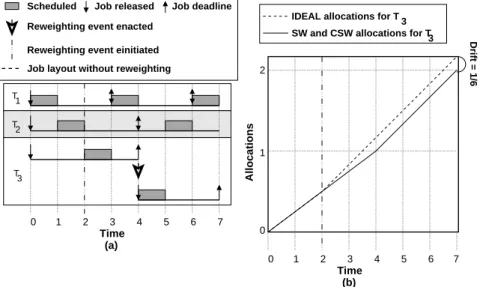
3.2 An example of the GEDF,IDEAL,CSW, andSW scheduling algorithms. . . . 68
3.4 A one-processor example of reweighting via Case (i) of Rule P underGEDF. . 73
3.5 A one-processor example of reweighting via Case (ii) of Rule P under GEDF. 73 3.6 A one-processor example of reweighting via Case (i) of Rule N underGEDF. . 75
3.7 A one-processor example of reweighting via Case (ii) of Rule N underGEDF. 75 3.8 A one-processor example of canceling a reweighting event. . . 77
3.9 A one-processor example ofNP-GEDF. . . 78
3.10 A one-processor example of task classes. . . 81
3.11 A one-processor example of task classes. . . 84
3.12 An example of the GEDF,IDEAL,CSW, and SWscheduling algorithms. . . . 87
3.13 A continuation of Figure 3.12. . . 88
3.14 An example of the EDF,IDEAL,CSW, and SWscheduling algorithms. . . 90
3.15 A partial schedule that illustrates drift when tasks miss deadlines. . . 95
3.16 A one-processor example of drift in NP-GEDF. . . 97
3.17 A one-processor example of drift in NP-GEDF. . . 98
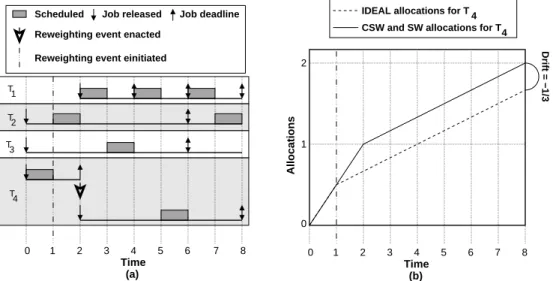
4.1 An example of the MAOE,MROE, and AROEmetrics. . . 106
4.2 A one-processor example of deadlines when minimizing the MROE. . . 112
4.3 A one-processor example of thePEDF and SWscheduling algorithms. . . 114
4.4 A one-processor example of thePEDF and SWscheduling algorithms. . . 115
4.5 A one-processor example of reweighting via Case (i) of Rule P underPEDF. . 119
4.6 A one-processor example of reweighting via Case (ii) of Rule P under PEDF. . 119
4.7 A one-processor example of reweighting via Case (i) of Rule N underPEDF. . 121
4.8 A one-processor example of reweighting via Case (ii) of Rule N underPEDF. 121 4.9 A one-processor example of canceling a reweighting event. . . 122
4.10 A one-processor example of NP-PEDFreweighting. . . 123
4.11 A two-processor example of resetting under PEDF. . . 125
4.12 An illustration of t1 andtd. . . 132
4.13 An illustration of tz and ǫz. . . 133
4.14 An example illustrating the the NP-PEDFtardiness bound. . . 135
4.15 An example of the PEDF,IDEAL,CSW,SW,PTscheduling algorithms. . . . 137
4.16 A continuation of Figure 4.15. . . 138
4.17 An example of the PEDF,IDEAL,CSW,SW, and PTscheduling algorithms. . 139
4.18 A one-processor example of the task decomposition in Lemma 4.4. . . 146
4.19 A one-processor example of multiple reweighting events. . . 152
4.20 Decomposition of a task for Lemma 4.7. . . 155
4.21 Decomposition of a task for Lemma 4.9. . . 160
4.22 A one-processor example of drift in NP-PEDF. . . 169
4.23 A one-processor example of drift in NP-PEDF. . . 170
5.1 The behavior of a periodic andIStask. . . 178
5.2 The behavior of a periodic heavy task. . . 181
5.3 Pseudo-code definingA(IIS,Ti[j],t). . . 182
5.4 Per-slot allocations forAISsystem. . . 185
5.5 An illustration of freeing the capacity. . . 187
5.6 A one-processorPD2 schedule of two tasks. . . 188
5.7 Pseudo-code defining theA(SW,Ti[j],t). . . 189
5.8 An illustration of Rule P under PD2. . . 192
5.9 An illustration of Rule N underPD2. . . 193
5.10 An example of instant reweighting causing a heavy task to miss its deadline. 194 5.11 An example of increasing the weight of a heavy-changeable task. . . 196
5.12 An example of decreasing the weight of a heavy-changeable task. . . 197
5.13 An example of decreasing the weight of a heavy-changeable task. . . 198
5.14 An illustration of theAGIS task model. . . 205
5.15 The behavior of a periodic heavy task in an AGIS system. . . 206
5.16 The reweighting rules in an AGISsystem. . . 207
5.17 An example of a heavy-changeable task in an AGIS system. . . 208
5.18 An illustration of displacements. . . 209
5.19 Illustrating the sets A, B, and I. . . 215
5.20 An illustration of displacements caused by remove X(1). . . 216
5.22 An illustration of the proof of Lemma 5.13. . . 222
5.23 An illustration of Tx Lemma 5.14. . . 225
5.24 An example of the IDEALalgorithm underPD2. . . 232
5.25 An illustration of why PD-LJis coarse-grained. . . 233
5.26 An illustration that all EPDF algorithms incur drift. . . 234
5.27 An illustration of Rule P under PD2. . . 236
5.28 An illustration of Rule N under PD2. . . 237
5.29 An illustration of Rule N under PD2. . . 238
6.1 Estimated weight vs. importance value/service level. . . 249
6.2 The AGEDFscheduling algorithm. . . 251
6.3 A feedback system’s response to a step input. . . 252
6.4 Estimated weight vs. importance value/service level. . . 259
6.5 An illustration of changing the code segment. . . 262
7.1 The Whisper system. . . 265
7.2 Pseudo-code defining correlation. . . 266
7.3 An illustration of correlation. . . 267
7.4 An illustration of the Kalman Filter. . . 269
7.5 The core loop in Whisper. . . 270
7.6 An illustration of an occluding object. . . 270
7.7 Example of different methods for removing noise from a pixel. . . 273
7.8 The flow diagram of the VEC. . . 277
7.9 The VEC system divided into tasks. . . 279
7.10 The simulated Whisper system. . . 286
7.11 Whisper simulations. . . 287
7.12 Whisper simulations continued. . . 288
7.13 The simulated VEC system. . . 289
7.14 VEC simulations. . . 291
7.15 VEC simulations, continued. . . 292
7.16 The simulated Whisper system. . . 294
7.17 The actual weight of a Whisper task at three different service levels. . . 296
7.18 AGEDF running Whisper Continued. . . 297
7.19 AGEDF running Whisper. . . 298
7.20 AGEDF running Whisper. . . 299
7.21 AGEDF running Whisper. . . 300
7.22 AGEDF running Whisper. . . 301
7.23 AGEDF running Whisper. . . 302
7.24 AGEDF running Whisper. . . 303
7.25 The simulated VEC system. . . 304
7.26 The actual weight of a VEC task at three different service levels. . . 305
7.27 The actual weight of a VEC task at three different service levels. . . 306
7.28 AGEDF running VEC. . . 307
7.29 AGEDF running VEC. . . 308
7.30 AGEDF running VEC. . . 309
7.31 AGEDF running VEC. . . 310
7.32 AGEDF running VEC. . . 311
7.33 AGEDF running VEC. . . 312
7.34 AGEDF running VEC. . . 313
7.35 AGEDF running VEC. . . 314
LIST OF ABBREVIATIONS
AIS Adaptable Intra-Sporadic Task Model
AGIS Adaptable Generalized Intra-Sporadic Task Model
AGEDF Adaptive GEDF
AAOE Average Absolute Overall Error
AROE Average Relative Overall Error
EDF Earliest-Deadline-First
EPDF Earliest-Pseudo-Deadline-First
EEVDF Earliest-Eligible-Virtual-Deadline-First
FF Fairness Factor
FCS Feedback-Control Real-Time Scheduling
FMLP Flexible Multiprocessor Locking Protocol
GEDF Global EDF
IS Intra-Sporadic
MAOE Maximal Absolute Overall Error
MROE Maximal Relative Overall Error
NP-GEDF Non-Preemptable GEDF
NP-PEDF Non-Preemptable PEDF
PEDF Partitioned EDF
RBED Rate-Based Earliest-Deadline
RTOS Real-Time Operating System
RAD Reasonable Allocation Decreasing
UA Average Under Allocation
CHAPTER 1
INTRODUCTION
The goal of this dissertation is to extend research on multiprocessor real-time systems in order
to enable such systems toadapt tasks’ processor shares—a process calledreweighting—in
re-sponse to both external and internal stimuli. The particular focus of this work is on adaptive
systems that are deployed in environments in which tasks may frequently require significant
share changes. Such environments are commonplace in computationally-intensive multimedia
applications. Prior to the research in this dissertation, no multiprocessor reweighting
algo-rithms had been proposed that could change task shares with bounded overhead. In this
dissertation, we extend prior work on uniprocessor and multiprocessor systems to construct
reweighting algorithms with minimal overhead for several different types of multiprocessor
systems. Furthermore, we examine how feedback and optimization techniques can be use to
determine, at run time, which reweighting events are needed. Finally, we evaluate the
pro-posed adaptive scheduling algorithms by using two multimedia applications developed at The
University of North Carolina at Chapel Hill: the Whisper human tracking system (Vallidis,
2002) and theVirtual Exposure Camera (VEC) night vision system (Bennett and McMillan,
2005).
To motivate the need for adaptive real-time scheduling, we begin this chapter with a brief
overview of Whisper and VEC. Next, we discuss the core real-time concepts that are relevant
to this dissertation. We then review prior work on adaptive real-time systems and state
1.1
Applications
Brief descriptions of Whisper and VEC are provided below; more detailed descriptions will be
given later in Chapter 7, where our experimental results are given. Before discussing Whisper
and VEC, it is important to point out that, since each is a multimedia application, both
must ensure certain timing constraints to provide an acceptable user experience and thus are
examples ofreal-time application. One of the questions we will answer in this dissertation is
how the timing constraints of real-time applications can be changed at run time while still
providing an acceptable quality-of-service (QoS).
1.1.1 Whisper
As mentioned above, Whisper performs full-body tracking in virtual environments (Vallidis,
2002). Whisper tracks users via an array of wall- and ceiling-mounted microphones that
detect signals (i.e., white noise) emitted from speakers attached to each user’s hands, feet,
and head. Specifically, by calculating the time-shift in the signal for each microphone-speaker
pair, Whisper is able to triangulate each speaker’s position. The amount of time required to
calculate the distance between a microphone-speaker pair is indirectly related to the
noise ratio. As the distance between a microphone-speaker pair increases, the
signal-to-noise ratio decreases, which increases the amount of time required to calculate this distance.
Also, other factors, like ambient noise, further degrade the signal-to-noise ratio causing total
computation time to increase. Because the computational cost associated with calculating
the distance between a microphone speaker-pair can change at run time, the tasks comprising
Whisper must be scheduled using algorithms that either allow task parameters to adapt or
allow task shares to be defined based on worst-case scenarios. Unfortunately, provisioning the
system based on worst-case scenarios may not be a viable option because there exist scenarios
for which no reasonable computational platform can correctly track a user (e.g., a room with
a 100dB of ambient noise). While using adaptive techniques reduces the resources required
to correctly track a user (relative to over-provisioning), the workload is still intensive enough
to necessitate a multiprocessor system.
1.1.2 Virtual Exposure Camera
The second application considered in this dissertation is the VEC video-enhancement
sys-tem (Bennett and McMillan, 2005).1 VEC is capable of improving the quality of an
under-exposed video feed so that objects that are indistinguishable from the background become
clear and in full color. In VEC, darker objects require more computation to correct. Thus, as
dark objects move in the video, the processor shares of the tasks assigned to process different
areas of the video will change. Like all multimedia applications, to create an acceptable user
experience, VEC must update the corrected image at a regular rate. VEC will eventually
be deployed in a full-color night vision system, so tasks will need to change shares as fast
as a user’s head can turn. In the planned configuration, a multicore platform consisting of
approximately ten processing cores will be used.
1.2
Real-Time Systems
The distinguishing characteristic of a real-time system is the need to satisfy timing constraints.
The timing constraints of recurrent applications (e.g., Whisper and VEC) can be represented
using thesporadic task model. In this model, each piece of sequential recurrent code is called
atask. Each invocation of such a task is called ajob. We denote theith
task of a set of tasksT
asTi (where tasks are ordered by some arbitrary method), and denote thejth job of the task
Ti asTij (where jobs are ordered by the sequence in which they are invoked). Associated with
a sporadic task is aworst-case execution time (WCET), denotede(Ti), and aperiod, denoted
p(Ti). The WCET denotes the maximum amount of time any job of the task requires; the
period denotes the minimum separation between consecutive job invocations and defines a
relative “deadline” for each job. The time at which a job is invoked is called its release time,
denoted r(Tij), and the (absolute) time by which a job must complete is called its deadline,
denotedd(Tij). Theweight of a taskTi, denotedwt(Ti), is the fraction of a process it requires
to be correctly scheduled and is defined as e(Ti)/p(Ti). For shorthand, we will use Ti:(e, p)
to denote a taskTi with a WCET of eand a period ofp.
1In prior work (Block and Anderson, 2006; Block et al., 2008a; Block et al., 2008b), we referred to VEC
11 5
4 3 2 1 T1
T2
T3
0 6 7 8 9 10
Scheduled
:(4,14) :(1,7/3) :(2,7)
Job release
Job deadline Job deadline & release
Time 12 13 14 15
Figure 1.1: A one-processor example with three sporadic tasks.
The release and deadline of the job Tij of a sporadic task Ti can be specified as
r(Ti1) = θ(Ti1)
r(Tij) = d(Tij−1) +θ(Tij), j >1
d(Tij) = r(Tij) +p(Ti), j≥1
where θ(Tij) ≥ 0 for j ≥1. θ(Tij) denotes the sporadic separation between job releases. If θ(Tij+1) = 0, thenTij+1 is released atTij’s deadline.
Example (Figure 1.1). Consider the example in Figure 1.1, which depicts a one-processor system with three tasks: T1:(2,7), which has a sporadic separation of one time unit between
T11andT12;T2:(1,7/3); andT3:(4,14). The grey boxes denote the time at which the associated
job is scheduled. Down arrows denote a job release. Up arrows denote a job deadline.
Up-and-down arrows denote that a job’s deadline and its successor’s release occur at the same
time. Similar notation will be used in later figures.
The actual execution time of jobTjj, denoted Ae(Tij), is the amount of time for which Tij
is scheduled; this value is upper-bounded bye(Ti). Depending on the scenario, this value may
or may not be known before the job finishes execution. To facilitate further discussion, a few
additional terms need to be defined.
Definition 1.1 (Window, Active, and Inactive). If Tij is a job in the task system T, then thewindow ofTij defined as the range [r(Tij),d(Tij)). Furthermore, the job Tij isactive
correct.
at time t iff t is in Tij’s window (i.e., t ∈ [r(Tij), d(Tij))), and inactive otherwise. We use
ACT(t) to denote the set of active jobs at time t.
For example, in Figure 1.1,T11 is active over the range [1, 7) and is inactive at every other
time.
Definition 1.2 (Completed). If S is a schedule of the task system T, then a job Tij ∈T is said to have completed by time t in S iff Tij has executed for Ae(Ti) time units by t in S. Similarly, a task Ti is said to be complete at time t iff at time t every job of Ti that was
released byt has completed.
For example, in Figure 1.1, T11 is complete at and after time 4. Also, at time 10/3, T2 is
complete since both T21 and T22 are complete by time 10/3.
Definition 1.3 (Pending and Ready). For an arbitrary scheduling algorithm A, if S is a schedule of the task system T under A, then a jobTij is said to bepending at time t in S if
r(Tij)≤tand Tij is incomplete att inS. Note that a job can be both pending and inactive, if it misses its deadline. A pending job Tij is said to be ready at time t in S if all prior jobs of taskTi have completed byt. A job Tij can be pending but not ready if T
j−1
i is incomplete
at r(Tij). (Such a scenario may occur in some multiprocessor algorithms.)
For example, in Figure 1.1, T11 is pending until time 4, and T31 is pending until time 11.
LetAbe an arbitrary scheduling algorithm, τ be an arbitrary task system, andS denote schedule of τ generated by A. Then, we useA(S,Tij,t1,t2) denote the total time allocated to Tij in S in [t1,t2). Similarly, we use A(S,Ti,t1,t2) and A(S,τ,t1,t2), respectively, to denote the total time allocated to all jobs ofTi inS and all tasks ofτ inS, over the interval
[t1,t2). We say that the value of A(S,Tij, 0,t) is the amount thatTij hasexecuted by t. For example in Figure 1.1,A(S,T1
1, 0, 2) = 1 andA(S,T11, 1, 4) = 2.
Depending on the consequences of missing a deadline, real-time systems can be classified
as either “hard” or “soft.” A system is ahard real-time (HRT) system if missingany deadline
implies that the system fails. In contrast, in asoft real-time (SRT) system, deadlines may be
missed. Examples of HRT systems include avionics and automotive applications. Examples
miss an occasional deadline, it is still possible for such systems to “fail;” however, there is no
single notion of a “correct” SRT system. Some possible notions of SRT correctness include:
boundeddeadline tardiness (i.e., all jobs complete within some bound of their deadline) (Devi
and Anderson, 2008); a specified percentage of deadlines must be met (Lu et al., 2002); and
mout of everykconsecutive jobs of each task complete before their deadline (Hamadoui and
Ramanathan, 1995). In this dissertation, we are primarily concerned with HRT systems and
SRT systems with bounded deadline tardiness. For HRT systems, we say that a given task set
isschedulable if it is possible to guarantee that no single task will miss its deadline; otherwise
we say that it is unschedulable. Similarly, for SRT systems, we say that a given task set is
schedulable if it is possible to guarantee that every task has bounded deadline tardiness, and
is unschedulable otherwise. Moreover, for many types of system, we can determine if a given
task set is schedulable using a scheduability test, i.e., a set of conditions that, when satisfied
by the task set, imply that it is schedulable.
1.2.1 Uniprocessor Systems
The weight of a task can be used to define an ideal schedule, in which, at each instant,
each task is allocated a fraction of a processor equal to its weight. While the ideal schedule
represents the most equitable allocation of resources possible, it is infeasible to implement
since it requires tasks to be preempted and swapped at arbitrarily small intervals. For a
uniprocessor system, a more realistic scheduling algorithm is theearliest-deadline-first (EDF)
algorithm, which schedules jobs based on their deadlines, with earlier deadlines having higher
priority. On a uniprocessor system, EDF can guarantee that every job completes before its
deadline if the total weight of all tasks is at most one, the total available utilization.
Example (Figure 1.2). Figure 1.2 depicts a one-processor example of an ideal and EDF
schedule of a system with four tasks: T1:(1,2); T2:(2,8); T3:(1,8); and T4:(1,8) T1. The
numbers in each box denote the fraction of the processor consumed by the associated task.
Insets (a) through (c) depict, respectively, an ideal schedule, anEDFschedule, and the actual
and ideal allocations forT1.
T
Time
0 8
Job release
Job deadline Job deadline & release Fraction X of the Processor Scheduing the Task
T1
T2
1 2 3 4 5 6 7 1 2 3 4 5 6 7 8
2
T X
(b)
T Allocations 1
:(1,2) :(2,8) 1 T (c) Ideal :(1,8) :(1,8) :(1,2) :(2,8) :(1,8) Actual 4 3 1 2 0 Time
0 2 3 4 5 6 7 8
:(1,8) 4 3 1 T T Time 0 (a) 4 3 T 1/8 1 1 1 1 1
1 1 1
1/2 1/2 1/2 1/2
1/4
1/8
Figure 1.2: A one-processor example of an (a) ideal and (b) EDF schedule, and (c) T1’s allocation in both.
1.2.2 Multiprocessor Partitioned Scheduling
Most multiprocessor scheduling algorithms can be classified as either partitioned or global.
Under partitioned algorithms, each task is permanently assigned to a specific processor and
each processor independently schedules its assigned tasks using a uniprocessor scheduling
al-gorithm. Alternatively, under global algorithms, a task may migrate among processors. The
advantage of partitioned approaches over global approaches is that they have lower
migra-tion/preemption costs. This is because, under partitioned approaches, tasks maintain cache
affinity for longer durations of time due to fewer task migrations than in global approaches.
The disadvantage of partitioned approaches is that such systems have inferior scheduability
conditions when compared to global approaches (as we shall see).
This section discusses the specifics of two partitioned scheduling algorithms: preemptive
and nonpreemptive partitioned EDF (abbreviated asPEDF andNP-PEDF, respectively).
Un-derPEDF andNP-PEDFeach processor is scheduled independently using theEDFscheduling
algorithm. The difference between them is that, under PEDF, a job can be preempted, and
underNP-PEDF, a job cannot be preempted.
Example (Figure 1.3). Consider the example in Figure 1.3, which depicts a two-processor system with six tasks.: T1:(3,12);T2:(1,6);T3:(3,6); T4:(1,4); T5:(1,4); andT6:(5,12). Tasks
T1,T3, andT5 are assigned to Processor 1, and tasksT2,T4, andT6 are assigned to Processor
10 8 7
Job release
0 7 8 9 10
Time 6 (a) T 3 T 4 T 5 T 6 (b) Time 12 11 :(3,12) 1 T 6 12 11 Processor 1 :(5,12) :(1,4)
Processor 2 Job deadline
0 9 T T5 T4 T3 T2
1 2 3 4 5 :(1,4) :(3,6) :(1,6) :(3,12) 1 6 T :(5,12) T :(1,4) :(1,4) :(3,6) :(1,6) 5 4 3 2 1 2
Figure 1.3: Two-processor (a)PEDF and (b)NP-PEDF schedules.
Notice that, sinceT5 is assigned to Processor 1, Processor 2 is idle over the range [10, 11)
even thoughT5has work to be completed. Also note that the difference between Figure 1.3(a)
and Figure 1.3(b) is that in Figure 1.3(b) once a job begins executing it continues to do so
until it completes. This behavior is illustrated by T1
6, which has a contiguous execution in Figure 1.3(b) but not in Figure 1.3(a).
Before continuing, there is one subtlety that must be discussed. Throughout this
dis-sertation, whenever we discuss partitioned scheduling algorithms, we will make a distinction
between theguaranteed weightof a task and thedesired weightof a task (given bye(Ti)/p(Ti)).
This distinction is important because under partitioned algorithms, it is possible for a
pro-cessor to be over-allocated, i.e., the propro-cessor is assigned tasks with a total weight exceeding
one. When a processor is over-allocated, there are two options: reject one or more tasks; or
reduce the shares of the tasks on that processor. For example, in a two-processor system with
three tasks each of weight 2/3 (depicted in Figure 1.4), either one of the three tasks must be
rejected or the shares of the tasks on the over-allocated processor must be reduced. Both of
these options guarantee that the shares of tasks do not overutilize either of the processors
even though the weights do. While both variants have their relative advantages, for adaptive
systems, the latter option is likely a better option. (A thorough discussion of this is issue given
in Section 4.2.) It is important to note that for the majority of the algorithms considered in
3 T1 T3 T2
Weight
Guaranteed
Weight
Guaranteed
1/3 2/3 3/3 4/3
Proc. 1 Proc. 2
T3 T2
Rejected
(c) (a)
1/3 2/3 3/3 4/3
Proc. 1 Proc. 2
Desired Weight
1/3 2/3 3/3
Proc. 1 Proc. 2
T
(b)
1
T1 T
T2
Figure 1.4: (a) A two-processor system with three tasks each with a desired weight of 2/3.
(b) The guaranteed weights of tasks in (a) when no task is rejected. (c) The guaranteed weights of tasks in (a) whenT2 is rejected.
this dissertation, a task’s guaranteed weight equals its desired weight. Thus, for brevity, we
will only use the terms “desired weight” and “guaranteed weight” when discussing algorithms
where the two may differ.
1.2.3 Restricted Global Multiprocessor Scheduling
In global scheduling algorithms, tasks are scheduled from a single priority queue and may
mi-grate among processors. Global algorithms can be further classified as either restricted and
unrestricted. A scheduling algorithm is considered to be restricted if the scheduling priority
of each job (for any given schedule) does not change once it has been released. A scheduling
algorithm is considered to be unrestricted if there exists a schedule in which some job changes
its priority after it is released. In this section, we discuss two restricted global scheduling
algorithms,preemptive global-EDF(GEDF) andnon-preemptive global-EDF(NP-GEDF);
unre-stricted algorithms are considered in Section 1.2.4. Under both GEDFand NP-GEDF, tasks
are scheduled from a single priority queue on anEDF basis. As with partitioned algorithms,
the only difference betweenGEDFandNP-GEDF is that jobs can be preempted inGEDFand
cannot be preempted in NP-GEDF.
Example (Figure 1.5). Consider the example in Figure 1.5, which pertains to a two-processor system with five tasks: T1:(2,7); T2:(1,7); T3:(1,7); T4:(3,7); and T5:(3,7). Inset
(a) depicts aGEDFschedule and inset (b) depicts anNP-GEDFschedule. In (a), T51 misses a
deadline by one time unit at time 7, and T52 misses a deadline by one time unit at time 14.
In (b),T52 misses a deadline by two time unit at time 14.
5 T 4 T 3 T 2 T 1 T (a)
Time 1112 13 1415
0 1 2 3 4 5 6 7 8 9 10
(b) 16 Time :(3,7) 15 :(2,7) 1 Processor 1 1 Job release Job deadline Processor 2 T :(3,7) :(3,7) :(3,7) :(3,7) 14 13 :(3,7) 12 11 :(3,7) 0 10 :(3,7) :(2,7) 5 T 9 8 7 4 T 3 6 T 2 5 T 4 3 2
Figure 1.5: Two-processor (a)GEDF and (b)NP-GEDF schedules.
it is not possible for a processor to be over-allocated in the long term, provided that total
utilization is at mostm, the number of processors. However, short-term over-allocations that
cause deadline misses are possible. Nonetheless, as shown by Devi and Anderson (Devi and
Anderson, 2008), such misses are only by bounded amounts. The amount of time by which
a job misses its deadline is called its tardiness. For example, in Figure 1.5(a), T51 misses a
deadline at time 7, and in both Figure 1.5(a) and Figure 1.5(b),T52 misses a deadline at time
14. As shown in (Devi and Anderson, 2008), underGEDF, the maximal tardiness of any job
of task aTi is bounded by a formula given shortly; however, before presenting their equation,
we briefly introduce a few needed terms. Letemindenote the minimum execution time of any
task in the systemτ. Define WT(τ) as
WT(τ) = X
Ti∈τ
wt(Ti).
Additionally, let maxe(k) and maxwt(k) denote, respectively, the kth largest execution time
and weight of any task. Finally, let the value Γ denote
Γ =
WT(τ)−1, WT(τ) is integral
⌊WT(τ)⌋, otherwise.
Using these terms, the maximal tardiness (as given in (Devi and Anderson, 2008)) for any
job of a task Ti is given as
PΓ
k=1maxe(k)−emin
m−PΓ−1
k=1maxwt(k)
+e(Ti), (1.1)
providedWT(τ)≤m, wheremis the number of processors. Since tasks cannot be preempted inNP-GEDF, its tardiness bound is slightly larger than (1.1). (See (Devi and Anderson, 2008)
for details.)
1.2.4 Unrestricted Global Multiprocessor Scheduling
The final multiprocessor scheduling algorithm we consider in this dissertation is the
unre-stricted global Pfair algorithm PD2 (Srinivasan and Anderson, 2005). PD2 schedules a task
by breaking it into a sequence in which of subtasks, each of which represents one time unit
of execution. Each such time unit is called a quantum. The jth
subtask of the task Ti is
denoted asTi[j], where subtasks are ordered by the sequence in which they are invoked.
Asso-ciated with each subtask is apseudo-release and pseudo-deadline (often called “release” and
“deadline” for brevity), which are defined as
r(Ti[1]) = θ(Ti[1])
r(Ti[j]) = d(Ti[j−1]) +
j−1
wt(Ti)
−
j−1
wt(Ti)
+θ(Tij), j >1
d(Ti[j]) = r(Ti[j])−
j−1
wt(Ti)
+
j
wt(Ti)
, j≥1
where θ(Ti[j]) ≥ 0 for j ≥ 1. θ(Ti[j]) denotes the “sporadic” separation between subtask releases (such separations are called “intra-sporadic”). PD2 schedules subtasks on an
earliest-pseudo-deadline-first basis with two tie-breaking rules, which are used in the event of a
dead-line tie. (A more thorough discussion ofPD2 can be found in Chapter 5.) Since tasks inPD2
are scheduled one quantum at a time, a task’s execution time is assumed to be a multiple of
the quantum size (and must be rounded up if this is not the case) and the scheduling of a
task depends only on its weight. The main advantage of PD2 over all other aforementioned
algorithms is that PD2 is the only algorithm that can guarantee that every job is scheduled
before its deadline and no processor is over-allocated provided total utilization is at most
T T 2 T 1 T
Time
0 1 2 3 4 5 6 7 8 111213 14
Subtask release Subtask deadline
Processor 2 Processor 1
:(3,7) :(3,7) :(3,7) :(3,7) :(2,7)
5 T 4 3
9 10
Figure 1.6: A two-processor system scheduled by PD2.
possible that a task will be preempted and migrated every quantum, which can cause tasks to
incur large migration/preemption costs. Another disadvantage ofPD2 is that task execution
times must be rounded up, which can cause the system to be underutilized. For example, if
a task has an execution time of 3.1 and a period of 4, then its weight would be 4/4 = 1, since
the execution time of 3.1 would be rounded up to one.
Example (Figure 1.6). Figure 1.6 shows aPD2 schedule for the task system consider earlier in Figure 1.5.
Notice that, in this schedule, tasks are scheduled one quantum at a time. As a result,
tasks may be preempted at the end of every quantum and may migrate nearly as frequently.
Also note that a subtask (unlike a job) may be released before the deadline of its successor.
Finally, notice that, in this schedule, every task is scheduled before its deadline and that tasks
with the same weight (but different periods) receives allocations at the same rate, e.g., T3
and T4 receive approximately one allocation in any 7/3-quantum interval.
1.2.5 Impact of Migrations and Preemptions
Given these five algorithms, it is obvious that in the absence of migration and preemption
costs, PD2 should be the preferred algorithm since it is the only algorithm that can both
guarantee that every job completes before its deadline and that the share of every task equals
its weight. However, for many applications, migration and preemption costs may be
stantial. Recently, our research group (Calandrino et al., 2006) constructed a multiprocessor
testbed, called LITMUSRT, to compare different real-time scheduling algorithms. We then
used this testbed to implement all of the aforementioned algorithms (except NP-PEDF) on a
four-processor system (with 2.7 GHz processors) in an effort to assess the impact of migration
and preemption costs. In our work, we varied the weight of tasks being scheduled and the
amount of cache used by each task. (Migrations and preemptions cause a loss of cache affinity,
and as a result, if a task utilizes a larger fraction of the cache, then that task has both higher
migration and preemption costs.)
Our experiments assessed the performance of each algorithm as measured by the number
of processors that would be required to schedule a number of randomly generated task sets
with a maximal utilization of four. These experiments showed the following:
• The HRT performance ofPEDFandGEDFimprove (relative to the other algorithms) as migration and preemption costs increase and/or the weights of tasks decrease. However,
PEDF always has better HRT performance thanGEDF.
• The performance ofPD2 improves (relative to the other algorithms) as migration and preemption costs decrease and/or the weights of the tasks increase.
• PD2 has virtually the same performance in both HRT and SRT systems.
• PEDFhas virtually the same performance in both HRT and SRT systems.
• BothGEDFandNP-GEDFalways perform better than any other algorithm for SRT
sys-tems. Furthermore,NP-GEDF has slightly better performance than GEDF. (The HRT
performance ofNP-GEDF was not considered since there does not exist a scheduability
test for it that would return meaningful results.)
The reason why the performance ofPEDF is adversely impacted by increasing task weights is
that, if tasks have higher weights, then it is harder to produce a valid partitioning. Similarly,
for GEDF, as task weights increase, it becomes more likely that a job will be tardy. As a
result, additional processing capacity is needed to prevent such a scenario. The performance
tasks with larger weights in consecutive quanta, thus reducing the number of migrations and
preemptions. GEDF andNP-GEDF perform well for SRT systems because even though these
algorithms can cause tasks to miss deadlines, they incur relatively little migration/preemption
cost. Moreover, since tasks are not partitioned underGEDFand NP-GEDF, the performance
(in terms of the required number of processors to guarantee bounded tardiness) does not
substantially degrade as task weights increase. Given these results, it is easy to see that
there there does not exist a single “best” multiprocessor scheduling algorithm, and the choice
of which algorithm depends on the scenario in which it will be used. The theoretical and
empirical results from this section are summarized in Tables. 1.1 and 1.2, respectively.
1.2.6 Research Needed
Under traditional task models (e.g., the sporadic model), the scheduability of a system is
based on each task’s WCET. The disadvantage of using WCETs is that a system may be
deemed unschedulable even if it would function correctly most (or possibly all) of the time
when deployed. Adaptive real-time scheduling algorithms allow per-task processor shares
to be adjusted based upon run time conditions, instead of always using constant share
al-locations based upon WCETs. Prior to the research in the dissertation, for multiprocessor
systems, one approach for reweighting a task had been proposed, as we will discuss in
Sec-tion 2.1 (Srinivasan and Anderson, 2005); however, this approach only allows tasks to reweight
at job boundaries. By delaying a task’s reweighting request until its next job boundary, the
system may “drift” from its “ideal” allocation by an arbitrarily large amount. As a result, for
applications like Whisper and VEC, where timing constraints are continually changing, such
delays may cause unacceptably poor performance. In this dissertation, we remedy this
short-coming by proposing a set of rules that allow tasks to reweight without causing unbounded
drift, and an adaptive framework that determines at run time which adaptions are needed.
Scheme Desired = Guaranteed Weight Guaranteed Deadlines
PEDF No Yes
NP-PEDF No No
GEDF Yes No
NP-GEDF Yes No
PD2 Yes Yes
Scheme Migrations Preemptions
PEDF Never At Job Completions and Releases
NP-PEDF Never Never
GEDF At Job Completions and Releases At Job Completions and Releases
NP-GEDF In Between Jobs Never
PD2 Every Quantum Every Quantum
Table 1.1: Summary of algorithms and their properties. Note that deadlines can be guaranteed underPEDFonly at the expense of allowing guaranteed weights to be less than desired weights.
Scheme Light Tasks Heavy Tasks
(Hard) (Hard) (Hard)
PEDF Best Poor
GEDF Good Worst
NP-GEDF N/A N/A
PD2 Worst Best
Scheme High Mig./Preemp. Costs Low Mig./Preemp. Costs
(Hard) (Hard) (Hard)
PEDF Best Poor
GEDF Good Worst
NP-GEDF N/A N/A
PD2 Worst Excellent
Scheme Soft-Real Time
(All cases)
PEDF Same as hard
GEDF Excellent
NP-GEDF Best
PD2 Same as hard
1.3
Adaptivity
This section provides a review of prior work on adaptive uniprocessor real-time schemes in
which tasks are reweighted based on external and internal stimuli.
1.3.1 Leave/join Reweighting
Underleave/join reweighting (Srinivasan and Anderson, 2005), a task’s weight is changed at
job boundaries by forcing it to leave with its old weight and rejoin with its new weight.
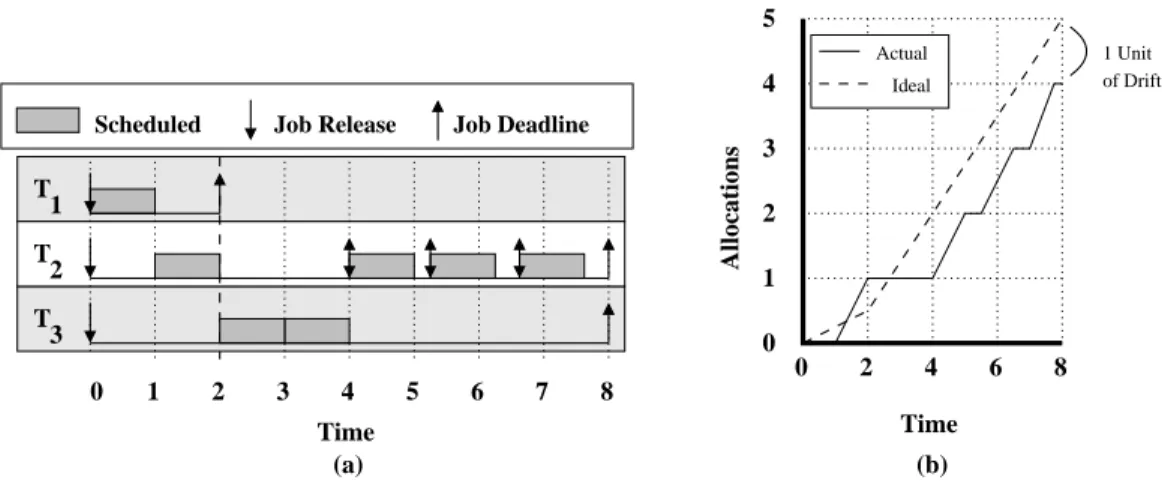
Example (Figure 1.7). Consider the example Figure 1.7, which depicts a one-processor system with three tasks: T1:(1,2) that leaves at time 2;T2, which has an initial weight of 1/4,
an execution cost of 1, and “initiates” a weight increase at time 2 to a weight of 3/4, which is
enacted by leave/join reweighting atT21’s deadline (i.e., time 4); andT3:(2,8). (a)illustrates theEDFschedule and(b) illustrates the ideal and actual allocations to taskT2.
Notice that, even though T2 “initiates” its change at time 2 and capacity exists for T2 to
increase its weight, this weight change cannot be “enacted” until its deadline. This illustrates
that the primary drawback to leave/join reweighting is that a task canonlychange its weight
at job boundaries. As a result, over the time range [2, 4),T2 behaves as though it is a task
of weight 1/4, even though in the ideal system (which can instantly enact weight changes) T2
would behave as a task of weight 3/4, is depicted in Figure 1.7(b). As a result,T2’s allocation
in the actual schedule “drifts” from its allocation in the ideal schedule by one time unit.
(Briefly,drift is the difference between a task’s ideal and actual allocations caused by a single
reweighting event.) Moreover, since leave/join reweighting cannot enact a reweighting event
until a job boundary, it is possible that a task can incur an arbitrarily large amount of drift
for one reweighting event. Section 1.5.3 provides a more detailed discussion concerning drift.
1.3.2 Rate-Based Earliest Deadline
Under rate-based earliest-deadline (RBED) scheduling (Brandt et al., 2003), which was
pro-posed for uniprocessor systems, tasks are scheduled on an EDF basis and can change their
1
3 T
2 T
T
Job Deadline
(b) Time (a)
Allocations
5
4
3
1
0 3
Scheduled Job Release
2
8 6 4 2 0
Time
8 7 6 5
0 1 2 4
1 Unit of Drift Ideal
Actual
Figure 1.7: The (a) EDF schedule and the (b) ideal and actual allocations to T2 in a one-processor example of leave/join reweighting.
weights and periods via two different rules based on whether the execution time or period is
changed. While these rules are more responsive than leave/join reweighting, it is still possible
for a task to incur an arbitrarily large amount of drift underRBED. In Chapter 2, we will
review this work in detail.
1.3.3 Proportional Share Scheduling
Underproportional share scheduling (Stoica et al., 1996), the guaranteed weight of each task
is determined as a function of its desired weight and the desired weight of all other tasks.
Specifically, the guaranteed weight of the taskTi at time tis defined as
Gwt(Ti, t) =
wt(Ti)
WT(τ,t), (1.2)
where WT(τ,t) is the total desired weight of all active tasks in the system τ at time t. For
example, consider a one-processor system that consists of four tasks: T1 that has a desired
weight of 1/2; T2 that has a desired weight of 1/4;T3 that has a desired weight of 1/4; and
T4 that has a desired weight of 1/8. If, at some time t1 all four tasks are active, then the
guaranteed weight for each task would be 1/(1/2 + 1/4 + 1/4 + 1/8) = 8/9 of its desired
weight. So, the desired weight of T1 would be 4/9. Alternatively, if at some time, t2, only
T1 andT2 were active, then the guaranteed weight of each would be 4/3 of its desired weight
for each task. So, the guaranteed weight of T1 would be 2/3. It is worthwhile to note
without using leave/join techniques. In Section 2.3, we will review one of the more popular
proportional share scheduling algorithms.
1.3.4 Adaptive Feedback-Based Frameworks
In adaptive feedback-based scheduling algorithms, the execution time of each job is unknown
until it is complete. As a result, in these systems, each task’s weight is defined as a function
of its estimated execution time, which is calculated for a job by using the actual execution
times of the task’s prior jobs. Moreover, a user can fine-tune a feedback-based system to
achieve desired behaviors.
Lu et al. (Lu et al., 2000) were the first to propose such a scheduling algorithm, which
was directed at uniprocessor systems.2 Under their algorithm, called FC-EDF2, each task
has multiple versions (called service levels), each of which has a different level of QoS and
a different nominal processor share, representing the fraction of a processor the task will
require on average if it executes at that service level. A task can only execute at one service
level at a time. In order to control the system, FC-EDF2 monitors the system’s utilization
and miss-ratio, i.e., the fraction of jobs with missed deadlines. In order to minimize the
miss-ratio while maximizing utilization,FC-EDF2 adjusts the set of scheduled tasks and their
service levels. More recently, Lu et al. extended this work to create a comprehensive feedback
scheduling framework (Lu et al., 2002) that more explicitly incorporates the value to the
system associated with each service level. This framework is the basis for the approach we
propose in this paper. One drawback ofFC-EDF2 is that, because only the utilization and the
system-wide miss-ratio are monitored, the system cannot identify whether an individual task
has an actual execution time that deviates substantially from its estimated execution time.
Thus, the system can only respond to differences between the actual and estimated execution
times of tasks by changing the entire system instead of only a few tasks.
Alternatively, Abeni et al. have proposed a uniprocessor feedback algorithm in which each
task has its own feedback-controller rather than one controller for the entire system (Abeni
2Specifically, the firstcorrect feedback algorithm was proposed in (Lu et al., 2000). The original system,
FC-EDF, proposed in (Lu et al., 1999) could not satisfy its design specification because it was possible for the
controller to become saturated, thus rendering it unable to correctly adjust the system.
et al., 2002). In order to attempt to maintain an accurate processor share for each task, their
algorithm monitors,for each task, the difference between the estimated and actual execution
times of each job. Once the system has calculated a new estimated execution time for a future
job, it adjusts the task’s weight. More recently, Cucinotta et al. extended this approach to
provide stochastic guarantees concerning per-task processor shares (Cucinotta et al., 2004).
One drawback of their approach is that it ignores the possibility that some tasks are more
important than others.
In addition to general-purpose real-time scheduling algorithms, feedback-based scheduling
has become increasingly important for managingcontrol tasks, i.e., tasks that control external
devices. In work by Mart´ı et al. (Marti et al., 2004), an approach is proposed that is similar
to that of Abeni et al., except that in (Marti et al., 2004), each period of each task has an
associated “importance value” that denotes the task’s value to the system in that period.
By using importance values, Mart´ı et al. determined the optimal period for each task via
standard linear programming techniques. One limitation of this approach is that it cannot
adjust the amount of time for which a task executes, like other approaches (e.g., like that of
Lu et al. (Lu et al., 2002)).
1.4
Thesis Statement
There are two major limitations of prior work on adaptive uniprocessor systems. First,
there does not exist a set of metrics for comparing different reweighting algorithms. Second,
existing methods for changing the weights of tasks (i.e., leave/join reweighting and RBED)
may give rise to an unacceptably long delay after initiating a weight change before it is
enacted. For multiprocessor systems, the limitations are even more severe since the only
method for changing the weight of a task is to use leave/join reweighting. Moreover, for
multiprocessor systems, there is an inherent tradeoff, which must be explored, between the
level of migration/preemption and the “accuracy” of the adaptive protocol. Also, there is
no global feedback-based adaptive framework, which would be necessary for implementing
applications like Whisper and VEC. The main thesis of this dissertation, which attempts to
Multiprocessor retime scheduling algorithms can be made more adaptive by
al-lowing tasks to reweight between job releases. Feedback and optimization techniques
can be used to determine at run time which reweighting events are needed. The
accuracy of such an algorithm can be improved by allowing more frequent task
mi-grations and preemptions; however, this accuracy comes at the expense of higher
migration and preemption costs, which impacts average-case performance. Thus,
there is a tradeoff between accuracy and average-case performance that will be
dependent on the frequency of task migrations/preemptions and their cost.
1.5
Contributions
In this section, we briefly discuss the contributions of this dissertation.
1.5.1 Adaptable Task Model and Reweighting Algorithms
The first contribution we discuss in the dissertation is the adaptable task model (originally
proposed in (Block et al., 2008b)). This model is an extension of the sporadic task model,
where the weight of each task T, wt(T,t), is a function of time t, and a task’s execution
time can vary between job releases. A task T changes weight or reweights at time t+ 1 if
wt(T,t)6=wt(T,t+ 1). If a task T changes weight at a time tc between the release and the
deadline of some job Tij, then the following two actions may occur:
(i) IfTij has not been scheduled by tc, thenTij may be “halted” at tc. (ii) r(Tij+1) may be redefined to be less than d(Tij).
In the sporadic model defined earlier, every job’s deadline is at or before its successor’s release.
As we will discuss in Section 1.5.2, the reason why the above two actions may occur is that
the value ofr(Tij+1) may change as a result of a reweighting event. The reweighting rules we
present later in this section state the conditions under which the above actions may occur
and the number of time units befored(Tij) that job Tij+1 can be released.
As has already been discussed, when a task reweights, there can be a difference between
when it initiates the change and when the change is enacted. The time at which the change
is initiated is a user-defined time; the time at which the change is enacted is dictated by a
set of conditions that differ slightly for each type of multiprocessor reweighting algorithm.
Furthermore, the release and deadline of a job of an adaptable task is defined based on the
weight of the task when it was released.
1.5.2 Reweighting Rules.
The second major contribution of this dissertation is the construction of reweighting rules
for PEDF, NP-PEDF, GEDF, NP-GEDF, and PD2. (The reweighting rules for PEDF, and
by extension forNP-PEDF, were proposed by Block and Anderson in (Block and Anderson,
2006); the reweighting rules forGEDFand NP-GEDFwere proposed by Block et al. in (Block
et al., 2008b); and the reweighting rules forPD2were proposed by Block et al. in (Block et al.,
2008a).) In all five reweighting algorithms, tasks change weight via one of two rules that are
based on whether a task’s active job is over- or under-allocated relative to an ideal schedule.
• If a task isunder-allocated, then the change is enacted by immediately halting the active job and releasing a new job with the remaining execution time.
• If a task is over-allocated, then one of two actions occurs: (i) if the task increases its weight, then the change is enacted by immediately halting the active job and releasing
the next job when the task’s “ideal” allocation equals its “actual” allocation; (ii)if the task decreases its weight, then the active job immediately halts and when the task’s
“ideal” allocation equals its “actual” allocation, the change is enacted and the next job
is released.
When aTij ishalted at timet,Tij is not scheduled after time t.
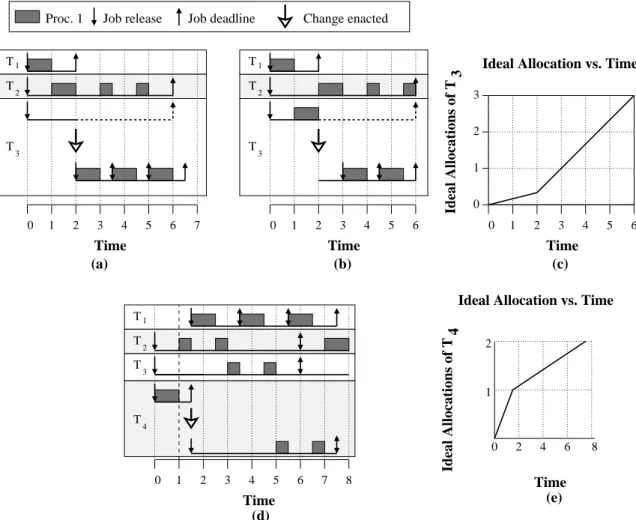
Example (Figure 1.8). Consider the examples depicted in Figure 1.8. Insets (a) and (b) pertain to a one-processor system with: T1:(1,2), which leaves the system at time 2;T2:(1,6);
andT3, with an execution cost of 3 and an initial weight of 1/6 that increases to 4/6 at time 2.
Since the first jobs of T2 andT3 have the same deadline, we can arbitrarily choose which job
has a higher scheduling priority. Inset (a) depicts the case where T2 has higher priority, and
Thus, when T3 reweights, its current job “halts” and its next job is immediately released.
Inset (b) depicts the case whereT3 has higher priority, and as a result,T3 is “over-allocated”
relative to the ideal system, when it reweights at time 2. Thus, whenT3 reweights, its current
job “halts” and its next job is not released until the difference between T3’s ideal and actual
allocations is zero (at time 3). The dotted lines denote the interval of the first job ofT3 that
has been changed by the reweighting event. Inset (c) depicts the ideal allocation of T3 as a
function of time. Notice that, at time 2, when T3 increases its weight from 1/6 to 4/6, the
ideal allocation rate increases from 1/6 to 4/6, and that at time 3, T3’s total ideal allocation
equals 1. Inset (d) depicts a one-processor system with four tasks: T1:(1,2), which joins
the system at time 1.5; T2:(1,6); T3:(1,6); and T4, which has an initial weight of 4/6 that
decreases to 1/6 at time 1. Since T4 is over-allocated at time 1 and decreases its weight, its
weight change is enacted when its ideal allocation equals its actual allocation (at time 1.5).
Inset (e) depicts ideal allocation forT4.
One important property of the above reweighting rules is that reweighting events are
task-independent. That is, if a task Ti changes its weight, thenonly the releases and deadlines of
jobs ofTi change. As a result of this independence, a task can only increase its weight at time
t if enough capacity for the reweighting event is available. For example, if a two-processor
task system has three tasks each of weight 0.6, then none of these tasks can initiate a weight
increase to 0.9 (since this would cause the system load to be 2.1), unless one of the other
two tasks first decreases its weight or leaves the system. (If reweighting events were not
task-independent, then it would be possible for a proportional-share scheduling algorithm to
increase the weight of a task at the expense of the shares of other tasks in the system.)
1.5.3 Evaluating Algorithms
The next contribution of this dissertation is a comparison of the reweighting algorithm for
dif-ferent multiprocessor scheduling frameworks. In order to evaluate the reweighting algorithms,
we use three different metrics: overload,tardiness, anddrift. Overload is the maximal amount
that a single processor is overutilized (assuming that the system is not overutilized). Tardiness
is the maximal amount by which a task can miss a deadline. Drift is the maximal amount of
Change enacted Job deadline
Job release Proc. 1
2 T
T
T T T
(a) (b) (c)
T T
T
Time (d)
Time (e)
0 1 2 3 4 5 6 7 0 1 2 3 4 5 6 0 1 2 3 4 5 6
1
0 2 3
T
Time Time Time
Ideal Allocation vs. Time
Ideal Allocations of T
0 1 2 3 4 5 6 7 8
T
Ideal Allocations of T
Ideal Allocation vs. Time
3
4
1
0 2 4 6 8
1 2
4 1 2
1 2
3
3 3
Figure 1.8: Several one-processor systems scheduled by EDF using our reweighting rules.