TEX
A GRAVITATIONAL-WAVE STANDARD SIREN MEASUREMENT OF THE HUBBLE CONSTANT
THE LIGO SCIENTIFICCOLLABORATION ANDTHEVIRGOCOLLABORATION, THE1M2H COLLABORATION, THEDARKENERGYCAMERAGW-EM COLLABORATION AND THEDES COLLABORATION,
THEDLT40 COLLABORATION, THELASCUMBRESOBSERVATORYCOLLABORATION, THEVINROUGE COLLABORATION, THEMASTER COLLABORATION, et al.
ABSTRACT
The detection of GW170817 (Abbott et al. 2017a) in both gravitational waves and electromagnetic waves heralds the age of gravitational-wave multi-messenger astronomy. On 17 August 2017 the Advanced Laser Interferometer Gravitational-wave Observatory (LIGO) (LIGO Scientific Collaboration et al. 2015) and Virgo (Acernese et al. 2015) detectors observed GW170817, a strong signal from the merger of a binary neutron-star system. Less than 2 seconds after the merger, a gamma-ray burst (GRB 170817A) was detected within a region of the sky consistent with the LIGO-Virgo-derived location of the gravitational-wave source (Abbott et al. 2017b; Goldstein et al. 2017; Savchenko et al. 2017). This sky region was subsequently observed by optical astronomy facilities (Abbott et al. 2017c), resulting in the identification of an optical transient signal within∼10arcsec of the galaxy NGC 4993 (Coulter et al. 2017;Soares-Santos et al. 2017; Valenti et al. 2017; Arcavi et al. 2017; Tanvir et al. 2017; Lipunov et al. 2017). These multi-messenger observations allow us to use GW170817 as a standard siren (Schutz 1986;Holz & Hughes 2005;Dalal et al. 2006;Nissanke et al. 2010,2013), the gravitational-wave analog of an astronomical standard candle, to mea-sure the Hubble constant. This quantity, which represents the local expansion rate of the Universe, sets the overall scale of the Universe and is of fundamental importance to cosmology. Our measurement combines the distance to the source inferred purely from the gravitational-wave signal with the recession velocity inferred from measurements of the redshift using electromagnetic data. This approach does not require any form of cosmic “distance ladder” (Freedman et al. 2001); the gravitational-wave (GW) analysis can be used to estimate the luminosity distance out to cosmological scales directly, without the use of intermedi-ate astronomical distance measurements. We determine the Hubble constant to be70.0+12−8.0.0km s−1Mpc−1 (maximum a posteriori and 68% credible interval). This is consistent with existing measurements (Planck Collaboration et al. 2016; Riess et al. 2016), while being completely independent of them. Additional standard-siren measurements from future gravitational-wave sources will provide precision constraints of this important cosmological parameter.
The Hubble constantH0 measures the mean ex-pansion rate of the Universe. At nearby distances (d . 50Mpc) it is well approximated by the ex-pression
vH =H0d, (1)
wherevH is the local “Hubble flow” velocity of a
source, anddis the distance to the source. At such distances all cosmological distance measures (such as luminosity distance and comoving distance) dif-fer at the order of vH/c where c is the speed of
light. As vH/c ∼ 1% for GW170817 we do not
distinguish between them. We are similarly insen-sitive to the values of other cosmological parame-ters, such asΩm andΩΛ.
To obtain the Hubble flow velocity at the posi-tion of GW170817, we use the optical identifica-tion of the host galaxy NGC 4993 (Abbott et al. 2017c). This identification is based solely on the 2-dimensional projected offset and is independent of any assumed value ofH0. The position and
red-shift of this galaxy allow us to estimate the appro-priate value of the Hubble flow velocity. Because the source is relatively nearby the random relative motions of galaxies, known as peculiar velocities, need to be taken into account. The peculiar veloc-ity is∼ 10% of the measured recessional velocity (see Methods).
The original standard siren proposal (Schutz 1986) did not rely on the unique identification of a host galaxy. By combining information from
∼100independent GW detections, each with a set of potential host galaxies, a ∼ 5% estimate of H0
can be obtained even without the detection of any transient optical counterparts (Del Pozzo 2012). This is particularly relevant, as gravitational-wave networks will detect many binary black hole merg-ers over the coming years (Abbott et al. 2016a), and these are not expected to be accompanied by electromagnetic counterparts. Alternatively, if an EM counterpart has been identified but the host galaxy is unknown, the same statistical method can be applied but using only those galaxies in
a narrow beam around the location of the opti-cal counterpart. However, such statistiopti-cal analyses are sensitive to a number of complicating effects, including the incompleteness of current galaxy cat-alogs or the need for dedicated follow-up surveys, as well as a range of selection effects ( Messen-ger & Veitch 2013). In what follows we exploit the identification of NGC 4993 as the host galaxy of GW170817 to perform a standard siren mea-surement of the Hubble constant (Holz & Hughes 2005; Dalal et al. 2006; Nissanke et al. 2010, 2013).
Analysis of the GW data associated with GW170817 produces estimates for the parameters of the source, under the assumption that general rela-tivity is the correct model of gravity (Abbott et al. 2017a). We are most interested in the joint pos-terior distribution on the luminosity distance and binary orbital inclination angle. For the analysis in this paper we fix the location of the GW source on the sky to the identified location of the counterpart (Coulter et al. 2017). See the Methods section for details.
An analysis of the GW data alone finds that GW170817 occurred at a distanced= 43.8+2−6..99Mpc (all values are quoted as the maximum posterior value with the minimal width68.3%credible inter-val). We note that the distance quoted here differs from that in other studies (Abbott et al. 2017a), since here we assume that the optical counter-part represents the true sky location of the GW source instead of marginalizing over a range of potential sky locations. The ∼ 15% uncertainty is due to a combination of statistical measurement error from the noise in the detectors, instrumen-tal calibration uncertainties (Abbott et al. 2017a), and a geometrical factor dependent upon the cor-relation of distance with inclination angle. The GW measurement is consistent with the distance to NGC 4993 measured using the Tully-Fisher re-lation, dTF = 41.1±5.8 Mpc (Sakai et al. 2000;
The measurement of the GW polarization is cru-cial for inferring the binary inclination. This in-clination, ι, is defined as the angle between the line of sight vector from the source to the detec-tor and the orbital angular momentum vecdetec-tor of the binary system. For electromagnetic (EM) phe-nomena it is typically not possible to tell whether a system is orbiting clockwise or counter-clockwise (or, equivalently, face-on or face-off), and sources are therefore usually characterized by a viewing angle: min (ι,180◦−ι). By contrast, GW mea-surements can identify the sense of the rotation, and thus ι ranges from 0 (counter-clockwise) to 180 deg (clockwise). Previous GW detections by LIGO had large uncertainties in luminosity dis-tance and inclination (Abbott et al. 2016a) because the two LIGO detectors that were involved are nearly co-aligned, preventing a precise polariza-tion measurement. In the present case, thanks to Virgo as an additional detector, the cosine of the inclination can be constrained at 68.3% (1σ) con-fidence to the range[−1.00,−0.81] corresponding to inclination angles between [144,180] deg. This implies that the plane of the binary orbit is almost, but not quite, perpendicular to our line of sight to the source (ι ≈ 180 deg), which is consistent with the observation of a coincident GRB (LVC, GBM, & INTEGRAL 2017 in prep.; Goldstein et al. 2017, ApJL, submitted; Savchenko et al. 2017, ApJL, submitted). We report inferences on cosι
because our prior for it is flat, so the posterior is proportional to the marginal likelihood for it from the GW observations.
EM follow-up of the GW sky localization re-gion (Abbott et al. 2017c) discovered an opti-cal transient (Coulter et al. 2017; Soares-Santos et al. 2017;Valenti et al. 2017;Arcavi et al. 2017; Tanvir et al. 2017; Lipunov et al. 2017) in close proximity to the galaxy NGC 4993. The location of the transient was previously observed by the
Distance Less Than 40 Mpc (DLT40) survey on 2017 July 27.99 UT and no sources were found (Valenti et al. 2017). We estimate the probability
50 60 70 80 90 100 110 120 130 140
H0 (kms1Mpc1) 0.00
0.01 0.02 0.03 0.04
p(
H0
)
(
km
1sM
pc
)
p(H0 GW170817)
Planck17 SHoES18
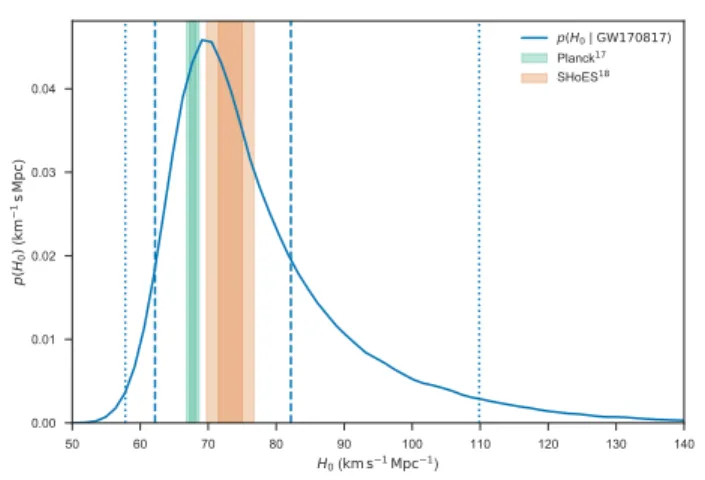
Figure 1. GW170817 measurement ofH0.
Marginal-ized posterior density forH0 (blue curve). Constraints at1- and2σ from Planck (Planck Collaboration et al. 2016) and SHoES (Riess et al. 2016) are shown in green and orange. The maximum a posteriori value and minimal 68.3%credible interval from this PDF is
H0 = 70.0+12−8.0.0km s
−1Mpc−1. The 68.3%(1σ) and
95.4%(2σ) minimal credible intervals are indicated by dashed and dotted lines.
of a random chance association between the opti-cal counterpart and NGC 4993 to be 0.004% (see the Methods section for details). In what follows we assume that the optical counterpart is associ-ated with GW170817, and that this source resides in NGC 4993.
To compute H0 we need to estimate the
50 60 70 80 90 100 110 120
H0 (kms1Mpc1) 1.0 0.9 0.8 0.7 0.6 0.5 0.4 co s 180 170 160 150 140 130 120 ( de g ) GW170817 Planck17 SHoES18
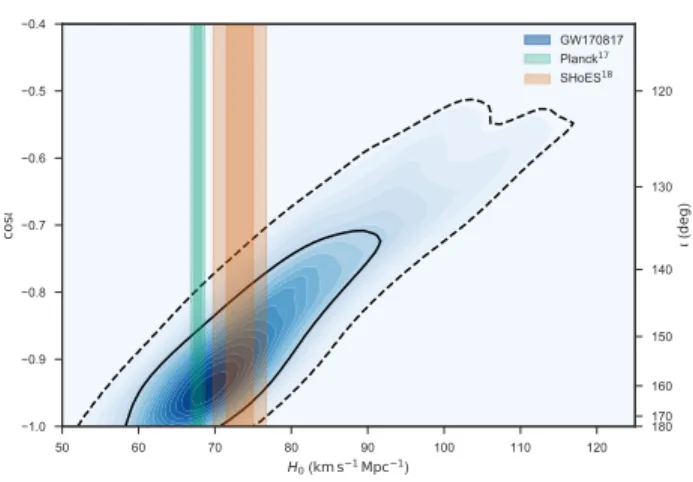
Figure 2. Inference onH0 and inclination.
Pos-terior density of H0 andcosι from the joint GW-EM analysis (blue contours). Shading levels are drawn at every5%credible level, with the68.3%(1σ, solid) and
95.4%(2σ, dashed) contours in black. Values ofH0and
1- and 2σ error bands are also displayed from Planck (Planck Collaboration et al. 2016) and SHoES (Riess et al. 2016). As noted in the text, inclination angles
near180 deg(cosι = −1) indicate that the orbital
an-gular momentum is anti-parallel with the direction from the source to the detector.
of NGC 4993 by correcting for local peculiar mo-tions.
NGC 4993 is part of a collection of galaxies, ESO-508, whose center-of-mass recession veloc-ity relative to the frame of the CMB (Hinshaw et al. 2009) is (Crook et al. 2007)3327±72 km s−1. We correct the group velocity by 310 km s−1 due to the coherent bulk flow (Springob et al. 2014; Car-rick et al. 2015) towards The Great Attractor (see Methods section for details). The standard error on our estimate of the peculiar velocity is69 km s−1, but recognizing that this value may be sensitive to details of the bulk flow motion that have been imperfectly modelled, in our subsequent analysis we adopt a more conservative estimate (Carrick et al. 2015) of 150km s−1 for the uncertainty on the peculiar velocity at the location of NGC 4993, and fold this into our estimate of the uncertainty on vH. From this, we obtain a Hubble velocity
vH = 3017±166 km s−1.
Once the distance and Hubble velocity distribu-tions have been determined from the GW and EM data, respectively, we can constrain the value of the Hubble constant. The measurement of the dis-tance is strongly correlated with the measurement of the inclination of the orbital plane of the bi-nary. The analysis of the GW data also depends on other parameters describing the source, such as the masses of the components (Abbott et al. 2016a). Here we treat the uncertainty in these other vari-ables by marginalizing over the posterior distribu-tion on system parameters (Abbott et al. 2017a), with the exception of the position of the system on the sky which is taken to be fixed at the location of the optical counterpart.
We carry out a Bayesian analysis to infer a posterior distribution on H0 and inclination,
marginalized over uncertainties in the recessional and peculiar velocities; see the Methods sec-tion for details. Figure 1 shows the marginal posterior for H0. The maximum a
posteri-ori value with the minimal 68.3% credible in-terval is H0 = 70.0+12−8.0.0km s
−1Mpc−1
. Our
re-sults are inconsistent at &3σ level. Our measure-ment does not resolve this tension, and is broadly consistent with both.
One of the main sources of uncertainty in our measurement of H0 is due to the degeneracy
be-tween distance and inclination in the GW measure-ments. A face-on or face-off binary far away has a similar gravitational-wave amplitude to an edge-on binary closer in. This relatiedge-onship is captured in Figure2, which shows posterior contours in the
H0–cosιparameter space.
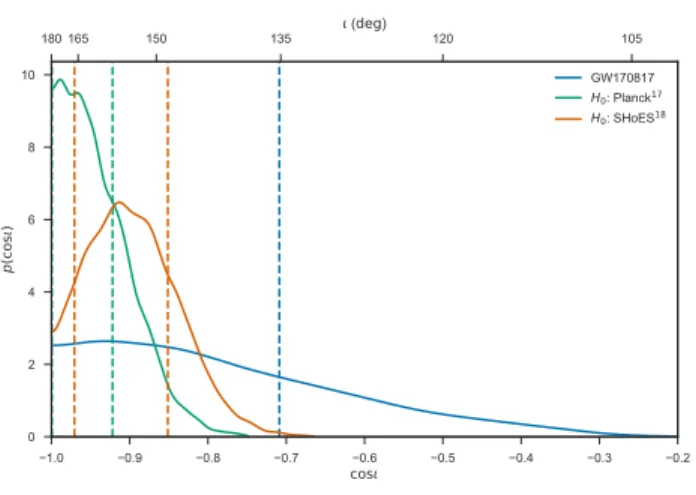
The posterior in Figure 1 results from the ver-tical projection of Figure 2, marginalizing out uncertainties in the cosine of inclination to de-rive constraints on the Hubble constant. Alterna-tively, it is possible to project horizontally, and thereby marginalize out the Hubble constant to derive constraints on the cosine of inclination. If instead of deriving H0 independently we take the existing constraints on H0 (Planck
Collabo-ration et al. 2016; Riess et al. 2016) as priors, we are able to significantly improve our con-straints on cosι as shown in Figure 3. Assum-ing the Planck value for H0, the minimal 68.3%
credible interval for the cosine of inclination is [−1.00,−0.92] (corresponding to an inclination angle range [157,177] deg). For the SHoES value ofH0, it is[−0.97,−0.85](corresponding to an
in-clination angle range[148,166] deg). For this latter SHoES result we note that the face-offι = 180 deg orientation is just outside the 90% confidence range. It will be particularly interesting to com-pare these constraints to those from modeling of the short GRB, afterglow, and optical counterpart associated with GW170817 (Abbott et al. 2017c).
We have presented a standard siren determina-tion of the Hubble constant, using a combinadetermina-tion of a GW distance and an EM Hubble velocity esti-mate. Our measurement does not use a “distance ladder”, and makes no prior assumptions about
H0. We findH0 = 70.0−8+12.0.0km s−1Mpc −1
, which is consistent with existing measurements (Riess et al. 2016;Planck Collaboration et al. 2016). This
1.0 0.9 0.8 0.7 0.6 0.5 0.4 0.3 0.2
cos
0 2 4 6 8 10
p(
co
s)
GW170817
H0: Planck17
H0: SHoES18 180 165 150 135 (deg) 120 105
Figure 3. Constraints on the inclination angle of
GW170817. Posterior density on cosι, for various
as-sumptions about the prior distribution ofH0. The anal-ysis of the joint GW and EM data with a 1/H0 prior density gives the blue curve; using values ofH0 from Planck (Planck Collaboration et al. 2016) and SHoES (Riess et al. 2016) as a prior onH0 give the green and red curves, respectively. Choosing a narrow prior onH0 converts the precise Hubble velocity measurements for the group containing NGC 4993 to a precise distance measurement, breaking the distance inclination degen-eracy, and leading to strong constraints on the inclina-tion. Minimal 68.3%(1σ) credible intervals are indi-cated by dashed lines. Because our prior on inclination is flat oncosιthe densities in this plot are proportional to the marginalised likelihood forcosι.
METHODS
PROBABILITY OF OPTICAL COUNTERPART ASSOCIATION WITH NGC 4993
We calculate the probability that an NGC 4993-like galaxy (or brighter) is misidentified as the host by asking how often the centre of one or more such galaxies falls by random chance within a given an-gular radiusθ of the counterpart. Assuming Pois-son counting statistics this probability is given by
P = 1 − exp [−πθ2S(< m)] where S(< m) is the surface density of galaxies with apparent mag-nitude equal to or brighter than m. From the lo-cal galaxy sample distribution in the infrared (K-band) apparent magnitude (Huang et al. 1998) we obtainS(< K) = 0.68×10(0.64(K−10.0)−0.7)deg−2
. As suggested by (Bloom et al. 2002), we set θ
equal to twice the half-light radius of the galaxy, for which we use NGC 4993’s diameter of ∼ 1.1 arcmin, as measured in the near infrared band (the predominant emission band for early-type galax-ies). Using K = 9.2mag taken from the 2MASS survey (Skrutskie et al. 2006) for NGC 4993, we find the probability of random chance association isP = 0.004%.
FINDING THE HUBBLE VELOCITY OF NGC 4993
In previous EM determinations of the cosmic “distance ladder”, the Hubble flow velocity of the local calibrating galaxies has generally been estimated using redshift-independent secondary galaxy distance indicators, such as the Tully-Fisher relation or type Ia supernovae, calibrated with more distant samples that can be assumed to sit in quiet Hubble flow (Freedman et al. 2001). We do not adopt this approach for NGC 4993, however, in order that our inference of the Hubble constant is fully independent of the electromagnetic distance scale. Instead we estimate the Hubble flow ve-locity at the position of NGC 4993 by correcting its measured recessional velocity for local peculiar motions.
NGC 4993 resides in a group of galaxies whose center-of-mass recession velocity relative to the Cosmic Microwave Background (CMB) frame (Hinshaw et al. 2009) is (Crook et al. 2007,2008) 3327±72 km s−1. We assume that all of the galax-ies in the group are at the same distance and there-fore have the same Hubble flow velocity, which we assign to be the Hubble velocity of GW170817. This assumption is accurate to within 1% given that the radius of the group is∼ 0.4Mpc. To cal-culate the Hubble flow velocity of the group, we correct its measured recessional velocity by the peculiar velocity caused by the local gravitational field. This is a significant correction (Springob et al. 2014; Carrick et al. 2015); typical peculiar velocities are300 km s−1, equivalent to∼ 10%of the total recessional velocity at a distance of 40 Mpc.
We employ the 6dF galaxy redshift survey pe-culiar velocity map (Springob et al. 2014; Jones et al. 2009), which used more than 8,000 Funda-mental Plane galaxies to map the peculiar veloc-ity field in the Southern hemisphere out to red-shift z ' 0.055. We weight the peculiar veloc-ity corrections from this catalog with a Gaussian kernel centered on NGC 4993’s sky position and with a width of8h−1Mpc; the kernel width is in-dependent of H0 and is equivalent to a width of
800 km s−1 in velocity space, typical of the widths used in the catalog itself. There are 10 galaxies in the 6dF peculiar velocity catalog within one ker-nel width of NGC 4993. In the CMB frame ( Hin-shaw et al. 2009), the weighted radial component of the peculiar velocity and associated uncertainty ishvpi= 310±69 km s−1.
com-parison with radial peculiar velocities of individual galaxies estimated from e.g. Tully-Fisher and Type Ia supernovae distances. Using these reconstructed peculiar velocities, which have a larger associated uncertainty (Carrick et al. 2015) of150 km s−1, at the position of NGC 4993 we find a Hubble veloc-ity in the CMB frame of vH = 3047 km s−1 – in
excellent agreement with the result derived using 6dF. We adopt this larger uncertainty on the pecu-liar velocity correction in recognition that the pe-culiar velocity estimated from the 6dF data may represent an imperfect model of the true bulk flow at the location of NGC 4993. For our inference of the Hubble constant we therefore use a Hubble ve-locityvH = 3017±166 km s−1 with 68.3%
uncer-tainty.
Finally, while we emphasise again the indepen-dence of our Hubble constant inference from the electromagnetic distance scale, we note the consis-tency of our GW distance estimate to NGC 4993 with the Tully-Fisher distance estimate derived by scaling back the Tully-Fisher relation calibrated with more distant galaxies in quiet Hubble flow (Sakai et al. 2000). This also strongly supports the robustness of our estimate for the Hubble velocity of NGC 4993.
SUMMARY OF THE MODEL
Given observed data from a set of GW detec-tors, xGW, parameter estimation is used to
gener-ate a posterior on the parameters that determine the waveform of the GW signal. Parameters are in-ferred within a Bayesian framework (Veitch et al. 2015) by comparing strain measurements (Abbott et al. 2017a) in the two LIGO detectors and the Virgo detector with the gravitational waveforms expected from the inspiral of two point masses (Hannam et al. 2014) under general relativity. We use algorithms for removing short-lived detector noise artifacts (Abbott et al. 2017a;Cornish & Lit-tenberg 2015) and we employ approximate point-particle waveform models (Buonanno & Damour 1999; Blanchet 2014; Hannam et al. 2014). We have verified that the systematic changes in the
re-sults presented here from incorporating non-point-mass (tidal) effects (Hinderer & Flanagan 2008; Vines et al. 2011) and from different data process-ing methods are much smaller than the statistical uncertainties in the measurement ofH0 and the
bi-nary orbital inclination angle.
From this analysis we can obtain the parame-ter estimation likelihood of the observed GW data, marginalized over all parameters characterizing the GW signal exceptdandcosι,
p(xGW |d,cosι) =
Z
p(xGW |d,cosι, ~λ)p(~λ)d~λ.
(2)
The other waveform parameters are denoted by~λ, withp(~λ)denoting the corresponding prior.
Given perfect knowledge of the Hubble flow ve-locity of the GW source, vH, this posterior
distri-bution can be readily converted into a posterior on cosιandH0 =vH/d,
p(H0,cosι|xGW)
∝(vH/H02)p(xGW |d=vH/H0,cosι) ×pd(vH/H0)pι(cosι), (3)
wherepd(d)andpι(cosι)are the prior distributions
on distance and inclination. For the Hubble veloc-ity vH = 3017 km s−1, the maximum a posteriori
distance from the GW measurement of 43.8 Mpc corresponds to H0 = 68.9 km s−1Mpc−1, so this procedure would be expected to generate a poste-rior onH0 that peaks close to that value.
While the above analysis is conceptually straight-forward, it makes a number of assumptions. In practice, the Hubble-flow velocity cannot be de-termined exactly and it must be corrected for un-certain peculiar velocities. The above does not explicitly set a prior on H0, but instead inherits
a 1/H4
0 prior from the usual pd(d) ∝ d2 prior
we cannot target particular galaxies or redshifts for GW sources. In practice, we wait for a GW event to trigger the analysis and this introduces potential selection effects which we must consider. We will see below that the simple analysis described above does give results that are consistent with a more careful analysis for this first detection. However, the simple analysis cannot be readily extended to include second and subsequent detections, so we now describe a more general framework that does not suffer from these limitations.
We suppose that we have observed a GW event, which generated data xGW in our detectors, and
that we have also measured a recessional velocity for the host,vr, and the peculiar velocity field,hvpi,
in the vicinity of the host. These observations are statistically independent and so the combined like-lihood is
p(xGW, vr,hvpi |d,cosι, vp, H0) =
p(xGW |d,cosι)p(vr |d, vp, H0)p(hvpi |vp).
(4)
The quantity p(vr | d, vp, H0) is the likelihood of
the recessional velocity measurement, which we model as
p(vr|d, vp, H0) =N
vp+H0d, σv2r
(vr) (5)
whereN[µ, σ2] (x)is the normal (Gaussian)
prob-ability density with meanµand standard deviation
σ evaluated at x. The measured recessional ve-locity, vr = 3327 km s−1, with uncertainty σvr = 72 km s−1, is the mean velocity and standard error for the members of the group hosting NGC 4993 taken from the two micron all sky survey (2MASS) (Crook et al. 2007, 2008), corrected to the CMB frame (Hinshaw et al. 2009). We take a similar Gaussian likelihood for the measured peculiar ve-locity, hvpi = 310 km s−1, with uncertaintyσvp = 150 km s−1:
p(hvpi |vp) =N h
vp, σv2p
i
(hvpi). (6)
From the likelihood (4) we derive the posterior
p(H0, d,cosι, vp |xGW, vr,hvpi)
∝ p(H0) Ns(H0)
p(xGW |d,cosι)p(vr |d, vp, H0)
× p(hvpi |vp)p(d)p(vp)p(cosι), (7)
where p(H0), p(d), p(vp) andp(cosι)are the
pa-rameter prior probabilities. Our standard analy-sis assumes a volumetric prior, p(d) ∝ d2, on
the Hubble distance, but we explore sensitivity to this choice below. We take a flat-in-log prior on
H0, p(H0) ∝ 1/H0, impose a flat (i.e. isotropic)
prior on cosι, and a flat prior on vp for vp ∈
[−1000,1000] km s−1. These priors characterise our beliefs about the cosmological population of GW events and their hosts before we make any additional measurements or account for selection biases. The full statistical model is summarized graphically in Extended Data Figure1. This model with these priors is our canonical analysis.
In Eq. (7), the term Ns(H0) encodes selection
effects (Loredo 2004; Mandel et al. 2016; Abbott et al. 2016a). These arise because of the finite sen-sitivity of our detectors. While all events in the Universe generate a response in the detector, we will only be able to identify, and hence use, sig-nals that generate a response of sufficiently high amplitude. The decision about whether to include an event in the analysis is a property of the data only, in this case {xGW, vr, hvpi}, but the fact
that we condition our analysis on a signal being detected, i.e., the data exceeding these thresholds, means that the likelihood must be renormalized to become the likelihood for detected events. This is the role of
Ns(H0) =
Z
detectable
d~λdddvpdcosιdxGWdvrdhvpi
×hp(xGW |d,cosι, ~λ)p(vr |d, vp, H0)
×p(hvpi |vp)p(~λ)p(d)p(vp)p(cosι) i
, (8)
that would be selected for inclusion in the analy-sis, i.e., exceed the specified thresholds. If the in-tegral was over all data sets it would evaluate to1, but because the range is restricted there can be a non-trivial dependence on parameters characteriz-ing the population of sources, in this caseH0.
In the current analysis, there are in principle se-lection effects in both the GW data and the EM data. However, around the time of detection of GW170817, the LIGO-Virgo detector network had a detection horizon of ∼ 190Mpc for binary neutron star (BNS) events (Abbott et al. 2017a), within which EM measurements are largely com-plete. For example, the counterpart associated with GW170817 had brightness∼17mag in the I band at40Mpc (Valenti et al. 2017;Arcavi et al. 2017; Tanvir et al. 2017; Lipunov et al. 2017; Coul-ter et al. 2017); this source would be ∼ 22mag at 400Mpc, and thus still detectable by survey telescopes such as DECam well beyond the GW horizon. Even the dimmest theoretical lightcurves for kilonovae are expected to peak at ∼ 22.5mag at the LIGO–Virgo horizon (Metzger & Berger 2012). We therefore expect that we are dominated by GW selection effects at the current time and can ignore EM selection effects. The fact that the fraction of BNS events that will have observed kilonova counterparts is presently unknown does not modify these conclusions, since we can restrict our analysis to GW events with kilonova counter-parts only.
In the GW data, the decision about whether or not to analyse an event is largely determined by the signal-to-noise ratio (SNR),ρ, of the event. A rea-sonable model for the selection process is a cut in SNR, i.e., events withρ > ρ∗are analysed (Abbott et al. 2016b). In that model, the integral overxGW
in Eq. (8) can be replaced by an integral over SNR from ρ∗ to∞, and p(xGW|d,cosι, ~λ) replaced by p(ρ|d,cosι, ~λ) in the integrand. This distribution depends on the noise properties of the operating detectors, and on the intrinsic strain amplitude of the source. The former are clearly independent of
the population parameters, while the latter scales like a function of the source parameters divided by the luminosity distance. The dependence on source parameters is on redshifted parameters, which in-troduces an explicit redshift dependence. How-ever, within the ∼ 190Mpc horizon, redshift cor-rections are at most.5%, and the Hubble constant measurement is a weak function of these, mean-ing the overall impact is even smaller. At present, whether or not a particular event in the population ends up being analysed can therefore be regarded as a function ofdonly. When GW selection effects dominate, only the terms in Eq. (8) arising from the GW measurement matter. As these are a function ofdonly and we set a prior ond, there is no explicit
H0 dependence in these terms. Hence, Ns(H0)is
a constant and can be ignored. This would not be the case if we set a prior on the redshifts of potential sources instead of their distances, since then changes inH0 would modify the range of
de-tectable redshifts. As the LIGO–Virgo detectors improve in sensitivity the redshift dependence in the GW selection effects will become more impor-tant, as will EM selection effects. However, at that point we will also have to consider deviations in the cosmological model from the simple Hubble flow described in Eq. (1) of the main article.
Marginalising Eq. (7) over d, vp and cosι then
yields
p(H0 |xGW, vr,hvpi)∝p(H0)
Z
dddvpdcosι
×p(xGW |d,cosι)p(vr|d, vp, H0)
×p(hvpi |vp)p(d)p(vp)p(cosι). (9)
The posterior computed in this way was shown in Figure 1 in the main article and has a max-imum a posteriori value and minimal 68.3% credible interval of 70.0+12−8.0.0km s−1Mpc−1, as quoted in the main article. The posterior mean is 78 km s−1Mpc−1 and the standard deviation is 15 km s−1Mpc−1. Various other summary statis-tics are given in Extended Data Table1.
d
cos
vp
H
0
x
GW
vr
vp
Extended Data Figure 1. Graphical model illustrat-ing the statistical relationships between the data and
parameters. Open circles indicate parameters which
require a prior; filled circles described measured data, which are conditioned on in the analysis. Here we as-sume we have measurements of the GW data, xGW, a recessional velocity (i.e. redshift),vr, and the mean
pe-culiar velocity in the neighborhood of NGC 4993,hvpi.
Arrows flowing into a node indicate that the conditional probability density for the node depends on the source parameters; for example, the conditional distribution for the observed GW data,p(xGW|d,cosι), discussed in the text, depends on the distance and inclination of the source (and additional parameters, here marginalized out).
Our canonical analysis uses a uniform volumet-ric prior on distance, p(d) ∝ d2. The distribu-tion of galaxies is not completely uniform due to clustering, so we explore sensitivity to this prior choice. We are free to place priors on any two of the three variables{d, H0, z}, wherez =H0d/cis
the Hubble flow redshift of NGC 4993. A choice of prior for two of these variables induces a prior on the third which may or may not correspond to a natural choice for that parameter. A prior on
z could be obtained from galaxy catalog observa-tions (Dalya et al. 2016), but must be corrected for incompleteness. When setting a prior onH0 andz,
the posterior becomes
p(H0, z,cosι, vp |xGW, vr,hvpi)
∝ p(H0) Ns(H0)
p(xGW |d=cz/H0,cosι)p(vr |z, vp)
× p(hvpi |vp)p(z)p(vp)p(cosι), (10)
but now
Ns(H0) =
Z
detectable
dzdvpdcosιdxGWdvrdhvpi
×p(xGW |d =cz/H0,cosι)p(vr|z, vp)
× p(hvpi |vp)p(z)p(vp)p(cosι). (11)
When GW selection effects dominate, the integral is effectively
Ns(H0) =
Z
dzdcosιdxGW
×p(xGW |d=cz/H0,cosι)p(z)p(cosι)
=
Z
dddcosιdxGW
×p(xGW |d,cosι)p(dH0/c)p(cosι) (H0/c),
(12)
which has an H0 dependence, unlessp(z) takes a
special,H0-dependent form,p(z) =f(z/H0)/H0.
However, if the redshift prior is volumetric,p(z)∝ z2, the selection effect term is∝ H3
0, which
can-cels a similar correction to the likelihood and gives a posterior onH0 that is identical to the canonical
analysis.
For a single event, any choice of prior can be mapped to our canonical analysis with a different prior onH0. For any reasonable prior choices ond
orz, we would expect to gradually lose sensitivity to the particular prior choice as further observed events are added to the analysis. However, to il-lustrate the uncertainty that comes from the prior choice for this first event, we compare in Extended Data Figure 2 and Extended Data Table 1 the re-sults from the canonical prior choice p(d) ∝ d2
onz, and assuming a velocity correction due to the peculiar velocity of NGC 4993 that is a Gaussian with width250 km s−1. (To do the first of these, the posterior samples from GW parameter estimation have to be re-weighted, since they are generated with the d2 prior used in the canonical analysis.
We first “undo” the default prior before applying the desired new prior.)
The choice of a flat prior onzis motivated by the simple model described above, in which we imag-ine first making a redshift measurement for the host and then use that as a prior for analysing the GW data. Setting priors on distance and redshift, the simple analysis gives the same result as the canon-ical analysis, but now we set a prior on redshift and H0 and obtain a different result. This is to
be expected because we are making different as-sumptions about the underlying population, and it arises for similar reasons as the different biases in peculiar velocity measurements based on redshift-selected or distance-redshift-selected samples (Strauss & Willick 1995). As can be seen in Extended Data Table1, the results change by less than1σ, as mea-sured by the statistical error of the canonical anal-ysis.
By increasing the uncertainty in the peculiar ve-locity prior, we test the assumptions in our canoni-cal analysis that (1) NGC 4993 is a member of the nearby group of galaxies, and (2) that this group has a center-of-mass velocity close to the Hubble flow. The results in Extended Data Table1 summa-rizes changes in the values of H0 and in the error
bars.
We conclude that the impact of a reasonable change to the prior is small relative to the statis-tical uncertainties for this event.
INCORPORATING ADDITIONAL CONSTRAINTS ONH0
By including previous measurements of H0
(Planck Collaboration et al. 2016; Riess et al. 2016) we can constrain the orbital inclination more precisely. We do this by setting the H0
prior in Eq. (7) top(H0|µH0, σ
2
H0) = N[µH0, σ
2
H0],
50 75 100 125 150 175 200 225
H0 (kms1Mpc1) 0.00 0.01 0.02 0.03 0.04 p( H0 ) ( km 1sM pc ) Canonical Flat z prior
250kms1 Uncertainty Planck17
SHoES18
Extended Data Figure 2. Using different
assump-tions compared to our canonical analysis. The
pos-terior distribution on H0 discussed in the main text is shown in black, the alternative flat prior onz(discussed in the Methods section) gives the distribution shown in blue, and the increased uncertainty (250 km s−1) ap-plied to our peculiar velocity measurement (also dis-cussed in the Methods section) is shown in pink. Mini-mal68.3%(1σ) credible intervals are shown by dashed lines.
where for ShoES (Riess et al. 2016) µH0 =
73.24 km s−1Mpc−1andσH0 = 1.74 km s
−1Mpc−1
, while for Planck (Planck Collaboration et al. 2016) µH0 = 67.74 km s
−1Mpc−1
and σH0 =
0.46 km s−1Mpc−1. The posterior oncosιis then
p(cosι|xGW, vr,hvpi, µH0, σ
2
H0)∝
Z
dddvpdH0
×p(xGW |d,cosι)p(vr |d, vp, H0)p(hvpi |vp)
× p(H0|µH0, σ
2
H0)p(d)p(vp). (13)
This posterior was shown in Figure 3of the main article.
Extended Data Table 1. Summary of constraints on the Hubble constant, binary inclination, and distance
Parameter 68.3% Symm. 68.3% MAP 90% Symm. 90% MAP
H0/ km s−1Mpc−1
74.0−8+16.0.0 70.0+12−8.0.0 74.0+33−12 70.0+28−11
H0/ km s−1Mpc−1
(flat inzprior) 81+27−13 71.0+23−9.0.0 81+50−17 71.0+48−11
H0/ km s−1Mpc−1
(250 km s−1 σvr) 74.0
+16.0
−9.0 70.0 +14.0
−9.0 74.0 +33
−14 70.0+29−14
cosι(GW only) −0.88−0+0..0918 −0.974−0+0..164026 −0.88−0+0..3211 −0.974+0−0..332026
cosι(SHoES) −0.901−0+0..057065 −0.912−0+0..061059 −0.901−0+0..106083 −0.912+0−0..095086
cosι(Planck) −0.948−0+0..036052 −0.982−0+0..060016 −0.948−0+0..091046 −0.982+0−0..104018
ι/deg(GW only) 152+14−17 167+13−23 152+20−27 167+13−37
ι/deg(SHoES) 154.0+9−8..00 156.0−7+10.0.0 154.0+15−12 156.0+21−11
ι/deg(Planck) 161.0+8−8..00 169.0−12+8.0.0 161.0+12−12 169.0+11−18
d/(Mpc) 41.1−7+4..03 43.8+2−6..99 41.1+5−12.6.6 43.8+5−13.6.1
NOTE—We give both one-sigma (68.3%) and 90% credible intervals for each quantity. “Symm.” refers to a symmetric interval (e.g. median and 5% to 95% range), while “MAP” refers to maximum a posteriori intervals (e.g. MAP value and smallest range enclosing 90% of the posterior). Values given forιare derived from arc-cosine transforming the corresponding values forcosι, so the “MAP” values differ from those that would be derived from the posterior onι.
of Advanced LIGO and construction and operation of the GEO600 detector. Additional support for Advanced LIGO was provided by the Australian Research Council. The authors gratefully ac-knowledge the Italian Istituto Nazionale di Fisica Nucleare (INFN), the French Centre National de la Recherche Scientifique (CNRS) and the Foun-dation for Fundamental Research on Matter sup-ported by the Netherlands Organisation for Scien-tific Research, for the construction and operation of the Virgo detector and the creation and support of the EGO consortium. The authors also grate-fully acknowledge research support from these agencies as well as by the Council of Scientific and Industrial Research of India, the Department of Science and Technology, India, the Science & Engineering Research Board (SERB), India, the Ministry of Human Resource Development, In-dia, the Spanish Agencia Estatal de Investigaci´on, the Vicepresid`encia i Conselleria d’Innovaci´o,
Science, Technology, Innovations, and Commu-nications, the International Center for Theoretical Physics South American Institute for Fundamen-tal Research (ICTP-SAIFR), the Research Grants Council of Hong Kong, the National Natural Sci-ence Foundation of China (NSFC), the Leverhulme Trust, the Research Corporation, the Ministry of Science and Technology (MOST), Taiwan and the Kavli Foundation. The authors gratefully acknowl-edge the support of the NSF, STFC, MPS, INFN, CNRS and the State of Niedersachsen/Germany for provision of computational resources. This article has been assigned the document number
LIGO-P1700296.
We thank the University of Copenhagen, DARK Cosmology Centre, and the Niels Bohr Inter-national Academy for hosting D.A.C., R.J.F., A.M.B., E.R., and M.R.S. during the discovery of GW170817/SSS17a. R.J.F., A.M.B., E.R., and D.E.H. were participating in the Kavli Summer Program in Astrophysics, “Astrophysics with grav-itational wave detections.” This program was sup-ported by the the Kavli Foundation, Danish Na-tional Research Foundation, the Niels Bohr In-ternational Academy, and the DARK Cosmology Centre.
The UCSC group is supported in part by NSF grant AST–1518052, the Gordon & Betty Moore Foundation, the Heising-Simons Foundation, gen-erous donations from many individuals through a UCSC Giving Day grant, and from fellowships from the Alfred P. Sloan Foundation (R.J.F), the David and Lucile Packard Foundation (R.J.F. and E.R.) and the Niels Bohr Professorship from the DNRF (E.R.). A.M.B. acknowledges support from a UCMEXUS-CONACYT Doctoral Fellow-ship. Support for this work was provided by NASA through Hubble Fellowship grants HST– HF–51348.001 and HST–HF–51373.001 awarded by the Space Telescope Science Institute, which is operated by the Association of Universities for Research in Astronomy, Inc., for NASA, under contract NAS5–26555.
The Berger Time-Domain Group at Harvard is supported in part by the NSF through grants AST-1411763 and AST-1714498, and by NASA through grants NNX15AE50G and NNX16AC22G.
Astrophysics (CAASTRO), through project num-ber CE110001020. This manuscript has been au-thored by Fermi Research Alliance, LLC under Contract No. DE-AC02-07CH11359 with the U.S. Department of Energy, Office of Science, Office of High Energy Physics. The United States Govern-ment retains and the publisher, by accepting the ar-ticle for publication, acknowledges that the United States Government retains a non-exclusive, paid-up, irrevocable, world-wide license to publish or reproduce the published form of this manuscript, or allow others to do so, for United States Govern-ment purposes.
D.J.S. acknowledges support for the DLT40 pro-gram from NSF grant AST-1517649.
Support for I.A. was provided by NASA through the Einstein Fellowship Program, grant PF6-170148. G.H., D.A.H. and C.M. are supported by NSF grant AST-1313484. D.P. acknowledges support by Israel Science Foundation grant 541/17. VINROUGE is an European Southern Observa-tory Large Survey (id: 0198.D-2010).
MASTER acknowledges the Lomonosov MSU Development Programm and the Russian Federa-tion Ministry of EducaFedera-tion and Science.
This research has made use of the NASA/IPAC Extragalactic Database (NED) which is operated by the Jet Propulsion Laboratory, California Insti-tute of Technology, under contract with the Na-tional Aeronautics and Space Administration.
All authors contributed to the work presented in this paper.
The authors declare that they have no competing financial interests.
Correspondence and requests for materials should be addressed to the LVC spokespeople (email: [email protected], [email protected]).
Available public codes can be found at the LIGO Open Science Center (https://losc.ligo. org).
Available public data can be found at the LIGO Open Science Center (https://losc.ligo. org).
REFERENCES
Abbott, B. P., Abbott, R., Abbott, T. D., et al. 2016a, PRX, 6, 041015
—. 2016b, ApJS, 227, 14
Abbott, B. P., et al. 2017a, PRL, 119, doi:10.1103/PhysRevLett.119.161101
—. 2017b, ApJL, 848, doi:10.3847/2041-8213/aa920c —. 2017c, ApJL, 848, doi:10.3847/2041-8213/aa91c9 Acernese, F., Agathos, M., Agatsuma, K., et al. 2015,
CQG, 32, 024001
Arcavi, I., Hosseinzadeh, G., Howell, D. A., et al. 2017, Nature, doi:10.1038/nature24291
Aubourg, ´E., Bailey, S., Bautista, J. E., et al. 2015, PRD, 92, 123516
Blanchet, L. 2014, LRR, 17, 2
Bloom, J. S., Kulkarni, S. R., & Djorgovski, S. G. 2002, AJ, 123, 1111
Bonvin, V., Courbin, F., Suyu, S. H., et al. 2017, MNRAS, 465, 4914
Buonanno, A., & Damour, T. 1999, PRD, D59, 084006 Carrick, J., Turnbull, S. J., Lavaux, G., & Hudson,
M. J. 2015, MNRAS, 450, 317
Cornish, N. J., & Littenberg, T. B. 2015, CQG, 32, 135012
Coulter, D. A., et al. 2017, Science, doi:10.1126/science.aap9811
Crook, A. C., Huchra, J. P., Martimbeau, N., et al. 2007, ApJ, 655, 790
—. 2008, ApJ, 685, 1320
Dalal, N., Holz, D. E., Hughes, S. A., & Jain, B. 2006, PRD, 74, 063006
Dalya, G., Frei, Z., Galgoczi, G., Raffai, P., & de Souza, R. S. 2016, VizieR Online Data Catalog, 7275
Del Pozzo, W. 2012, PRD, D86, 043011
Freedman, W. L., Madore, B. F., Gibson, B. K., et al. 2001, ApJ, 553, 47
Goldstein, A., et al. 2017, ApJL, 848, doi:10.3847/2041-8213/aa8f41
Hannam, M., Schmidt, P., Boh´e, A., et al. 2014, PRL, 113, 151101
Hinderer, T., & Flanagan, ´E. ´E. 2008, PRD, 78, 064028 Hinshaw, G., Weiland, J. L., Hill, R. S., et al. 2009,
ApJS, 180, 225
Holz, D. E., & Hughes, S. A. 2005, ApJ, 629, 15 Huang, J.-S., Cowie, L. L., & Luppino, G. A. 1998,
ApJ, 496, 31
Huchra, J. P., Macri, L. M., Masters, K. L., et al. 2012, ApJS, 199, 26
Jones, D. H., Read, M. A., Saunders, W., et al. 2009, MNRAS, 399, 683
LIGO Scientific Collaboration, Aasi, J., Abbott, B. P., et al. 2015, CQG, 32, 074001
Lipunov, V., Gorbovskoy, E., Kornilov, V., et al. 2017, ApJL, 848, doi:10.3847/2041-8213/aa92c0
Loredo, T. J. 2004, in AIP Conference Series, Vol. 735, AIP Conference Series, ed. R. Fischer, R. Preuss, & U. V. Toussaint, 195–206
Mandel, I., Farr, W. M., & Gair, J. 2016, Extracting distribution parameters from multiple uncertain observations with selection biases, Tech. rep., LIGO,
https:
//dcc.ligo.org/LIGO-P1600187/public
Messenger, C., & Veitch, J. 2013, NJP, 15, 053027 Metzger, B. D., & Berger, E. 2012, ApJ, 746, 48 Nissanke, S., Holz, D. E., Dalal, N., et al. 2013, ArXiv
e-prints, arXiv:1307.2638
Nissanke, S., Holz, D. E., Hughes, S. A., Dalal, N., & Sievers, J. L. 2010, ApJ, 725, 496
Planck Collaboration, Ade, P. A. R., Aghanim, N., et al. 2016, A&A, 594, A13
Riess, A. G., Macri, L. M., Hoffmann, S. L., et al. 2016, ApJ, 826, 56
Sakai, S., Mould, J. R., Hughes, S. M. G., et al. 2000, ApJ, 529, 698
Savchenko, V., et al. 2017, ApJL, 848, doi:10.3847/2041-8213/aa8f94 Schutz, B. F. 1986, Nature, 323, 310
Skrutskie, M. F., Cutri, R. M., Stiening, R., et al. 2006, AJ, 131, 1163
Soares-Santos, M., Holz, D. E., Annis, J., et al. 2017, ApJL, 848, doi:10.3847/2041-8213/aa9059 Springob, C. M., Magoulas, C., Colless, M., et al.
2014, MNRAS, 445, 2677
Strauss, M. A., & Willick, J. A. 1995, PR, 261, 271 Tanvir, N., et al. 2017, ApJL, 848,
doi:10.3847/2041-8213/aa90b6
Valenti, S., Sand, D. J., Yang, S., et al. 2017, ApJL, 848, doi:10.3847/2041-8213/aa8edf
Veitch, J., Raymond, V., Farr, B., et al. 2015, PRD, 91, 042003
THE LIGO SCIENTIFICCOLLABORATION ANDTHEVIRGOCOLLABORATION, THE1M2H COLLABORATION, THEDARKENERGYCAMERAGW-EM COLLABORATION AND THEDES COLLABORATION,
THEDLT40 COLLABORATION, THELASCUMBRESOBSERVATORYCOLLABORATION,
THEVINROUGE COLLABORATION, THEMASTER COLLABORATION, B. P. ABBOTT,1R. ABBOTT,1 T. D. ABBOTT,2 F. ACERNESE,3, 4 K. ACKLEY,5, 6C. ADAMS,7 T. ADAMS,8 P. ADDESSO,9 R. X. ADHIKARI,1
V. B. ADYA,10C. AFFELDT,10M. AFROUGH,11B. AGARWAL,12M. AGATHOS,13K. AGATSUMA,14 N. AGGARWAL,15O. D. AGUIAR,16L. AIELLO,17, 18A. AIN,19P. AJITH,20B. ALLEN,10, 21, 22G. ALLEN,12
A. ALLOCCA,23, 24 P. A. ALTIN,25A. AMATO,26 A. ANANYEVA,1S. B. ANDERSON,1W. G. ANDERSON,21 S. V. ANGELOVA,27S. ANTIER,28S. APPERT,1 K. ARAI,1M. C. ARAYA,1 J. S. AREEDA,29N. ARNAUD,28, 30
K. G. ARUN,31S. ASCENZI,32, 33 G. ASHTON,10M. AST,34S. M. ASTON,7 P. ASTONE,35D. V. ATALLAH,36 P. AUFMUTH,22C. AULBERT,10K. AULTONEAL,37C. AUSTIN,2A. AVILA-ALVAREZ,29S. BABAK,38
P. BACON,39 M. K. M. BADER,14S. BAE,40P. T. BAKER,41F. BALDACCINI,42, 43G. BALLARDIN,30 S. W. BALLMER,44S. BANAGIRI,45J. C. BARAYOGA,1 S. E. BARCLAY,46B. C. BARISH,1D. BARKER,47 K. BARKETT,48F. BARONE,3, 4B. BARR,46L. BARSOTTI,15M. BARSUGLIA,39D. BARTA,49 J. BARTLETT,47
I. BARTOS,50, 5R. BASSIRI,51A. BASTI,23, 24J. C. BATCH,47M. BAWAJ,52, 43 J. C. BAYLEY,46 M. BAZZAN,53, 54 B. B ´ECSY,55C. BEER,10M. BEJGER,56I. BELAHCENE,28A. S. BELL,46B. K. BERGER,1
G. BERGMANN,10J. J. BERO,57C. P. L. BERRY,58D. BERSANETTI,59 A. BERTOLINI,14J. BETZWIESER,7 S. BHAGWAT,44R. BHANDARE,60I. A. BILENKO,61G. BILLINGSLEY,1C. R. BILLMAN,5J. BIRCH,7
R. BIRNEY,62O. BIRNHOLTZ,10S. BISCANS,1, 15S. BISCOVEANU,63, 6A. BISHT,22M. BITOSSI,30, 24 C. BIWER,44M. A. BIZOUARD,28J. K. BLACKBURN,1 J. BLACKMAN,48C. D. BLAIR,1, 64D. G. BLAIR,64
R. M. BLAIR,47S. BLOEMEN,65O. BOCK,10N. BODE,10M. BOER,66G. BOGAERT,66A. BOHE,38
F. BONDU,67E. BONILLA,51R. BONNAND,8B. A. BOOM,14R. BORK,1V. BOSCHI,30, 24S. BOSE,68, 19 K. BOSSIE,7Y. BOUFFANAIS,39A. BOZZI,30C. BRADASCHIA,24P. R. BRADY,21M. BRANCHESI,17, 18
J. E. BRAU,69T. BRIANT,70A. BRILLET,66M. BRINKMANN,10V. BRISSON,28P. BROCKILL,21 J. E. BROIDA,71A. F. BROOKS,1D. A. BROWN,44D. D. BROWN,72S. BRUNETT,1 C. C. BUCHANAN,2
A. BUIKEMA,15 T. BULIK,73H. J. BULTEN,74, 14 A. BUONANNO,38, 75 D. BUSKULIC,8 C. BUY,39 R. L. BYER,51M. CABERO,10L. CADONATI,76G. CAGNOLI,26, 77 C. CAHILLANE,1 J. CALDERON´ BUSTILLO,76T. A. CALLISTER,1E. CALLONI,78, 4J. B. CAMP,79M. CANEPA,80, 59
P. CANIZARES,65K. C. CANNON,81H. CAO,72J. CAO,82C. D. CAPANO,10E. CAPOCASA,39 F. CARBOGNANI,30S. CARIDE,83M. F. CARNEY,84J. CASANUEVADIAZ,28C. CASENTINI,32, 33 S. CAUDILL,21, 14M. CAVAGLIA`,11F. CAVALIER,28R. CAVALIERI,30 G. CELLA,24C. B. CEPEDA,1 P. CERDA-DUR´ AN,´ 85G. CERRETANI,23, 24 E. CESARINI,86, 33S. J. CHAMBERLIN,63M. CHAN,46S. CHAO,87
P. CHARLTON,88E. CHASE,89E. CHASSANDE-MOTTIN,39D. CHATTERJEE,21K. CHATZIIOANNOU,90 B. D. CHEESEBORO,41H. Y. CHEN,91X. CHEN,64Y. CHEN,48 H.-P. CHENG,5H. CHIA,5A. CHINCARINI,59
A. CHIUMMO,30T. CHMIEL,84 H. S. CHO,92M. CHO,75J. H. CHOW,25N. CHRISTENSEN,71, 66Q. CHU,64 A. J. K. CHUA,13S. CHUA,70A. K. W. CHUNG,93S. CHUNG,64G. CIANI,5, 53, 54 R. CIOLFI,94, 95
C. E. CIRELLI,51A. CIRONE,80, 59F. CLARA,47 J. A. CLARK,76P. CLEARWATER,96F. CLEVA,66 C. COCCHIERI,11E. COCCIA,17, 18 P.-F. COHADON,70D. COHEN,28A. COLLA,97, 35 C. G. COLLETTE,98 L. R. COMINSKY,99M. CONSTANCIOJR.,16L. CONTI,54S. J. COOPER,58P. CORBAN,7T. R. CORBITT,2 I. CORDERO-CARRION,´ 100K. R. CORLEY,50N. CORNISH,101 A. CORSI,83S. CORTESE,30C. A. COSTA,16
M. W. COUGHLIN,71, 1S. B. COUGHLIN,89J.-P. COULON,66 S. T. COUNTRYMAN,50P. COUVARES,1 P. B. COVAS,102 E. E. COWAN,76D. M. COWARD,64M. J. COWART,7 D. C. COYNE,1R. COYNE,83
J. D. E. CREIGHTON,21T. D. CREIGHTON,103 J. CRIPE,2S. G. CROWDER,104 T. J. CULLEN,29, 2 A. CUMMING,46L. CUNNINGHAM,46E. CUOCO,30T. DALCANTON,79G. D ´ALYA,55S. L. DANILISHIN,22, 10
J. DEGALLAIX,26M. DELAURENTIS,17, 4 S. DELEGLISE,´ 70W. DELPOZZO,58, 23, 24N. DEMOS,15
T. DENKER,10 T. DENT,10 R. DEPIETRI,107, 108 V. DERGACHEV,38R. DEROSA,78, 4R. T. DEROSA,7 C. DEROSSI,26, 30 R. DESALVO,109O.DEVARONA,10J. DEVENSON,27S. DHURANDHAR,19M. C. D´IAZ,103
L. DIFIORE,4M. DIGIOVANNI,110, 95T. DIGIROLAMO,50, 78, 4 A. DILIETO,23, 24S. DIPACE,97, 35
I. DIPALMA,97, 35 F. DI RENZO,23, 24 Z. DOCTOR,91V. DOLIQUE,26F. DONOVAN,15K. L. DOOLEY,11 S. DORAVARI,10I. DORRINGTON,36R. DOUGLAS,46M. DOVALEALVAREZ,´ 58T. P. DOWNES,21M. DRAGO,10 C. DREISSIGACKER,10J. C. DRIGGERS,47Z. DU,82M. DUCROT,8P. DUPEJ,46S. E. DWYER,47T. B. EDO,106 M. C. EDWARDS,71A. EFFLER,7 H.-B. EGGENSTEIN,38, 10 P. EHRENS,1J. EICHHOLZ,1 S. S. EIKENBERRY,5
R. A. EISENSTEIN,15R. C. ESSICK,15D. ESTEVEZ,8 Z. B. ETIENNE,41T. ETZEL,1M. EVANS,15 T. M. EVANS,7 M. FACTOUROVICH,50V. FAFONE,32, 33, 17 H. FAIR,44S. FAIRHURST,36X. FAN,82 S. FARINON,59B. FARR,91W. M. FARR,58E. J. FAUCHON-JONES,36M. FAVATA,111 M. FAYS,36C. FEE,84
H. FEHRMANN,10J. FEICHT,1 M. M. FEJER,51A. FERNANDEZ-GALIANA,15I. FERRANTE,23, 24 E. C. FERREIRA,16F. FERRINI,30F. FIDECARO,23, 24 D. FINSTAD,44I. FIORI,30D. FIORUCCI,39 M. FISHBACH,91R. P. FISHER,44M. FITZ-AXEN,45R. FLAMINIO,26, 112M. FLETCHER,46H. FONG,90 J. A. FONT,85, 113P. W. F. FORSYTH,25S. S. FORSYTH,76J.-D. FOURNIER,66S. FRASCA,97, 35F. FRASCONI,24
Z. FREI,55A. FREISE,58R. FREY,69V. FREY,28E. M. FRIES,1 P. FRITSCHEL,15V. V. FROLOV,7 P. FULDA,5 M. FYFFE,7H. GABBARD,46 B. U. GADRE,19S. M. GAEBEL,58J. R. GAIR,114L. GAMMAITONI,42 M. R. GANIJA,72S. G. GAONKAR,19C. GARCIA-QUIROS,102 F. GARUFI,78, 4B. GATELEY,47S. GAUDIO,37
G. GAUR,115V. GAYATHRI,116 N. GEHRELS,79 ,∗ G. GEMME,59 E. GENIN,30A. GENNAI,24D. GEORGE,12 J. GEORGE,60L. GERGELY,117 V. GERMAIN,8S. GHONGE,76ABHIRUPGHOSH,20ARCHISMANGHOSH,20, 14
S. GHOSH,65, 14, 21 J. A. GIAIME,2, 7 K. D. GIARDINA,7A. GIAZOTTO,24K. GILL,37L. GLOVER,109 E. GOETZ,118 R. GOETZ,5S. GOMES,36B. GONCHAROV,6G. GONZALEZ,´ 2 J. M. GONZALEZCASTRO,23, 24 A. GOPAKUMAR,119M. L. GORODETSKY,61S. E. GOSSAN,1 M. GOSSELIN,30R. GOUATY,8A. GRADO,120, 4
C. GRAEF,46M. GRANATA,26A. GRANT,46S. GRAS,15C. GRAY,47G. GRECO,121, 122 A. C. GREEN,58 E. M. GRETARSSON,37P. GROOT,65 H. GROTE,10S. GRUNEWALD,38P. GRUNING,28G. M. GUIDI,121, 122
X. GUO,82A. GUPTA,63M. K. GUPTA,105 K. E. GUSHWA,1 E. K. GUSTAFSON,1 R. GUSTAFSON,118 O. HALIM,18, 17 B. R. HALL,68E. D. HALL,15E. Z. HAMILTON,36G. HAMMOND,46 M. HANEY,123 M. M. HANKE,10J. HANKS,47C. HANNA,63M. D. HANNAM,36O. A. HANNUKSELA,93J. HANSON,7
T. HARDWICK,2J. HARMS,17, 18 G. M. HARRY,124 I. W. HARRY,38M. J. HART,46C.-J. HASTER,90 K. HAUGHIAN,46J. HEALY,57A. HEIDMANN,70 M. C. HEINTZE,7H. HEITMANN,66P. HELLO,28 G. HEMMING,30M. HENDRY,46I. S. HENG,46J. HENNIG,46A. W. HEPTONSTALL,1M. HEURS,10, 22 S. HILD,46T. HINDERER,65D. HOAK,30D. HOFMAN,26K. HOLT,7 D. E. HOLZ,91P. HOPKINS,36C. HORST,21
J. HOUGH,46E. A. HOUSTON,46E. J. HOWELL,64A. HREIBI,66Y. M. HU,10E. A. HUERTA,12D. HUET,28 B. HUGHEY,37S. HUSA,102 S. H. HUTTNER,46 T. HUYNH-DINH,7 N. INDIK,10R. INTA,83G. INTINI,97, 35 H. N. ISA,46 J.-M. ISAC,70M. ISI,1 B. R. IYER,20K. IZUMI,47T. JACQMIN,70K. JANI,76P. JARANOWSKI,125
S. JAWAHAR,62F. JIMENEZ-FORTEZA,´ 102 W. W. JOHNSON,2D. I. JONES,126R. JONES,46R. J. G. JONKER,14 L. JU,64J. JUNKER,10C. V. KALAGHATGI,36V. KALOGERA,89B. KAMAI,1S. KANDHASAMY,7G. KANG,40
J. B. KANNER,1S. J. KAPADIA,21S. KARKI,69K. S. KARVINEN,10M. KASPRZACK,2 M. KATOLIK,12
E. KATSAVOUNIDIS,15W. KATZMAN,7S. KAUFER,22K. KAWABE,47F. K ´EFELIAN,´ 66D. KEITEL,46 A. J. KEMBALL,12R. KENNEDY,106 C. KENT,36J. S. KEY,127 F. Y. KHALILI,61I. KHAN,17, 33S. KHAN,10
Z. KHAN,105E. A. KHAZANOV,128N. KIJBUNCHOO,25CHUNGLEEKIM,129 J. C. KIM,130 K. KIM,93 W. KIM,72W. S. KIM,131Y.-M. KIM,92 S. J. KIMBRELL,76E. J. KING,72P. J. KING,47 M. KINLEY-HANLON,124R. KIRCHHOFF,10J. S. KISSEL,47L. KLEYBOLTE,34S. KLIMENKO,5 T. D. KNOWLES,41P. KOCH,10S. M. KOEHLENBECK,10S. KOLEY,14V. KONDRASHOV,1 A. KONTOS,15
M. KOROBKO,34W. Z. KORTH,1I. KOWALSKA,73D. B. KOZAK,1 C. KRAMER,¨ 10V. KRINGEL,10 B. KRISHNAN,10A. KROLAK,´ 132, 133 G. KUEHN,10 P. KUMAR,90R. KUMAR,105 S. KUMAR,20L. KUO,87 A. KUTYNIA,132 S. KWANG,21B. D. LACKEY,38 K. H. LAI,93M. LANDRY,47R. N. LANG,134J. LANGE,57
C. LAZZARO,54P. LEACI,97, 35 S. LEAVEY,46C. H. LEE,92 H. K. LEE,135 H. M. LEE,136 H. W. LEE,130
K. LEE,46J. LEHMANN,10A. LENON,41M. LEONARDI,110, 95 N. LEROY,28N. LETENDRE,8 Y. LEVIN,6 T. G. F. LI,93S. D. LINKER,109 T. B. LITTENBERG,137J. LIU,64X. LIU,21 R. K. L. LO,93
N. A. LOCKERBIE,62L. T. LONDON,36J. E. LORD,44M. LORENZINI,17, 18 V. LORIETTE,138M. LORMAND,7
G. LOSURDO,24J. D. LOUGH,10C. O. LOUSTO,57G. LOVELACE,29H. L ¨UCK,22, 10D. LUMACA,32, 33 A. P. LUNDGREN,10R. LYNCH,15Y. MA,48R. MACAS,36S. MACFOY,27B. MACHENSCHALK,10
M. MACINNIS,15D. M. MACLEOD,36 I. MAGANA˜ HERNANDEZ,21F. MAGANA-SANDOVAL,˜ 44
L. MAGANA˜ ZERTUCHE,44R. M. MAGEE,63E. MAJORANA,35I. MAKSIMOVIC,138 N. MAN,66V. MANDIC,45 V. MANGANO,46G. L. MANSELL,25M. MANSKE,21, 25 M. MANTOVANI,30F. MARCHESONI,52, 43 F. MARION,8
S. M ´ARKA,50Z. M ´ARKA,50 C. MARKAKIS,12A. S. MARKOSYAN,51A. MARKOWITZ,1E. MAROS,1 A. MARQUINA,100 F. MARTELLI,121, 122 L. MARTELLINI,66I. W. MARTIN,46R. M. MARTIN,111 D. V. MARTYNOV,15K. MASON,15E. MASSERA,106 A. MASSEROT,8 T. J. MASSINGER,1 M. MASSO-REID,46
S. MASTROGIOVANNI,97, 35 A. MATAS,45F. MATICHARD,1, 15L. MATONE,50N. MAVALVALA,15 N. MAZUMDER,68R. MCCARTHY,47 D. E. MCCLELLAND,25 S. MCCORMICK,7 L. MCCULLER,15 S. C. MCGUIRE,139G. MCINTYRE,1J. MCIVER,1 D. J. MCMANUS,25L. MCNEILL,6 T. MCRAE,25
S. T. MCWILLIAMS,41D. MEACHER,63G. D. MEADORS,38, 10 M. MEHMET,10 J. MEIDAM,14
E. MEJUTO-VILLA,9 A. MELATOS,96G. MENDELL,47R. A. MERCER,21E. L. MERILH,47M. MERZOUGUI,66 S. MESHKOV,1 C. MESSENGER,46C. MESSICK,63 R. METZDORFF,70P. M. MEYERS,45 H. MIAO,58
C. MICHEL,26H. MIDDLETON,58E. E. MIKHAILOV,140 L. MILANO,78, 4 A. L. MILLER,5, 97, 35 B. B. MILLER,89J. MILLER,15 M. MILLHOUSE,101M. C. MILOVICH-GOFF,109O. MINAZZOLI,66, 141 Y. MINENKOV,33J. MING,38C. MISHRA,142 S. MITRA,19V. P. MITROFANOV,61G. MITSELMAKHER,5 R. MITTLEMAN,15D. MOFFA,84A. MOGGI,24K. MOGUSHI,11M. MOHAN,30S. R. P. MOHAPATRA,15 M. MONTANI,121, 122 C. J. MOORE,13D. MORARU,47G. MORENO,47S. R. MORRISS,103 B. MOURS,8
C. M. MOW-LOWRY,58G. MUELLER,5 A. W. MUIR,36ARUNAVAMUKHERJEE,10D. MUKHERJEE,21 S. MUKHERJEE,103N. MUKUND,19 A. MULLAVEY,7 J. MUNCH,72E. A. MUNIZ˜ ,44 M. MURATORE,37 P. G. MURRAY,46K. NAPIER,76 I. NARDECCHIA,32, 33 L. NATICCHIONI,97, 35 R. K. NAYAK,143 J. NEILSON,109
G. NELEMANS,65, 14 T. J. N. NELSON,7 M. NERY,10A. NEUNZERT,118L. NEVIN,1 J. M. NEWPORT,124 G. NEWTON,46 ,†K. K. Y. NG,93T. T. NGUYEN,25D. NICHOLS,65A. B. NIELSEN,10 S. NISSANKE,65, 14
A. NITZ,10A. NOACK,10F. NOCERA,30 D. NOLTING,7C. NORTH,36L. K. NUTTALL,36J. OBERLING,47 G. D. O’DEA,109G. H. OGIN,144J. J. OH,131S. H. OH,131 F. OHME,10M. A. OKADA,16M. OLIVER,102
P. OPPERMANN,10RICHARDJ. ORAM,7B. O’REILLY,7R. ORMISTON,45L. F. ORTEGA,5
R. O’SHAUGHNESSY,57S. OSSOKINE,38D. J. OTTAWAY,72 H. OVERMIER,7 B. J. OWEN,83A. E. PACE,63 J. PAGE,137 M. A. PAGE,64A. PAI,116, 145 S. A. PAI,60J. R. PALAMOS,69 O. PALASHOV,128 C. PALOMBA,35
A. PAL-SINGH,34HOWARDPAN,87HUANG-WEIPAN,87B. PANG,48P. T. H. PANG,93 C. PANKOW,89 F. PANNARALE,36 B. C. PANT,60F. PAOLETTI,24A. PAOLI,30M. A. PAPA,38, 21, 10A. PARIDA,19W. PARKER,7
D. PASCUCCI,46A. PASQUALETTI,30R. PASSAQUIETI,23, 24 D. PASSUELLO,24 M. PATIL,133
B. PATRICELLI,146, 24B. L. PEARLSTONE,46M. PEDRAZA,1R. PEDURAND,26, 147 L. PEKOWSKY,44A. PELE,7 S. PENN,148 C. J. PEREZ,47A. PERRECA,1, 110, 95L. M. PERRI,89H. P. PFEIFFER,90, 38 M. PHELPS,46
O. J. PICCINNI,97, 35 M. PICHOT,66 F. PIERGIOVANNI,121, 122 V. PIERRO,9G. PILLANT,30L. PINARD,26 I. M. PINTO,9 M. PIRELLO,47M. PITKIN,46M. POE,21R. POGGIANI,23, 24 P. POPOLIZIO,30E. K. PORTER,39
A. POST,10J. POWELL,46, 149J. PRASAD,19J. W. W. PRATT,37G. PRATTEN,102V. PREDOI,36
T. PRESTEGARD,21M. PRIJATELJ,10M. PRINCIPE,9S. PRIVITERA,38G. A. PRODI,110, 95 L. G. PROKHOROV,61 O. PUNCKEN,10M. PUNTURO,43P. PUPPO,35M. P ¨URRER,38H. QI,21V. QUETSCHKE,103 E. A. QUINTERO,1
R. QUITZOW-JAMES,69F. J. RAAB,47D. S. RABELING,25H. RADKINS,47P. RAFFAI,55S. RAJA,60 C. RAJAN,60B. RAJBHANDARI,83M. RAKHMANOV,103K. E. RAMIREZ,103 A. RAMOS-BUADES,102 P. RAPAGNANI,97, 35V. RAYMOND,38M. RAZZANO,23, 24J. READ,29 T. REGIMBAU,66L. REI,59S. REID,62
J. G. ROLLINS,1 V. J. ROMA,69J. D. ROMANO,103R. ROMANO,3, 4 C. L. ROMEL,47J. H. ROMIE,7
D. ROSINSKA,´ 150, 56 M. P. ROSS,151S. ROWAN,46A. R ¨UDIGER,10P. RUGGI,30G. RUTINS,27K. RYAN,47 S. SACHDEV,1 T. SADECKI,47L. SADEGHIAN,21M. SAKELLARIADOU,152L. SALCONI,30M. SALEEM,116
F. SALEMI,10A. SAMAJDAR,143L. SAMMUT,6 L. M. SAMPSON,89E. J. SANCHEZ,1L. E. SANCHEZ,1
N. SANCHIS-GUAL,85V. SANDBERG,47J. R. SANDERS,44B. SASSOLAS,26B. S. SATHYAPRAKASH,63, 36 P. R. SAULSON,44O. SAUTER,118 R. L. SAVAGE,47A. SAWADSKY,34P. SCHALE,69M. SCHEEL,48 J. SCHEUER,89J. SCHMIDT,10P. SCHMIDT,1, 65 R. SCHNABEL,34R. M. S. SCHOFIELD,69 A. SCHONBECK,¨ 34 E. SCHREIBER,10 D. SCHUETTE,10, 22 B. W. SCHULTE,10B. F. SCHUTZ,36, 10 S. G. SCHWALBE,37J. SCOTT,46
S. M. SCOTT,25E. SEIDEL,12D. SELLERS,7 A. S. SENGUPTA,153D. SENTENAC,30 V. SEQUINO,32, 33, 17 A. SERGEEV,128 D. A. SHADDOCK,25T. J. SHAFFER,47A. A. SHAH,137M. S. SHAHRIAR,89 M. B. SHANER,109 L. SHAO,38B. SHAPIRO,51P. SHAWHAN,75 A. SHEPERD,21D. H. SHOEMAKER,15
D. M. SHOEMAKER,76K. SIELLEZ,76X. SIEMENS,21M. SIENIAWSKA,56D. SIGG,47 A. D. SILVA,16 L. P. SINGER,79A. SINGH,38, 10, 22 A. SINGHAL,17, 35 A. M. SINTES,102 B. J. J. SLAGMOLEN,25B. SMITH,7
J. R. SMITH,29 R. J. E. SMITH,1, 6S. SOMALA,154 E. J. SON,131 J. A. SONNENBERG,21B. SORAZU,46 F. SORRENTINO,59T. SOURADEEP,19 A. P. SPENCER,46A. K. SRIVASTAVA,105K. STAATS,37A. STALEY,50
D. STEER,39M. STEINKE,10J. STEINLECHNER,34, 46 S. STEINLECHNER,34D. STEINMEYER,10 S. P. STEVENSON,58, 149R. STONE,103D. J. STOPS,58K. A. STRAIN,46G. STRATTA,121, 122 S. E. STRIGIN,61
A. STRUNK,47R. STURANI,155 A. L. STUVER,7 T. Z. SUMMERSCALES,156 L. SUN,96S. SUNIL,105 J. SURESH,19P. J. SUTTON,36B. L. SWINKELS,30M. J. SZCZEPANCZYK,´ 37M. TACCA,14 S. C. TAIT,46
C. TALBOT,6D. TALUKDER,69D. B. TANNER,5 M. T ´APAI,117 A. TARACCHINI,38J. D. TASSON,71 J. A. TAYLOR,137R. TAYLOR,1 S. V. TEWARI,148 T. THEEG,10F. THIES,10E. G. THOMAS,58M. THOMAS,7
P. THOMAS,47K. A. THORNE,7 E. THRANE,6 S. TIWARI,17, 95 V. TIWARI,36K. V. TOKMAKOV,62 K. TOLAND,46M. TONELLI,23, 24Z. TORNASI,46A. TORRES-FORNE,´ 85C. I. TORRIE,1D. T ¨OYRA,¨ 58 F. TRAVASSO,30, 43 G. TRAYLOR,7 J. TRINASTIC,5 M. C. TRINGALI,110, 95L. TROZZO,157, 24K. W. TSANG,14
M. TSE,15R. TSO,1 L. TSUKADA,81D. TSUNA,81D. TUYENBAYEV,103 K. UENO,21D. UGOLINI,158 C. S. UNNIKRISHNAN,119A. L. URBAN,1S. A. USMAN,36H. VAHLBRUCH,22G. VAJENTE,1 G. VALDES,2
N.VANBAKEL,14 M.VANBEUZEKOM,14J. F. J.VAN DENBRAND,74, 14 C. VANDENBROECK,14 D. C. VANDER-HYDE,44L.VAN DERSCHAAF,14J. V.VANHEIJNINGEN,14A. A.VAN VEGGEL,46 M. VARDARO,53, 54 V. VARMA,48S. VASS,1M. VASUTH,´ 49A. VECCHIO,58G. VEDOVATO,54J. VEITCH,46
P. J. VEITCH,72K. VENKATESWARA,151G. VENUGOPALAN,1D. VERKINDT,8F. VETRANO,121, 122 A. VICERE,´ 121, 122 A. D. VIETS,21S. VINCIGUERRA,58D. J. VINE,27J.-Y. VINET,66S. VITALE,15 T. VO,44
H. VOCCA,42, 43 C. VORVICK,47S. P. VYATCHANIN,61A. R. WADE,1 L. E. WADE,84M. WADE,84 R. WALET,14M. WALKER,29L. WALLACE,1S. WALSH,38, 10, 21G. WANG,17, 122 H. WANG,58J. Z. WANG,63
W. H. WANG,103 Y. F. WANG,93R. L. WARD,25J. WARNER,47M. WAS,8J. WATCHI,98B. WEAVER,47 L.-W. WEI,10, 22 M. WEINERT,10A. J. WEINSTEIN,1R. WEISS,15L. WEN,64E. K. WESSEL,12P. WESSELS,10
J. WESTERWECK,10T. WESTPHAL,10K. WETTE,25J. T. WHELAN,57S. E. WHITCOMB,1B. F. WHITING,5 C. WHITTLE,6 D. WILKEN,10D. WILLIAMS,46 R. D. WILLIAMS,1A. R. WILLIAMSON,65J. L. WILLIS,1, 159
B. WILLKE,22, 10M. H. WIMMER,10W. WINKLER,10C. C. WIPF,1H. WITTEL,10, 22 G. WOAN,46
J. WOEHLER,10J. WOFFORD,57K. W. K. WONG,93J. WORDEN,47J. L. WRIGHT,46D. S. WU,10 D. M. WYSOCKI,57S. XIAO,1 H. YAMAMOTO,1 C. C. YANCEY,75L. YANG,160 M. J. YAP,25 M. YAZBACK,5 HANGYU,15HAOCUNYU,15M. YVERT,8A. ZADROZNY,˙ 132M. ZANOLIN,37 T. ZELENOVA,30J.-P. ZENDRI,54
M. ZEVIN,89L. ZHANG,1 M. ZHANG,140 T. ZHANG,46Y.-H. ZHANG,57C. ZHAO,64M. ZHOU,89Z. ZHOU,89 S. J. ZHU,38, 10 X. J. ZHU,6A. B. ZIMMERMAN,90M. E. ZUCKER,1, 15ANDJ. ZWEIZIG1
THELIGO SCIENTIFICCOLLABORATION ANDTHEVIRGOCOLLABORATION
E. RAMIREZ-RUIZ,161, 166 A. REST,167C. ROJAS-BRAVO,161B. J. SHAPPEE,162, 168, 169 M. R. SIEBERT,161
J. D. SIMON,162 ANDN. ULLOA170 THE 1M2H COLLABORATION
J. ANNIS,171 M. SOARES-SANTOS,172, 171 D. BROUT,173 D. SCOLNIC,174 H. T. DIEHL,171, 171 J. FRIEMAN,171, 174 E. BERGER,175 K. D. ALEXANDER,175 S. ALLAM,171, 171 E. BALBINOT,176 P. BLANCHARD,177 R. E. BUTLER,178, 171 R. CHORNOCK,179E. R. COOK,180, 181 P. COWPERTHWAITE,175
A. DRLICA-WAGNER,171, 171 M. R. DROUT,163, 182 F. DURRET,183 T. EFTEKHARI,177 D. A. FINLEY,171 W. FONG,184, 185 C. L. FRYER,186J. GARC´IA-BELLIDO,187 M. S .S. GILL,188 R. A. GRUENDL,189, 190 C. HANNA,191, 190 W. HARTLEY,192, 193 K. HERNER,171D. HUTERER,194 D. KASEN,195 R. KESSLER,174 T. S. LI,171 H. LIN,171, 171 P. A. A. LOPES,196 A. C. C. LOURENC¸O,196R. MARGUTTI,197 J. MARRINER,171
J. L. MARSHALL,180, 198 T. MATHESON,199 G. E. MEDINA,200 B. D. METZGER,201 R. R. MUNOZ,˜ 200 J. MUIR,202 M. NICHOLL,175 P. NUGENT,203 A. PALMESE,192 F. PAZ-CHINCHON,´ 190, 190 E. QUATAERT,204 M. SAKO,173M. SAUSEDA,180 D. J. SCHLEGEL,205 L. F. SECCO,173 N. SMITH,206 F. SOBREIRA,207, 208, 207, 208
A. STEBBINS,171 V. A. VILLAR,177 A. K. VIVAS,209 W. WESTER,171P. K. G. WILLIAMS,177B. YANNY,171 A. ZENTENO,209T. M. C. ABBOTT,209 F. B. ABDALLA,192, 210 K. BECHTOL,181 A. BENOIT-L ´EVY,211, 192, 212
E. BERTIN,211, 212 S. L. BRIDLE,213 D. BROOKS,192 E. BUCKLEY-GEER,171 D. L. BURKE,214, 188 A. CARNEROROSELL,208, 215 M. CARRASCOKIND,189, 190 J. CARRETERO,216 F. J. CASTANDER,217 C. E. CUNHA,214 C. B. D’ANDREA,173 L. N.DACOSTA,208, 215 C. DAVIS,214 D. L. DEPOY,198 S. DESAI,218
J. P. DIETRICH,219, 220 J. ESTRADA,171E. FERNANDEZ,216 B. FLAUGHER,171 P. FOSALBA,217 E. GAZTANAGA,217 D. W. GERDES,221, 194 T. GIANNANTONIO,222, 223, 224D. A. GOLDSTEIN,225, 203
D. GRUEN,214, 188 G. GUTIERREZ,171W. G. HARTLEY,192, 193 K. HONSCHEID,226, 227 B. JAIN,173 D. J. JAMES,228 T. JELTEMA,229 M. W. G. JOHNSON,190S. KENT,171, 174 E. KRAUSE,214 R. KRON,171, 174
K. KUEHN,230 S. KUHLMANN,231N. KUROPATKIN,171 O. LAHAV,192 M. LIMA,232, 208 M. A. G. MAIA,208, 215 M. MARCH,173 C. J. MILLER,221, 194 R. MIQUEL,233, 216 E. NEILSEN,171 B. NORD,171
R. L. C. OGANDO,208, 215 A. A. PLAZAS,234A. K. ROMER,235A. ROODMAN,214, 188 E. S. RYKOFF,214, 188
E. SANCHEZ,236V. SCARPINE,171 M. SCHUBNELL,194 I. SEVILLA-NOARBE,236 M. SMITH,237 R. C. SMITH,209 E. SUCHYTA,238G. TARLE,194D. THOMAS,239 R. C. THOMAS,203 M. A. TROXEL,226, 227 D. L. TUCKER,171
V. VIKRAM,231 A. R. WALKER,209 J. WELLER,219, 240, 224ANDY. ZHANG171
THEDARK ENERGY CAMERAGW-EM COLLABORATION AND THEDES COLLABORATION
J. B. HAISLIP,241V. V. KOUPRIANOV,241 D. E. REICHART,241 L. TARTAGLIA,242, 243 D. J. SAND,242 S. VALENTI,243ANDS. YANG243, 244, 245
THEDLT40 COLLABORATION
IAIRARCAVI,246, 247 GRIFFINHOSSEINZADEH,246, 247 D. ANDREWHOWELL,246, 247 CURTISMCCULLY,246, 247
DOVIPOZNANSKI,248 ANDSERGIYVASYLYEV246, 247 THELASCUMBRESOBSERVATORYCOLLABORATION
N. R. TANVIR,249A. J. LEVAN,250J. HJORTH,251 Z. CANO,252C. COPPERWHEAT,253 A.DEUGARTE-POSTIGO,252 P.A. EVANS,249 J.P.U. FYNBO,251 C. GONZALEZ-FERN´ ANDEZ,´ 254 J. GREINER,255 M. IRWIN,254J. LYMAN,250I. MANDEL,256 R. MCMAHON,254B. MILVANG-JENSEN,251 P. O’BRIEN,249J. P. OSBORNE,249 D. A. PERLEY,253 E. PIAN,257 E. PALAZZI,257 E. ROL,258S. ROSETTI,249
S. ROSSWOG,259 A. ROWLINSON,260, 261 S. SCHULZE,262 D.T.H. STEEGHS,250C.C. THONE,¨ 252 K. ULACZYK,250 D. WATSON,251 ANDK. WIERSEMA249, 250
THEVINROUGE COLLABORATION
V.M. LIPUNOV,263, 264 E. GORBOVSKOY,264 V.G. KORNILOV,263, 264 N .TYURINA,264 P. BALANUTSA,264 D.VLASENKO,263, 264 I.GORBUNOV,264 R. PODESTA,265H. LEVATO,266 C. SAFFE,266 D.A.H.BUCKLEY,267
THEMASTER COLLABORATION
1LIGO, California Institute of Technology, Pasadena, CA 91125, USA
2Louisiana State University, Baton Rouge, LA 70803, USA
3Universit`a di Salerno, Fisciano, I-84084 Salerno, Italy
4INFN, Sezione di Napoli, Complesso Universitario di Monte S.Angelo, I-80126 Napoli, Italy
5University of Florida, Gainesville, FL 32611, USA
6OzGrav, School of Physics & Astronomy, Monash University, Clayton 3800, Victoria, Australia
7LIGO Livingston Observatory, Livingston, LA 70754, USA
8Laboratoire d’Annecy-le-Vieux de Physique des Particules (LAPP), Universit´e Savoie Mont Blanc, CNRS/IN2P3, F-74941
Annecy, France
9University of Sannio at Benevento, I-82100 Benevento, Italy and INFN, Sezione di Napoli, I-80100 Napoli, Italy
10Max Planck Institute for Gravitational Physics (Albert Einstein Institute), D-30167 Hannover, Germany
11The University of Mississippi, University, MS 38677, USA
12NCSA, University of Illinois at Urbana-Champaign, Urbana, IL 61801, USA
13University of Cambridge, Cambridge CB2 1TN, United Kingdom
14Nikhef, Science Park, 1098 XG Amsterdam, The Netherlands
15LIGO, Massachusetts Institute of Technology, Cambridge, MA 02139, USA
16Instituto Nacional de Pesquisas Espaciais, 12227-010 S˜ao Jos´e dos Campos, S˜ao Paulo, Brazil
17Gran Sasso Science Institute (GSSI), I-67100 L’Aquila, Italy
18INFN, Laboratori Nazionali del Gran Sasso, I-67100 Assergi, Italy
19Inter-University Centre for Astronomy and Astrophysics, Pune 411007, India
20International Centre for Theoretical Sciences, Tata Institute of Fundamental Research, Bengaluru 560089, India
21University of Wisconsin-Milwaukee, Milwaukee, WI 53201, USA
22Leibniz Universit¨at Hannover, D-30167 Hannover, Germany
23Universit`a di Pisa, I-56127 Pisa, Italy
24INFN, Sezione di Pisa, I-56127 Pisa, Italy
25OzGrav, Australian National University, Canberra, Australian Capital Territory 0200, Australia
26Laboratoire des Mat´eriaux Avanc´es (LMA), CNRS/IN2P3, F-69622 Villeurbanne, France
27SUPA, University of the West of Scotland, Paisley PA1 2BE, United Kingdom
28LAL, Univ. Paris-Sud, CNRS/IN2P3, Universit´e Paris-Saclay, F-91898 Orsay, France
29California State University Fullerton, Fullerton, CA 92831, USA
30European Gravitational Observatory (EGO), I-56021 Cascina, Pisa, Italy
31Chennai Mathematical Institute, Chennai 603103, India
32Universit`a di Roma Tor Vergata, I-00133 Roma, Italy
33INFN, Sezione di Roma Tor Vergata, I-00133 Roma, Italy
34Universit¨at Hamburg, D-22761 Hamburg, Germany
35INFN, Sezione di Roma, I-00185 Roma, Italy
36Cardiff University, Cardiff CF24 3AA, United Kingdom
37Embry-Riddle Aeronautical University, Prescott, AZ 86301, USA
38Max Planck Institute for Gravitational Physics (Albert Einstein Institute), D-14476 Potsdam-Golm, Germany
39APC, AstroParticule et Cosmologie, Universit´e Paris Diderot, CNRS/IN2P3, CEA/Irfu, Observatoire de Paris, Sorbonne Paris
Cit´e, F-75205 Paris Cedex 13, France
40Korea Institute of Science and Technology Information, Daejeon 34141, Korea
41West Virginia University, Morgantown, WV 26506, USA
42Universit`a di Perugia, I-06123 Perugia, Italy
43INFN, Sezione di Perugia, I-06123 Perugia, Italy
44Syracuse University, Syracuse, NY 13244, USA
45University of Minnesota, Minneapolis, MN 55455, USA
46SUPA, University of Glasgow, Glasgow G12 8QQ, United Kingdom
47LIGO Hanford Observatory, Richland, WA 99352, USA