Basic Problems and Corresponding Risks of the Corporate Credit
Market, Relating to Real Sector in Turkish Banking Sector: An
Example of Construction Sector
Cenap Mengü Tunçay
Department of Economics, Gazi University, Ankara, Turkey Abstract
In this study, the main problems of the corporate credit market for crediting the real sector in Turkish Banking Sector and their impacts on credit markets are analyzed within the theoretical approaches. It has been tried to determine that if these approaches, related to risk due to the asymmetric information theory, are convenient or not for the corporate credit markets, related to the construction sector in Turkey via causality analysis. In the causality analysis specifically, it has been also tried to determine if there is causality between selected financial structure ratios of the private firms, which are short term bank loans obtained to total liabilities and long term bank loans obtained to total liabilities and the sector's credit risk, represented by the ratio of the liquidated loans in the sector to total cash loans used by the sector. Financial ratios and ratio of the credit risk have been received from Central Bank of Rebuplic of Turkey (CBRT), Company Accounts between 1991 and 2015 for the firms, operating in the construction sector. As a result of the causality analysis made, it has been concluded that the credit risk in the construction sector affects the short-term crediting of the firms operating in the construction sector. Due to mentioned conclusion, by evaluating strategies followed by banks for corporate lending, a number of proposals particular to the construction sector, have been developed in order to eliminate the risk of liquidated loans.
Keywords: credit markets, corporate credits, credit risk, construction sector, granger causality 1. Introduction
Along with the growing globalization in Turkey in the 1980s, financial markets have been affected by international financial developments and have changed drastically with the structural arrangements carried out. In 1980 in the banking sector, the development process accelerated particularly with the introduction of positive interest rates and the development of new financial instruments. With high inflation and insufficient propensity to save in 1994, banks assessed it as risky to credit real sector investments and because of the low exchange rate and the high domestic interest rates due to high public sector domestic borrowing requirements, mediated funding of the public sector with high open positions instead of real sector lending. They also achieved high profit rates depending on the finances of the public sector. Between 1990 and 1994, in the banking sector, public sector debt securities had a large share of the securities portfolio and the ratio of the securities portfolio to total assets increased. This is why the real sector credit has decreased. Holding banking has also become more widespread in this period and the banks have made loan placement with low interest rate to their subsidiaries. Since the loans have become liquidated, many banks have been transferred to the Savings Deposits Insurance Fund (SDIF). In this period, because of the high domestic interest rates and also the fixed and managed exchange rate policy in the country; it has been very attractive for commercial banks to borrow foreign currency and convert it to national currency loan with high interest rates in assets in balance of payments. By increasing their open positions, the banks lent the public sector, which was more risk free than the private sector, when there were high domestic interest rates. However, this situation's risk of increasing the foreign exchange risk and causing crises were ignored, the measures were delayed and the 1994 crisis was experienced. The 1994 crisis caused to lose confidence in the national currency because of the extreme depreciation of the national currency and therefore, it was tried to take measures to restore confidence in the national currency by being taken all of the deposits in the Turkish Banking Sector (TBS) into the SDIF. This practice has led banks operating in the banking sector to become insensitive for financing risky investments by responding positively to credit requests, even if the bad credit risk is high. These credits also caused moral hazard in the sector due to deposit insurances, provided by SDIF. In this period, the banking sector became a market type, which no economic theorem mentions due to the fact that it was relatively free to enter the market and quit was nearly blocked because of deposit insurance of SDIF(Çolak,2007). With the help of full deposit insurance, banks, becoming less sensitive to risk factors, have tried to offer high deposit interest rate to raise funds and have experienced a serious competition in accumulating deposits. A similar situation has been the case for South East Asian countries, these countries have attracted considerable foreign capital during the year of 1996. This situation has led to high growth, more funds in the economy, and the banking sector to try to expand financial depth in financial markets by increasing the number of financial instruments. However, the adverse selection and moral hazard caused by financial fragility and asymmetric information that might arise in a situation of increasing financial depth, could
not be prevented (Çolak,2007). The inability to prevent the adverse selection and the moral hazard has led commercial banks to make wrong investment decisions. In 1997, South East Asian crisis broke out with the bankruptcy of mainly Korean companies and many Asian firms in Asian Tigers such as Indonesia, South Korea, Hong Kong, Malaysia and Thailand. In South East Asia crisis, the living standards fell due to unemployment and high devaluations made imports more expensive and also millions of poor people have been at serious risk. The middle class has lost all of its savings and wealth has changed hands as usual in almost every crisis (Goldstein,Turner,1996). As the financial crisis, emerging in any country in the global world, spreads to other countries through the financial systems, together with the crisis, The European banks, having significant funds in the system, have faced liquidity risk and foreign exchange rate risk. However, good risk management systems and capital adequacy have mitigated the effects of the crises on these banks and the crisis has been followed by the Japanese crisis. In Turkey, with the 1997 crisis due to the contraction in the economy, the loans, given to the real sector, have not returned, this situation has caused deterioration of the financial situation of banks and the liquidity shortage. In this period, the banks have behaved as if the loans have not sank in order to avoid having bad loans as damage/lost in their balance sheets (Eğilmez, Kumcu, 2007). However, significant reductions in equity have occurred and the banks have started to be transferred to the SDIF. The South East Asian crisis has brought about that not only collateral is insufficient against credit risk, but also collateral is under threat in crisis period. Risks in the banking sector tended to increase again in 1998 due to the Far East and Russian crises; there was financial collapse in Russia and significant amount of hot money outflow from Turkey. By the year 1999, it was aimed to make TBS more competitive and transparent according to international criteria by issuing the Banks Act No. 4389 and it was aimed to reduce the political interventions in the system by establishing Banking Regulation and Supervision Agency (BRSA) (Çolak,2007). Since the beginning of 2000, foreign exchange deposits (FX deposits) have started to take more place in the source of funds of the banks and while the share of domestic currency loans in total assets has increased in TBS, the share of foreign currency loans in total loans has decreased. Banks have faced with currency exchange rate risk, because of the fact that the national currency has lost nearly twice the value and banks have very short-term sources of funds, high liquidity risk due to introducing the fluctuating exchange rate system. High interest rates have increased costs of banks’ sources and due to sales on the stock market, there has been substantial devaluation in banks' securities. The proportion of securities portfolio to the total assets has also significantly decreased and the liquidated loans of the banks, whose assets became very risky, have also reached high ratios within the total assets. In November 2000, increased interest rates due to the risks of liquidity increased the funding costs of banks. Share sales and capital market outflows reduced the share of banks' securities portfolio within total assets. Arised crises have affected the real sector and brought about credit risk. The fluctuating exchange rate system was introduced in February 2001 and the financial system made the economy more fragile following the crises of 2000 and 2001 due to the high interest rates, maturity mismatch, depreciation of the national currency and the increase in the ratio of overdue/liquidated loans to total loans. Impairments in asset quality, which became more pronounced due to the fact that the ratio of liquidated loans to total loans reached 17% from 11% at the end of 2001; the fact that the burden of the duty losses of public banks are covered by the Treasury and the inadequate evaluation of the credibility of credit requests and the inadequate internal control and bad risk management have increased the fragility of the economy.
One of the main causes of banking crises is liquidated loans. Liquidated loans, followed by credit rationing can be caused by bad bank management especially in terms wrong crediting decisions due to asymmetric information, irrational decisions taken under political pressure and corruption, which can be gathered to a large extent under the heading of internal reasons. The causes that can be gathered under the heading of external causes are the sudden exchange rate stemming from fluctuations in foreign trade, the fluctuations in international interest rates and the capital flows that these fluctuations affect to a great extent, inflation and growth rates.
In this study, it has been analyzed that whether there has been causality between liquidated loans, showing risky portfolios due to asymmetric information, and credit rationing in the construction sector. As a labor-intensive sector, the construction sector is most important sector for the economy due to the fact that it is a locomotive sector that is directly affected by the production of hundreds of kinds of goods and services due to the close connection of many sectors in the revival period of the economy and its contributions that can not be denied to the level of socio-economic prosperity. In terms of banks, construction sector, that needs to be credited by making long term plans with accurate risk analysis in loan facility. The stagnation or recession, caused by the deterioration of the cash flow in the construction sector, also creates a risk in the credit portfolio of the banks.The construction sector in Turkey has been selected to be analyzed because it is among the most important sectors of the country in terms of both employment and production and export volume due to being a labor-intensive sector. The health of the sector is closely related to the resolution of financing problems of firms that can be counted as SMEs that are trying to maintain their activities in the sector. One of the most important problems that the construction sector faces today is that the vast majority of investments are made with high interest and short term borrowing and this situation deteriorate the financial structures of the companies
operating in the sector. The objective of this study is to reach a conclusion as to whether credit rationing is a consequence of credit portfolio risk as predicted in the Stiglitz - Weiss Model in the credit markets, related to construction sector. In the analysis, it has been investigated how the causality relation between the changes in the ratios of the liquidation credits of the firms in the construction sector within the total cash loans and the credits given to the sector. As a result of the analysis, it was tried to be understood whether the credit market in Turkish Banking Sector has showed the structure, in line with theoretical structure of Stiglitz Weiss Model or not. Since the data obtained from the real sector statistics of the firms operating in the construction sector are only available as a standard between the years 1991-2015 in the CBRT Company Accounts and because of the absence of the CBRT Company Accounts retrospectively from 1991; the scope of the work was limited to the period 1991-2015. 2. Main Risk Factors in the Running of the Corporate Loan Market and Credit Risk in Turkish Banking Sector
Interest and commission income from the loans granted and loans have a considerable place in the assets of the banks, creating products with both assets and liabilities, collecting funds from individuals and institutions that have more funds in the economy through the products they create in their liabilities according to their core functions and extend loans to individuals and institutions in need of funds. The purpose of the bank is to establish a balance between the risk and the revenue which will be derived from loans and to obtain maximum revenue with minimum risk (Şakar,2006). The important thing in banking is to maximize profits without increasing the risks faced with. Therefore, risk management is important to be well done.
The components of the loan market are loan supply and demand. Especially the factors determining the corporate loan demand are the companies' profit expectation and loan interest rates. While the loan demand curve can be determined according to the loan interest rate, the existence of the high borrowing requirement of the public sector can also cause a shift in the loan demand curve. Particularly in the case of high domestic borrowing requirement, the public sector might have most of the loan demand. Demand for loans is also increased when bank liabilities are very swollen and the economy is in the process of growth due to high domestic borrowing requirement of the public sector. The suppliers of loans are mainly the banks and the non-banking financial sector. Due to the low share of non-non-banking finance sector’s loans in total loans in Turkey, it can be said that only the loans, granted by banks determine the supply side of the credit market. Since the deposit banks have the highest share in loans in the banking sector, the determinants of loan supply in the market are creditable funds of deposit banks. When the number of branches of deposit banks is examined, even though the number of commercial banks in TBS does not increase, the fact that the sector is predominantly in the form of deposit banking with its widespread branch network, it is required that the loan volume of commercial banks operating in the sector for loan supply should be taken into consideration in the analysis that the loan market is the subject . There are other factors that determine the loan supply. Increases and decreases in the supply of deposits can affect banks' funding costs, even if not to a large extent, due to the presence of international funds and loan interest rates can be affected. Therefore, there may be a mutual dependence between bank loans and bank deposits. If the deposit interest rates fall as a result of the increases in deposit supply, or if the operating costs decrease due to technological developments, the credit supply curve can shift to the right since the cost of funding for each bank will decrease. However, public regulations and changes in the tax legislation can increase the costs and reverse the situation.
The crediting process begins with the arrival of the borrower's loan request, continues with the assessment and structuring of the loan and ends with the reimbursement following the internal audit and monitoring of the loan. The high share of loans within the assets increases the importance of qualified lending and providing a qualified asset structure. A strategy, insensitive to the risk of non-repayment for credit granting, can be followed in terms of ensuring that creditable funds do not increase cost burden in the liabilities in balance sheets, especially when the creditable fund supply is more than the demand for funds in the credit market. Credit analysis techniques have been developed to identify and minimize risks based on non-repayment or late repayment in the credit market.
There are four fundamental issues for the lending operations of banks, which are at the following; risk, maturity, reliability and income (Güney,2007). Risk means that any possible situation that may prevent repayment in the period, lasting up to the fulfillment of the repayment commitment of the given loans. As maturity lasts, it becomes a factor which increases the credit risk because of the fact that, the future is uncertain (Güney,2007). One of the most important factors for the lenders in the lending process is the factor of reliability. Lending institutions want to take all kind of measures for providing that the loan can be repaid. These measures can be exemplified as the necessity of having insurance of vehicle following the vehicle loans and the necessity of having insurance of earthquake and fire insurance following the housing loans. Reliability is generally provided through collaterals in corporate credits. However, since crises can often cause the future value of the collateral to become uncertain by reducing the value of collateral, the credit granting to the highly reliable person or institutions rather than collateral can eliminate to some extend the risk of non-repayment and positively affect
the profitability. Before granting the credits, banks must analyze whether the one, requesting the loan will be faithful for repaying the loan or not and their characteristic features due to ethic and habit of reimbursement very well. The capacity of income generating of the borrower is an important indicator of the power of repayment. The dominance, experience and duration of work in their field of activity of the firm or person, demanding loan, form an important criteria for the detection of this situation. Moreover, the net value of the capital of the borrower, the market structure of the sector, which are the economic conditions in which the borrower will invest and the capacity of sales…etc. are also important. Choosing risky firms by making mistakes in firm selection, irrational crediting and while increasing the nonpayment rates in checks and bonds, not taking additional collateral or being late in receiving collateral with insufficient or wrong receiving collaterals, are other factors that are effective in making bank loans become liquidated.
The asymmetric information between the demanders and the suppliers of loans causes the banks to reflect the high risk premium on the cost, in mark up pricing in the crediting process. Due to the asymmetric information, the risk premium is higher than it should be and this situation causes the financing costs of the sector firms to increase. The disadvantage of this application for companies is that firms, which manage their risks well, can not take advantage of this situation and have to have funds at relatively higher interest rates.
The factor which is defined as the possibility of influencing of assets, which is sensitive to interest rate, due to unexpected changes in the interest rates and the interest risk which the banks face with is that the maturity structure of the deposits is different from the loans’ maturity structure; while loans are granted for a long-term, deposit is short-term (Sayım,2006). If banks had given most of the loans at fixed interest rates, they would face the risk of loss since the funding costs will increase in case of rising the interest rates. In general, banks consider the funding costs and profits in the process of interest rate determination at the crediting stage. Competition in funding costs, meaning the weighted average cost of fund, is significant and affects costs. In the determination of the dividend, risk premium is effective. In determining the credit interest rate, banks may enter the market with a lower interest rate than the average market interest rate in order to have a higher share in the market strategically or they can offer side services and give advantages to borrowers by keeping the interest rate higher than this average. These pricing strategies are based on competition. Inflation and interest rates are closely related. As inflation increases, credit interest rates increase and the possibility of lending to the real sector at low interest rates decreases. Since, increased non-performing loans bring an additional burden on the cost of sources; it will affect the unit costs of the banks' funding sources and it may be another factor that could increase the loan interest rates. It is generally accepted as a normal rate unless the ratio of the non-performing loans to total loans granted by banks exceeds the level of 5% (Güney,2007). Other factors, that increase costs of sources, are the SDIF premiums and the deposit reserve requirements. In addition, costs of credits are increased by the Banking and Insurance Transaction Tax (BITT), Resource Utilization Support Fund (RUSF) premiums, expense tax and other expenses. Keeping high level public securities proportionally in the assets can also make banks face with high interest rate risk.
It is clear that the loans, which constitute the biggest share in the banking sector assets, have a great importance in determining the asset quality of the banking sector. The delay in repayment or non-repayment of the loans granted by the banking sector means a quality impairment for the loans and a risk in the sector. In order to minimize the risks, loan analysis techniques have been developed by the banks, operating in the sector, in different forms depending on the structure and size of the related banks. The problem of crediting quality is one of the most important causes of bank failures or bankruptcies. This situation indicated the necessity of providing information about borrowers (Saunders,Cornett,2004).
Due to the fact that the loan portfolio become risky as the credit interest rates increase, an optimal interest rate should be determined by the banks by considering the competitive structure. In order to increase the profit, increasing the interest rates by banks create the risk of losing firms or individuals, demanding credit in a competitive market. If the financing of the investments, to be made by the companies, is desired to be made by having credits, the loan is taken at a certain interest rate, but the risk of the borrower may increase this interest rate. Therefore, due to the uncertainty, the banks, that have the biggest share in the credit supply, must determine the risk of the real person or legal entities to whom they lend. As the risks of real person or legal entities, demanding credit, increases; the loan interest rate, applied to them and the possibilities of non-repayment of the given credits, will increase. Providing the right information is of utmost importance in determining the risk of those, demanding credit. Nowadays, banks try to determine the ones, having high ability of repayment of the loan, qualified and honest, by means of providing information by affording some certain expenses through their inquiry units and to give credit to loan demanders, who are honest and have the ability of repayment. The continuous relationship between the banks and the firm is very important in providing the reliable information to the bank.
One of the factors that increase the credit risk is that the banks pretend that they have qualified loans instead of liquidated loans by recrediting to individuals and firms, having difficulty in repaying. Nowadays, this situation leads some commercial banks to lending strategy based on recrediting for repayment of defaulted
amounts of individual or corporate borrowers' loans. In a sense, this means that despite the fact that, the borrower is known to be in a risky situation, in other words, the bank obtain full information about the borrower, who has default risk and unable to repay the loan; banks give credit to them by ignoring this situation. The relationship of lending is contradictory to the theory of asymmetric information. However, if this loan is granted with a relatively high interest rate, it is clear that this situation will be appropriate with the theory. According to the Stiglitz Weiss (1981) model, which states that risky credits can cause credit rationing and increasing interest rates, it can be stated that this lending is a lending that will make the loan portfolio risky. With this granting strategy, if the liquidated loans in banks' balance sheets are systematically shown less; no provision will be made for credit losses. An increase in credit risk increases the marginal cost of the bank's debt and capital.
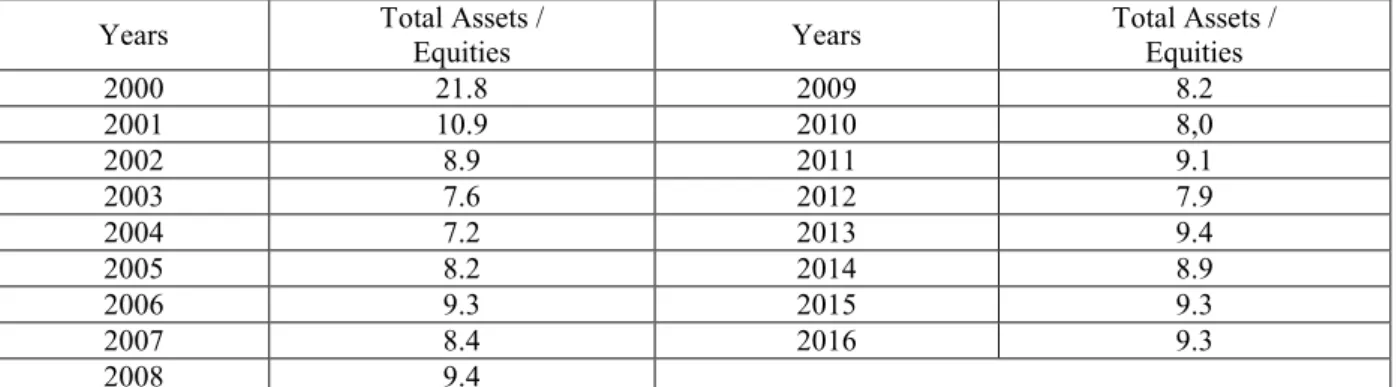
The higher the ratio of assets to equities, so-called leverage ratio, the higher the average return of the capital. However, it is quite possible that the risk of non-repayment of the loans, which constitute a large part of the assets in general, may increase so much. This situation can cause the bank to make loss by increasing non-returning credits. These rates calculated for the deposit banks operating in TBS are shown in Table 1 and it is seen that the high rates, in crisis years, have decreased since 2001. The year-end value of 2016 is 9.3%.
Table 1. Leverage Ratios of Commercial Banks Operating in TBS Years Total Assets /
Equities Years Total Assets / Equities 2000 21.8 2009 8.2 2001 10.9 2010 8,0 2002 8.9 2011 9.1 2003 7.6 2012 7.9 2004 7.2 2013 9.4 2005 8.2 2014 8.9 2006 9.3 2015 9.3 2007 8.4 2016 9.3 2008 9.4
Source : Figures have been calculated from the balance sheets of deposit banks, taken place in reports, called TBB, Bankalarımız 2000-2016
If the papers, regarding the causality relationship between risk structure due to liquidated loans and crediting or credit rationing, are taken into consideration in the literature of economics; the studies at the following can be examined. Aras and Müslümov (2004) found out that credit rationing is affected by liquidated loans. Okuyan (2009) found out the same result with Toda Yamamoto Causality Analysis. Ayrıçay and Altıntaş (2009) also reached to the same result. Altunışık (2009) stated that excess size of liquidated loans affects credit rationing in crisis. Köksel and Yöntem (2014) stated that liquidated loans have not affected credit rationing after 2002, in which there has been restructuring in TBS.
3. Data and Econometric Method
In this part of the article, the causal relationships between the selected financial ratios of firms, operating in the construction sector in Turkey and the construction sector’s credit risk ratio, exist in the CBRT sectoral balance sheets have been analyzed. It has been examined that whether there is a causality relationship between risk of credit portfolio due to asymmetric information and selected financial ratio of the firms, operating in construction sector, from CBRT statistics. Accordingly it has been analyzed whether riskiness of credit portfolio causes credit rationing or not.
Among the financial structure ratios of firms operating in the construction sector, three variables, deemed to be appropriate and important for the theoretical structure have been chosen. These variables are given below. Y1, Liquidated total loans in the sector / total cash loans used by the sector
Y2, Short-term bank loans obtained / total liabilities
Y3, Long-term bank loans obtained / total liabilities
The Y1 variable is calculated by us by dividing the liquidated total loans of the companies operating in the sector to the cash loans used by the sector.
It has been planned to interrogate the causal relationship between Y2 and Y3 of financial structure ratios that can represent the availability of credit rationing and the credit riskiness ratio (Y1) in the construction sector. Accordingly, it has been tried to obtain information about the direction of the causality relationship between the relevant variables. As a consequence of the analysis, it has been tried to find that whether the credit market, related to construction sector, has appropriate structure with the theoretical structure or not.
Unit root tests are required to examine causal relationships and to determine the method for the causality test to be used. In the first step of the econometric analysis, findings related with these tests are presented in
Table 2. Unit root tests conclude that the series integration orders are
Y ~ I
1(0)
,Y ~ I
2(0)
, and3
(0)
Y ~ I
.
Table 2. Unit Root Tests
Series Test Statistics Lag Length Break Date
Y1 -6.9095[<0.01] 2 2005
Y2 -5.3929[0.0278] 0 2003
Y3 -5.3243[0.0112] 0 2003
Notes: Perron (1997) was performed for unit root test with structural break. Vogelsang (1993) asymptotic one-sided p-values are used and provided in square brackets. Trend specification is trend and intercept, break specification is trend only, break type is an innovational outlier. The null is “series is has a unit root with a structural break”.
Due to the fact that there are requirements for the determination of the VAR(p) model optimum lag length and adequate lag for autocorrelation tests; pairs of variables have been deemed essential instead of analyzing three variables together in order to get rid of the degree of freedom problem.
Causality tests give information about the presence or absence of a causal relationship between relevant variables. In the presence of a causal relationship, information about the direction of the relationship between variables is attained. It is also useful to point out here that the choice of approaches used for causality should vary based on the time series characteristics of the concerned series.
Table 3. Causality Tests
Hypothesis VAR(p) χ2 (d.f.) p-value Result
Y1 does not Granger cause Y2
Y2 does not Granger cause Y1 VAR(4)
χ2 (4) = 12.9766 χ2 (4) = 3.1125
0.0114
0.5392 Y1 → Y2 Y1 does not Granger cause Y3
Y3 does not Granger cause Y1 VAR(2)
χ2 (2) = 1.2894 χ2 (2) = 1.6681
0.5248
0.4343 No causality Y2 does not Granger cause Y3
Y3 does not Granger cause Y2 VAR(1)
χ2 (1) = 1.0541 χ2 (1) = 0.0022
0.3045
0.9622 No causality Notes: p is the optimum lag for the VAR model and determined using the minimum information criteria. The dummy variable was employed as a exogenous variable in the VAR estimation. The periods of 2003 and 2005 are 1 and the others are 0. There are no autocorrelation problem up to 6 lags in the residuals of the estimated three VAR models and no heteroscedasticity is observed. The causality test method has been determined by considering the integration order of the series. Causality tests were applied with Wald tests by estimating the VAR model at the level of the series.
Based on the findings of the causality test, there is unidirectional causal relationship from Y1 to Y2 with high statistical significance for the period between 1991 and 2015. The other important findings are no causality between Y1 and Y3, also Y2 and Y3.
This means that changes in risk structure in construction sector affects the short run crediting of the firms, operating in construction sector. In other words, liquidated loans to total loans ratio of the construction sector brings about the changes in short term credit, using in construction sector.
At this stage, the impulse-response functions between variables are analyzed using VAR models.1 Figure 1. Impulse-Response Functions, Response of Y2 to Y1 Shock
Figure 1. illustrates the response of Y2 (short-term bank loans obtained / total liabilities) to 1 unit standard deviation shock that may occur in Y1 (the total loan to be liquidated in the sector / the total cash loans used by the sector). Findings indicates that Y2 instantly responds in decreasing direction to the Y1 shock, and this response reaches the highest point in the fourth period, and the effect of the shock continues to decrease during 8 periods. The effect of the shock seems to die-out after nine periods.
1Y
4. Conclusion
The perception that the construction sector provides relatively high returns in short term, increases the interest of the investors; together with that the nature of the sector, which can be highly competitive with the high financing costs, can cause aggressive sales campaigns and irrational investment strategies.
However, if we ignore the impression created by aggressive sales campaigns, specifically increasing in cash construction loans may indicate a risk accumulation in the construction sector.
The construction sector is composed of complex and risky projects with high financial costs. According to the report of Banks Association of Turkey (BAT), called Distribution Banks Loans by Sector Code September-2017, the most risky sectors in terms of liquidated receivables, were the construction and wholesale and retail trade sectors.
Also, according to Turkish Statistical Institute (TSI) and Banking Regulation and Supervision Agency (BRSA) September 2016 data, while the ratio of construction sector credits to GDP has increased over the years, the ratio of housing loans to GDP has remained flat between 2013-2016.
If the construction projects can not be continued for various reasons, due to the high costs, this situation can cause big losses for the investors in terms of the finance. For this reason, it is of great importance in terms of return of loans to examinate the data such as the asset and liability in balance sheets of the firms, the ability to collect receivables, the total bank debts, the contribution of the equity, the market reputation of the firm and its partners, the experience and assets of the sector as well as the use of the loans demanded from the banks.
Even if the ratio of liquidated loans to total loans decreases, this decline is relatively good for the sector, but the fact that non-transparent financial structure of the sector and insufficiently controlled requires this information to be cautiously approached. Considering that housing sales based on mortgage-financed housing have decreased proportionally for some monthly periods in recent years, it is understood that the monitoring of such risks is important.
In general, banks do not want to endure the cost of funding resources in their liabilities as reserves. Since the change in nonrefunded credit ratios affects short-term crediting of the construction sector, it can be concluded that the banking sector does not take into account the change in nonrefunded credit ratios. In this case, since, regardless of the risk structure of the construction sector, long-term credits can be given by the banks in the sector; it might be possible for banks to act ambitiously for crediting the construction sector in long term in credit market, which banks don't have particular problems in terms of resource acquisition. Accordingly, almost every short term credit might be transformed to long term credit by banks regardless of the risk structure of these firms. However, in a possible crisis, losses can reach very serious dimensions.
References
Altunışık, U. (2009). An Empirical Study Of Banking Credit Chanel In Turkey: Credit Rationing.
Aras, G., & Müslümov, A. (2004). Kredi Piyasalarında Asimetrik Bilgi ve Bankacılık Sistemi Üzerindeki Etkileri. İktisat, İşletme-Finans Dergisi, 222, 55-65.
Ayriçay, Y., & Altintaş, (2009) H. Türkiye’de Asimetrik Bilgi ve Kredi Tayınlamasının Ekonometrik Analizi: 1992-2009.
Çolak, Ö. F. (2007). Finansal Piyasalar ve Para Politikası, Gazi Kitapevi.
Eğilmez, A. M., & Kumcu, E. (2007). Ekonomi politikası: teori ve Türkiye uygulaması. Remzi Yayınevi. Goldstein, M., & Turner, P. (1996). Banking crises in emerging economies: origins and policy options. In BIS
Economic Paper 46. Bank for International Settlements, Monetary and Economic Department, Basle. Güney, A. (2007). Banka işlemleri. Beta.
Köksel. B.. & Yöntem. T. (2014). Türk Bankacilik Sektöründe Kredi Tayinlamasi: 2002-2013 Dönemi Üzerine Bir Uygulama [Credit Rationing in the Turkish Banking Sector: An Application Between 2002-2013]. Erciyes Üniversitesi İktisadi ve İdari Bilimler Fakültesi Dergisi. (43). 107-131. doi: 10.18070/euiibfd.91309 Okuyan, H. A. (2009). Asimetrik Bilginin Türk Bankacılık Sektörü ve Kredi Piyasaları Üzerinde Etkisi. In
EconAnadolu 2009: Anadolu International Conference in Economics (pp. 1-10).
Perron, P. (1997). Further Evidence on Breaking Trend Functions in Macroeconomic Variables, Journal of Econometrics, 80(2), 355-385.
Saunders, A., & Cornett, M. M. (2004). Financial markets and ınstitutions: A modern perspective (2. bs.). Sayım, F. (2006). Bankalarda kredi karşılıkları sistemi ve vergisel incelemesi. Türkiye Bankalar Birliği.
Stiglitz. J. E. & Weiss. A. (1981). Credit rationing in markets with imperfect information. The American
economic review. 71(3). 393-410. Retrieved from:
http://socsci2.ucsd.edu/~aronatas/project/academic/Stiglitz%20credit.pdf Şakar, B., (2006). Banka Kredileri ve Yönetimi, Beta Basım Yayın A.Ş The Banks Association of Turkey (https://www.tbb.org.tr/en/home).
Vogelsang, J. T., (1993) Essays on Testing for Nonstationarities and Structural Change in Time Series Models, Unpublished Ph.D. Dissertation, Princeton University, NJ.