ISSN Online: 2165-3925 ISSN Print: 2165-3917
DOI: 10.4236/ojapps.2019.96036 Jun. 3, 2019 439 Open Journal of Applied Sciences
Surface Effects on the Diffraction of P Wave by
an Arbitrary Shaped Cavity
Zhiying Ou
*, Hongjun Han
School of Science, Lanzhou University of Technology, Gansu, Lanzhou, China
Abstract
This paper presents the effects of surface effects in the cavity of variable cur-vature. The wave function expansion method and the conformal mapping method are used in the solution of dynamic stress concentration factor around an irregularly shaped cavity at nano-scale. The stress boundary con-ditions on the surface are obtained by using the generalized Young-Laplace equation. The results show that the degree of stress concentration becomes more obvious with curvature increasing. Taking the elliptical cavity as an example, the influence of the ration of the major and minor axis of the ellipse, the numbers of the incident wave and the surface effects on the dynamic stress concentration factor are analyzed. The ration of the major and minor axis, the incident wave frequency and the surface effects show the pro-nounced effects on the dynamic stress concentration distributions.
Keywords
Conformal Mapping, Dynamic Stress Concentration Factor, Irregularly Shaped Cavity, Surface Effect
1. Introduction
Nano-structured materials and nano-sized structural elements have unique me-chanical and physical properties. Atoms near the surface and interface of solids have different equilibrium positions and energies from that of the bulk material. Therefore, the surface and interface of solids display different mechanical prop-erties compared with their bulk parts. To account for the effects of surface or in-terface, Gurtin et al. established the surface elasticity theory, which a surface is regarded as a negligibly thin membrane adhered to the bulk without slipping. The presence of surface stress gives rise to a non-classical boundary condition, which shows a good agreement with directly atomic simulations [1] [2]. There-How to cite this paper: Ou, Z.Y. and Han,
H.J. (2019) Surface Effects on the Diffrac-tion of P Wave by an Arbitrary Shaped Cavity. Open Journal of Applied Sciences, 9, 439-450.
https://doi.org/10.4236/ojapps.2019.96036
Received: May 21, 2019 Accepted: May 31, 2019 Published: June 3, 2019
Copyright © 2019 by author(s) and Scientific Research Publishing Inc. This work is licensed under the Creative Commons Attribution International License (CC BY 4.0).
DOI: 10.4236/ojapps.2019.96036 440 Open Journal of Applied Sciences fore, at the micro- and nano-sized, the surface elasticity theory has been adopted to elucidate many phenomena. Dingreville et al. [3] addressed the surface effects on the size-dependent elastic behaviors of nano-sized structural elements. Al-though such size-dependency is negligible for conventional structural elements, it becomes significant when one of the dimensions of the element shrinks to na-nometers. For composites containing nano-sized inhomogeneities, the accom-modation of surface or interface energy predicted the size-dependent effective moduli [4] [5]. Using of surface elasticity theory, Lei et al. [6] studied the effects of surface stress on the contact problem at nanometers, in which the contact mechanical properties are remarkably different from those in bulk solids.
In fact, the surface elasticity theory can be applied not only to the statics analysis, but also to the dynamics analysis. In the framework of surface elasticity theory, the scattering of plane compressional and shear waves by a single na-no-sized coated fiber and the multiple scattering by two cylinder inclusions, which embedded in an elastic matrix is studied by Ou and Lee using the method of eigenfunction expansion [7] [8]. Zhang et al. [9] used the wave function ex-pansion method to study the effect of nano-sized arrays on the longitudinal wave diffraction in elastic media, and gave the corresponding elastic diffraction fields. Ru etal. [10] considered the SV wave multiple scattering caused by a cluster of nano-cylindrical holes. Using the displacement potential method and the wave function expansion method, they derived the scattering field around the hole. Ou
et al. [11] studied the effects of semi-cylindrical inclusions on the scattering of plane P wave in an elastic half-plane. The results show that surface energy has a significant effect on the scattering of plane P wave as the radius of the semi-cylindrical inclusions shrink to nanometers. Wang et al. [12] [13] used Gurtin’s surface elasticity model to analyze the diffraction of elastic wave by a nanosized inhomogeneity, and they also demonstrated that the surface energy has a significant effect on the diffraction of the elastic wave when the cavity ra-dius is reduced to the nanoscale.
DOI: 10.4236/ojapps.2019.96036 441 Open Journal of Applied Sciences mainly studies the diffraction of P wave by arbitrary shape cavity at the nano-scale, and gives a method for estimating the magnitude of the dynamic stress concentration factor (DSCF).
2. Wave Function
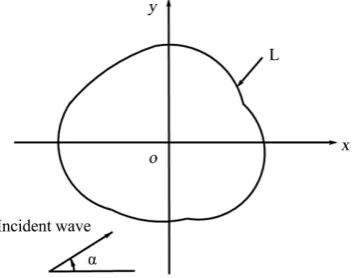
Assume a harmonically time-varying plane P wave propagating at an angle
α
with respect to the x-axis with circular frequencies
ω
as shown in Figure 1. The elastic medium is defined by the Lames constants λ, µ and the densityρ.
Such an incident wave can be described by a displacement potential in the x-y
plane as
(
)
(
( )
( )
)
inc
0 p
, exp I cos sin .
x y k x y
φ =φ α + α (1) where φ0 is the amplitude of incident wave, the superscript inc represents the
incident wave, kp =ω cp is the wave number of P wave, cp =
(
λ
+2µ ρ
)
is the wave velocity of P wave, I= −1. For the convenience of calculation, the time-dependent term e−Iωt is suppressed throughout.Based on the complex function theory, we introduce complex variables I
z x y= + , Equation (1) is then transformed to the following form
( )
(
)
inc I I
0
I
, exp e e .
2
p k
z z z α z α
φ =φ − +
(2)
When the incident wave impinges upon the irregularly shaped cavity boun-dary, two waves are reflected from the boundary [19]. They are a P wave and an S wave, which their displacement potential functions can be expressed as follows, respectively
( )
( )1(
)
ref , ,
n
n n p n
z
z z A H k z
z
φ
∞=−∞
=
∑
(3)( )
( )1(
)
ref , .
n
n n s n
z
z z B H k z
z
ψ
∞=−∞
=
∑
(4)where the superscript ref represents the reflect wave, An and Bn are arbitrary expansion coefficients to be determined. ks =ω cs is the wave number of SV wave, cs = µ ρ is the wave velocity of SV wave. Hn( )1
( )
⋅ is the nth Hankel function of the first kind. Hankel function is related to the Bessel functions of the first kind Jn( )
⋅ and the second kind Yn( )
⋅ by Hn( )1( )
⋅ =Jn( )
⋅ + ⋅I Yn( )
⋅ .3. Solution of the Problem
In this section, we use the variable
η ζ
= +Iξ
. For wave scattering problemsinvolving noncircular boundary [20] [21], it is possible to transform the domain L external to a closed curve in the z-plane into the domain S bounded by a unit circle in the η-plane by means of the conformal mapping in Figure 2.
DOI: 10.4236/ojapps.2019.96036 442 Open Journal of Applied Sciences
Figure 1. P wave propagating at an angle α
[image:4.595.284.464.247.390.2]with respect to the x-axis.
Figure 2. Image plane after conformal mapping.
( )
01
1 .
n n n
z ω η cη c
η
∞
=
= = +
∑
(5)Substituting Equation (5) into Equations (2)-(4), we find
(
)
( )
( )
inc I I
0
I
, exp e e ,
2
p
k α α
φ η η =φ ω η − +ω η
(6)
(
)
( )(
( )
)
( )
( )
1ref , ,
n
n n p
n A H k
ω η
φ η η ω η
ω η
∞
=−∞
=
∑
(7)(
)
( )(
( )
)
( )
( )
1ref
s
, .
n
n n
n B H k
ω η
ψ η η ω η
ω η
∞
=−∞
=
∑
(8)Thus the total elastic field is described by
φ φ
= inc+φ
refand
ψ ψ
= ref . Meanwhile, the stress components σrr, σθθ and σrθ in η-plane are given by [24](
)
( )
( )
(
)
( )
( )
(
)
2 2
2
2
2
2 1 I
2 1 I ,
rr kp
r
r
µη
σ λ µ φ φ ψ
η ω η η ω η
µη φ ψ
η η
ω η ω η
∂ ∂
= − + + ∂ ′ ∂ +
′
∂ ∂
+ −
′ ∂ ′ ∂
DOI: 10.4236/ojapps.2019.96036 443 Open Journal of Applied Sciences
(
)
( )
( )
(
)
( )
( )
(
)
2 2
2
2
2
2 1 I
2 1 I ,
p k
r
r θθ
µη
σ λ µ φ φ ψ
η ω η η ω η
µη φ ψ
η η
ω η ω η
∂ ∂
= − + − ′ +
∂ ∂
′
∂ ∂
− −
′ ∂ ′ ∂
(10)
( )
( )
(
)
( )
( )
(
)
2
2
2
2
2I 1 I
2I 1 I .
r r
r θ
µη
σ φ ψ
η ω η η ω η
µη φ ψ
η η
ω η ω η
∂ ∂
= +
′
∂ ∂
′
∂ ∂
− −
′ ∂ ′ ∂
(11)
Assume that the surface adheres perfectly to the bulk material without slip-ping. The equilibrium equations and the constitutive relations on the surface are expressed as
, 0,
s
tα+σβα β = (12) ,
s ij i jn n αβ αβ
σ =σ κ (13)
(
)
(
)
0 2 0 0 .
s s s
αβ αβ αγ γβ γγ αβ
σ =τ δ + µ −τ δ ε + λ +τ ε δ (14) where ni denotes the normal vector of the surface, tα is the negative of the tangential component of the traction ti=σij jn in the xα direction, and καβ
is the curvature of the surface. Two dimensional indicators
α
,β
value 1, 2.The elastic property of anisotropic surface is characterized by two material con-stants
µ
s and λs. sαβ
σ is surface stress tensor. τ0 is the residual surface
tension under unstrained condition. Generally, the surface inertia force can be neglected in Equation (14) for the dynamic problems.
In the bulk, the classical elastic theory holds, and the isotropic constitutive re-lation reads as
2 ,
1 2
ij ij
ν
kk ijσ
µ ε
ε δ
ν
= +
−
(15)
For plane strain problems, the strain εθθ is given by
(
)
1 1 ,
2 rr
θθ θθ
ε
ν σ
νσ
µ
= − − (16)
Thus the surface stress s
θθ
σ
is obtained as0 .
s Es
θθ θθ
σ
= +τ
ε
(17)with Es =2
µ
s+λ τ
s− 0. Since the residual surface stress τ0 always induces anadditional deformation field, independent of the external loading, we assume the residual surface stress τ0 to be zero in what follows.
The boundary conditions on the circular hole (r a= ) with surface effects are
given from Equations (12) and (13) as
, .
s s
rr
σ
aθθ rθ aσ
θθσ
σ
θ
∂
= = −
∂ (18)
DOI: 10.4236/ojapps.2019.96036 444 Open Journal of Applied Sciences effects are given by
(
)
(
)
(
)
{
}
(
) (
2)
1 2
1 2
2
2 1 ,
2
s s
rr rr
s
p rr rr
s
p rr
E
E k
E k
θθ θθ
σ σ ν σ νσ
µ
ν λ µ φ σ νσ
µ
ν λ µ φ σ
µ
= = − −
= − − + − −
= − − + +
(19)
(
) (
2)
2 1 .
2
s s
rθ θθ E kp rr
σ
σ ν λ µ φ σ
θ µ θ
∂ ∂
= − = − + +
∂ ∂ (20)
Substituting of Equations (6)-(8) and Equations (9)-(11) into Equations (19) and (20), we find
2
1
, 1,2.
n n
ij j i
j n E X Y i
∞
= =−∞
= =
∑ ∑
(21)where X1n= An, X2n=Bn, and the elements of Eijn are presented in Appen-dix A.
Multiplying both side of Equation (21) by e−Ilθ and integrating between the interval
(
−π,π)
, we have2
1
, 1,2; 0, 1,
n n ijl j il
j n E X Y i l
∞
= =−∞
= = = ±
∑ ∑
(22)where π I
π
1 e d
2π
n n l
ijl ij
E E − θ θ
−
=
∫
, π Iπ
1 e d
2π
l
il i
Y Y −θ θ
−
=
∫
.We can get a set of infinite algebraic equations to determine the coefficients n
A and Bn. After solving the linear equation system, the coefficients An and n
B can be obtained, then the elastic scattering fields due to the incident P wave can be determined.
4. Numerical Results and Discussion
The dynamic stress concentration factor (DSCF) is defined as the ratio between the hoop stress along the circumference of a cavity and the maximum amplitude of the incident stress wave at the same point
0
DSCF σθθ .
σ
= (23)
For compressive incident wave, the maximum amplitude of incident stress
0
σ is
2
0 ks 0.
σ
= −µ φ
(24) To illustrate the computational procedure, we consider the well-known case of a planar steady state compressive wave incident on a circular cavity. For a circu-lar boundary, we take the mapping function as( )
.z=
ω η
=aη
(25)DOI: 10.4236/ojapps.2019.96036 445 Open Journal of Applied Sciences 2
s
s E=
µ
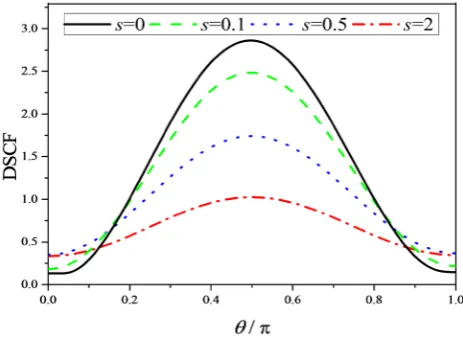
a. The Poisson ration is assumed to be ν =0.25 for all calculation. For low frequency incident wave with k ap =0.2, surface parameter s hassignificant effect on DSCF near a circle cavity. With the increase in parameter s, the DSCF continuously decrease around θ =π 2 but increases around θ =0 and θ =π in Figure 3. Let s=0, the present nanosized circle cavity reduces to the classical cavity problem without a surface effect. These results are consis-tent with those in [13].
For simplicity, we assume that the incident planar compressive wave is com-ing along the direction of the x-axis. The distribution of dynamic stress concen-tration in the neighborhood of an elliptic cavity, with semi-major axis a and
semi-minor axis b can be made by choosing another mapping function
( )
2 2
a b a b
z=ω η = + η+ − η. (26)
Figure 4 shows distribution of the DSCF near the elliptic cavity for a b=3 2 with the surface parameter, and the image is symmetric about θ =π 2. When
0.5
s≤ , the DSCF is found the maximum value in θ =π 2. However, when 2
s= , the DSCF gets a minimum value. For the case of s=0, these results are consistent with those in [14].
Figure 5 illustrates distribution of the DSCF around the elliptic cavity with the different surface parameter for a b=2 3. In this case, the image is symme-tric about θ =π 2. With increasing surface parameter s, the DSCF declines continuously in 0.1π< <θ 0.9π. When s=0, the DSCF almost unchanged around θ =π 2. But s>0, the DSCF dramatically increases around θ =π 2.
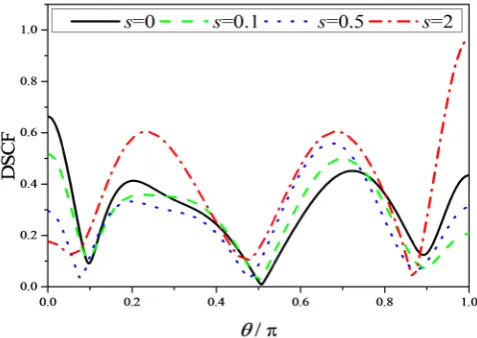
For a high frequency incident wave with k ap =π, the dynamic stress
[image:7.595.257.489.533.702.2]con-centration factor at the elliptical cavity surface is more complicated and the im-ages appear multiple asymmetric peaks in Figure 6. For the different surface parameter s, distribution of the DSCF around the elliptical cavity surface is clearly depicted. Although the DSCF varies with the surface parameter is not very regular, the surface parameters take different values, the canyons of the im-age can be found at θ =0.1π, θ =0.5π, θ =0.9π.
DOI: 10.4236/ojapps.2019.96036 446 Open Journal of Applied Sciences
[image:8.595.255.492.292.467.2]Figure 4. Effect of surface parameter s on DSCF near an elliptic cavity for k ap =0.2, a b=3 2.
Figure 5. Effect of surface parameter s on DSCF near an elliptic cavity for k ap =0.2, a b=2 3.
[image:8.595.254.493.519.688.2]DOI: 10.4236/ojapps.2019.96036 447 Open Journal of Applied Sciences
5. Conclusion
In this paper, we have presented a method of complex functions to analyze the two dimensional problems of dynamic elasticity with non-circular geometry. The method is applied to evaluate the dynamic stress concentration factor around a circular and an elliptical cavity. Various type of scattering phenomena and dynamic stress concentrations due to a more general type of elastic inclu-sion can also be analyzed similarly.
Acknowledgements
The supports from the National Natural Science Foundation (Grant No. 11362009 and No. 11862014) are acknowledged.
Conflicts of Interest
The authors declare no conflicts of interest regarding the publication of this pa-per.
References
[1] Miller, R.E. and Shenoy, V.B. (2000) Size-Dependent Elastic Properties of Nano-sized Structural Elements. Nanotechnology, 11, 139-145.
[2] Shenoy, V.B. (2002) Size-Dependent Rigidities of Nanosized Torsional Elements.
International Journal of Solids and Structures, 39, 4039-4052. https://doi.org/10.1016/S0020-7683(02)00261-5
[3] Dingreville, R., Qu, J. and Cherkaoui, M. (2005) Surface Free Energy and Its Effect on the Elastic Behavior of Nano-Sized Particles, Wires and Films. Journal of the Mechanics and Physics of Solids, 53, 1827-1854.
https://doi.org/10.1016/j.jmps.2005.02.012
[4] Duan, H.L., Wang, J., Huang, Z.P. and Karihaloo, B.L. (2005) Size-Dependent Ef-fective Elastic Constants of Solids Containing Nano-Inhomogeneities with Interface Stress. Journal of the Mechanics and Physics of Solids, 53, 1574-1596.
https://doi.org/10.1016/j.jmps.2005.02.009
[5] Chen, T., Dvorak, G.J. and Yu, C.C. (2007) Size-Dependent Elastic Properties of Unidirectional Nano-Composites with Interface Stresses. Acta Mechanica, 188, 39-54. https://doi.org/10.1007/s00707-006-0371-2
[6] Lei, D.X., Wang, L.Y. and Ou, Z.Y. (2012) Elastic Analysis for Nanocontact Problem with Surface Stress Effects under Shear Load. Journal of Nanomaterials, 6, 1-7. https://doi.org/10.1155/2012/505034
[7] Ou, Z.Y. and Lee, D.W. (2012) Effects of Interface Energy on Scattering of Plane Elastic Wave by a Nano-Sized Coated Fiber. Journal of Sound and Vibration, 331, 5623-5643. https://doi.org/10.1016/j.jsv.2012.07.023
[8] Ou, Z.Y. and Lee, D.W. (2012) Effects of Interface Energy on Multiple Scattering of Plane Compressional Waves by Two Cylindrical Fibers. International Journal of Applied Mechanics, 4, 401-419. https://doi.org/10.1142/S1758825112500408
Concentra-DOI: 10.4236/ojapps.2019.96036 448 Open Journal of Applied Sciences
tion Near a Cluster of Cylindrical Nanoholes Arranged as Quadrate Shape. Ad-vances in Materials Science and Engineering, 5, 1-8.
https://doi.org/10.1155/2015/134975
[11] Ou, Z.Y., Liu, C. and Liu, X.W. (2013) Effects of Surface Elasticity on Scattering of P Waves by an Elastic Half Plane with a Nanosized Semi-Cylindrical Inclusion. Ap-plied Mechanics and Materials, 303, 2661-2666.
https://doi.org/10.4028/www.scientific.net/AMM.303-306.2661
[12] Wang, G.F. and Wang, T.J. (2006) Deformation around a Nanosized Elliptical Hole with Surface Effect. Applied Physics Letters, 89, 1901-1916.
https://doi.org/10.1063/1.2362988
[13] Wang, G.F., Wang, T.J. and Feng, X.Q. (2006) Surface Effects on the Diffraction of Plane Compressional Waves by a Nanosized Circular Hole. Journal of Applied Physics, 89, 1923-1925. https://doi.org/10.1063/1.2403899
[14] Liu, D.K., Gai, B.Z. and Tao, G.Y. (1982) Applications of the Method of Complex Functions to Dynamic Stress Concentrations. Wave Motion, 4, 293-304.
https://doi.org/10.1016/0165-2125(82)90025-7
[15] Ou, Z.Y. and Zhao, C.H. (2018) Stress Concentration around a Nanosized Arbitra-rily Shaped Hole in Elastic Half-Space under Uniformly Distributed Load. Journal of Lanzhou University of Technology, 44, 160-165.
[16] Sommerfeld, A. (2004) Mathematical Theory of Diffraction. Springer Science Busi-ness Media. Springer Nature Switzerland AG, Basel, Switzerland.
https://doi.org/10.1007/978-0-8176-8196-8
[17] Lee, V.W. and Karl, J. (1992) Diffraction of SV Waves by Underground, Circular, Cylindrical Cavities. Soil Dynamics and Earthquake Engineering, 11, 445-456. https://doi.org/10.1016/0267-7261(92)90008-2
[18] Gilbert, F. and Knopoff, L. (1959) Scattering of Impulsive Elastic Waves by a Rigid Cylinder. Journal of the Acoustical Society of America, 31, 1169-1175.
https://doi.org/10.1121/1.1907846
[19] Mow, C.C. and Pao, Y.H. (1973) Diffraction of Elastic Waves and Dynamic Stress Concentrations. Journal of Applied Mechanics, 40, 872-1500.
[20] Wang, J.H., Lu, J.F. and Zhou, X.L. (2009) Complex Variable Function Method for the Scattering of Plane Waves by an Arbitrary Hole in a Porous Medium. European Journal of Mechanica—A/Solids, 28, 582-590.
https://doi.org/10.1016/j.euromechsol.2008.09.005
[21] Zitron, N.R. (1967) Multiple Scattering of Elastic Waves by Two Arbitrary Cylind-ers. Journal of the Acoustical Society of America, 42, 620-624.
https://doi.org/10.1121/1.1910633
[22] Liu, D.K. and Chen, Z.G. (2004) Scattering of SH-Wave by Cracks Originating at an Elliptic Hole and Dynamic Stress Intensity Factor. Applied Mathematics and Me-chanics, 25, 1047-1056. https://doi.org/10.1007/BF02438354
[23] Fang, X.Q. and Jin, H.X. (2016) Visco-Elastic Imperfect Bonding Effect on Dynamic Response of a Non-Circular Lined Tunnel Subjected to P and SV Waves. Soil Dy-namics and Earthquake Engineering, 88, 1-7.
https://doi.org/10.1016/j.soildyn.2016.05.014
DOI: 10.4236/ojapps.2019.96036 449 Open Journal of Applied Sciences
Appendix A
(
)
( )(
( )
)
( )
( )
( )
( )
( )(
( )
)
( )
( )
( )
( )
( )(
( )
)
( )
( )
(
) (
)
( )(
( )
)
( )
( )
1 2 11 2 2 2 1 2 2 2 2 1 2 1 2 1 2 2 2 1 n s np n p
n p n p n p n p n s
p n p
E
E k H k
k
H k
k
H k
E k H k
ω η
λ µ ω η
µ ω η
µ η ω η ω η
ω η
ω η ω η
µ η ω η ω η
ω η
ω η ω η
ω η
ν λ µ ω η
µ ω η
− − + + = + − + ′ + ′ ′ + ′ + − + (A.1)
( )
( )
( )(
( )
)
( )
( )
( )
( )
( )(
( )
)
( )
( )
2 2 2 1 12 2 2 2 2 1 2 I 1 2 2 I 2 n s s n n s n s n s k EE H k
k
H k
µ η ω η ω η
ω η
µ ω η ω η
µ η ω η ω η
ω η
ω η ω η
− − + + ′ = + ′ ′ − ′ (A.2)
( )
( )
( )
( )
(
)(
)
( )
( )
2 2 2I 2I 12 I I
0
1 e e
2 2 2
I
1 exp e e
2 s s p p E Y k E k α α α α
µη ω η µη ω η
λ µ
µ ω η ω η
λ µ ν φ ω η ω η
µ − − ′ ′ = + + + + ′ ′ − + − + (A.3)
( )
( )
( )(
( )
)
( )
( )
( )
( )
( )(
( )
)
( )
( )
2 2 2 1 21 2 2 2 2 1 2 1 I 2 I 2 2 n p n n p n s p n p kE H k
k H k E F
µ η ω η ω η
ω η
ω η ω η
µ η ω η ω η
ω η
ω η ω η µ θ
− − + + ′ = ′ ′ ∂ − + ′ ∂ (A.4)
( )
( )
( )(
( )
)
( )
( )
( )
( )
( )(
( )
)
( )
( )
2 2 2 1 22 2 2 2 2 1 2 2 2 2 2 n s n n s n s s n s kE H k
k H k E F
µ η ω η ω η
ω η
ω η ω η
µ η ω η ω η
ω η
ω η ω η µ θ
− − + + ′ = − ′ ′ ∂ − + ′ ∂ (A.5)
( )
( )
( )
( )
( )
( )
2 22I 2I 2
2 0 I I 3 I I e e 2 2 I
exp e e
2 2 p s p Y k k E F α α α α
µη ω η
µη ω η
φ
ω η
ω η
ω η
ω η
µ θ
− − ′ ′ = − ′ ′ ∂ × + − ∂ (A.6)(
) (
)
( )(
( )
)
( )
( )
( )
( )
( )(
( )
)
( )
( )
1 2 1 2 2 2 1 2 2 1 2 np n p
n p
n p
F k H k
k
H k
ω η
ν λ µ ω η
ω η
µ η ω η ω η
DOI: 10.4236/ojapps.2019.96036 450 Open Journal of Applied Sciences
( )
( )
( )(
( )
)
( )
( )
2 2 2
1 2
2
n p
n p
k
H k
µ η ω η ω η
ω η
ω η ω η
+
+
′
−
′
( )
( )
( )(
( )
)
( )
( )
( )
( )
( )(
( )
)
( )
( )
2 2 2
1
2 2
2 2 2
1 2
I 2 I
2
n s
n s
n s
n s
k
F H k
k
H k
µ η ω η ω η
ω η
ω η ω η
µ η ω η ω η
ω η
ω η ω η
−
−
+
+
′
= −
′
′
+
′
(A.8)
(
)(
)
( )
( )
( )
( )
( )
( )
2 2
2I 2I 2
3 0
I I
2 1 e e
2 2
I
exp e e
2
p
p
F k
k
α α
α α
µη ω η
µη ω η
ν
λ µ
φ
ω η
ω η
ω η
ω η
−
−
′ ′
= − + + +
′ ′
× +