Am J Respir Crit Care Med Vol 157. pp 1844–1849, 1998 Internet address: www.atsjournals.org
Effects of Topically Delivered Benzamil and Amiloride
on Nasal Potential Difference in Cystic Fibrosis
T. HOFMANN, M. J. STUTTS, A. ZIERSCH, C. RÜCKES, W. M. WEBER, M. R. KNOWLES,
H. LINDEMANN, and R. C. BOUCHER
Cystic Fibrosis Working Group and Selbst. Funktionsbereich Allergologie und Pneumologie der Justus Liebig Universitäts-Kinderklinik, Giessen, Germany; and Cystic Fibrosis/Pulmonary Research and Treatment Center, University of North Carolina at Chapel Hill, Chapel Hill, North Carolina
The raised nasal transepithelial potential difference (PD) in cystic fibrosis (CF) reflects accelerated active transport of Na1, and is inhibited by topical administration of the Na1 channel blocker, amiloride. The aim of this study was to investigate the dose-effect and time course of topically admin-istered Na1 conductance inhibitors to inhibit nasal PD, including benzamil, an analog of amiloride. We measured the magnitude of drug inhibition of Na1 transport [percent inhibition of baseline PD (DPD%)] and duration of inhibition of PD, defined as the time when drug inhibition of PD had recov-ered by 50% (effective time 5 ET50). Amiloride [1023 M (n 5 16), 3 3 1023 M (n 5 9), 6 3 1023 M (n 5 7), 1022 M (n 5 3)] or benzamil [1.7 3 1023 M (n 5 7), and 7 3 1023 M (n 5 5)] were adminis-tered to the nasal surface via an aerosol generated by a jet nebulizer and a nasal mask. The concen-tration-dependent magnitude (DPD%) of inhibition was similar for amiloride and benzamil (z 67– 77%), whereas the duration of inhibition (ET50) was about two-and-a-half times longer after ben-zamil administration as compared with equivalent concentrations of amiloride [1.6 6 0.06 versus 4.5 6 0.6 h (ET506 SEM), at 6–7 3 1023 M]. In vitro studies of cultured normal nasal epithelia demonstrated directly that benzamil induced an approximately 2-fold more prolonged inhibition of active Na1 transport than amiloride. These data suggest aerosolized benzamil is a candidate long-duration Na1 channel blocker for CF. Hofmann T, Stutts MJ, Ziersch A, Rückes C, Weber WM, Knowles MR, Lindemann H, Boucher RC. Effects of topically delivered benzamil and amiloride on nasal potential difference in cystic fibrosis. AM J RESPIR CRIT CARE MED 1998;157:1844–1849.
Cystic fibrosis (CF) is a common, frequently fatal inherited disorder in the Caucasian population, affecting about one in 2,500 live births. The major cause of morbidity likely reflects ion transport abnormalities in airway epithelia, leading to mu-costasis, bacterial colonization with chronic inflammation, and irreversible lung damage (1). The airway epithelia of patients with CF exhibit impaired cAMP-mediated chloride secretion (2, 3) and increased transcellular sodium absorption (4, 5). It is likely that these ion transport defects lead to abnormal surface liquid composition and abnormal mucus viscosity and clear-ance in vivo (6).
Because the respiratory epithelium under the inferior tur-binate of the nose is functionally and morphologically similar to the ciliated epithelium of the lower airways, the nasal epi-thelium may serve as a model for studying ion transport in the lower airways (2, 7, 8). Studies of pharmacotherapy in CF are most easily initially explored in the nasal cavity because of the ease of access. Topical administration of epithelial Na1
chan-nel blockers, e.g., amiloride, to the nasal epithelium in CF de-creases the basal potential difference (PD), a parameter which has been shown to directly correlate with the rate of basal so-dium absorption in respiratory epithelial (4, 9).
The clinical value of amiloride aerosol therapy is currently under debate. There are data available which generally show short-term benefits of inhaled amiloride, particularly in younger subjects (6, 10–16). However, there are more conflicting results concerning the possible long-term benefits of amiloride (17, 18). Studies in normal subjects using a filter paper sampling technique showed that amiloride has a half-life of 35 to 40 min on airway surfaces (19), raising the speculation that the phar-macodynamics of the drug were not optimal for longer term therapy. Recent primary cell culture experiments found that benzamil, an analog of amiloride, is a more potent inhibitor of Na1 transport in the human nasal epithelium in vitro (20, 21). These results, in agreement with published data from other epithelia, indicate that benzamil is more potent than amiloride in inhibiting epithelial sodium transport and, based on improved pharmacodynamic attributes, could be therapeutically more effective than amiloride (22). The aim of the present study was to measure the magnitude and duration of the effect of topi-cally administered benzamil, as compared with amiloride, on sodium transport in the nasal epithelium of patients with CF
in vivo. Aerosol application of drugs to the nasal or bronchial epithelium is known to lead to a 10- to 100-fold dilution of drug concentration (19) at the epithelial surface, and for this
(Received in original form September 9, 1997 and in revised form December 30, 1997)
Supported by DFG Ho 1746/1-1; Förderverein Mukoviszidose Giessen e. V.
Hofmann, Stutts, Ziersch, et al.: Effects of Benzamil and Amiloride 1845
reason, we employed 10- to 100-fold higher sodium blocker concentrations in the nebulizer than previously used for the nasal superfusion technique. Parallel studies were performed in cultured nasal epithelial preparations, measuring the short circuit current which predominantly reflects active Na1 trans-port (23).
METHODS
Study Subjects
We studied 41 CF patients (18 female, 23 male; age range 18 to 35 yr, 24.4 6 0.7 yr, mean 6 SEM). Six patients participated in both the amiloride and the benzamil protocols. The CF diagnoses were based on two elevated sweat Cl2 tests and clinical findings. All CF subjects attended the Pulmonary Department of the Justus Liebig Universität-Giessen, Pediatric Hospital. The clinical status of the patients played no role in the selection of patients for the drug/drug concentration tested. Each subject was without acute symptoms of nasal infection nor was there nasal polyposis at the time of the PD measurement. For 24 h prior to the study, no other drugs apart from the study drugs were applied to the nasal epithelium of the patients. The protocols were ap-proved by the committee for human studies of the Justus Liebig Uni-versität-Giessen, and written consent was obtained from the subjects.
Techniques
Potential difference measurement. The apparatus consisted of a high-impedance voltmeter (WTW PH530; Weilheim, Chapel Hill, NC; 1011V), connected to a strip-chart recorder (Philips Two Line PM 8272;
Philips, Netherlands). The voltmeter was connected via standard ref-erence electrodes (Ingold type 373; Ingold, Steinbach, Germany) and saturated 3 M potassium chloride agar bridges to reference and re-cording electrodes (7, 9). Both were slowly (2 to 4 ml/h) perfused with Ringer’s saline by use of infusion pumps (“perfused electrodes”). Bac-terial contamination was avoided by use of polycarbonate filters (CareFil 0.2 mm; CareMed, Rothenburg, Germany).
Exploring electrode. Nasal PD measurements were made on the lateral wall and the inferior surface of the turbinate at 0.5 to 4 cm from the nasal meatus. We connected a nasal speculum to a cold light source to accomplish visualization. The recording electrode (umbilical vessel catheter, Argyle 3.5 Ch [5 1.17 mm] 3 38 cm) was placed at the most distal (4-cm) site, and slowly withdrawn in direction of the nares. The highest (most negative) potential maintaining stability for at least 3 s was recorded in each nostril.
Reference electrode (24-gauge plastic catheter). An epicutaneous reference electrode was placed on the right forearm after a slight abrasion of the superficial stratum corneum, using fine sandpaper and applying a KCl-containing electrode gel (24).
Nasal aerosol administration. We administered 2 ml of each test so-lution to both nostrils via nebulization (z 10 min) using a jet nebulizer (Pari Master Model 84.0100; Pari GmbH, Starnberg, Germany, mass median aerodynamic diameter [MMAD]: 3.1 mm; output: 0.6 g/min) at a mean airflow rate of 5.2 L/min. Amiloride (Synopharm, Ham-burg, Germany) and benzamil (RBI, Cologne, Germany) solutions were prepared using sterile filtration and were stored in sterile flasks. Instead of the usual mouthpiece, an adapter with a nasal mask (Laer-dal Child No. 3, flow through) was used to assure nasal deposition of drugs. The patients were instructed to inhale through their nose, and exhale through their mouth.
Protocols
Before nasal aerosol application of amiloride or benzamil, the maxi-mal nasal basal PD was measured in each CF patient by surveying (from 0.5 to 3 cm) the area under the turbinate. Occasionally, consid-erable differences in baseline PD between the two nostrils were found, reflecting possible differences in blood flow and/or epithelial lesions (25). Therefore, for all subjects, the mean of two measure-ments taken in the nostril with the highest (“most negative”) value was defined as the patient’s maximal PD (PDmax). The nostril with the
highest initial mean PDmax was subsequently used to measure PDmax
postaerosol administration. Following drug administration, PD was measured at the previously identified site of PDmax for up to 6 h, using
anatomic landmarks (i.e., location of the inferior meatus and distance from the anterior tip of the turbinate). PDmax was measured as the
high-est sustained (. 3 s) PD in single measurements at each time interval after which the catheter was removed. This method of data reduction reflects a modification of the published method (7) but is more easily performed and less sensitive to unilateral epithelial variances.
Forty-one CF patients were studied, amiloride was administered to 35, and benzamil was administered to 12. Six CF patients received both benzamil and amiloride. Each CF patient in the amiloride group received only one dose of drug, and each CF patient in the benzamil group also received only one dose of drug.
After the baseline measurement, 1023 M amiloride solution was
aerosolized to the nasal epithelium of 16 CF patients (age 5 to 35 yr), 3 3 1023 M amiloride to nine CF patients (13 to 32 yr), 6 3 1023 M
amiloride to seven CF patients (17 to 30 yr), and 1022 M amiloride to
three CF patients (22 to 28 yr). In the second group of patients (18 to 35 yr), benzamil 1.7 3 1023 M was aerosolized to the nasal surface of
seven CF patients and 7 3 1023 M benzamil to five CF patients. All
amiloride and benzamil solutions were prepared under sterile condi-tions using isotonic saline, except the 1022 M amiloride and 7 3 1023 M
benzamil solutions, which were diluted in distilled water to avoid drug precipitation. The amiloride concentrations were chosen equal to those that had been clinically used as an aerosol for CF in our clinic. Both benzamil solutions were prepared with the rationale of achieving the longest possible duration of effect (i.e., nasal sodium transport inhibi-tion) by aerosolizing the maximal achievable solution concentrations. For this reason, the benzamil solutions used in this study are not equimolar to the amiloride solutions: The 1.7 3 1023 M benzamil
solu-tion is at the limit of solubility in isotonic saline, and 7 3 1023 M
ben-zamil is at the limit of solubility in water. The total doses delivered from the nebulizer (i.e., the volume, 2 ml, in the nebulizer, times concentra-tion) for amiloride were 0.6 mg (1023 M, n 5 16), 1.8 mg (3 3 1023 M,
n 5 9), 3.6 mg (6 3 1023 M, n 5 7), and 6 mg (1022 M, n 5 3), and for
benzamil were 1.2 mg (1.7 3 1023 M, n 5 7) and 5 mg (7 3 1023 M,
n 5 5).
The sodium transport inhibitory effects of amiloride and benzamil in the nasal respiratory epithelium were quantitated by calculation of the maximal decrease of nasal PD immediately after the aerosol ad-ministration of drug (as a percent of baseline, i.e., DPD%). The dura-tion of the PD inhibidura-tion was monitored through repetitive (10-min to 1-h intervals) measurements of nasal PDmax until a return to 6 10% of
the baseline value was detected (or until 6 h passed).
For patient convenience, the PD was measured over a time limited to 6 h after administration of drug. Based on the assumption that 50% PD inhibition is a rough threshold for a therapeutic effect, i.e., returns the twofold enhanced CF Na1 transport to the normal range, the “ef-fective time” (ET50) was calculated as the time required for the PD
af-ter drug administration to return to 50% of the inhibited PD. ET50
was determined for each concentration of amiloride and benzamil tested.
In Vitro Studies
Airway epithelial cells were isolated from surgical specimens of nor-mal subjects and cultured on permeable collagen supports as previ-ously described (26). Prior studies established that the transepithelial PD and short circuit current (Isc) generated by these preparations
predominantly reflect amiloride-sensitive sodium absorption (4, 20). After baseline measurements of transepithelial PD and Isc during
con-tinuous bilateral perfusion (1 ml/min) of Krebs bicarbonate Ringer (KBR), preparations were exposed on the luminal surface to amilo-ride (1024 M), phenamil (1024 M, another analog of amiloride, a
gen-erous gift from Dr. T. Kleyman, University of Pennsylvania), or ben-zamil (1024 M) for 5 min, and the maximal inhibition of PD and I
sc
were recorded. Following the 5-min drug perfusion, the lumenal su-perfusate was returned to KBR and the time required for Isc and PD
to return to basal values (maximum recovery) recorded.
Statistical Analysis
1846 AMERICAN JOURNAL OF RESPIRATORY AND CRITICAL CARE MEDICINE VOL 157 1998
PROC GLM, a general linear models procedure (27). Regression lines were estimated for both the amiloride and benzamil groups, and the hypothesis of equal slopes for amiloride versus benzamil was tested. In in vitro studies, the Isc (% inhibition) and recovery (min)
data for amiloride, phenamil, and benzamil were compared by un-paired Student’s t test.
RESULTS
All nasal PDs were lumen negative with respect to the refer-ence electrode. The magnitudes of the baseline PDs in CF patients (mean 6 SEM), as referenced to the epicutaneous electrode, were in agreement with our own previous results (24) and those published elsewhere in the literature (7, 9, 28, 29). No differences in baseline PD (predrug) between the amiloride and benzamil groups were found: PDs were 249.3 6 2.1 mV (mean 6 SEM) for the CF group receiving amiloride (n 5 35), and 247.9 6 2.5 mV for the CF group receiving benzamil (n 5 12).
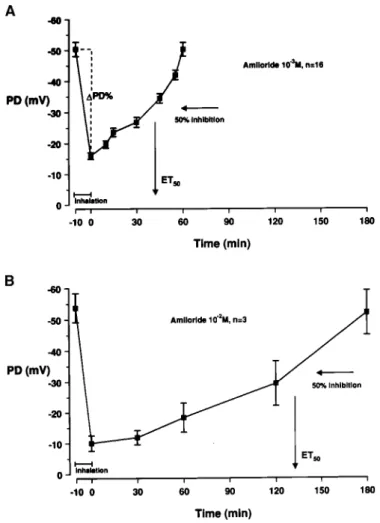
Plots of the PD/time curves are shown for the lowest (1023 M, n 5 16) and for the highest concentration of amiloride (1022 M,
n 5 3) tested (Figure 1A and B, respectively). DPD%s were
67.1 6 2.9% for 1023 M amiloride and 77.3 6 4.3% for 1022 M amiloride, values that were not significantly different. Figure 1A and B also illustrate the calculations of the average ET50,
which for 1023 M amiloride is 0.7 6 0.02 h, and for 1022 M
amiloride 2.2 6 0.12 h.
Mean data for the high-dose benzamil concentration are shown in Figure 2. Note that the x-axis in Figure 2 is labeled in hours as compared with minutes in Figure 1A and B. The ap-plication of 7 3 1023 M benzamil induces inhibition of PD of 76.2 6 4.2%. The ET50 is estimated to 4.5 6 0.6 h. The nasal
PD was not monitored until return to the initial baseline value because of the time required (. 6 h) and patient compliance.
Figure 3 displays the dose–effect relationships for amilo-ride and benzamil with respect to effectiveness. No differences in DPD% between the six different treatment groups were found, indicating a maximal initial sodium inhibition by all ap-plied concentrations of the two drugs (Figure 3A). The “effec-tive times” (ET50) were determined for each drug
concentra-tion (Figure 3B). ET50 was highly positively correlated with
amiloride concentration (r 5 0.99, p , 0.001). Although only two concentrations of benzamil were tested, it is evident that ET50 after administration of benzamil was at least twice as
long at equivalent concentrations of amiloride. ET50 values in
the high-dose benzamil group (7 3 1023 M) were greater than
for both the equivalent amiloride groups (6 3 1023 M and 1022 M). In the low-dose benzamil group (1.7 3 1023 M), ET
50
values were higher than in the 1023 M amiloride, and the 3 3
1023 M amiloride groups. When the durations of effect (ET 50)
of amiloride and benzamil were compared using a general lin-ear models procedure, the hypothesis of equal slopes was re-jected (p , 0.01). Thus, it can be concluded that the durations of effect for the two drug treatment groups were significantly different. The complete analyses performed for all four con-centrations of amiloride and the two concon-centrations of ben-zamil tested are shown in Table 1.
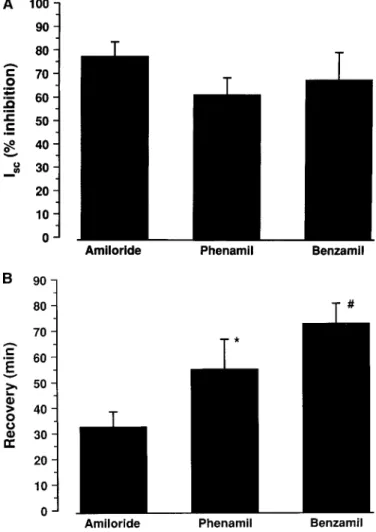
In vitro studies revealed an inhibition of Isc by 1024 M
amiloride, phenamil, or benzamil that ranged from 61 to 77% of the basal value that was not statistically different among treatment groups (Figure 4A and Table 1). There was a simi-lar degree of inhibition of PD in vitro (amiloride 73.4 6 8.0%, phenamil 58.2 6 3.0%, benzamil 64.8 6 7.0%; n 5 5) in each group. These data are consistent with reports of the maximally effective local concentration of each agent from previous stud-ies of airway epithelia (21). The fact that no drug completely
Figure 1. (A) Effect of 1023 M amiloride (lowest dose) on nasal PD
after nasal aerosol administration as a function of time. PD inhibi-tion and return to baseline after 55 min are shown. DPD% is the initial PD inhibition in percent of the baseline (67.1 6 2.9%), ET50
is the effective time of PD inhibition until return to the half-maxi-mal inhibition (0.7 6 0.02 h). (B) Effect of 1022 M amiloride
(high-est dose) on nasal PD after nasal aerosol administration. PD inhibi-tion and return to baseline (after z 185 min) are shown. Mean
DPD% is 77.3 6 4.3%, and mean ET50 is 2.2 6 0.12 h.
Figure 2. Effect of 7 3 1023 benzamil on nasal PD after nasal
Hofmann, Stutts, Ziersch, et al.: Effects of Benzamil and Amiloride 1847
abolished Isc reflects the fact that chloride secretion is induced
by Na1 channel blockade in normal airway epithelia (4). Upon perfusion with drug-free solution, the tissues in each drug treatment group approached full recovery of pretreatment Isc
(and PD), suggesting that each drug is a reversible inhibitor. However, the time required to recover to the pretreatment values varied significantly (Figure 4B): The amiloride tested group returned to baseline Isc most rapidly (32.6 6 6.0 min;
mean 6 SEM, n 5 5), followed by phenamil (55.0 6 11.5 min, n 5 5), whereas benzamil had the longest duration of effect (72.4 6 7.8 min, n 5 5, p , 0.05, different from amiloride and
phenamil). Time of recovery of PD paralleled the time of re-covery of Isc.
DISCUSSION
The overall goal of inhibiting sodium absorption by aero-solized amiloride therapy for CF lung disease is to normalize Na1 transport for therapeutically relevant intervals. In previ-ous clinical investigations, 1023 M and 5 3 1023 M amiloride
solutions were tested as aerosol therapy in patients with CF lung disease (11, 17, 18, 30). Despite indications of short-term efficacy of amiloride employing surrogate markers of disease and certain clinical indices, long-term beneficial effects of amiloride have been difficult to detect. One possible reason for this failure to observe a large drug effect of amiloride in chronic studies is the short duration of amiloride action. The half-life of inhaled 14C-amiloride on airway surfaces was
mea-sured and found to be short (t1/2z 35 to 40 min) (19). Our
findings are in agreement with these earlier estimates of the half-life of aerosolized amiloride on airway surfaces (Figure 1). Two options to enhance inhibition of sodium absorption for clinical use are available. These include a considerable in-crease of the daily dose of amiloride, or the use of substances with a higher affinity to the epithelial sodium channel. A po-tential benefit of the second option is reduction of the dosing frequency, which may improve patient compliance.
We used the nasal transepithelial potential difference as an index to compare the efficacy of a candidate high-affinity Na1 channel blocker, benzamil, with amiloride, to inhibit the ab-normally high rate of Na1 transport in CF (9, 28). Certain fea-tures of the PD technique for this study differ from previously published methods. Previous PD studies have been performed using a subcutaneous reference electrode (9, 29). We modified this protocol by using an epicutaneous reference electrode to extend the time frame (. 5 h) over which drug effects can be easily monitored (31). Measuring nasal PD with an epicutane-ous reference electrode yields slightly lower values than with a subcutaneous reference electrode (9, 29), whereas the vari-ability in the measurement of PD is similar (31). We also used a different method to apply amiloride and benzamil to the na-sal mucosa. Typically, drugs are administered by local super-fusion with simultaneous PD measurement using a double-barreled catheter. In this procedure, the PD sensing electrode is located precisely at the site of constant perfusion of a known drug concentration (7). However, this methodology requires extensive experience and is not suitable for long duration studies. Application of drugs via nasal aerosol with periodic measurement of PD is a simple alternative that better mimics
Figure 3. (A) Initial inhibition of nasal PD (DPD%) after nasal aero-sol administration of different concentrations of amiloride [1023 M
(n 5 16), 3 3 1023 M (n 5 9), 6 3 1023 M (n 5 7), 1022 M (n 5
3)] and benzamil [1.7 3 1023 M (n 5 7), and 7 3 1023 M (n 5
5)], expressed as percent of the baseline value (% 6 SEM). No sig-nificant differences were detected between groups. (B) Duration of the PD inhibition after nasal aerosol administration of different concentrations of amiloride [1023 M (n 5 16), 3 3 1023 M (n 5 9),
6 3 1023 M (n 5 7), 1022 M (n 5 3)] and benzamil [1.7 3 1023 M
(n 5 7), and 7 3 1023 M (n 5 5)] expressed as ET
50. When the
du-rations of effect (ET50) of amiloride and benzamil are compared
us-ing a general linear models procedure, the slopes are significantly different (p , 0.01).
TABLE 1
PHARMACODYNAMICS OF SODIUM BLOCKING AGENTS ON NASAL PD IN CYSTIC FIBROSIS NASAL EPITHELIUM BY FOUR DIFFERENT
DOSES OF AMILORIDE, AND TWO DOSES OF BENZAMIL
Sodium
Blocker Concentration n
DPD (%)
ET50
(h)
Time to Complete Return to Baseline
(min)
Amiloride 1023 M 16 67.1 6 2.9 0.7 6 0.02 z 55
Amiloride 3 3 1023 M 9 74.4 6 2.4 1.1 6 0.04 z 80
Amiloride 6 3 1023 M 7 75.9 6 3.5 1.6 6 0.06 z 130
Amiloride 1022 M 3 77.3 6 4.3 2.2 6 0.12 z 185
Benzamil 1.7 3 1023 M 7 74.9 6 3.0 1.7 6 0.3 z 180
Benzamil 7 3 1023 M 5 76.2 6 4.2 4.5 6 0.6 . 300
* No differences between groups.
1848 AMERICAN JOURNAL OF RESPIRATORY AND CRITICAL CARE MEDICINE VOL 157 1998
the results of the lung aerosol deposition required for clinical administration. We also chose vehicles (distilled water or iso-tonic saline) that do not alter nasal PD when nebulized to the nasal epithelium of normal subjects (10). Repetitive topical administration of isotonic saline (0.25 ml every 15 min) does not alter the nasal PD over an 8-h interval (32). Our experi-ence suggests that topical spray application is a reliable method that leads to a homogenous deposition of the drug to the nasal epithelium (10).
A maximal inhibition of basal PD was attained with all amiloride concentrations (DPD 67–77%, Table 1). Previous studies using the superfusion technique describe PD inhibition of 70–80% as the maximal inhibition noted in vivo in CF pa-tients, indicating that our aerosol delivery system delivers maximally effective drug concentrations (9). It is not clear what ion transport processes (i.e., a residual non–cystic fibro-sis transmembrane-conductance regulator [CFTR]-mediated Cl2 secretory current or amiloride-insensitive Na1 absorp-tion) support the remaining potential in vivo in CF patients.
Benzamil at both concentrations tested yielded similar maxi-mal DPD% as amiloride (Table 1, Figure 3A). Based on the observation that the DPD% values for the amiloride concen-trations and the two benzamil concenconcen-trations tested were equal, we conclude that both drugs are capable of maximally blocking sodium transport.
The data clearly indicate that benzamil is an attractive al-ternative to amiloride (Figure 3A, B). As noted above, the ef-ficacy of sodium transport inhibition after benzamil applica-tion in vivo is similar to amiloride, with a reducapplica-tion of PD to values within the normal range (Table 1, Figure 3A). How-ever, the time to return to baseline (ET50) is significantly
longer for benzamil than for amiloride (Figure 3B). The re-turn of PD to basal values following drug administration sug-gests that the inhibition of PD induced by each drug, including benzamil, reflects blockade of the Na1 channel and not dam-age to the epithelium. We speculate that the longer time for the PD to return to basal after benzamil reflects in part the higher affinity of the drug for the apical sodium channel.
The in vitro studies in cultured nasal epithelium comple-ment the in vivo comparison of amiloride and benzamil. The similar magnitude of drug-induced inhibition of Isc (and PD) in vitro indicates that maximal concentrations of each drug
were studied, and the concordance of drug effects on Isc and
PD in vitro indicate that in vivo PD is an accurate assessment of actions on Na1 transport (Figure 4A). The recovery of Isc
after removal of each drug application is consistent with a re-versible inhibition of the Na1 channel. The slower “washout” of benzamil inhibition is again similar to the in vivo results (Figure 4B). For the in vitro studies, drug concentration in the bulk solution was rapidly reduced to negligible levels by per-fusion with drug-free solution. Therefore, the slower recovery of Isc (and PD) after benzamil likely reflects a greater affinity
of the agent for the sodium channel. However, slower washout of the more lipophilic benzamil from a tissue surface compart-ment contiguous with the Na1 channel cannot be ruled out.
Previous binding studies using tritiated benzamil and phe-namil, as well as other studies of rank order potency for so-dium transport inhibition, are consistent with greater binding affinity and potency for benzamil relative to amiloride in renal epithelia (22). Very recently, Blank and colleagues compared the affinities of Na1 channel blockers for the epithelial Na1 channel in CF airway epithelia, including amiloride, and three of its analogs, benzamil, phenamil, and EIPA [5-(N-ethyl-N-isopropyl)-29-49-amiloride] (33). Their results showed that benzamil exhibits the highest affinity for these channels, indi-cated by the lowest half-maximal blocker concentration (in CF nasal tissue, 1,000-fold lower than amiloride). Phenamil, which had been described previously as having an irreversible effect on other Na1 channels, caused a reversible blockade of the epithelial Na1 channels. It was less potent than benzamil, but still 150-fold more potent than amiloride. Although ben-zamil is more potent than amiloride for Na1 channel inhibi-tion, benzamil has been reported to be less potent than amiloride for inhibition of the Na1/H1 exchanger (22). Conse-quently, benzamil may be the Na1 channel blocker of choice for further in vivo clinical studies because of its specificity for the Na1 channel. In vitro studies in sheep and rat tracheal epi-thelium (34, 35) did describe effects of very high concentra-tions of benzamil other than inhibition of apical Na1 conduc-tance, e.g., a decrease of the basolateral potassium conductance and blockade of cyclic guanosine monophosphate (cGMP)-gated Na1 channels, but these effects are also seen with amil-oride.
This is the first report on the sodium transport blocking ef-fect of benzamil in the respiratory epithelium in vivo. The
Figure 4. (A) Effect of amiloride and analogs, phenamil and ben-zamil (all 1024 M), on inhibition of the short circuit current (% of
original) of primary culture of normal human respiratory epithe-lium (n 5 5 in each group), indicating efficacy of inhibiting so-dium absorption. (B) Times to maximal recovery (Isc, time after
washout) from 5-min administration of amiloride, phenamil, and benzamil (all 1024 M) to primary culture of normal human
respira-tory epithelium. Percent recoveries were amiloride 84.1 6 7.1% (mean 6 SEM), phenamil 80.8 6 10.7%, and benzamil 79.4 6 6.9%. *p , 0.05, different from amiloride. #p , 0.05, different
Hofmann, Stutts, Ziersch, et al.: Effects of Benzamil and Amiloride 1849
greater target specificity of benzamil, greater potency, and its longer duration of sodium transport inhibition might lead to improved clinical outcomes, compared with amiloride, and re-duce the frequency of drug administration required for CF pa-tients. However, there are not yet sufficient safety data de-scribing benzamil delivered systemically or via aerosol to estimate its therapeutic index. Compared with amiloride, ben-zamil contains an additional benzyl moiety instead of one of the hydrogen atoms of the terminal amino group and is, there-fore, more lipophilic (22). Potentially increased toxicity com-pared with amiloride may be a consequence of this property of the analog. However, systemic central infusion of benzamil in Dahl S rats has been shown to prevent development of sys-temic hypertension after saline exposure, while not exhibiting any toxic effects (36). Complete safety studies will be manda-tory prior to further clinical studies in the lung. However, in view of these results and the need for novel and effective drug treatments for CF patients, further studies of benzamil as ther-apy for CF lung disease appear warranted.
References
1. Welsh, M. J., L. Tsui, T. F. Boat, and A. L. Beaudet. 1995. Cystic fibrosis.
In C. R. Scriver, A. L. Beaudet, W. S. Sly, D. Valle, J. B. Stanbury,
J. B. Wyngaarden, and D. S. Fredrickson, editors. The Metabolic and Molecular Bases of Inherited Disease. McGraw-Hill, New York. 3799–3876.
2. Knowles, M., J. Gatzy, and R. Boucher. 1983. Relative ion permeability of normal and cystic fibrosis nasal epithelium. J. Clin. Invest. 71:1410– 1417.
3. Anderson, M. P., D. P. Rich, R. J. Gregory, A. E. Smith, and M. J. Welsh. 1991. Generation of cAMP-activated chloride currents by ex-pression of CFTR. Science 251:679–682.
4. Boucher, R. C., M. J. Stutts, M. R. Knowles, L. Cantley, and J. T. Gatzy. 1986. Na1 transport in cystic fibrosis respiratory epithelia: abnormal basal rate and response to adenylate cyclase activation. J. Clin. Invest. 78:1245–1252.
5. Boucher, R. C., C. U. Cotton, J. T. Gatzy, M. R. Knowles, and J. R. Yankaskas. 1988. Evidence for reduced Cl2 and increased Na1 per-meability in cystic fibrosis human primary cell cultures. J. Physiol.
(Lond.) 405:77–103.
6. Tomkiewicz, R. P., E. M. App, J. G. Zayas, O. Ramirez, N. Church, R. C. Boucher, M. R. Knowles, and M. King. 1993. Amiloride inhala-tion therapy in cystic fibrosis: influence on ion content, hydrainhala-tion, and rheology of sputum. Am. Rev. Respir. Dis. 148:1002–1007.
7. Knowles, M. R., J. L. Carson, A. M. Collier, J. T. Gatzy, and R. C. Boucher. 1981. Measurements of nasal transepithelial electric poten-tial differences in normal human subjects in vivo. Am. Rev. Respir.
Dis. 124:484–490.
8. Knowles, M. R., M. J. Stutts, J. R. Yankaskas, J. T. Gatzy, and R. C. Boucher, Jr. 1986. Abnormal respiratory epithelial ion transport in cystic fibrosis. Clin. Chest Med. 7:285–297.
9. Knowles, M. R., J. Gatzy, and R. Boucher. 1981. Increased bioelectric potential difference across respiratory epithelia in cystic fibrosis. N.
Engl. J. Med. 305:1489–1495.
10. Hofmann, T., I. Senier, P. Bittner, G. Huels, H. J. Schwandt, and H. Lin-demann. 1997. Aerosolized amiloride: dose–effect on nasal bioelectric properties, pharmacokinetics, and effect on sputum expectoration in patients with cystic fibrosis. J. Aerosol Med. 10:147–158.
11. Kohler, D., E. App, M. Schmitz-Schumann, G. Wuertemberger, and H. Matthys. 1986. Inhalation of amiloride improves the mucociliary and the cough clearance in patients with cystic fibroses. Eur. J. Respir. Dis. 69(Suppl. 146):319–326.
12. App, E. M., M. King, R. Helfesrieder, D. Kohler, and H. Matthys. 1990. Acute and long-term amiloride inhalation in cystic fibrosis lung dis-ease: a rational approach to cystic fibrosis therapy. Am. Rev. Respir.
Dis. 141:605–612.
13. Bowler, I. M., B. Kelman, D. Worthington, J. M. Littlewood, A. Watson, S. P. Conway, S. W. Smye, S. L. James, and T. A. Sheldon. 1995. Neb-ulized amiloride in respiratory exacerbations of cystic fibrosis: a ran-domised controlled trial. Arch. Dis. Child. 73:427–430.
14. Visca, A., and E. Bignamini. 1996. Concentration of inhaled amiloride in cystic fibrosis. Lancet 347:1126.
15. Robinson, M., J. A. Regnis, D. L. Bailey, M. King, G. J. Bautovich, and P. T. Bye. 1996. Effect of hypertonic saline, amiloride, and cough on mucociliary clearance in patients with cystic fibrosis. Am. J. Respir.
Crit. Care Med. 153:1503–1509.
16. Bennett, W. D., K. N. Olivier, K. L. Zeman, K. W. Hohneker, R. C. Boucher, and M. R. Knowles. 1996. Effect of uridine 59-triphosphate plus amiloride on mucociliary clearance in adult cystic fibrosis. Am. J.
Respir. Crit. Care Med. 153:1796–1801.
17. Knowles, M. R., N. L. Church, W. E. Waltner, J. R. Yankaskas, P. H. Gilligan, M. King, L. J. Edwards, R. W. Helms, and R. C. Boucher. 1990. A pilot study of aerosolized amiloride for the treatment of lung disease in cystic fibrosis. N. Engl. J. Med. 322:1189–1194.
18. Graham, A., A. Hasani, E. W. F. W. Alton, G. P. Martin, C. Marriott, M. E. Hodson, S. W. Clarke, and D. M. Geddes. 1993. No added ben-efit from nebulized amiloride in patients with cystic fibrosis. Eur.
Respir. J. 6:1243–1248.
19. Knowles, M. R., N. L. Church, W. E. Waltner, J. T. Gatzy, and R. C. Boucher. 1992. Amiloride in cystic fibrosis: safety, pharmacokinetics, and efficacy in the treatment of pulmonary disease. In E. J. Cragoe, Jr., T. R. Kleyman, and L. Simchowitz, editors. Amiloride and Its An-alogs: Unique Cation Transport Inhibitors. VCH Publishers, New York. 301–316
20. Blank, U., W. Clauss, and W. M. Weber. 1995. Effects of benzamil in hu-man cystic fibrosis airway epithelium. Cell Physiol. Biochem. 5:385–390. 21. Stutts, M. J., C. M. Canessa, J. C. Olsen, M. Hamrick, J. A. Cohn, B. C. Rossier, and R. C. Boucher. 1995. CFTR as a cAMP-dependent regu-lator of sodium channels. Science 269:847–850.
22. Simchowitz, L., T. R. Kleyman, and E. J. Cragoe. 1992. An overview of the structure–activity relations in the amiloride series. In E. J. Cragoe, T. R. Kleyman, and L. Simchowitz, editors. Amiloride and Its Ana-logs. VCH Publishers, New York. 9–24.
23. Willumsen, N. J., and R. C. Boucher. 1991. Sodium transport and intrac-ellular sodium activity in cultured human nasal epithelium. Am. J.
Physiol. 261:C319–C331.
24. Hofmann, T. 1995. Kindgerechte Bestimmung der transepithelialen na-salen Potentialdifferenz am respiratorischen Epithel der Nase. Inau-gural-Dissertation Giessen 1994. Mikroedition Verlag Haensel-Ho-henhausen, Egelsbach–Frankfurt–Washington.
25. Cauna, N. 1982. Blood and nerve supply of the nasal lining. In D. F. Proctor and I. B. Andersen, editors. The Nose. Upper Airway Physi-ology and the Atmospheric Environment. Elsevier Biomedical Press, Amsterdam. 45–69.
26. Yankaskas, J. R., C. U. Cotton, M. R. Knowles, J. T. Gatzy, and R. C. Boucher. 1985. Culture of human nasal epithelial cells on collagen ma-trix supports. Am. Rev. Respir. Dis. 132:1281–1287.
27. Anonymous. 1990. SAS Institute, Inc. SAS/STAT Users Guide, Version 6. SAS Institute, Inc., Cary, NC.
28. Alton, E. W., J. G. Hay, C. Munro, and D. M. Geddes. 1987. Measure-ment of nasal potential difference in adult cystic fibrosis, Young’s syn-drome, and bronchiectasis. Thorax 42:815–817.
29. Alton, E. W. F. W., D. Currie, R. Logan-Sinclair, J. O. Warner, M. E. Hodson, and D. M. Geddes. 1990. Nasal potential difference: a clinical diagnostic test for cystic fibrosis. Eur. Respir. J. 3:922–926.
30. Lindemann, H., T. Becker, P. Bittner, A. Boldt, T. Hofmann, and H. J. Schwandt. 1990. Sekretelimination bei CF-Patienten unter Amilorid-inhalation [Elimination of secretions in CF patients under amiloride inhalation]. Pneumologie 44:1148–1150.
31. Hofmann, T., O. Böhmer, P. Bittner, G. Hüls, H. G. Terbrack, E. Heerd, and H. Lindemann. 1997. Conventional and modified nasal potential difference measurement: clinical use in cystic fibrosis. Am. J. Respir.
Crit. Care Med. 155:1908–1913.
32. Hofmann, T., C. E. Foy, J. M. Robinson, V. Homolya, R. C. Boucher, and M. R. Knowles. 1997. Dexamethasone increases sodium transport in human nasal epithelium in vivo. Ped. Pulm. (Suppl. 14):234. 33. Blank, U., T. Hofmann, W. Clauss, H. Lindemann, G. Hüls, and W.
We-ber. 1996. Inhibitory potency of amiloride, benzamil and phenamil on sodium conductances in primary cultured cystic fibrosis nasal epithe-lium (abstract). Isr. J. Med. Sci. 32:S225.
34. Acevedo, M., R. E. Olver, and M. R. Ward. 1991. Effect of benzamil on sheep tracheal epithelium. Exp. Physiol. 76:935–941.
35. Schwiebert, E. M., E. D. Potter, T. H. Hwang, J. S. Woo, C. Ding, W. Qiu, W. B. Guggino, M. A. Levine, and S. E. Guggino. 1997. cGMP stimulates sodium and chloride currents in rat tracheal airway epithe-lia. Am. J. Physiol. 272:C911–C022.
![Figure 3. (A) Initial inhibition of nasal PD ( DPD%) after nasal aero- aero-sol administration of different concentrations of amiloride [10 23 M (n 5 16), 3 3 10 23 M (n 5 9), 6 3 10 23 M (n 5 7), 10 22 M (n 5 3)] and benzamil [1.7 3 10 23 M (n](https://thumb-us.123doks.com/thumbv2/123dok_us/7935099.2109608/4.904.66.442.62.678/figure-initial-inhibition-administration-different-concentrations-amiloride-benzamil.webp)