Creating global
software: Text handling
and localization in
Taligent’s CommonPoint
application system
by M. E. Davis J. D. Grimes D. J. KnolesDeveloping software that can be used across global enterprises is one of the many challenges of today’s information technology systems. Taligent’s CommonPointTM application system eases this problem by providing a foundation for fully global software’ based on object-oriented frameworks and the Unicodem character encoding standard, This paper describes Taligent’s Unicode implementation and the CommonPoint text and international frameworks. It discusses how the CommonPoint system can be used to build international software and some of the advantages of object-oriented technology.
M
any organizations today are faced with the challenge of implementing software that op- erates seamlessly across national borders. The goal is to create global applications, that is, applications that have a single binary form that can be used ev- erywhere. These applications are then localized for use in a particular geographic region, usually a coun- try, that shares a language along with other local characteristics such as a time zone, currency units, and common number and date formats. Unfortu- nately, it is not easy to create global applications, and often a different binaryversion is needed to sup- port each country or region. In addition to the ex- pense and inconvenience of creating and maintain- ing multiple versions of an application, documentscreated using a particular localized version of a pro- gram cannot be displayed correctly by other versions. Taligent’s CommonPoint*
* application system fa-
cilitates the creation of global software. The Com- monPoint system comprises a set of integrated ob- ject-oriented frameworks, implemented in C ++,
that enable the development of modular object-ori- ented applications and documents. The Common- Point system runs as a layer on existing operating systems, including the Advanced Interactive Exec- utive* (AIX*) and Operating System/2* (0s/2*) en- vironments. The CommonPoint system allows ap- plications to be created with these global qualities:Users can enter and manipulate textual and nu- merical data in their native language, and can cre- ate and display multilingual text.
The application can be completely localized with- out accessing its source code. The interface can be presented in any user’s native language, and the same binary version can have multiple localized presentations.
Wopyright 1996 by International Business Machines Corpora- tion. Copying in printed form for private use is permitted with- out payment of royalty provided that (1) each reproduction is done without alteration and (2) the Journal reference and IBM copy- right notice are included on the first page. The title and abstract, but no other portions, of this paper may be copied or distributed royalty free without further permission by computer-based and other information-service systems. Permission to republish any other portion of this paper must be obtained from the Editor.
There is high potential for customization by both the user and the developer, provided by object- oriented frameworks and modular, data-driven objects. Users have more control over which re- sources they use, and developers can take advan- tage of the functionality already provided by the frameworks and focus on adding more specialized features and more localized resources.
This paper describes the support for globally distrib- utable software provided by the CommonPoint ap- plication system. The CommonPoint system enables international software development by providing:
An implementation of the Unicode*
*
character en- coding standard that provides a common mech- anism for storing character data regardless of lan- guage. The Unicode character set provides a full set of symbols and other characters, enables the creation of text in multiple languages and scripts, and provides data integrity.Text handling mechanisms that facilitate the stor- age and manipulation of multilingual-styled text Character input features that allow users to enter multilingual text using today's standard input de- vices
Localization services that allow localizable re- sources to be easily created, stored, and custom- ized for use in a specific language or geographic region
Powerful object-oriented frameworks and data- driven localizable objects that enable a high de- gree of customization and extensibility
The paper describes these mechanisms and discusses the impact of object-oriented technology on the im- plementation of international software.
Applying the Unicode standard
Use of the Unicode standard as the sole character encoding mechanism is the foundation for the Com- monPoint international feature set. Because the Uni- code standard is so fundamental to the design of the CommonPoint system's text and international frame- works, it is worth summarizing the standard and some of its features here.
Developed by the Unicode Consortium,* the Uni- code standard is a fixed-width, 16-bit character en- coding system that contains codes for every charac- ter needed by the major writing systems currently in use in the modern world, along with codes for a full range of punctuation, symbols, and control charac-
228 DAVIS, GRIMES, AND KNOLES
ters. The Unicode standard provides, in all, codes for over 34 000 characters from the world's alpha- bets, ideographs, and symbol sets. The standard in- corporates characters from many existing stan- dards-for example, the first 256 characters correspond to the International Organization for Standardization (ISO) Latin-1 character set (which attempts to provide character coverage for the ma- jor Western European languages)-and is compat- ible with the international standard ISO/IEC (Inter- national Electrotechnical Commission) 10646. 3,4
Along with a script or character name, the Unicode standard associates semantic information with each character that can be used to simplify text process- ing features. Each character can have an associated set of descriptive type properties identifying, for ex- ample:
Punctuation marks (for example,
[?I
and['I)
Diacritical marks (for example, ['1
and["I)
Uppercased, lowercased, and uncased letters (for example, [A] and [a], respectively-uncased let- ters appear in languages such as Hebrew andAr-
abic that do not distinguish between uppercase and lowercase)
Characters used to represent digits (for example, Control characters (for
101
and ~51) example, a carriage return or end-of-text character)Exclusive use of the Unicode standard for all char- acter data in the CommonPoint system automatically eases several of the problems inherent in creating international applications on many of today's cur- rent systems by providing a simple and consistent in- terface, for manipulating character data, that does not vary based on the language being manipulated. Many programs on existing systems are currently based on much more limited character sets-for ex- ample, the 7-bit ASCII (American National Standard Code for Information Interchange) character stan- dard. Several methods have been developed to help overcome the limitations of these relatively small character sets. The ISO 8859 standard, for example, provides a series of 8-bit extended character sets that use the standard ASCII character set for the first 7 bits and the eighth bit to define another 128 char- acters, thus extending ASCII to support a variety of additional languages.
This provides a partial solution for programs that need to support only a single language, or a set of languages whose character requirements are very
similar. However, implementing the ability to pro- Text handling duce many combinations of Character sets-requires
an additional enhancement: the use of switching codes, or escape sequences, that are embedded in
I the text and indicate the character set of the follow-
ing characters. This allows the creation of multilin- gual text, but text features become much more dif- ficult to implement because the program must implement mechanisms that determine the charac- ter set to which any given character or range of text belongs.
Providing applications that support Japanese, or other eastern languages that cannot be supported by an 8-bit character set, is even more complicated. In these markets, double-byte and triple-byte char- acter sets are used to define the large number of char- Typically these languages are encoded with a com- bination of single- and double-byte codes, such as shift-JIS (JIS is the Japanese Industrial Standard). Programs quickly become much more complex be- cause processing double-byte character data requires very different code than processing single-byte char- acter data.
These are some of the problems the Unicode stan- dard eliminates. The Unicode standard provides a built-in solution because it contains codes for vir- tually all of the characters needed to support all ma- acter is encapsulated as a 16-bit unsigned integer, so there is no need to write different code to deal with both single-byte and double-byte data. Perhaps more importantly, the integrity of text data is much higher because character data are always interpreted using a single encoding standard. This means that:
l acters-often tens of thousands-that are required.
l jor writing systems, in any combination. Every char-
Programming errors are minimized-text-process- ing code does not need to examine the current font, maintain escape-sequence state, or use any other heuristic to determine the semantics, or the byte
I boundaries, of a character. The semantic mean-
ing is inherent in the character code.
Data loss is prevented-internal conversions be- tween different code pages are not required. This prevents problems that occur today when charac- ters cannot be represented in current code pages, and means that loss of font information or escape- sequence tags does not destroy the meaning of the text data.
IBM SYSTEMS JOURNAL, VOL 35, NO 2, 1996 1
All text handling in the CommonPoint system is based on the Unicode standard described above. The CommonPoint system defines a system data type called UniChar, analogous to the C language data type char, which encapsulates individual Unicode char- acter codes. (Note: w-char is not used because, un- fortunately, the C+
+
standard does not guarantee that its implementation will be large enough to hold 16 bits.)All CommonPoint character data are encapsulated using the UniChar data type. Text data from a non- Unicode system can be converted to Unicode data at the point of entry into the CommonPoint system and then used anywhere. The CommonPoint text sys- tem provides special objects called transcoders to han- dle this conversion. Each transcoder supports a spe- cific non-Unicode character encoding standard, such as ASCII or JIS, and can handle mapping of character data both into and out of that standard. Transcod- ers can be built to support any character encoding. Higher-level text handling mechanisms provided by the CommonPoint system are also based on Unicode character data. The primary text-handling mecha- nisms are the basic text class TText, used to encap- sulate Unicode character strings, and the text edit- ing framework, which allows users to enter and edit multilingual-styled text.
Creating text objects. n e x t , an abstract class, de- fines the interface for text objects that are usable any- where in the CommonPoint system. Instances of TText subclasses can contain any combination of Unicode characters from any of the available scripts or symbol sets. This means that this class can be used to store and manipulate multilingual text strings with- out having to add any additional multilingual text- handling support. n e x t also allows styling informa- tion to be associated with any or all characters encapsulated by a text object. The exact implemen- tation for character and styling information is de- fined by TText subclasses.
Because TText provides a single set of protocols for text strings throughout the system, mixed-style text can appear anywhere text appears, including labels, buttons, menu text, dialog fields, and spreadsheet cells. TText bundles character and style information in the same object, which means that, unlike many current systems, text can be moved between Com- monPoint applications and subsystems without los-
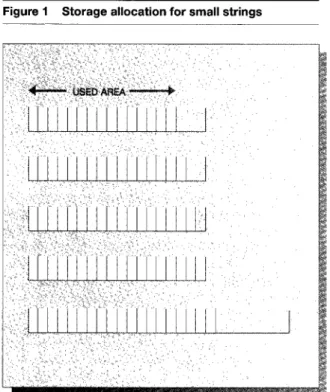
Figure 1 Storage allocation for small strings to entire paragraphs, as delimited by paragraph sep-
arator characters, so that specific character ranges need not be calculated. TStandardText manages all the necessary storage for these styles and ensures that styling information is stored efficiently. For ex- ample, any contiguous range of adjacent characters or paragraphs with identical styling information al- ways shares a single style set. TStandardText objects allocate space for styling information only when the style is actually applied to the text. This means that unstyled text objects are very lightweight, yet the same class can be used to store fully styled text data. TStandardText also ensures that no contradictory styling information is applied to the same text. If a user applies a red color style to a character string, for example, any existing color style information is replaced.
Figure 3 shows the class relationships for text and style classes. The “A7’ symbol indicates an abstract class or method or an inheritance relationship (for example, TStandardText is a subclass of the abstract class n e x t ) . The “n” indicates a one-to-many re- lationship (for example, a TStyleSet object can con- tain more than one TStyle object).
ing any of the styling information. The system in- cludes a concrete subclass, TStandardText, that provides the primary mechanism for representing styled text.
Storing character data. TStandardText can be used for strings of almost any size, from only a few char- acters up to 2 billion characters. TStandardText ob- jects dynamically change their storage allocation strategy to provide efficient storage at different sizes. At small sizes, each instance uses a single contigu- ous block of memory. For efficiency, the block is re- sized only when necessary. Figure 1 shows the use of memory with successive character insertions. The strategy automatically changes to use discontiguous storage for longer strings, as shown in Figure 2. This implementation provides for much better perfor- mance when inserting and deleting characters, avoid- ing rescoping or reallocating data unnecessarily.
Storing style data. TStandardText also implements a storage mechanism for styling information. Individ- ual styles or groups of styles (called style sets) are created, and then applied to specific characters or ranges of characters in the text object. Styles that apply to paragraphs rather than individual charac- ters, such as indentation or justification, are applied
Note that styles in the CommonPoint system derive from the general protocol for data attributes. In CommonPoint, text styles never affect the underly- ing meaning of the character data (unlike in the Macintosh system, where multiple character sets are supported by a single character encoding by apply- ing different fonts for each character set). Text styles simply associate additional characteristics with the text, typically describing how it should be displayed. While encapsulated in a single text object, style data are actually parallel to character data and can be ig- nored by text operations such as searching for and sorting character strings.
Subclasses of the abstract class TStyle support a wide variety of text styles, including common styles such as font, point size, weight (for example, bold or light), posture (for example, italic or backslant), typo- graphic style, letter-spacing, line-spacing, justifica- tion and paragraph indentation, superscripts and subscripts, color, underlining, and so on. The styl- ing mechanism can also be used to apply arbitrary graphic transformations to text strings, such as skew- ing, stretching, and rotating, as shown in Figure 4.
In addition to the kinds of styles used to determine how to render (or display) text, the styling mecha- nism supports nonrendering styles that can be used 230 DAVIS, GRIMES, AND KNOLES IBM SYSTEMS JOURNAL, VOL 35, NO 2, 1996
Figure 2 Storage allocation for longer strings
Figure 3 Class relationships for text and style classes
~~~
to encapsulate other information about characters ing a multilingual text document for text of a or paragraphs. For example, the style TLanguage- particular language-text of other languages could Style identifies the natural language of a character be eliminated from the search range. This informa- string, providing information in addition to the char- tion also enables the system to effectively select an acter information inherent in the Unicode represen- appropriate font for displaying character strings if tation. This might be useful, for example, in search- a font is not explicitly specified. Because any class
Figure 4 Text string transformations
“Text allows you to
skevv;
stretch,
and
~ o p p
text, in addition to
applying traditional styles such as underlines,
;f,~!:.~i.:-,and
Sizes.
descending from TStyle can be applied to a range of characters in a n e x t object, TStyle subclasses can be designed to add arbitrary information to any piece of text.
An important aspect of the CommonPoint text and international features is the separation of language- sensitive facilities from basic string storage and ma- nipulation. For example, a TTextComparator object, an object that encompasses the rules necessary for language-sensitive string comparison, is a separate object. Different comparators can be used with dif- ferent strings at will-no global state is involved. Ad- ditionally, as a separate object it can be:
Sent to a server for remote sorting and searching Modified (that is, rules can be added or deleted) operations
and then applied to text
User editing features. Support for display and ed- iting of styled text is provided by the text editing framework. Like other CommonPoint frameworks, the text editing framework is extensible and provides a foundation for continued evolution of text editing f~nctionality.~ The text editing framework is in- tended to provide a complete text editing facility that can be used by applications in which the primary fo- cus is not text editing, for example, for e-mail or for text fields in a charting program. Word processing
232
DAVIS, GRIMES, AND KNOLESand desktop publishing programs should not subclass this framework, but build directly on the underlying system support. The text editing framework is inte- grated with the rest of the system, and is based on other application frameworks that provide features such as automatic “undo” and “redo” of user actions, collaboration, and the ability to embed other data types (for example, movies or graphics) within text.6 The editable text data type is based on TStandard- Text and provides the additional features needed to display and edit the character and style data. The text editing framework provides a fully functional in- terface for entering text, including preassembled menus that allow users to apply any of the character or paragraph styles described above to any selected range of characters or paragraphs. The framework also includes a set of cursor tools that provide an alternative mechanism for applying styles-the user activates the tool and uses the mouse or cursor to apply styles through direct manipulation.
The text editing framework supports entry and dis- play of text in arbitrary combinations of languages and scripts. Input of multilingual text using the key- board is enabled by a set of typing configurations, described in more detail in the next section. The framework provides menus that allow users to switch between any available typing configurations-includ- ing English, French, Greek, and Japanese-to en-
Figure 5 Multilingual text in a document
i
You can enter multilingual text in CommonPoint documents. For
example, you can enter some Japanese
text
8
and then return to
English or enter another language.
ter multilingual text into a single document. The framework provides intuitive behavior for switching between configurations. For example, the framework automatically changes the font, if necessary, when the user activates a new typing configuration. When the user switches from an English keyboard config- uration to a Russian keyboard configuration, for ex- ample, the framework automatically begins apply- ing a Cyrillic font to the input text. The framework also reactivates the correct typing configuration when a user places the cursor arbitrarily into a text doc- ument. For example, if a user placed the cursor within the Kanji ideographs in the document shown in Figure 5 , the Japanese typing configuration would automatically be activated.
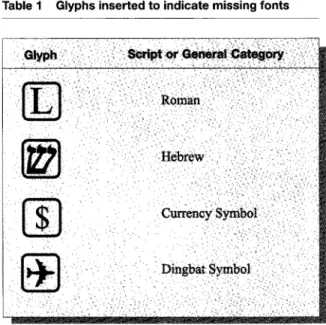
The text editing framework also implements a font substitution mechanism to ensure that multilingual text data are always displayed meaningfully. This mechanism is automatically activated when the user enters a character that is not displayable by the cur- rent font. Instead of displaying a “box” or other meaningless glyph, the mechanism searches the avail- able fonts for the correct glyph to display that char- acter, using heuristics that take context into account. If it cannot find an appropriate glyph, it displays a glyph from a special font provided by the Common- Point system that identifies the script or general cat- egory of that character. These glyphs are enclosed by a rounded rectangle so that you can identify im-
IBM SYSTEMS JOURNAL, VOL 35, NO 2, 1996
mediately that an additional font must be installed to display the data. For example, Table 1 shows the glyphs used to represent missing glyphs from sev- eral scripts and categories. This mechanism ensures meaningful display of multilingual text and facilitates the exchange of text documents internationally. Entering multilingual text
Multilingual character input in the CommonPoint system is enabled by typing configurations, each of which supports typing in a specific script or language. Users generally select a typing configuration as the default for their system. However, they can activate different configurations arbitrarily to enter multilin- gual text, as described in the previous section. A typing configuration consists of several compo- nents:
A virtual keyboard mapping
One or more text modifiers (tools that map char- acters from one sequence into another based on context)
Optionally, an input method for entering ideo- graphic characters such as Kanji
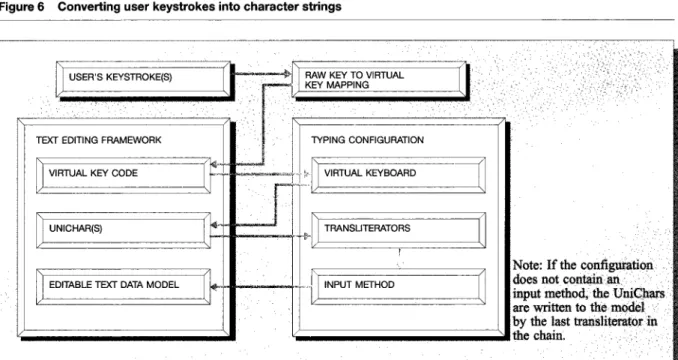
As the user types, the CommonPoint input system converts keystrokes to key codes and passes them to the active typing configuration. The typing config-
Table 1 Glyphs inserted to indicate missing fonts
uration creates the correct character string and in- serts it into the document, as shown in Figure 6. Each of these elements takes advantage of the Unicode foundation and of the data reuse inherent in object- oriented technology to provide efficient, robust typ- ing functionality.
Virtual keyboards. The virtual keyboard is the only required element in the typing configuration. The virtual keyboard provides a mapping between the codes issued by the physical keyboard and virtual key codes associated with specific characters. Generally a virtual keyboard mapping corresponds to a spe- cific language, so there can be multiple keyboard mappings that support a particular script. For exam- ple, on an English keyboard, key 2 (the “Q” key on a QWERTY keyboard) maps to the character “q,” while on a French keyboard it maps to the character “a.” A virtual keyboard can produce any text object from a keystroke, including multiple characters and styled text. For example, a keyboard could be con- figured to enter the user’s name or another common string with a single keystroke.
Text modifiers. After the virtual keyboard deter- mines the correct character codes, they are processed by any text modifiers in the configuration. The typ- ing configuration allows text modifiers to be chained together, so that the modified text produced by one text modifier is the input text to the next text mod- ifier. Currently the CommonPoint system has defined 234 DAVIS, GRIMES, AND KNOLES
two kinds of text modifiers: lexical tools and trans- literators. Lexical tools operate on words, such as spelling or grammar checkers. Lexical tools can be added directly to the typing configuration so that these operations occur as the user types.
The CommonPoint system does not currently pro- vide any lexical tools directly. It does, however, in- clude a number of transliterators. Transliterators perform transformations on text input based on a specific algorithm or set of rules. Transliterators can, for example, perform the following as the user types: Provide accent composition, such as combining the key sequence [a][”] or [“][a] into the single char- acter [a]. Transliterators allow this to occur with- out needing “dead keys,” that is, key combinations such as alt-U that do not create a display until the character to be accented (the “a” in this case) is Change the case of selected letters, such as cap- italizing the first letter of each word or sentence Create “smart quotes,” that is, replace straight quo- tation marks with left and right quotation marks as appropriate
Provide phonetic transcription between scripts, for example, between Latin and Greek or between Ro- maji and Kana
typed.
Most of the transliterators provided by the Common- Point system are rule-based, meaning that they use a table of rules to determine how to modify the text. Each rule has up to four fields defining the input text, the output text, and, optionally, preceding and suc- ceeding contexts that allow the rules to be context sensitive. Each rule field can contain up to 256 char- acters, allowing the creation of very specific rules. Table 2 lists example fields for the very simple trans- literation operation of changing straight quotation marks to left and right quotation marks. The rules are traversed in order, and once a rule is applied the transliteration is complete. “NIL” could be specified for the preceding context in the second rule in Ta- ble 2, because if the criteria for the first rule is not met the second rule must be applied.
Range variables can be specified that provide a lim- ited amount of wildcard matching for rule input and context fields. For example, a variable might be de- fined to represent all uppercase letters (the range A-Z) or all vowels (the set aeiouAEIOU). Inverse rules can be created that are applied if a character in the variable range or set does not appear in the
Figure 6 Converting user keystrokes into character strings
~ ~ _ _ _ _ _ ~~~~~
Table 2 Sample rules for transliteration
~ ~~~
Change straight quotation II /I Letters, NIL
mark to right quotation punctuation mark when ending a
quotation
.**
Change straight quotation II VI NIL
m
mark to left quotation mark when beginning a
quotation
I * I ,
,I ,I I
input field. For example, all nonletter characters could be identified by creating an inverse rule based on the ranges a-z and A-Z.
Once a transliterator is built, it can be used anywhere in the system to perform text processing-even pro- grammatically outside the typing configuration. For example, commands that change letters from low- ercase to uppercase or that change the alphabet of selected text could use transliterators.
Input methods. Finally, the typing configuration can include an input method to allow phonetic entry of ideographic characters (used primarily by Chinese, Japanese, and Korean). Input methods often take the results of transliterators and provide more so- phisticated processing. For example, a Japanese typ- ing configuration can use transliterators to convert from a Roman transcription of Japanese text into Kana, and then use an input method to convert from Kana to Kanji. Input methods define both the tech-
nique for parsing the input and the user interaction model, for example, how alternate options for hom- onyms are chosen.
The CommonPoint input method framework allows input methods to be modular. The interface for an input method is the same no matter what type of doc- ument is being created or changed. The system cur- rently includes an input method for Japanese; oth- ers can be added. The system also provides a porting interface to make it easier to port existing non-Uni- code input methods.
Localization
The CommonPoint system includes specific services that support localization. The services support the creation of customized resources for a particular lan- guage, country, or region. Many of these resources are modular and can be added to the system at any time for use by any application. They include:
Language-specific text analysis features such as col- lation, searching, and boundary analysis
Language- or region-specific text-to-binary scan- ning and formatting for data types such as dates, times, and numbers
Conditional formatting
Additionally, mechanisms are provided for collect- ing and accessing the resources for a particular region, including the ability to define fine-grained localizations and to archive program interfaces lo- calized for a number of different presentation lan- guages.
Collating and searching. Common sorting opera- tions on strings rely on an ordering of the charac- ters, called a collation order (often thought of as an alphabetic order). For example, if an alphabetic se- quence specifies that [a] is less than [b], in an alpha- betized list strings beginning with [a] would come before strings beginning with [b]. Collation orders are used to enable more natural sorting and search- ing than a simple ordering based on character codes can support. For instance, in the ISO Latin-1 char- acter set, the code for [Z] is less than the code for [a] and the code for [z] is less than the code for [ii], which leads to incorrect sorting results. Collation or- ders differ between languages, sometimes even when those languages use the same script-for example, French sorts differently than Swedish. Some lan- guages also do not have a single “standard” colla-
236
DAVIS, GRIMES, AND KNOLEStion order that can be used for every sorting oper- ation.
Because of the requirements of natural language, col- lation orders must implement a number of features to provide intuitive sorting. The CommonPoint sys- tem defines a table-based approach for creating col- lation orders (instances of the class TTextCompara- tor), based on the Unicode standard, that allows full functionality for language-sensitive sorting. To sup- port this functionality, CommonPoint collation or- ders support:
Ordering priorities for up to three levels of col- Normal or reverse “French” orientation
Multiple character mappings for grouped or ex- Two levels of ignorable characters
Ordering for unmapped characters
Ordering priorities enable collation features in which characters that are often considered equivalent for sorting purposes (for example, the uppercase and lowercase versions of a character) are sorted together as users expect. Simply reordering characters, such as ordering an uppercase [PI between the lowercase [p] and [q], is not sophisticated enough to produce the preferred results; with this scheme, for example, “put” would sort before “Pet” because the lowercase [p] is less than the uppercase [PI.
Ordering priorities define the priority of the differ- ence between any two adjacent characters in the ranking; differences between two characters can be primary, secondary, or tertiary. In the English col- lation order, for example, the difference between [a] and [b] is primary, the difference between [a] and [a] is secondary, and the difference between [a] and [A] is tertiary. Other European languages may have other features that correspond to secondary or ter- tiary differences.
When comparing, secondary differences are consid- ered only when there are no primary differences. So,
for example, the secondary difference between [e] and [C] is used to sort the following strings: resume
rCsumC resumes
Likewise, tertiary differences are only considered when there are no primary or secondary differences.
lation
panding characters
The tertiary difference between [r] and [R] is used to sort the following strings:
resume Resume rCsumC
Note that ordering priorities can be used to control the sensitivity of searches. For example, case-insen- sitive searches in English text can ignore tertiary dif- ferences: - resume and Resume would be considered equal.
The ability to specify orientation enables correct sort- ing of French, which attaches more weight to accent differences that occur later in the strings being com- pared rather than earlier in the strings. For exam- ple, the string “pcche” sorts before “pkchC,” but the string “pCcher” sorts before “pEcher.” Whether to use the reverse French orientation for sorting only secondary differences or both secondary and tertiary differences can be specified.
Multiple character mappings allow correct compar- isons when a single character expands to multiple characters (for example, the [0] in German is some- times mapped to [o][e]) or when multiple charac- ters are grouped as a single character (for example, the [ch] character grouping in Spanish). This allows “Tonen” to be sorted before “Ton” in German, or “czar” before “chico” in Spanish.
Ignorable characters allow the identification of char- acters, such as punctuation marks or accents, that should be ignored in certain contexts. These are char- acters that generally represent a secondary or ter- tiary difference but can be ignored if there are no other differences in the string. For example, by iden- tifying the hyphen as an ignorable character, the strings “blackbird” and “black-bird” would be con- sidered equivalent.
Finally, the CommonPoint collation orders allow control of the ordering of characters that do not need to be mapped by the ordering object. Generally these are characters for which ordering is not relevant, such as dingbats or other symbols. For efficiency they can be ordered using the values of their Unicode char- acter codes, or sorted before, within, or after the gen- eral ordering defined by the collation object. Collation orders also provide a high level of param- etrization, allowing programmers to exercise control over the collation process and to retrieve informa-
-
IBM SYSTEMS JOURNAL, VOL 35, NO 2, 1996
tion about the results. For example, the program- mer may need to know exactly the point at which differences occur between two strings so that common initial substrings can be identified; the collation ob- ject’s comparison functions return this information. The CommonPoint collation orders implement the algorithm defined by Unicode Version 1.1 that iden- tifies when two sequences are considered equiva- lent-for example, the composed sequence [a][” ] is equivalent to the precomposed character [a]-allow- ing them to be collated identically.
These collation orders also form the basis for the CommonPoint text-searching mechanism. The sys- tem includes classes for objects that iterate through text, looking for a particular string, using collation orders to provide language-sensitive searching. The features described can be used to influence the search results-for example, in English a case-insen- sitive search can be done by telling the collation or- dering object to ignore tertiary differences. The sys- tem implements an algorithm for sublinear searching that enables searching to be done very quickly, yet handles international comparisons. 7”1
Collation ordering objects provide an efficient mech- anism for building international sorting and search- ing features. Because collation orders are inter- changeable, features can be created that are not dependent on a particular language. The program interfaces with the collation object, and different col- lation objects can be substituted to provide correct results for text in different languages. These oper- ations also benefit tremendously from the use of Uni- code-cross-language searches are more easily en- abled because of the uniform character encoding. Because they are table-based, collation objects can be built easily by supplying the appropriate data; or- derings that require more sophisticated processing, such as those requiring dictionary lookup, can be cre- ated by subclassing the abstract class TTextOrder. Collation objects can also be merged. For example, French and Arabic objects could be combined to cre- ate a collation order for use in North Africa. One of the original orderings would be specified as the “master” so that its rules take precedence if any con- flicts arise. The rules from the “slave” are added wherever they do not conflict with the master.
Performing boundary analysis. Boundary analysis is done to programmatically break up a Unicode text string into logical text elements such as characters, words, lines, or sentences. This allows users to nav- igate through a display of characters one at a time
using cursor keys, or to select a word, line, or sen- tence with a double or triple mouse-click. It also de- termines the necessary information to allow text to be dynamically formatted into lines.
This analysis is not trivial, especially given that the desired results may vary between regions. Often the text alone does not provide enough information to determine boundaries-for example, the ambiguous use of the period character as both an end-of-sen- tence indicator and within abbreviations can make it difficult to determine sentence boundaries cor- rectly. However, heuristics can be applied that pro- duce reasonable results in most cases, especially for user selections that do not need to be exact. The re- quirements can also change based on the operation being performed. For example, trailing spaces can be included in word elements, but for operations such as search-and-replace, the inclusion of trailing spaces as part of the word can cause the search to fail. Rather than develop algorithms to search for the ac- tual text elements (words, sentences, and so on), the CommonPoint system implements a mechanism that looks for the boundaries between those elements. This simplifies the necessary computation, allowing the elements to be identified more quickly. The Com- monPoint system also gives the ability to override this mechanism for instances in which more sophis- ticated processing, such as dictionary lookup, is also required.
Boundary analysis for particular kinds of text ele- ments is performed by iterators, each of which is based on a specification of where boundaries can oc- cur for an element. The boundary specification de- fines different collections of characters and lists the rules for boundaries in terms of those character col- lections. The character collections can be specified either as a list of characters (literal characters or ranges of characters) or as a Unicode character prop- erty, as defined in the CommonPoint Unicode im- plementation (for example, letters or closing punc- tuation marks).
For example, a specification for determining sen- tence boundaries might define the following char- acter collections:
Paragraph and line separator characters Space separator character
Nonspacing marks Closing punctuation
Terminating characters ("!" and "?")
238
DAVIS, GRIMES, AND KNOLESPeriod character
Capital letters (uppercase letters, title case letters, Lowercase letters
The following rules could then be defined to deter- mine sentence boundaries:
1. Always break after paragraph separators. 2. Break after sentence terminators, but include
inside the sentence boundary any nonspacing marks, closing punctuation, and trailing spaces. 3. Handle periods separately because they may be within an abbreviation or number rather than a terminating character. Do not break the sentence after the period if it is followed by a lowercase letter instead of an uppercase letter.
and noncased letters)
An implementation of this specification is created by mapping characters to a type identifier (TypeID) and using the TypeIDs to determine the boundaries with a state table that expresses each rule as a state transition. This is encapsulated by an iterator object that can be used to iterate either forward or back- ward through a block of text, searching for bound- aries of a particular type of text element. The sys- tem also includes a mechanism that ensures accuracy when the iteration is begun at a random point within the text. For example, if the cursor is placed in the middle of a sentence when iteration for sentence boundaries begins, the iterator will locate the start- ing boundary of the sentence before moving forward.
Scanning and formatting numbers and times. Text formatting is the process of converting binary data (such as a number) into a meaningful textual rep- resentation; scanning is the reverse operation. The CommonPoint system provides objects called for- matters that perform both formatting and scanning for the system data types representing numbers and times. The formatter classes can also be subclassed to provide scanning and formatting capabilities for other data types.
Generally, localized instances of these formatters are created to provide the correct behavior for specific regions. For example, formatters could be created that produce a string representing the same binary number in either an American (9,999.99) or a French (9.999,99) format, or represent the number using a different numbering system (for example, Roman nu- merals). Because these formatters manipulate n e x t data, styling information can be used to express or interpret meaning. For example, negative numbers
can be represented in red, or scientific notation in the format 1.23 X lo3, where the superscripted num- ber is always the exponent. Nondigit characters can be attached to the output, so, for example, number formatters could provide currency formats such as “$300.00” or “f19,999.”
The CommonPoint system provides a set of num- ber formatters for a variety of formats. These include floating-point numbers, scientific notation, Roman numerals, fractions, and Han numbering. These for- matters give a great deal of control over the details of number formatting, for example, separator char- acters, rounding precision, zero-padding, and so on. The system also includes formatters for converting the system’s internal time representation into the cor- rect local time in the desired format. The internal representation is a flow of time according to the in- ternational standard called Coordinated Universal Time (uTC) which is equivalent to Greenwich Mean Time. These formatters use several resources to pro- duce a meaningful textual representation: a time zone defining the differential from GMT, a calendar object defining the calendaring system (for example, Gregorian or Arabic), and a pattern defining the fields of interest and their format. The same binary UTC data could be formatted into any of the follow- ing: “2:15 pm,” “1415 hours,” “Monday, May 1,” “1-5-95,” or other created patterns.
Allowing conditional formatting. CommonPoint for- matters allow for conditional formatting and subfor- matting of text representations based on the value of certain fields. This allows, for example, the cre- ation of messages that are grammatically correct. For example, a conditional formatter could generate the messages:
“You have not deleted any files.” “You have deleted 1 file.” “You have deleted 3 files.” instead of the generic message: “You have deleted 1 file@).”
To generate these messages, a special formatter called a parameter formatter is created that checks an input parameter (in this case, the parameter rep- resenting the number of files) and chooses the right text based on its value. This is particularly useful in more complex scenarios; for example, in some Slavic languages the plural form of a noun changes based
IBM SYSTEMS JOURNAL, VOL 35, NO 2, 1996
on whether there are two items, three to five items, or more than five items. These formatters can also be used to format and scan the date and time pat- terns described above. Aparameter formatter maps the numeric value of a field, for example, “1” in the “month” field, to a language-specific textual repre- sentation such as “January” or “Janvier.”
Parameter formatters also enable flexible scanning by allowing the specification of alternate text matches for specific fields or ranges in the scan text. For ex- ample, when scanning formatted dates, the dates “1-1-99” and “1/1/99” should scan identically. Param- eter formatters allow the character [/] to be spec- ified as an alternate match for the [-] character.
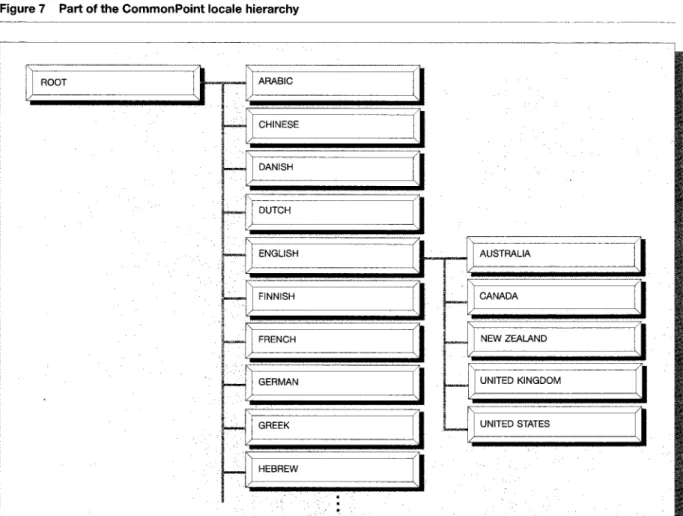
Enabling the localization process. To facilitate the process for localizing software, the CommonPoint system includes the locale mechanism. Conceptually, a locale represents a geographic region for which ob- jects need to be localized-locale objects then col- lect all the objects for a particular locale. Locales are organized into a hierarchy that descends from a single root locale. The first level beneath the root generally represents languages, and levels beneath that represent increasingly fine-grained locales. Figure 7 shows part of the CommonPoint locale hi- erarchy. This hierarchy allows regions to share com- mon resources from a high-level locale rather than duplicating it. For example, the United States and the United Kingdom can share language-specific re- sources, while lower-level locales provide resources that are country-specific, such as date, number, and currency formats.
Locales are associated with open-ended collections of heterogenous locale objects. Objects commonly referenced by locales include a country identifier, a language identifier, a default typing configuration, font preferences, and a number of typical date and number formatters. New kinds of objects can be added to any locale at any time.
The locale hierarchy also helps organize multiple lo- calized interfaces for applications. Each program has an associated archive that contains all the localiz- able interface elements, such as menu labels, sounds, and icons. The information in these archives is or- ganized according to the locale hierarchy shown above, allowing it to contain multiple versions that correspond to different languages or regions. Apro- gram’s archive could contain localized interfaces in French, Russian, English, and Japanese. The user
Figure 7 Part of the CommonPoint locale hierarchy
UNITED KINGDOM
can then choose a preferred language, and the sys- tem presents the program interface in that language if it exists in the archive. If the program has not been localized to that language, the default presentation for the program is used-generally the language in which the program was originally created. Taligent provides an interface development tool, the cpConstructor*
* User Interface Development Tool,
that makes it easy to create an archive for a program’s interface and to localize that interface for use in any number of locales.Taking advantage of object-oriented technology
Object-oriented design philosophy provides several implementation advantages for the international software features described in this paper. The Com-
monPoint application system, including the text and international frameworks described here, derive sev- eral advantages from being object-oriented that are important to the development of international soft- ware: they are modular, data-driven, and tailorable. The modular nature of an object-oriented system al- lows individual pieces of functionality to be added arbitrarily. This means that new localized resources can be added to the system at any time. They are immediately usable, and do not interfere with any already-installed objects in that locale. Multilingual or international users can choose between virtual keyboards or collation orders for different languages, number and date formatters for various standard for- mats, and so on. From the developer’s standpoint, many of these resources are already available and can be used as-is in new programs, making the de- velopment of international software much more ef- 240 DAVIS, GRIMES, AND KNOLES IBM SYSTEMS JOURNAL, VOL 35, NO 2, 1996
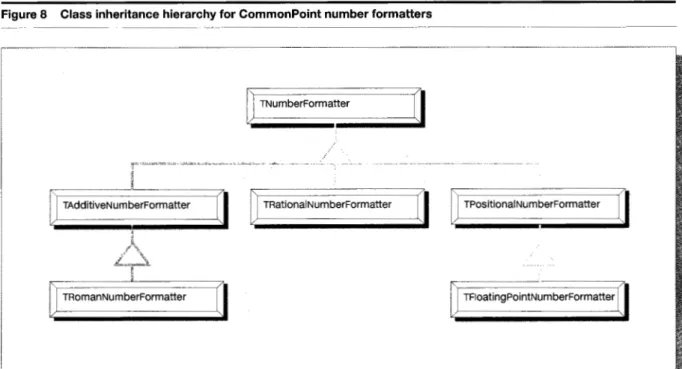
Figure 8 Class inheritance hierarchy for CommonPoint number formatters
TAdditiveNumberFormatter
I'
rFormatter
il
.l."..". .h. . .. . . - . . . . .. ..
TRationalNumberFormatter TPositionalNumberFormatter
ficient. Because these objects are independent of the locale, they can be accessed, or copied and altered. They can also be shipped to a server which may not even have the original locale.
Development is also more straightforward because all objects of a particular type behave the same way, regardless of what region or language they are lo- calized for. Standard protocols are defined for each type of object, but the behavior of a particular in- stance is determined by the encapsulated data. For example, a collation ordering object can be relied on to provide protocol for comparing two strings- the result of the comparison, however, is determined by the language-specific data that define that colla- tion order. New collation objects for other locales can be built easily, just by providing the correct ta- ble of collation rules, or an existing object can be customized by editing the collation rules. This cus- tomization is easily provided with any of the inter- national objects that are table-based, including col- lation orders, text boundary specifications, and virtual keyboards. Other types of objects are param- etrized to allow them to work with different data. For example, number formatters can be instantiated to work with the different sets of digits supported by the Unicode standard, such as Arabic or Bengali digits.
The inheritance mechanism provided by the object- oriented implementation can be used to create ob- jects that are more finely tailored to specific needs. Subclassing allows preexisting data and functional- ity to be reused, so that programming efforts can be concentrated on providing more specialized or so- phisticated features. The CommonPoint number for- matters provide an example of how inheritance can be used to create increasingly specialized objects, as shown in Figure 8.
Higher-level classes provide more generic functions for converting between binary numbers and text rep- resentations. Classes further down in the hierarchy inherit that functionality and provide additional func- tionality that is more specific to particular formats. For example, the rational-number formatter provides functions for specifying whether to superscript and subscript the numerator and denominator portions of the fraction, while the floating-point-number for- matter provides functions for setting formatting op- tions for exponential notation.
The inheritance mechanism also makes customiza- tion easier when large amounts of data are involved. For example, the JIS character encoding set includes thousands of characters. Variations of JIS use slightly
different encodings but are all algorithmically derived
from the same basic standard. Instead of creating a different transcoder to encapsulate all the necessary data for each variation, a more efficient implemen- tation could be created using inheritance. The transcoder for each variation could be subclassed from a base JIS transcoder class, and, instead of du- plicating the data, functions can be overridden or added to create the variation algorithmically. The implementation is not only simpler but the derived classes can be used polymorphically.
Conclusions
Taligent’s CommonPoint application system pro- vides an example of how object-oriented principles can be applied to provide improved functionality in areas that are crucial to the development of global software-text handling, character input, and local- ization. The text system provides a model for mul- tilingual text manipulation, as well as a simple mech- anism for creating and collecting the resources that are appropriate for any given locale. The Common- Point system’s object-oriented implementation makes it easy to use, extend, and customize, giving developers a high degree of flexibility. Exclusive us- age of the Unicode character encoding standard is also integral to the CommonPoint strategy for in- ternational software development, providing a much greater degree of integrity for character data. The CommonPoint text and international frame- works described in this article comprise hundreds of classes and thousands of functions. This rich in- ternational feature set, combined with pure object- oriented implementation, make the CommonPoint application system a powerful foundation for devel- oping global software applications that can be local- ized for fine-grained regions, yet remain integrated and compatible across modern international orga- nizations.
*Trademark or registered trademark of International Business Machines Corporation.
**Trademark or registered trademark of Taligent, Inc. and Uni- code, Inc.
Cited references and notes
1. This paper has been substantially revised and expanded from an earlier version published in Objects in Europe, a Supple- ment to SIGS Publications 2, No. 2 (July-August 1995). 2. The Unicode Consortium, a nonprofit organization, was
founded in 1991. Members of the consortium include major computer corporations, software producers, database vendors, research institutions, international agencies,
and various use groups. For more information on the Uni- code Consortium, see the Unicode home page at http:
iiwww.stonehand.comiunicode.htm1.
3. The Unicode Consortium, The Unicode Standard: Worldwide Character Encoding, Version 1.0 (2 volumes), Addison-Wes- ley Publishing Co., Reading, MA (1991).
4. The Unicode Standard, Version 1.1., Unicode Technical Re- port #4 (prepublication edition), The Unicode Consortium,
Mountain View, CA (1993).
5. Taligent, Inc., The Power of Frameworks, Addison-Wesley Publishing Co., Reading, MA (1995).
6. S. Cotter and M. Potel, Inside Taligent Technology, Addison- Wesley Publishing Co., Reading, MA (1995).
7. R. Boyer and S. Moore, “AFast String SearchingAlgorithm,” Communications of the ACM 20, No. 10, 762-772 (October 1977).
8. G. H. Gonnet and R. Baeza-Yates, Handbook ofAlgonthms and Data Structures in Pascal and C , Second Edition, Addison- Wesley Publishing Co., Wokingham, UK (1991). 9. A. Hume and D. M. Sunday, “Fast String Searching,” Soft-
ware Practice & Experience 21, No. 11, 1221-1248 (Novem- ber 1991).
10. P. D. Smith, “Experiments with a Very Fast Substring Search Algorithm,’’ Software Practice & Experience 21, No. 10,1065- 1074 (October 1991).
11. D. M. Sunday, “A Very Fast Substring Search Algorithm,” Communications of the ACM 33, No. 8, 132-142 (August 1990).
General references
Apple Computer, Inc., Guide toMacintosh Software Localization, Addison-Wesley Publishing Co., Menlo Park, CA (1992). Apple Computer, Inc., Inside Macintosh: Text, Addison-Wesley Publishing Co., Menlo Park, CA (1993).
Designing NL Enabled Products, SE09-8001, IBM Corporation (1987); available through IBM branch offices.
NLS Reference Manual Release 4, SE09-8002, IBM Corporation (1994); available through IBM branch offices.
The Unicode Consortium, The Unicode Standard, Version 2.0, Ad- dison-Wesley Publishing Co., Reading, MA (to be published in 1996).
Accepted for publication January 31, 1996.
Mark E. Davis Taligent, Incorporated, 10355 North De Anza Boulevard, Cupertino, C A 95014-2233 (electronic mail: mark- [email protected]). Dr. Davis is the director of the Core Tech- nologies department at Taligent. He received a B.A. degree from the University of California at Irvine in 1973 and a Ph.D. degree from Stanford University in 1979. After four years at Systime AG in Zurich, where he developed commercial software for multi- lingual text and data manipulation, he joined Apple Computer, Inc. There he coauthored the KanjiTalk Japanese Macintosh sys- tem and the Macintosh Script Manager and authored the Arabic and Hebrew Macintosh systems. He has been with Taligent from the time that it was formed. Dr. Davis cofounded the Unicode effort and is the president of the Unicode Consortium. He had a key role in the development of the Unicode Standard and the successful resolution of its merger with the ISOiIEC 10646 stan- dard, as well as in its further development.
Jack D. Grimes 1CVERIFX 473 Roland Way, Oakland, CA 94621 (electronic mail: [email protected]). Dr. Grimes is Vice Pres- ident, Engineering at ICVERIFY, a company that creates au- thorization software for credit and debit cards. He worked for Taligent from early 1992 to early 1996. Before joining Taligent he held executive positions with Mass Microsystems, Intel Cor- poration, and ITT Corporation. Over the past two decades he has worked as both an electrical and a software engineer, in en- gineering management, in marketing, and in advanced technol- ogy. Dr. Grimes earned his Ph.D. degree in electrical engineer- ing and computer science and his M.S. and B.S. degrees in electrical engineering from the University of Iowa. His M.S. de- gree in experimental psychology was received from the Univer- sity of Oregon. His many speaking engagements include tutori- als on the psychology of user interface design, and he has published more than 45 papers on subjects ranging from visual perception to VLSI (very large scale integrated) graphics and object tech- nology.
Deborah J. Knoles Taligent, Incorporated, 10355 North DeAnza Boulevard, Cupertino, CA 95014-2233 (electronic mail: debbie- [email protected]). Ms. Knoles has been a member of the Tech- nical Communications department at Taligent since shortly after its inception in 1992, with responsibility for documentation and training materials for the CommonPoint text and international frameworks. She previously spent three years at IBM, support- ing system software products. Ms. Knoles holds a B.A. degree in English from Stanford University.
Reprint Order No. G321-5603.
IBM SYSTEMS JOURNAL, VOL 35, NO 2, 1996 1