Original citation:
Knee, George C., Rowe, Patrick, Smith, Luke, Troisi, Alessandro and Datta, Animesh. (2017) Structure-dynamics relation in physically-plausible multi-chromophore systems. The Journal of Physical Chemistry Letters. doi: 10.1021/acs.jpclett.7b00829
Permanent WRAP URL:
http://wrap.warwick.ac.uk/88332
Copyright and reuse:
The Warwick Research Archive Portal (WRAP) makes this work by researchers of the University of Warwick available open access under the following conditions. Copyright © and all moral rights to the version of the paper presented here belong to the individual author(s) and/or other copyright owners. To the extent reasonable and practicable the material made available in WRAP has been checked for eligibility before being made available.
Copies of full items can be used for personal research or study, educational, or not-for profit purposes without prior permission or charge. Provided that the authors, title and full bibliographic details are credited, a hyperlink and/or URL is given for the original metadata page and the content is not changed in any way.
Publisher’s statement:
This document is the Accepted Manuscript version of a Published Work that appeared in final form in The Journal of Physical Chemistry Letters, copyright © American Chemical Society after peer review and technical editing by the publisher.
To access the final edited and published work see http://dx.doi.org/10.1021/acs.jpclett.7b00829
A note on versions:
The version presented here may differ from the published version or, version of record, if you wish to cite this item you are advised to consult the publisher’s version. Please see the ‘permanent WRAP url’ above for details on accessing the published version and note that access may require a subscription.
Structure-Dynamics Relation in
Physically-Plausible Multi-Chromophore
Systems
George C. Knee,
∗,†Patrick Rowe,
‡,¶Luke D. Smith,
†Alessandro Troisi,
‡,§and
Animesh Datta
∗,††Department of Physics, University of Warwick, Coventry CV4 7AL, United Kingdom
‡Department of Chemistry, University of Warwick, Coventry CV4 7AL, United Kingdom
¶London Centre for Nanotechnology, Thomas Young Centre, and Department of Physics
and Astronomy, University College London, 17-19 Gordon Street, London WC1H 0AH,
United Kingdom
§Department of Chemistry, University of Liverpool, Liverpool L69 7ZD, United Kingdom
E-mail: [email protected]; [email protected]
The process of excitonic energy transport is of great interest across many fields of study, from evolutionary biology to the engineering of solar cells. It is a key component of both natural photosynthesis (occurring in light harvesting complexes (LHCs), which are assem-blages of chromophores found in a famously ‘warm and wet’ environment) and artificial photovoltaics. It is tempting to suggest that, since natural selection has had perhaps billions of years1 over which to improve the efficiency of the process, we might learn from nature
how to better engineer artificial light harvesting systems. This view has gathered interest in recent years, in tandem with claims that naturally occurring systems can exhibit outstand-ingly high efficiency.2,3 It is often said that quantum coherence could play a pivotal role in
enhancing transport4–7 through constructive interference of excitation pathways (although
this is hotly debated8–10) and that the structural arrangement of chromophores has been
optimised for this functionality.3 Contrariwise, it might be suggested that efficient transport
through a network of chromophores is actually generic and most of the possible structural arrangements would show similar performance. It is difficult to draw conclusions about the general structure-dynamics relationship from studying only a handful of naturally occurring LHCs. Indeed, while it is clearly desirable to learn from the results of natural selection,11
we must also be able to relax the constraints that it operated under in order to uncover the potential for technological advantage, while at all times keeping our imagination on a short enough leash so that any new structures remain physically plausible.
Theoretical efforts have so far proceeded along two paths. The first technique is to ran-domly ‘sprinkle’ point-like electrical dipoles into a restricted volume: This approach has allowed the use of genetic algorithms to optimise their positions,12 and later showed how
fast transport is typically aided by a ‘backbone plus pair’ geometry by reinforcing construc-tive interference,13 and correlated to the centrosymmetry of the Hamiltonian describing the
energy of the system.14 The spatial density of dipoles was considered,15 and (although
gen-erally correlated with efficient exciton transport) was found to saturate to the densities typically found in natural LHCs.16 A drawback of such approaches is that they may not
have much to say about realistic systems, whose structure and properties are determined by more complicated, highly-constrained relations between anisotropic molecules extended in physical space.
The second technique begins with a commonly accepted mathematical model of an exist-ing system, and performs perturbations on it. This approach has enabled investigations of ro-bustness and identification of dominant transport pathways in a naturally occurring LHC,17
as well as transport efficiency in purple bacteria compared with counterfactual structures, obtained through rotating10 or ‘trimming’18 chromophores from the LH1 and LH2
com-plexes. The latter works speculate on the relative importance of coherent supertransfer in these systems (noting that it is a ‘spandrel’ – or evolutionary byproduct – rather than an adaption) as well as the degree of attunedness of the original structure for energy transport. A possible drawback of these approaches, as we explain below, is the potential physical im-plausibility of the perturbed models, especially when the transformations involve ‘deleting’ coupling terms or making uncorrelated perturbations to the Hamiltonian matrix. Other strategies deploy abstract models of the transport system19–23 to learn general principles
from idealised ‘network’ models that may operate to a greater or lesser extent in realistic systems.
In this Letter, we incorporate the best of the above strategies to address two key questions on the structure-dynamics relationship for exciton transport: (i) which structural motifs influence exciton dynamics in typical physically-plausible multi-chromophore complexes? and (ii) do naturally occurring complexes appear to be attuned for certain transport tasks (by exploiting these motifs or otherwise)? We proceed by simulating the transport properties of a large number of artificial, orersatz structures obtained from a reference one by geometrical
perturbations (GPs). We illustrate our methodology by considering the efficiency of excitonic transport in the FMO, but it can just as well be applied to any LHC and any performance metric.
We generate a sample of plausible structures, associating to each an N×N Hamiltonian
(cm-1)
drain
source
H1
[image:6.612.190.423.70.400.2]H100
H200
H300
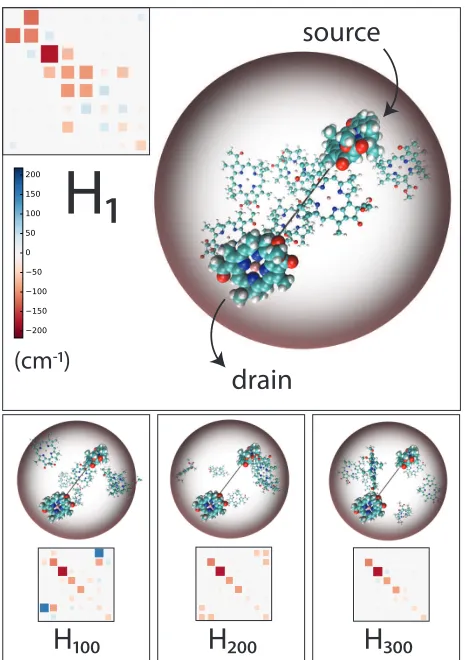
Figure 1: The FMO trimer is composed of three (monomer) subunits, each consisting of eight BChl chromophores supported in a protein scaffolding. We consider a single unit of the complex, where the protein is retained only implicitly through its role as a dielectric and vibrational environment. Observe our enclosing sphere, which all chromophores must fit within, and the ‘transport vector’ which connects BChls 1 and 3 (enlarged for clarity), which serve as source and drain respectively. We generate 50,000 new structures through physical changes to the FMO. Three representative structures are shown, along with their resulting Hamiltonian matrices (in the chromophore basis) which we calculate using an Atomic Tran-sition Charge method. To aid clarity, the energies of all BChls have been shifted such that the energy of BChl 1 is zero.
matrix representing a network of N chromophores where a single excitation can exist. We take the naturally occurring Fenna-Matthews-Olsen (FMO) complex24as our reference
struc-ture, chosen for its simplicity and relevance as a model system for LHCs.25Present in species
of green sulfur bacteria, the complex takes the form of three identical protein monomers, each of which comprising a protein matrix which contains N = 8 identical bacteriochlorophyll-a
(BChl) chromophores26 (see Fig. 1). As we will be interested in exciton transport between
BChls 1 (‘source’, closest to the antenna) and 3 (‘drain’, closest to the reaction centre), we fix their position, while the other 6 BChls are rigidly displaced and rotated by a sequence of n= 50,000 Monte-Carlo moves, starting with their reference locations.27–29 During the GP,
we retain only plausibleersatz structures by rejecting those where the minimum inter-atomic
separation between the BChls is smaller than dmin = 2Å, a cut-off intermediate between
bonding and van der Waals distances; and contain the geometric centroid of each BChl within a sphere of radius rmax= 22.3Å from the midpoint between BChls 1 and 3 (roughly
representing the volume contained by the protein matrix in the reference structure). To each ersatz structure iwe associate the excitonic Hamiltonian
Hi = N=8
X
l=1
ǫl|lihl|+
X
m6=n
V(i) mn
|mihn|+|nihm|. (1)
This expression is written with respect to an orthonormal set of basis states |li, each rep-resenting the situation where BChl l is excited and all other BChls are not. The first structure i = 1 is our reference structure. The diagonals ǫl represent the energy landscape
for non-interacting chromophores. While some previous studies set their distribution to be uniform,12 we retain a non trivial distribution by fixing the diagonals to those corresponding
to the reference FMO (see supplementary information S4 and S6). An energy gradient, aided by a bath-mediated relaxation, can ‘funnel’ excitations towards lower-lying excited states. Although our modelling of the bath forbids this relaxation, we argue that these ‘site’ energies can be nevertheless very influential on the exciton dynamics. They determine the energy eigenstates of Hi and therefore influence the phase relationship and subsequent interference
between different pathways through the network. .
The off-diagonal elementsVmn(i) arise from Coulomb interactions between transition charge
densities, and depend on the mutual orientation of the chromophores. It is well known that a simple point-dipole approximation to Vmn(i) would break down at the short distances
we consider:30 we therefore adopt a superior approach,31 partitioning the atomic transition
density for each structureiinto atomic transition chargesqt
αm(with coordinatesR (i)
αm) centred
on atom α of chromophore m. The Coulombic interaction is then summed to evaluate the coupling
V(i) mn =f
Na
X
α Nb
X
β
qt αmqtβn
|R(αmi) −R(βn|i) . (2)
We use a phenomenological dynamical model for the motion of a single exciton through our network of chromophores. While several variations32 and more elaborate models exist,33
our Lindblad master equation captures the essential effects of dephasing and dissipation, and represents a completely positive transformation34 on the density matrix ρ. Defining L(ρ)≡LρL†
− 12{L †L, ρ
}, we have
˙
ρi =−i[Hi, ρi]+
Lsink(ρ i) +
8
X
l=1
h
Ldephl (ρi) +Ldissl (ρi)
i
. (3)
The first term represents closed-system dynamics, and the other terms represent effects arising from interaction with an environment, with the collapse operators taken to be inde-pendent of the structure index i and given by
Lsink =√2Γsink |sinkih3|; Γsink = 6.3ps−1
Ldephl =√2Γdeph |lihl|; Γdeph = 2.1ps−1
Ldissl = √
2Γdiss |envihl|; Γdiss = 0.0005ps−1. (4)
We have expanded the Hilbert space to include |sinki and |envi (environment) which are states accessible through dissipation but which cannot build up any coherence with the rest of the network. Here, Lsink is a fast and irreversible process that represents successful
capture of the exciton at BChl 3, where it is transferred to a reaction centre, or ‘sink’.1
Otherwise, here all incoherent processes operate independently of the chromophore index j.
Ldiss represents the relatively slow process of exciton dissipation (or decay). TheLdeph j term
represents the averaged coupling of BChlj to its vibrational environment, leading to a local loss of coherence. If this happens too quickly, the exciton can be ‘frozen’ and prevented from evolving as per the Zeno effect.35 If dephasing is too slow, destructive interference can
lock the exciton in a particular subspace.20,36 We choose rates extracted from spectroscopy
experiments at 77K,37 but our conclusions are robust to moderate changes in these values
(see supplementary information S1).
Although the choice of a realistic initial condition for the exciton transport is the subject of some debate,38 we set ρ
i(0) = |1ih1|, an exciton localised on BChl 1 (our ‘source’).
This is consistent with the accepted photo-excitation process, which occurs in the nearby chlorosome (which acts as an antenna1). We numerically solve the Lindblad master equation
forρi(t), which can be thought of as a Hilbert-space operator ‘trajectory’ associated with each ersatz structure. It is this association which will allow us to explore the structure-dynamics
relationship.
First we consider how compact the chromophores are along the ‘transport vector’ which connects the source and drain (see Fig. (1)). Define
Mi ≡
X
k∈Mg
(r(ki))2, (5)
(the mass-normalised moment of inertia), where ri
k is the perpendicular distance of each
atom in structure i to the transport vector and the sum is taken only over the coordinates of the Magnesium atoms that lie roughly in the centre of each BChl. Fig. (2a) shows that the vast majority of our sample hasMi > M1. We infer that it is difficult to pack the BChls
into a volume smaller than nature has, without having unreasonably short distances between chromophores. We will return to this point later on.
Our focus is on investigating the structural properties of those randomly generated struc-tures which perform ‘best’ at some exciton transport function, e.g. fast or high-yield trans-port; high-retention storage or even fast energy-dissipation. Those structures performing
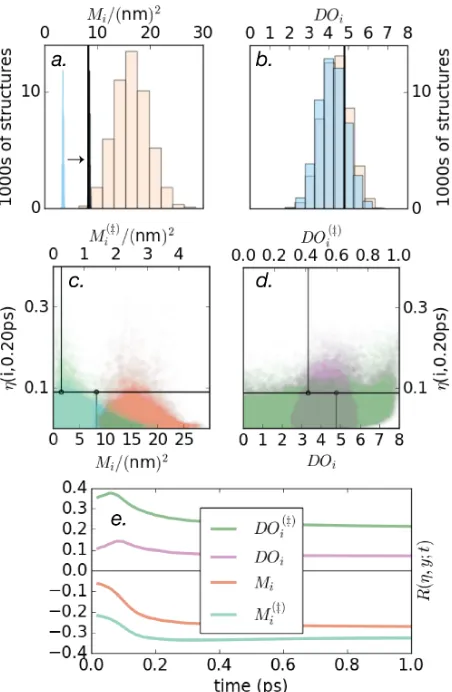
Figure 2: The upper panels show histograms for a) moment of inertia (Mi) and b) dipole
orientation (DOi) of the geometric perturbation (GP, peach) and rotations only (GP(R),
blue) sample of structures. Reference values M1 and DO1 are shown with thick black lines.
In panel a) the very narrow histogram for GP(R) has been shifted by 5 (nm)2 for clarity. The
middle panels show scatter plots of our structural properties versus transport efficiency at0.2
ps. One can visualise c) a negative correlation with moment of inertia Mi (orange, bottom
axis), and a stronger negative correlation with the key moment of inertiaMi(‡) (turqoise, top axis); and d) a positive correlation with DOi (purple, bottom axis) along with a stronger
positive correlation with the key dipole orientation DOi(‡) (green, top axis). In panel d), we have frozen the moment of inertia of all structures to be that of the reference Mi →M1. In
each panel, the data point for the reference structure is shown with a black crosshair. These time-resolved correlations are shown in panel e). Note the separation of timescales: up to about 1/2Γdeph∼250fs, the correlations change rapidly before stabilising.
well can be inspected for characteristics which might form the basis of design principles for synthetic applications. Here, we quantify the performance of our dynamics via the transport
efficiency
ηi(t)≡ hsink|ρi(t)|sinki, (6)
which measures both the speed and yield of energy transfer.
To identify the main structural motifs influencing the exciton dynamics we use the Spear-man rank correlation coefficient S(x, y). Ranging between −1 and +1, the coefficient
mea-sures the extent to which two quantitiesxandyare monotonically related (see supplementary information S3). In this work, we fix x = ηi(t), and begin with y = Mi. Fig. (2c,e) shows
an inverse correlation between the moment of inertia Mi and the transport efficiency ηi(t).
More compact structures tend to exhibit faster transport.
In fact, this realisation has a bearing on the second of our key questions (ii): To inves-tigate the relative performance of the reference structure, we introduce the normalised rank (henceforth ‘rank’) Rx defined as
Rx ≡1−o(x)/n, (7)
where o(x) ∈ {1, . . . , n = 50,000} is the ordinal rank by measure x through our sample of
ersatz structures. Thus, at time t, the reference structure has Rη equal to one (zero) if it
has the highest (lowest)ηi(t)among allersatz structures in the sample. A rank of 0.5 means
there are as many ersatz structures outperforming as underperforming the reference. The
standard deviation ofηi(t) is written asσ(η) :=
q
1 n
P
i(ηi(t)−µ)2, withµ=
P
iηi(t)/n. It
has its usual statistical definition (as the square root of the variance), and gives an idea of the overall variation in transport efficiencies exhibited by our sample of structures at each instant of time. If σ(η) is small, then a high rank may correspond to a small increase in
efficiency in absolute terms. Likewise a large deviation hints that there is more variation in the sample, and more efficiency at stake for high ranking structures to benefit from.
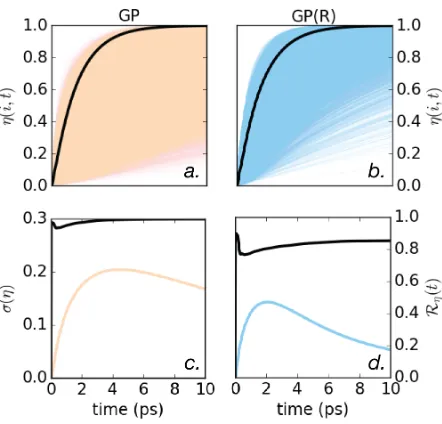
The raw data for transport efficiency are shown in Fig (3a), with our summary statistics shown below. Fig (3c) shows that the standard deviation increases from zero to a maximum
around 300 fs and then decreases: it also shows the high ranking of the reference structure amongst our sample ofersatzs, which exhibits a sizeable variation of transport efficiencies. A
partial explanation for this lies in the tendency for our physically-plausible GPs to generate structures with Mi larger than that of the FMO, coupled with the negative correlation
between Mi and transport efficiency.39
Figure 3: The upper panels show exciton transport efficiency over time for a) all structures generated with geometric perturbation (GP) method (peach) and b) all structures generated with rotations only (GP(R)) method (blue). In both cases the reference FMO structure is shown with a thick black line. The lower panels show the deviation in efficiencyσ(η) of the
sample (left axis, colour), again for c) GP and d) GP(R) methods. The rank of the reference FMO structure (right axis) is shown with a thick black line.
Delving deeper into the structure-dynamics relationship, a closer visual inspection of the top ten performing structures all feature a BChl directly between source and drain, while the bottom ten did not have this feature. This caused us to investigate the contribution of the chromophore closest to the transport vector. We call this the ‘key’ chromophore, with index
‡. In our sample each distinct chromophore assumed this role with approximately equal
frequency. This step allowed us to uncover some stronger correlations with Mi(‡) ≡(r(‡i))2 of
relative importance up to ∼3.5× but generally decreasing over time, as shown in Fig. (2e).
But does the combination of a) the strength of correlation between Mi and ηi and b) the
bias inMi of our sample ofersatzs (with respect to the referenceM1) completely explain the
high ranking of the reference structure? We address this by studying a sample GP(R) where only rotations are allowed. For theseersatzs, the structures are equally compact40 (Fig. 2a),
but Fig. (3b,d) shows that the rank of the reference structure has significantly decreased. This is consistent with the improved distribution ofMi in the GP(R) sample, which typically
leads to higher excitonic couplings (see supplementary information S7). Because the reference still ranks highly, however, we posit that there is some aspect of the relative orientation of the BChls that is also tuned up for transport.
Investigating this further requires us to probe the structure at a finer level. We adopt an hierarchical approach by fixing variables where we have found a correlation (i.e. Mi →M1)
before investigating the next variable. This way, we avoid marginalising over the correlations that are known to exist, which would otherwise wash out the evidence of further correlations. Define the total dipole orientation
DOi =
X
l
|dl(i)·A|, (8)
as the sum of projections of the Qy transition dipole moment dj of each BChl41 onto the
transport vector A. DOi is zero(one) when the dipoles are perpendicular (parallel or
an-tiparallel) to the transport vector. Fig. (2e) shows a positive correlation S(DOi, ηi(t))which
again increases (by up to∼3.3×) when we select only the key chromophore in Eq. (8) – i.e.
DOi(‡).
Fig. (2b) shows that the reference structure has a slightly larger than averageDOi,which
could partially explain its high rank independently of the considerations of moment of inertia. Another likely reason that the reference may be so highly ranked is our conditioning on nat-ural FMO energies. We made a sample where the couplingsVmn(i) are fixed, but energiesǫl are
chosen randomly, finding R(t)≈0.5. Given the energy distribution ǫl of the natural FMO,
its structure is highly attuned; but given its structure, the energy distribution is not attuned. This hints at improvements that may be possible through on-site energy changes alone. The correlations found in this work are statistically reliable and significant: we demonstrate this in the supplementary information (S2 and S3) using (respectively) convergence diagnostics and a p-value analysis.
We have performed a statistical analysis of a large sample of physically-plausible
mophore structures, and succeeded in extracting significant correlations between their struc-tural properties and the time-resolved efficiency with which they transport excitons. We found that compact structures tend to exhibit higher efficiency, and among those, efficiency tended to be higher in structures whose chromophores have their transition dipole aligned with the vector pointing from source to drain. Furthermore, we provide compelling evidence that one chromophore in particular has a dominating influence on the transport efficiency – namely the chromophore that is closest to this vector. The most influential structural prop-erty is actually the orientation of this key chromophore, although it becomes less dominant after around 100 fs. These insights could allow for improvements in the transport properties of genetically engineered excitonic networks.42 Lastly, since our reference structure – that
of the natural FMO – is very compact and has moderately well-aligned chromophores, it has a remarkably high efficiency when compared to the other structures we generated. Al-though these structural properties go some way to explaining the high performance, they most likely do so in combination with energetic considerations – namely the on-site energies of the network (which we were not able to perturb in the same physically-plausible sense as the couplings).
Our geometric perturbation approach places the natural FMO close to the top of the class, with advantages of the order of 20pp (percentage point) increase in transport effi-ciency around 4 ps (Rη(4ps) = 0.991, or 466th of 50,000). This is perhaps more surprising
than the striking ranking of light harvesting complexes in purple bacteria, where the 5.5 s.d. advantage may attributed to the high symmetry of the chromophore structure,18 a property
that the FMO does not ostensibly possess. Conclusions such as these (based on changes in physical space) are at odds with those inferred from other methodologies of generating er-satzs,17,20 such as uncorrelated matrix-element-perturbation (UMEP) methods. These work
by perturbing the Hamiltonian directly in the Hilbert space (see supplementary information S8) and rank the natural FMO as generic with R ≈0.5. Given the lack of assured physical
plausibility, the necessity of choosing small deviations, and the difficulty of discovering
ent biases, we view the insights gleaned from these methodologies to be of limited relevance to the question of whether natural structures are attuned.
Follow-up research may proceed along several directions: i) running a more sophisticated optimisation routine (such as those that simulate evolutionary processes12) to find high
per-forming structures, rather than the simple random search exhibited above; ii) more powerful, machine-powered pattern-finding could be leveraged13to seek structural motifs that correlate
more strongly with desired transport properties than the rudimentary measures we chose; iii) applying our methodology to alternative pigment-protein complexes or solid state energy transfer materials might reveal other (distinct) structure-dynamics relationships. It should be possible to consider a variable number of chromophores, calculating (for example) the minimum number of chromophores needed to reach a certain efficiency. Lastly, it may be possible to invert the structure-dynamics link in order to estimate unknown structures from measurements of excited-state dynamics (e.g. those probed with ultrafast spectroscopy43),
potentially complementing other theoretical techniques that explore a structure-spectrum link.44
Acknowledgement
G.C.K. was supported by the Royal Commission for the Exhibition of 1851, P.R. by UK EPSRC, A.T. by ERC (Grant No. 615834), and AD by UK EPSRC (EP/K04057X/2) This work benefited from the Monash Warwick Alliance. The authors thank Martin Plenio, Felix Pollock and Kavan Modi for interesting discussions.
Supporting Information Available
Zip file containing 50,000 Hamiltonians from our GP method. Further analysis supporting our conclusions. This material is available free of charge via the Internet athttp://pubs.
acs.org/.
Notes and References
(1) Blankenship, R. Molecular Mechanisms of Photosynthesis; Wiley, 2014.
(2) Panitchayangkoon, G.; Hayes, D.; Fransted, K. A.; Caram, J. R.; Harel, E.; Wen, J.; Blankenship, R. E.; Engel, G. S. Long-lived quantum coherence in photosynthetic com-plexes at physiological temperature. Proceedings of the National Academy of Sciences
2010, 107, 12766–12770.
(3) Scholes, G. D. Quantum-Coherent Electronic Energy Transfer: Did Nature Think of It First? The Journal of Physical Chemistry Letters 2010, 1, 2–8.
(4) Engel, G. S.; Calhoun, T. R.; Read, E. L.; Ahn, T.-K.; Mancal, T.; Cheng, Y.-C.; Blankenship, R. E.; Fleming, G. R. Evidence for wavelike energy transfer through quantum coherence in photosynthetic systems. Nature 2007, 446, 782–786.
(5) Collini, E.; Wong, C. Y.; Wilk, K. E.; Curmi, P. M. G.; Brumer, P.; Scholes, G. D. Co-herently wired light-harvesting in photosynthetic marine algae at ambient temperature.
Nature 2010, 463, 644–647.
(6) Huelga, S.; Plenio, M. Vibrations, quanta and biology. Contemporary Physics 2013,
54, 181–207.
(7) Ishizaki, A.; Fleming, G. R. Quantum Coherence in Photosynthetic Light Harvesting.
Annual Review of Condensed Matter Physics 2012, 3, 333–361.
(8) Wilkins, D. M.; Dattani, N. S. Why Quantum Coherence Is Not Important in the Fenna–Matthews–Olsen Complex.Journal of Chemical Theory and Computation2015,
11, 3411–3419.
(9) Duan, H.-G.; Prokhorenko, V. I.; Cogdell, R.; Ashraf, K.; Stevens, A. L.; Thorwart, M.; Miller, R. J. D. Nature does not rely on long-lived electronic quantum coherence for
photosynthetic energy transfer. ,
(10) Baghbanzadeh, S.; Kassal, I. Distinguishing the roles of energy funnelling and delocal-ization in photosynthetic light harvesting. Phys. Chem. Chem. Phys. 2016, 18, 7459–
7467.
(11) Schlau-Cohen, G. S. Principles of light harvesting from single photosynthetic complexes.
Interface Focus 2015, 5.
(12) Scholak, T.; Wellens, T.; Buchleitner, A. Optimal networks for excitonic energy trans-port.Journal of Physics B: Atomic, Molecular and Optical Physics 2011, 44, 184012.
(13) Mostarda, S.; Levi, F.; Prada-Gracia, D.; Mintert, F.; Rao, F. Structure–dynamics relationship in coherent transport through disordered systems.Nat Commun 2013, 4.
(14) Zech, T.; Mulet, R.; Wellens, T.; Buchleitner, A. Centrosymmetry enhances quantum transport in disordered molecular networks.New Journal of Physics 2014,16, 055002.
(15) Jesenko, S.; Žnidarič, M. Optimal number of pigments in photosynthetic complexes.
New Journal of Physics 2012, 14, 093017.
(16) Mohseni, M.; Shabani, A.; Lloyd, S.; Omar, Y.; Rabitz, H. Geometrical effects on energy transfer in disordered open quantum systems. The Journal of Chemical Physics 2013,
138, 204309.
(17) Baker, L. A.; Habershon, S. Robustness, efficiency, and optimality in the Fenna-Matthews-Olson photosynthetic pigment-protein complex. The Journal of Chemical Physics 2015, 143.
(18) Baghbanzadeh, S.; Kassal, I. Geometry, Supertransfer, and Optimality in the Light Harvesting of Purple Bacteria. The Journal of Physical Chemistry Letters 2016, 7,
3804–3811.
(19) Mohseni, M.; Rebentrost, P.; Lloyd, S.; Aspuru-Guzik, A. Environment-assisted quan-tum walks in photosynthetic energy transfer. The Journal of Chemical Physics 2008,
129.
(20) Caruso, F.; Chin, A. W.; Datta, A.; Huelga, S. F.; Plenio, M. B. Highly efficient energy excitation transfer in light-harvesting complexes: The fundamental role of noise-assisted transport.The Journal of Chemical Physics 2009,131.
(21) Schijven, P.; Kohlberger, J.; Blumen, A.; Mülken, O. Modeling the quantum to classical crossover in topologically disordered networks.Journal of Physics A: Mathematical and Theoretical 2012, 45, 215003.
(22) Caruso, F. Universally optimal noisy quantum walks on complex networks.New Journal of Physics 2014, 16, 055015.
(23) Li, Y.; Caruso, F.; Gauger, E.; Benjamin, S. C. ‘Momentum rejuvenation’ underlies the phenomenon of noise-assisted quantum energy flow. New Journal of Physics 2015,17,
013057.
(24) Fenna, R. E.; Matthews, B. W. Chlorophyll arrangement in a bacteriochlorophyll pro-tein from Chlorobium limicola. Nature 1975,258, 573–577.
(25) Löhner, A.; Ashraf, K.; Cogdell, R. J.; Köhler, J. Fluorescence-excitation and Emission Spectroscopy on Single FMO Complexes. Scientific Reports 2016, 6, 31875.
(26) Moix, J.; Wu, J.; Huo, P.; Coker, D.; Cao, J. Efficient Energy Transfer in Light-Harvesting Systems, III: The Influence of the Eighth Bacteriochlorophyll on the Dy-namics and Efficiency in FMO. The Journal of Physical Chemistry Letters 2011, 2,
3045–3052.
(27) Tronrud, D. E.; Wen, J.; Gay, L.; Blankenship, R. E. The structural basis for the
difference in absorbance spectra for the FMO antenna protein from various green sulfur bacteria. Photosynthesis Research 2009,100, 79–87.
(28) The Protein Data Bank (entry 3EOJ).http://www.rcsb.org/pdb/explore/explore.
do?structureId=3EOJ.
(29) Berman, H. M.; Westbrook, J.; Feng, Z.; Gilliland, G.; Bhat, T. N.; Weissig, H.; Shindyalov, I. N.; Bourne, P. E. The Protein Data Bank.Nucleic Acids Research 2000,
28, 235–242.
(30) Curutchet, C.; Mennucci, B. Quantum Chemical Studies of Light Harvesting.Chemical Reviews 2017, 117, 294–343.
(31) Madjet, M. E.; Abdurahman, A.; Renger, T. Intermolecular Coulomb Couplings from Ab Initio Electrostatic Potentials: Application to Optical Transitions of Strongly Cou-pled Pigments in Photosynthetic Antennae and Reaction Centers.The Journal of Phys-ical Chemistry B 2006, 110, 17268–17281.
(32) Wu, J.; Liu, F.; Ma, J.; Silbey, R. J.; Cao, J. Efficient energy transfer in light-harvesting systems: Quantum-classical comparison, flux network, and robustness analysis. The Journal of Chemical Physics 2012, 137, 174111.
(33) Chenu, A.; Scholes, G. D. Coherence in energy transfer and photosynthesis. Annual review of physical chemistry 2015, 66, 69–96.
(34) Breuer, H.; Petruccione, F.The Theory of Open Quantum Systems; OUP Oxford, 2007.
(35) Misra, B.; Sudarshan, E. C. G. The Zeno’s paradox in quantum theory. Journal of Mathematical Physics 1977, 18, 756–763.
(36) Wu, J.; Silbey, R. J.; Cao, J. Generic Mechanism of Optimal Energy Transfer Efficiency: A Scaling Theory of the Mean First-Passage Time in Exciton Systems.Phys. Rev. Lett.
2013, 110, 200402. 3
(37) Rebentrost, P.; Mohseni, M.; Aspuru-Guzik, A. Role of Quantum Coherence and En-vironmental Fluctuations in Chromophoric Energy Transport. The Journal of Physical Chemistry B 2009, 113, 9942–9947.
(38) Kassal, I.; Yuen-Zhou, J.; Rahimi-Keshari, S. Does Coherence Enhance Transport in Photosynthesis? The Journal of Physical Chemistry Letters 2013, 4, 362–367.
(39) We made a new sample with much stricter constraints on the moment of inertia (re-moving the bias), and the reference FMO continued to perform well there (see supple-mentary information S5).
(40) The moment of inertia is only approximately constant when we perform only rotations of the chromophores. This is because we rotate chromophores around their geometric centroids, but calculate moment of inertia with the central Magnesium atom. These two points are slightly displaced with respect to each other (∼0.312Å).
(41) Milder, M. T. W.; Brüggemann, B.; van Grondelle, R.; Herek, J. L. Revisiting the optical properties of the FMO protein. Photosynthesis Research 2010, 104, 257–274.
(42) Park, H.; Heldman, N.; Rebentrost, P.; Abbondanza, L.; Iagatti, A.; Alessi, A.; Pa-trizi, B.; Salvalaggio, M.; Bussotti, L.; Mohseni, M. et al. Enhanced energy transport in genetically engineered excitonic networks. Nat Mater 2016, 15, 211–216.
(43) Yuen-Zhou, J.; Krich, J.; Kassal, I.; Aspuru-Guzik, A.; Johnson, A. Ultrafast Spec-troscopy: Quantum Information and Wavepackets; IOP expanding physics; Institute of
Physics Publishing, 2014.
(44) Chenu, A.; Cao, J. Construction of Multichromophoric Spectra from Monomer Data: Applications to Resonant Energy Transfer. Phys. Rev. Lett. 2017, 118, 013001.