© 2019, IRJET | Impact Factor value: 7.211 | ISO 9001:2008 Certified Journal
| Page 6619
Implementation of Automated Crop Management and Irrigation system
using IoT
E. Srinivasan
1, G. Gayathri
2, S.P. Sakthi Parameswari
3, M. Sherin
42,3,4
Dept. of Electronics and Communication, Panimalar Engineering College, Tamil Nadu, India
---***---Abstract -
The potential need for agriculture is water and good fertile soil for better growth of the plant. In recent years lack of rainfall and soil erosion and man-made disasters reduce the soil quality and area of cultivable land. Automated agriculture helps not only in yield but also reduces the wastage in agriculture. With the help of this system, one can vegetate in a small farm in urban region to overcome the demand in agriculture production. The key feature of our project is to sense the required physical parameters as per the crop requirement depending on soil water flow model which will keep the plant in moist environment and the UV environment make plant grow healthy and pest free. UV helps in developing the plants natural immunity and increase the crops nutrition value. Using IoT, this system can monitor parameters for wide range which can be used for different regions and various crop based on the climatic condition and the nature of the crop to be cultivated as our country has different climatic condition and agriculture methods. So, here we are implementing a project which will give the whole data about the farm cultivation.Key Words
:
IoT platform, PIC- microcontroller, Fertilizers, Agriculture Production, Embedded C.
1. INTRODUCTION
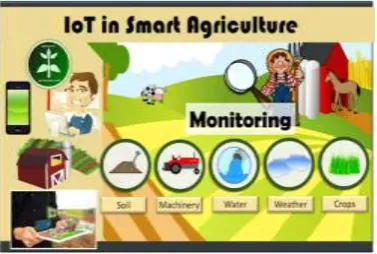
[image:1.595.68.257.596.723.2]Food is an essential necessity of human life and requires its continuous supply and production to cater the needs of the growing population through sustainable agriculture. Appropriate environmental conditions are necessary for plant growth, improved crop yields, efficient use of water and other resources.[1]
Fig 1: IoT Scenario in Smart Agriculture
Automating the data acquisition process of the soil conditions and various climatic conditions that govern the plant growth allows information to be collected at high frequency with less labor’s requirements. This can be achieved with the application of emerging technologies in sector to maximize production across vegetation [2].
Technology can aid and improve agriculture in several ways through pre-planning and during harvesting by the use of advanced technology through IoT to determine soil nutrient, pH, soil moisture and water level at the right time amount and right place application [3]. Irrigation is the delivery of water to grow crops. The irrigation system helps the farmers to have less Dependency on rain-water for the purpose of agriculture. In this paper, an automatic irrigation system that works Based on Internet of Things(IoT) in order to reduce the manual work of the humans[5]. IoT is changing the domain and empowering farmers to fight with the huge difficulties they face. PIC microcontroller is used here.
To boost the productivity and minimize the barrier in agriculture field there is need to use innovative technology and technique called Internet of things. The technological advances in their areas gather increasing momentum and this means that maintaining as the overview. The most important things of smart farming are environmental and water managements affect the plant growth [6].
© 2019, IRJET | Impact Factor value: 7.211 | ISO 9001:2008 Certified Journal
| Page 6620
Table 1:Comparison of various irrigation methods in pastdecades [9].
Sno. (year) Work Sensor used Conditions Irrigation Saving
(mm)
1. 2001 Soil moisture sensor (SMS) Landscape 726
2 2007
Evapotranspiration (ET) &
Soil moisture sensor (SMS)
Fescue turf
grass plots 488
3. 2009
Evapotranspiration (ET) & Soil moisture sensor (SMS) St. Augustine grass turf plots 840
4. 2010 self-designed wireless sensor Virtual 685.5
5. 2010
Temperature Sensor (RS)
& Soil moisture sensor (SMS)
Bermuda grass turf
plots 602
6. 2014 Soil moisture sensor (SMS) Landscape 603
7. 2016
Temperature Sensor (RS)
Humidity sensor
Solid pH Sensor
virtual 673
8. 2017 Soil moisture sensor (SMS) Landscape No Result
9. 2018 Soil moisture sensor (SMS) Landscape No Result
2.
EXPERIMENTATIONS AND METHODOLOGY
2.1Tools Utilization
New and modern tools has been utilized in agriculture sector can improve the agricultural production and sustainability. For instance, best management practices and technological tools are widely applied for improvement of agriculture nowadays. Our model (IoT) and sensing devices
such as water sensing, soil sensing, and pH sensing etc., can provides information to farmers for realizing precision agriculture, which is done by matching inputs based on actual yields of different portions on the field. These tools play a vital role and also allow agriculture to manage land for our wildlife.
2.2 Internet of Things
The Internet of things (IoT) is the network of everyday objects and physical things embedded with electronics, software, sensors, and connectivity enabling data exchange. Basically, a little networked computer is attached to a thing, allowing information exchange to and from that thing. Be it light bulbs, toasters, refrigerators, flower pots, watches, fans, planes, trains, automobiles, or anything else around you, a little networked computer can be combined with it to accept input (especially object control) or to gather and generate informational output (typically object status or other sensory data). This means computers will be permeating everything around us ubiquitous embedded computing devices, uniquely identifiable, interconnected across the Internet. The IoT act as a receiving section which receives the sensor values where we can monitor the parameters in the IoT website.
Fig 2: Photo copy of IoT System
2.2 PIC16F877- Microcontroller:
The term PIC, or Peripheral Interface Controller, is the name given by Microchip Technologies to its single – chip microcontrollers. PIC micros have grown to become the most widely used microcontrollers in the 8- bit microcontroller segment. The PIC16F877A CMOS FLASH-based 8-bit microcontroller is upward compatible with the PIC16C5x, PIC12Cxxx and PIC16C7x devices. The microcontroller sends the sensed physical parameter values to the IoT where it can be monitored by the people.
2.3 Soil Moisture:
[image:2.595.306.561.395.488.2]© 2019, IRJET | Impact Factor value: 7.211 | ISO 9001:2008 Certified Journal
| Page 6621
on their fields, not only are farmers able to generally use less water to grow a crop, they are also able to increase yields and the quality of the crop by improved management of soil moisture during critical plant growth stages.
2.4 Water Level Sensor:
The water level sensor connected with microcontroller, made up of floating type of plastic, which floats in water to sense the level of water. When the water is full in the land the floating type sensor will float in water and reaches the top edge which used to indicate the water is full. Likewise when water is low in the land it reached the bottom and indicate the microcontroller that water is low. All the data will be send to the particular person through IoT by the microcontroller
2.4 Process Flow:
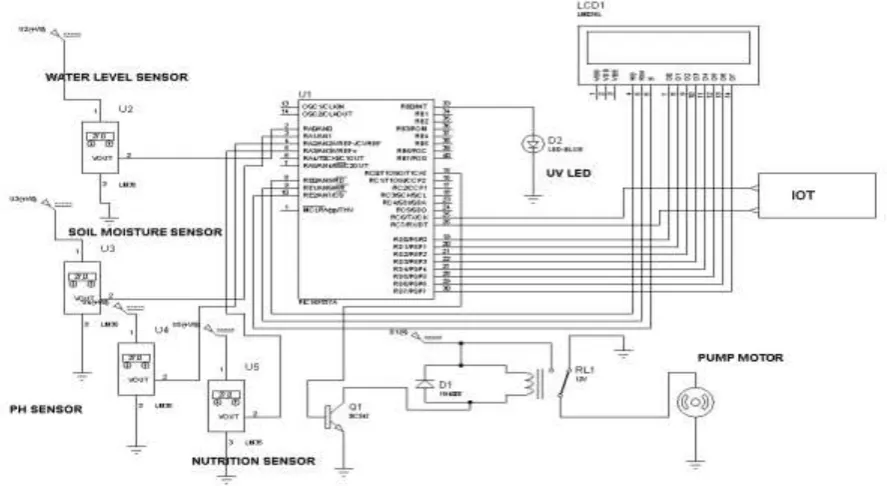
Soil moisture is directly connected to the microcontroller which will measure the moisture of soil present. If the moisture of soil is less than threshold level, then microcontroller will command the driver circuit to turn ON the pump motors. Water level sensor detects the level of water present in the farm cultivation.
An IOT is connected to the microcontroller to display the data and control the water pump according to that. pH sensor is used to monitor ph level and nutrition sensor is used to find out the nutrition in the field and crop according to that. To improve crop immunity UV LED is placed. Real
time data monitoring and logging in cloud storage with easy access. Use of UV LED increases the crops immunity and nutrition value.
Fig 3: Work Flow Model.
2.5 Automated agriculture irrigation system:
[image:3.595.332.529.145.400.2] [image:3.595.76.520.491.734.2]© 2019, IRJET | Impact Factor value: 7.211 | ISO 9001:2008 Certified Journal
| Page 6622
In Fig 4 shows the circuit for our system which senses the moisture content of the soil and automatically switches the pump when the power is ON state. A proper usage of irrigation system is very important because the main reason is the shortage of land reserved water due to lack of rain, unplanned use of water as a result large amounts of water goes waste. So we implement this system, which will very useful in all climate conditions.
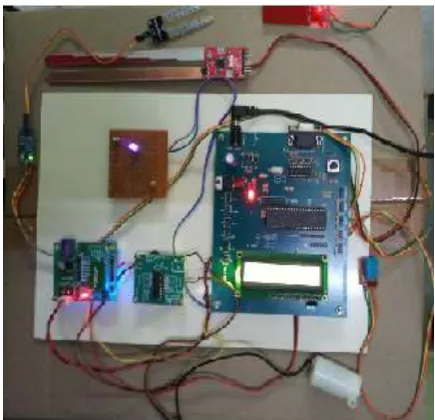
Fig 5: Photo copy of Hardware System
3. RESULTS AND DISCUSSIONS
We tried and implemented, digitalize farming and crop management activities so that the farmers can check on the requirements of the crops and accurately predict their growth. Our concept will surely accelerate their business to reach new heights and also more profitable with help of IoT based technology into the agriculture business and better crop production and system automatically convey the status of crops such as water level, temperature, pH level, nutrition and etc., all these are executed by sending status as SMS notification by collecting the valuable information by proper detailed data analysis.
Table: 2
Sensed Physical parameters and their valuesSno. Time Soil
moisture Water level Nutrition
1. 1pm 232 0 254
2. 2pm 235 75 253
3. 3pm 243 125 257
4. 4pm 248 132 245
5. 5pm 252 146 260
6. 6pm 256 161 255
The above mentioned parameters are made by observing the fields at various conditions and the value of pH depends on nature of the soil (alkalinity or acidity).
Fig 6: Moisture vs Time
In Fig 6 we developed web interface for soil moisture monitoring and time generator by system. It was seen that it succeeded in detecting a fall in moisture and correcting soil moisture, thus maintaining a constant environment
Fig 7: Nutrition and Water level vs. Time
In Fig 7 water level is analysed and maintained automatically with the help of our project. Water level is present only if we supply it efficiently. Since water quality in any source of water and at the point of use can change with time and other factors continuously monitoring of water is essential. The nutrition level represents the good quality of the crops and the sustainability of the crops on the fields.
4. CONCLUSION
[image:4.595.309.560.139.222.2] [image:4.595.52.270.195.405.2] [image:4.595.314.553.319.513.2]© 2019, IRJET | Impact Factor value: 7.211 | ISO 9001:2008 Certified Journal
| Page 6623
monitoring behavior of the animals, robotics sprayers to sprinkle fertilizers and pesticides and much more.
5. REFERENCES
[1] Zhiqiang Cheng, Jihua Meng, “Improving Soil
Available Nutrient Estimation by Integrating Modified WOFOST Model and Time-Series Earth Observation, 2018.
[2] Joaquin Gutierrez Jaguey, Juan Francisco
Villa-Medina, “Smartphone Irrigation Sensor” IEEE Sensors Journal, VOL-15, NO.9, September 2015.
[3] Federico Viani, Member, IEEE, Michael Bertolli,
Member, IEEE, “Low-cost wireless monitoring and Decision support for water saving in agriculture”IEEE Sensors Journal, VOL-17,N0. 13,July 2017
[4] Using IoT to enhance Agricultural Sector by
“www.agrotechnomarket.com”.
[5] Mehdi Roopei, Paul Rad, ”Could of Things in smart
agriculture: Intelligent Irrigation monitoring system by Thermal Imaging” IEEE cloud of computing by IEEE Computer Society, February 2017.
[6] R.Suresh, S.Gopinath “GSM based Automated
Irrigation Control using Raingun Irrigation System”, International Journal of Advanced Research in Computer and Communication Engineering Vol. 3, Issue 2, February 2014
[7] Shiraz Pasha B.R., Dr. B Yogesha, “Microcontroller
Based Automated Irrigation System”, The International Journal Of Engineering And Science (IJES), Volume3, Issue 7, pp 06-09, June2014.
[8] Imran Sarwar Bajwa, M.Safdar Munir, “Design &
implementation of an IoT system for smart energy consumption & smart irrigation in tunnel farming”, Energies, Volume 11, Issue 3427, December 2018.
[9] Rahul G Godake, Altaf Mulani, “Microcontroller
![Table 1: Comparison of various irrigation methods in past decades [9].](https://thumb-us.123doks.com/thumbv2/123dok_us/9379845.440775/2.595.306.561.395.488/table-comparison-various-irrigation-methods-past-decades.webp)