R E S E A R C H A R T I C L E
Open Access
Using Bayesian adaptive designs to
improve phase III trials: a respiratory care
example
Elizabeth G. Ryan
1,2*, Julie Bruce
1, Andrew J. Metcalfe
1,3, Nigel Stallard
4, Sarah E. Lamb
1,5, Kert Viele
6,
Duncan Young
7and Simon Gates
1,2Abstract
Background:Bayesian adaptive designs can improve the efficiency of trials, and lead to trials that can produce high quality evidence more quickly, with fewer patients and lower costs than traditional methods. The aim of this work was to determine how Bayesian adaptive designs can be constructed for phase III clinical trials in critical care, and to assess the influence that Bayesian designs would have on trial efficiency and study results.
Methods:We re-designed the High Frequency OSCillation in Acute Respiratory distress syndrome (OSCAR) trial using Bayesian adaptive design methods, to allow for the possibility of early stopping for success or futility. We constructed several alternative designs and studied their operating characteristics via simulation. We then performed virtual re-executions by applying the Bayesian adaptive designs using the OSCAR data to demonstrate the practical applicability of the designs.
Results:We constructed five alternative Bayesian adaptive designs and identified a preferred design based on the simulated operating characteristics, which had similar power to the original design but recruited fewer patients on average. The virtual re-executions showed the Bayesian sequential approach and original OSCAR trial yielded similar trial conclusions. However, using a Bayesian sequential design could have led to a reduced sample size and earlier completion of the trial.
Conclusions:Using the OSCAR trial as an example, this case study found that Bayesian adaptive designs can be constructed for phase III critical care trials. If the OSCAR trial had been run using one of the proposed Bayesian adaptive designs, it would have terminated at a smaller sample size with fewer deaths in the trial, whilst reaching the same conclusions. We recommend the wider use of Bayesian adaptive approaches in phase III clinical trials. Trial registration:OSCAR Trial registration ISRCTN,ISRCTN10416500. Retrospectively registered 13 June 2007.
Keywords:Bayesian sequential design, Interim analyses, Randomised controlled trials, Critical care
Background
Phase III randomised controlled trials (RCTs) are typically long and expensive, restricting their use and resulting in long lead times to answer important clinical questions [1]. Traditional phase III design methods require specification of the sample size in advance. This can be inefficient when
limited information is available at the design stage, espe-cially regarding the likely effect size. Researchers and fun-ders have recognised the need to use more efficient trial designs, yet the majority of trials continue to use trad-itional methods. Adaptive and sequential trial designs have been described and even recommended by bodies such as the US Food and Drug Administration [2], but their use remains sporadic amid uncertainty about their utility out-side of early phase trials.
Sequential adaptive designs allow repeated interim ana-lyses during the trial to decide whether it should continue or terminate due to sufficient evidence to reach a
© The Author(s). 2019Open AccessThis article is distributed under the terms of the Creative Commons Attribution 4.0 International License (http://creativecommons.org/licenses/by/4.0/), which permits unrestricted use, distribution, and reproduction in any medium, provided you give appropriate credit to the original author(s) and the source, provide a link to the Creative Commons license, and indicate if changes were made. The Creative Commons Public Domain Dedication waiver (http://creativecommons.org/publicdomain/zero/1.0/) applies to the data made available in this article, unless otherwise stated.
* Correspondence:[email protected]
1
Warwick Clinical Trials Unit, Warwick Medical School, University of Warwick, Coventry CV4 7AL, UK
2Cancer Research UK Clinical Trials Unit, Institute of Cancer and Genomic
Sciences, University of Birmingham, Birmingham, UK
conclusion. The timing and criteria for these decisions must be specified before the trial begins. Sequential de-signs can offer a more efficient approach for conducting RCTs and frequently result, on average, in smaller and shorter trials than traditional approaches. Sequential de-signs may be implemented using frequentist methods, which typically use null hypothesis testing, or Bayesian methods.
The use of Bayesian statistical methods for designing and analysing RCTs has increased (e.g., [3–6]). We con-centrate here on Bayesian methods, because they have a number of advantages, particularly for adaptive trials. Bayesian statistics provide a formal method for updating information about the treatment effect as new data are observed, and hence are well suited to interim analyses with accumulating information. The results of Bayesian analyses may also be easier to interpret than frequentist analyses as they can provide the probability of various estimates of the unknown treatment effect. The poster-ior distribution can also provide probabilistic statements about other measures of interest, such as adverse event rates and the dose-response relationship.
Bayesian approaches require specification of a prior distribution for the possible values of the unknown treatment effect, thereby accounting for uncertainty in its value. The prior distribution can incorporate previous information. Accumulating trial information is combined with this prior to produce a posterior distribution that summarises the current state of knowledge about the treatment effect. This updating occurs at each interim analysis.
The posterior distribution drives key decisions at each interim analysis, such as stopping for trial success. Pre-dictive probabilities can also be obtained from the pos-terior, such as the probability that the trial will be successful if it continues to completion. These measures, which are more clinically relevant thanp-values, can be used to decide whether the trial should stop at an in-terim analysis in what will be termed a “Bayesian se-quential design”[7].
Bayesian adaptive trial designs are increasingly being used in early phase trials, but their use in phase III trials is more limited. The few published works mostly consist of trial protocols [8] or are re-executions of completed traditionally-designed trials using Bayesian adaptive de-signs for comparative purposes (e.g., [9–12]). Few pub-lished phase III trials have used Bayesian adaptive methods from the design phase (e.g., [3,5,6]).
The aim of this work was to explore the implementation of Bayesian sequential designs for phase III trials in critical care. Using an example from a recent critical care trial, we demonstrate how a Bayesian sequential design can be con-structed, and illustrate the choices required during the de-sign phase. The operating characteristics of the dede-signs
were studied via simulation and virtual re-executions of the trial were performed using the Bayesian designs and actual trial data. These were conducted to establish the ef-ficiency of such designs, and demonstrate how these de-signs can be implemented and the decisions that would be made in a real-world trial during the interim analyses.
Materials and methods Case study
The High Frequency OSCillation in Acute Respiratory distress syndrome (ARDS) study (OSCAR) [13] com-pared conventional positive pressure ventilation (con-trol) with high frequency oscillatory ventilation (HFOV) in adults with ARDS. The primary outcome was mortal-ity at 30 days. The planned sample size was 1006 pa-tients (503 in each arm). This gave 80% power to detect a 9% reduction from a control group 30-day mortality of 45% with a significance level of 5%, assuming 3% drop-out. Recruitment occurred from 7 December 2007 to 31 July 2012.
Two formal interim analyses were planned in the OSCAR trial at approximately one third and two thirds of the way through recruitment. The design allowed for an additional interim analysis halfway through recruit-ment if the Data Monitoring and Ethics Committee (DMEC) requested closer monitoring. No formal stopping rules were used, but O’Brien-Fleming alpha-spending functions were used to provide guideline critical values for early success stopping and control type I error. These values were calculated for designs where two or three interim analyses may be performed. The trial could be stopped or modified by the DMEC if the treatments were convincingly different in terms of 30-day mortality, or for safety reasons. The DMEC re-quested sample size re-estimation to be performed at a planned interim analysis, due to slow recruitment. The trial statistician became unblind to the control arm pri-mary outcome data and calculated a revised sample size of 401 patients per arm. This calculation assumed a 10% absolute change in mortality, with 80% power, a 5% sig-nificance level, and 3% dropout.
OSCAR randomised 795 patients from 29 hospitals and did not find any evidence that HFOV was superior in the primary outcome: 166/398 (41.7%) HFOV patients and 163/397 (41.1%) control patients died within 30-days (p= 0.85).
Potential adaptations and candidate designs
it can preserve resources that could instead be used on more promising treatments and prevent patients from being given an ineffective experimental treatment. The Bayesian sequential designs allowed early stopping for lack of benefit or evidence of success. The number and timing of the interim analyses were investigated. Interim analyses could occur based on either calendar time or number of patients recruited.
The designs were constructed by a statistician (EGR) who was blind to the trial results and relied on the OSCAR protocol and statistical analysis plan. Feedback was provided from two clinical academics with experi-ence in running RCTs (JB and AJM) who were also inde-pendent from the original trial and blinded to the results.
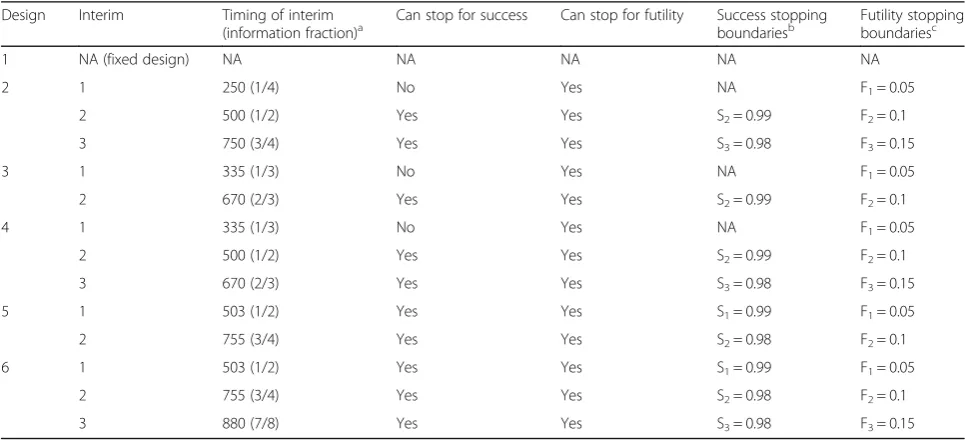
The maximum sample size was specified to be the same as the original planned sample size (N= 1006). The clinical academics provided key information on the min-imal sample size for interpretability and on logistics. They indicated that success stopping should not occur before enrolling half of the original proposed sample size and that more than three interim analyses would be too burdensome. This led to a final candidate set of six de-signs (see Table1) including a non-adaptive/fixed design with a Bayesian final analysis (Design 1) for comparative purposes. The stopping boundaries in Table 1 are de-scribed in the“Decision criteria”section.
Software and simulation settings
Simulations of the trial designs were performed using the Fixed and Adaptive Clinical Trial Simulator (FACTS)
program version 6.1 [14]. For each design 10,000 ex-ample trials were simulated assuming a true effect size. These simulations allowed the distribution of final sam-ple size and duration to be estimated, and quantified type I error and power. The simulations also provided insights into how the operating characteristics were af-fected if the trial conditions were not as expected, e.g., slower recruitment, or unexpected harm.
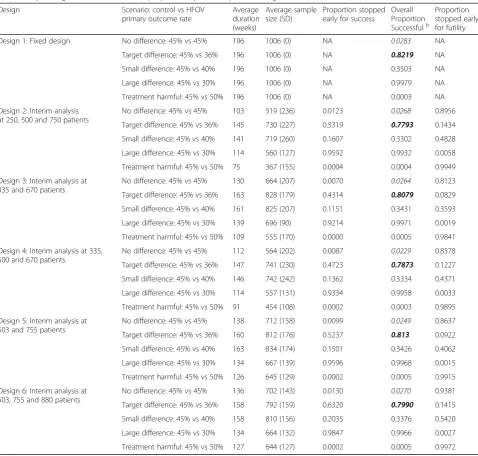
The Bayesian sequential designs were constructed as one-sided superiority studies as we were interested in showing reduction in mortality in HFOV over the control. A range of plausible scenarios were simulated for each sign to investigate the operating characteristics of the de-signs under a range of true effect sizes (see Table2). There was some uncertainty regarding the control primary out-come rate, so this rate was varied in the plausible scenarios.
The recruitment rate was simulated in FACTS using a mean of 5.5 participants/week, based on the original pro-jected recruitment rates for OSCAR. The same assumed dropout rate was used as for OSCAR. The operating char-acteristics were also studied assuming slower recruitment (2/week), faster recruitment (11/week), and no dropouts.
Non-informative prior distributions were used for the primary outcome rate for each arm, corresponding to all response rates between 0 and 100% being equally likely. More informative (and more realistic) priors based on pre-vious studies were also investigated (see Additional file1).
Decision criteria
[image:3.595.56.539.487.707.2]“Trial success” was defined as declaring superiority of HFOV. The stopping criteria for statistical futility were
Table 1Candidate Bayesian sequential designs generated for OSCAR
Design Interim Timing of interim (information fraction)a
Can stop for success Can stop for futility Success stopping boundariesb
Futility stopping boundariesc
1 NA (fixed design) NA NA NA NA NA
2 1 250 (1/4) No Yes NA F1= 0.05
2 500 (1/2) Yes Yes S2= 0.99 F2= 0.1
3 750 (3/4) Yes Yes S3= 0.98 F3= 0.15
3 1 335 (1/3) No Yes NA F1= 0.05
2 670 (2/3) Yes Yes S2= 0.99 F2= 0.1
4 1 335 (1/3) No Yes NA F1= 0.05
2 500 (1/2) Yes Yes S2= 0.99 F2= 0.1
3 670 (2/3) Yes Yes S3= 0.98 F3= 0.15
5 1 503 (1/2) Yes Yes S1= 0.99 F1= 0.05
2 755 (3/4) Yes Yes S2= 0.98 F2= 0.1
6 1 503 (1/2) Yes Yes S1= 0.99 F1= 0.05
2 755 (3/4) Yes Yes S2= 0.98 F2= 0.1
3 880 (7/8) Yes Yes S3= 0.98 F3= 0.15
a
The timing of the interims was based on the number of patients recruited
b
Siis the stopping boundary for success at thei-th interim analysis.cFiis the stopping boundary for futility at thei-th interim analysis. The stopping boundaries
based on the posterior predictive probability of trial suc-cess at the maximum sample size, which is denoted by Pmax. Pmaxincorporates accumulated complete data, un-certainty in patients enrolled without complete follow-up, and uncertainty in future patients up to the maximum sample size [9]. The trial was stopped early for futility if Pmaxwas less than a futility thresholdFiat interim analysis i. For the purposes of simulating trial duration, if a trial stopped for futility the trial was as-sumed to cease immediately. If the intervention was causing harm, then the trial would be stopped for“ futil-ity”at the interim analyses.
[image:4.595.59.538.96.552.2]The stopping criteria for success were based on the posterior predictive probability of trial success at the current sample size, after accounting for uncertainty in enrolled patients without complete follow-up. If this probability, Pcurr, was greater than the success threshold Si at interim analysis i, accrual stopped for success. All incomplete patients were followed up, after which the final analysis was conducted. Operat-ing characteristics were calculated assumOperat-ing the futil-ity and success stopping rules would always be followed. The original OSCAR trial did not have binding stopping rules.
Table 2Operating characteristics for the proposed Bayesian sequential designs for the OSCAR triala
Design Scenario: control vs HFOV
primary outcome rate
Average duration (weeks)
Average sample size (SD)
Proportion stopped early for success
Overall Proportion Successfulb
Proportion stopped early for futility
Design 1: Fixed design No difference: 45% vs 45% 196 1006 (0) NA 0.0283 NA
Target difference: 45% vs 36% 196 1006 (0) NA 0.8219 NA
Small difference: 45% vs 40% 196 1006 (0) NA 0.3503 NA
Large difference: 45% vs 30% 196 1006 (0) NA 0.9979 NA
Treatment harmful: 45% vs 50% 196 1006 (0) NA 0.0003 NA
Design 2: Interim analysis at 250, 500 and 750 patients
No difference: 45% vs 45% 103 519 (236) 0.0123 0.0268 0.8956
Target difference: 45% vs 36% 145 730 (227) 0.5319 0.7793 0.1434
Small difference: 45% vs 40% 141 719 (260) 0.1607 0.3302 0.4828
Large difference: 45% vs 30% 114 560 (127) 0.9592 0.9932 0.0058
Treatment harmful: 45% vs 50% 75 367 (155) 0.0004 0.0004 0.9949
Design 3: Interim analysis at 335 and 670 patients
No difference: 45% vs 45% 130 664 (207) 0.0070 0.0264 0.8123
Target difference: 45% vs 36% 163 828 (179) 0.4314 0.8079 0.0829
Small difference: 45% vs 40% 161 825 (207) 0.1151 0.3431 0.3593
Large difference: 45% vs 30% 139 696 (90) 0.9214 0.9971 0.0019
Treatment harmful: 45% vs 50% 109 555 (170) 0.0000 0.0005 0.9841
Design 4: Interim analysis at 335, 500 and 670 patients
No difference: 45% vs 45% 112 564 (202) 0.0087 0.0229 0.8578
Target difference: 45% vs 36% 147 741 (230) 0.4723 0.7873 0.1227
Small difference: 45% vs 40% 146 742 (242) 0.1362 0.3334 0.4371
Large difference: 45% vs 30% 114 557 (131) 0.9334 0.9958 0.0033
Treatment harmful: 45% vs 50% 91 454 (108) 0.0002 0.0003 0.9895
Design 5: Interim analysis at 503 and 755 patients
No difference: 45% vs 45% 138 712 (158) 0.0099 0.0249 0.8637
Target difference: 45% vs 36% 160 812 (176) 0.5237 0.813 0.0922
Small difference: 45% vs 40% 163 834 (174) 0.1501 0.3426 0.4062
Large difference: 45% vs 30% 134 667 (139) 0.9596 0.9968 0.0015
Treatment harmful: 45% vs 50% 126 645 (129) 0.0002 0.0005 0.9915
Design 6: Interim analysis at 503, 755 and 880 patients
No difference: 45% vs 45% 136 702 (143) 0.0130 0.0270 0.9381
Target difference: 45% vs 36% 158 792 (159) 0.6320 0.7990 0.1415
Small difference: 45% vs 40% 158 810 (156) 0.2035 0.3376 0.5420
Large difference: 45% vs 30% 134 664 (132) 0.9847 0.9966 0.0027
Treatment harmful: 45% vs 50% 127 644 (127) 0.0002 0.0005 0.9972
a
The“proportions”in columns 5–7 refer to the proportion of the 10, 000 simulated trials for each scenario, and the averages and standard deviations (SD) are over the 10, 000 simulated trials.b
Using values based on previous studies [9, 10, 15] a range of potential success and futility threshold values were explored. For the candidate designs in Table 1, threshold values were chosen that produced similar power to the original design and a one-sided type I error of approximately 2.5%. Table 1 gives the stopping boundaries for each design.
The trial was deemed successful at the final analysis if the posterior probability that HFOV had a lower 30-day mortality rate was above 0.975. This value was chosen based on the clinical academics’preferences and by con-sidering the power and simulated type I error it pro-duced. The same value was used for each Bayesian design.
The type I error was calculated from the simulations under the null hypothesis scenario of no difference, esti-mating the type I error rate as the proportion of such simulations that falsely declared HFOV superior. The power was calculated as the proportion of simulations that concluded that HFOV was superior under the target difference of 9%.
Identification of preferred design
The designs’operating characteristics were presented to the clinical academics to identify a preferred design that they felt could have been implemented. It was desirable to have a design which offered high power, low type I error, and minimised the sample size. These present a trade-off as designs which aggressively minimise sample size may result in lower power.
Virtual re-execution of designs
A virtual re-execution of the OSCAR trial was per-formed to illustrate the application of the Bayesian se-quential designs to a real-world trial. The trial data were read into FACTS and each of the Bayesian sequential de-signs were implemented. The trial data were read in using the original sequence of patients in recruitment order with the interim analyses being performed after the appropriate number of recruits for each design. At each interim analysis, accumulated data were analysed to determine whether the trial should be terminated early. It was assumed that there were no delays in having the endpoint data available for analysis. These re-executions represent the analysis of a single realisation of the trial. If a different trial dataset had been used, different con-clusions would have been drawn from using these par-ticular Bayesian designs. The OSCAR trial data represent the only existing dataset of patients that were actually recruited to this trial, in contrast to simulated datasets, which may fail to capture some important as-pect. The virtual re-executions therefore show what would have happened if a different trial design had been used when running the OSCAR trial.
Results
Design simulations and operating characteristics
Table 2 presents the average sample size, average dur-ation, type I error, and power for each design and sce-nario. Distributions for the sample size and study duration over the 10,000 simulations are shown in Add-itional file2: Figure S1 and Figure S2. Table2 also pre-sents the proportion of simulations stopped early for success or futility. There was little variation in the oper-ating characteristics when the prior or accrual assump-tions were varied (results not presented).
The Bayesian sequential designs had around 80% power and acceptable simulated type I errors of 2.3— 2.7%, while saving on the sample size. Under the null scenario, the average sample sizes were reduced by ap-proximately 300–500 patients. Under the target differ-ence of a 9% reduction in 30-day mortality, the average sample sizes were reduced by approximately 200–300 patients. Similar sample size reductions were observed when a small positive effect was assumed. The average sample size was reduced by 300–450 patients when a large positive effect was assumed.
The designs performed well in terms of safety and effi-ciency, in that they stopped earliest for a harmful effect, followed by either a large positive effect or no effect. Uncertainty in the control arm rate had little impact (see in Additional file3: Table S1).
Design 5, which had interim analyses at 503 and 755 patients recruited, was chosen independently by JB and AJM, since it had the highest power of the Bayesian de-signs at 81.3% and a low type I error rate of 2.49%. The clinical academics also preferred the timing of these in-terim analyses.
Re-execution of the OSCAR trial Interim analyses
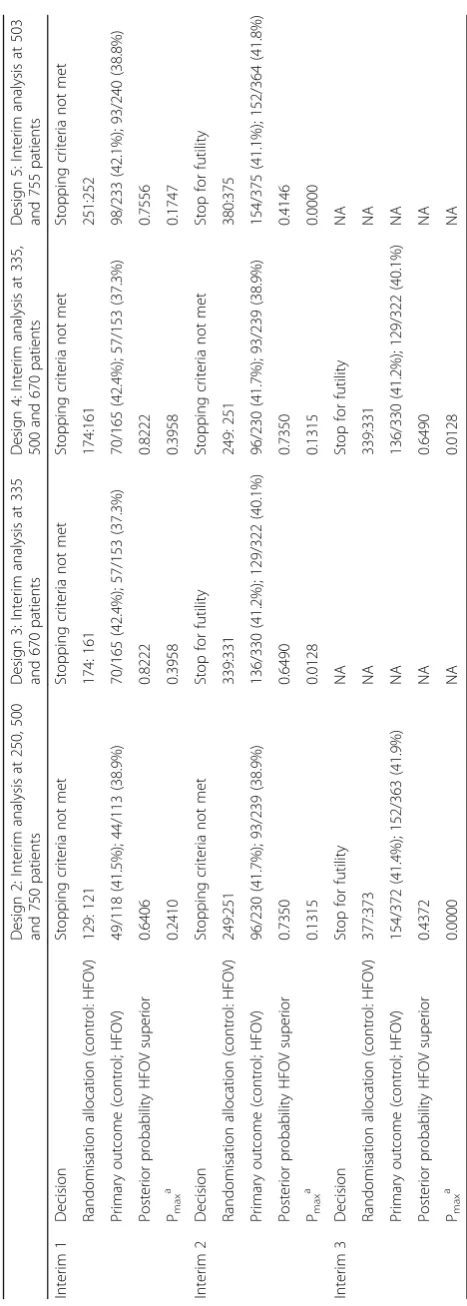
The virtual executions of Designs 2–5 are presented in Table3. Design 1 (fixed design) is not presented. Design 6 was not executed as the trial would have stopped be-fore interim analysis 3, giving the same results as Design 5. Sensitivity analyses were performed using alternatives to the default non-informative priors, but little differ-ences were seen between the analyses (results not presented).
the stopping boundaries for futility until their third in-terim analysis. Pmax(the predictive probability of success if the trial continued to its maximum sample size) did not drop below 0.1 until 546 patients had been recruited (Pmax= 0.0893 atN= 546).
Final analyses
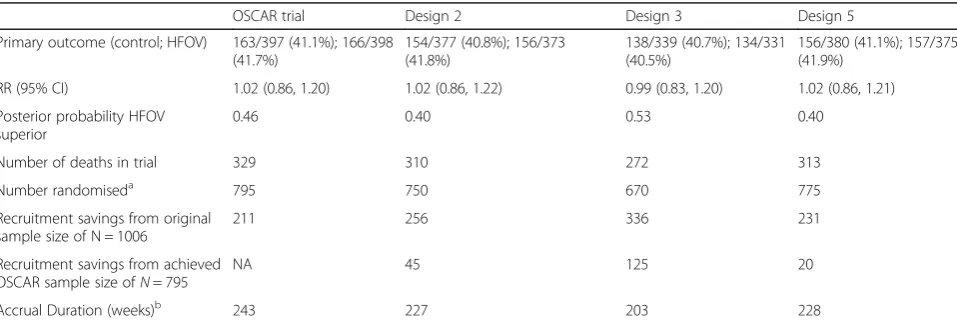
The analyses based on the final data, including follow-up, from each Bayesian sequential design are pre-sented in Table4along with the original trial results and the savings in recruitment for these trial data. Results for Designs 4 and 6 are not presented as these are the same as for Designs 3 and 5, respectively. There was lit-tle variation in the results across the designs–the rela-tive risks (RRs) ranged from 0.99–1.02, and the posterior probabilities that HFOV was superior ranged from 0.40– 0.53.
The results given in Table 4 show that the re-executions using the different designs based on this single set of trial data reflect the operating character-istics presented and discussed above. With the data observed, each of the proposed Bayesian sequential designs would have saved on overall trial duration, sample size and number of deaths relative to the ac-tual trial. The Bayesian sequential designs could have shortened the trial duration by between 15 and 40 weeks and recruited 231–336 fewer patients than the target sample size of N= 1006 and 20–125 fewer pa-tients than the 795 that the OSCAR trial achieved.
Designs 3 and 4 performed best in terms of redu-cing the number of patients randomised and the trial duration by stopping the trial earliest for futility. These are the Bayesian versions of the OSCAR design that was originally proposed. In the re-executions, all of the Bayesian designs would have terminated the trial with fewer patient deaths than the trial that was actually conducted.
Care should be taken not to over-interpret these results since they represent the analysis of a single dataset. How-ever, the data are the only information on patients re-cruited to this trial that actually exists, and re-executing the trial with alternative designs tells us how these would have performed in reality. To fully understand the real-life efficiency savings that these designs may lead to, they would have to be run on a large number of trials. It should be recognised that a large number of phase III trials fail to detect differences between treatment arms and therefore the example chosen is a common scenario, and more widespread use of futility stopping would likely result in efficiency gains across a broad portfolio of trials.
Discussion Summary
We have demonstrated how Bayesian sequential designs, a type of adaptive design, could be implemented for a phase III trial in acute respiratory distress syndrome (ARDS). We outlined the process involved in construct-ing the sequential designs, and demonstrated their oper-ating characteristics under a range of scenarios. These showed potential advantages over the original OSCAR trial design. By performing virtual executions of the de-signs using actual data from the OSCAR trial, we dem-onstrated how decisions would be made using the posterior predictive probability of trial success at each interim analysis.
[image:7.595.59.538.552.714.2]OSCAR is a trial where a Bayesian sequential design could have been used as it has a relatively simple design, short follow-up period for the primary outcome, object-ive primary outcomes that can easily be collected, and slow recruitment. Trials that have longer follow-up pe-riods for the primary outcome and faster recruitment rates are more challenging for adaptive designs as less information may be available at each interim analysis.
Table 4Final analyses based on the resulting sample collected from each design
OSCAR trial Design 2 Design 3 Design 5
Primary outcome (control; HFOV) 163/397 (41.1%); 166/398 (41.7%)
154/377 (40.8%); 156/373 (41.8%)
138/339 (40.7%); 134/331 (40.5%)
156/380 (41.1%); 157/375 (41.9%)
RR (95% CI) 1.02 (0.86, 1.20) 1.02 (0.86, 1.22) 0.99 (0.83, 1.20) 1.02 (0.86, 1.21)
Posterior probability HFOV superior
0.46 0.40 0.53 0.40
Number of deaths in trial 329 310 272 313
Number randomiseda 795 750 670 775
Recruitment savings from original sample size of N = 1006
211 256 336 231
Recruitment savings from achieved OSCAR sample size ofN= 795
NA 45 125 20
Accrual Duration (weeks)b 243 227 203 228
a
Based on the number of patients required to trigger the interim analyses at which the trial was stopped.b
Due to the two-armed nature of the study, the design adaptations were restricted to stopping early for success or futility. The proposed Bayesian sequential designs dif-fered in the number and timing of their interim analyses. Bayesian adaptive designs can be most advantageous for trials with complex designs, such as multi-arm trials or those with longitudinal modelling due to their ability to deal with multiple complex decisions [16].
The OSCAR study had planned interim analyses but no formal stopping rules. The early stopping rules in the Bayesian sequential designs for OSCAR allowed for spe-cification of more aggressive stopping and allowed stop-ping for futility. This is particularly important for interventions that appear to be harmful or are more ex-pensive and enables patients to receive beneficial treat-ments more quickly. The cost per patient in the OSCAR trial was £3402, and significant savings could have been made by stopping the trial early. The OSCAR trial did not allow for early futility stopping and if it had done so, our Bayesian designs may not have shown an increased efficiency.
Not all Bayesian adaptive trials would want to incorp-orate early stopping for futility, and the decisions to be made at interim analyses are trial-dependent. For in-stance, trials that plan cost-effectiveness in their primary analysis may not want to stop early for futility, or may wish to incorporate cost-effectiveness into their stopping criteria.
The simulations of the Bayesian designs produced simi-lar operating characteristics. The virtual re-executions produced similar results to the OSCAR trial across the de-signs for the primary outcome analysis. In practice, one Bayesian design would have been used and the retrospect-ive comparison of multiple designs would not be possible. Also, designs which stop early have been shown to have small biases in the treatment effect estimates (see, for ex-ample, [17,18]) compared to trials that did not stop early. Checks for potential bias should be performed during the simulation stage and bias-correction methods imple-mented if necessary (e.g., [19]).
Limitations
The designs proposed in this paper are situation-specific, as all Bayesian adaptive designs are, and cannot be gener-alised to all phase III trials. Similar principles to those out-lined in this study should be used when constructing adaptive designs that are tailored to the trial aims and clinical practicalities in other settings.
Sequential designs are well known to reduce the ex-pected sample size, and for these trials, similar results might have been obtained if frequentist stopping criteria had been employed. Bayesian criteria were employed to demonstrate their usefulness to clinicians, particularly with regards to interpretability.
The adaptive designs presented in this paper are not ne-cessarily optimal – if different clinicians had been con-sulted, alternative designs would have been selected. An increase in the number of interims would have led to smaller expected sample sizes, but at the cost of increased operational complexity. Also, if different values had been chosen for the stopping criteria, different decisions may have been made at the interim analyses. For instance, if Design 2 instead used less aggressive stopping boundaries for futility, higher power could be obtained, whilst main-taining the ability to stop early for harm. Selection of the stopping boundaries involves a trade-off of the power, type I error and expected sample size. The main benefit of this approach is that efficient and practically relevant designs can be generated using statistical measures that are intui-tive to interpret.
The decisions made by the clinical academics when constructing and choosing the designs were based on a mixture of the statistical aspects of the designs as well as their views about the operational factors. These included the timings of interim analyses and concerns about the perceived external validity of very aggressive stopping rules when presented to a clinical audience who are often naïve to these novel designs. These practical issues are important to consider when such designs are pro-posed. Operationally, interim analyses need to be ad-equately spaced to allow time for data cleaning, performing the analysis and presentation to DMECs and Trial Steering Committees (TSCs). In setting the bound-aries, it was also noted that decisions need to be taken as to whether the analyses should be based at pre-specified times (which are easier to manage oper-ationally) or a pre-specified number of samples (which are harder to manage operationally, but are easier to manage statistically).
There are a number of practical challenges associated with running adaptive designs in RCTs. In these ana-lyses, we assumed there was no delay between the in-terim analyses and stopping recruitment if the stopping criteria were met. We also assumed that primary out-come data were immediately available following the 30-day follow-up period. In reality, there might be slight delays for both of these processes, particularly for the former as the DMEC and TSC are likely to be involved. This would decrease the savings achieved by the Bayes-ian sequential designs.
perform as this can be set-up in advance of the trial and can be automated.
Our Bayesian adaptive designs assumed that stopping early for success or futility was driven by the primary outcome. For OSCAR, the primary outcome was also a safety outcome. If a suitable secondary outcome had been available to use in the interim analyses, then differ-ent decisions may have been made when considering the trade-off between outcomes.
Part of the reason for the lack of wide scale adoption of adaptive or sequential designs may be that investiga-tors are not incentivised to terminate trials early. Al-though early termination may have benefits for the funding agency, it has little benefit for the researchers, who may then face problems of loss of research income and retention of staff. Furthermore, there may be criti-cism of trials that fail to recruit their planned maximum sample size. It is easier to apply adaptive methodologies in multi-armed trials, where closure of arms is less con-sequential. It is likely that a change in the funding model for publicly funded trials is required to take full advan-tage of innovation in trial design.
Conclusions
There is a great need for phase III trials to become more efficient, yet the majority of clinical trials continue to employ traditional methods. Innovation in clinical trial design is of high importance as it can potentially im-prove the efficiency, quality of knowledge gained, cost and safety of clinical trials. In this work we have illus-trated the benefits of using Bayesian sequential trial de-signs, using a published example from respiratory medicine, and recommend their use in the wider clinical community.
Additional files
Additional file 1:Prior distributions. (DOCX 14 kb)
Additional file 2:Distribution plots for sample size and trial duration for
OSCAR trial simulations (DOCX 139 kb)
Additional file 3:Simulated operating characteristics for Bayesian
sequential designs for different control arm rates (DOCX 22 kb)
Abbreviations
ARDS:Acute Respiratory distress syndrome; DMEC: Data Monitoring and Ethics Committee; FACTS: Fixed and Adaptive Clinical Trial Simulator; HFOV: High frequency oscillatory ventilation; OSCAR: High Frequency OSCillation in Acute Respiratory distress syndrome study; RCT: Randomised controlled trial; TSC: Trial Steering Committee
Acknowledgements
The authors would like to thank the OSCAR team for their work on the original trial, especially Ranjit Lall who is the data custodian.
Funding
EGR, NS, KV, SEL and SG were supported by a Medical Research Council (MRC) Methodology Research Grant (Grant number: MR/N028287/1) during the conduct of this research.
Availability of data and materials
The data used in this study were generated as part of the OSCAR study. Requests to share individual, de-identified participant data, aggregated data, data dictionaries, and other study documents from this study should be sent to the OSCAR CI (D Young). The data are archived at Oxford and Warwick Universities and will likely be available whilst the data guardians (R Lall and D Young) are employed by these institutions. Data-sharing requests will be assessed on their individual merits. Other documents relating to this second-ary analysis may be available on request from the lead researcher (EG Ryan). Requests for documents will be assessed on their individual merits.
Authors’contributions
EGR constructed the Bayesian adaptive designs, with feedback from JB and AJM, ran the simulations of the designs, applied the designs to the trial data and drafted the manuscript; SG directed the research; SEL and DY ran the original OSCAR trial; all authors discussed and commented on the manuscript. All authors read and approved the final manuscript.
Ethics approval and consent to participate
The OSCAR trial was approved by UK ethics review committees and research governance departments at each participating centre (Multicentre Research Ethics Committee: 07/H0502/98). Patients or their representatives provided written consent. Additional ethics approval was not sought to perform this secondary analysis.
Consent for publication Not applicable.
Competing interests
The authors declare that they have no competing interests.
Publisher’s Note
Springer Nature remains neutral with regard to jurisdictional claims in published maps and institutional affiliations.
Author details 1
Warwick Clinical Trials Unit, Warwick Medical School, University of Warwick, Coventry CV4 7AL, UK.2Cancer Research UK Clinical Trials Unit, Institute of Cancer and Genomic Sciences, University of Birmingham, Birmingham, UK. 3Department of Trauma and Orthopaedic Surgery, University Hospital
Coventry & Warwick, Coventry, UK.4Statistics and Epidemiology, Division of Health Sciences, Warwick Medical School, University of Warwick, Coventry, UK.5Centre for Rehabilitation Research and Centre for Statistics in Medicine, Nuffield Department of Orthopaedics Rheumatology & Musculoskeletal Sciences, Botnar Research Centre, University of Oxford, Oxford, UK.6Berry Consultants, Austin, TX, USA.7Nuffield Department of Clinical Neurosciences, University of Oxford, John Radcliffe Hospital, Oxford, UK.
Received: 5 October 2018 Accepted: 22 April 2019
References
1. Luce BR, Kramer JM, Goodman SN, Connor JT, Tunis S, Whicher D, Schwartz
JS. Rethinking randomized clinical trials for comparative effectiveness research: the need for transformational change. Ann Intern Med. 2009;151: 206–9.
2. U.S. Food and Drug Administration: Draft Guidance for Industry: Adaptive Design Clinical Trials for Drugs and Biologics. Food and Drug
Administration, Rockville, MD, 2010 Available at:https://www.emwa.org/ Documents/Freelancer/adaptivestudydesign/FDA%20adaptive%20design_ Aug%202010.pdfAccessed 8 March, 2018.
3. Shah PL, Slebos D-J, Cardoso PFG, Cetti E, Voelker K, Levine B, et al. Bronchoscopic lung-volume reduction with exhale airway stents for emphysema (EASE trial): randomized, sham-controlled, multicentre trial. Lancet.2011;378:997–1005.
5. Reardon MJ, Van Mieghem NM, Popma JJ, Kleiman NS, Søndergaard L, Mumtaz M, et al. Aortic-valve replacement in intermediate-risk patients. N Engl J Med. 2017;376(14):1321–31.
6. Nogueira RG, Jadhav AP, Haussen DC, Bonafe A, Budzik RF, Bhuva P, et al. Thrombectomy 6 to 24 hours after stroke with a mismatch between deficit and infarct. N Engl J Med. 2018;378:11–21.
7. Berry SM, Carlin BP, Lee JJ, Muller P. Bayesian adaptive methods for clinical trials. Boca Raton. Florida: CRC Press; 2011.
8. Connor JT, Elm JJ, Broglio KR. ESETT and ADAPT-IT Investigators. Bayesian adaptive trials offer advantages in comparative effectiveness trials: an example in status epilepticus. J Clin Epidemiol. 2013;66:S130–7. 9. Connor JT, Luce BR, Broglio KR, Ishak KJ, Mullins CD, Vanness DJ, et al. Do
Bayesian adaptive trials offer advantages for comparative effectiveness research? Protocol for the RE-ADAPT study. Clin Trials. 2013;10(5):807–27. 10. Broglio KR, Connor JT, Berry SM. Not too big, not too small: a goldilocks approach to sample size selection. J Biopharm Stat. 2014;24(3):685–705. 11. Connor JT, Broglio KR, Durkalski V, Meurer WJ, Johnston KC. The stroke
hyperglycemia insulin network effort (SHINE) trial: an adaptive trial design case study. Trials.2015;16:72.
12. Luce BR, Connor JT, Broglio KR, Mullins CD, Ishak KJ, Saunders E, et al. Using Bayesian adaptive trial designs for comparative effectiveness research: a virtual trial execution. Ann Intern Med. 2016;165:431–8.
13. Young D, Lamb SE, Shah S, MacKenzie I, Tunnicliffe W, Lall R, et al. High-frequency oscillation for acute respiratory distress syndrome. N Engl J Med. 2013;368(9):806–13.
14. Fixed and Adaptive Clinical Trial Simulator (FACTS). Version 6.1. 2017 Berry consultants, Austin TX.
15. Jiang Y, Zhao W, Durkalski-Mauldin V. Impact of adaptation algorithm, timing, and stopping boundaries on the performance of Bayesian response adaptive randomization in confirmative trials with a binary endpoint. Contemp Clin Trials. 2017;62:114–20.
16. Berry DA. Adaptive clinical trials: the promise and the caution. J Clin Oncol. 2011;29(6):606–9.
17. Bassler D, Montori VM, Briel M, Glasziou P, Walter S, Ramsay T, et al. Reflections on meta-analyses involving trials stopped early for benefit: is there a problem and if so, what is it? Stat Methods Med Res. 2013;22(2): 159–68.
18. Walter SD, Han H, Briel M, Guyatt GH. Quantifying the bias in the estimated treatment effect in randomized trials having interim analyses and a rule for early stopping for futility. Stat Med. 2017;36:1506–18.