Contents lists available atScienceDirect
Journal
of
Computer
and
System
Sciences
www.elsevier.com/locate/jcss
Clique-width
and
well-quasi-ordering
of
triangle-free
graph
classes
✩
Konrad K. Dabrowski
a,
∗
,
Vadim V. Lozin
b,
Daniël Paulusma
aaDepartmentofComputerScience,DurhamUniversity,LowerMountjoy,SouthRoad,DurhamDH13LE,UnitedKingdom bMathematicsInstitute,UniversityofWarwick,CoventryCV47AL,UnitedKingdom
a
r
t
i
c
l
e
i
n
f
o
a
b
s
t
r
a
c
t
Articlehistory:
Received24May2018
Receivedinrevisedform 29December2018 Accepted9September2019
Availableonlinexxxx
Keywords:
Clique-width
Forbiddeninducedsubgraph Hereditarygraphclass Well-quasi-ordering
We obtainacompleteclassificationofgraphs Hforwhichtheclassof
(
triangle, H)-free graphs is well-quasi-orderedby the inducedsubgraph relationand analmostcomplete classification of graphs H for which the classof (triangle, H)-free graphs has bounded clique-width. Inparticular, weshow thatforthese graphclasses,well-quasi-orderability implies boundedness ofclique-width. To obtain our results,we furtherrefine aknown methodbasedoncanonicaldecomposition.Thisleadstoanewdecompositiontechnique thatisapplicabletobothnotions,well-quasi-orderabilityandclique-width.©2019TheAuthors.PublishedbyElsevierInc.ThisisanopenaccessarticleundertheCC BYlicense(http://creativecommons.org/licenses/by/4.0/).
1. Introduction
Clique-width.EveryNP-hardgraphproblembecomespolynomial-timesolvableafterplacingappropriaterestrictionsonthe input.Ageneralmethodinthedesignofgraphalgorithms forspecialgraphclassesistodecompose thevertexsetofthe graphintolargesets of“similarlybehaving”’verticesandtoexploitthisdecompositionalgorithmically.An optimalvertex set decompositiongivesusthe “width” ofthe graph.Clique-width isone ofthe moststudied widthparameters (see, for example,thesurveys [26,29]).Thevertexsetdecompositionofclique-widthis definedvia agraphconstruction basedon vertexlabellings.Startingfromtheemptygraph,agraphG isbuiltupvertex-by-vertexusingfourspecificgraphoperations. Theseoperationsensurethatverticeslabelledalikewillkeepthesamelabelandthus“behave”identically.Theclique-width ofG istheminimumnumberofdifferentlabelsneededtoconstructG inthisway(seeSection 2foraprecisedefinition). A graphclass
G
hasboundedclique-widthifthereexistsaconstantcsuchthateverygraphinG
hasclique-widthatmostc. Thealgorithmicimportanceofhavingboundedclique-widthfollowsfromtheexistenceofseveralmeta-theorems [10,21,31, 41] which,whencombinedwithanapproximationresult [39],ensurethatmanywell-knownNP-hardgraphproblems,such asGraphColouringandHamiltonCycle,becomepolynomial-timesolvableforeverygraphclassofboundedclique-width. Hence,thereisaneedtoverifyboundednessofclique-widthofspecialgraphclasses,inparticularwhenundertakinga sys-tematicclassificationintothecomputationalcomplexity ofgraphproblemsunderinput restrictions;see,forexample, [25] fortheimportanceofclique-widthfortheGraphColouringproblem.✩ ThisresearchwassupportedbyEPSRC(EP/K025090/1andEP/L020408/1)andtheLeverhulmeTrustRPG-2016-258.Anextendedabstractofthispaper
appearedintheproceedingsofWG2017 [14].
*
Correspondingauthor.E-mailaddresses:[email protected](K.K. Dabrowski),[email protected](V.V. Lozin),[email protected](D. Paulusma).
https://doi.org/10.1016/j.jcss.2019.09.001
Well-quasi-orderings.Agraphclass
G
iswell-quasi-orderedbyacontainmentrelationifforanyinfinitesequenceG0,
G1,
. . .
of graphs in
G
, there is a pair i,j with i<
j such that Gi is contained in Gj. Justas is the case for having bounded clique-width, beingwell-quasi-orderedisahighlydesirableproperty,whichhasbeenfrequentlydiscoveredintheareasof discrete mathematicsand theoreticalcomputer science [1,23,35].To illustrateits importance, let usmentiontheseminal project ofRobertsonandSeymour ongraph minors,whichculminated in2004in theproof [43] ofWagner’s conjecture. Wagner’sconjecturestatesthatthesetofallfinitegraphsiswell-quasi-orderedbytheminorrelation(agraphHisaminor ofagraphGif HcanbeobtainedfromG viaasequenceofvertexdeletions,edgedeletionsandedgecontractions).Asan algorithmicconsequence,givenaminor-closedgraphclass,itispossibletotestincubictimewhetheragivengraphbelongs tothisclass [42] (see [28] foraquadraticalgorithm).Togivesomemoreexamples,aresultofDing [20] impliesthateveryclassofgraphswithboundedvertexcovernumber iswell-quasi-orderedbytheinducedsubgraphrelation,whereasMader [38] showedthateveryclassofgraphswithbounded feedbackvertexnumberiswell-quasi-orderedbythetopologicalminorrelation.Fellows,HermelinandRosamund [22] sim-plifiedtheproofsoftheseresultsandalsoshowedthateveryclassofgraphsofboundedcircumferenceiswell-quasi-ordered by the induced minorrelation.Furthermore,as “interestingapplications”of thesethreeresults, they gavelinear-time al-gorithms forrecognizing graphs from anytopological-minor-closed graph class of boundedfeedback vertexnumber, any induced-minor-closedgraphclassofboundedcircumference,andanyinduced-subgraph-closedgraphclassofbounded ver-texcovernumber.
Hereditarygraphclasses. Graph classes closed under taking induced subgraphs are said to be hereditary. Courcelle [9] proved thattheclassofgraphsobtainedfromgraphsofclique-width 3 viaone ormoreedgecontractionshasunbounded clique-width.Thismeansthattheclique-widthofagraphcanbemuchsmallerthantheclique-widthofitsminors.Onthe otherhand,theclique-widthofagraphisatleasttheclique-widthofanyofitsinducedsubgraphs(see,forexample, [11]). Hence,itisnaturaltofocusondeterminingboundednessofclique-widthforhereditarygraphclasses.
Researchgoals. Nothing in the definitions of clique-widthand well-quasi-orderability suggeststhat there is anything in common betweenthetwo notions. However, aswe willdiscuss, recent resultsforhereditarygraph classessuggestedan intriguing connection betweenthem. This connection is not yet well understood,and as such, it remains to be further explored.Ourunderlyingresearchgoalsare:
– toincreaseunderstandingoftherelationbetweenwell-quasi-orderabilitybytheinducedsubgraphrelationand bound-ednessofclique-widthforhereditarygraphclasses;and
– toobtainnewresultsforbothnotionsappliedtohereditarygraphclasses.
Inaprevious paper [15] weshowedthatcertain graphoperationsandgraphconstructionsworkequallywellforbounded clique-widthandwell-quasi-orderability.Inthispaperwewillexplorecommongraphtechniquesfurther.Beforediscussing ourresultsindetail,wefirstdiscussaconjecturethatmotivatedourresearch.
Conjecture.Wefirstnotethatthehereditaryclassofgraphsofdegreeatmost 2 isnotwell-quasi-orderedbytheinduced subgraph relation,asit containsthe classofcycles,whichformaninfiniteantichain. Asevery graphofdegreeatmost 2 hasclique-widthatmost 4,havingboundedclique-widthdoesnotimplywell-quasi-orderabilitybytheinducedsubgraph relation.In2010,Daligault,RaoandThomassé [18] askedaboutthereverseimplication:doeseveryhereditarygraphclass that iswell-quasi-orderedby theinduced subgraphrelationhaveboundedclique-width? AtWG 2015, Lozin, Razgonand Zamaraev [37] gavea negative answer tothisquestion. It isreadily seen that aclass ofgraphs ishereditaryif andonly ifitcan becharacterisedbya uniqueset
F
ofminimalforbiddeninduced subgraphs.As thesetF
ofminimal forbidden inducedsubgraphsinthecounter-exampleof [37] isinfinite,thequestionofDaligault,RaoandThomassé [18] remainsopen forfinitelydefinedhereditarygraphclasses,thatis,hereditarygraphclassesforwhichF
isfinite.Conjecture1([37]).Ifafinitelydefinedhereditaryclassofgraphs
G
iswell-quasi-orderedbytheinducedsubgraphrelation,thenG
hasboundedclique-width.IfConjecture1weretrue,thenforfinitelydefinedhereditarygraphclasses,theaforementionedalgorithmicconsequences of having bounded clique-widthwould also holdfor the property of beingwell-quasi-ordered by the induced subgraph relation.Infact,beingwell-quasi-orderedcouldbetheunderlyingpropertyenablingtheseconsequences.
A hereditarygraphclass definedbya single forbiddeninducedsubgraph H iswell-quasi-orderedby theinduced sub-graphrelationifandonlyifithasboundedclique-widthifandonlyifHisaninducedsubgraphofP4(see,forinstance, [17,
19,33]).1 HenceConjecture1holdswhen
F
hassize 1.WeconsiderthecasewhenF
hassize 2,sayF
= {
H1,
H2}
.Suchgraph classesaresaidto bebigenicor
(H
1,
H2)-free
graphclasses.InthiscaseConjecture1isalsoknownto betrueex-ceptfortwostubbornopencases,namely
(H
1,
H2)
=
(K
3,
P2+
P4)
and(H
1,
H2)
=
(P
1+
P4,
P2+
P3);
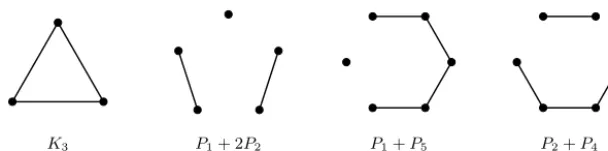
see [15].InbothofFig. 1.The forbidden induced subgraphs considered in our results.
thesecases,itisneitherknownwhetherthegraphclassunderconsiderationhasboundedclique-widthnorwhetheritis well-quasi-orderedbytheinducedsubgraphrelation.
Resultsandmethodology. In Section 5, we prove that Conjecture1 holds for the class of
(K
3,
P2+
P4)-free
graphs byshowingthat thisclasshas boundedclique-widthandiswell-quasi-orderedby theinduced subgraph relation.Insteadof using ad hocarguments, we emphasize that our underlyingresearch goalis to develop methodology that could also be applied morewidely toother classesandwhich increasesourunderstanding ofthe structureof specialgraphclasses.In thispaperwefocusonK3-freegraphsandweprovethetworesultson
(K
3,
P2+
P4)-free
graphsbyusingageneralmethodexplainedinSection4.
Ourmethodisbasedonextending(alabelledversionof)well-quasi-orderabilityorboundednessofclique-widthofthe bipartite graphsinahereditarygraphclass X toa specialsubclassof3-partitegraphsin X.Thecrucialpropertyofthese 3-partitegraphsisthatnothreeverticesfromthethreedifferentpartitionclassesformacliqueorindependentset.Wesay thatsuch 3-partitegraphsarecurious.ThemethodfindsitsorigininapaperofFouquet,GiakoumakisandVanherpe [24], who characterized totally decomposablebipartite graphs, that is,bipartite graphs that can recursively be canonically de-composedintographsisomorphictoanisolatedvertex.Dabrowski,DrossandPaulusma [12] generalizedthisdecomposition frombipartite graphstok-partitegraphsforanyk
≥
2 andpartiallycharacterizedtotally3-decomposablegraphs.This suf-ficedtoprovethat(K
3,
P1+
P5)-free
graphshaveboundedclique-width [12],butitisnotstrongenoughforourpurposes.Ournewdecompositionmethodallowsustoalsodealwithcuriousgraphsthatarenottotally3-decomposable.
In Section 5 we show how to generalize results for curious
(K
3,
P2+
P4)-free
graphs to the whole class of(K
3,
P2+
P4)-free
graphs.Duetothegeneralityofourmethod,itimmediatelyfollowsthattheclassof(K
3,
P1+
P5)-free
graphs is also well-quasi-ordered, which was not previously known (see [3,33]). Since
(K
3,
P1+
2P2)-free
graphs are(K
3,
P1+
P5)-free
(and(K
3,
P2+
P4)-free),
our results immediately imply that the class of(K
3,
P1+
2P2)-free
graphsis also well-quasi-ordered by the induced subgraph relation, which was also previously unknown (see [3,33]).As men-tioned,it wasalreadyknown [12] thattheclassof
(K
3,
P1+
P5)-free
graphshasboundedclique-width(andsothesamewasknownfortheclassof
(K
3,
P1+
2P2)-free
graphs);aswewillsee,thisalsofollowsdirectlyfromourmethod.SeeFig.1forpicturesoftheforbiddeninducedsubgraphsmentionedinthisparagraph.
DichotomyforK3-freegraphs. Previously, well-quasi-orderability was known for
(K
3,
P6)-free
graphs [3],(P
2+
P4)-free
bipartitegraphs [32] and
(P
1+
P5)-free
bipartitegraphs [32]. Ithasalsobeenshownthat H-freebipartite graphsarenotwell-quasi-orderedif H contains an induced3P1
+
P2 [33], 3P2 [20] or 2P3 [32].Moreover, forevery s≥
1,theclass of(K
3,
s P1)-free
graphsisfiniteduetoRamsey’sTheorem [40].TheaboveresultsleadtothefollowingknowndichotomyforH-freebipartitegraphs.
Theorem1.Let H beagraph.TheclassofH -freebipartitegraphsiswell-quasi-orderedbytheinducedsubgraphrelationifandonlyif H
=
s P1forsomes≥
1or H isaninducedsubgraphofP1+
P5,P2+
P4or P6.Now combiningthe aforementioned known resultsfor
(K
3,
H)-free graphs and H-free bipartite graphs withour newresultsyieldsthefollowingnewdichotomyfor H-freetriangle-freegraphs,whichisexactlythesameastheone in Theo-rem1.
Theorem2.Let H beagraph.Theclassof
(K
3,
H)-freegraphsiswell-quasi-orderedbytheinducedsubgraphrelationifandonlyifH
=
s P1forsomes≥
1orH isaninducedsubgraphofP1+
P5,P2+
P4,or P6.Besidesourmethodbasedoncuriousgraphs,wealsoexpectthatTheorem2willitselfbeausefulingredientforshowing resultson well-quasi-orderabilityforother graphclasses,justasTheorem 1hasalreadyproven to beusefulforthis(see e.g. [32]).
Forclique-widththefollowingdichotomy isknownfor H-free bipartitegraphs; seeSection 2forthedefinitionofthe graphSh,i,j.
Theorem3([16]).Let H beagraph.TheclassofH -freebipartitegraphshasboundedclique-widthifandonly ifH
=
s P1forsomeItwouldbeinterestingtodeterminewhether
(K
3,
H)-freegraphsallowthesamedichotomywithrespecttothebound-ednessoftheir clique-width.The evidencesofarisaffirmative,butinordertoanswerthisquestion tworemaining cases need tobesolved, namely
(H
1,
H2)
=
(K
3,
P1+
S1,1,3)
and(H
1,
H2)
=
(K
3,
S1,2,3).
Both casesturnouttobe highlynon-trivial;inparticular,theclassof
(K
3,
P1+
S1,1,3)-free
graphscontainstheclassof(K
3,
P1+
P5)-free
graphs,andtheclassof
(K
3,
S1,2,3)-free
graphscontainsboththeclassesof(K
3,
P1+
P5)-free
and(K
3,
P2+
P4)-free
graphs.In Section 6 we give state-of-the-art summaries for well-quasi-orderability and boundedness of clique-width of bi-genic graphclasses (which include ournew results), together with an overviewof the missingcases for both problems (which include the missing cases mentioned in this section). In particular, these summaries show that our results for
(K
3,
P2+
P4)-free
graphs are tightin thesense that(H,
P2+
P4)-free
graphs haveunbounded clique-widthandarenotwell-quasi-orderedbytheinducedsubgraphrelationforanyinducedsupergraphH of K3,unlessH isthepaw(thegraph
P1
+
P3).InSection7weconcludeourpaperwithsomeremarksforfuturework.2. Preliminaries
Throughoutthepaper,weconsideronlyfinite,undirectedgraphswithoutmultipleedgesorself-loops.Below,wedefine furthergraphterminology.
Thedisjointunion
(V
(G)
∪
V(H),
E(G)
∪
E(H))oftwovertex-disjointgraphsGandHisdenotedbyG+
Handthedisjoint unionofrcopiesofagraphG isdenotedbyrG.Thecomplement G ofagraphG hasvertexset V(G)
=
V(G)
andanedge betweentwodistinct verticesu,v ifandonlyifuv∈
/
E(G).Forasubset S⊆
V(G),
welet G[
S]
denotethesubgraphofG inducedby S,whichhasvertexsetSandedgeset{
uv|
u,v∈
S,uv∈
E(G)
}
.IfS= {
s1,
. . . ,
sr}then,tosimplifynotation,wemayalsowriteG
[
s1,
. . . ,
sr]insteadofG[{
s1,
. . . ,
sr}].WeuseG\
S todenotethegraphobtainedfromGbydeletingeveryvertexinS,thatis,G
\
S=
G[
V(G)
\
S]
.Wewrite G⊆i
Gtoindicatethat G isaninducedsubgraphofG.The graphs Cr, Kr, K1,r−1 and Pr denote the cycle, complete graph, star and path on r vertices, respectively. The graphs K3 and K1,3 are also called the triangle and claw, respectively. A graph G is a linearforest ifevery component
ofG isapath(on atleastonevertex).ThegraphSh,i,j,for1
≤
h≤
i≤
j,denotesthesubdividedclaw,thatis,thetreethat hasonlyone vertexxofdegree 3 andexactlythree leaves,whichare atdistanceh, i and j fromx,respectively.Observe that S1,1,1=
K1,3.WeletS
denotetheclassofgraphs,eachconnectedcomponentofwhichiseitherasubdividedclaworapath.
Forasetofgraphs
{
H1,
. . . ,
Hp},agraphGis(H
1,
. . . ,
Hp)-freeifithasnoinducedsubgraphisomorphictoagraphin{
H1,
. . . ,
Hp};ifp=
1,wemaywrite H1-freeinsteadof(H
1)-free.
Agraphisk-partiteifitsvertexcanbepartitionedintok(possibly empty)independent sets; 2-partite graphsare also knownas bipartite graphs.The biclique orcompletebipartite graph Kr,s isthebipartitegraphwithsetsinthepartitionofsizerandsrespectively,suchthat everyvertexinonesetis adjacenttoeveryvertexintheotherset.ForagraphG
=
(V
,
E),thesetN(u)= {
v∈
V|
uv∈
E}
denotestheneighbourhood of u∈
V.Let X be aset ofvertices in G.Avertex y∈
V\
X iscomplete to X ifit is adjacentto every vertexof X and anti-complete to X ifitis non-adjacentto everyvertexof X. Asetofvertices Y⊆
V\
X iscomplete (resp.anti-complete) to X ifevery vertexin Y is complete(resp. anti-complete)to X.If X and Y are disjointsets ofvertices ina graph,we saythat theedges betweenthesetwosets forma matching ifeach vertexin X hasatmostone neighbourinY andvice versa;ifeachvertexhasexactlyonesuchneighbour,wesaythatthematchingisperfect.Similarly,theedgesbetweenthese sets form aco-matching ifeach vertexin X has atmostone non-neighbourin Y andviceversa. We saythat theset X dominates Y ifeveryvertexofY hasatleastone neighbourin X.Similarly,avertexx dominates Y ifevery vertexofY is adjacenttox.Avertexy∈
V\
X distinguishes Xify hasbothaneighbourandanon-neighbourinX.Theset X isamodule ofGifnovertexinV\
X distinguishes X.Amodule X isnon-trivialif1<
|
X|
<
|
V|
,otherwiseitistrivial.Agraphisprime ifithasonlytrivialmodules.Twoverticesarefalsetwinsiftheyhavethesameneighbourhood(notethatsuchverticesmust benon-adjacent).Clearlyanyprimegraphonatleastthreeverticescannotcontainapairoffalsetwins,asanysuchpairof verticeswouldformanon-trivialmodule.Wewillusethefollowingstructuralresult.
Lemma1([12]).Let G beaconnected
(K
3,
C5,
S1,2,3)-free
graphthatdoesnotcontainapairoffalsetwins.Then G iseitherbipartiteoracycle.
2.1. Clique-width
The clique-widthcw(G) ofagraph G isthe minimumnumberoflabelsneededto constructG byusingthe following fouroperations:
1. i(v):creatinganewgraphconsistingofasinglevertexv withlabeli; 2. G1
⊕
G2:takingthedisjointunionoftwolabelledgraphsG1andG2;We say that aconstruction of a graph G withthe fouroperationsis a k-expressionifit uses atmostk labels.Thus the clique-widthofGistheminimumkforwhichGhasak-expression.Recallthataclassofgraphs
G
hasboundedclique-width ifthereisaconstantcsuchthattheclique-widthofeverygraphinG
isatmostc;otherwisetheclique-widthisunbounded. LetG be agraph.Wedefine thefollowingoperations. Foraninduced subgraph G⊆i
G,thesubgraphcomplementation operation(acting onG withrespectto G) replacesevery edgepresentinG byanon-edge,andviceversa.Similarly, for two disjointvertexsubsets S and T in G,the bipartitecomplementation operationwithrespect to S and T acts on G by replacingeveryedgewithoneend-vertexin SandtheotheroneinT byanon-edgeandviceversa.Wenowstatesomeusefulfactsabouthowtheaboveoperations(andsomeotherones)influencetheclique-widthofa graph.Wewillusethesefactsthroughoutthepaper.Letk
≥
0 beaconstant andletγ
besome graphoperation.Wesay thatagraphclassG
is(k,
γ
)-obtained
fromagraphclassG
ifthefollowingtwoconditionshold:1. everygraphin
G
isobtainedfromagraphinG
byperformingγ
atmostktimes,and2. foreveryG
∈
G
thereexistsatleastonegraphinG
obtainedfromG byperformingγ
atmostktimes.Wesaythat
γ
preservesboundednessofclique-widthifforanyfiniteconstantkandanygraphclassG
,anygraphclassG
thatis(k,
γ
)-obtained
fromG
hasboundedclique-widthifandonlyifG
hasboundedclique-width.Fact 1.Vertexdeletionpreservesboundednessofclique-width [36].
Fact 2. Subgraphcomplementationpreservesboundednessofclique-width [29]. Fact 3. Bipartitecomplementationpreservesboundednessofclique-width [29].
Lemma2([11]).Let G beagraphandlet
P
bethesetofallinducedsubgraphsof G thatareprime.Thencw(G)=
maxH∈Pcw(H).2.2. Well-quasi-orderability
Aquasiorder
≤
onaset X isa reflexive,transitivebinaryrelation.Twoelements x,y∈
X inthisquasi-orderare com-parable if x≤
y or y≤
x,otherwise they are incomparable. Aset ofelements in a quasi-orderis achain ifevery pair of elementsiscomparableanditisanantichainifeverypairofelementsisincomparable.Thequasi-order≤
isa well-quasi-order if anyinfinitesequence of elements x1,
x2,
x3,
. . .
in X contains a pair(x
i,xj) with xi≤
xj andi<
j.Equivalently, a quasi-orderisawell-quasi-order ifandonlyifithasnoinfinite strictlydecreasingsequence x1x2x3· · ·
andnoinfiniteantichain.
Foran arbitraryset M, let M∗ denote theset offinite sequences ofelements of M. Aquasi-order
≤
on M definesa quasi-order≤
∗ on M∗ asfollows:(a
1,
. . . ,
am)≤
∗(b
1,
. . . ,
bn)ifandonlyifthereisasequence ofintegers i1,
. . . ,
im with1
≤
i1<
· · ·
<
im≤
nsuchthataj≤
bij for j∈ {
1,. . . ,
m}
.Wecall≤
∗thesubsequencerelation.Lemma3(Higman’sLemma [27]).If
(M,
≤
)
isawell-quasi-orderthen(M
∗,
≤
∗)
isawell-quasi-order.Todefine thenotionoflabelledinducedsubgraphs,letusconsideranarbitraryquasi-order
(W
,
≤
).
Wesaythat Gisa labelledgraphifeach vertexv ofG isequippedwithan elementlG(v)∈
W (the labelofv).Giventwolabelledgraphs G and H,we saythat G isalabelledinducedsubgraphof H ifG is isomorphictoan inducedsubgraphof H andthereisan isomorphismthatmapseachvertexv ofGtoavertexwofH withlG(v)≤
lH(w).
Clearly,if(W
,
≤
)
isawell-quasi-order, thena graphclass X cannot containaninfinitesequenceoflabelledgraphsthat isstrictly-decreasingwithrespecttothe labelled induced subgraph relation.We thereforesay that a graph class X is well-quasi-orderedby the labelled induced subgraphrelationifitcontainsnoinfiniteantichainsoflabelledgraphswhenever(W
,
≤
)
isawell-quasi-order.Suchaclass isreadilyseentoalsobewell-quasi-orderedbytheinducedsubgraphrelation.Daligault,RaoandThomassé [18] showedthateveryhereditaryclassofgraphsthatiswell-quasi-orderedbythelabelled induced subgraph relationis definedby a finiteset offorbidden induced subgraphs. Korpelainen, LozinandRazgon [34] conjecturedthatifahereditaryclassofgraphs
G
isdefinedbyafinitesetofforbiddeninducedsubgraphs,thenG
is well-quasi-ordered by the induced subgraph relation ifand only ifit is well-quasi-orderedby the labelled induced subgraph relation.Brignall,EngenandVatter [8] recentlyfoundaclassG
∗ with14forbiddeninducedsubgraphsthatisa counterex-ampleforthisconjecture,thatisG
∗ iswell-quasi-orderedbytheinducedsubgraphrelationbutnotbythelabelledinduced subgraphrelation.However,sofar,allknownresultsforbigenicgraphclasses,includingthoseinthispaper,agreewiththe conjectureforbigenicgraphclasses.Lemma4([15]).Thefollowingoperationspreservewell-quasi-orderabilitybythelabelledinducedsubgraphrelation:
(i) Subgraphcomplementation, (ii) Bipartitecomplementationand (iii) Vertexdeletion.
Lemma5([3]).Ahereditaryclass X ofgraphsiswell-quasi-orderedbythelabelledinducedsubgraphrelationifandonlyifthesetof primegraphsin X is.Inparticular,X iswell-quasi-orderedbythelabelledinducedsubgraphrelationifandonlyifthesetofconnected graphsin X is.
Lemma6([3,32]).
(P
7,
S1,2,3)-free
bipartitegraphsarewell-quasi-orderedbythelabelledinducedsubgraphrelation.Let
(L
1,
≤
1)
and(L
2,
≤
2)
bewell-quasi-orders.We definetheCartesianProduct(L
1,
≤
1)
×
(L
2,
≤
2)
ofthesewell-quasi-orders asthe order
(L,
≤L
)
on the set L:=
L1×
L2 where(l
1,
l2)
≤L
(l
1,
l2)
if andonlyifl1≤
1l1 andl2≤
2l2. Lemma3impliesthat
(L,
≤L
)
isalsoawell-quasi-order. IfG hasa labellingwithelements ofL1 andofL2,sayl1:
V(G)
→
L1 andl2
:
V(G)
→
L2,wecanconstructthecombinedlabellingin(L
1,
≤
1)
×
(L
2,
≤
2)
that labelseachvertexv ofG withthelabel(l
1(v),
l2(v)).
Lemma7.Fixawell-quasi-order
(L
1,
≤
1)
thathasatleastoneelement.Let X beaclassofgraphs.ForeachG∈
X fixalabellingl1G:
V
(G)
→
L1.Then X iswell-quasi-orderedbythelabelledinducedsubgraphrelationifandonlyifforeverywell-quasi-order(L
2,
≤
2)
andeverylabellingofthegraphsin X bythisorder,thecombinedlabellingin
(L
1,
≤
1)
×
(L
2,
≤
2)
obtainedfromtheselabellingsalsoresultsinawell-quasi-orderedsetoflabelledgraphs.
Proof. IfX iswell-quasi-orderedbythelabelledinducedsubgraphrelationthenbydefinitionitiswell-quasi-orderedwhen labelledwithlabelsfrom
(L
1,
≤
1)
×
(L
2,
≤
2).
If X isnotwell-quasi-orderedbythelabelledinducedsubgraphrelationthentheremustbeawell-quasi-order
(L
2,
≤
2)
andaninfinitesetofgraphsG1,
G2,
. . .
whoseverticesarelabelledwithelementsof L2 such that thesegraphs form an infinite labelledantichain. Foreach graph Gi, replace the label l on vertex v by
(l
1G1(v),
l).The graphsarenowlabelledwithelementsofthewell-quasi-order(L
1,
≤
1)
×
(L
2,
≤
2)
andresultinaninfinitelabelledantichainofgraphslabelledwithsuchcombinedlabellings.Thiscompletestheproof.
2
2.3. k-uniformgraphs
For an integerk
≥
1, a graph G is k-uniform ifthere isa symmetric square 0,1 matrix K oforder k anda graph Fk on vertices1,2,. . . ,
k such thatG∈
P
(K
,
Fk),whereP
(K
,
Fk)isthegraphclassdefinedasfollows.Let H bethedisjoint union ofinfinitelymanycopiesof Fk.Fori∈ {
1,. . . ,
k}
,let Vi be thesubset of V(H)
containing vertexi fromeach copy of Fk.Constructfrom Han infinitegraph H(K)
onthesamevertexsetbyapplyingasubgraph complementationto Vi if andonly if K(i,
i)=
1 and byapplying abipartite complementationto a pair Vi,Vj ifandonlyif K(i,
j)=
1.Thus, two vertices u∈
Vi and v∈
Vj areadjacent in H(K)
ifandonly ifuv∈
E(H)
and K(i,
j)=
0 or uv∈
/
E(H)and K(i,
j)=
1. Then,P
(K
,
Fk)
isthehereditaryclassconsistingofallthefiniteinducedsubgraphsof H(K).
Theminimumksuchthat G isk-uniformistheuniformicityofG.Thesecondofthenexttwolemmasfollowsdirectlyfromtheabovedefinitions.ThefollowingresultwasprovedbyKorpelainenandLozin.Theclassofdisjointunionsofcliquesisacounterexamplefor thereverseimplication.
Lemma8([33]).Anyclassofgraphsofboundeduniformicityiswell-quasi-orderedbythelabelledinducedsubgraphrelation.
Thefollowinglemmafollowsfromthedefinitionofclique-widthandthedefinitionofk-uniformgraphs(seealso [2] for amoregeneralresult).Forcompleteness,weincludeaformalproof.
Lemma9.Foreveryk
≥
1,everyk-uniformgraphhasclique-widthatmost2k.Proof. Letk
≥
1 andlet H(K)
be thegraphfromthedefinitionofk-uniformforsome FkandK.Wewillshowthatevery finiteinduced subgraphofH(K)
hasclique-widthatmost 2k.Let X1,
X2,
. . .
be thesets ofverticescorrespondingtoeachcopyofFkintheconstructionofH(K
)
andnotethat|
Xh|=
kforallh≥
1 andthat|
Xh∩
Vi|=
1 forallh≥
1,i∈ {
1,. . . ,
k}
. Furthermore, iftwo vertices x∈
Vi and y∈
Vj do not lie in the same set Xh,then xand y are adjacent ifandonly if K(i,
j)=
1.For≥
0,let H=
H(K)[
X1∪ · · · ∪
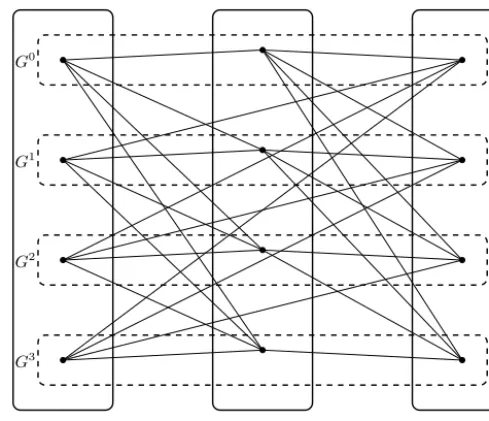
X](soH0 istheemptygraph,whichhasnovertices).Fig. 2.A 3-partite graph partitioned into slicesG0, . . . ,G3isomorphic toP 3.
withthepropertythatoncethisnew2k-expressionhasbeenapplied,foralli
∈ {
1,. . . ,
k}
everyvertexinV(H
+1)
∩
Vi has labeli.Todothis,wefirsttake the2k-expressionfor H andthen forevery i∈ {
1,. . . ,
k}
,wecreatetheuniquevertexof X+1∩
Vi withlabelk+
i andtake thedisjointunionoftheseverticeswiththeconstructed H.Next,fori,j∈ {
1,. . . ,
k}
withi<
j,if theunique vertexof X+1∩
Vi isadjacent to theunique vertexof X+1∩
Vj in H+1,then we apply thejoinoperation
η
k+i,k+j().Next,fori,j∈ {
1,. . . ,
k}
,ifK(i,
j)=
1,thenweapplythejoinoperationη
i,k+j().Finally,forevery i∈ {1,
. . . ,
k}weapplytherelabeloperationρ
k+i→i().Theresulting2k-expressionconstructsH+1withtherequiredlabels,so theinductionhypothesis alsoholdsfor
+
1. Byinduction,theinductionhypothesis holds forevery≥
0 and sowe concludethat H hasclique-widthatmost 2kforevery.
NowifG isak-uniformgraphthenitisafiniteinducedsubgraphof H(K
),
sothereisansuch thatG isaninduced subgraphofH.Itfollowsthat Ghasclique-widthatmost 2k.Thiscompletestheproof.
2
3. Outlineofourproofmethod
Weproveourresultsonbothwell-quasi-orderabilityandboundednessofclique-widthbyafurthergeneralizationofthe canonicaldecompositionmethodintroducedbyFouquet,GiakoumakisandVanherpe [24] forbipartitegraphs.Asdiscussed inSection1,thismethodwasgeneralizedto3-partitegraphsin [12],butforourpurposesweneedanon-trivialrefinement. WeexplainthisrefinementindetailinSection4,butbelowwesketchthemainideasbehindit.Inordertodothis,wefirst needtointroducesometerminology.
LetG bea3-partitegraphgivenwithapartition ofits vertexsetintothreeindependentsets V1, V2 and V3.Suppose
thateachset Vi canbe partitionedintosets Vi0
,
. . . ,
Vi(the valueofisthesameforeachi
∈ {
1,2,3}
) suchthat,taking subscriptsmodulo 3:– fori
∈ {
1,2,3}
if j<
k,thenVij iscompletetoVki+1andanti-completeto Vik+2.Fori
∈ {
0,. . . ,
}
letGi=
G[
Vi1
∪
V2i∪
V3i]
.WesaythatthegraphsGiaretheslicesofG.Iftheslicesbelongtosomegraphclass X,thenwesaythatG canbepartitionedintoslicesfrom X;seeFig.2foranexample. InSection4.1weprovethefollowingtworesults:
(i) every3-partitegraphthatcanbepartitionedintoslicesofclique-widthatmostkhasclique-widthatmost max(3k,6); (ii) foreverysetY of3-partitegraphsthatbelongtosomehereditarygraphclass X:ifthegraphsinY canbepartitioned intoslicesfromsome subclass Z
⊆
X thatiswell-quasi-orderedby thelabelledinduced subgraphrelation,then Y is alsowell-quasi-orderedbythelabelledinducedsubgraphrelation.withrespecttothepartition
(V
1,
V2,
V3)
ifitcontains norainbow K3 or 3P1 when itsvertexsetispartitionedinthisway.We saythat G iscuriousifthereisapartition
(V
1,
V2,
V3)
withrespecttowhichitiscurious;note thatbipartite graphsarecurious,sinceweallowthecasewhenVi
= ∅
forsomei.InSection4.2wewillprovethefollowingresult:(iii) if theset Xofbipartitegraphs ina hereditarygraphclass X iswell-quasi-orderedbythelabelledinducedsubgraph relationorhaveboundedclique-width,thenthesameistrueforthecuriousgraphsin X.
We will prove result (iii)by showingthat the curiousgraphs in X allow a partition intoslices from X,so that we can indeedapplyresults (i)and (ii).
Finally,inSection 5,weapply result (iii) ontheclassesof
(K
3,
P1+
P5)-free
graphs and(K
3,
P2+
P4)-free
graphs,inordertoprovethattheseclasseshaveboundedclique-widthandarewell-quasi-orderedby thelabelledinducedsubgraph relation.Todothis,weprovetwostructurallemmas.Theselemmasconsiderthecasewhenagraphinoneoftheseclasses contains an induced subgraphisomorphic to C5. Wepartition the remaining vertices ofthe graphinto setsaccording to
their neighbourhood in this C5 and analyse theedges betweenthe vertices inthese sets. We usethis analysisto show
how tousea constantnumberof vertexdeletionsandbipartite complementationsto transformthe graphintoa disjoint unionofcuriousgraphsand3-uniformgraphsintherespectivegraphclass.Thetwolemmasenableustoapplyresult (iii) after combining them with Theorem 3 andLemma 6, respectively, which implythat the bipartite graphs in the classes of
(K
3,
P1+
P5)-free
graphsand(K
3,
P2+
P4)-free
graphshaveboundedclique-widthandare well-quasi-orderedby the(labelled)inducedsubgraphrelation,respectively.
4. Partitioning3-partitegraphs
InSection4.1werecallourgraphdecompositionon3-partitegraphs.Wethenshowhowtoextendresultsonbounded clique-width or well-quasi-orderability by the labelled induced subgraph relation from bipartite graphs in an arbitrary hereditaryclass ofgraphs tothe 3-partitegraphsin thisclassthat aredecomposable inthisway.In Section 4.2wegive sufficientconditionsfora3-partitegraphtohavesuchadecomposition.
4.1. Thedecomposition
LetG be a3-partitegraphgivenwithapartitionofitsvertexsetintothreeindependentsets V1, V2 andV3.Suppose
that eachsetVi canbepartitionedintosetsVi0
,
. . . ,
Vi (thevalueofisthesameforeachi
∈ {
1,2,3}
)suchthat,taking subscriptsmodulo 3:– for i
∈ {
1,2,3}
if j<
kthen Vijiscompleteto Vik+1 andanti-completetoVik+2.Fori
∈ {
0,. . . ,
}
letGi=
G[
Vi1
∪
V2i∪
V3i]
.RecallthatthegraphsGiaretheslicesofG andthatiftheslicesbelongtosomegraphclass X,thenGcanbepartitionedintoslicesfromX.
Lemma 10.If G isa 3-partite graphthatcanbe partitionedintoslicesofclique-widthatmost k,then G hasclique-widthat mostmax(3k,6).
Proof. Since every slice Gj of G hasclique-widthat mostk, itcan be constructedusing ak-expression,which uses the labels 1,
. . . ,
k. Applying relabellingoperations if necessary, we mayassume that at the end of this construction, every vertex haslabel 1. Wecan modify thisk-expression sothat we usethe 3k labels 11,
. . . ,
k1,
12,
. . . ,
k2,
13,
. . . ,
k3 instead(sothemodified expressionwillbe a3k-expression forGj), insuchawaythatatall pointsintheconstruction, foreach i
∈ {
1,2,3}
everyconstructedvertexinVi hasalabelin{
1i,. . . ,
ki}.Todothiswereplace:– creationoperationsi(v)byij(v
)
ifv∈
Vj,– relabeloperations
ρ
j→k()byρ
j1→k1(
ρ
j2→k2(
ρ
j3→k3()))
and – joinoperationsη
j,k()byη
j1,k1(
η
j1,k2(
η
j1,k3(
η
j2,k1(
η
j2,k2(
η
j2,k3(
η
j3,k1(
η
j3,k2(
η
j3,k3())))))))).
This new3k-expressionuses 3k labelsand atthe endofit, every vertexin Vi is labelledwith label 1i.We find such a 3k-expressionEj foreverysliceGj ofG independently.
We now prove by induction on j
≥
0 that there is a max(3k,6)-expression which constructs G[
V(G
0)
∪ · · · ∪
V(G
j)]
in such a waythat every vertex in Vi is labelled withlabel 2i. For j=
0 we simply take the 3k-expression E0 for G0 andthenapplythreerelabellingoperationsρ
11→21,ρ
12→22 andρ
13→23.Supposetheinductionhypothesisholdsforsome j≥
0 and let Fj be the corresponding max(3k,6)-expression for G[
V(G
0)
∪ · · · ∪
V(G
j)]
. We take thedisjoint union of the max(3k,6)-expressions Fj and Ej+1. Next, we apply join operationsη
relabelling operations
ρ
11→21,ρ
12→22 andρ
13→23. This yields a max(3k,6)-expression for G[
V(G
0
)
∪ · · · ∪
V(G
j+1)
]
insuch awaythatevery vertexinVi islabelledwith 2i.(Note thatintheobtainedexpression weonlyeverusethelabels
{
11,
. . . ,
max(k,2)1,
12,
. . . ,
max(k,2)2,
13,
. . . ,
max(k,2)3}
,soitisindeedamax(3k,6)-expression.)Thereforetheinductionhypothesisholdsforevery j
≥
0.Byinduction,itfollowsthatG hasclique-widthatmost max(3k,6).2
Lemma11.Let X beahereditarygraphclasscontainingaclass Z .Let Y bethesetof3-partitegraphsin X thatcanbepartitionedinto slicesfrom Z .If Z iswell-quasi-orderedbythelabelledinducedsubgraphrelation,thensois Y .
Proof. Foreach graphG inY,wemayfixapartition intoindependentsets
(V
1,
V2,
V3)
withrespectto whichthegraphcanbepartitionedintoslicesfromZ.Let
(L
1,
≤
1)
bethewell-quasi-orderwithL1= {
1,2,3}
inwhicheverypairofdistinctelementsisincomparable.ByLemma7,we needonlyconsiderlabellingsofgraphsinY oftheform
(i,
l(v))wherev∈
Vi and l(v) belongs to an arbitrarywell-quasi-order L. Suppose G can be partitioned into slices G0,
. . . ,
Gk, withvertices labelledasin G.Notethat the orderedlist G0,
. . . ,
Gk completelyspecifies theedges of G andthe labelson its vertices. Indeed, two vertices x,y∈
V(G
i)
are adjacent in G if and only if they are adjacent in Gi and two vertices x∈
V(G
i),
y∈
V(G
j)
withi<
jareadjacentinGifandonlyifx∈
Vkandy∈
Vk+1 forsomek∈ {
1,2,3}
(subscriptstakenmodulo 3).Now consider two labelled graphs G,H
∈
Y with corresponding partitions into slices G0,
. . . ,
Gk and H0,
. . . ,
H. If(H
0,
. . . ,
H)
is smallerthan orequal to(G
0,
. . . ,
Gk)
underthe subsequence relation,then H is a labelledinduced sub-graphofG.TheresultfollowsbyLemma3.2
4.2. Curiousgraphs
LetG bea3-partitegraphgiventogetherwithapartitionofitsvertexsetintothreeindependentsets V1, V2 and V3.
Recallthataninduced K3 or 3P1 inG israinbow ifit hasexactlyone vertexineach set Vi.Alsorecallthat G iscurious
withrespecttothepartition
(V
1,
V2,
V3)
ifitcontainsnorainbow K3 or 3P1 whenitsvertexsetispartitionedinthisway,andthat G iscuriousifthere isapartition
(V
1,
V2,
V3)
withrespecttowhichit iscurious.Inthissection wewillprovethatgivenahereditaryclass X,ifthebipartitegraphsinXarewell-quasi-orderedbythelabelledinducedsubgraphrelation orhaveboundedclique-width,thenthesameistrueforthecuriousgraphsin X.
Alinearorder
(x
1,
x2,
. . . ,
xk)oftheverticesofanindependentsetI is– increasingifi
<
jimpliesN(xi)⊆
N(xj), – decreasingifi<
jimpliesN(xi)⊇
N(xj), – monotoneifitiseitherincreasingordecreasing.Bipartite graphs that are 2P2-free are also known asbipartite chain graphs. It is well known (and easy to verify) that
a bipartite graph G is 2P2-free ifand onlyif the verticesin each independent set ofthe bipartition admit a monotone
ordering. Suppose G is a curious graph with respect to some partition
(V
1,
V2,
V3).
We say that (with respect to thispartition)thegraphG isacuriousgraphoftype tifexactlytofthegraphsG
[
V1∪
V2]
,G[
V1∪
V3]
andG[
V2∪
V3]
containaninduced 2P2.
4.2.1. Curiousgraphsoftype0and1
NotethatifGisacuriousgraphoftype 0 or 1 withrespecttothepartition
(V
1,
V2,
V3)
thenwithoutlossofgenerality,wemayassumethatG
[
V1∪
V2]
andG[
V1∪
V3]
areboth2P2-free.Lemma12.Let G beacuriousgraphwithrespectto
(V
1,
V2,
V3),
suchthatG[
V1∪
V2]
andG[
V1∪
V3]
areboth2P2-free.Thentheverticesof V1admitalinearorderingwhichisdecreasinginG
[
V1∪
V2]
andincreasinginG[
V1∪
V3]
.Proof. ForasetS
⊆
V,weuseNS(u)
:=
N(u)∩
Stodenotethesetofverticesin Sthatareadjacenttou.Wemaychoose a linear order x1,
. . . ,
x of the vertices of V1 according to their neighbourhood in V2, breaking ties according to theirneighbourhoodinV3i.e.anordersuchthat:
(i) ifNV2
(x
i)NV2(x
j)theni<
j and(ii) ifNV2
(x
i)=
NV2(x
j)andNV3(x
i)NV3(x
j)theni<
j.ClearlysuchanorderingisdecreasinginG
[
V1∪
V2]
.Suppose,forcontradiction, thatthisorderis notincreasing inG
[
V1∪
V3]
.Then theremustbe indicesi<
j such thatNV3
(x
i)NV3(x
j).Then NV2(x
i)=
NV2(x
j) by Property (ii).ByProperty (i) itfollowsthat NV2(x
i)NV2(x
j).Thismeans that there are vertices y∈
NV2(xi)
\
NV2(xj)
and z∈
NV3(xi)
\
NV3(xj).
Now if y is adjacent to z then G[
xi,y,z]
is a rainbow K3 and if y isnon-adjacent to z then G[
xj,y,z]
is arainbow 3P1.This contradictionimpliesthat the orderisLemma13.If G isacuriousgraphoftype0or1withrespecttoapartition
(V
1,
V2,
V3)
then G canbepartitionedintoslicesthatarebipartite.
Proof. SinceGisacuriousgraphoftype 0 or 1,withoutlossofgenerality,wemayassumethatG
[
V1∪
V2]
andG[
V1∪
V3]
are both 2P2-free. Let
= |
V1|
(wewill partition G into+
1 slices G0,
. . . ,
G). Letx1,
. . . ,
x be alinear order on V1satisfyingLemma12.LetV10
= ∅
andfori∈ {
1,. . . ,
}
,let V1i= {
xi}.Wepartition V2 and V3 asfollows.Fori∈ {
0,. . . ,
}
,let Vi
2
= {
y∈
V2|
xjy∈
E(G)
if and only if j≤
i}
. For i∈ {
0,. . . ,
}
, let V3i= {
z∈
V3|
xjz∈
/
E(G)
if and only if j≤
i}
. In particular,notethattheverticesofV2
∪
V30andV20∪
V3arecompleteandanti-completeto V1,respectively.Thefollowingpropertieshold:
– If j
<
k,then V1jiscompleteto Vk2 andanti-completeto V3k.
– If j
>
k,then V1jisanti-completetoVk2 andcompleteto V3k.
If j
<
k and y∈
V2j is non-adjacentto z∈
V3k then G[
xk,y,z]
isa rainbow 3P1,a contradiction. If j>
k and y∈
V2j isadjacenttoz
∈
Vk3 thenG[
xj,y,z]
isarainbow K3,acontradiction.Itfollowsthat:– If j
<
k,then V2jiscompleteto Vk3.
– If j
>
k,then V2jisanti-completetoVk3.Fori
∈ {
0,. . . ,
}
,letGi=
G[
V1i∪
V2i∪
V3i]
.TheabovepropertiesabouttheedgesbetweenthesetsVijimplythefollowing statements:– If j
<
k,then V1jiscompleteto V2kandanti-completeto V3k. – If j<
k,then V2jiscompleteto V3kandanti-completeto V1k. – If j<
k,then V3jiscompleteto Vk1 andanti-completeto V2k.
ThusGcanbepartitionedintotheslicesG0
,
. . . ,
G.Now,foreachi∈ {
0,. . . ,
}
,Vi1isanti-completetoV3i,soeverysliceG
i
isbipartite.Thiscompletestheproof.
2
4.2.2. Curiousgraphsoftype2and3
Lemma14.Fixt
∈ {
2,3}
.If G isacuriousgraphoftype t withrespecttoapartition(V
1,
V2,
V3)
then G canbepartitionedintoslicesoftypeatmostt
−
1.Proof. Fixt
∈ {
2,3}
andlet G bea curiousgraphoftype t withrespecttoa partition(V
1,
V2,
V3).
WemayassumethatG
[
V1∪
V2]
containsaninduced 2P2.Claim1.Givena2P2inG
[
V1∪
V2]
,everyvertexof V3hasexactlytwoneighboursinthe2P2andtheseneighbourseitherbothliein V1orbothliein V2.
Letx1
,
x2∈
V1andy1,
y2∈
V2inducea 2P2inGsuchthatx1isadjacenttoy1butnotto y2andx2isadjacentto y2butnotto y1.Consider z
∈
V3.Fori∈ {
1,2}
,ifz isadjacenttobothxi andyi,thenG[
xi,yi,z]
isarainbow K3,acontradiction.Therefore z can haveatmostone neighbourin
{
x1,
y1}
andatmostone neighbourin{
x2,
y2}
.If z isnon-adjacentto x1and y2 thenG
[
x1,
y2,
z]
isarainbow 3P1,acontradiction.Therefore,zcanhaveatmostonenon-neighbourin{
x1,
y2}
,andsimilarly z canhave atmostone non-neighbourin
{
x2,
y1}
.Therefore,ifz isadjacentto x1,thenitmustbe non-adjacentto y1,soitmustbeadjacenttox2,soitmustbenon-adjacentto y2.Similarly,ifz isnon-adjacenttox1 then itmustbe
adjacentto y2,soitmustbenon-adjacenttox2,soitmustbeadjacentto y1.HenceClaim1follows.
Consideramaximalset
{
H1,
. . . ,
Hq}
ofvertex-disjointsetsthatinducecopiesof 2P2inG
[
V1∪
V2]
.WesaythatavertexofV3distinguishestwographsG
[
Hi]
andG[
Hj]
ifitsneighboursinHiandHj donotbelongtothesamesetVk.Wegroup thesesets Hi intoblocks B1,
. . . ,
Bp that arenot distinguished by anyvertexof V3.Inother words,every Bi contains atleastone 2P2andeveryvertexofV3 iscompletetooneofthesets Bi
∩
V1 andBi∩
V2andanti-completetotheother.Forj
∈ {
1,2}
,letBij
=
Bi∩
Vj.Wedefinearelation<B
ontheblocksasfollows:– Bi
<B
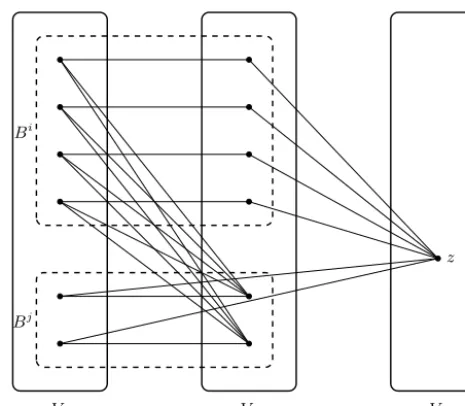
Bj holdsifBi1 iscompletetoB2j,while B2i isanti-completeto B1j.Fig. 3.Two blocksBiandBjwithBi<BBjand a vertexz∈V
3distinguishing them.
Claim2.Let Biand Bjbedistinctblocks.Thereisavertexz
∈
V3 thatdistinguishes Bi and Bj.If z iscompleteto Bi2∪
Bj
1and
anti-completetoBi
1
∪
Bj
2thenBi
<B
Bj(seealsoFig.3).If z iscompletetoBj
2
∪
Bi1andanti-completeto Bj
1
∪
Bi2thenBj<B
Bi.Furthermore,oneofthesecasesmustapply,whichimpliesthateitherBi
<B
BjorBj<B
Biforeverypairofdistinctblocks Biand Bj.Bydefinitionoftheblocks Bi andBj theremustbeavertexz
∈
V3 thatdistinguishesthem.Withoutlossofgenerality
we mayassume that z iscompleteto B2i
∪
B1j andanti-completeto B1i∪
B2j.Itremains toshow that Bi<B
Bj.If y∈
Bi2
isadjacentto z
∈
B1j thenG[
x,y,z]
isarainbow K3,acontradiction.If y∈
B1i isnon-adjacenttoz∈
Bj
2 then G
[
x,y,z]
isa rainbow 3P1,a contradiction. Therefore Bi2 is anti-complete to B
j
1 and Bi1 is completeto B
j
2.It follows that Bi
<B
Bj.Claim2followsbysymmetry.
Claim3.Therelation
<B
istransitive.SupposethatBi
<B
BjandBj<B
Bk.SinceBjandBkaredistinct,theremustbeavertexz∈
V3 thatdistinguishesthem,
andby combiningClaim2withthefact that Bj
<B
Bk it followsthat z must becomplete to Bj2
∪
Bk1 andanti-completetoB2j
∪
Bk1.Supposex∈
Bi1and y∈
B2j.Then xisadjacentto y,since Bi<B
Bjandy isadjacenttozbychoiceofz.Now x ismustbe non-adjacentto z otherwise G[
x,y,z]
wouldbea rainbow K3.Therefore z isanti-complete to Bi1.RecallthateveryvertexofV3 iscompletetooneofBi1andBi2andanti-completetotheother(duetoClaim1).Thereforeziscomplete
to Bi
2,andsozdistinguishesBi andBk.ByClaim2itfollowsthatBi
<B
Bk.ThiscompletestheproofofClaim3.CombiningClaims1–3,wefindthat
<B
isalinearorderontheblocks.Weobtainthefollowingconclusion,whichwe callthechainproperty.Claim4.ThesetofblocksadmitsalinearorderB1
<B
B2<B
· · ·
<B
Bpsuchthat(i) if i
<
j then Bi1iscompleteto B
j
2,while Bi2isanti-completeto B
j
1and
(ii) foreachz
∈
V3thereexistsani∈ {
0,. . . ,
p}
suchthatifj≤
i then z iscompleteto B2jandanti-completeto B1jandifj>
i then zisanti-completeto B2jandcompleteto B1j.
NextconsiderthesetofverticesinV1
∪
V2thatdonotbelongtoanysetBi.LetRdenotethissetandnotethat G[
R]
is2P2-freebymaximalityoftheset
{
H1,
. . . ,
Hq}
.Fori∈ {
1,2}
letRi=
R∩
Vi.Claim5.Ifx
∈
R1hasaneighbourin Bi2,then x iscompleteto B2i+1,andif x hasanon-neighbourin Bi2,then x isanti-completeto Bi2−1.Ifx
∈
R2hasanon-neighbourinBi1,thenx isanti-completeto Bi+1
1 ,andif x hasaneighbourin B1i,then x iscompleteto B
i−1 1 .
Suppose,forcontradiction,thatx
∈
R1 isadjacentto y∈
B2i andnon-adjacentto y∈
Bi+1
2 .Consideravertexz
∈
V3thatdistinguishesBiandBi+1.SinceBi
<B
Bi+1,Claim2impliesthatziscompletetoBi+1 1∪
Bi
2andanti-completetoB
i+1 2
∪
Bi