MODELS FOR PERSISTENCE IN LAZY FUNCTIONAL
PROGRAMMING SYSTEMS
David J. McNally
A Thesis Submitted for the Degree of PhD
at the
University of St Andrews
1993
Full metadata for this item is available in
St Andrews Research Repository
at:
http://research-repository.st-andrews.ac.uk/
Please use this identifier to cite or link to this item:
http://hdl.handle.net/10023/13436
Models for Persistence in
Lazy Functional Programming Systems
David J. McNally
Department of Mathematical and Computational
Sciences
University of St Andrews
Fife
ProQuest Number: 10167178
All rights reserved
INFORMATION TO ALL USERS
The quality of this reproduction is d ep en d en t upon the quality of the copy submitted.
In the unlikely ev en t that the author did not send a co m p lete manuscript
and there are missing p a g es, these will be noted. Also, if material had to be rem oved, a n o te will indicate the deletion.
uest
ProQuest 10167178
Published by ProQuest LLO (2017). Copyright of the Dissertation is held by the Author.
All rights reserved.
This work is protected against unauthorized copying under Title 17, United States C o d e
Microform Edition © ProQuest LLO.
ProQuest LLO.
789 East Eisenhower Parkway P.Q. Box 1346
Declarations
I, David John M cNally, hereby certify that this thesis has been com posed by
myself, that it is a record of my own work, and that it has not been accepted in
partial or complete fulfilment of any other degree or professional qualification.
Signed Date
I was admitted to the Faculty of Science of the University of St Andrews under
Ordinance General No. 12 on 1st October 1986 and as a candidate for the degree of
Ph.D. on 1st October 1986.
Signed Date
I hereby certify that the candidate has fulfilled the conditions of the Resolution and
Regulations appropriate to the degree of Ph.D.
Copyright
In submitting this thesis to the University of St Andrews I understand that I am giving permission for it to be made available for use in accordance with the
regulations of the University Library for the time being in force, subject to any
copyright vested in the work not being affected thereby. I also understand that the title and abstract will be published, and that a copy of the work may be made and
supplied to any bona fid e library or research worker.
Acknowledgements
It is clear that in any work of this kind, there will be influences from many
sources. The research community as a whole is a lively source of ideas and intuitions and it would be impossible to acknowledge all who have contributed to
this research though I thank them all. It is appropriate, however, that a number of
people be thanked explicitly. Fred Brown, Richard Connor, Quintin Cutts, A1
Tony Davie, A1 Dearie, Simon Peyton Jones, Stef Joosten, Graham Kirby, Ron
Morrison, Dave Munro, Gerald Ostheimer and Norman Paterson have all provided interesting and stimulating discussions leading to ideas presented here.
Ron Morrison has been particularly important in sharpening up many of the ideas
which have arisen during the period of this work. Simon Peyton Jones has helped in pointing me in the right direction. Special mention should also go to Tony Davie
my supervisor and Richard Connor who both played a significant part in the
Abstract
Research into providing support for long term data in lazy functional programming
systems is presented in this thesis. The motivation for this work has been to reap
the benefits of integrating lazy functional programming languages and persistence.
The benefits are
• the programmer need not write code to support long term data since
this is provided as part of the programming system
• persistent data can be used in a type safe way since the programming
language type system applies to data with the w hole range of
persistence
• the benefits of lazy evaluation are extended to the full lifetime of a data value. W hilst data is reachable, any evaluation performed on the data
persists. A data value changes monotonically from an unevaluated
state towards a completely evaluated state over time.
• interactive data intensive applications such as functional databases can
be developed.
These benefits are realised by the development of models for persistence in lazy
functional programming systems. Two models are proposed w hich make persistence available to the functional programmer. The first, persistent modules,
allows values named in modules to be stored in persistent storage for later reuse.
The second model, stream persistence allows dynamic, interactive access to
persistent storage. These models are supported by a system architecture which
incorporates a persistent abstract machine, PCASE, integrated with a persistent object store. The resulting persistent lazy functional programming system, Staple,
Table of Contents
Chapter 1 — Introduction... 1
1.1 What is Functional Programming? ...2
1.1.1 The Development of Functional Languages... 4
1.1.2 Evaluation Strategy... 7
1.1.3 L a z in e s s ...8
1.1.4 Advantages of Laziness over Strictness... 11
1.1.5 Costs of Lazy Functional Languages... 12
1.2 Persistent Programm ing...13
1.2.1 P e rs is te n c e ...13
1.2.1.1 Identifying Persistent D ata... 14
1.2.2 O rthogonal P ersistence...15
1.2.3 Advantages of Persistence... 17
1.2.3.1 Software R euse...19
1.2.4 Costs of Persistence...19
1.3 Combining Persistence with Lazy Functional Programming...20
1.3.1 Im proving E fficiency...22
1.3.2 Facilitating Database Application B uilding... .23
1.3.3 The Staple System... 25
1.4 Related W ork on Persistent Languages... 26
1.4.1 Amber and CAML...26
1.4.2 A g n a ...28
1.4.3 P o ly ...28
1.4.4 PSA SL... 29
1.5 Thesis Structure •... 30
Chapter 2 — Persistent M odules... 31
2.1 Introduction...31
2.2 The Command Interface to the Persistent Module System ... 32
2.2.1 Changing the Interactive Environment... 36
2.3 Binding... 37
2.4 Scoping...37
2.5 System E v o lu tio n ... 38
2.5.1 Replacing a M odule... 39
2.6 Exam ples of Using Persistent M odules...41
2.6.1 M e m o isa tio n ... 41
2.7 Conclusions... 45
Chapter 3 — Stream Persistence... 47
3.1 Introduction... 47
3.2 Stream s and Stream I/O ...48
3.2.1 Character Stream s...49
3.2.2 Token Stream s... 50
3.3 Dialogues...52
3.4 Streams and Persistence... 52
3.5 T ype C h e c k in g ...54
3 .5 .1 Staple Type Algebra... 55
3.5.2 Static Type C hecking... 57
3.5.3 D ynam ic Type Equivalence... 58
3.6 An Extended Exam ple... 61
3.8 Conclusions... 64
Chapter 4 — PCASE - An Abstract Machine for Persistent Lazy Functional Programm ing... 65
4.1 Introduction... 65
4.1.1 How to P roceed...67
4.1.2 P ersistent O bject Form ats... 69
4.2 A Persistent Abstract M achine...69
4.2.1 Stacks... 71
4.2.2 Code Vectors...71
4.2.3 The Environment... 72
4.3 Operational Semantics...75
4.3.1 Stack In stru ctio n s... 75
4.3.1.1 Loading an argument register...75
4.3.1.2 Loading a free variable...77
4.3.1.3 Loading literals...78
4.3.1.4 Built in operators...80
4.3.1.5 Conditionals and Jum ps...81
4.3.1.6 Data Structure Creation and Dereferencing...85
4.3.1.7 Function creation, entry and exit...88
4.3.1.8 Block entry and exit... 92
4.3.1.9 L a z in e ss... 93
4.3.1.10 Recursion... 99
4.3.1.11 Module creation...101
4.3.1.12 Type A ny... 102
4.3.2 Efficiency... 104
4.4.1 Initialising the Object Store...... 106
4.4.2
Closing the Object Store... ... 1064.4.3
Creating O bjects... ... 1064.4.4
Destroying an Object...... 1074.4.5 Accessing the Root Object...... 107
4.4.6 Writing to O bjects... ...108
4.4.7 Dereferencing Objects... ...
109
4.4.8 Stability... ...109
4.4.9 Garbage Collection... ...110
4.4.10 Q uality of S ervice... ....111
4.5 Conclusions... ... I l l Chapter 5 — Implementing Persistent Modules and Stream P e rs is te n c e 113 5 .1 The Staple C om piler... 114
5.2 The Run Time System ... 116
5.2.1 D riving E v alu atio n ...117
5.3 Persistent M odules...118
5.3.1 S taple M o d u les...119
5.3.2 The Staple Universe...119
5.3.3 Module T ranslation...121
5.3.3.1 Parsing and Transformation... 122
5.3.3.2 Code Generation...123
5.3.3.3 L in k in g ...123
5.3.3.4 Execution...124
5.3.3.5 Binding to the M odule N am e... 125
5.4 Stieam Persistence...125
5.4.1 Stream Persistence Resource M apping...126
5.4.2 Stream I/O on Files...126
5.4.3 Persistent Stieam Requests...130
5.5 Conclusions... 132
Chapter 6 — Persistent Functional Programming... 134
6.1 The Frankfurt Transportation Network...134
6.1.1 A Provisional Expedient...135
6.1.2 A P ersistent Im plem entation...137
6.2 Functional Database Programming W ith Stream Persistence...139
6.2.1 Introduction...139
6.2.1.1 Describe the D atabase...139
6.2.2 The Tasks in Staple...141
6.2.2.1 Describing the D atabase...;.... 141
6.2.2.2 Printing Details of Imported Parts...143
6.2.2.3 Print cost and mass of composite part 145 6.2.2.4 Update the Database... 146
6.2.3 Integrity R ules... 147
6.2.3.1 Lawful T ypes...148
6.3 Conclusion...149
Chapter 7 — Conclusions and Future Research ... 151
7.1 Models for Persistence Lazy Functional Programming Systems — 151 7.1.1 Persistent M odules...152
7.1.2 Stream P ersistence... ..153
7.1.3 The PCASE M achine... 154
7.1.4 The System Architecture... 155
7.1.5 Applications... 157
7.1.6 Concluding Discussion...158
7.2 Future Research...159
7.2.1 Unevaluation...159
7.2.2 Creating M odules Interactively...160
7.3 Some Parting W ords... 161
R e fe re n c e s... 163
Chapter 1
Introduction
Lazy functional programming systems [Tum79a,Bird88,Davi92,Huda92] combine
programming by the definition and application of functions with lazy evaluation
w here subexpressions are only evaluated if their value is required for the program's result. All programs are expressions and execution consists of the
evaluation of the expression represented by the program.
Persistence [Atki83,Atki85,Atki87] is the length of time for which data is available for use. Persistent programming systems automatically support data over the
whole spectrum of persistence from temporary program variables to long term
databases.
Lazy functional programming systems and persistence can be integrated in a way
which yields some important benefits. The benefits are
• support for long lived data is provided as part of the programming system
• long term data is strongly typed since the use of persistent data is governed by the programming language type system
• data values can be shared between many program invocations,
computation which is perfoiTned on shared values is never repeated so
the benefit of the evaluation lasts for as long as the data is usable
• the construction of applications in which functional programs access
and manipulate persistent data interactively is facilitated.
Two models for the integration of persistence and lazy functional programming
m odels are incorporated in the Staple persistent lazy functional programming
system [Davi90].
An introduction to the styles of programming known as functional programming
and persistent programming is now given. A brief description of some languages in each style is included and the benefits and costs associated with each paradigm
are discussed. An overview of the remainder of the thesis concludes the chapter.
1.1 What is Functional Programming?
Functional programming is a style of programming which consists entirely of the
definition, and application of functions. Unlike imperative programming, there are
no side-effects caused by the evaluation of an expression.
Com putation is performed in functional programming by the evaluation of
referentially transparent expressions. A programming language is said to be referentially transparent if the value of expressions written in the language depends
solely on the value of their well-formed (syntactically correct) sub-expressions
[W hitl3, Quin60, Turn82, Davi92].
Various claims have been made about the virtues of functional programming
languages;
• Functional programs are more amenable to rigour since the formal
semantics of a functional language is much simpler than that of other
kinds of language primarily because of the absence of an updateable
store or state. In addition, unlike imperative languages, equality is reflexive which enables the use of normal mathematical techniques.
Because of the recursive nature of many functions, various induction techniques can be used to prove correctness [Burs69]. Since
-1
mathematics, it is possible to use the function definitions themselves in
the mathematical proofs. [Boye84]
Functional programming languages are well placed to take advantage of
modern parallel com puter systems [Darl89], The property of referential transparency guarantees that the value of an expression
depends only on the values of its sub-expressions. Thus the order in
which the sub-expressions are evaluated does not affect the value of the
expression. In particular, the sub-expressions can be evaluated
concurrently [Darl8l,Peyt87a,Arvi90].
Joosten [Joos89a] and Henderson [Hend86] have claim ed that functional languages are good vehicles for rapid prototyping because
features such as list comprehensions and equational definitions make them near to specification languages. Several large scale prototypes
have been built to test this hypothesis including a hospital drug
management system, a hidden line removal program [Joos89a] and a
transportation problem [Joos89b]. The last of these was facilitated using the Staple persistent functional programming system.
Functional programming languages typically have more succinct syntax than other languages and provide powerful abstractions for data
manipulation such as list comprehensions and pattern matching which
leads to programs being easier to write, more concise and higher-level.
Functional program s resem ble mathematics m ore closely than
imperative ones. Functional programs tend to be much shorter than % programs written in other languages. Hughes [Hugh89] claims that
they are an order of magnitude shorter.
Program transform ation can easily be perform ed on functional
preserving their semantics. For example, list comprehensions which
can be used to model queries in relational algebra are amenable to the
same kind of optimising transformations used for database query
optimisation [Trin89b]. Other important kinds of transformation can improve the utilisation of parallel architectures [Darl91],
• Functional languages have some properties which make them appealing
as query languages [Bune79]. List com prehension are a language m echanism for manipulating lists which allow the expression of
relational algebra type queries. Trinder [Trin89b] has shown that list
com prehensions can model all queries expressible using relational
algebra. Furthermore, Trinder has shown that list comprehensions can
be optimised in the same way as relational algebra queries.
These issues are largely subjective and debates on their validity are frequent and lively amongst the programming language community.
1.1.1
The Development of Functional Languages
The tlrst functional language (although not originally intended as a programming
language) was C hurch’s lam bda calculus [Chur41]. A lthough no serious
implementations of the pure lambda calculus have been created, the semantics of the lambda calculus underlie most of the functional languages which were to
follow. Indeed, functional languages can generally be considered as pure lambda calculus together with syntactic sugaring and type systems to ease the task of
programming. Functional programs can be transformed into the pure lambda
calculus and consequently their semantics are often defined in term s of the
semantics of the lam bda calculus together with transformation rules from the language into the lambda calculus. The following list is not meant to be complete,
but should give a flavour of the way functional programming languages have
LISP [McCaôO] was not deliberately based on the lambda calculus [McCa78], but McCarthy intended to incorporate the idea of referential transparency. In addition
all data values including functions could be manipulated in the same way. Early
implementations, however, did not have static scoping, and names were resolved
by referring to the most recent definition that had been made of the name. LISP
with dynamic scoping is not referentially transparent since it is not possible to
know which value the occurrence of a name has statically - its value depends on the dynamic execution of the program. McCarthy later stated that the dynamic scoping
of early LISP implementations was a mistake. In addition, early implementations
of LISP included an assignm ent construct which also precludes referential
transparency. Later implementations and variants of LISP (e.g. Scheme [Stee75,
Abel85, Rees86] and Common Lisp [Stee82]) have returned to static scoping and
no assignment.
ISWIM [Land66] introduced the where and let clauses which allow the definition
of local values. These definitions were potentially mutually recursive. ISWIM also adopted the use of infix notation for operator expressions. LISP had
previously insisted on all expressions being written in prefix notation e.g. (+ 3 4)
instead of (3 + 4). Landin also introduced the SECD machine [Land64] as an
abstract machine ideally suited for the evaluation of referentially transparent
expressions. Tlie SECD machine, albeit in a modified form, has been the basis for
a number of functional language implementations including the Staple system
described in this thesis.
Other approaches such as Iversons’s APL (which has a functional subset) [Iver62]
and later Backus’ FP [Back78] use combining forms (higher order functions)
which allow user defined functions to be combined in standard ways. These
languages were restrictive in that the programmer could not define new combining
forms. They showed that a functional programming style could be achieved
%
.1
functional languages would face both in implementation and in particular, the one
which concerns this thesis, their lack of support for large bodies of long term data.
The em ergence of the importance of strong static typing and polymorphism [Stra67] are typified in the language ML [Gord78,Miln91]. Although ML has
assignment and store semantics, it has a largely functional core language and has
been popular with the functional programming community. W hether a value is
mutable or not is denoted by its type. ML also included user defined algebraic and
abstract data types and pattern matching although these innovations were earlier
found in Hope [Burs77,Burs80]. Indeed pattern matching originated in the procedural world with SNOBOL [Farb64]. Type checking in ML is done by
inference which automatically computes the most general type of each expression
and allows the programmer to omit type assertions from the program.
L az in ess has becom e prev alen t in m odern fu n ctio n al languages
[W ads71,Frie76,H end76]. A revolution in the im plem entation techniques
available for lazy functional languages was begun with a graph reduction technique invented by David Turner [Turn79b]. Evaluation involved only a very small
num ber of fixed transformation rules which were represented as higher order
functions. These functions have the property that they have no free variables and
are called combinators. Source programs were first transformed to ones involving
just combinators and constants.
This new implementation technique for functional languages based on combinators
[Turn79b] underlied implementations of the languages SASL [Turn79a], KRC
[Tum82] and Miranda [Turn85]. The technique involves combinator based graph
reduction and these languages employ lazy evaluation semantics in which values
are only computed when needed. In SASL programs, definitions were made using
equations which resem bled mathematics. KRC introduced ZF expressions
" - ï
important in functional programming - maps (where a function is applied to all the
elements of a list) and filters (where elements of a list are selected to form the result list only if they satisfy some predicate).
One of the most recent languages in this family is Haskell [Huda92], Haskell,
named after the logician Haskell B. Curry, is a lazy functional language defined by an international body of computer scientists which brings together many of the
features found in various existing languages. Haskell is an attempt to standardise
in a single language, features found in a wide range of popular functional
languages. The main technical innovation of Haskell is the ability to automatically infer the type of overloaded operators by grouping types together with operators
over the types into classes. An operator belonging to a class has a separate
instance for each of the types which are instances of the class. For example, plus (+) has an instance for integers and real numbers. These instances can be user
defined, but many are included as part of the language definition.
1.1.2
Evaluation Strategy
A consequence of the property of referential transparency is that the language designer has a choice of evaluation strategy. The value of an expression does not
depend on the order in which the sub-expressions are evaluated. For example
function parameters may be evaluated before the body of the function is entered.
This is known as applicative order evaluation or call by value [Naur63] and is the strategy found in most imperative languages.
A second possibility is to delay the computation of certain values, possibly
indefinitely. Uncomputed values are called suspensions. This leads to a strategy known as normal order graph reduction [Wads71] or, where function calls are involved, call by need, because suspension allows a strategy in which no object is ever evaluated until it is needed. This reduction strategy has come to be known as
an applicative order evaluation strategy will terminate when evaluated using lazy
evaluation. This is because the value which causes the program to fail to terminate
with applicative order evaluation may not actually be needed for the result. Lazy
evaluation would not evaluate such a value,
1.1 .3
Laziness
Laziness arises from a reduction strategy in the X-calculus called normal order reduction. In its pure form, normal order reduction involves replacing occurrences of a formal parameter of a function with copies of the actual parameter in the right
hand side of the function. For example
double X = X + X
when applied to some argument which may take a long time to compute would
yield
double longtime —> longtime + longtime
which is an expression, with the same value, preserving referential transparency, but whose evaluation involves computing the value of the argument to the function
twice. Lazy evaluation on the other hand, as embodied in the technique of graph
reduction, is an implementation technique for normal order reduction which
optimises expressions so that multiple occurrences of a formal parameter will share
a representation of the unevaluated actual param eter (a suspension). W hen
evaluated the representation will be ovei*written by its value in place and the sharing
of the suspension is replaced by sharing of the computed value (in weak head
normal form). When a lazy evaluation strategy is adopted, suspension is made to
happen in three situations.
Firstly, constructor functions, which create new structured values, do not
immediately evaluate their arguments. Such lazy data structures may be used to
data structures which it would be unreasonable to pre-evaluate such as the tree of
all move sequences in a game. It is only at a later stage, if and when the value of a
field of a structure is required, that it is evaluated.
Secondly, when a function is applied to an argument, the evaluation of the
function’s body may take a course that does not need the value of the argument.
For example the function
f( x,y ) = if x>0 then y+1 else 0
may not need to evaluate y.
Thirdly, when bindings are made directly in definitions, the right hand side of the
definition is not evaluated. The formal parameter should be bound to a suspension
since its value may never be needed. So for example in the definition
fortyTwo = ultImateQuestionOf 11feUniverseAndEverything
the right hand side is not computed when the definition is made - thus something
which may take a very long time to compute [Adam79] is delayed until its value is
really needed if it is needed at all.
As well as being completely suspended, expressions may also be in partially
evaluated states. The representation of a value proceeds through a spectrum of
states of evaluation (all stales of evaluation representing the same value) and may,
if needed, finally aiiive at a fully evaluated state, a normal or canonical forai. This reluctance to evaluate expressions is further extended to make sure that only
enough computation is done for present needs. If, for instance, the behaviour of a
function differs according to whether its parameter is the empty list or not (e.g. a
function which finds the length of a list), the parameter will only be evaluated
enough to find out if it is the empty list or not and no evaluation of the elements of
the list will be carried out. This is called evaluation to weak head normal form.
application of a data constructor or it is a function applied to an insufficient number
of arguments for a reduction to proceed.
Lazy evaluation is usually implemented by using a normal order evaluation strategy
coupled with graph reduction [Turn82, John83, Hugh84, Peyt87b] in which the states of evaluation are represented by graphs. W ith normal order, calls of
functions do not evaluate parameters before entry, and it is only within the body of
the function that a parameter may be evaluated and then only if it is needed. Any graph can be overwritten by or reduced to another representing a more evaluated state. It is possible for these graphs to contain shared sub-graphs. W hen the
shared sub-graph is overwritten, all references to it will refer to the new graph.
Sharing is introduced in a functional program by parameter binding. There are two ways in which binding of formal to actual parameters occurs. Firstly, aliases for
the same value may be created with different names by giving a definition of the alias whose right hand side is simply the original name of the value. Secondly,
formal parameters of a function may be used many times in the body of the
function. When the function is applied, each occuirence can share the value of the
actual parameter. It would clearly be advantageous if evaluation of any of the
aliases implied that the others would not need further evaluation. In any situation
in which sharing arises, overwriting a suspension by its value will affect all graphs
which share it. If the expressions represented by those graphs are subsequently
evaluated, they will have immediate access to the value which was computed for
the sub-graph.
A number of functional programming languages (e.g. SASL [Turn79a], Hope
[Burs80], LML [Augu84], M iranda [Turn85], Haskell [Huda92]) exploit lazy
semantics which has the attractive features that:
• No value is ever computed unless it is needed for computing the
result of a program.
• Some programs will terminate with a result, when evaluated lazily,
which would otherwise have gone into a loop. • Every value, if computed, is computed once only.
Consider the following function definition.
cond test left right = if test then left else right
If this function is applied to some actual parameters, for example
cond true 4 (5+6)
then the expression (5+6) is not evaluated because it is not needed for the result of the expression.
A consequence of this is that if evaluation of the third parameter to the function above fails to terminate, then the expression will return a result when non-lazy
systems would not terminate.
1.1.4
Advantages of Laziness over Strictness
W ith lazy evaluation, values are computed at most once and only if they are
needed. In addition, it is possible to describe very large and even infinite data
values since only enough evaluation is ever done to satisfy present needs.
The efficiency, in both space and time, of programs is a major consideration for a programming system designer. An increase in the efficiency of functional
programs may be achieved by using lazy evaluation semantics in which only values
which are actually needed for the result are computed.
A programming technique associated with lazy evaluation is the ability to represent
j
from( n ) = n : froro( n+1 )
allows the infinite list of positive integers to be expressed as from ( i ). The list
forming operator is " : This expression starts life being represented by a graph representing the application of from to i. Depending on how much of the infinite
list is needed later, it can be in any of the states:
from( 1 ) = 1
= 1
= 1
from( 1+1 )
(1+1) : from( (1+1)+1 )
(1 + 1) : ( (l + D+l) ; from( ( (1+1)+1)+1 )
and of course any of the additions may be replaced by the integers that they
represent at any time they are needed. All the expressions of the form ( i+ i ) will
be shared in a graph reduction system as will all those of the form ( {i+ i ) +1 ) and
so on.
1.1.5
Costs of Lazy Functional Languages
Because of the ability to perform assignment, there are some algorithms which can be coded easily and efficiently in an imperative language which are much more
difficult to code with the same space and time complexity in a functional language.
One example of this is a queue, but the more general case is any algorithm which
involves transforming a general graph. The transformed graph may need to be
constructed by making a complete copy of the original one whilst maintaining the
topology. This operation may be impossible since the program cannot detect
where sharing occurs.
There are a number of costs associated with lazy evaluation on conventional
machines. There is a significant overhead associated with building and storing
representations of uncomputed values (suspensions). All data values must be
tagged since it must be possible to distinguish between suspensions and computed
technique). Every time a value is needed, a check has to be made to determine if the value is suspended. This will usually require a dereference of the object's tag
followed by a test and conditional jump.
These costs explain why im plem entations of lazy functional languages on
conventional machines tend to be less efficient than imperative implementations.
Some techniques such as strictness analysis [Mycr80,Abra85,Abra87,Hank90], however, can greatly reduce these costs.
1.2 Persistent Programming
Persistent programming is a style of programming in which the programmer writes
code which treats data uniformly regardless of its lifetime. Persistent programming
languages help to address the problems of complexity in software engineering. Large programs can be extremely complex and difficult to maintain. A significant
part of the code in data intensive applications is concerned with the movement of
data to and from long term storage. The persistence abstraction hides this movement from the programmer, thereby reducing the overall complexity of the
system.
1.2.1
Persistence
The persistence of data [Atki83] is the length of time for which the data exists and
is usable. Thus there is a range of persistence which data can possess which can
be grouped into two distinct categories. Those usually provided by a programming
language are
1) intermediate values computed during expression evaluation
2) actual parameters in function evaluation.
3) values with global scope and heap items whose extent (lifetime) is
and those provided by the tile system or database management system are
4) data which exists between invocations of a program
5) data which exists between versions of a program
6) data which outlives the program
Persistence is an abstraction which deals with the management of long term data in
a way which is transparent to the programmer. In a persistent programming
system, the programmer is relieved of the task of managing data which is required
to outlive the execution time of the program. Traditional programming languages
leave the programm er to design and implement specific code for storing and retrieving data from the file system. Persistence allows the program m er to
concentrate on solving the problem at hand rather than have to concentrate effort on
data transfer.
Database management systems have traditionally been responsible for the storage
and manipulation of long term structured data. Access to the data is by the use of query languages which although well suited to simple querying tasks, are not able
to perform general purpose computation [Atki87]. Persistent programming languages arise from the integration of general purpose programming languages in
place of a query language and some form of persistent object management system
(POMS) [Cock84,Brow89] responsible for managing the database of long term
data objects.
1.2.1.1
Identifying Persistent Data
The programming system must be given notification of which data values are to persist after the end of the program execution. This is so that the storage manager
can arrange for these data values to be kept. There are two main techniques which
• Only data which is explicitly marked persists.
• All data which is reachable from some known point(s) will persist.
The first technique involves marking objects explicitly by giving persistent data a
type different from those for transient data. In such systems, the user has more control over which data can persist. However, the type system is more complex
and code must be written differently depending on the requirement that it be able to
manipulate persistent or non-persistent data. Because code has to be written
differently, some of the advantages of the abstraction are not realised. More
serious objections are given below in Section 6.1.1.
The second technique is used by accessing and updating a data structure called the
root o f persistence. The user indicates that an object is to persist by making it reachable from the root. The underlying storage manager can discover which
values must persist by calculating the transitive closure of the reachability relation
from the root.
Early attempts at implementing persistence by reachability simply provided a core
dump in which the entire machine state is dumped to a file and restored at a later
time. Data which exists (e.g. in the heap or stack) is preserved regardless of
whether it is available for use or not. The user has little or no control in such a
system over which values persist. In addition, it may be im possible for independent developers to share software or data by this method, since their
programs inhabit different unconnected universes, without using the file system
which breaks the persistence abstraction.
1.2.2
Orthogonal Persistence
In addition to the above, persistent systems may have additional desirable
Atkinson and Morrison have given a definition of orthogonal persistence [Atki83], defined as follows.
In persistent programming languages, programs may manipulate data values
independently of their persistence and need not refer to the persistence of the values
they create. This is known as the principle o f persistence independence.
The principle o f persistent data type orthogonality is an extension of the principle o f data type completeness which states that all data types should be first class without arbitrary restriction on their use. Data type orthogonality requires that all
denotable values have full civil rights and can be passed to and returned from functions, named, stored in data structures and in particular given the full range of
persistence. Such languages are not only easier to understand, but are easier to
learn since there are no arbitrary exceptions to the design goals to explain to a user
[Morr79,Morr82].
The process of identifying persistent data should be orthogonal to other features of
the programming language and in particular, its type system. This is the principle o f persistence identification. That is, the type of a data value should not depend on its persistence. Failure to adhere to this principle may lead to problems such as
those exemplified in E [Rich89a,Rich89b] which proposes different types (called
database types) for persistent data from those for non-persistent data. For example 4
the type of a persistent integer is different to the type of a non-persistent one. This contradicts both the principle of persistence identification and the principle of
persistence independence and is more com plicated for the program m er to
understand and use whilst yielding no extra power. A consequence of this in
systems like E is that they require the programmer to predict which objects will
persist. This may not always be known statically. The need to differentiate between persistent and non-persistent data can be avoided by making everything a
The application of the above three principles yields orthogonal persistence.
Orthogonal persistence ensures that no code need be written to deal with the transfer of data between short and long term storage explicitly. Moreover, the
sharing and topology of data structures is always preserved. This is the property
known as referential integrity and is particularly important in a lazy functional language setting which relies on sharing for efficiency. Languages such as Amber
[C ard83] and a proposal for persistence in ML [MacQ89] do not preserve referential integrity in that objects accessed more than once will be duplicated rather
than shared. Others such as E [Rich89a] may result in dangling pointers if a
persistent data structure is created which contains non-database types.
In this thesis, the term persistence will be used to mean orthogonal persistence.
1.2.3
Advantages of Persistence
Morrison and Atkinson [Morr90] describe four main advantages which are derived from persistence as follows;
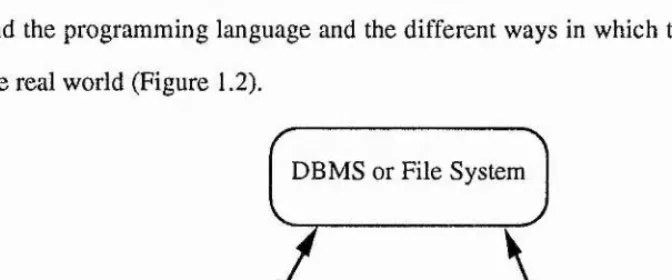
First, there is reduced complexity for the programmer. In non-persistent systems,
the programmer must manage the mapping between database management system
and the programming language and the different ways in which they each model
the real world (Figure 1.2).
DBMS or File System
/
Programming
Language Real World
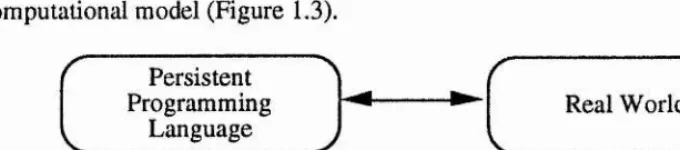
[image:29.612.111.447.518.658.2]In persistent systems, however, the programmer need only consider the mapping
between the real world and the persistent programming language using a single
computational model (Figure 1.3).
Real World Persistent
Programming Language
Figure 1.3 - A single mapping in a persistent system
Secondly, there is a reduction in code size. One experiment [IBM78] found that 30% of the total code in a typical database application deals with the mapping of
data between long term and transient storage. This code is not needed in persistent
systems since it is exactly this functionality that is provided transparently by the persistent programming system.
Thirdly, persistence provides an opportunity to enforce a single protection
mechanism throughout the programming system. A simple way to break the type
systems of traditional languages is, for example, to output a string to a file and then read it back in as an integer. By ensuring that persistent load and store operations
are strongly typed, such anom alies are removed. The com plexity to the programmer of the anomaly is also removed and a uniform view of the type system
applies to the entire programming system.
The fourth important benefit with persistence is that the topology of data structures
is preserved over store operations. That is, referential integrity is always
preserved. Data structures with shared subcomponents do not lose the sharing when they are read in from the persistent store. This is im portant for lazy
evaluation which uses sharing of the representation of expressions to optimise the
normal order reduction strategy. It is important if recomputation of values is to be
[image:30.613.111.451.118.193.2]1.2.3.1
Software Reuse
When constructing large and complex software systems, the software engineer is
faced with the task of controlling complexity and evolution. The complexity of the
system must be managed and the system must be able to evolve over time.
Persistent programming systems may be used to ease these tasks. In addition to
orthogonal persistence, a flexible incremental binding mechanism can support a
number of different methodologies for the binding of program components. Also
to maximise the re-use of software, type abstraction allows program segments to
be written which do not need to refer to a full specification of the data over which
they operate. A polymorphic type system allows generic software components to be constructed in which procedures may be written independently of the type of the
data which they manipulate [Stra67].
Languages in which functions are first class values support a style of programming
involving higher order functions which provide a means of achieving modularity
using first class functions. Such functions can be composed to construct new
applications. If persistence is applied orthogonally to the language, it should be
possible for these first class functions to be given the full range of persistence. This opens up the possibility of the persistent programming system providing
support for users to place functions in persistent storage and for other users to bind
to these functions and re-use them in different applications without copies being made [Atki84]
1.2.4
Costs of Persistence
Providing persistence in a programm ing system is not without its costs. The
POMS through high-level abstractions which effectively allow a data value to be
made persistent or a persistent data value to be accessed. However, these high level abstractions must be supported by the POMS which must maintain internal
data structures such as address translation tables.
The persistence abstraction itself may lead to a loss of efficiency in some programs since the programmer does not have full access to the underlying system and is
restricted to the functionality provided by the interface to the store. For example,
all store access may first have to pass through an address translation mechanism which may cause an object fault which triggers off a disk read.
The persistent system s in existence today are all constructed in software
[Cock84,Care86,Brow89]. The activity of the object manager, however, is much more closely related to the memory management functions like paging and virtual
memory. A hardware address translation mechanism for persistent objects might
improve the performance of persistent systems [Rose85,Rose87].
13 Combining Persistence with Lazy Functional
Programming
By combining persistence with lazy functional programming, it becomes possible
to reuse values which have been computed by a previous program invocation or
even by a different program. A combined system has advantages with efficiency
and the application domain for which the programming system can be used for
implementation is extended.
In this thesis, two models for persistence are described which provide automatic
management of persistent data. The programmer does not have to write any
explicit code for dealing with the transfer of data between long and short term
Large software systems evolve over time and it is desirable that a persistent lazy functional programming system should support this evolution in a controlled and
safe way. The use of persistent values is governed by the programming language type system and it is possible for such a system to be strongly typed. The use of
persistent data can be guaranteed to be type safe between different invocations of a program or between different programs.
The state of evaluation of data values can be preserved in persistent storage so that
computation performed on persistent values is done only once and all programs which reuse the value will benefit from the evaluation. The persistent store acts as
a cache in which values are stored and subsequently shared between many
programs over time. During the lifetime of a data value, its state of evaluation
changes monotonically towards a fully evaluated state. In a non-lazy persistent
system, data values are computed, stored in persistent storage and subsequently
reused many times. Analogously in a lazy persistent system a data value is
computed, stored and then shared. The data value may have any state of evaluation when it was first stored. Use of the value can cause more evaluation to be
performed. Frequently used values will in general be in a more evaluated state than
infrequently used ones. There may be a case for replacing data values with the
suspensions which yielded them, for example to free some space. This topic is not
pursued in this thesis, but may be an interesting avenue of future research.
A combined persistent lazy functional programming system can go some way to
tackling the problems of scale and longevity of data. In this thesis, two models are
developed which combine the two paradigms. These have allowed a new style of
program m ing - persistent lazy functional program m ing. Together with persistence, a lazy functional programming system can facilitate the construction of
larger scale applications which are difficult to construct in non-persistent functional
Integrating persistence and lazy functional programming can yield benefits in
efficiency. In Section 1.3.1 there is a description of common technique in lazy
programs, memoisation, which exemplifies the benefits in efficiency which can be achieved with a persistent system.
In addition to the benefits in efficiency, the application domain for which such
systems are suitable is extended. Section 1.3.2 discusses some of the issues
which arise when constructing a new class of applications in which programs
access and manipulate persistent data interactively.
1.3.1
Improving Efficiency
Values in functional programs may be in one of any number of states of evaluation.
In non-persistent systems, information about the state of evaluation is lost at the
end of program execution or the end of an interactive session and there must be some recomputation to return to a similar state. The results of a computation can
be stored in the file system, but code must be written to perform the input and output. Furthermore this input and output is inherently unsafe since the type
system governing the use of stored values does not match that of the programming
language.
In a persistent system, however
• data values computed dynam ically can be shared between many
program invocations, com putation which is perform ed on shared
values is never repeated so the benefit of the evaluation lasts for as long as the data is usable
• support for long lived data is automatic and provided as part of the
programming system
• the long term data storage is strongly typed since the use of persistent
data is governed by the programming language type system
À %
A data value such as that defined as follows
integers = from 1 where
from n = n : from (n+1)
which is preserved in persistent storage and subsequently reused many times will
gradually become more and more evaluated. For example if the third element of
the list is requested using the list indexing operator i as follows
integers ! 3
then the state of evaluation of the list will be the following list.
1:2 :3 : suspended representation o f from 4
Any use of the first, second or third elements of the list will cause no evaluation
other than that required to scan down the list to the required point, but if an element
beyond the third is requested, for example the ninth
integers ! 9
more evaluation is performed and the state of evaluation becomes
l:2;3:4:5;6:7:8:9:a suspended representation o f from 10
and so on. The state of evaluation continues to change as further elements beyond
the last one computed are requested. This monotonie increase in the state of
evaluation is a particularly important feature of persistent lazy functional systems.
Any sharing which occurs in the representation of data values is preserved.
1.3.2
Facilitating Database Application Building
Trinder [Trin89a] argued that current functional programming systems did not provide enough support to build database applications. Some of his requirements
are that an implementation language must have the ability to store data permanently
‘ï
many functional languages, there are a number of difficulties with ad-hoc approaches to long term storage (see Section 6.1.1). The operations on long term
data (lookup, update, insert, delete) must be efficient. Persistence offers a
mechanism which provides efficient storage of long term data with the ability to store values of any type. This allows the database implementor to utilise the
richness of the programming language type system when modelling the real world.
A typical functional database application is one which processes a stream of
transactions each of which performs an operation on the database. In a functional
system, the database is viewed as being transformed and a new database is produced which represents the old database after the transaction has been
processed. This process can be modelled in a functional language as follows
process (transact : transactions) database
= process transactions (transact database) process [] database = database
The parameter transact is a function which transforms one database into another
by performing some operation such as update, insert or delete. The changing state of the database is modelled by passing each transformed database back into the
processing cycle at each recursive call. A database system requires that the
database itself be stored permanently. This thesis presents a language model which
supports this kind of processing.
Query languages are used to interrogate databases [Date77,Ullm80]. The query
language FQL [Bune79], based on the functional language FP uses a small set of
higher order functions which can be composed to manipulate the database. Lazy
evaluation of the list processing can reduce the number of disk accesses required to
process a query [Trind89a].
Functional queries can be expressed using the concise notation of list
for denoting queries [Nikh87,Breu88]. They provide a more natural notation for
users than do the terse parameterless notation of FQL/FP. Query optimisation in
the relational world has provided techniques which can significantly improve the
performance of relational algebra queries. These optimisations turn out to have
analogous optimisations when using list com prehensions to represent queries
[Trin89b]. Functional databases have been modelled in lazy functional languages
but, because of the lack of persistence, have usually been translated into, at best, a persistent im perative language. The Staple system can be used directly to
implement functional databases.
Functional languages seem to offer many of the facilities required for the
construction of functional databases. The model for persistence described in
Chapter 3 enables programmers to construct interactive database applications in a purely lazy functional language. The implementation of some typical database
functions using this model of persistence is developed in Chapter 6.
1,3.3
The Staple System
The Staple system incorporates the two models for persistence described in this
thesis. These models have been integrated with a lazy functional language with
adherence to the principles for orthogonal persistence and whilst retaining S referential transparency.
The first model utilises a module system in which a module is a set of definitions
of data values and data types. All data values exported by a module are retained in
a persistent storage system. This module is essentially static in nature and does not
allow functional programs to manipulate the content of the persistent store.
The second model allows more interactive access to the persistent store. The property of referential transparency is preserved by using stream processing to
4
returns responses to the requests in a stream which may be evaluated by the program at some later time.
The im plem entation of these two models relies on a stable storage system
developed by Fred Brown [Brow89,Brow90], This storage system underlies
implementations of other persistent languages including Napier88 [Morr89] and
Galileo [Alba85].
1.4 Related Work on Persistent Languages
In this section, a number of persistent languages with features related to the work
presented in this thesis are discussed. W here appropriate, sim ilarities and differences between these languages and the Staple system are noted.
1.4.1
Amber and CAML
Amber [Card85] and CAML [Lero91] are non-lazy applicative languages which support persistence by providing functions to export and import values to the file
system. In common with Staple, the values to be made persistent must be of a
special dynamic type. When a value of the dynamic type is to be used, a run-time
type check is performed to enforce the strong typing in the language. The dynamic
type itself is an orthogonal feature of these languages.
CAML the implementation of ML developed at INRIA provides the two functions
for creating and accessing persistent data:
extern : extern_channel X dyn -> unit intern : intern_channel -> dyn
The expression
writes a value of the dynamic type out to the file specified by outchannei. The expression (dynamic 1) creates a value of the dynamic type. To read this in at a
later time, the expression
intern inChannel
is used where inchannel is the channel obtained by opening the appropriate file.
The extern function is a function which is executed for its side-effect of updating
the contents of a file. Because this function is imperative in nature, there is a loss
of referential transparency. It would therefore be an unsuitable method for adding
persistence to a purely functional language.
These systems have an external file system representation of data which can be
accessed by opening and reading the file contents. In this thesis, however, all data
regardless of its persistence is treated and stored uniformly and is strongly typed.
The CAM L implementation also exhibits a loss of referential integrity over store
operations. If a value is read in from persistent storage more than once, then the resulting values are not shared, but are duplicates. It is possible to detect when a
value which has already been read in is requested a second time, but the file
contents may have changed in between the two requests. As mentioned above,
Amber and CAML are non-lazy languages and a loss of sharing may not have
serious consequences other than requiring more storage space in the run-time heap.
In lazy languages, however, referential integrity over store operations is important
for the efficiency of lazy evaluation. If sharing is lost, then additional unnecessary evaluation may be required.
The com plexity of the managem ent of persistent values required to ensure
referential integrity is preserved is subsum ed by using a persistent object
m anagement system (POMS) such as the one described in Section 4.4. Such a
used to ensure referential integrity. Because sharing is always preserved, lazy evaluation provides its full benefits over the full lifetime of a data value.
1.4.2
Agna
Agna [Heyt91] is a LISP like language which defines databases as a top-level
persistent environment of bindings that associate names with persistent objects. User defined object types may be introduced and if these type definitions are
qualified with the extent keyword, then a structure containing all values created
with the defined type is maintained automatically by the system. For example, a
type for representing lecturers would be defined as
(type LECTURER (extent) ((name <=> STRING) (salary => NUMBER) (room => NUMBER)
(coursesTaught *<=>*) COURSE)))
Each time a lecturer is created, it is added to the persistent data structure. This method of providing persistence breaks the principle of persistence identification,
because persistence of data does depend on its type. Agna, therefore, does not
have orthogonal persistence.
In Staple, persistent data can have exactly the same types as transient data. This
leads to much less complexity for the programmer to grasp. When a data value is
created, there is no side-effect of a persistent data structure being updated with the
new value. It may be that the programmer requires this value to be transient. To do so in Agna, a different non-persistent type would have to be used.
1.4.3
Poly
Poly [Matt88] is an interactive programming system in which the user enters
expressions and definitions which are executed immediately. W hen a session
■vî
i
dumping technique for preserving persistent data. At the beginning of the
subsequent session, the system state is restored and the user continues as though
there had been no interruption. As an optimisation to this technique, Poly uses a
persistent storage system which brings values into the run-time core image on
demand.
Poly groups definitions together into environments which M atthews likens to
directories in a file system. W hen an environment is selected (the current
environm ent) all new definitions are added to that environm ent. Thus the
environm ent is extended. Declarations can only be added or removed by the interactive environment. It is therefore not possible to manipulate the environments
from within an interactive program. In Staple, stream persistence allows executing
programs to issue requests to update persistent data whilst preserving referential transparency.
1.4.4
PSASL
PS ASL [Dear85] is a persistent version of Turner's SASL language which allows the top level environm ent to be named, stored and retrieved. For example, a
session in which the definitions
def a = 3 b = 4
?
have been made defines an environm ent in which a and b are bound. This
environment can be stored with
dump envName
In a subsequent session, the environment can be restored with
persistent modules extend the environment model with a strong type system and the ability to combine modules together.
As with Poly, Agna, CAML and Amber, programs themselves cannot manipulate the contents of persistent storage during execution.
13 Thesis Structure
This thesis concerns the integration of the two styles of persistent and functional programming into a single programming system. Chapters 2 and 3 describe two
possible language models for persistence in lazy functional languages - persistent
modules and stream persistence. Persistent modules provide a static model for persistence in functional programs. In order to access persistent values in an
interactive way during the execution of a program, a different model is required. Chapter 3 describes Stream Persistence, a model for persistence in which persistent
values can be accessed dynamically. Chapter 4 describes the PCASE abstract
machine which underlies the implementation of persistent modules and stream
persistence. Chapter 5 details the underlying architecture for the implementation of
a functional persistent programming language and describes the techniques used to implement persistent modules and stream persistence. Chapter 6 describes two
applications which benefit from using the two models for persistence. Chapter 7
Chapter 2
Persistent Modules
The Staple system allows persistent modules to be created, combined, used and
m odified. The system also provides a standard interactive programm ing environm ent in which expressions can be entered and evaluated. These
expressions may refer to names which have been brought into scope by importing
persistent modules. The state of evaluation of persistent values changes over time
monotonically towards a fully evaluated state. W hen a persistent module is
created, binding to free variables in imported modules are made and type checked. Referentially transparency is ensured because these bindings are made at module
creation time before any of the values in the module are used.
2.1 Introduction
A functional program typically consists of two parts. The first part is a set of definitions of data types and values (including functions). These definitions are
usually grouped together into a script or m odule. The module defines an environment in which the second part of the program, an expression, is evaluated.
Larger programs can be constructed by combining modules together. These
m odules provide the foundation on which the first model for orthogonal
persistence in a lazy functional programming system was built [McNa90].
Persistent modules are a means of providing persistence in a transparent way. The
scripts or modules which functional programmers are accustomed to writing are
still used, but as a mechanism for identifying which (named) values or type
A module is a source program created using a text editor and stored in the file
system of the host machine. The source file is then com piled and a module is
placed in persistent storage. The values and types in a module are accessed by
supplying the name of the module to the compiler. Data values defined within the
module are initially suspended and as they are used, the state of evaluation changes
monotonically towards a fully evaluated state.
In a non-persistent module system, as in Haskell [Huda92] for example, all data values m ust be recomputed from a completely unevaluated state each time a
program which imports a value from another module is executed. In a persistent
module system, values imported from modules may be in any state of evaluation
reflecting the previous usage of the value.
The persistent store is used in two ways.
• modules are compiled and placed in the persistent store
• expressions are entered and evaluated interactively possibly referring to
values in modules in the persistent store.
These two facilities are provided by the programming environment. An integrated
persistent functional programming environment which provides persistence in this
way is described in [Davi89a]. The Staple system provides these facilities at the operating system command interface level.
2.2 The Command Interface to the Persistent Module
System
The Staple persistent environment contains a set of modules each of which can
contain a number of definitions. The modules are organised as an associative
lookup table within the persistent store and modules are accessed at compile time
via their name. The name of a module is in no way part of the programming