Randomised controlled trial of video clips and
interactive games to improve vision in children
with amblyopia using the I-BiT system
Nicola Herbison,
1Daisy MacKeith,
2Anthony Vivian,
2Jon Purdy,
3Apostolos Fakis,
4Isabel M Ash,
1Sue V Cobb,
5Richard M Eastgate,
5Stephen M Haworth,
6Richard M Gregson,
6Alexander JE Foss
1▸Additional material is published online only. To view, please visit the journal online (http://dx.doi.org/10.1136/ bjophthalmol-2015-307798).
1Department of
Ophthalmology, Nottingham University Hospitals, Nottingham, UK
2Department of
Ophthalmology, Addenbrooke’s Hospital, Cambridge, UK
3
Department of Computer Science, University of Hull, Hull, UK
4Derby Clinical Trials Unit,
College of Health and Social Care, University of Derby, Derby, UK
5Department of Mechanical,
Materials and Manufacturing Engineering, University of Nottingham, Nottingham, UK
6Department of
Ophthalmology, Nottingham University Hospitals, Nottingham, UK*
Correspondence to
Professor Alexander JE Foss, Department of Ophthalmology, Queen’s Medical Centre, Nottingham NG7 2UH, UK; [email protected]. uk
*Previous address, now retired.
Received 7 September 2015 Revised 5 December 2015 Accepted 25 January 2016 Published Online First 7 March 2016
To cite:Herbison N, MacKeith D, Vivian A,et al.
Br J Ophthalmol
2016;100:1511–1516.
ABSTRACT
Background Traditional treatment of amblyopia involves either wearing a patch or atropine penalisation of the better eye. A new treatment is being developed on the basis of virtual reality technology allowing either DVD footage or computer games which present a common background to both eyes and the foreground, containing the imagery of interest, only to the amblyopic eye.
Methods A randomised control trial was performed on patients with amblyopia aged 4–8 years with three arms. All three arms had dichoptic stimulation using shutter glass technology. One arm had DVD footage shown to the amblyopic eye and common background to both, the second used a modified shooter game, Nux, with sprite and targets presented to the amblyopic eye (and background to both) while the third arm had both background and foreground presented to both eyes (non-interactive binocular treatment (non-I-BiT) games). Results Seventy-five patients were randomised; 67 were residual amblyopes and 70 had an associated strabismus. The visual acuity improved in all three arms by approximately 0.07 logMAR in the amblyopic eye at 6 weeks. There was no difference between I-BiT DVD and non-I-BiT games compared with I-BiT games (stated primary outcome) in terms of gain in vision.
Conclusions There was a modest vision improvement in all three arms. Treatment was well tolerated and safe. There was no difference between the three treatments in terms of primary stated outcomes but treatment duration was short and the high proportion of previously treated amblyopia and strabismic amblyopia disadvantaged dichoptic stimulation treatment.
Trial registration number NCT01702727, results.
INTRODUCTION
The mainstay of treatment for amblyopia caused by anisometropia or strabismus, after correction of refractive error, is occlusion, by patching, of the normal eye. This idea of ‘forcing’ the amblyopic eye to see dates at least as far back as de Buffon.1 There is a sensitive period for the development of the visual system during which patching is effective. It is more effective for younger children but a ran-domised control trial of patching has shown that about half of children with amblyopia in the 7– 12 year age range will respond to optical treatment and patching.2 Some children over the age of
12 years also improved but only if they had not received previous treatment.2
The additive effect of patching after spectacle adaptation is modest. A randomised control trial of patching in children who had 16 weeks of full refractive correction gained a further 1.3 lines in the control group (spectacle correction alone can con-tinue to improve vision for up to 30 weeks) and 2.2 lines in those who had 2 h of patching per day.3The effectiveness of patching depends upon the degree of amblyopia with little benefit for those with mild levels of amblyopia (6 September–6 December).4In
the 1850s, Javal introduced atropine penalisation which is as effective as patching5–8 and the two
treatments are not additive—nothing is to be gained by combining them.9
Current treatments are only moderately effective with amblyopia persisting beyond the age of 16 years in 80% of patients.10 A further drawback shared by both patching and penalisation is that they are‘dissociative’and do nothing to encourage the amblyopic and the normal eye to work in harmony together. Furthermore, compliance with patching is often poor with up to 50% of patients not complying with the prescribed dosage,11 sug-gesting that the treatment is not popular with chil-dren. There is clearly a need for something better.
These considerations led us to develop a virtual reality-based system12 to treat amblyopia using dichoptic stimulation in the context of either playing special video games or watching DVDs. This interactive binocular treatment (I-BiT) system uses specially configured software to preferentially stimulate the amblyopic eye without compromising the vision in the good eye.
Three pilot studies13–15 have shown the I-BiT
system can improve the visual acuity in patients with amblyopia. The most recent of these pilot studies using shutter glasses technology15 showed that all patients who completed their planned treat-ment (9 of the 10 patients) showed an improve-ment in visual acuity from 0.025 to 0.45 logMAR units with a mean of 0.18 (SD 0.14).
On the basis of these results, we decided to proceed to a small two centre randomised control trial with the intention of ensuring that the treat-ment was safe, acceptable and to get an improved indication of its efficacy.
MATERIALS AND METHODS Trial design
The study was a randomised parallel group design with the intention to recruit 75 patients. The eligible patients were ran-domised to one of three treatments.
▸ I-BiT game
▸ Non-I-BiT game
▸ I-BiT DVD.
Each received their randomised treatment weekly for 6 weeks, for a 30 min period.
At baseline their logMAR visual acuity, with glasses if required, was recorded along with the results of their cover test, oculomotility assessment, binocular vision assessment, visuo-scope and Sbisa bar results.
Visual acuity was assessed pretreatment (week 1), after three treatments (week 3), after six treatments (week 6) and 4 weeks after theirfinal treatment (week 10). Visual acuity was assessed with either the logMAR crowded test (formally Glasgow acuity cards, manufactured by Keeler) or the crowded Kay’s picture test. Choice of visual acuity (VA) test was dependent on the par-ticipant’s ability and remained consistent throughout the trial.
Participants and recruitment
Children aged 4–8 years with strabismic, anisometropic or mixed amblyopia were recruited from two test sites (Queen’s Medical Centre, Nottingham and Addenbrooke’s Hospital,
Cambridge), from January 2012 to November 2013. Stimulus deprivation amblyopia was excluded.
Children who had prior treatment with either patching or atropine penalisation were eligible for recruitment providing they had a 0.20 logMAR intraocular acuity difference and no current improvement with patching. Those whose suppression measured four or less on the Sbisa bar were deemed at risk of double vision and were excluded. For full list of inclusion and exclusion criteria, see the protocol paper.16
Interventions
I-BiT shutter glasses system
The I-BiT system hardware is designed for use under supervision and consists of a desktop PC with two monitors, one for the clinician and one for the patient. The clinician monitor is used to control the treatment the patient receives and the patient monitor displays the visual stimuli. The patient monitor is a
[image:2.595.197.553.337.751.2]flat-screen 22-inch 3D monitor with a refresh rate of 120 Hz and this allows separate images to be presented to each eye with the use of shutter glasses. The shutter glass lenses lighten and darken in synchrony with the monitor but faster than the user can perceive and this allows a common background to be pre-sented to both eyes and an ‘enriched’ image to be presented only to the amblyopic eye (dichoptic stimulation). The I-BiT
system can display video footage and interactive games. A gaming control pad is used for the games.
DVD stimulus
The I-BiT DVD stimulus is divided into two zones. There is an outer ‘border’termed a locking stimulus which is presented to both eyes while the inner part of the screen presents the video footage predominately to the amblyopic eye.
Game stimulus
An interactive game called‘Nux’was used to provide the game play. Through the I-BiT system, the player and the background are shown to both eyes but the obstacles, enemies and coins are shown only to the amblyopic eye. Therefore, in order for the child to play the game successfully, they must use their ambly-opic eye.
Control stimulus
In the non-I-BiT game version (control arm) both eyes receive identical stimulation.
Outcomes
The primary objectives of the study were:
1. To determine the difference in visual acuity improvement in patients treated with I-BiT compared with non-I-BiT treatment.
2. To determine the difference in effectivity between the inter-active games and DVDs.
The primary outcome measure was the change in logMAR visual acuity from week 1 ( pretreatment) to week 6 ( post-treatment).
The secondary outcome measures included changes in stereoacuity (Frisby test), and the safety, acceptability and com-pliance of treatment.
Loss of visual acuity of 0.1 logMAR units at week 3 or double vision induced withdrawal from the trial.
Sample size
The sample size of 75 patients (25 in each arm) was calculated assuming an SD of 0.25 with the aim to detect a minimum dif-ference of 0.2 logMAR units at the 5% significance level (two-sided) with 80% power.
Randomisation
The randomisation sequence was generated using the RALLOC function in Stata V.10 and used random permuted blocks of sizes 2, 4 and 6. It was stratified by centre and whether or not the patient had previous treatment for amblyopia.
Masking
The research orthoptist who delivered the treatment was aware of the patient allocation but not of visual acuity measurements which were performed by an independent orthoptist who was masked to the treatment allocation.
Statistical methods
Data analysis was performed using Stata V.11.2. Intention to treat analysis was performed for the primary outcome. All missing data were assumed to be missing completely at random and imputation methods were not used to compensate for missing data.
The primary endpoint of change in visual acuity from week 1 to end of treatment (week 6) was compared between the treat-ment groups using Analysis of Covariance (ANCOVA) with
baseline visual acuity as covariate. The change in visual acuity from week 1 to week 3 and 10 was compared between the treat-ment groups using ANCOVA with baseline visual acuity as cov-ariate. Difference within groups from baseline to 3, 6 and 10 weeks post-treatment was tested for using a two-tailed paired t test. The proportion of patients showing a clinically important change in VA (≥0.125 logMAR) from baseline at 3, 6 and 10 weeks was compared between the three groups using Fisher’s exact test. The frequency (%) of patients’ satisfaction, compli-ance with treatment and adverse events were also analysed.
Unplanned secondary analyses of the change in VA for all par-ticipants from baseline to weeks 3, 6 and 10 were performed using a paired t test.
Ethical review
This study was approved by Nottingham Research Ethics Committee 2.
RESULTS
Participantflow and baseline data
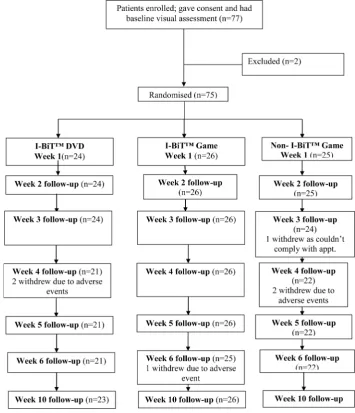
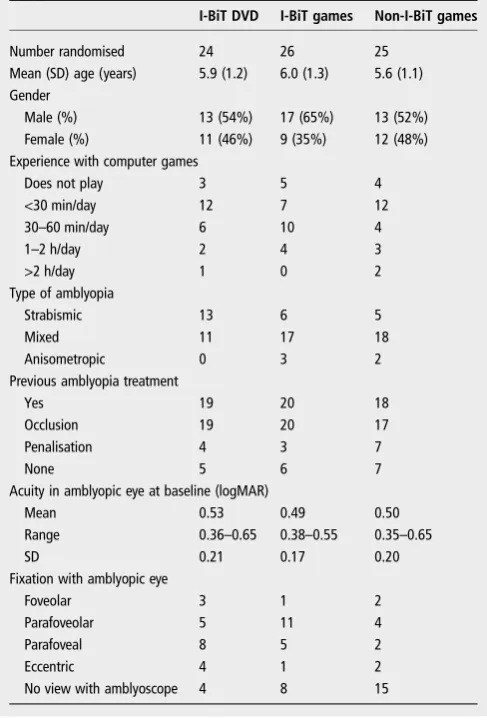
The patient flow is summarised in the Consolidated Standards of Reporting Trials (CONSORT) diagram (figure 1) and the baseline data intable 1and further baseline data can be found in the online supplementaryfile.
[image:3.595.308.552.389.752.2]The visual acuity improved in all three groups at weeks 3, 6 and 10 with the average improvement of vision at week 6 of
Table 1 Summary of baseline characteristics of the study population
I-BiT DVD I-BiT games Non-I-BiT games
Number randomised 24 26 25 Mean (SD) age (years) 5.9 (1.2) 6.0 (1.3) 5.6 (1.1) Gender
Male (%) 13 (54%) 17 (65%) 13 (52%) Female (%) 11 (46%) 9 (35%) 12 (48%) Experience with computer games
Does not play 3 5 4
<30 min/day 12 7 12
30–60 min/day 6 10 4
1–2 h/day 2 4 3
>2 h/day 1 0 2
Type of amblyopia
Strabismic 13 6 5
Mixed 11 17 18
Anisometropic 0 3 2
Previous amblyopia treatment
Yes 19 20 18
Occlusion 19 20 17
Penalisation 4 3 7
None 5 6 7
Acuity in amblyopic eye at baseline (logMAR)
Mean 0.53 0.49 0.50
Range 0.36–0.65 0.38–0.55 0.35–0.65
SD 0.21 0.17 0.20
Fixation with amblyopic eye
Foveolar 3 1 2
Parafoveolar 5 11 4
Parafoveal 8 5 2
Eccentric 4 1 2
0.07 logMAR which was sustained at week 10. This improve-ment was significant at all three time points (using paired t tests, p<0.001 at all three time points) (table 2).
The primary outcome
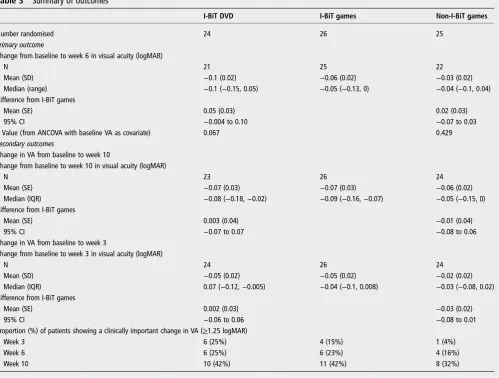
The primary outcome measure was the difference in visual acuity improvement between the three arms at week 6 with I-BiT games as the comparison arm. The change in visual acuity from baseline to the end of treatment (week 6) is shown intable 3.
There was no difference in the change from baseline between those having I-BiT games and those having non-I-BiT games (mean 0.02 logMAR units 95% CI (−0.07 to 0.03)). The improve-ment in vision from baseline at 6 weeks differed between the two
games treatment groups and the DVD group, with a mean of change in the I-BiT DVD group of−0.1 compared with−0.06 in the I-BiT games group and−0.03 in the non-I-BiT games group.
Secondary outcomes
The change in vision at weeks 3 and 10, and the proportion of patients with a clinically significant improvement (defined as
≥1.25 logMAR units) are summarised intable 3.
There were no significant improvements in stereoacuity (Frisby) in the three arms (see online supplementary material).
The I-BiT DVD and non-I-BiT game improved vision to week 6 then declined slightly after treatmentfinished (week 10). The I-BiT games group increased from weeks 3–6 and then a decrease to week 10. The mean VA at week 10 was less than baseline for all three groups.
The patient satisfaction questionnaire showed that >90% of participants felt that they enjoyed their treatment, >80% felt that the time allowed was just right, and that 67% or more felt that it was easy to concentrate.
Compliance with each of the treatments was excellent with the majority of participants playing the game/watching the DVD for 30 min at each session.
Adverse events
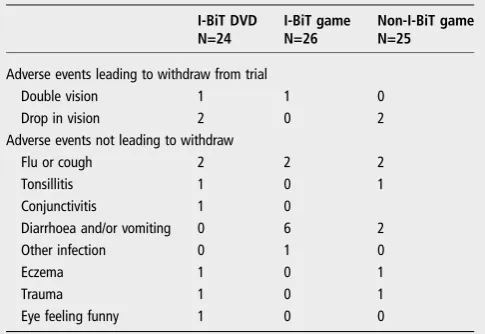
[image:4.595.45.285.67.132.2]These are summarised in table 4. There were two cases of double vision which were assumed to be adverse device effects
Table 3 Summary of outcomes
I-BiT DVD I-BiT games Non-I-BiT games
Number randomised 24 26 25
Primary outcome
Change from baseline to week 6 in visual acuity (logMAR)
N 21 25 22
Mean (SD) −0.1 (0.02) −0.06 (0.02) −0.03 (0.02)
Median (range) −0.1 (−0.15, 0.05) −0.05 (−0.13, 0) −0.04 (−0.1, 0.04) Difference from I-BiT games
Mean (SE) 0.05 (0.03) 0.02 (0.03)
95% CI −0.004 to 0.10 −0.07 to 0.03
p Value (from ANCOVA with baseline VA as covariate) 0.067 0.429
Secondary outcomes
Change in VA from baseline to week 10
Change from baseline to week 10 in visual acuity (logMAR)
N 23 26 24
Mean (SE) −0.07 (0.03) −0.07 (0.03) −0.06 (0.02)
Median (IQR) −0.08 (−0.18,−0.02) −0.09 (−0.16,−0.07) −0.05 (−0.15, 0) Difference from I-BiT games
Mean (SE) 0.003 (0.04) −0.01 (0.04)
95% CI −0.07 to 0.07 −0.08 to 0.06
Change in VA from baseline to week 3
Change from baseline to week 3 in visual acuity (logMAR)
N 24 26 24
Mean (SD) −0.05 (0.02) −0.05 (0.02) −0.02 (0.02)
Median (IQR) 0.07 (−0.12,−0.005) −0.04 (−0.1, 0.008) −0.03 (−0.08, 0.02) Difference from I-BiT games
Mean (SE) 0.002 (0.03) −0.03 (0.02)
95% CI −0.06 to 0.06 −0.08 to 0.01
Proportion (%) of patients showing a clinically important change in VA (≥1.25 logMAR)
Week 3 6 (25%) 4 (15%) 1 (4%)
Week 6 6 (25%) 6 (23%) 4 (16%)
[image:4.595.52.552.370.748.2]Week 10 10 (42%) 11 (42%) 8 (32%)
Table 2 Improvement in vision for all the patients in the trial
Improvement in
logMAR vision CIs p Value
Baseline and week 3 −0.04 −0.63 to−0.20 <0.001 Baseline and week 6 −0.07 −0.11 to−0.047 <0.0001 Baseline and week 10 −0.067 −0.097 to 0.038 <0.0001
and they both resolved spontaneously following cessation of treatment. All other adverse events are assumed to be not device related.
DISCUSSION
There was a modest visual acuity improvement in all groups including group 3 who received the non-I-BiT game. The visual acuity improvement of 0.07 logMAR is less than the 0.18 which we had observed previously but is similar to the 0.1 improvement reported by Liet al.17 It was an unexpected
finding that the non-I-BiT game showed some improvement in visual acuity and the reason is not clear. It is possible that use of the shutter glasses alone may have improved amblyopic vision. The control group had all of the game content shown to both eyes but because of the shutter glasses it is, in reality, only shown to one eye at a time. The shutter glasses operate fast enough that the game content is perceived by both eyes simultaneously. Dichoptic stimulation may itself improve vision without the use of ‘preferential stimulation’ of the amblyopic eye which occurred in the I-BiT game and I-BiT DVD groups.
The study was disadvantaged by the fact that the majority of participants in this trial (67/75) were residual amblyopes (con-ventional patching failures) and there was a high proportion of strabismic amblyopia (70/75). This represents a poor prognostic group but the decision to allow previous amblyopia treatment failures into the trial was based on the fact that they were far easier and quicker to recruit. Another limiting factor was that the treatment in this trial was hospital based during working and school hours which limited the duration and frequency of treatment sessions to only half an hour a week. The total treat-ment time of only 3 h is very short when compared with patch-ing where the Monitored Occlusion Treatment of Amblyopia (MOTAS) group recommended at least 150 h and showed a linear response for up to 400 h.18The study by Liet alused an
I-Pad delivery system with 16 h of game play >4 weeks and with no extra benefit from a further 16 h over a further 4 week period.17 Hess’s group, using an I-Pad at home19 showed that 1–2 h per day for 1–3 weeks can improve acuity, restore binocu-larity and restore stereopsis in adults.20 Vedamurthy et al also developed a dichoptic action videogame and with 40 h of treat-ment in adults showed improvetreat-ments in both anisometropic and strabismic amblyopes of logMAR 0.14.21
There were two classes of adverse events that lead to patient withdrawal diplopia and reduction visual acuity Double vision is
presumed to be due to the treatment reversing suppression and was considered a device-related adverse event and the two cases resolved fully on cessation of treatment. No adverse events have been reported by other groups.
Patching and penalisation are not popular treatments and sys-tematic reviews have suggested that the impact on health-related quality of life for patients with amblyopia comes from the treat-ment rather than the disease.22 23 This dichoptic stimulation
treatment was very acceptable and with a compliance rate of >90%, much better than the 48% reported for patching.24
Others have also noted the high acceptability of computer games as a vehicle for treatment.25 Amblyopia often coexists
with strabismus and 70 of the 75 patients in this trial had mani-fest strabismus. Failure of the amblyopic eye to become thefi x-ating eye may prevent dichoptic stimulation being an effective treatment in patients with strabismus unless the stimulus can be delivered to the fovea.
There was some improvement in vision in all three groups after a total of 3 h of treatment which was well tolerated and safe. There was no apparent advantage to differential target-ing of the amblyopic eye with dichoptic stimulation. However, the short total treatment time, high proportion of previous amblyopia treatment failures and high proportion of patients with strabismus disadvantage dichoptic stimulation and this study does not suggest that a treatment benefit is not achievable. Further studies are being targeted at longer treat-ment duration (requiring a home-based treattreat-ment), naïve amblyopes and a greater proportions of anisometropic amblyopes to determine whether the I-BiT system has the potential to deliver a treatment for amblyopia which is more acceptable and equally or more effective than conventional treatment.
Contributors RMG was the principal investigator who conceived and designed the study. He retired prior to commencement of this trial and AJEF took over as chief investigator and principal investigator for the Nottingham site and oversaw delivery. AV was the principal investigator for the Cambridge site. NH was project manager and research orthoptist at the Nottingham site. DMK was research orthoptist at both the Nottingham and Cambridge site. JP had responsibility for the programming. SVC and RME helped both design and maintain the equipment. AF was the trial statistician and undertook the analyses. SMH was a member of the project steering group. This manuscript was drafted by AJEF, revised by AV and approved by all living authors.
Funding The work in this study was funded by the Wellcome Trust (Translation Award 090465).
Competing interests AJEF reports that Nottingham University Hospitals Trust and Nottingham University own the rights to an European patent EP 1 509 121 B1. My coauthors include IMA, SVC, RME, RMG and SMH who are included in the list of inventors.
Ethics approval Nottingham Research Ethics Committee 2.
Provenance and peer reviewNot commissioned; externally peer reviewed.
Data sharing statement Unpublished data are available upon request.
Open Access This is an Open Access article distributed in accordance with the terms of the Creative Commons Attribution (CC BY 4.0) license, which permits others to distribute, remix, adapt and build upon this work, for commercial use, provided the original work is properly cited. See: http://creativecommons.org/licenses/ by/4.0/
REFERENCES
1 de Buffon L.Bull Mém Acad Sci Paris1743;Suppl III:174.
2 Scheiman MM, Hertle RW, Beck RW,et al. Pediatric Eye Disease Investigator Group. Randomized trial of treatment of amblyopia in children aged 7 to 17 years.Arch Ophthalmol2005;123:437–47.
[image:5.595.45.288.63.230.2]3 Wallace DK, Pediatric Eye Disease Investigator Group. A randomized trial to evaluate 2 hours of daily patching for strabismic and anisometropic amblyopia in children.Ophthalmology2006;113:904–12.
Table 4 Summary of adverse events in the trial
I-BiT DVD N=24
I-BiT game N=26
Non-I-BiT game N=25
Adverse events leading to withdraw from trial
Double vision 1 1 0
Drop in vision 2 0 2
Adverse events not leading to withdraw
Flu or cough 2 2 2
Tonsillitis 1 0 1
Conjunctivitis 1 0
Diarrhoea and/or vomiting 0 6 2
Other infection 0 1 0
Eczema 1 0 1
Trauma 1 0 1
4 Clarke MP, Wright CM, Hrisos S,et al. Randomised controlled trial of treatment of unilateral visual impairment detected at preschool vision screening.BMJ
2003;327:1251.
5 Foley-Nolan A, McCann A, O’Keefe M. Atropine penalisation versus occlusion as the primary treatment for amblyopia.Br J Ophthalmol
1997;81:54–7.
6 Repka MX, Wallace DK, Beck RW,et al. Two-year follow-up of a 6-month randomized trial of atropine vs patching for treatment of moderate amblyopia in children.Arch Ophthalmol2005;123:149–57.
7 Tejedor J, Ogallar C. Comparative efficacy of penalization methods in moderate to mild amblyopia.Am J Ophthalmol2008;145:562–9.
8 Medghalchi AR, Dalili S. A randomized trial of atropine vs patching for treatment of moderate amblyopia.Iran Red Crescent Med J2011;13:578–81.
9 Pediatric Eye Disease Investigator Group (PEDIG) Writing CommitteeWallace DK, Kraker RT,et al. Randomized trial to evaluate combined patching and atropine for residual amblyopia.Arch Ophthalmol2011;129:960–2.
10 Rahi JS, Cumberland PM, Peckham CS. Does amblyopia affect educational, health, and social outcomes? Findings from 1958 British birth cohort.BMJ
2006;332:820–5.
11 Wallace MP, Stewart CE, Moseley MJ,et al. Compliance with occlusion therapy for childhood amblyopia.Invest Ophthalmol Vis Sci2013;54:6158–66.
12 Easgate RM, Griffiths GD, Waddingham PE,et al. Modified virtual reality technology for treatment of amblyopia.Eye (Lond)2006;20:370–4.
13 Cleary M, Moody AD, Buchanan A,et al. Assessment of a computer-based treatment for older amblyopes: the Glasgow Pilot Study.Eye (Lond)
2009;23:124–31.
14 Waddingham PE, Butler TK, Cobb SV,et al. Preliminary results from the use of the novel interactive binocular treatment (I-BiT) system, in the treatment of strabismic and anisometropic amblyopia.Eye (Lond)2006;20:375–8.
15 Herbison N, Cobb S, Gregson R,et al. Interactive binocular treatment (I-BiT) for amblyopia: results of a pilot study of 3D shutter glasses system.Eye (Lond)
2013;27:1077–83.
16 Foss AJ, Gregson RM, MacKeith D,et al. Evaluation and development of a novel binocular treatment (I-BiTTM) system using video clips and interactive games to improve vision in children with amblyopia (‘lazy eye’): study protocol for a randomised controlled trial.Trials2013;14:145.
17 Li SL, Jost RM, Morale SE,et al. A binocular iPad treatment for amblyopic children.
Eye (Lond)2014;28:1246–53.
18 Stewart CE, Stephens DA, Fielder AR,et al. MOTAS Cooperative. Modeling dose-response in amblyopia: toward a child-specific treatment plan.Invest Ophthalmol Vis Sci2007;48:2589–94.
19 To L, Thompson B, Blum JR,et al. A game platform for treatment of amblyopia.
IEEE Trans Neural Syst Rehabil Eng2011;19:280–9.
20 Hess RF, Thompson B, Black JM,et al. An iPod treatment for amblyopia: an updated binocular approach.Optometry2012;15:87–94.
21 Vedamurthy I, Nahum M, Huang SJ,et al. A dichoptic custom-made action video game as a treatment for adult amblyopia.Vision Res2015;114:173–87. 22 Carlton J, Kaltenthaler E. Amblyopia and quality of life: a systematic review.Eye
(Lond)2011;25:403–13.
23 Carlton J, Kaltenthaler E. Health-related quality of life measures (HRQoL) in patients with amblyopia and strabismus: a systematic review.Br J Ophthalmol
2011;95:325–30.
24 Stewart CE, Moseley MJ, Stephens DA,et al., MOTAS Cooperative. Treatment dose-response in amblyopia therapy: the Monitored Occlusion Treatment of Amblyopia Study (MOTAS).Invest Ophthalmol Vis Sci2004;45:3048–54. 25 Tailor VK, Glaze S, Khandelwal P,et al. Prescribed computer games in addition to