Project-Out Cascaded Regression with an application to Face Alignment
Georgios Tzimiropoulos
School of Computer Science
University of Nottingham, U.K.
[email protected]Abstract
Cascaded regression approaches have been recently shown to achieve state-of-the-art performance for many computer vision tasks. Beyond its connection to boosting, cascaded regression has been interpreted as a learning-based approach to iterative optimization methods like the Newton’s method. However, in prior work, the connection to optimization theory is limited only in learning a mapping from image features to problem parameters.
In this paper, we consider the problem of facial de-formable model fitting using cascaded regression and make the following contributions: (a) We propose regression to learn a sequence of averaged Jacobian and Hessian matri-ces from data, and from them descent directions in a fashion inspired by Gauss-Newton optimization. (b) We show that the optimization problem in hand has structure and devise a learning strategy for a cascaded regression approach that takes the problem structure into account. By doing so, the proposed method learns and employs a sequence of aver-aged Jacobians and descent directions in a subspace or-thogonal to the facial appearance variation; hence, we call it Project-Out Cascaded Regression (PO-CR). (c) Based on the principles of PO-CR, we built a face alignment system that produces remarkably accurate results on the challeng-ing iBUG data set outperformchalleng-ing previously proposed sys-tems by a large margin. Code for our system is available fromhttp://www.cs.nott.ac.uk/˜yzt/.
1. Introduction
Regression is a standard tool for approaching various computer vision problems like human and head pose esti-mation [30, 12], deformable model fitting [7, 37], object localization and tracking [33], and face and behaviour anal-ysis [24] to name a few. Typically, regression-based meth-ods wish to learn a function that maps object appearance to the desired target output variables. Being discrimina-tive in nature and by capitalizing on the very large anno-tated data sets that are now readily available, they have been
[image:1.612.309.546.232.303.2](a) (b) (c) (d)
Figure 1. Project-Out Cascaded Regression vs Gauss-Newton op-timization. In prior work in face alignment, given the current esti-mate of the landmarks’ location (a)-(b), image specific Jacobians are calculated to be used in analytic gradient descent. In (c), the image Jacobian with respect to the 3rd shape parameter is shown. In this work, we propose regression to learn a sequence of av-eraged Jacobians from data, and from them descent directions. In (d), the learned averaged Jacobian with respect to the 3rd shape pa-rameter for the first level of the cascade is shown. Notably, PO-CR learns averaged Jacobians from which facial appearance variation isprojected-out.
shown to produce state-of-the-art performance for many of the aforementioned tasks. At the same time, regression-based methods enjoy a high degree of computational effi-ciency in both training and testing. In this work, the focus is on regression-based fitting of facial deformable models to unconstrained images, also known as face alignment in-the-wild. Arguably, for this problem, regression-based ap-proaches have recently emerged as the state-of-the-art.
A plethora of regression methods have been employed to tackle the above mentioned problems including linear and ridge [4], Support Vector [31], Boosted [13], Gaussian pro-cess [26], and more recently, Deep Neural Nets [18]. A recent notable approach that is of particular interest in this work is the so-called Cascaded Pose Regression (CPR) [11]. CPR is an iterative (cascaded) regression method that is re-lated to boosting with the main difference being that it uses pose-indexed features i.e. features that are sampled from the image based on the current pose estimate. This idea has been shown to produce excellent results on a variety of tasks and, owing to its efficiency and accuracy, it has been recently extensively explored by a number of authors for the problem of face alignment [6, 38, 32, 40, 39, 27, 1, 17].
Regression, as a learning-based solution to optimiza-tion, dates back to the seminal work of [7]. More recently, the Supervised Descent Method (SDM) [38] considers the problem of fitting deformable models to facial images using non-linear least squares optimization and derives CPR as a supervised (learning-based) solution to that problem. As we show hereafter, in prior work (including [7] and [38]), (a) the connection to optimization theory is limited only in learning a mapping from image features to problem param-eters, (b) there is no attempt to estimate the Jacobian and Hessian matrices (key concepts in optimization) and (c) the structure of the optimization problem in hand is not taken into account.
1.1. Contributions and main results
In this paper, we consider the problem of facial de-formable model fitting using cascaded regression and make the following contributions:
• We propose regression to learn a sequence of averaged Jacobian and Hessian matrices from data, and from them descent directions. Our method is inspired by prior work on Gauss-Newton optimization for fitting facial deformable models but rather than calculating image specific Jacobians to be used in analytic gradi-ent descgradi-ent, we propose cascaded regression to learn a sequence of averaged Jacobians from data, one per iteration.
• We show that the optimization problem in hand has structure and devise a learning strategy for a cascaded regression approach that takes the problem structure into account. In particular, we propose Project-Out Cascaded Regression (PO-CR), a cascaded regression approach for fitting facial deformable models to un-constrained images that learns and employs regressors in a subspace orthogonal to the appearance variation. In particular, the key idea in the proposed learning strategy for PO-CR is to compute a sequence of aver-aged Jacobians from which facial appearance variation isprojected-out.
• Based on the principles of PO-CR, we built a face alignment system and tested it on the most popular fa-cial databases, namely LFPW [3], Helen [19], AFW [41] and iBUG [28]. Notably, our system produces remarkably accurate results on the challenging iBUG data set outperforming previously proposed systems by a large margin. Code for our system is available fromhttp://www.cs.nott.ac.uk/˜yzt/.
We note that there are many examples of computer vision problems including bundle adjustment [34, 20], parameter-ized model fitting [15, 23] and detection/tracking [14, 16], in which the resulting optimization problems have structure;
for example, the underlying normal equations might exhibit a sparse block or circulant structure [5]. Within the pro-posed formulation, our results show that this structure must be exploited during learning to produce accurate and robust solutions during testing.
1.2. Related work
The proposed Project-Out Cascaded Regression (PO-CR) is a cascaded regression approach and hence the start-ing point for our work is the CPR of [11]. CPR is an itera-tive regression method in which the output of regression at iteration k−1 is used as input for iteration k, and each regressor uses image features that depend on the current pose estimate. This idea was explored for the problem of face alignment in [6] where the authors demonstrated ex-cellent results on the LFPW data set [3]. The proposed PO-CR is a cascaded regression approach that is derived as a solution to a non-linear least squares optimization prob-lem for fitting generative deformable models to facial im-ages and as such is related to the recently proposed SDM of [38]. Interestingly, the connection between regression and non-linear least squares optimization dates back to the original Active Appearance Model (AAM) formulation of [7]. None of these approaches however proposes to learn a sequence of averaged Jacobian and Hessian matrices from data nor takes into account the problem structure in the for-mulated optimization problem as suggested by PO-CR. This structure has been occasionally explored by a number of authors in the context of fitting facial deformable models to images using analytic gradient descent (Gauss-Newton optimization) [15, 23, 25, 35], with well-known examples being the Project-Out Inverse Compositional algorithm of [23] and, more recently, the Gauss-Newton generative de-formable part model of [36]. Notably, in these methods, the update of the shape parameters at each iteration is found by
projecting-outthe facial appearance variation from the im-age specific Jacobian. A similar idea is explored for learn-ing in the proposed PO-CR. See also Fig. 1.
2. State-of-the-art in face alignment
been removed. More recently, the focus has been shifted to the family of methods coined Constrained Local Mod-els (CLMs) [9, 22, 29] which build upon the ASMs. Be-sides new methodologies, another notable development in the field has been the collection and annotation of large facial data sets captured in unconstrained conditions (in-the-wild) [3, 41, 19, 28]. Being able to capitalize on large amounts of data, a number of (cascaded) regression-based techniques have been recently proposed which achieve im-pressive performance [37, 6, 38, 32, 27, 1, 17]. The ap-proaches described in [38, 27, 1, 17] along with the part-based generative deformable model of [36] are considered to be the state-of-the-art in face alignment.
3. Project-Out Cascaded Regression
The proposed Project-Out Cascaded Regression (PO-CR) uses generative models of facial shape and appearance fitted via cascaded regression in a subspace orthogonal to the learned appearance variation. In the following sections, we describe (a) the facial shape and appearance models em-ployed by PO-CR (section 3.1), (b) the optimization prob-lem which provides the basis for learning in PO-CR (section 3.2), (c) the learning and fitting process in PO-CR (section 3.3), and finally (d) the differences between PO-CR and re-lated prior work (section 3.4).
3.1. Shape and appearance models
In this section, we describe the shape and appearance models employed by the proposed PO-CR. In particular, we use a parametric global shape model and a paramet-ric part-based appearance model akin to the ones originally proposed in [10] and more recently employed in [36]. A notable difference from recent work on cascaded regression is that we use parametric generative models for shape and appearance both learned via PCA from an annotated train-ing set as explained below. Although recent regression ap-proaches advocate the use of non-parametric shape mod-els [6], the parametric one employed here is more compact having far less number of parameters to optimize. Addi-tionally, learning a generative appearance model is a key idea in PO-CR. In contrast to recently proposed cascaded regression methods, PO-CR learns and employs averaged Jacobians and descent directions in a subspace orthogonal to the learned appearance model.
As in most works in face alignment, we assume a super-vised setting where a set of training facial imagesIiare
an-notated withufiducial points. For each image, the set of all points is a vector∈ R2u×1that is said to define the shape of each face. To learn the shape model used in PO-CR, the annotated shapes are firstly normalized using Procrustes Analysis. This step removes variations due to similarity transformations (translation, rotation and scaling). Then, PCA is applied on the normalized shapes to obtain the shape
model. The model is defined by the mean shapes0andn shape eigenvectorssicompactly represented as columns of
matrixS∈ R2u×n. Finally, to model similarity transforms,
Sis appended with 4 additional bases as described in [23]. An instance of the shape model is given by
s(p) =s0+Sp, (1)
wherep∈ Rn×1is the vector of the shape parameters. To learn the appearance model used in PO-CR, each training imageIiis warped to a reference frame so that
sim-ilarity transformations are removed. Then, a descriptor (e.g. image patch or SIFT [21]) describing the local appearance around each landmark is computed and all descriptors are stacked in a vector∈ RN×1 which defines the part-based appearance of Ii. Then, PCA is applied on the part-based
representations of all training images to obtain the appear-ance model. The model is defined by the mean appearappear-ance
A0 and m appearance eigenvectors Ai compactly
repre-sented as columns of matrixA ∈ RN×m. An instance of
the appearance model is given by
A(c) =A0+Ac, (2)
wherec ∈ Rm×1 is the vector of the appearance parame-ters.
3.2. Optimization problem for PO-CR
In this section, we formulate and solve the non-linear least squares optimization problem which provides the ba-sis for learning and fitting in PO-CR. Similarly to [38], we will proceed by deriving the optimization problem using an-alytic gradient descent which will give rise to Eqs. (7) and (8). Then, in the next section, we will use Eqs. (7) and (8) to devise the learning and fitting process for the proposed PO-CR.
The formulation herein is based on the large amount of work on non-linear least squares for fitting generative de-formable models usinganalytic gradient descent, for exam-ple see [23, 35]. The derived optimization problem below is akin to the one described in [36] with one difference be-ing that here we consider forward rather than inverse fit-ting algorithms. Note that the fundamental difference be-tween PO-CR and all the aforementioned algorithms (in-cluding the one described below) is that PO-CR proposes aregression-basedsolution as opposed to analytic gradient descent.
Let us denote byI(s(p)) ∈ RN×1the vector obtained by generatingulandmarks from a shape instances(p)and concatenating the computed descriptors for all landmarks. To localize the landmarks in a new image, we would like to findpandcsuch that
arg min
p,c ||I(s(p))−A(c)||
To find a locally optimal solution to the above problem, we iterate the following procedure: given a current estimate of
pandcat iteration k, we perform a first-order Taylor ap-proximation in a similar fashion to the Lucas-Kanade algo-rithm [2]. Then, an update for pandccan be found by solving the following optimization problem
arg min
∆p,∆c||I(s(p)) +JI∆p−A0−Ac−A∆c||
2, (4)
whereJI ∈ RN×nis the image specific Jacobian with
re-spect to the shape parameters.
Let us define ∆q = [∆p; ∆c] ∈ R(n+m)×1, J q =
[JI −A] ∈ RN×(n+m)andHq = JTqJq. Then, a
so-lution for∆qat iterationkcan be found from
∆q=−H−1q JTq(I(s(p))−A(c)). (5)
As we may observe at each iteration one needs to solve forboth∆pand∆c. Fortunately, there is an alternative way that by-passes the computation for the optimal∆cat each iteration and guarantees an exact update for∆pby taking into account the problem structure. This structure can be readily seen by writing
Hq =
Hpp Hpc
Hcp Hcc
=
JT
IJI −JTIA −ATJ
I Em
,
whereEm=ATAis them×midentity matrix.
To take advantage of the problem structure, we firstly
optimize the problem of Eq. (4) with respect to∆c. The optimal∆cis readily given by
∆c=AT(I(s(p)) +JI∆p−A(c)), (6)
which as we may observe is a function of∆p. Then, we plug in the solution back to Eq. (4) [5, 15, 35]. By doing so, we end up with the following optimization problem
arg min
∆p ||I(s(p)) +JI∆p−A0||
2
P, (7)
where we have used the notation||x||2
W = x
TWxto
de-note the weighted`2-norm of a vectorx. The solution to the above problem is readily given by1
∆p=−H−1P JTP(I(s(p))−A0), (8)
whereJP =PJI andHP =JTPJP,P=E−AAT is a
projection operator thatprojects out the facial appearance variationfrom the image JacobianJI, andEis the identity
matrix. Note that the Jacobian, the Hessian and its inverse
1Alternatively, we could use Schur’s complement to derive∆p, but this
way does not allow us to derive (7) which is used in PO-CR for learning averaged Jacobians from data. See also section 3.3.
need to be re-computed per iteration giving rise to an algo-rithm with complexityO(nmN+n2N)per iteration.
To summarize, we have derived Eqs. (7) and (8) from an analytic gradient descent perspective. In the next section, we will describe the learning and fitting process for the pro-posed PO-CR as aregression-basedsolution to Eqs. (7) and (8).
3.3. Learning and fitting in PO-CR
Learning in PO-CR is based on Eqs. (7) and (8). In particular, as we may observe from Eq. (8), at each itera-tion calculating∆prequires (a) computing the image Jaco-bian, (b) projecting-out the facial appearance variation from it and (c) computing the Hessian and its inverse. Based on this procedure, we propose to adopt a similar idea for our learning strategy in PO-CR.
In particular, for notational clarity let us first make the dependency of variables on iterationkexplicit. Then, the key idea in PO-CR is to compute from a set of training examples an averaged Jacobian bJ(k) from which the
fa-cial appearance variation is projected-out. The averaged projected-out Jacobian, denoted as bJP(k), is then used to
compute an averaged projected-out Hessian and descent di-rections. In detail, our learning strategy for PO-CR is as follows:
Step I.Starting from the ground truth shape parameters
p∗i for each training image Ii,i = 1, . . . , H, we
gener-ate a set of K perturbed shape parameters for iteration 1
pi,j(1),j = 1, . . . , Kthat capture the statistics of the face
detection initialization process. Using the set∆pi,j(1) =
p∗i −pi,j(1), PO-CR learns the averaged projected-out
Ja-cobianbJP(1) = PbJ(1)for iteration 1 by solving the
fol-lowing weighted least squares problem
arg min
b JP(1)
H X i=1 K X j=1
||I(s(pi,j(1))) +J(1)∆pi,j(1)−A0||2P,
(9) where the solution for bJP(1) is obtained using
ridge-regression 2. Notice that the above optimization problem is formulated inP. As our experiments have shown work-ing in this subspace is necessary for achievwork-ing good perfor-mance. See also section 4.
Step II. Having computed bJP(1), we further
com-pute the averaged projected-out Hessian HbP(1) =
b
JP(1)TbJP(1)and its inverse.
Step III.GivenJbP(1)andHbP(1)−1, the descent
direc-tionsR(1)∈ Rn×N for iteration 1 are given by
R(1) =HbP(1)−1bJP(1)T. (10)
2Notice that by simple mathematical manipulation, the`
2-norm in Eq.
Step IV. For each training sample, a new estimate for its shape parameters (to be used at the next iteration) is ob-tained from
pi,j(2) =pi,j(1) +R(1)(I(s(pi,j(1)))−A0). (11)
Finally, Steps I-IV are sequentially repeated until conver-gence and the whole process produces a set ofLregressor matricesR(l),l= 1, . . . , L.
During testing, and in a similar fashion to cascaded re-gression techniques, given a current estimate of the shape parameters at iteration k, p(k), we extract image features
I(s(p(k)))and then compute an update for the shape pa-rameters from
∆p(k) =R(k)(I(s(p(k)))−A0). (12)
Finally, afterL iterations we obtain the fitted shape. No-tice that the complexity per iteration isO(nN)only, and hence at testing time PO-CR maintains the high degree of computational efficiency typically characterizing cascaded regression techniques. We note that optimized implementa-tions of such methods have been shown to operate in tens of frames per second (e.g. [38, 1]).
3.4. Comparison with prior work
Against AAMs. The proposed project-out
formula-tion is reminiscent of the well-known Project-Out Inverse Compositional (PO-IC) algorithm used in AAM fitting [23]. Both algorithms work in a subspace orthogonal to the appearance variation and have the same computational complexity per iteration (O(nN)). However, PO-IC pre-computes and employs an image Jacobian from the mean appearance A0 which remains fixed in all iterations. In contrast, PO-CR proposes Eq. (9) and regression to pre-compute a sequence of averaged Jacobians from data, one per iteration. PO-IC is an approximate algorithm for solv-ing the problem of Eq. (4) [35]. In contrast, PO-CR uses Eqs. (7) and (8) as a basis for regression, i.e. the exact method for solving the problem of Eq. (4).
Against SDM.Both PO-CR and SDM learn a sequence
of regression matrices (one per iteration) and during fitting the update of the shape parameters is computed in a very similar fashion. Both methods have similar computational complexity. However, SDM uses non-parametric shape and appearance models as opposed to the parametric ones em-ployed by PO-CR. More importantly, learning in PO-CR and SDM is very different. SDM learns directly a map-ping from image features to problem parameters. In con-trast, PO-CR learns a set of averaged Jacobian and Hessian matrices from data, and from them descent directions in a subspace orthogonal to the appearance variation.
4. Experiments
4.1. Performance evaluation
To evaluate the performance of PO-CR for the applica-tion of face alignment, we conducted a large number of experiments on the most popular facial databases, namely LFPW [3], Helen [19], AFW [41] and iBUG [28]. We com-pare the performance of PO-CR with that of a variant of our method as well as with that of publicly available systems.
In-house. As in [36], we used the SIFT implementation
of [38]. For training, we used the training sets of LFPW and Helen and the available landmark annotations of the 300-W challenge [28]. In addition to PO-CR, we implemented a version of our method in which the project-out component was intentionally omitted. This version simply replaces the
projected-outbJP(k)withJb(k), i.e. the solution to Eq. (9)
but after dropping the projection operator P. We simply denote this method as “No projection”. We included this version in order to illustrate the importance of working in a subspace orthogonal to the learned appearance variation.
Publicly available systems. We compared the
perfor-mance of PO-CR with that of two publicly available sys-tems: SDM [38] and Chehra [1]. SDM was trained on in-ternal CMU data that are not publicly available, and Chehra on the whole LFPW, Helen, AFW and iBUG data sets in-cluding data that is not publicly available. We note that the training data for Chehra included the test sets of LFPW, He-len, AFW and iBUG on which we report performance be-low, and hence Chehra has an inherent advantage over all other methods.
For initialization, we used the ground truth points to compute the ground truth bounding box for each image (rotation angle was removed) which was then scaled and translated according to a uniform noise distribution. In this way, we could identify the range of initializations that SDM [38] and Chehra [1] can handle. We used a noise level of σnoise = 3.5 for which both methods performed very well on LFPW. We found that Chehra works well for noise level up toσnoise = 5. For the same noise level (i.e. σnoise = 5) our systems operates with literally no loss in performance. To measure performance, we used the point-to-point (pt-pt) error normalized by the face size [41] and report the cumu-lative curve corresponding to the percentage of images for which the error was less than a specific value. To facilitate comparison with [38] and [1], we report performance on the 49 interior points.
Figure 2. Average pt-pt Euclidean error (normalized by the face size) vs fraction of images for LFPW, Helen, AFW and iBUG. We compare the performance of Project-Out Cascaded Regression (black), our approach without projecting-out (cyan), SDM [38] (magenta) and Chehra [1] (yellow). The average error is computed over 49 points.
In fact, this method performs the worst compared to all other methods. This shows the importance of the proposed project-out formulation. (c) Our system consistently pro-duces the most accurate results on all data sets. (d) Our sys-tem is the most robust among all other methods producing literally the same fitting accuracy on all data sets, including iBUG.
4.2. Fittings results from the iBUG data set
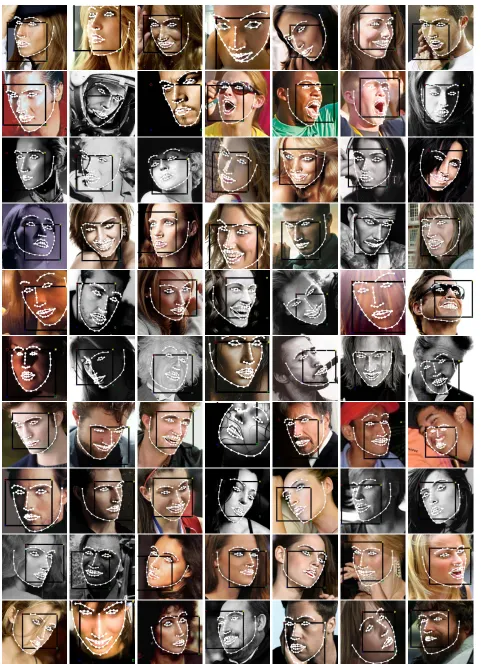
As the iBUG data set is the most challenging among all data sets but contains only 135 images, in Figs. 3 and 4, we present the fittings produced by PO-CR for all 135 images of this data set as well as the bounding box initializations used (produced by noise level σnoise = 5). As it can be observed, our system is able to fit images with very large shape and appearance variation even for the case of chal-lenging initializations.
5. Conclusions
References
[1] A. Asthana, S. Zafeiriou, S. Cheng, and M. Pantic. Incre-mental face alignment in the wild. InCVPR, 2014.
[2] S. Baker and I. Matthews. Lucas-kanade 20 years on: A unifying framework.IJCV, 56(3):221–255, 2004.
[3] P. Belhumeur, D. Jacobs, D. Kriegman, and N. Kumar. Lo-calizing parts of faces using a consensus of exemplars. In
CVPR, 2011.
[4] C. M. Bishop. Pattern recognition and machine learning. springer New York, 2006.
[5] S. Boyd and L. Vandenberghe. Convex optimization. Cam-bridge university press, 2004.
[6] X. Cao, Y. Wei, F. Wen, and J. Sun. Face alignment by ex-plicit shape regression. InCVPR, 2012.
[7] T. Cootes, G. Edwards, and C. Taylor. Active appearance models.TPAMI, 23(6):681–685, 2001.
[8] T. Cootes, C. Taylor, D. Cooper, and J. Graham. Active shape models-their training and application. CVIU, 61(1):38–59, 1995.
[9] D. Cristinacce and T. Cootes. Feature detection and tracking with constrained local models. InBMVC, 2006.
[10] D. Cristinacce and T. Cootes. Automatic feature localisa-tion with constrained local models. Pattern Recognition, 41(10):3054–3067, 2008.
[11] P. Doll´ar, P. Welinder, and P. Perona. Cascaded pose regres-sion. InCVPR, 2010.
[12] G. Fanelli, J. Gall, and L. Van Gool. Real time head pose estimation with random regression forests. InCVPR, 2011. [13] J. H. Friedman. Greedy function approximation: a gradient
boosting machine. Annals of Statistics, pages 1189–1232, 2001.
[14] H. K. Galoogahi, T. Sim, and S. Lucey. Multi-channel corre-lation filters. InICCV, 2013.
[15] G. D. Hager and P. N. Belhumeur. Efficient region tracking with parametric models of geometry and illumination.IEEE TPAMI, 20(10):1025–1039, 1998.
[16] J. F. Henriques, R. Caseiro, P. Martins, and J. Batista. Ex-ploiting the circulant structure of tracking-by-detection with kernels. InECCV, 2012.
[17] V. Kazemi and S. Josephine. One millisecond face alignment with an ensemble of regression trees. InCVPR, 2014. [18] A. Krizhevsky, I. Sutskever, and G. E. Hinton. Imagenet
classification with deep convolutional neural networks. In
NIPS, 2012.
[19] V. Le, J. Brandt, Z. Lin, L. Bourdev, and T. S. Huang. Inter-active facial feature localization. InECCV, 2012.
[20] M. A. Lourakis and A. Argyros. Sba: A software package for generic sparse bundle adjustment.ACM TOMS, 36(1):1–30, 2009.
[21] D. G. Lowe. Distinctive image features from scale-invariant keypoints.IJCV, 60(2):91–110, 2004.
[22] S. Lucey, Y. Wang, M. Cox, S. Sridharan, and J. Cohn. Efficient constrained local model fitting for non-rigid face alignment.Image and Vision Computing, 27(12):1804–1813, 2009.
[23] I. Matthews and S. Baker. Active appearance models revis-ited.IJCV, 60(2):135–164, 2004.
[24] M. A. Nicolaou, H. Gunes, and M. Pantic. Output-associative rvm regression for dimensional and continuous emotion prediction.IVCJ, 30(3):186–196, 2012.
[25] G. Papandreou and P. Maragos. Adaptive and constrained al-gorithms for inverse compositional active appearance model fitting. InCVPR 2008, 2008.
[26] C. E. Rasmussen.Gaussian processes for machine learning. MIT Press, 2006.
[27] S. Ren, X. Cao, Y. Wei, and J. Sun. Face alignment at 3000 fps via regressing local binary features. InCVPR, 2014. [28] C. Sagonas, G. Tzimiropoulos, S. Zafeiriou, and M. Pantic.
A semi-automatic methodology for facial landmark annota-tion. InCVPR-W, 2013.
[29] J. Saragih, S. Lucey, and J. Cohn. Deformable model fitting by regularized landmark mean-shift. IJCV, 91(2):200–215, 2011.
[30] J. Shotton, R. Girshick, A. Fitzgibbon, T. Sharp, M. Cook, M. Finocchio, R. Moore, P. Kohli, A. Criminisi, A. Kipman, et al. Efficient human pose estimation from single depth im-ages.IEEE TPAMI, 35(12):2821–2840, 2013.
[31] A. J. Smola and B. Sch¨olkopf. A tutorial on support vector regression.Statistics and computing, 14(3):199–222, 2004. [32] Y. Sun, X. Wang, and X. Tang. Deep convolutional network
cascade for facial point detection. InCVPR, 2013.
[33] D. J. Tan, S. Holzer, N. Navab, and S. Ilic. Deformable tem-plate tracking in 1ms. InBMVC, 2014.
[34] B. Triggs, P. F. McLauchlan, R. I. Hartley, and A. W. Fitzgib-bon. Bundle adjustment: a modern synthesis. InVision algo-rithms: theory and practice, pages 298–372. Springer, 2000. [35] G. Tzimiropoulos and M. Pantic. Optimization problems for
fast aam fitting in-the-wild. InICCV, 2013.
[36] G. Tzimiropoulos and M. Pantic. Gauss-newton deformable part models for face alignment in-the-wild. InCVPR, 2014. [37] M. Valstar, B. Martinez, X. Binefa, and M. Pantic. Facial point detection using boosted regression and graph models. InCVPR, 2010.
[38] X. Xiong and F. De la Torre. Supervised descent method and its applications to face alignment. InCVPR, 2013.
[39] H. Yang and I. Patras. Face parts localization using structured-output regression forests. InACCV 2012. 2013. [40] H. Yang and I. Patras. Sieving regression forest votes for
facial feature detection in the wild. InICCV, 2013. [41] X. Zhu and D. Ramanan. Face detection, pose estimation,