1457
Comparative Study of the Kinetics of Dissolution of Laterite in some
Acidic Media
Olushola S. AYANDA1*, Folahan A. ADEKOLA2, Alafara A. BABA2, Olalekan S. FATOKI1 and Bhekumusa J. XIMBA1
1Department of Chemistry, Faculty of Applied Sciences, Cape Peninsula University of
Technology, P.O. Box 652, Cape Town, South Africa.
2Department of Chemistry, University of Ilorin, P.M.B 1515, Ilorin, Nigeria.
* Corresponding author: [email protected]
ABSTRACT
Studies on the kinetics of dissolution of a Nigerian lateritic soil in acids media including hydrochloric, nitric and sulphuric acids have been undertaken. The elemental and mineralogical characterization, loss of mass on ignition, moisture content and pH of the material suspension in water were determined. The effects of acid concentration, process temperature, stirring rate and particle size on the dissolution rate were investigated. Experimental results indicated that laterite dissolution was greatly influenced by hydrogen ion concentration and the leaching data fitted a diffusion model. The linear dependence of the rate constant k on 1/ro2 supported the proposed kinetic model. Values of 60.23 kJmol-1, 64.31 kJmol-1 and 67.53 kJmol-1 were obtained for the activation energies of laterite dissolution in hydrochloric, nitric and sulphuric acids respectively; and the order of reaction was approximately one with respect to each of the three acids.
Keywords: Lateritic soil, Dissolution kinetics, Hydrochloric acid, Nitric acid, Sulphuric acid.
1. INTRODUCTION
Laterite is a soil formed in hot and wet tropical area that is enriched in iron and aluminium by intensive and long lasting weathering of the underlying parent rock. The percolation of rainwater causes dissolution of primary rock minerals leading to a decrease in sodium, potassium, calcium, magnesium and silicon, giving rise to a residual concentration of more insoluble elements predominantly iron and aluminium [1].
Laterite finds its applications in building houses and road construction. Solid lateritic gravel is also used in aquaria where it favours the growth of tropical plants. Intensive laterization results in the formation of aluminium-rich laterite (Bauxite) and laterization of igneous rocks often results in a considerable nickel and cobalt concentration [1, 3, 4]. Cobalt and nickel have found numerous applications in chemical and manufacturing industries. The strategic nature of cobalt has made it imperative to search for cobalt-enriched laterites, which constitutes one of its primary sources. As there is no comprehensive study on kinetic dissolution of laterites in Nigeria, except the one reported by Olanipekun (2000) [5] on the dissolution of laterite in HCl medium. The present study represents a more comprehensive study on a Nigerian laterite.
The present investigation was therefore aimed at establishing the conditions for the leaching of a Nigerian lateritic soil in hydrochloric, nitric and sulphuric acids, followed by a comparative analysis of the kinetic data.
2. EXPERIMENTALS
2.1 Material
Lateritic soil used for this study was collected from a mining site in Ilorin, Nigeria. Elemental analysis and mineralogical characterization were respectively carried out by X-ray fluorescence model 12045B4/3 and Philips PW1800 X-ray diffractometer, with CuKα (1.54 Å) radiation
generated at 40 kV and 55 mA.
All reagents used were of analar grade and were all products of BDH. Doubly distilled water was used for all the analytical preparations.
2.2 Physico-chemical Characterization
2.2.1 Loss of mass on ignition
The loss of mass on ignition was carried out gravimetrically at 600 °C using ASTM method until a constant weight was obtained. The process was carried out in triplicate.
2.2.2 Moisture content determination
The moisture content determination was carried out gravimetrically by heating 1.0 g of laterite in the oven at temperature of 105 ºC for 5 hours.
2.2.3 pH determination
The pH of 10.0 g suspension of laterite in 30 ml distilled water was measured by the use of a
2.3 Leaching Procedure
1.0 g of laterite sample of < 0.2 mm particle size was put into a 100 ml of 0.5 M acid (HCl, HNO3 and H2SO4). The magnetic stirrer was introduced and the solution mixture heated at
temperature of 55 ºC and stirred at a rate of 200 rpm for a particular contact time.
At the end of the contact time and for each concentration of the leachant, the solution obtained was filtered and the insoluble residue left in the filter paper was washed thoroughly with distilled water. The residue in the filter paper was oven-dried at about 60 oC and was reweighed. The difference in the amount of the laterite left from the original mass was then noted. This was then used to determine the percentage of the laterite dissolved in the leachant [6, 7, 8].
The same procedure was repeated for other acids concentrations: 1.0 M, 2.0 M, 4.0 M and 8.0 M. Each concentration of acid was contacted with 1.0 g of laterite for 5, 10, 30, 60 and 120 mins. A controlled experiment was carried out using doubly distilled water, so as to determine the percentage of laterite released/soluble in ordinary distilled water. All leaching data were subsequently corrected by subtracting the amount dissolved in ordinary water from the corresponding data obtained for various acids concentrations.
The concentration which gave the highest percentage of dissolution was used for optimization of other parameters including temperature, particle size and stirring rate. The activation energy and the orders of reactions were finally calculated from the Arrhenius plots for the three acids.
3. RESULTS AND DISCUSSION
3.1 Physico-chemical Characterization
3.1.1 Loss of mass on ignition and moisture content
The average percentage loss of mass on ignition of laterite ore was 21.83 % ± 0.02. The loss of mass could be accounted for by the presence of organic/decayed substances in the laterite. The moisture content of the laterite was 9.1 % ± 0.004.
3.1.2 pH determination
The pH of the laterite-water suspension was 8.5. This value suggests that the surface of laterite is basic. This is in support of the predominant chemical form of laterite, which is oxide.
3.1.3 XRF analysis
Table 1: Chemical Assay of laterite by XRF
Element K2O CaO TiO2 MnO Fe2O3 NiO CoO CuO ZnO ZrO
Concentration
(%) 2.29 2.84 0.24 0.01 12.42 0.07 0.02 0.01 0.01 0.01
LOMOI = 21.84 %; MC = 9.10 % and α-SiO2 = 51.14 %
(LOMOI = loss of mass on ignition; MC = moisture content and α-SiO2 = residual silica,
obtained by difference).
3.1.4 XRD analysis
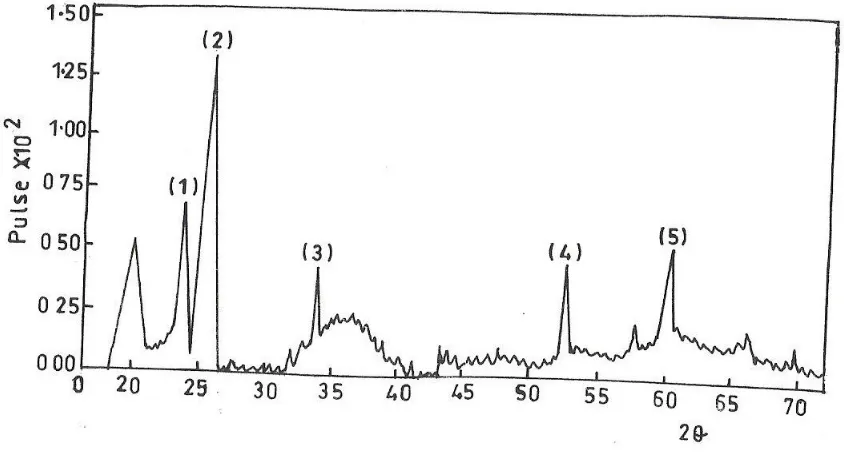
The mineralogical phases of laterite by X-ray diffraction showed that the laterite consists of Fe2O3, Ni2SiO4 (liebenbergite), Al2O3, Al2SiO5 (andalusite), Al2Si2O5(OH)4 (nacrite), SiO2,
CaSiO3 (wollastonite), Ca2Fe2O5 (srebrodolskite), Mg3Si2O5(OH)4 (orthochrysotile) and
Na2SiO5. The XRD spectrum of the material is shown in Fig. 1.
Fig. 1: XRD spectrum of laterite
3.2 Leaching Studies
3.2.1 Effect of acid concentration
[image:4.612.93.515.309.535.2]0 0.05 0.1 0.15 0.2 0.25 0.3 0.35 0.4
0 20 40 60 80 100 120 140
Contact time (min)
[image:5.612.114.488.81.343.2]F ra c ti o n o f la te ri te d is s o lv e d ( X ) 0.5M 1.0M 2.0M 4.0M 8.0M
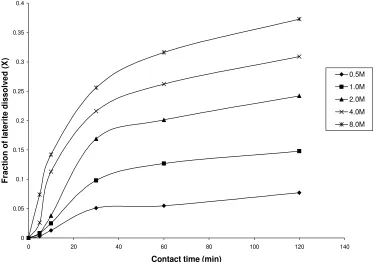
Fig. 2: Fraction of laterite dissolved (X) versus contact time (min) at different concentrations of HCl (Experimental conditions: Temperature = 55 oC, mass of laterite used = 1.0 g, stirring rate = 200 rpm, particle size = < 0.2 mm.)
0 0.05 0.1 0.15 0.2 0.25 0.3 0.35 0.4
0 20 40 60 80 100 120 140
Contact time (min)
F ra c ti o n o f la te ri te d is s o lv e d ( X ) 0.5M 1.0M 2.0M 4.0M 8.0M
Fig. 3: Fraction of laterite dissolved (X) versus contact time (min) at different concentrations of HNO3 (Experimental conditions: Temperature = 55 oC, mass of laterite used = 1.0 g, stirring rate
[image:5.612.101.500.404.663.2]0 0.02 0.04 0.06 0.08 0.1 0.12 0.14 0.16 0.18 0.2
0 20 40 60 80 100 120 140
Contact time (min)
F
ra
c
ti
o
n
o
f
la
te
ri
te
d
is
s
o
lv
e
d
(
X
)
0.5M
1.0M
2.0M
4.0M
[image:6.612.112.487.86.358.2]8.0M
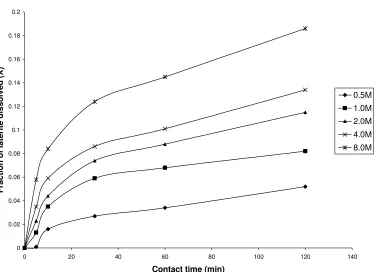
Fig. 4: Fraction of laterite dissolved (X) versus contact time (min) at different concentrations of H2SO4 (Experimental conditions: Temperature = 55 oC, mass of laterite used = 1.0 g, stirring rate
= 200 rpm, particle size = < 0.2 mm).
It is evident that percentage of laterite dissolved increased linearly with the concentration of the acids. Concentration of the leachant thus has a significant effect on the leaching of laterite.
Though, HCl is more effective in terms of leaching capacity as evidenced from the comparison of Figs. 2 – 4. The pattern of the result obtained in Figs. 2 are in agreement with the work reported by Olanipekun (2000) [5] on a separate study involving leaching of raw and pre-roasted laterites by HCl.
3.2.2 Effect of temperature
The effect of temperature on rate of laterite dissolution was studied over the temperature ranges of 28 ºC – 80 ºC for 4 M HCl, 4 M HNO3 and 2 M H2SO4.
R2 = 0.996
R2 = 0.9989
R2 = 0.9981
0 0.05 0.1 0.15 0.2 0.25 0.3 0.35 0.4 0.45 0.5
20 30 40 50 60 70 80 90
Temperature (oC)
F
ra
c
ti
o
n
o
f
la
te
ri
te
d
is
s
o
lv
e
d
(
X
)
HCl
HNO3
[image:7.612.91.527.75.362.2]H2SO4
Fig. 5: Fraction of laterite dissolved (X) versus different contact temperature (oC). Experimental conditions: mass of laterite used = 1.0 g, stirring rate = 200 rpm, contact time = 120 min, particle
size = < 0.2 mm.
However, it was also observed that leaching was greatly enhanced in hydrochloric acid medium than in nitric and sulphuric acids media (Fig. 5) and was retained for subsequent use in this study.
3.2.3 Effect of particle size
Fig. 6 shows the effect of particle size on the dissolution of laterite in 4 M HCl solution at 80 ºC, using four particle sizes: < 0.2 mm, + 0.2 - 0.3 mm, + 0.3 - 0.4 mm and + 0.4 - 0.5 mm and at a stirring rate of 200 rpm.
From Fig. 6, it is apparent that the fraction with the smallest particle size (< 0.2 mm) gave the highest percentage (47 %) of laterite dissolution. This was due to higher specific area for lower particle size. This particle size was then chosen for further investigation.
3.2.4 Effect of stirring speed
0 0.05 0.1 0.15 0.2 0.25 0.3 0.35 0.4 0.45 0.5
0 20 40 60 80 100 120 140
Contact time (min)
[image:8.612.92.506.74.359.2]F ra c ti o n o f la te ri te d is s o lv e d ( X ) <0.2mm +0.2-0.3mm +0.3-0.4mm +0.4-0.5mm
Fig. 6: Effect of particle size on laterite dissolution in 4 M HCl and 80 oC
0 10 20 30 40 50 60
0 100 200 300 400 500 600
Stirring rate (rpm)
F ra c ti o n o f la te ri te d is s o lv e d ( % )
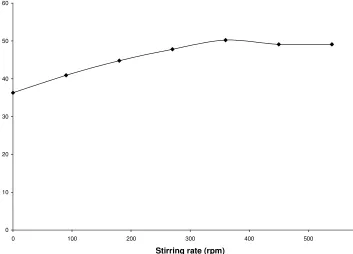
[image:8.612.126.479.417.671.2]It was clear from Fig. 7 that the amount of laterite dissolved increases with the stirring speed between 0 – 360 rpm. The percentage dissolved appears to be practically constant afterwards. There is no appreciable gain from 360 – 540 rpm. Hence, increase in the percentage of laterite dissolved with increasing stirring speed demonstrates the importance of diffusion in the dissolution process.
3.3 Kinetic Analysis
The shrinking core model considers that the leaching process is controlled either by the diffusion of reactant through the solution boundary layer or through a solid product layer; or by the rate of the surface chemical reaction; or combination of surface chemical reaction and diffusion of reactant (mixed control mechanism).
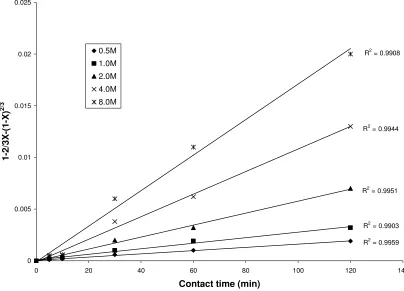
For this study, three shrinking core models were investigated with respect to the linearization of the dissolution curves (Figs. 2 – 4) as proposed by several investigators [6, 7, 9]:
1- (1 - X)1/3 = krt (1)
1- 2/3X - (1 - X)2/3 = kdt (2)
1- (1- X)1/3 + y/6[(1- X)1/3 + 1 - 2(1- X)2/3] = kmt (3)
where X is the fraction of laterite dissolved; t is contact time (s); kr, kd and km are the reaction
rate constants.
Equation 1 is based on the surface chemical reaction as the rate controlling step and its slope corresponds to the apparent rate constant kr. Equation 2 on the other hand is based on the
assumption that the rate controlling step is diffusion through a semi-permeable product layer formed around the solid and its slope gives the apparent rate constant kd. Lastly, equation 3 is a
combination of both surface chemical reaction and diffusion or simply called a mixed controlled reaction. The slope of this graph corresponds to the apparent rate constant km. The rate constant
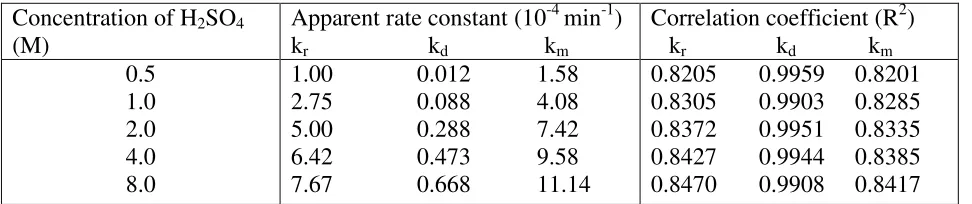
values kr, kd and km calculated from the corresponding graphs illustrated in Figures 8, 9 and 10 at
various concentrations of HCl, HNO3 and H2SO4 are summarized in Tables 3, 4 and 5,
R2 = 0.9975
R2 = 0.9971
R2 = 0.9975 R2 = 0.9972
R2 = 0.998
0 0.005 0.01 0.015 0.02 0.025 0.03
0 20 40 60 80 100 120 140
Contact time (min)
1
-2
/3
X
-(
1
-X
)
2
/3
0.5M
1.0M
2.0M
4.0M
[image:10.612.100.480.78.365.2]8.0M
Fig. 8: Plot of [1-2/3X-(1-X)2/3] versus contact time at various concentrations of HCl
R2 = 0.9968
R2 = 0.9878 R2 = 0.9962
R2 = 0.9937
R2 = 0.9983
0 0.001 0.002 0.003 0.004 0.005 0.006
0 20 40 60 80 100 120 140
Contact time (min)
1
-2
/3
X
-(
1
-X
)
2
/3
0.5M
1.0M
2.0M
4.0M
8.0M
[image:10.612.83.463.411.668.2]R2 = 0.9959 R2 = 0.9903 R2 = 0.9951 R2 = 0.9944 R2 = 0.9908
0 0.005 0.01 0.015 0.02 0.025
0 20 40 60 80 100 120 140
Contact time (min)
[image:11.612.84.488.83.374.2]1 -2 /3 X -( 1 -X ) 2 /3 0.5M 1.0M 2.0M 4.0M 8.0M
[image:11.612.71.544.448.550.2]Fig. 10: Plot of [1-2/3X-(1-X)2/3] versus contact time at various concentrations of H2SO4
Table 2: Apparent rate constants kr, kd and km and correlation coefficient values at various
concentrations of HCl Concentration of HCl (M) Apparent rate constant (10-4 min-1)
kr kd km
Correlation coefficient (R2)
kr kd km
0.5 1.0 2.0 4.0 8.0
2.50 0.076 3.83 5.08 0.303 7.67 10.80 1.28 15.80 12.80 1.80 18.80 15.80 2.63 22.90
0.9049 0.9975 0.9064 0.8905 0.9971 0.8888 0.8887 0.9975 0.8853 0.8946 0.9972 0.8900 0.8990 0.9980 0.8927
Table 3: Apparent rate constants kr, kd and km and correlation coefficient values at various
concentrations of HNO3
Concentration of HNO3
(M)
Apparent rate constant (10-4 min-1) kr kd km
Correlation coefficient (R2) kr kd km
0.5 1.0 2.0 4.0 8.0
1.67 0.029 2.50 3.58 0.153 5.42 7.25 0.608 10.80 9.67 1.05 14.30 11.50 1.47 16.90
[image:11.612.73.547.603.707.2]Table 4: Apparent rate constants kr, kd and km and correlation coefficient values at various
concentrations of H2SO4
Concentration of H2SO4
(M) Apparent rate constant (10
-4 min-1)
kr kd km
Correlation coefficient (R2) kr kd km
0.5 1.0 2.0 4.0 8.0
1.00 0.012 1.58 2.75 0.088 4.08 5.00 0.288 7.42 6.42 0.473 9.58 7.67 0.668 11.14
0.8205 0.9959 0.8201 0.8305 0.9903 0.8285 0.8372 0.9951 0.8335 0.8427 0.9944 0.8385 0.8470 0.9908 0.8417
These results (Fig. 8 – 10, Tables 2 – 4) clearly indicated that the mechanism of dissolution of laterite follows perfectly the diffusion through a semi-permeable product layer. Furthermore, the plot of rate constant, k versus reciprocal of the square of particle size, 1/ro2 (Fig. 11), was linear
with a correlation coefficient of 0.9992, and this supports the proposition of diffusion kinetic model for the laterite ore dissolution [7, 10]. It is worthy of note that the plot of the rate constant k against the reciprocal of the particle radii, 1/ro did not give a straight line.
R2 = 0.9992
0 5 10 15 20 25 30
0 0.1 0.2 0.3 0.4 0.5 0.6
1/ro2
k
X
1
0
-5
Fig.11: Dependence of k on 1/ro2
3.3.1 Activation energy
[image:12.612.94.477.335.631.2]R2 = 0.9678 R2 = 0.9709 R2 = 0.9731
-14 -13 -12 -11 -10 -9 -8 -7
2.8 2.9 3 3.1 3.2 3.3 3.4
T-1 X 10⁻³ (K-1)
ln
k
HCl
HNO3
[image:13.612.94.501.81.371.2]H2SO4
Fig. 12: Arrhenius plot for laterite dissolution in HCl, HNO3 and H2SO4 acid
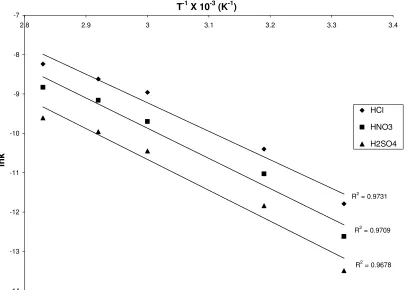
Table 5 summarizes the apparent rate constant values for HCl 4 M, HNO3 4 M and H2SO4 2 M at
various temperatures. The activation energy (Ea) values for the dissolution of laterite calculated
from their respective slopes in Fig. 12 for HCl, HNO3 and H2SO4 were 60.23 kJmol-1, 64.31
[image:13.612.115.500.524.696.2]kJmol-1 and 67.53 kJmol-1, respectively.
Table 5: Apparent rate constant values kd for HCl (4 M), HNO3 (4 M) and H2SO4 (2 M) at
different temperatures
TºC 1/T (K-1)
4 M HCl kd (h-1)
4 M HNO3
kd (h-1)
2 M H2SO4
kd (h-1)
28
40
60
70
80
3.32 X10⁻³
3.19 X10⁻³
3.00 X 10⁻³
2.92 X 10⁻³
2.83 X 10⁻³
7.60 X 10⁻⁶
3.03 X 10⁻⁵
1.28 X 10⁻⁴
1.80 X 10⁻⁴
2.63 X 10⁻⁴
3.29X 10⁻⁶
1.53 X 10⁻⁵
6.08 X 10⁻⁵
1.05 X 10⁻⁴
1.47 X 10⁻⁴
1.25X 10⁻⁶
8.83 X 10⁻⁶
2.88 X 10⁻⁵
4.73 X 10⁻⁵
Olanipekun, (2000) [5] who previously investigated the kinetic of dissolution of another type of Nigerian laterite in hydrochloric acid reported values of 65.2 kJ/mol and 71.7 kJ/mol for the activation energy of pre-roasted and raw laterite respectively. The relatively higher values suggest that the type of laterite used by this author is obviously more difficult to leach when compared to the value of 60.2 kJ/mol obtained for this study. It is important to also note that several authors who had previously worked on some other types of laterite have reported dissolution data that fitted the diffusion kinetic equation with activation energy greater than 60 kJ/mol [5, 11]. Therefore, the increasing order of activation energies for the three leachants investigated in this work is given thus:
Ea (HCl) < Ea (HNO3) < Ea (H2SO4)
Hence, HCl would lead to higher laterite dissolution than HNO3 and H2SO4 by atmospheric
leaching for the used hydrogen ion concentration and temperatures.
3.3.2 Order of reaction
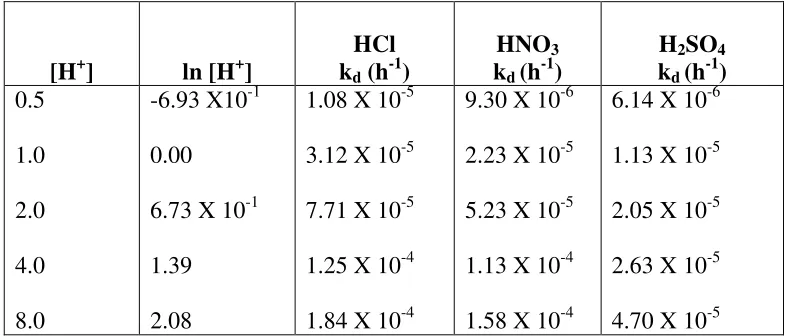
[image:14.612.109.503.375.543.2]The results on the effect of the three mineral acids concentrations were applied to this kinetic model and kd values for each hydrogen ion concentration are given in Table 6.
Table 6: Values for rate constant for HCl, HNO3 and H2SO4 media at various concentrations
[H+] ln [H+]
HCl kd (h-1)
HNO3
kd (h-1)
H2SO4
kd (h-1)
0.5
1.0
2.0
4.0
8.0
-6.93 X10⁻¹
0.00
6.73 X 10⁻¹
1.39
2.08
1.08 X 10⁻⁵
3.12 X 10⁻⁵
7.71 X 10⁻⁵
1.25 X 10⁻⁴
1.84 X 10⁻⁴
9.30 X 10⁻⁶
2.23 X 10⁻⁵
5.23 X 10⁻⁵
1.13 X 10⁻⁴
1.58 X 10⁻⁴
6.14 X 10⁻⁶
1.13 X 10⁻⁵
2.05 X 10⁻⁵
2.63 X 10⁻⁵
4.70 X 10⁻⁵
From the kd and hydrogen ion concentration values in Table 6, a plot of ln kd versus ln [H+] were
R2 = 0.9561
R2 = 0.982
-12.5 -12 -11.5 -11 -10.5 -10 -9.5 -9 -8.5 -8
-1 -0.5 0 0.5 1 1.5 2 2.5
ln[H+]
ln
kd
HCl
[image:15.612.117.509.80.364.2]H2SO4
Fig. 13: Plot of ln kd vs ln [H+] for HCl and H2SO4
R2 = 0.9776
-12 -11.5 -11 -10.5 -10 -9.5 -9 -8.5 -8
-1 -0.5 0 0.5 1 1.5 2 2.5
ln[H+]
ln
kd
HNO3
[image:15.612.119.503.396.672.2]As seen from Figs. 13 and 14, the estimated order of reaction for the systems were 1.02, 1.02 and 0.73 with respect to HCl, HNO3 and H2SO4 concentations respectively.
Furthermore, the activation energy and the order of reaction values with respect to the various acids concentration, temperature and particle size confirm the shrinking core model for a diffusion controlled process.
4. CONCLUSION
In the present study, the dissolution of laterite in hydrochloric, nitric and sulphuric acid solutions was studied. It was found that the rate of laterite dissolution increases with acid concentration, temperature, stirring speed and decreases with particle size. The dissolution of laterite was found to be controlled by the shrinking core model for a diffusion-controlled process. Values of 60.23 kJmol-1, 64.31 kJmol-1 and 67.53 kJmol-1 were obtained for the activation energies of laterite dissolution in hydrochloric, nitric and sulphuric acids, respectively, and the order of reaction was approximately one with respect to each of the three acids.
REFERENCES
1. Aleva, G. J. J., 1994, Laterites: Concept, Geology, Morphology and Chemistry, ISRIC, Wageningen, the Netherlands, ISBN 90-6672-053-0.
2. Hudson, R. 2005, Using Laterite, AquaBotanic, Salem.
3. Schellmann, W., 1983, “Geochemical Principles of Lateritic Nickel Ore Formation.” Proceedings of the International Seminar on Laterization Processes, Sao Paulo, 119-135. 4. Bardossy, G., and Aleva, G. J. J., 1990, “Lateritic Bauxites.” Development in Economic
Geology, 27, 624.
5. Olanipekun, E. O., 2000, “Kinetics of leaching laterite.” International Journal of Mineral Processing, 60, 9-14.
6. Aydogan, S., Aras, A., and Canbazoglu, M., 2005, “Dissolution kinetics of Sphalerite in acidic ferric chloride leaching.” Chemical Engineering Journal, 114, 67-72.
7. Baba, A. A., Adekola, A. F., and Bale, R. B., 2009, “Development of a combined pyro- and hydro-metallurgical route to treat spent zinc-carbon batteries.” Journal of Hazardous Materials, 171, 838-844.
8. Madhuchhanda, M., Devi, N. B., Rao, K. S., Rath, P. C., and Paramguru, R. K., 2000, “Oxidation of Sphalerite in Hydrochloric acid medium in the presence of manganese dioxide.” The Inst. of Min. and Metallurgy, 109, C150-C155.
9. Antonijevic, M. M., Jankovic, Z. D., and Dimitrijeviv, M. D., 2004, “Kinetics of Chalcopyrite dissolution by hydrogen peroxide in Sulphuric acid.” Hydrometallurgy, 71, 329-334.
10. Ucar, G., 2009, “Kinetics of Sphalerite dissolution by sodium chlorate in hydrochloric Acid.” Hydrometallurgy, 95, 39-43.

![Fig. 8: Plot of [1-2/3X-(1-X)2/3] versus contact time at various concentrations of HCl](https://thumb-us.123doks.com/thumbv2/123dok_us/9244744.412083/10.612.83.463.411.668/fig-plot-versus-contact-time-various-concentrations-hcl.webp)