Translating Compounds by Learning Component
Gloss Translation Models via Multiple Languages
Nikesh Garera and David Yarowsky Department of Computer Science Center for Language and Speech Processing
Johns Hopkins University Baltimore, MD 21218, USA {ngarera,yarowsky}@cs.jhu.edu
Abstract
This paper presents an approach to the translation of compound words without the need for bilingual training text, by mod-eling the mapping of literal component word glosses (e.g. “iron-path”) into flu-ent English (e.g. “railway”) across mul-tiple languages. Performance is improved by adding component-sequence and learned-morphology models along with context sim-ilarity from monolingual text and optional combination with traditional bilingual-text-based translation discovery.
1 Introduction
Compound words such as lighthouse and fireplace are words that are composed of two or more compo-nent words and are often a challenge for machine translation due to their potentially complex com-pounding behavior and ambiguous interpretations (Rackow et al., 1992). For many languages, such words form a significant portion of the lexicon and the compounding process is further complicated by diverse morphological processes (Levi, 1978) and the properties of different compound sequences such as Noun-Noun, Adj-Adj, Adj-Noun, Verb-Verb, etc. Compounds also tend to have a high type frequency but a low token frequency which makes their transla-tion difficult to learn using corpus-based algorithms (Tanaka and Baldwin, 2003). Furthermore, most of the literature on compound translation has been re-stricted to a few languages dealing with compound-ing phenomena specific to the language in question.
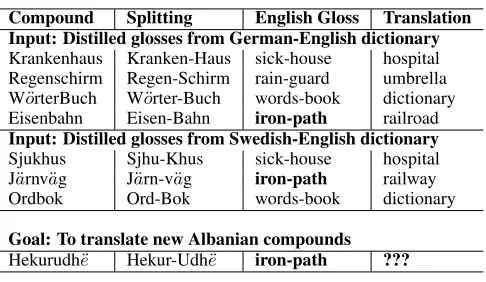
Compound Splitting English Gloss Translation Input: Distilled glosses from German-English dictionary Krankenhaus Kranken-Haus sick-house hospital Regenschirm Regen-Schirm rain-guard umbrella WorterBuch¨ Worter-Buch¨ words-book dictionary Eisenbahn Eisen-Bahn iron-path railroad Input: Distilled glosses from Swedish-English dictionary Sjukhus Sjhu-Khus sick-house hospital J¨arnv¨ag J¨arn-vag¨ iron-path railway Ordbok Ord-Bok words-book dictionary
[image:1.612.315.558.252.393.2]Goal: To translate new Albanian compounds Hekurudh¨e Hekur-Udh¨e iron-path ???
Table 1:Example lexical resources used in this task and their application to translating compound words in new languages.
With these challenges in mind, the primary goal of this work is to improve the coverage of translation lexicons for compounds, as illustrated in Table 1 and Figure 1, in multiple new languages. We show how using cross-language compound evidence ob-tained from bilingual dictionaries can aid in com-pound translation. A primary motivating idea for this work is that the literal component glosses for compound words (such as “iron path” for railway) is often replicated in multiple languages, providing insight into the fluent translation of a similar literal gloss in a new (often resource-poor) language. 2 Resources Utilized
3 Related Work
The compound-translation literature typically deals with these steps: 1) Compound splitting, 2) transla-tion candidate generatransla-tion and 3) translatransla-tion candi-date scoring. Compound splitting is generally done using translation lexicon lookup and allowing for different splitting options based on corpus frequency (Zhang et al., 2000; Koehn and Knight, 2003). Translation candidate generation is an important phase and this is where our work differs signifi-cantly from the previous literature. Most of the pre-vious work has been focused on generating com-positional translation candidates, that is, the trans-lation candidates of the compound words are lexi-cally composed of the component word translations. This has been done by either just concatenating the translations of component words to form a candi-date (Grefenstette, 1999; Cao and Li, 2002), or us-ing syntactic templates such as “E2 in E1”, “E1 of
E2” to form translation candidates from the
transla-tion of the component words E2 and E1 (Baldwin
and Tanaka, 2004), or using synsets of the compo-nent word translations to include synonyms in the compositional candidates (Navigli et al., 2003). The above class of work in compositional-candidate generation fails to translate compounds such as Krankenhaus (hospital) whose component word translations areKranken (sick) and Haus (hospital), and composingsickandhousein any order will not result in the correct translation (hospital). Another problem with using fixed syntactic templates is that they are restricted to the specific patterns occurring in the target language. We show how one can use the gloss patterns of compounds in multiple other languages to hypothesize translation candidates that are not lexically compositional.
4 Approach
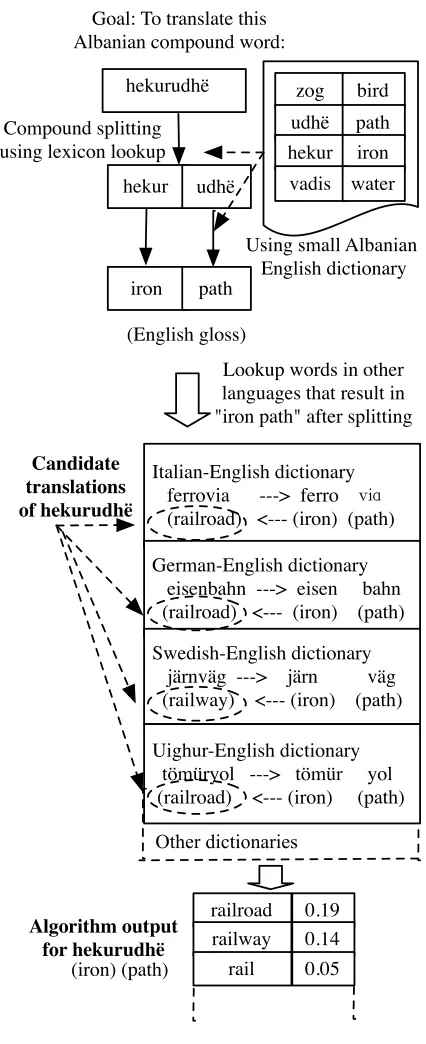
Our approach to compound word translation is illus-trated in Figure 1.
4.1 Splitting compound words and gloss generation with translation lexicon lookup
We first split a given source word, such as the Al-banian compound hekurudh¨e, into a set of compo-nent word partitions, such ashekur (iron) andudh¨e
(path). Our initial approach is to consider all possi-ble partitions based on contiguous component words found in a small dictionary for the language, as in
Goal: To translate this Albanian compound word:
udhë
(English gloss) Compound splitting
using lexicon lookup
Using small Albanian English dictionary
Italian-English dictionary ferrovia ---> ferro via (railroad) <--- (iron) (path)
German-English dictionary eisenbahn ---> eisen bahn (railroad) <--- (iron) (path)
Swedish-English dictionary järnväg ---> järn väg (railway) <--- (iron) (path)
Uighur-English dictionary tömüryol ---> tömür yol (railroad) <--- (iron) (path)
Lookup words in other languages that result in "iron path" after splitting
Candidate translations of hekurudhë
Other dictionaries
iron path
hekur
hekurudhë zog bird
udhë path
hekur iron
vadis water
0.19 0.14 0.05 railroad railway
rail
Algorithm output for hekurudhë
[image:2.612.321.534.118.640.2](iron) (path)
Brown (2002) and Koehn and Knight (2003)1. For a given split, we generate its English glosses by using all possible English translations of the component words given in the dictionary of that language2.
4.2 Using cross-language evidence from different bilingual dictionaries
For many compound words (especially for borrow-ings), the compounding process is identical across several languages and the literal English gloss re-mains the same across these languages. For ex-ample, the English word railwayis translated as a compound word in many languages, and the English gloss of those compounds is often“iron path”or a similar literal meaning3. Thus knowing the fluent English translation of the literal gloss “iron path” in some relatively resource-rich language provides a vehicle for the translation from all other languages sharing that literal gloss4
4.3 Ranking translation candidates
The confidence in the correctness of a mapping be-tween a literal gloss (e.g. “iron path”) and fluent translation (e.g. “railroad”) can be based on the number of distinct languages exhibiting this associa-tion. Thus we rank the candidate translations gener-ated via different languages as in Figure 1 as fol-lows: For a given target compound word, say fc
with a set of English glosses G obtained via mul-tiple splitting options or mulmul-tiple component word translations, the translation probability for a candi-date translation can be computed as:
p(ec|fc) =
X
g∈G
p(ec, g|fc)
= X
g∈G
p(g|fc)·p(ec|g, fc)
= X
g∈G
p(g|fc)·p(ec|g)
1In order to avoid inflections as component-words we limit the component-word length to at least three characters.
2
The algorithm is allowed to generate multiple glosses “iron way,” “iron road,” etc. based on multiple translations of the component words. Multiple glosses only add to the number of translation candidates generated.
3
For the gloss, “iron path”, we found 10 other languages in which some compound word has the English gloss after split-ting and component-word translation
4
We do assume an existing small translation lexicon in the target language for the individual component-words, but these are often higher frequency words and present either in a basic dictionary or discoverable through corpus-based techniques.
where, p(g|fc) = p(g1|f1) ·p(g2|f2). f1, f2 are
the individual component-words of compound and
g1, g2 are their translations from the existing
dic-tionary. For human dictionaries, p(g|fc) is
uni-form for all g ∈ G, while variable probabilities can also be acquired from bitext or other translation discovery approaches. Also, p(ec|g) = f reqf req(g,ec(g)),
wheref req(g, ec)is the number of times the
com-pound word with English gloss g is translated as
ec in the bilingual dictionaries of other languages
andf req(g)is the total number of times the English
gloss appears in these dictionaries.
5 Evaluation using Exact-match Translation Accuracy
For evaluation, we assess the performance of the algorithm on the following 10 languages: Alba-nian, Arabic, Bulgarian, Czech, Farsi, German, Hungarian, Russian, Slovak and Swedish. We de-tail both the average performance for these 10 lan-guages (Avg10), as well as provide individual
per-formance details on Albanian, Bulgarian, German and Swedish. For each of the compound trans-lation models, we report coverage (the # of com-pound words for which a hypothesis was generated by the algorithm) and Top1/Top10 accuracy. Top1 and Top 10 accuracy are the fraction of words for which a correct translation (listed in the evaluation dictionary) appears in the Top 1 and Top 10 trans-lation candidates respectively, as ranked by the al-gorithm. Because evaluation dictionaries are often missing acceptable translations (e.g. railroadrather thanrailway), and any deviation from exact-match is scored as incorrect, these measures will be a lower bound on acceptable translation accuracy. Also, target language models can often select effectively among such hypothesis lists in context.
6 Comparison of different compound translation models
6.1 A simple model using literal English gloss concatenation as the translation
udh¨e(path)) and hypothesizes three translation can-didate variants: “iron path”, path” and “iron-path”. A test instance is scored as correct if any of these translation candidates occur in the transla-tions ofhekurudh¨ein the bilingual dictionary. This baseline performance measures how well simple lit-eral glosses serve as translation candidates. In cases such as the German compoundNußschale(nutshell), which is a simple concatenation of the individual componentsNuß(nut)andSchale (shell), the literal gloss is correct. For this baseline, if the component-words have multiple translations, then each of the possible English gloss is ranked randomly. While Grefenstette (1999) and Cao and Li (2002) proposed re-ranking these candidates using web-data, the po-tential gains of this ranking are limited, as we see in Table 2 that even theFound Acc. is very low5, that is for most of the cases the correct translation does not appear anywhere in the set of English glosses6
[image:4.612.317.564.425.498.2]Language Cmpnd wrds Top1 Top10 Found translated Acc. Acc. Acc. Albanian 4472 (10.11%) 0.001 0.010 0.020 Bulgarian 9093 (12.50%) 0.001 0.015 0.031 German 15731 (29.11%) 0.004 0.079 0.134 Swedish 18316 (31.57%) 0.005 0.068 0.111 Avg10 14228 (17.84%) 0.002 0.030 0.055
Table 2: Baseline performance using unreordered literal En-glish glosses as translations. The percentages in parentheses indicate what fraction of all the words in the test (entire) vocab-ulary were detected and translated as compounds.
6.2 Using bilingual dictionaries
This section describes the results from the model ex-plained in Section 4. To recap, this model attempts to translate every test word such that there is at least one additional language whose bilingual dictionary supports an equivalent split and literal English gloss, and bases its translation hypotheses on the consen-sus fluent translation(s) corresponding to the literal glosses in these other languages. The performance is shown in Table 3. The substantial increase in ac-curacy over the baseline indicates the usefulness of
5
Found Acc. is the fraction of examples for which the cor-rect translation appearsanywherein the n-best list
6One explanation for this could be that for only a small per-centage of compound words, their dictionary translations are formed by concatenating their English glosses. Also, Grefen-stette (1999) reports much higher accuracies for German on this model because the 724 German test compounds were chosen in such a way that their correct translation is a concatenation of the possible component word translations.
such gloss-to-translation guidance from other lan-guages. The rest of the sections detail our investi-gation of improvements to this model.
Language Compound words Top1 Top10 translated Acc. Acc. Albanian 3085 (6.97%) 0.185 0.332 Bulgarian 6719 (9.24%) 0.247 0.416 German 11103 (20.55%) 0.195 0.362 Swedish 12681 (21.86%) 0.188 0.346 Avg10 9320.9 (11.98%) 0.184 0.326
Table 3: Coverage and accuracy for the standard model us-ing gloss-to-fluent translation mappus-ings learned from bilus-ingual dictionaries in other languages (in forward order only).
6.3 Using forward and backward ordering for English gloss search
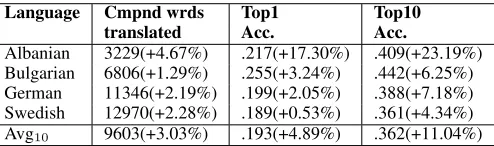
In our standard model, the literal English gloss for a source compound word (for example, iron path) matches glosses in other language dictionaries only in the identical order. But given that modifier/head word order often differs between languages, we test how searching for both orderings (e.g. “iron path” and “path iron”) can improve performance, as shown in Table 4. The percentages in parentheses show relative increase from the performance of the standard model in Section 6.2. We see a substantial improvement in both coverage and accuracy.
Language Cmpnd wrds Top1 Top10
translated Acc. Acc.
Albanian 3229(+4.67%) .217(+17.30%) .409(+23.19%) Bulgarian 6806(+1.29%) .255(+3.24%) .442(+6.25%) German 11346(+2.19%) .199(+2.05%) .388(+7.18%) Swedish 12970(+2.28%) .189(+0.53%) .361(+4.34%) Avg10 9603(+3.03%) .193(+4.89%) .362(+11.04%)
Table 4: Performance for looking up English gloss via both orderings. The percentages in parentheses are relative improve-ments from the performance in Table 3
.
6.4 Increasing coverage by automatically discovering compound morphology
Geschäft s Führer
Paterfamilias
Pater Familia s
+ + + +
s as Middle Glue
in German
s as End Glue
in Latin Geschäftsführer
(Business) (Guide) (Father) (Family)
[image:5.612.313.560.71.145.2](Manager) (Household head)
Figure 2: Illustration of compounding morphology using middle and end glue characters.
can be estimated directly from corpora in different languages. In additional to fillers, compound can also introduce morphology at the suffix or prefix of compounds, for example, in the Latin language, the lexemepaterfamiliascontains the genitive form fa-miliasof the lexemefamilia (family), thuss in this case is referred to as the“end glue”character. To
Albanian Bulgarian German Swedish Top 5 Middle Glue Character(s)
j 0.059 O 0.129 s 0.133 s 0.132 s 0.048 N 0.046 n 0.090 l 0.051 t 0.042 H 0.036 k 0.066 n 0.049 r 0.042 E 0.025 h 0.042 t 0.045 i 0.038 A 0.025 f 0.037 r 0.035 Top 5 End Glue Character(s)
[image:5.612.76.290.72.154.2]m 0.146 T 0.124 n 0.188 a 0.074 t 0.079 EH 0.092 t 0.167 g 0.073 s 0.059 H 0.063 en 0.130 t 0.059 k 0.048 M 0.049 e 0.069 e 0.057 r 0.037 AM 0.047 d 0.043 d 0.057
Table 5:Top 5 middle glues (fillers) and end glues discovered for each language along with their probability scores.
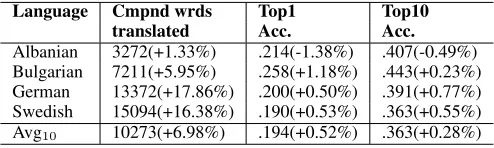
augment the splitting step outlined in Section 4.1, we allow deletion of up to two middle characters and two end characters. Then, for each glue candi-date (for examplees), we estimate its probability as the relative frequency of unique hypothesized com-pound words successfully using that particular glue. We rank the set of glues by their probability and take the top 10 middle and end glues for each language. A sample of glues discovered for some of the lan-guages are shown in Table 5. The performance for the morphology step is shown in Table 6. The rela-tive percentage improvements are with respect to the previous Section 6.3. We observe significant gain in coverage as the flexibility of glue process allows dis-covery of more compounds.
6.5 Re-ranking using context vector projection
We may further improve performance by re-ranking candidate translations based on the goodness of se-mantic “fit” between two words, as measured by
Language Cmpnd wrds Top1 Top10
translated Acc. Acc.
Albanian 3272(+1.33%) .214(-1.38%) .407(-0.49%) Bulgarian 7211(+5.95%) .258(+1.18%) .443(+0.23%) German 13372(+17.86%) .200(+0.50%) .391(+0.77%) Swedish 15094(+16.38%) .190(+0.53%) .363(+0.55%) Avg10 10273(+6.98%) .194(+0.52%) .363(+0.28%)
Table 6: Performance for increasing coverage by including compounding morphology. The percentages in parentheses are relative improvements from the performance in Table 4
.
their context similarity. This can be accomplished as in Rapp (1999) and Schafer and Yarowsky (2002) by creating bag-of-words context vectors around both the source and target language words and then pro-jecting the source vectors into the (English) target space via the current small translation dictionary. Once in the same language space, source words and their translation hypotheses are compared via co-sine similarity using their surrounding context vec-tors. We performed this experiment for German and Swedish and report average accuracies with and without this addition in Table 7. For monolingual corpora, we used the German and Swedish side of the Europarl corpus (Koehn, 2005) consisting of ap-proximately 15 million and 21 million words respec-tively. We were able to project context vectors for an average of 4224.5 words in the two languages among all the possible compound words detected in Section 6.4. The poor Eurpoarl coverage could be due to the fact that compound words are generally technical words with low Europarl corpus frequency, especially in parliamentary proceedings. We believe that the small performance gains here are due to these limitations of the monolingual corpora.
Method Top1avg Top10avg
Original ranking 0.196 0.388 Comb. with Context Sim 0.201 0.391
Table 7: Average performance on German and Swedish with and without using context vector similarity from monolingual corpora.
6.6 Using phrase-tables if a parallel corpus is available
[image:5.612.73.308.293.427.2]dis-covery work compares with traditional bitext-based lexicon induction (and how well the approaches can be combined). For this purpose, we used phrase ta-bles learned by the standard statistical MT Toolkit Moses (Koehn et al., 2007). We tested the phrase-table accuracy on two languages, one for which we had a lot of parallel data available (German-English Europarl corpus with approx. 15 million words) and one for which we had relatively little parallel data (Czech-English news-commentary corpus with ap-prox. 1 million words). This was done to see how the amount of parallel data available affects the ac-curacy and coverage of compound translation. Table 8 shows the performance for this experiment. For German, we see a significant improvement in accu-racy and for Czech a small improvement in Top1 but a decline in Top10 accuracy. Note that these ac-curacies are still quite low as compared to general performance of phrase tables in an end-to-end MT system because we are measuring exact-match ac-curacy on a generally more challenging and often-lower-frequency lexicon subset. The third row in Table 8 for each of the languages shows that if one had a parallel corpus available, its n-best list can be combined with the n-best list of Bilingual Dictio-naries algorithm to provide much higher consensus accuracy gains using weighted voting.
Method # of words Top1 Top10 translated Acc. Acc. German
BiDict 13372 0.200 0.391 Parallel Corpus SMT 3281 0.423 0.576 Parallel + BiDict 3281 0.452 0.579 Czech
BiDictthresh=1 3455 0.276 0.514
[image:6.612.324.528.78.216.2]Parallel Corpus SMT 309 0.285 0.404 Parallel + BiDict 309 0.359 0.599
Table 8: Performance of this paper’s BiDict approach com-pared with and augmented with traditional statistical MT learn-ing from bitext.
7 Quantifying the Role of Cross-languages
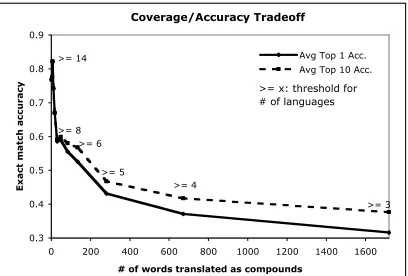
7.1 Coverage/Accuracy Trade off
The number of languages offering a translation hy-pothesis for a given literal English gloss is a use-ful parameter for measuring confidence in the algo-rithm’s selection. The more distinct languages ex-hibiting a translation for the gloss, the higher like-lihood that the majority translation will be correct
Coverage/Accuracy Tradeoff
0.3 0.4 0.5 0.6 0.7 0.8 0.9
0 200 400 600 800 1000 1200 1400 1600
# of words translated as compounds
Exact match accuracy
Avg Top 1 Acc. Avg Top 10 Acc.
>= 8
>= 5
>= 4
>= 3 >= 6
>= 14
>= x: threshold for # of languages
Figure 3:Coverage/Accuracy trade off curve by incrementing the minimum number of languages exhibiting a candidate trans-lation for the source-word’s literal English gloss. Accuracy here is the Top1 accuracy averaged over all 10 test languages.
rather than noise. Varying this parameter yields the coverage/accuracy trade off as shown in Figure 3.
7.2 Varying size of bilingual dictionaries
Figure 4 illustrates how the size of the bilingual dictionaries used for providing cross-language evi-dence affects translation performance. In order to take both coverage and accuracy into account, per-formance measure used was the F-score which is a harmonic average of Precision (the accuracy on the subset of words that could be translated) and Psuedo-recall (which is the correctly translated frac-tion out of total words that could be translated using 100% of the dictionary size). We can see in Figure 4 that increasing the percentage of dictionary size7 al-ways helps without plateauing, suggesting substan-tial extrapolation potensubstan-tial from large dictionaries.
7.3 Greedy vs Random Selection of Utilized Languages
A natural question for our compound translation al-gorithm is how does the choice of additional lan-guages affect performance. We report two experi-ments on this question. A simple experiment is to use bilingual dictionaries of randomly selected lan-guages and test the performance of K-randomly se-lected languages8, incrementing K until it is the full set of 50 languages. The dashed lines in Figures 5
7
Each run of choosing a percentage of dictionary size was averaged over 10 runs
8
[image:6.612.80.292.447.552.2]0 0.05 0.1 0.15 0.2 0.25 0.3 0.35
0 10 20 30 40 50 60 70 80 90 100
% of dictionary used
F- score
[image:7.612.88.293.91.235.2]Top 1 Top 10
Figure 4: F-measure performance given varying sizes of the bilingual dictionaries used for cross-language evidence (as a percentage of words randomly utilized from each dictionary).
0 0.02 0.04 0.06 0.08 0.1 0.12 0.14 0.16 0.18 0.2
0 10 20 30 40 50
# of languages utilized (K)
F-score (Top 1)
[image:7.612.88.293.309.450.2]K-Random K-Greedy
Figure 5: Top-1 match F-score performance utilizing K guages for cross-language evidence, for both a random K lan-guages and greedy selection of the most effective K lanlan-guages (typically the closest or largest dictionaries)
0 0.05 0.1 0.15 0.2 0.25 0.3 0.35
0 10 20 30 40 50
# of languages utilized (K)
F-score (Top 10)
K-Random K-Greedy
Figure 6: The performance relationship detailed in Figure 5 caption for Top-10 match F-score.
and 6 show this trend. The performance is measured by F-score as in section 7.1, where Pseudo-Recall here is the fraction of correct candidates out of the total candidates that could be translated had we used bilingual dictionaries of all the languages. We can see that adding random bilingual dictionaries helps improve the performance in a close to linear fashion. Furthermore, we observe that certain contributing languages are much more effective than others (e.g. Arabic/Farsi vs. Arabic/Czech). We use a greedy heuristic for ranking an additional cross-language, that is the number of test words for which the correct English translation can be provided by the bilingual dictionary of the respective cross-language. Figures 5 and 6 show that greedy selection of the most ef-fective K utilized languages using this heuristic sub-stantially accelerates performance. In fact, beyond the best 10 languages, performance plateaus and ac-tually decreases slightly, indicating that increased noise is outweighing increased coverage.
Albanian Arabic
Russian 0.067 0.116 Farsi 0.051 0.090 +Spanish 0.100 0.169 +Spanish 0.059 0.111 +Bulgarian 0.119 0.201 +French 0.077 0.138
Bulgarian Czech
Russian 0.186 0.294 Slovak 0.177 0.289 +Hungarian 0.190 0.319 +Russian 0.222 0.368 +Swedish 0.203 0.339 +Hungarian 0.235 0.407
Farsi German
Arabic 0.031 0.047 Dutch 0.130 0.228 +Dutch 0.038 0.070 +Swedish 0.191 0.316 +Spanish 0.044 0.079 +Hungarian 0.204 0.355
Hungarian Russian
Swedish 0.073 0.108 Bulgarian 0.185 0.250 +Dutch 0.103 0.158 +Hungarian 0.199 0.292 +German 0.117 0.182 +Swedish 0.216 0.319
Slovak Swedish
[image:7.612.314.553.355.558.2]Czech 0.145 0.218 German 0.120 0.188 +Russian 0.168 0.280 +Hungarian 0.152 0.264 +Hungarian 0.176 0.300 +Dutch 0.182 0.309
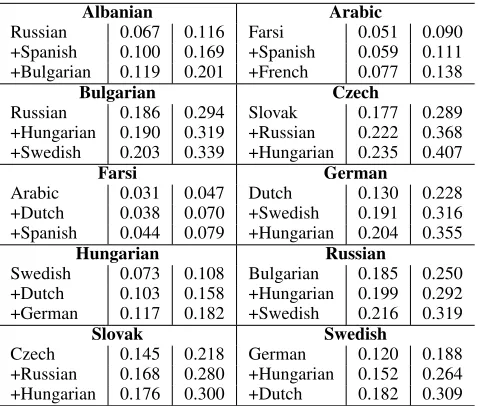
Table 9:Illustrating 3-best cross-languages obtained for each test language (shown in bold). Each row shows the effect of adding the respective cross-language to the set of languages in the rows above it and the corresponding F-scores (Top 1 and Top 10) achieved.
7.4 Languages found using Greedy selection
[image:7.612.89.294.535.675.2]effective for the test language German, and Slovak is most effective for Czech. We can also see interest-ing symmetries between related languages, for ex-ample: Farsi is the top language used for test lan-guage Arabic and vice-versa. Such symmetries can also be seen for other pairs of related languages such as (Czech, Slovak) and (Russian, Bulgarian). Thus, related languages are most helpful and they can be related in several ways such as etymologically, cul-turally and physically (such as Hungarian contact with the Germanic languages). The second point to note is that languages having large dictionaries also tend to be especially helpful, even when un-related. This can be seen by the presence of Hun-garian in top three cross-languages for most of the test languages. This is likely because Hungarian was one of the largest dictionaries and hence can provide good coverage for obtaining translation candidates of rarer or technical compounds, which may have more language universal literal glosses.
8 Conclusion
This paper has shown that successful translation of compounds can be achieved without the need for bilingual training text, by modeling the map-ping of literal component-word glosses (e.g. “iron-path”) into fluent English (e.g. “railway”) across multiple languages. An interesting property of us-ing such cross-language evidence is that one does need to restrict the candidate translations to compo-sitional (or “glossy”) translations, as our model al-lows the successful generation of more fluent non-compositional translations. We further show im-proved performance by adding component-sequence and learned-morphology models along with context similarity from monolingual text and optional com-bination with traditional bilingual-text-based trans-lation discovery. These models show consistent per-formance gains across 10 diverse test languages.
9 Acknowledgments
We thank Chris Callison-Burch for providing access to phrase tables and giving valuable comments on this work as well as suggesting useful additional ex-periments. We also thank Markus Dreyer for helping with German examples and David Smith for giving valuable comments on initial version of the paper.
References
T. Baldwin and T. Tanaka. 2004. Translation by Machine of Complex Nominals: Getting it Right. Proceedings
of the ACL-2004 Workshop on Multiword Expressions,
pages 24–31.
R.D. Brown. 2002. Corpus-driven splitting of compound words. Proceedings of TMI-2002.
Y. Cao and H. Li. 2002. Base Noun Phrase translation using web data and the EM algorithm. Proceedings of
COLING-Volume 1, pages 1–7.
G. Grefenstette. 1999. The World Wide Web as a Re-source for Example-Based Machine Translation Tasks. In ASLIB’99 Translating and the Computer 21. P. Koehn and K. Knight. 2003. Empirical methods for
compound splitting. Proceedings of the EACL-Volume 1, pages 187–193.
P. Koehn, H. Hoang, A. Birch, C. Callison-Burch, M. Federico, N. Bertoldi, B. Cowan, W. Shen, C. Moran, R. Zens, et al. 2007. Moses: Open source toolkit for statistical machine translation. Proceedings
of ACL, companion volume, pages 177–180.
P. Koehn. 2005. Europarl: A parallel corpus for statisti-cal machine translation. MT Summit X.
J.N. Levi. 1978. The Syntax and Semantics of Complex
Nominals.
R. Navigli, P. Velardi, and A. Gangemi. 2003. Ontology learning and its application to automated terminology translation.Intelligent Systems, IEEE, 18(1):22–31. U. Rackow, I. Dagan, and U. Schwall. 1992.
Auto-matic translation of noun compounds. Proceedings of
COLING-Volume 4, pages 1249–1253.
R. Rapp. 1999. Automatic identification of word trans-lations from unrelated English and German corpora.
Proceedings of ACL, pages 519–526.
C. Schafer and D. Yarowsky. 2002. Inducing translation lexicons via diverse similarity measures and bridge languages. Proceedings of COLING, pages 1–7. C. Schafer and D. Yarowsky. 2004. Exploiting aggregate
properties of bilingual dictionaries for distinguishing senses of English words and inducing English sense clusters. Proceedings of ACL-2004, pages 118–121.
T. Tanaka and T. Baldwin. 2003. Noun-Noun Compound Machine Translation: A Feasibility Study on Shallow Processing. Proceedings of the ACL-2003 Workshop
on Multiword Expressions, pages 17–24.
J. Zhang, J. Gao, and M. Zhou. 2000. Extraction of Chinese compound words: an experimental study on a very large corpus. Proceedings of the Second
Work-shop on Chinese Language Processing, pages 132–