INFECTED FRUIT PART DETECTION USING CLUSTERING
*Dr. Indra Gandhi
Department of Computer Science, Mother Teresa Women’s University,
ARTICLE INFO ABSTRACT
Nowadays, overseas commerce has increased drastically in many countries. Plenty fruits are imported from the other nations.
paper presents defect segmentation of fruits based on surface color features with unsupervised K Means clustering and Fuzzy C
defective fruits are pre
remove noise. The images are then segmented with the purpose of separating the defects from the edible regions using proposed clustering algorithms.
Segmentation. Defect segmentation is carried out into two stages. At first, the pixels are clustered based on their color and spatial features, where the clustering process is accomplished. Then the clustered bloc
study and
effectiveness of proposed
and computational time. The simulation results reveal that the proposed approach is promising.
Copyright © 2015 Dr. Indra Gandhi and Pandiyammal.
unrestricted use, distribution, and reproduction in any medium, provided the original work is properly cited.
INTRODUCTION
Image segmentation is one of the key techniques in image understanding and computer vision. The task of image segmentation is to divide an image into a number of non overlapping regions, which have same characteristics such as gray level, color, tone, texture, etc. A lot of clustering based methods have been proposed for image segmentation. Image segmentation methods are generally based on one of two fundamental properties of the intensity values of image pixels: similarity, where the image is partitioned into regions that are similar according to a set of predefined criteria, and discontinuity, where the image is partitioned based on sharp changes in intensity values. Based on the discontinuity or similarity criteria, many segmentation metho
introduced which can be broadly classified into six categories: i) Histogram based method, ii) Edge Detection, iii) Neural Network based segmentation methods, iv)
based approach, v) Region based methods (Region splitting, Region growing and merging), vi) Clustering (Fuzzy C clustering and K-Means clustering). Quality assessment of fruits and vegetables is done based on the analysis of external feature like color, size, shape, texture and presence of damage. As consumers are mostly influenced to choose or reject a particular fruit by its color, it is the most important attribute for assessing the quality of fruits.
*Corresponding author: Dr. Indra Gandhi, M. P
Department of Computer Science, Mother Teresa Women’s University, Kodaikanal-624101, India.
ISSN: 0975-833X
Article History:
Received 14th December, 2014
Received in revised form
06th January, 2015
Accepted 28th February, 2015
Published online 31st March,2015
Key words:
Image Segmentation, Clustering, Histogram, Filtering, Fruit Images, K-means,
Fuzzy C-Means (FCM).
RESEARCH ARTICLE
INFECTED FRUIT PART DETECTION USING CLUSTERING
*Dr. Indra Gandhi, M. P. and Andiyammal, P.P.
Department of Computer Science, Mother Teresa Women’s University, Kodaikanal
ABSTRACT
Nowadays, overseas commerce has increased drastically in many countries. Plenty fruits are imported from the other nations. Manual identification of defected fruit is very time consuming.
paper presents defect segmentation of fruits based on surface color features with unsupervised K Means clustering and Fuzzy C-Means algorithms. As the first step, the digital colo
defective fruits are pre-processed using Gaussian low-pass filter (GLPF) smoothing operator to remove noise. The images are then segmented with the purpose of separating the defects from the edible regions using proposed clustering algorithms. We used color images of fruits for Defect Segmentation. Defect segmentation is carried out into two stages. At first, the pixels are clustered based on their color and spatial features, where the clustering process is accomplished. Then the clustered blocks are merged to a specific number of regions. We have taken three fruits as a case study and evaluated the proposed approach using defected fruits. The
effectiveness of proposed approach to improve the defect segmentation
and computational time. The simulation results reveal that the proposed approach is promising.
. This is an open access article distributed under the Creative Commons Att use, distribution, and reproduction in any medium, provided the original work is properly cited.
Image segmentation is one of the key techniques in image understanding and computer vision. The task of image segmentation is to divide an image into a number of non overlapping regions, which have same characteristics such as olor, tone, texture, etc. A lot of clustering based methods have been proposed for image segmentation. Image segmentation methods are generally based on one of two fundamental properties of the intensity values of image pixels: is partitioned into regions that are similar according to a set of predefined criteria, and discontinuity, where the image is partitioned based on sharp changes in intensity values. Based on the discontinuity or similarity criteria, many segmentation methods have been introduced which can be broadly classified into six categories: i) Histogram based method, ii) Edge Detection, iii) Neural Network based segmentation methods, iv) Physical Model Region based methods (Region splitting, growing and merging), vi) Clustering (Fuzzy C-means Quality assessment of fruits and vegetables is done based on the analysis of external feature like color, size, shape, texture and presence of damage. mostly influenced to choose or reject a particular fruit by its color, it is the most important attribute for
Dr. Indra Gandhi, M. P.,
Department of Computer Science, Mother Teresa Women’s
The most widely used color spaces in computers and digital images are RGB, HSI and L*a*b*. In RGB the color of a pixel in image is expressed as three coordinates of primary colors red, green and blue in a color space.
which is closer to the human perception of color, like the hue, saturation and intensity. However, RGB and HSI are non uniform color spaces and hence uniform color space like L*a*b* is used to implement the proposed algorithms. The defect segmentation of fruits based on surface color feature can be considered as an instance of image segmentation where we are segmenting only the defective portion of the fruit. Image segmentation is the process of partitioning the image into several constituent components. It partitions the digital image into disjoint (non-overlapping) regions. Segmentation is an essential step in computer vision and automatic pattern recognition processes based on image analysis of foods as subsequent extracted data are highly dependent on the accuracy of this operation. This paper presents an efficient image segmentation approach using K
clustering technique based on color features from the images of the fruits. Defect segmentation is carried ou
At first, the pixels are clustered based on their color and spatial features, where the clustering process is accomplished. Then the clustered blocks are merged to a specific number of regions. Using this two step procedure, it is possib
the computational efficiency avoiding feature extraction for every pixel in the image of fruits. Although the color is not commonly used for defect segmentation, it produces a high discriminative power for different regions of the image.
International Journal of Current Research
Vol. 7, Issue, 03, pp.13866-13871, March, 2015
INTERNATIONAL
INFECTED FRUIT PART DETECTION USING CLUSTERING
Kodaikanal-624101, India
Nowadays, overseas commerce has increased drastically in many countries. Plenty fruits are imported Manual identification of defected fruit is very time consuming. The proposed paper presents defect segmentation of fruits based on surface color features with unsupervised
K-Means algorithms. As the first step, the digital color images of pass filter (GLPF) smoothing operator to remove noise. The images are then segmented with the purpose of separating the defects from the We used color images of fruits for Defect Segmentation. Defect segmentation is carried out into two stages. At first, the pixels are clustered based on their color and spatial features, where the clustering process is accomplished. Then the ks are merged to a specific number of regions. We have taken three fruits as a case evaluated the proposed approach using defected fruits. The experimental results clarify the approach to improve the defect segmentation quality in aspects of precision and computational time. The simulation results reveal that the proposed approach is promising.
is an open access article distributed under the Creative Commons Attribution License, which permits
The most widely used color spaces in computers and digital images are RGB, HSI and L*a*b*. In RGB the color of a pixel expressed as three coordinates of primary colors red, green and blue in a color space. HIS is the color space which is closer to the human perception of color, like the hue, saturation and intensity. However, RGB and HSI are non-uniform color spaces and hence non-uniform color space like L*a*b* is used to implement the proposed algorithms. The defect segmentation of fruits based on surface color feature can be considered as an instance of image segmentation where we are segmenting only the defective portion of the fruit. Image segmentation is the process of partitioning the image into nstituent components. It partitions the digital image overlapping) regions. Segmentation is an essential step in computer vision and automatic pattern recognition processes based on image analysis of foods as e highly dependent on the accuracy of this operation. This paper presents an efficient image segmentation approach using K-means and Fuzzy C-means clustering technique based on color features from the images of the fruits. Defect segmentation is carried out into two stages. At first, the pixels are clustered based on their color and spatial features, where the clustering process is accomplished. Then the clustered blocks are merged to a specific number of regions. Using this two step procedure, it is possible to increase the computational efficiency avoiding feature extraction for every pixel in the image of fruits. Although the color is not commonly used for defect segmentation, it produces a high discriminative power for different regions of the image.
Literature survey
In the base paper the author presents defect segmentation of fruits based on surface color features with unsupervised K-Means clustering. As the first step, the digital color images of defective apples are pre-processed using Gaussian low-pass filter (GLPF) smoothing operator to remove noise (Shiv Ram Dubey et al., ?) The efficiency of color image Segmentation may significantly influence the quality of an understanding system (Leemans et al., 2002).
Diseases appear as spots on the fruits and if not treated on time, cause severe losses. Excessive uses of pesticide for fruit disease treatment increases the danger of toxic residue level on agricultural products and has been identified as a major contributor to the ground water contamination (Shiv Ram Dubey et al., ?). Pesticides are also among the highest components in the production cost thus their use must be minimized. Therefore, we have attempted to give an approach which can identify the diseases in the fruits as soon as they produce their symptoms on the growing fruits such that a proper management application can be applied (Mehl et al.,
2002).
Defect segmentation, feature extraction, training and classification are the major tasks to be performed. For the fruit disease identification problem, precise image segmentation is required; otherwise the features of the non-infected region will dominate over the features of the infected region (Shiv Ram Dubey, ?). K-means based defect segmentation is used to detect the region of interest which is the infected part only in the image (Ilea and Whelan, 2006).
There are many approaches of clustering designed for a wide variety of purposes. K-means is a typical clustering algorithm .K-means is generally used to determine the natural groupings of pixels present in an image. It is attractive in practice, because it is straightforward and it is generally very fast. It partitions the input dataset into k clusters. Each cluster is represented by an adaptively changing center (also called cluster center), starting from some initial values named seed-points. K-means clustering computes the distances between the inputs (also called input data points) and centers, and assigns inputs to the nearest center (Suman Tatiraju and Avi Mehta, ?). Read the input image of defective fruit. In order to remove the image noise and reduce detail levels the Gaussian low-pass filter (GLPF) smoothing operator is applied. Then transform the image from RGB to L*a*b* color space as all of the color information is present in thea*and b* layers only.
Finally calculate the histograms of the image to decide the number of clusters. Then Classify colors using K-means clustering in a*b* space, with Euclidean distance to measure the distance between two colors. Authors in (Leemans et al.,
2002), (Borji et al., 2007) have used the concept of k-means clustering for background subtraction. They segmented the region of interest (i.e. foreground) with the background by making two clusters one for foreground and one for background. In the case of fruit diseases more than one disease may be present at a time so we have to use more than two clusters to segment the infected part with fruit and background.
PROPOSED METHODOLOGY
Image Segmentation
Segmentation is generally the first stage in any attempt to analyze or interpret an image automatically. Segmentation bridges the gap between low-level image processing and high-level image processing. Some kinds of segmentation technique will be found in any application involving the detection, recognition, and measurement of objects in images.
Clustering
Clustering is one of the widely used image segmentation techniques which classify patterns in such a way that samples of the same group are more similar to one another than samples belonging to different groups. There has been considerable interest recently in the use of fuzzy clustering methods, which retain more information from the original image than hard clustering methods.
Histogram
Histogram is a plot between number of pixel and pixel intensity. To plot the histogram, bar graph can be used. The histogram code operates by first reading the greyscale value at the first entry and coming up with pixel intensity between 0 and 255. In scientific experiments, histograms are useful in characterizing the spread of data from repeated trials and for determining the probability of given measurement.
K-Means Clustering Algorithm
K-means method is an unsupervised clustering method that classifies the input data objects into multiple classes on the basis of their inherent distance from each other .Clustering algorithm assumes that a vector space is formed from the data features and tries to identify natural clustering in them. The objects are clustered around the centroids ii = 1.
⋁ = ∑ ∑ ( −µ)
€
2
Where k is the number of clusters i.e. Si, i = 1, 2 , . . . , k and i
is the mean point or centroid of all the points xj Si.
Fuzzy C-means Algorithm
∑uij 1,∀j 1,...., n
i 1
The dissimilarity function used in FCM is given by,
c c n
J (U , c1, c2,....,cc)∑ J i ∑∑uij m
d ij
2
i 1 i 1 j 1
Uij is between 0 and 1;
Cij is the centroid of cluster i;
Defect Segmentation
Read the input image of defective fruit.In order to remove the image noise and reduce detail levels the Gaussian low-pass filter(GLPF) smoothing operator is applied. Then calculate the histograms of the image to decide the number of clusters. Classify pixel intensities using FCM algorithm (initial value of
m = 2 and ε = 0.01) with number of clusters as determined. Finally Generate image by allocating different intensity levels for each subclass of the image.
RESLUTS AND DISCUSSION
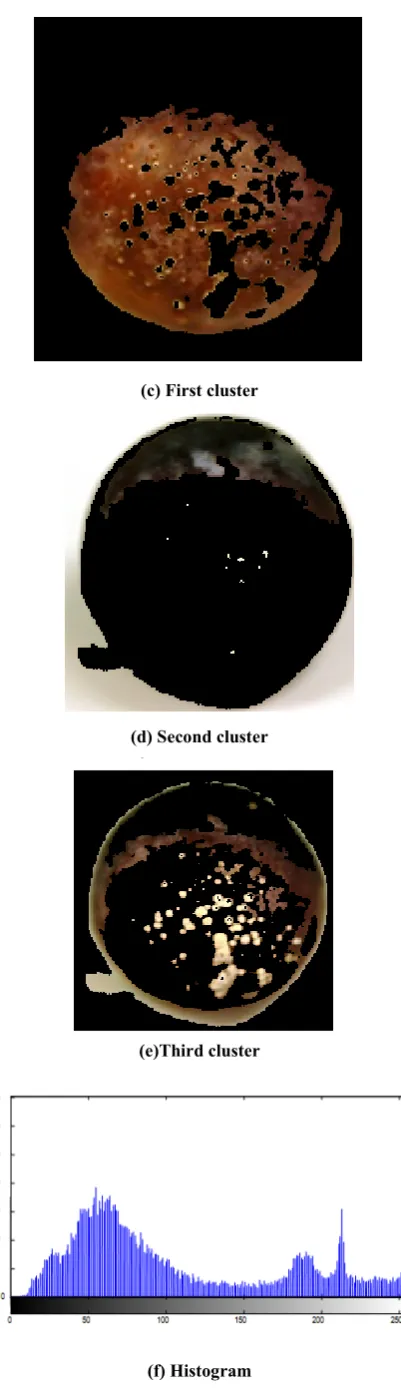
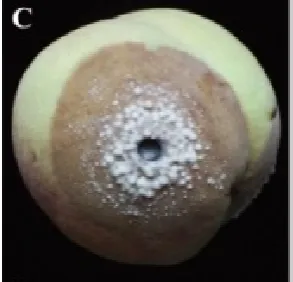
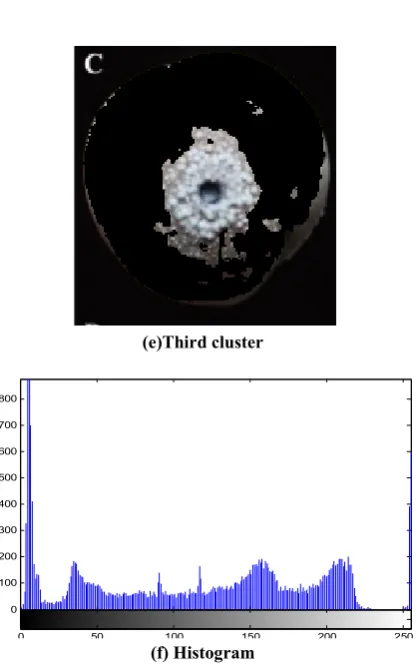
We have segmented the input image into three clusters depending on the data provided by the histogram shown in Fig.1. (f), Fig. 2(f) and Fig. 3(f). Fig. 2(a), Fig. 3(a) and Fig. 4(a) show the preprocessed image filtered by Gaussian low-pass filter smoothing operator. Among the images in different clusters second cluster correctly segments the defective portion of the image whereas the first cluster demonstrates the non-defective part of the fruit. Fig. 4. Fig. 5. and Fig. 6. illustrate the resultant images obtained from FCM.
(a) Original image
(b) Image cluster index
(c) First cluster
(d) Second cluster
(e)Third cluster
[image:3.595.334.535.48.746.2](f) Histogram
Fig. 1. K-means defect segmentation of plums
objects in cluster 2
[image:3.595.350.518.54.437.2](a)Original image
(b)Image cluster index
(c) First cluster
(d) Second cluster
(e)Third cluster
[image:4.595.361.508.410.551.2](f) Histogram
Fig. 2. K-means defect segmentation of pear
(a) Original image
(b) Image cluster index
0 50 100 150 200 250 300 350 400 450 500
(c) First cluster
(d) Second cluster
(e)Third cluster
[image:5.595.315.556.58.199.2](f) Histogram
Fig. 3. K-means defect segmentation of peach
(a)Original image (b) FCM Processed Image
Fig.4. Fuzzy C-means defect segmentation of plums
[image:5.595.329.543.226.394.2]
(a)Original image (b)FCM Processed Image
Fig. 5. Fuzzy C-means defect segmentation of pear
[image:5.595.62.272.370.704.2](a) Original image (b) FCM Processed Image
Fig. 6. Fuzzy C-means defect segmentation of peach
The amount of defect in a given sample using K-Means and FCM clustering is tabulated in Table 1. FCM, being unsupervised fuzzy clustering algorithm, is motivated by the need to find interesting patterns or groupings in a given set of data. The cluster allocation in FCM is based on the high membership value and less on distance.
0 100 200 300 400 500 600 700 800
[image:5.595.308.549.424.568.2]0 50 100 150 200 250
Table 1. Amount of Defect in Selected Fruit Samples
S. Data K-Means FCM
No. Sample
1 Plums 70% 62%
2 Pear 54% 30%
3 Peach 20% 19%
[image:5.595.319.544.621.670.2]Conclusion
The automated inspection of agricultural products, fruits in particular, is an important processas it reduces human interaction with the inspected goods, classify generally faster than humans and tend to be more consistent in classification. The segmentation of defects in fruits is proposed and evaluated in this paper. The proposed approach used K-Means clustering and Fuzzy C-Means clustering to segment defects in different types of fruit images. Experimental results suggest that the algorithms are able to segment the defects 93% accuracy. The major drawback of K-Means is that, there may be a skewed clustering result if the cluster number estimate is incorrect. It is overcome to certain extent in the proposed method by determining the number of clusters using the histogram of the image. The image is also pre-processed to remove noise.
Future enhancement
This program can be improved to modify images with various fruit images, to provide complete error free image.
REFERENCES
Borji A. Hamidi, M. and Moghadam, A. M. E. 2007. “CLPSO-based Fuzzy Color Image Segmentation”, in Proceedings of the North American Fuzzy Information Processing Society, pp. 508-513.
Chattopadhyay, S., Pratihar, D.K. and De Sarkar, S.C. 2011. “A Comparative Study of Fuzzy C-means Algorithm and Entropy-based Fuzzy Clustering Algorithms”, Computing
and Informatics, Vol. 30, 701–720.
Ilea, D. E. and Whelan, P. F. 2006. “Color Image Segmentation using a Spatial K-means Clustering Algorithm,” inProceedings of the Irish Machine Vision & Image ProcessingConference 2006 (IMVIP 2006),Dublin City University, pp. 146–53.
Leemans V., Mageinb, H. Destain, M.F. 2002. “On-line Fruit Grading according to their External Quality using Machine Vision”, Biosystems Engineering, 83 (4), 397–404
Mehl, P.M., Chao, K. Kim, M. Chen, Y. R. 2002. “Detection of Defects on Selected apple Cultivars using Hyperspectral and Multispectral Image Analysis” Applied Engineering in Agriculture American Society of Agricultural Engineers,
ISSN 0883–8542, Vol. 18(2) 219–226:
Shiv Ram Dubey, GLA University Mathura, India Anand Singh Jalal, GLA University Mathura, India , “Adapted Approach for Fruit Disease Identification using Images”. Shiv Ram Dubey, Pushkar Dixit, Nishant Singh and Jay
Prakash Gupta, “Infected Fruit Part Detection using K-Means Clustering Segmentation Technique”, International
Journal of Artificial Intelligence and Interactive
Multimedia, Vol. 2, NO. 2.
Suman Tatiraju, Avi Mehta, “Image Segmentation using K-means Clustering, EM and Normalized Cuts.”
VaniAshok1, Dr. Vinod2, D.S. 2014. “Using K-means Cluster and Fuzzy C-means for Defect Segmentation in Fruits”,
International Journal of Computer Engineering and
Technology (IJCET), Volume 5, issue 9, September, pp.
11-191.