THE USE SCREENING SCALES TO APPROACH OF PUERPERAL POSTPARTUM
DEPRESSION: A SYSTEMATIC REVIEW
Maria Erbenia Soares de Freitas
University Anhanguera of Guarulhos,
ARTICLE INFO ABSTRACT
This systematic review aims to identify scientific publications Postpartum Depression (PPD) applied until sixth month after systematic review was conducted using PubMed, LILASC, M (Preferred Reporting Items for Systematic Reviews and Meta keywords: Postpartum Depression,
resulted in 55 articles that were sc
research observed it most articles discuss the importance of early screening and the relationship between anxiety, maternal availability and PPD.
Copyright © 2015 Maria Erbenia Soares de Freitaset al.
permits unrestricted use, distribution, and reproduction in any medium, provided the original work is properly cited.
INTRODUCTION
The psychiatric disorder can to occur on any phase of life, and the vulnerability can be sharp by substantial event. puerperal period represent the important phase of life women’s, is in this moment que occurring the biologics and psychology changes, expanding the risks to development of mental diseases. Consequently, this puerperal period is described as the moment that the feelings, perspectives and experiences tend to cause an emotional imbalance
et al., 2015). This psychiatric syndrome can occur on life women’s soon after the partum or during the period up to one year after the birth of her son. The most common are the postpartum melancholic (Postpartum blues), may vary among 30% to 90% of mothers; the postpartum psychosis have lower prevalence, to happen only of 1% to 2% of cases; and the postpartum depression (PPD), that occur among 18% to 39,4% (Yawn et al., 2012). The PPD can be described as the mental disorder that causes changes in some aspects like the cognitive, emotional, physical and behavior (Sockola
etiology although not fully known, studies indicated to have multifactorial causes, soon, it isn’t caused to isolated reasons, the women needs be exposed to risks factors for develop pathology.
*Corresponding author: Luciene Rodrigues Barbosa
University Anhanguera of Guarulhos, Guarulhos, Brazil
ISSN: 0975-833X
Article History:
Received 20th July, 2015
Received in revised form
11th August, 2015
Accepted 27th September, 2015
Published online 31st October,2015
Key words:
Postpartum depression, Brief psychiatric
rating scale, Maternal depression, Screening tools.
Citation: Maria Erbenia Soares de Freitas, Fagner Pereira da Silva and approach of puerperal postpartum depression: A systematic review
RESEARCH ARTICLE
THE USE SCREENING SCALES TO APPROACH OF PUERPERAL POSTPARTUM
DEPRESSION: A SYSTEMATIC REVIEW
Freitas, Fagner Pereira da Silva and *Luciene Rodrigues Barbosa
University Anhanguera of Guarulhos, Guarulhos, Brazil
ABSTRACT
This systematic review aims to identify scientific publications addressing the use screening scales partum Depression (PPD) applied until sixth month after postpartum
systematic review was conducted using PubMed, LILASC, MEDLINE and the PRISMA guidelines (Preferred Reporting Items for Systematic Reviews and Meta
keywords: Postpartum Depression, Brief psychiatric rating scale
resulted in 55 articles that were screened by title and abstract, these 09 articles were analyzed. In this research observed it most articles discuss the importance of early screening and the relationship between anxiety, maternal availability and PPD.
et al. This is an open access article distributed under the Creative Commons Att use, distribution, and reproduction in any medium, provided the original work is properly cited.
The psychiatric disorder can to occur on any phase of life, and the vulnerability can be sharp by substantial event. The puerperal period represent the important phase of life women’s, is in this moment que occurring the biologics and psychology changes, expanding the risks to development of mental diseases. Consequently, this puerperal period is that the feelings, perspectives and experiences tend to cause an emotional imbalance (Hartley
can occur on life women’s soon after the partum or during the period up to one year after the birth of her son. The most common are the postpartum melancholic (Postpartum blues), may vary among psychosis have lower prevalence, to happen only of 1% to 2% of cases; and the postpartum depression (PPD), that occur among 18% to 39,4% The PPD can be described as the mental er that causes changes in some aspects like the cognitive, (Sockola et al., 2012), it etiology although not fully known, studies indicated to have multifactorial causes, soon, it isn’t caused to isolated reasons, ed to risks factors for develop the
Rodrigues Barbosa,
University Anhanguera of Guarulhos, Guarulhos, Brazil
Among them can mention the socioeconomic factors (low income, unemployment, low level of education); the social factors (family and/or marital relationship conflict, lack of support in daily activities); obstetrics factors (pregnancy complications, risk of birth complications or postpartum compared to the baby or puerperal) and emotional factors (experienced moments of stress during the pregnancy, unwanted pregnancy, domestic violence)
The variable clinical situation, may present irritability, demotivation, lack of motivation, lack of sex drive, inability to deal with new situations, insomnia or hypersomnia, unwillingness to perform daily tasks, gain or weight gain, reasoning deficit, the woman feels guilty, sad and abandoned (Santos Júnior, Silveira, and Gualda 2009)
cases, the mother may present obsession or detachment from the baby and fear cause you some damage, This condition can be worsened by the presence of other mental disorders as panic and anxiety disorders, which end up hindering the prognosis (Yawn et al., 2012).
Although the depression symptoms be evident, often, is confused as “fatigue and physical stress” typical this puerperal phase, where the woman is overloaded by accumulation of new functions (Ventevogel et al.,
Further all this physical changes, there is a certain burden of cultural charges, of family, of society and even the woman to International Journal of Current Research
Vol. 7, Issue, 10, pp.21735-21740, October, 2015
INTERNATIONAL
Fagner Pereira da Silva and Luciene Rodrigues Barbosa, 2015. “ approach of puerperal postpartum depression: A systematic review”, International Journal of Current Research
THE USE SCREENING SCALES TO APPROACH OF PUERPERAL POSTPARTUM
Luciene Rodrigues Barbosa
addressing the use screening scales postpartum in mothers over 15 years. A
EDLINE and the PRISMA guidelines (Preferred Reporting Items for Systematic Reviews and Meta-Analyses), using the following Brief psychiatric rating scale, Maternal Depression. The search reened by title and abstract, these 09 articles were analyzed. In this research observed it most articles discuss the importance of early screening and the relationship
is an open access article distributed under the Creative Commons Attribution License, which
Among them can mention the socioeconomic factors (low income, unemployment, low level of education); the social factors (family and/or marital relationship conflict, lack of support in daily activities); obstetrics factors (pregnancy birth complications or postpartum compared to the baby or puerperal) and emotional factors (experienced moments of stress during the pregnancy, unwanted pregnancy, domestic violence) (Hou et al., 2014).
The variable clinical situation, may present irritability, , lack of motivation, lack of sex drive, inability to deal with new situations, insomnia or hypersomnia, unwillingness to perform daily tasks, gain or weight gain, reasoning deficit, the woman feels guilty, sad and abandoned (Santos Júnior, Silveira, and Gualda 2009). In more severe e mother may present obsession or detachment from the baby and fear cause you some damage, This condition can be worsened by the presence of other mental disorders as panic and anxiety disorders, which end up hindering the prognosis
Although the depression symptoms be evident, often, is confused as “fatigue and physical stress” typical this puerperal phase, where the woman is overloaded by accumulation of new 2007; Sockola et al., 2011). Further all this physical changes, there is a certain burden of cultural charges, of family, of society and even the woman to
INTERNATIONAL JOURNAL OF CURRENT RESEARCH
herself to play her maternal role in an exemplary manner, without fail, leaving the postpartum psychological further weakened.
The PPD cause the impact on bond of mother and baby is very significant, because the fact of the disease limit the mother in caring for the baby causes emotional contact, the affection and harmony that exist normally between the mother and baby being compromised, principle the baby can feel the lack of protection and the contact with the mother and express in the form of apathy, irritable and constant crying (Ali et al., 2013). The disease affect very negative way the relationship mother-baby and familiar, front of it, the principle forms that there are to decrease the damage and injuries caused by diseases is clinical evaluation adequate for the screening and early treatment (Ali et al., 2013).
The realization of early diagnostic , associated to treatment, pharmacological, therapeutic and family support, are able to promote a better control of the disease, and to prevent major repercussions in the life of this woman (Hartley et al., 2015). However, the PPD diagnosis is very difficult (Drake et al. 2012), because there isn’t consensus about the etiology or treatment of disease.
On clinical practice although there many tools able to realize the detection of postpartum depression, in Brazil due to ignorance of some health professionals about the use of scales to depression, by its size or time to be complete it tend to be little used, being restricted scientific research (Figueira et al., 2009).In primary attention the qualified hearing by nurse or other health professional during the puerperal consultation, is the most importance, because in this moment that is collected informations that will to identify if the woman present a clinical situation stable, behavior changes (Figueira et al., 2009). This proximity may enable the use of specifics scales to PPD that could help on diagnosis of disease through the symptoms identification.
Nowadays there are many scales to screening of depression validated to Portuguese, however, the evaluated of symptoms depend of category of symptoms elected on tool. For example, social behavior (apathy, withdrawal), somatic symptoms (changes in sleep, appetite and weight), motor signs (inhibition, restlessness), mood (sadness, crying spells or laughter), cognitive (ideation of guilt and suicide), irritability (hostility, self-harm) and anxiety (psychic, phobic, somatic). This categories aren’t presented all in a only scale, consequently the researcher must choose the category that are important and what scale is the best to the search (Yawn et al., 2012).
Studies realized to screening of postpartum depression have been used the followings scales: Edinburgh Depression Postpartum Scale (EDPS), Self-Report Questinnaire 20 (SRQ-20), Postpartum Depression Screening Scale (PDSS) and Aga Khan University Anxiety and depression Scale (AKUADS) Hopkins Symptom Check List (SCL-25), this scales have different category of symptoms and numbers of questions (Zhao et al., 2015; Takahashi and Tamakoshi 2014). Considered the high prevalence of PPD and the relevance of
early diagnosis of PPS, the objective of this study was to systematic review aims to identify scientific publications addressing the use screening scales Postpartum Depression (PPD) applied until sixth month after postpartum in mothers over 15 years.
MATERIALS AND METHODS
This is an exploratory systematic review study performed through critical analysis of articles. A planned thorough review aims to summarize the original research highlighting its relevant issues. It uses a clear method to identify, select and describe the studies quality, data collection and analysis (Mendes, Karina dal Sasso, Renata Cristina de Campos Pereira, and Galvão 2008).
To start the study, the following guiding question was made: "What has scientific literature presented on the Postpartum depression screening scales?"
The search and selection of open-access indexed scientific articles were conducted in national and international databases, as follows: PubMed (Public Medline), LILACS (Latina-American and Caribean System on Health Sciences Information) and MEDLINE (Medical Literature Analysis and Retrieval System Online). The search was focused on articles published in January 2008 till the final search that was conducted on December 2014.
Guidelines Systematic Review
Assessment of the scientific articles it was used PRISMA guidelines for methodology (Moher D, Liberati A, Tetzlaff J 2009). PRISMA is the often used methodology in systematic reviews for enhancing the clarity the quality of the systematic review (Fleming, Koletsi, and Pandis 2014).
Identification and Screening
To select the articles, inclusion and exclusion criteria were established and a thorough analysis of the articles quality was performed to ensure the reliability of selected literature, thus allowing increasing the study accuracy.
Eligibility
The following Descriptors Health Sciences (DeCS) and Medical Subject Headings (MeSH) descriptors were established to check the quality of scientific publications. As a strategy to gather the articles, the first descriptor was crossed with the second, and subsequently, the descriptors mentioned earlier were crossed with the third. The selected articles were analyzed by two reviewers who judiciously and independently read the resume/ resumen/abstract of the relevant materials in order to identify articles fulfilling the inclusion criteria established for this review. Table 1 provides an overview of the literature search.
RESULTS
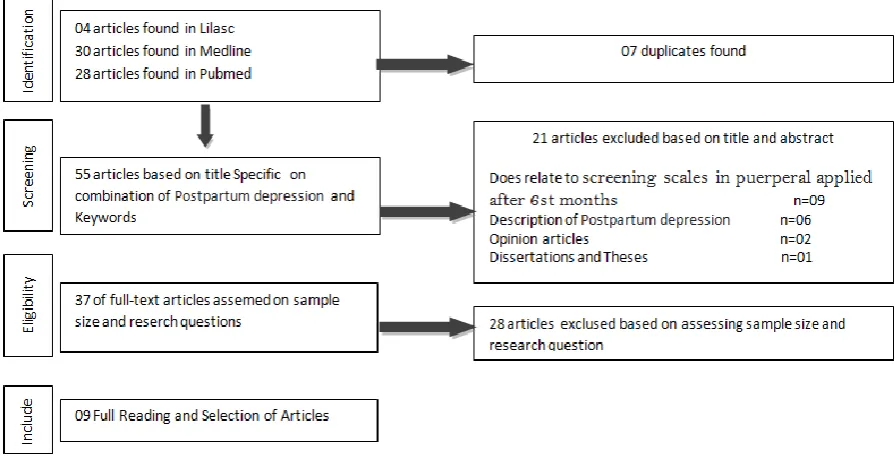
Thus, a total of 55 articles were identified. All articles that didn’t address the proposed theme, whose full version was not available and that were repeated in more than one database were excluded from this review n = 46, thereby forming a sample of (n = 09) articles. The articles selection flow is shown in Figure 1.
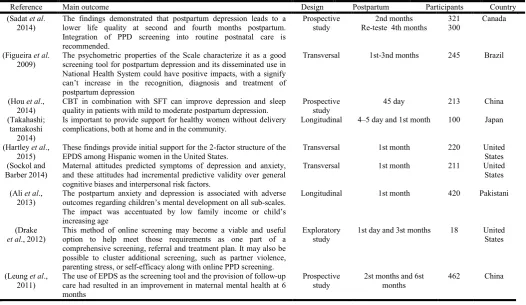
With regard to characterization of selected articles, Chart 1 shows the study distribution by authors, objectives, data collection techniques, final considerations, and journal identification. Overall, it should be noted that the publications that address the use screening scales Postpartum Depression found in public health journal (44,4%), followed by mental health journal (66,6%). Selected articles showed that researches with this theme were mostly conducted in United States (33.3%).
In relation to data collection, one can still observe that 80.1% of the articles used two and three different screening scales to obtain the necessary information. Table 2 provides an overview of the main outcomes per included study.
The screening scales used on studies were applied on mother by health professionals. The relationship to professional contact with patient varied among the studies, however, the most held the interview during the puerperal consultation or home visit. The period of evaluate on immediate postpartum period occurred among 01 day and 6 months postpartum, some test studies and retest that most times was realized after the intervention.
The Table 2 feature the scale used in each study to screening of depression with respective psychometric properties and results found. The PPD prevalence varied of 5,4% to 40%. On studies that realized one more of evaluation, was different on prevalence of first and second evaluate, ranging of 23,4% on first evaluation to 15,6% on second evaluation.
[image:3.595.44.536.78.208.2]This analysis was possible identify other aspects in relation to specimen, as obstetrics information and socioeconomics data (type of partum, age, civil state, among others). This factor is submitted as risks factors to developing of PPD in many studies performed earlier.
Table 1. Type styles Literature search
Literature search Selection for inclusion based on title
PubMed, Lilasc and Medline Search criteria
Articles published 2009 till December 2014
English language.
MeSH terms and DeCS: Postpartum Depression,
Brief psychiatric rating scale, Maternal Depression
Postpartum depression major area of interest + keyword
Obstetrical nursing
Screening
Common mental disorders
Puerperal
Selection for inclusion based on abstract and eligibility phase Inclusion:
Explanatory articles for the relationship between postpartum depression and
screening scales in puerperal.
Available online for free and full texts.
Focused on the study object.
Exclusion:
Describing only concept of postpartum depression.
Opinion articles, Letter to editor, Dissertations and Theses.
[image:3.595.76.524.435.663.2]Related to partum type most realized was the vaginal partum, ranging of 60% to 80%, while the others were described as casarean partum. The primiparous predominate in almost all samples, ranging of 35% to 52%. Some studies feature the primiparous rate bigger than primigravidae due to abortions. On studies that exhibit this variable, the percentage varies of 2,9% to 50%, including historical of abortion in previous pregnancy and unsuccessful attempt during the pregnancy. About the sociodemographic characteristics of sample this studies, the age average of patients varied of 15 to 40 years, predominantly with married woman (stable union and married), ranging of 52% to 90%. The degree of schooling was predominant secondary, ranging of 37% to 45%. The rest of samples including functional illiterates, primary education. The occupation most common was activities home’s, and when
engaged in a remunerated activity the income every exhibit the lower salary range.
DISCUSSION
[image:4.595.36.563.80.385.2]The depressive symptoms of mother can aggravated due the physical conditions resulted of partum, historic obstetrics problem, fear for the health of the child or their own health, bad experience no postpartum, long wait to contact of mother with her baby, domestic violence, socioeconomic conditions, unwanted pregnancy, not live with your partner, previous depression historic (Ali et al., 2013, Sockola et al., 2012). The teenage pregnancy is seen as the factor aggravated to postpartum depression, as teenage well as pregnancy its seen as complex phases, if the instance is concomitant can bring Table 1. Characterization of selected articles for analysis
Reference Main outcome Design Postpartum Participants Country
(Sadat et al.
2014)
The findings demonstrated that postpartum depression leads to a lower life quality at second and fourth months postpartum. Integration of PPD screening into routine postnatal care is recommended.
Prospective study
2nd months Re-teste 4th months
321 300
Canada
(Figueira et al.
2009)
The psychometric properties of the Scale characterize it as a good screening tool for postpartum depression and its disseminated use in National Health System could have positive impacts, with a signify can’t increase in the recognition, diagnosis and treatment of postpartum depression
Transversal 1st-3nd months 245 Brazil
(Hou et al.,
2014)
CBT in combination with SFT can improve depression and sleep quality in patients with mild to moderate postpartum depression.
Prospective study
45 day 213 China
(Takahashi; tamakoshi
2014)
Is important to provide support for healthy women without delivery complications, both at home and in the community.
Longitudinal 4–5 day and 1st month 100 Japan
(Hartley et al.,
2015)
These findings provide initial support for the 2-factor structure of the EPDS among Hispanic women in the United States.
Transversal 1st month 220 United
States (Sockol and
Barber 2014)
Maternal attitudes predicted symptoms of depression and anxiety, and these attitudes had incremental predictive validity over general cognitive biases and interpersonal risk factors.
Transversal 1st month 211 United
States
(Ali et al.,
2013)
The postpartum anxiety and depression is associated with adverse outcomes regarding children’s mental development on all sub-scales. The impact was accentuated by low family income or child’s increasing age
Longitudinal 1st month 420 Pakistani
(Drake
et al., 2012)
This method of online screening may become a viable and useful option to help meet those requirements as one part of a comprehensive screening, referral and treatment plan. It may also be possible to cluster additional screening, such as partner violence, parenting stress, or self-efficacy along with online PPD screening.
Exploratory study
1st day and 3st months 18 United
States
(Leung et al.,
2011)
The use of EPDS as the screening tool and the provision of follow-up care had resulted in an improvement in maternal mental health at 6 months
Prospective study
2st months and 6st months
462 China
Table 2. The scale used in each study to screening of depression with respective psychometric properties and results found
Reference Screening Ponto de Corte Results
(Sadat et al., 2014) EPDS ≥ 13 PPD 2nd months = 75 (23.4 %)
PPD 4th months= 47 (15.6 %)
(Figueira et al., 2009) EPDS >10 PPD= 26,9%
(Hou et al., 2014) EPDS > 12 PPD before intervention=33,8%
PPD after intervention= 28,9%
(Takahashi andTamakoshi 2014) EPDS ≥9 PPD= 10%
(Hartley et al., 2015) EPDS ≥ 13 PPD English =6.6 (5.1%)
PPD Spanish=5.4 (4.8%)
(Sockol and Barber 2014) EPDS > 12 PPD
(Ali et al., 2013) AKUADS >16 PPD 1st months= 4.8%
PPD 2nd months= 4.7%
(Drake et al., 2012) EPDS > 13 PPD=1%
(Leung et al., 2011) EPDS >10 PPD 2nd months= 29,6%
PPD 6st months= 35%
[image:4.595.82.495.414.556.2]significant changes in the pregnant adolescent routine, be it in relation to the family, at school or with internal conflicts (Sockola et al., 2012). Front this situation is evident that the teenage depression becomes a critical moment, for immature effectively, leave early the studies; further to leave for second plan the friends and fun. The teenage is considered hard, to be the phase of physical and psychological changes, the pregnancy during this period can aggravated the emotional state of women leaving most vulnerable to PPD.
The anxiety although not be cited on most articles, also is considered as the worrying factor, because the its and depression normally walk together, there is some distress disproportionate in relation to the development and health of the baby, the mother think that will be unable to care of baby, this way just getting worse the depression (Hou et al., 2014). The anxiety is considered normal on pregnancy period if no exaggerated or persistent, otherwise it may be synonymous with depression and extend until the postpartum period.
Among all risks factors collaborate to postpartum depression, the lack of social support is that more influence, being considered the factor principle by authors. It is Understood as social support , the emotional and practice support of peoples nearest of women during the pregnancy and postpartum, offer companionship, affect and assistance of daily activities enabling best interaction of mother and child, doing love her, protected and valued (Karadağ et al., 2015)
The paternal role also is addressed on literature as the risk factor as well of protection to mental health women. The relation between the postpartum and difficult marital relationship have been widely studied. When the child born, because the more impact on life women’s than the men, the lack of support, the women feel frustrated and evaluate negative form the companionship and her relationship with him, hurting the emotional state. The absence this support affect, often, on quality of care practice to baby and favors the developing of depression symptoms on mother (Sadat et al., 2014). Before the analysis of article, revealed that there aren't consent among the best period to apply the PPD scale in woman on postpartum, however, the scale most used in this period is EPDS with a specificity of 80% to confirmation of postpartum Depression cases. Various types of scales are found to screening of several sizes, that possibility the professionals choose the best to suit of situation.
A longitudinal study that aimed follow woman during the período till 6 months on postpartum, evidenced that the use to screening scale ensures the progressive monitoring of PPD situation and demonstrated that woman with diagnosis without stress symptoms were diagnosed with the disease postpartum (Ali et al., 2013; Takahashi ; Tamakoshi 2014). The most used scale on studies was the Edinburg Depression Postpartum Scale (EDPS), that is a tool for auto evaluation, able to diagnose and measure the intensity of depressive symptoms on postpartum, the scale have ten items with options of zero to three, the women choose the option that best expresses the way how you felt in the seven days preceding the application of the test, if the punctuation will bigger or equal to 12 the postpartum depression is confirmed (Yawn et al., 2012). The
EDPS is used on several studies with differences points of cut, this variation depend of dimension samples and pathology prevalence’s, this difference have the aim also to keep the balance among the value of sensibility and specifically, that it important points on evaluate with use of scales (Gibson et al., 2009). The wat to approach the pathology isn’t unified, the diagnosis must be confirmed on base clinical evaluation only the application of screening scales, and the findings are worrisome once the suicide and infanticide are the most serious complications arising from puerperal disorders. The use to screening scale have been discussion in the literature, other types of scales are also used as a tool to detect symptoms of anxiety, stress and symptoms postpartum depression, among this we can cite the Edinburg Depression Postpartum Scale (EDPS) and Aga Khan University Anxiety and depression Scale (AKUADS).
The screening scales have sizes and questions diversified, and its utilization provides the diagnosis and treatment early, however, this instrument isn’t seen as beneficial in the treatment routine being applied women. This conduct is related to unfamiliarity with use of scales, the size or the time required to fill them (Gibson et al., 2009). The postpartum depression is a disease of prevalence significant, demonstrate that this pathology can be considered a problem public health, for this reason is important that the health professional able to identify psychiatric disorder in pregnant and postpartum women, as well as the risk factors associated (Takahashi ; Tamakoshi 2014).
Maternal health should take care in public health , is important that the nurse, obtain clinicals and socioculturals information of woman, evaluating aspects with relation to means family of global form contribuing to emphat relationship, enabling a receptive listening to what woman can externalize their feelings of conflict, thus facilitating their evaluation (Drake
et al., 2012). The prenatal consultation and puerperal are situations propitious for the Postpartum Depression diagnosis, in this sense the use of scale promotes the early detection.
Conclusion
The pathology is associated to biopsychosocial factors, the ones that stand out are the socioeconomic conditions, lack of social support, unintended pregnancy, young age, previous depression and obstetric problems, this factors can be identify both in prenatal consultation as puerperal consultation, through the qualified hearing. The late diagnosis can be associated to lack of knowledge with relation to pathology and its consequences part of familiars and of health professionals that confuse the PPD with the characteristic symptoms of postpartum period, often dealing with neglect and underestimate the suffering of women.
REFERENCES
Ali, Niloufer Sultan, Sadia Mahmud, Asia Khan, and Badar Sabir Ali. 2013. “Impact of Postpartum Anxiety and Depression on Child’s Mental Development from Two Peri-Urban Communities of Karachi, Pakistan: A Quasi-Experimental Study.” BMC Psychiatry, 13 (1). BMC Psychiatry: 274. doi:10.1186/1471-244X-13-274.
Chaudron, Linda H, Peter G Szilagyi, Wan Tang, Nancy L Talbot, Holly I M Wadkins, and Xin Tu. 2011. “NIH Public Access” 125 (3): 1–19. doi:10.1542/peds.2008-3261. Accuracy.
Chaves, M.M., M.J. Menezes Brito, L. Cozer Montenegro, and M. Alves. 2010. “Competencias Profesionales de Los Enfermeros: El Método Developing a Curriculum Como Posibilidad Para Elaborar Un Proyecto Pedagógico.”
Enfermería Global, 18: 1–18.
doi:10.4321/S1695-61412010000100012.
Figueira, Patrícia, Humberto Corrêa, Leandro Malloy-Diniz, and Marco Aurélio Romano-Silva. 2009. “Edinburgh Postnatal Depression Scale for screening in the public health system.” Revista de Saúde Pública, 43: 79–84. doi:10.1590/S0034-89102009000800012.
Fleming, Padhraig S., Despina Koletsi, and Nikolaos Pandis. 2014. “Blinded by PRISMA: Are Systematic Reviewers Focusing on PRISMA and Ignoring Other Guidelines?”
PLoS ONE, 9 (5). doi:10.1371/journal.pone.0096407.
Gibson J, McKenzie-Mcharg K, Shakespeare J, Price J, Gray R. A systematic review of studies validatin. http:// onlinelibrary.wiley.com/journal/122230000/abstract. Hartley, Chelsey M, Nicole Barroso, Yasmin Rey, Jeremy W
Pettit, and Daniel M Bagner. 2015. “HHS Public Access” 70 (12): 1240–50. doi:10.1002/jclp.22101. Factor.
Hou, Yongmei, Peicheng Hu, Yongmei Zhang, Qiaoyun Lu, Dandan Wang, Ling Yin, Yaoqi Chen, and Xiaobo Zou. 2014. “Cognitive Behavioral Therapy in Combination with Systemic Family Therapy Improves Mild to Moderate Postpartum Depression.” Revista Brasileira de Psiquiatria
(São Paulo, Brazil : 1999) 36 (1): 47–52.
doi:10.1590/1516-4446-2013-1170.
Karadağ, AYİSE, FİLİZ Hisar, Zehra GÖÇMEN Baykara, Nurcan Çalışkan, HATİCE Karabulut, and DENİZ Öztürk. 2015. “A Longitudınal Study on the Effect of Tailored Training and Counseling on the Professional Attitude of Nursing Students.” Journal of Professional Nursing, 31 (3). Elsevier: 262–70. doi:10.1016/j.profnurs.2014.10.004. Kerber, Suzi Roseli, Olga Garcia Falceto, and Carmen Luiza C
Fernandes. 2010. “Problemas Conjugais E Outros Fatores Associados a Transtornos Psiquitricos Do Pos-Parto.”
Revista Brasileira de Psiquiatria, 32 (4): 453–54.
doi:10.1590/S1516-44462010000400020.
Konradt, Caroline Elizabeth, Ricardo Azevedo Da Silva, Karen Jansen, Daniela Martins Vianna, Luciana De Avila Quevedo, Luciano Dias De Mattos Souza, Jean Pierre Oses, and Ricardo Tavares Pinheiro. 2011. “Depressão Pós-Parto E Percepção de Suporte Social Durante a Gestação.”
Revista de Psiquiatria Do Rio Grande Do Sul, 33 (2): 76–79. doi:10.1590/S0101-81082011005000010.
Leung, Shirley S L, Cynthia Leung, T H Lam, S F Hung, Ruth Chan, Timothy Yeung, May Miao, et al. 2011. “Outcome of a Postnatal Depression Screening Programme Using the Edinburgh Postnatal Depression Scale: A Randomized Controlled Trial.” Journal of Public Health (Oxford,
England) 33 (2): 292–301. doi:10.1093/pubmed/fdq075.
Matão MEL, Miranda DB, Campos PHF et al. 2011. “Artigo de Pesquisa” 1 (1): 9–16.
Mendes, Karina dal Sasso, Silveira, Renata Cristina de Campos Pereira, and Cristina Maria Galvão. 2008. “Revisão Integrativa:método de Pesquisa Para a Incorporação de Evidências Na Saúde E Na Enfermagem.”
Texto Contexto Enferm, 17 (4): 758–64.
Moher D, Liberati A, Tetzlaff J, Altman Dg. 2009. “Preferred Reporting Items for Systematic Reviews and Meta Analyses: The Prisma Statement.” PLoS Med, 6 (60): 1–13. doi:10.1371/journal.pmed1000097.
Sadat, Zohreh, Masoumeh Abedzadeh Kalahroudi, Mahboobeh Kafaei Atrian, Zahra Karimian, and Zahra Sooki. 2014. “The Impact of Postpartum Depression on Quality of Life in Women after Child’s Birth.” Iranian Red Crescent Medical Journal, 16 (2). doi:10.5812/ircmj.14995.
Santos Júnior, Hudson Pires De Oliveira, Maria De Fátima De Araújo Silveira, and Dulce Maria Rosa Gualda. 2009. “Depressão Pós-Parto: Um Problema Latente.” Revista Gaúcha de Enfermagem 30 (3): 516. http://seer.ufrgs. br/RevistaGauchadeEnfermagem/article/view/8062. Sockol, Laura E, and Jacques P Barber. 2014. “Time Mothers”
17 (3): 199–212. doi:10.1007/s00737-014-0424-9.The. Takahashi YUKI ; Tamakoshi, KOJI. 2014. “Factors
associated with early postpartum maternity blues and depression tendency among japanese mothers with full-term healthy infants.” Nagoya J. Med., 76: 129–38.
Ventevogel, Peter, Gieljan De Vries, Willem F. Scholte, Nasratullah Rasa Shinwari, Hafizullah Faiz, Ruhullah Nassery, Wim van den Brink, and Miranda Olff. 2007. “Properties of the Hopkins Symptom Checklist-25 (HSCL-25) and the Self-Reporting Questionnaire (SRQ-20) as Screening Instruments Used in Primary Care in Afghanistan.” Social Psychiatry and Psychiatric
Epidemiology, 42 (4): 328–35.
doi:10.1007/s00127-007-0161-8.
Yawn, Barbara P., Ardis L. Olson, Susan Bertram, Wilson Pace, Peter Wollan, and Allen J. Dietrich. 2012. “Postpartum Depression: Screening, Diagnosis, and Management Programs 2000 through 2010.” Depression
Research and Treatment, 2012. doi:10.1155/2012/363964.
Zhao, Ying, Irene Kane, Jing Wang, Beibei Shen, Jianfeng Luo, and Shenxun Shi. 2015. “Combined Use of the Postpartum Depression Screening Scale (PDSS) and Edinburgh Postnatal Depression Scale (EPDS) to Identify Antenatal Depression among Chinese Pregnant Women with Obstetric Complications.” Psychiatry Research, 226 (1). Elsevier: 113–19. doi:10.1016/j.psychres.2014.12.016.