Journal of Applied Mathematics and Physics, 2013, 1, 1-5
doi:10.4236/jamp.2013.11001 Published Online February 2013 (http://www.scirp.org/journal/jamp)
A Ranking Method of Extreme Efficient DMUs Using
Super-Efficiency Model
*
Dariush Akbarian
Department of Mathematics, Arak Branch, Islamic Azad University, Arak, Iran. Email: [email protected],[email protected]
Received 2013
Abstract
In this paper, we present a method for ranking extreme efficient decision making units (DMUs) in data envelopment analysis (DEA) models based on measuring distance between them and new PPS (after omission extreme efficient DMUs) along the input-axis or output axis.
Keywords: Data envelopment analysis; Efficiency; Ranking.
1.
Introduction
Data envelopment analysis (DEA) is a non-parametric method for measuring efficiency of a set of Decision Making Units (DMUs) such as firms or a public sector agencies, first introduced by Charnes, Cooper and Rhodes (CCR) [1] and extended by Banker, Charnes, and Cooper (BCC) [2]. One important issue in DEA which has been studied by many DEA researchers, is to discri-minate between efficient DMUs. Several authors have proposed methods for ranking the best performers ([3]-[10] among others). Ying-Ming Wang et al. [10] proposed a ranking methodology for DMUs by imposing an appropriate minimum weight restriction on all inputs and outputs, which is decided by a decision maker (DM) or an assessor in terms of the solutions to a series of li-near programming (LP) models that are specially con-structed to determine a maximin weight for each DEA efficient unit. Jahanshahloo et al. [4] proposed a ranking system based on changing reference set. in the proposed ranking system, the evaluation for efficient DMUs is dependent of the efficiency changes of all inefficient units due to its absence in the reference set while the estimate for inefficient DMUs depends on the influence of the exclusion of each efficient unit from the reference set. For a review of ranking methods, readers are referred to Adler et al. [8]; in which the previous methods were divided into six categories. One of the six areas is well-known as the super-efficiency approach, which was first proposed by Andersen and Petersen (AP) [9] to rank extreme efficient DMUs. The main idea of this approach is to evaluate a DMU after this performer itself is ex-cluded from the reference set. However, in some cases, especially under the condition of variable returns to scale
(VRS), the method may fail due to the infeasibility prob-lem associated with the super-efficiency models. In this paper, we intend to introduce a new ranking system for extreme efficient DMUs under the condition of VRS and CRS. For this aim, we use a variance of super-efficiency models (see models (6) and (7)) and obtain the most dis-tance between them and new PPS (after omission ex-treme efficient DMUs) along the input-axis or out-put-axis. Also, our proposed method is able to rank ex-treme efficient DMUs even in presence of infeasibility. This paper is organized as follows. Section 2 presents some basic DEA models. Section 3 introduces our pro-posal and states and proves some facts related to proper-ties and characteristics of it. A numerical example is given in Section 4 and Section 5 comprehends our con-clusions.
2.
Background
Consider a set of n DMUs which is associated with m
inputs and s outputs. Particularly, 𝐷𝐷𝑀𝑀𝑈𝑈𝑗𝑗(𝑗𝑗ϵ𝐽𝐽= {1, ..., n}) consumes amount xijof input i and produces amount yrj
of output r
.
Let
𝑋𝑋
𝑗𝑗=(
𝑥𝑥
1𝑗𝑗, … ,
𝑥𝑥
𝑚𝑚𝑗𝑗)
in which
𝑋𝑋
𝑗𝑗≥
0 &
𝑋𝑋
𝑗𝑗≠0 and
𝑌𝑌
𝑗𝑗=�𝑦𝑦
1𝑗𝑗, … ,
𝑦𝑦
𝑚𝑚𝑗𝑗�
in which
𝑌𝑌
𝑗𝑗≥
0 &
𝑌𝑌
𝑗𝑗≠
0.
The production possibility set (PPS) of CCR model de-fine as follows:
(
)
1 1
{
,
|
,
,
0,
}
n n
c j
j
j j j j
j
T
X Y X
λ
X Y
λ
Y
λ
j
J
= =
=
≥
∑
≤
∑
≥
∈
(
)
1 1 1
{ , | , , 1, 0, }
n n n
v j j j j j j
j j j
T X Y X λX Y λX λ λ j J
= = =
= ≥
∑
≤∑
∑
= ≥ ∈By omitting �𝑋𝑋𝑝𝑝,𝑌𝑌𝑝𝑝� from𝑇𝑇𝑐𝑐, the new production pos-sibility set is as follows:
{ } { }
{( , ) | n , n , 0, { }}.
c j J p j j j J p j j j
T = X Y X≥
∑
∈ − λX Y≤∑
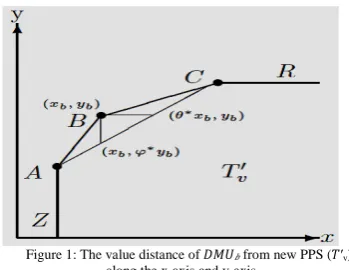
∈ − λY λ ≥ j∈ −J pIn figure (1) the polyhedral 𝑍𝑍𝐴𝐴𝐵𝐵𝐶𝐶𝑅𝑅 and 𝑍𝑍𝐴𝐴𝐶𝐶𝑅𝑅 are 𝑇𝑇𝑣𝑣 and𝑇𝑇𝑣𝑣′, respectively.
The input-oriented BCC and input-oriented CCR models, corresponds to𝐷𝐷𝑀𝑀𝑈𝑈𝑝𝑝,𝑝𝑝 ∈ 𝐽𝐽, is given by (1) and (2), re-spectively:
1
min
(
)
m s
i r
i a r
s
s
θ
+ −= =
− ∈
∑
+
∑
. .
1,
,
1,
, (1)
1
j ij i ik
j J
j rj r rk
j J
j j J
s t
x
s
x i
m
y
s
y r
s
λ
θ
λ
λ
− ∈ + ∈ ∈+
=
= …
−
=
= …
=
∑
∑
∑
0
jλ
≥
j
∈
J
0
i
s
−≥
i
= …
1,
,
m
0
r
s
+≥
r
= …
1,
,
s
θ
free
1 1
min min
(
)
m i r s i r
t
t
θ
= = + −− ∈
∑ ∑
+
. .
1,
,
1,
, (2)
j ij i ik
j J
j rj r rk j J
s t
x
t
x i
m
y
t
y r
s
λ
θ
λ
− ∈ + ∈+ =
= …
− =
= …
∑
∑
0
jλ
≥
j
∈
J
0
i
t
−≥
i
= …
1,
,
m
0
r
t
+≥
r
= …
1,
,
s
θ
free
where ϵis non-Archimedean small and positive number and 𝑠𝑠𝑖𝑖+,𝑠𝑠𝑟𝑟−,𝑡𝑡𝑖𝑖+and𝑡𝑡𝑟𝑟−, 𝑖𝑖= 1, … ,𝑚𝑚,𝑟𝑟= 1, … ,𝑠𝑠are called slack variables belong to ℝ≥0. Note that 𝑠𝑠𝑖𝑖−and 𝑡𝑡𝑟𝑟− represent input excesses; also𝑠𝑠𝑟𝑟+and 𝑡𝑡𝑟𝑟+ represent output shortfalls. The models (1) and (2) are called e
n
velopment forms (withnon-Archimedean number).
𝐷𝐷𝑀𝑀𝑈𝑈𝑝𝑝is said to be strong efficient (CCR-efficient) if and
only if: 𝜃𝜃* = 1 and t*+ = 0, t*- = 0. Where the superscript
(*) indicates optimality. In similar manner the BCC- effi-cient DMUs can be defined.
The AP model is as follows [9]:
{ }
{ }
. .
1,
,
1,
, (3)
j ij ip j J p
j rj rp j J p
s t
x
x i
m
y
y r
s
λ
θ
λ
∈ − ∈ −≤
= …
≥
= …
∑
∑
0
jλ
≥
j
∈
J
θ
free
The Jahanshahloo’s method corresponding inefficient
𝐷𝐷𝑀𝑀𝑈𝑈𝑎𝑎is as follows: [4]
, ,
1
}
1
{
min
min
(
)
. .
1,
,
m s
a b a b i
i
r r
j ij i ia
j J b
s
s
s t
x
s
x i
m
θ
λ
θ
+ − = − = − ∈∂
∂ = −
+
+
=
= …
∑ ∑
∑
{ }1,
, (4)
j rj r ra
j J b
y
s
y r
s
λ
+ ∈ −−
=
= …
∑
0
jλ
≥
j
∈ −
J
{ }
b
0
i
s
−≥
i
= …
1,
,
m
0
r
s
+≥
r
= …
1,
,
s
The efficiency of strong efficiency 𝐷𝐷𝑀𝑀𝑈𝑈𝑏𝑏 will be
de-noted by Ω and will be given by: ,
Ω
a Jn a bb
n
∈∂
=
∑
in which𝐽𝐽𝑛𝑛is the set of non-strong efficiency DMUs and
𝑛𝑛�is the number of non-strong efficiency DMUs.
Jahanshahloo et al. [14] used 𝑙𝑙1-norm in order to rank the extremely efficient DMUs in DEA models with constant and variable returns to scale, and the proposed method can remove the difficulties arising from AP and MAJ models. Their proposed model is as follows:
1 1
min
Γ
( , )
m s
c
p i ip r rp
i r
X Y
x
x
y
y
= =
=
∑
−
+
∑
−
{ }
. .
j ij i1,
,
j J p
s t
λ
x
x i
m
∈ −
≤
= …
∑
{ }
1,
, (5)
j rj r j J p
y
y r
s
λ
∈ −≥
= …
∑
0
ix
≥
i
= …
1,
,
m
0
r
y
≥
r
= …
1,
,
s
0
j
λ
≥
j
∈ −
J
{ }
p
D. Akbarian ET AL. 3
min 𝜃𝜃𝑝𝑝𝑙𝑙 { }
. .
jp lj lp lkj J p
s t
λ
x
θ
x
∈ −
≤
∑
{ }
1,
(6)
p
j ij ik j J p
x
x i
m i
l
λ
∈ −≤
= …
≠
∑
{ }
1,
,
p
j rj rk j J k
y
y r
s
λ
∈ −≥
= …
∑
λ
jp≥
0
j
∈
J p
{ }
min
ϕ
qp{ }
. .
jp ij ip1,
,
j J k
s t
µ
x
x i
m
∈ −
≤
= …
∑
{ }
,
1,
, (7)
p
j rj rp j J p
y
y
r
s r
q
µ
∈ −≤
= …
≠
∑
{ }
p p
j qj q qp j J p
y
y
µ
ϕ
∈ −
≥
∑
µ
jp≥
0
in which 𝑙𝑙= 1, … ,𝑚𝑚 and 𝑞𝑞= 1, … ,𝑠𝑠.
In order to rank DMUs in BCC model the constraint
∑𝑗𝑗 ∈𝐽𝐽−{𝑝𝑝} 𝜆𝜆𝑗𝑗𝑝𝑝=1 is is added to (6) and (7) (see [13]).
Remark 1: In (6) and (7), for each 𝑙𝑙and 𝑞𝑞, 𝜃𝜃𝑝𝑝𝑙𝑙 =𝜑𝜑𝑝𝑝𝑞𝑞=
1 if and only if strong efficient 𝐷𝐷𝑀𝑀𝑈𝑈𝑘𝑘lies on the strong defining hyperplane of PPS. In fact it is an interior point of strong defining hyperplane.
[image:3.595.77.252.424.559.2]
Figure 1: The value distance of 𝐷𝐷𝑀𝑀𝑈𝑈𝑏𝑏 from new PPS (𝑇𝑇′v)
along the x-axis and y-axis
Remark 2: In (6) (or (7)), if for some 𝑙𝑙(or 𝑞𝑞), 𝜃𝜃𝑝𝑝𝑙𝑙 > 1 (or 𝜑𝜑𝑝𝑝𝑞𝑞< 1) or if for some l(or q), model (6) (or model (7)) is infeasible then, strong efficient 𝐷𝐷𝑀𝑀𝑈𝑈𝑘𝑘lies on the
extreme ray (edge) of PPS and vice versa. (For more details on models (6) and (7) see [12].)
We call all efficient DMUs lying on extreme ray (edge) of PPS of CCR model as extreme efficient DMUs, he-reafter.
Remark 3: In multiple output case, if for some 𝑞𝑞model (7) is infeasible then, virtual DMU
(
)
'
1
,
,
,
1,
,
,
,
k k mk k qk sk
DMU
=
x
…
x
y
…
y
− …
γ
y
inwhich 𝛾𝛾 > 0, is on the weak defining hyperplane of PPS vertical to hyperplane 𝑦𝑦𝑞𝑞=0.
Remark 4: In multiple inputs case, if for at least one 𝑙𝑙, model (6) is infeasible then virtual DMU
𝐷𝐷𝑀𝑀𝑈𝑈𝑘𝑘′ = (𝑥𝑥1𝑘𝑘, … ,𝑥𝑥𝑙𝑙𝑘𝑘+𝛼𝛼, … ,𝑥𝑥𝑚𝑚𝑘𝑘,𝑦𝑦1𝑘𝑘, … ,𝑦𝑦𝑠𝑠𝑘𝑘) in which
𝛼𝛼 > 0, is on the weak defining hyperplane which passes through 𝑙𝑙th axis of input.1
3.
A proposed method for ranking by
su-per-efficiency model
We state the following theorem without proof.
Theorem 1: If there exist at least two DEA-efficient
DMUs then, there is at least one 𝑙𝑙(or 𝑞𝑞) so that model (6) (or model (7)) is feasible.
First, we evaluate each 𝐷𝐷𝑀𝑀𝑈𝑈𝑘𝑘, (𝑘𝑘 ϵ 𝐽𝐽), by models (2).
Suppose that 𝐿𝐿 DMUs are strong efficient. Without lose of generality we can assume that these efficient DMUs are 𝐷𝐷𝑀𝑀𝑈𝑈1 ,…, 𝐷𝐷𝑀𝑀𝑈𝑈𝐿𝐿 . Consider the set 𝐸𝐸 = {1, ..., 𝐿𝐿}. Then, corresponding to each 𝐷𝐷𝑀𝑀𝑈𝑈𝑝𝑝, (𝑝𝑝ϵ𝐸𝐸), we solve the models (6) and (7). In view of remarks 1,2 we can iden-tify all extreme efficient DMUs.
Corresponding each extreme efficient 𝐷𝐷𝑀𝑀𝑈𝑈𝑝𝑝 we ob-tain 𝜃𝜃𝑙𝑙𝑝𝑝∗and𝜑𝜑𝑝𝑝∗𝑞𝑞, 𝑖𝑖= 1,…,𝑚𝑚, 𝑞𝑞 = 1,..., 𝑠𝑠.
Note that for some 𝑙𝑙 and 𝑞𝑞 the models (6) and (7) may be infeasible. But by theorem 1 for 𝐷𝐷𝑀𝑀𝑈𝑈𝑝𝑝 there exist at least for one 𝑙𝑙or 𝑞𝑞so that the models (6) or (7) have fi-nite optimal solution.
We have:
𝑥𝑥𝑙𝑙𝑝𝑝�𝜃𝜃𝑙𝑙𝑝𝑝∗−1�=The value distance of 𝐷𝐷𝑀𝑀𝑈𝑈𝑝𝑝 from new
PPS (′Tc) along the 𝑙𝑙th axis of input.
𝑦𝑦𝑞𝑞𝑝𝑝�1− 𝜑𝜑𝑝𝑝∗𝑞𝑞�=The value distance of 𝐷𝐷𝑀𝑀𝑈𝑈𝑝𝑝 from new PPS (Tc) along the 𝑞𝑞th axis of output.
Where it is understood that the above value distances are taken over existing 𝜃𝜃𝑙𝑙𝑝𝑝∗and 𝜑𝜑𝑝𝑝∗𝑞𝑞(see Fig. 1).
Let
𝛾𝛾𝑝𝑝∗= max𝑙𝑙,𝑞𝑞 {𝑥𝑥𝑙𝑙𝑝𝑝�𝜃𝜃𝑙𝑙𝑝𝑝∗−1�,𝑦𝑦𝑞𝑞𝑝𝑝�1− 𝜑𝜑𝑝𝑝∗𝑞𝑞�} In order to judge which DMU has better rank in compar-ison with other DMUs, the following definition is given:
Definition. 𝐷𝐷𝑀𝑀𝑈𝑈𝑝𝑝has a better rank in comparison with
𝐷𝐷𝑀𝑀𝑈𝑈𝑘𝑘if 𝛾𝛾𝑝𝑝∗>𝛾𝛾𝑘𝑘∗.
The following theorem shows that our proposed method has more influence to the PPS of DEA models than
𝑙𝑙1-method has
.
Theorem 2: Γ𝑝𝑝𝑐𝑐(𝑋𝑋,𝑌𝑌)≤ 𝛾𝛾𝑝𝑝∗. Proof. The proof is straightforward.
4.
Numerical Example
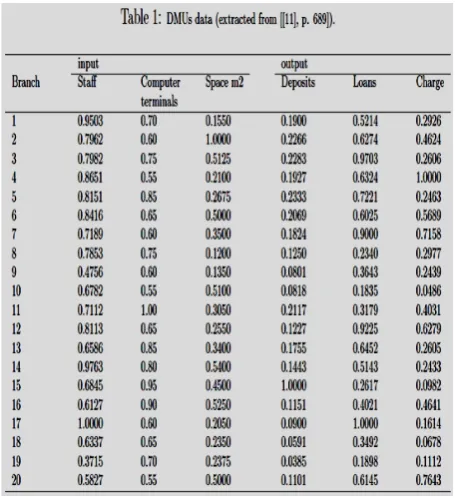
[image:4.595.47.275.113.364.2]We evaluated with our method the data of 20 branch banks of Iran. This data was previously analyzed by Amirteimoori and Kordrostami [11] and is listed in Table 1. The use of our method generated the analysis shown in
Table 2, in which, the statement “infs” means “infeasi-ble”. Table 3 shows a comparison of our proposal and some other ranking approaches. All these approaches are implemented in input-oriented version under the condi-tion of CRS. As reported in Table 3, 𝐷𝐷𝑀𝑀𝑈𝑈15 is the most efficient one in our method and other methods. Accord-ing to the results, the rankAccord-ings of DMUs by the four me-thods are almost similar; in particular, the results of our method are more similar to the method [4].
5.
Conclusion
In this paper we propose a method for ranking extreme efficient DMUs based on measuring distance between extreme efficient DMUs and new PPS (after omission extreme efficient DMUs) along the input-axis or out-put-axis, using supper efficiency models (6) and (7). It seems that our approach is more robust than other me-thod [14]; because, as it was shown in theorem 2, our proposed method has more influence in new PPS than the proposed method by Jahanshahloo et al. [14]. Initial studies had shown that our approach also can be applied with BCC model. We suggest as future works a deeper analysis in this subject.
REFERENCES
[1] A. Charnes, W.W. Cooper, E. Rodes, “Measuring the efficiency of decision making units”, European Journal of Operational Research, Vol. 2, No. 6, 1978, pp. 429-444.
[2] R.D. Banker, A. Charnes, W.W. Cooper, “Some models for estimating technical and scale inefficiencies in data envelopment analysis”, Management Science, Vol. 30, No. 9, 1984, pp.1078-1092.
[3] Jin-Xiao Chen, Mingrong Deng, “A cross-dependence based ranking system for efficient and inefficient units in DEA”, Expert Systems with Applications, Vol. 38, 2011, pp. 9648-9655.
[4] G.R. Jahanshahloo, H.V. Junior, F. Hosseinzadeh Lotfi, & D. Akbarian, “A new DEA ranking system based on changing the reference set”, European Journal of Opera-tional Research, Vol. 18, 2007, pp. 331-337.
[5] S. Li, G.R. Jahanshahloo & M. Khodabakhshi, “A su-per-efficiency model for ranking efficient units in data envelopment analysis”, Applied Mathematics and Com-putation, Vol.184, 2007, pp. 638-648.
[6] F. Hosseinzadeh Lotfi, A.A. Noora, G.R. Jahanshahloo, M. Reshadi, “One DEA rankingmethod based on apply-ing aggregate units”, Expert Systems with Applications, Vol. 38, 2011, pp. 13468-13471
D. Akbarian ET AL. 5
data envelopment analysis”. Computational Optimization and Applications, Vol. 14, 1999, pp. 261-266.
[8] N. Adler, L. Friedman & Z. Sinuany-Stern, “Review of ranking methods in the data envelopmentanalysis con-text”, European Journal of Operational Research, Vol. 140, 2000, pp. 249-265.
[9] P. Andersen & N.C. Petersen, “A procedure for ranking efficient units in data envelopment analysis”, Manage-ment Science, Vol. 39, 1993, pp. 1261-1264.
[10] Y.M. Wanga, Y. Luob, L. Liang, “Ranking decision making units by imposing a minimum weight restriction in the data envelopment analysis”, Journal of Computa-tional and Applied Mathematics, Vol. 223, 2009, pp. 469-484.
[11] A. Amirteimoori & S. Kordrostami, “Efficient surfaces and an efficiency index in DEA: A constant returns to
scale”, Applied Mathematics and Computation, Vol. 163, 2005, pp. 683-691.
[12] G.R. Jahanshahloo, F. Hosseinzadeh Lotfi & D. Akbarian, “Finding weak defining hyperplanes of PPS of the CCR model”, submited to journal Applied Mathematical Mod-elling, Vol. 34, 2010, pp. 3321-3332.
[13] G.R. Jahanshahloo, F. Hosseinzadeh Lotfi & D. Akba-rian, ”Finding weak defining hyperplanes of PPS of the BCC model”, Applied Mathematical Modelling, Vol. 34, No.11, 2010, pp. 3321-3332.