Convolution Kernels for Subjectivity Detection
Michael Wiegand and Dietrich Klakow Spoken Language Systems
Saarland University D-66123 Saarbr¨ucken, Germany
{Michael.Wiegand|Dietrich.Klakow}@lsv.uni-saarland.de
Abstract
In this paper, we explore different linguis-tic structures encoded as convolution ker-nels for the detection of subjective expres-sions. The advantage of convolution ker-nels is that complex structures can be di-rectly provided to a classifier without riving explicit features. The feature de-sign for the detection of subjective ex-pressions is fairly difficult and there cur-rently exists no commonly accepted fea-ture set. We consider various strucfea-tures, such as constituency parse structures, de-pendency parse structures, and predicate-argument structures. In order to generalize from lexical information, we additionally augment these structures with clustering information and the task-specific knowl-edge of subjective words. The convolution kernels will be compared with a standard vector kernel.
1 Introduction
One of the most prominent subtasks in sentiment analysis is the detection of subjectivity. Given some expression in a particular context, one is to decide whether this expression conveys some sub-jective meaning:
1. The United States and its principal allies have acted with exceptional caution over recent weeks to the unbelievable provocation of the 11 September attacks.
2. General Lucas Rincon held a brief news con-ference to say Mr Chavez’ resignation had been demanded and accepted.
Though there are several words, such as horri-ble or ambitious, that are subjective a priori, there are many ambiguous expressions being subjective
only in particular contexts, such as the word re-actions which is subjective in Sentence 3 but is not subjective in Sentence 4. These examples also illustrate that the contextual information is very helpful in order to decide whether a target word is subjective or not. In Sentence 3, the words that are syntactically related to the target word, e.g. the modifier healthy or its governing predicate pro-vokes, are particularly predictive as they can be considered subjective expressions themselves.
3. That is a bitter pill to swallow in a thoroughly non-militaristic society such as ours, where the clash of weapons provokes healthy reac-tions of repulsion.
4. Although computers with DNA input and output have been made before, they have al-ways involved a laborious series of reactions, each requiring human supervision.
In this paper, we explore different linguistic structures encoded as convolution kernels for the detection of such subjective expressions. We assume that contextual information of structures other than lexical units is useful for this task. The advantage of convolution kernels is that complex structures can be directly provided to a classifier without deriving explicit features. The feature de-sign for the detection of subjective expressions is fairly difficult and there currently exists no com-monly accepted feature set. Therefore, we assume that the usage of convolution kernels for this task may be suitable.
We consider various linguistic levels of repre-sentation commonly used for classification and ex-traction tasks in natural language processing, such as constituency parse structures, dependency parse structures, and predicate-argument structures. In order to generalize from lexical information, we additionally augment these structures with cluster-ing information and the task-specific knowledge of
subjective words. The convolution kernels will be compared with a standard vector kernel.
2 Related Work
Convolution kernels have been shown to be ef-fective in various tasks in natural language pro-cessing, ranging from relation extraction (Bunescu and Mooney, 2005; Zhang et al., 2006; Nguyen et al., 2009), semantic role labeling (Moschitti et al., 2008) to question answering (Zhang and Lee, 2003; Moschitti, 2008). In sentiment analysis, this method has been successfully applied on opinion holder extraction (Wiegand and Klakow, 2010).
There is no general agreement as to whether lin-guistic information is useful for text classification tasks in sentiment analysis (which next to sub-jectivity detection also comprises polarity classi-fication1). For supervised document-level anal-ysis, traditional word-level features (i.e. bag of words/n-grams) are usually sufficient (Ng et al., 2006). The usage of more expressive features has been found more effective on fine-grained senti-ment analysis, in particular, the classification at word/phrase level (Wilson et al., 2005; Karlgren et al., 2010; Johansson and Moschitti, 2010). The features used in those works have been manually designed and comprise various levels of represen-tation, such as grammatical relations or predicate-argument structures. Johansson and Moschitti (2010) also use a tree kernel encoding dependency parse trees, however, there is no significant im-provement achieved by that structure.
In this work, we not only consider dependency parse trees for convolution kernels but also other linguistic levels of representation. Moreover, we also consider appropriate substructures rather than the structures derived from an entire sentence. The latter approach has already been proved ef-fective in opinion holder extraction (Wiegand and Klakow, 2010).
3 Data
As a labeled corpus, we use the Multi-Perspective Question Answering Corpus (MPQA-2.0)2 which is a widely used corpus annotated with fine-grained information, such as expression-level sub-jectivity annotation. As subjective expressions, we consider nouns, (full) verbs, and adjectives being
1
Polarity classification is the task of distinguishing be-tween positive and negative opinions.
2
www.cs.pitt.edu/mpqa/databaserelease
labeled as a direct subjective or expressive subjec-tivity. We excluded those expressions with low or implicit subjectivity.3 Please note that the expres-sions that are labeled as subjective need not be in-dividual words but can also be phrases. For our approach, we will then consider each word of this phrase being either a noun, verb, or adjective sepa-rately, e.g. for Sentence 5 we will consider biggest and story as two subjective words.
5. You’re making us leave as the biggest story gets here.
4 Method
4.1 Support Vector Machines and Kernel Methods
Support Vector Machines (SVMs) are one of the most robust supervised machine learning tech-niques in which training data instances~xare sepa-rated by a hyperplaneH(~x) =w~·~x+b= 0where
w ∈Rnandb∈ R(Joachims, 1999). The hyper-plane can be reformulated with a kernel function
K : X ×X → R that computes the similarity of two data instances ~xi and ~xj (~xi ∧~xj ∈ X).
While in a standard vector kernel these instances are represented by manually defined features, such as bag of words, in a convolution kernel the in-stances can be described by more complex discrete structures, such as trees or sequences. A convolu-tion kernel funcconvolu-tion is an algorithm that specifies how the similarity of two instances represented by such discrete structures can be computed.
The convolution kernels we evaluate in this work are two tree kernels: Subset Tree Kernel (ST K) (Collins and Duffy, 2002) and Partial Tree Kernel (P T Kbasic) (Moschitti, 2006). We will
focus exclusively on tree structures since they largely outperform other kernels, such as sequence kernels (Wiegand and Klakow, 2010). In a tree kernel, the similarity of two trees is computed by counting the number of common tree fragments. InST K, a tree fragment can be any set of nodes and edges of the original tree provided that every node has either all or none of its children. This constraint makes that kind of kernel well-suited for constituency trees (Zhang et al., 2006; Nguyen et al., 2009; Wiegand and Klakow, 2010) that have
3Beyond the experiments presented in this paper, we also
been generated by context free grammars since the constraint corresponds to the restriction that no grammatical rule must be broken. For example,
ST K enforces that a subtree, such as [VP [VBZ, NP]], cannot be matched with [VP [VBZ]] since the latter VP node only possesses one of the chil-dren of the former.
P T Kbasicis more flexible since the constraint of
ST K on nodes is relaxed. This makes this type of tree kernel less suitable for constituency trees. We, therefore, apply it only to trees representing dependency trees (thus following Johansson and Moschitti (2010)) and predicate-argument struc-tures (thus following Moschitti (2008)).
4.2 Bag of Words
The simplest form of contextual information to be used for our task is lexical information, i.e. bag of words. Even though it is extremely simple and cheap to produce, this level of representation is known to be fairly robust for different kinds of text classification tasks. We will examine several con-text windows and encode this representation in a standard vector kernel.
4.3 Convolution Kernels
The following subsections present the different kinds of tree structures that are used for convolu-tion kernels.
4.3.1 Constituency Parse Structures (CON)
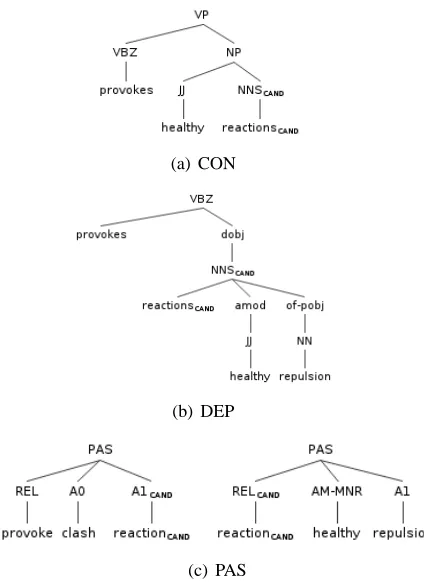
Wiegand and Klakow (2010) showed for opinion holder extraction that using the entire constituency parse tree of a sentence produces very low per-forming classifiers. Structures derived from an en-tire sentence contain too much irrelevant informa-tion for such a task at expression level. We assume that the same is true for the detection of subjectiv-ity. Wiegand and Klakow (2010) use subtrees de-rived from scopes. The best performing subtree is the tree with the predicate scope, i.e. a sub-tree with the boundaries being the candidate or target expression and the nearest predicate. We also assume that this structure is meaningful for our task. As already discovered in previous work on the detection of subjective expressions (Riloff and Wiebe, 2003; Riloff and Wiebe, 2003; Wilson et al., 2005), discriminant patterns often encode a relation between the target expression and the nearest predicate. An illustration of this substruc-ture is given in Figure 1(a). We use the Stanford
Parser (Klein and Manning, 2003) for obtaining constituency parse trees.
4.3.2 Dependency Parse Structures (DEP)
Apart from manually designed features, Johans-son and Moschitti (2010) also test a tree ker-nel for subjectivity detection using a dependency parse. However, the entire parse comprising a sentence is considered. The resulting tree ker-nel does not show any significant improvement (again presumably because of the large amount of irrelevant information). The usefulness of partic-ular (usually direct) relations, however, has been found effective on other related tasks in senti-ment analysis (Jakob and Gurevych, 2010; Wie-gand and Klakow, 2010). We therefore only con-sider the subtree exclusively containing the lexical units that are connected to the target word by a direct syntactic dependency relationship (i.e. di-rect parent and didi-rect children). The precise en-coding of the pertaining information (i.e. part-of-speech, grammatical relation, and lexical informa-tion) in the resulting tree is taken from (Johansson and Moschitti, 2010). An illustration of this sub-structure is given in Figure 1(b). Again, we use the Stanford Parser (Klein and Manning, 2003) for obtaining dependency parse trees.
4.3.3 Predicate-Argument Structures (PAS)
Predicate-argument structures (PAS), in particular, semantic role labeling has been shown to be ef-fective for many information extraction tasks, in-cluding opinion holder extraction (Kim and Hovy, 2006; Wiegand and Klakow, 2010) and opinion target extraction (Kim and Hovy, 2006). Johans-son and Moschitti (2010) also examine this level of representation for subjectivity detection. How-ever, they employ manual features derived from these structures rather than using a corresponding tree kernel.
rather than a single structure. Thus, the actual par-tial tree kernel function we use for this task,P T K, sums over all possible pairsP ASl andP ASm of
two data instancesX xi and xj: P T K(xi, xj) =
P ASl∈xi
X
P ASm∈xj
P T Kbasic(P ASl, P ASm). An
illustration of these substructures is given in Fig-ure 1(c).
(a) CON
(b) DEP
[image:4.612.95.307.155.448.2](c) PAS
Figure 1: Illustration of the different tree struc-tures employed for convolution kernels derived from Sentence 3 with reactions as the target word.
4.3.4 Augmentation with Clustering
A common type of unsupervised generalization is clustering. Words which co-occur with each other are automatically grouped into clusters. Ideally, a cluster thus contains words with similar syntac-tic/semantic properties. The cluster membership of individual words is induced from a large unla-beled corpus.
As the context windows of our target expressions contain fairly sparse lexical information, the addi-tional usage of the cluster membership might be useful. Turian et al. (2010) have shown that for named-entity recognition, i.e. a task which faces similar lexical sparseness, features based on such a cluster membership improve the overall perfor-mance. For clustering, we chose Brown
cluster-ing (Brown et al., 1992) which is the best per-forming algorithm in (Turian et al., 2010). This algorithm induces clusters with the help of co-occurrence statistics of bigrams. We augment our structures with the clustering information. We add the node with a cluster label in such a way that it directly dominates the pertaining lexical node. As a software we use SRILM (Stolcke, 2002) with the default algorithm. The clusters are in-duced on the North American News Text Corpus (LDC95T21). We chose this corpus as it contains news texts similar to our evaluation corpus (i.e. MPQA). Following Turian et al. (2010), we in-duced1000clusters.
As many names of persons and organizations can be very domain-specific, they may not appear in the corpus from which clusters are induced. Con-sequently, these expressions cannot be assigned to a cluster. We try to compensate this by incorpo-rating the knowledge about named entities in tree kernels, i.e. instead of assigning some expression to a cluster we assign it to a named entity type. Named-entity information is obtained by the Stan-ford tagger (Finkel et al., 2005).
4.4 The Different Settings
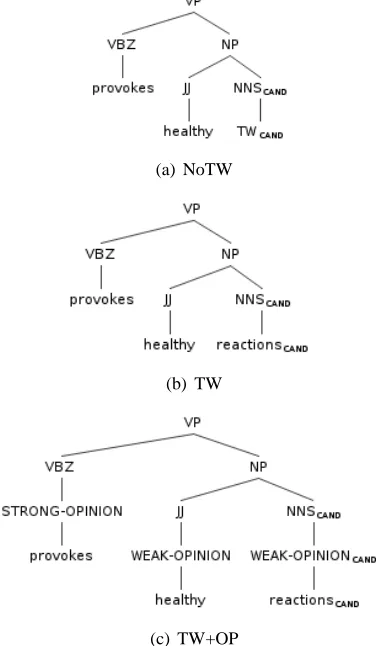
word is considered, i.e. we have dedicated fea-tures (original word form + lemma4) in the vector kernel and we retain the label of the leaf node rep-resenting the target word in the tree kernels. The final setting T W+OP also incorporates the knowledge about subjective expressions. For the vector kernel, we add features indicating whether the target word is either a weak or strong subjec-tive expression. Moreover, we include two fea-tures indicating whether the context (i.e. the words surrounding the target word in its context window) contains either at least one weak or strong subjec-tive expression. The knowledge about subjecsubjec-tive expressions is drawn from a given sentiment lex-icon. We use the Subjectivity Lexicon from the MPQA project (Wilson et al., 2005). Table 1 sum-marizes the different settings with regard to the re-spective features in the vector kernel and the en-coding of the convolution kernels. An illustration of the different settings on a constituency parse tree (CON) is displayed in Figure 2.
5 Experiments
We used400documents of the MPQA corpus for five-fold cross-validation and 133 documents as a development set. We will exclusively report the results that are averages over cross-validation. We report statistical significance on the basis of a paired t-test using0.05as the significance level.
As there is a heavy class imbalance between positive and negative data (e.g. for nouns, more than85%of the data instances are negative exam-ples), we evaluate with F-Score rather than accu-racy. In order to achieve an optimal F-Score, we tuned the cost parameterj(Morik et al., 1999) on the development set using our baseline classifier, i.e. VK.5This cost parameter allows to specify a higher penalty on false negative errors. Thus, on data sets with an imbalanced class distribution bet-ter models assigning less conservatively labels of the minority class can be produced. We setj= 4. As far as tree kernels are concerned, we used the parameter settings from Moschitti (2008). Kernels were combined using plain summation.
For all experiments apart from those presented in Section 5.3 will be based on our main setting, i.e.T W (see Section 4.4).
4
The lemma feature is important for normalizing inflec-tional forms. From the parts of speech that we consider verbs mostly benefit from such a normalization.
5
Note that the cost parameter is the only parameter tuned on the development set.
(a) NoTW
(b) TW
[image:5.612.335.523.43.366.2](c) TW+OP
Figure 2: Illustration of the different settings (as defined in Table 1) on a constituency parse tree (CON).
5.1 Different Vector Kernel Configurations
Table 2 displays the performance (F-Score) of the vector kernel with different configurations. We vary the window size6and the kernel type, i.e. lin-ear or polynomial kernel. We use a second degree polynomial kernel as we obtained the best perfor-mance with that type. The table shows that, usu-ally the polynomial kernel always outperforms the linear kernel. Moreover, the best window size is between 5and 10. The difference between those two window sizes using a polynomial kernel is, however, never statistically significant.
5.2 Different Convolution Kernel Configurations
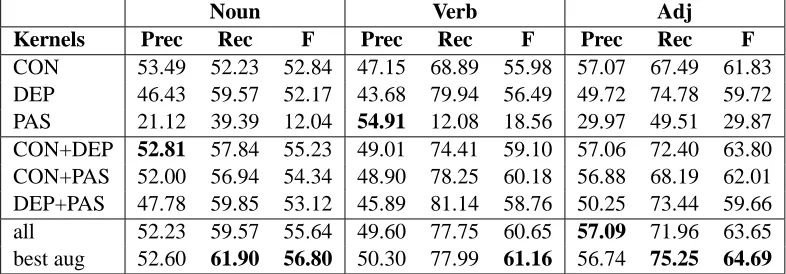
Table 3 displays the performance of the different convolution kernels. As far as individual kernels are concerned, CON and DEP are fairly simi-lar, P ASperforms much worse. Overall, the best
6
Setting Vector Kernel (Features) Convolution Kernel (Encoding)
NoTW context words within window label of target word node is replaced by generic TW TW all features from NoTW + label of target word node is not changed
(default) target word
lemma of target word
TW+OP all features from TW + label of target word node is not changed is target word a weak/strong
sub-jective word?
augment trees if weak/strong subjective words are present
[image:6.612.87.546.33.173.2]has context more than one weak/strong subjective word?
Table 1: The different settings with the design of the corresponding kernel types.
Noun Verb Adj
WS linear poly linear poly linear poly 2 53.66 54.77 59.05 62.34 63.23 64.51 5 55.90 59.29 61.58 63.63 64.16 66.52 10 55.68 58.87 62.34 64.46 64.52 66.38 20 54.76 55.90 62.68 63.42 62.79 64.33
Table 2: F-Score of vector kernels using different window sizes (W S) and kernel types (using de-fault settingT W).
combination isCON andDEP. A combination of P AS with the other convolution kernels only has a notable positive impact for verbs, which does not come as a surprise since semantic role label-ing is clearly verb-centred (still, it is too sparse to be used as a kernel on its own). With the ex-ception of verbs, a combination of all convolution kernels is not necessary, i.e. the combination of
CON and DEP suffices (there is no significant improvement achieved by also addingP AS).
We were surprised that in spite of the fact that
P ASas an individual kernel performs very poorly, it never harms performance when it is added to another kernel type and occasionally also causes some improvement. We ran some more experi-ments and found that the low performance ofP AS
is mainly due to the fact that a default value for the depth parameterµ(Zhang and Lee, 2003) was used. With an increased depth parameter (e.g.
µ= 0.8) which more suitably accounts for the low depth of flat predicate-argument structures, P AS
performs much better. However, since for com-bined structures, the optimized parameter has only a marginal impact and we only use a defaultµfor all other configurations, for reasons of consistency we just useP ASwith default settings.
Finally, the usage of tree augmentation using clustering (i.e. best aug), is always beneficial. Ta-ble 4 lists the content of three clusters that are in-duced. All three of them mostly contain expres-sions one would intuitively label as subjective ex-pressions. This means that to a certain extent, clus-tering is able to group subjective expressions and objective expressions into different clusters.
We also ran some experiments using differ-ent structures than those presdiffer-ented in Section 4.3. Though for opinion holder extraction, a combina-tion of scopes is useful for the constituency parse trees (Wiegand and Klakow, 2010), we found that for this task adding other scopes does not help. Further extensions of the dependency structure, e.g. by also including indirect syntactic depen-dency relationships (grandparent and grandchil-dren of the target word) did not help either. These results suggest that for this task there is little room for improvement by applying state-of-the-art con-volution tree kernels on other structures than the one presented in this paper.
5.3 Comparing Vector Kernels with Convolution Kernels
Table 5 compares the best vector kernel (VK) for each respective part of speech and the combination of the best convolution kernel (CKs) with a vector kernel. As from the results for the individual vec-tor kernels on the setting T W (Table 2) it is not obvious which window size is best (i.e. 5or10), we always tested both sizes and will report the best result in Table 5. For the combination with CKs, we always chose a vector kernel with the window size of 10 as, unlike the experiments on VK, we observed that this window size was consistently better than using the window size of5.
set-Noun Verb Adj
Kernels Prec Rec F Prec Rec F Prec Rec F
[image:7.612.118.511.35.172.2]CON 53.49 52.23 52.84 47.15 68.89 55.98 57.07 67.49 61.83 DEP 46.43 59.57 52.17 43.68 79.94 56.49 49.72 74.78 59.72 PAS 21.12 39.39 12.04 54.91 12.08 18.56 29.97 49.51 29.87 CON+DEP 52.81 57.84 55.23 49.01 74.41 59.10 57.06 72.40 63.80 CON+PAS 52.00 56.94 54.34 48.90 78.25 60.18 56.88 68.19 62.01 DEP+PAS 47.78 59.85 53.12 45.89 81.14 58.76 50.25 73.44 59.66 all 52.23 59.57 55.64 49.60 77.75 60.65 57.09 71.96 63.65 best aug 52.60 61.90 56.80 50.30 77.99 61.16 56.74 75.25 64.69
Table 3: Performance of the different convolution kernels (using default settingT W).
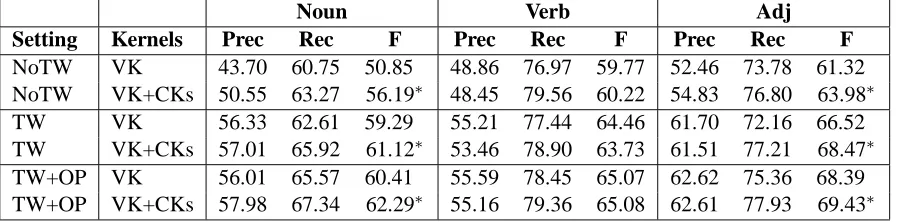
tings, i.e. N oT W, T W and T W+OP (see Sec-tion 4.4). The table shows that the overall perfor-mance ofN oT W is worst and that ofT W+OP is best, which is quite intuitive as it corresponds to the amount of knowledge encoded in the configu-rations. The gap betweenN oT W andT W is the largest indicating that the knowledge of the target word itself is extremely important. The knowledge of subjective expressions T W+OP helps but the degree of improvement is smaller.7
As far as the relation between vector kernels and convolution kernels is concerned, the combination of vector kernel and convolution kernels is mostly beneficial. With the exception of verbs, we always obtain a significant improvement over just using the best vector kernel.
If we compare the relation between vector ker-nel and the combination of vector kerker-nel and con-volution kernels across the different settings, we also observe that the less is known about the target word, the more helpful the information is that can be drawn from the convolution kernels. For exam-ple, when CKs are added to VK on nouns, there is an improvement of 5 percentage points while on the other settings the improvement is usually less than 2 percentage points. In other words, if we have test data in which many target words are unknown, then the structural context information is much more important than if the target words have mostly appeared in the training data.
7Since we expected a greater improvement by adding
knowledge of subjective words, we ran some more ex-ploratory experiments. We found that if we run SVMs with a default configuration that assigns the equal cost to the differ-ent classes , i.e. setting the cost parameterj= 1, the relative improvement fromT W toT W+OP is considerably larger (though in absolute numbers, the F-Scores are much lower than by using the optimized parameter).
acclaim, admiration, backing, benefit, con-tempt, disdain, disregard, disrespect, doom, fi-nesse, gratitude, harm, praise, redress, refrain, rent, respect, ridicule, support, sympathy anticipate, attribute, believe, confess, detest, expect, imply, indicate, liken, mean, owe, pre-sume, pretend, resent, suggest, swear
decent, fantastic, good, handy, lousy, mediocre, miserable, nice, nostalgic, pleasant, shrewd, smart, terrific, wise, wonderful
Table 4: Some automatically induced clusters.
6 Conclusion
In this paper, we examined the usage of convolu-tion kernels for the detecconvolu-tion of subjective expres-sions and compared it to the performance of a vec-tor kernel trained on bag-of-words features. The polynomial vector kernel is a hard baseline. For nouns and adjectives, however, the performance can be significantly increased if in addition to the vector kernel a pair of convolution kernels encod-ing a constituency parse subtree with predicate scope and a dependency parse subtree encoding the direct relationships between the target word and other words in a sentence is used. Addition-ally, the trees can be effectively augmented with cluster-membership information.
Acknowledgements
Noun Verb Adj
Setting Kernels Prec Rec F Prec Rec F Prec Rec F
[image:8.612.92.541.35.146.2]NoTW VK 43.70 60.75 50.85 48.86 76.97 59.77 52.46 73.78 61.32 NoTW VK+CKs 50.55 63.27 56.19∗ 48.45 79.56 60.22 54.83 76.80 63.98∗ TW VK 56.33 62.61 59.29 55.21 77.44 64.46 61.70 72.16 66.52 TW VK+CKs 57.01 65.92 61.12∗ 53.46 78.90 63.73 61.51 77.21 68.47∗ TW+OP VK 56.01 65.57 60.41 55.59 78.45 65.07 62.62 75.36 68.39 TW+OP VK+CKs 57.98 67.34 62.29∗ 55.16 79.36 65.08 62.61 77.93 69.43∗
Table 5: Comparison of the (best) vector kernel and convolution kernels using different settings (∗: significantly better than VK withp≤0.05).
References
P. F. Brown, P. V. deSouza, R. L. Mercer, V. J. Della Pietra, and J. C. Lai. 1992. Class-based n-gram models of natural language. Computational Lin-guistics, 18:467–479.
R. C. Bunescu and R. J. Mooney. 2005. Subsequence Kernels for Relation Extraction. In Proc. of NIPS.
M. Collins and N. Duffy. 2002. New Ranking Algo-rithms for Parsing and Tagging. In Proc. of ACL.
J. R. Finkel, T. Grenager, and C. Manning. 2005. In-corporating Non-local Information into Information Extraction Systems by Gibbs Sampling. In Proc. of ACL.
N. Jakob and I. Gurevych. 2010. Extracting Opinion Targets in a Single- and Cross-Domain Setting with Conditional Random Fields. In Proc. of EMNLP.
T. Joachims. 1999. Making Large-Scale SVM Learn-ing Practical. In B. Sch ¨olkopf, C. Burges, and A. Smola, editors, Advances in Kernel Methods -Support Vector Learning. MIT Press.
R. Johansson and A. Moschitti. 2010. Syntactic and Semantic Structure for Opinion Expression Detec-tion. In Proc. of CoNLL.
J. Karlgren, G. Eriksson, O. T¨ackstr¨om, and M. Sahlgren. 2010. Between Bags and Trees - Con-structional Patterns in Text Used for Attitude Identi-fication. In Proc. of ECIR.
S. Kim and E. Hovy. 2006. Extracting Opinions, Opin-ion Holders, and Topics Expressed in Online News Media Text. In Proc. of the ACL Workshop on Sen-timent and Subjectivity in Text.
P. Kingsbury and M. Palmer. 2002. From TreeBank to PropBank. In Proc. of LREC.
D. Klein and C. D. Manning. 2003. Accurate Unlexi-calized Parsing. In Proc. of ACL.
K. Morik, P. Brockhausen, and T. Joachims. 1999. Combining statistical learning with a knowledge-based approach - A case study in intensive care mon-itoring. In Proc. in ICML.
A. Moschitti, D. Pighin, and R. Basili. 2008. Tree Kernels for Semantic Role Labeling. Computational Linguistics, 34(2):193 – 224.
A. Moschitti. 2006. Efficient Convolution Kernels for Dependency and Constituent Syntactic Trees. In Proc. of ECML.
A. Moschitti. 2008. Kernel Methods, Syntax and Se-mantics for Relational Text Categorization. In Proc. of CIKM.
V. Ng, S. Dasgupta, and S. M. Niaz Arifin. 2006. Ex-amining the Role of Linguistic Knowledge Sources in the Automatic Identification and Classification of Reviews. In Proc. of COLING/ACL.
T.-V. T. Nguyen, A. Moschitti, and G. Riccardi. 2009. Convolution Kernels on Constituent, Dependency and Sequential Structures for Relation Extraction. In Proc. of EMNLP.
E. Riloff and J. Wiebe. 2003. Learning Extraction Patterns for Recognizing Subjective Expressions. In Proc. of EMNLP.
A. Stolcke. 2002. SRILM - An Extensible Language Modeling Toolkit. In Proc. of ICSLP.
J. Turian, L. Ratinov, and Y. Bengio. 2010. Word Representations: A Simple and General Method for Semi-supervised Learning. In Proc. of ACL.
M. Wiegand and D. Klakow. 2010. Convolution Ker-nels for Opinion Holder Extraction. In Proc. of HLT/NAACL.
T. Wilson, J. Wiebe, and P. Hoffmann. 2005. Recog-nizing Contextual Polarity in Phrase-level Sentiment Analysis. In Proc. of HLT/EMNLP.
D. Zhang and W. S. Lee. 2003. Question Classification using Support Vector Machines. In Proc. of SIGIR.
M. Zhang, J. Zhang, and J. Su. 2006. Exploring Syn-tactic Features for Relation Extraction using a Con-volution Tree Kernel. In Proc. of HLT/NAACL.
Y. Zhang, R. Wang, and H. Uszkoreit. 2008. Hybrid Learning of Dependency Structures from Heteroge-neous Linguistic Resources. In Proc. of CoNLL.