Incorporating Lexicon Knowledge into SVM Learning to Improve
Sentiment Classification
Ji Fang
Intelligent Systems Laboratory Palo Alto Research Center Palo Alto, California 94304, USA
Bi Chen
College of Information Sciences and Technology Pennsylvania State University
Pennsylvania, USA
Abstract
Two typical approaches to sentiment anal-ysis are lexicon look up and machine learning. Even though recent studies have shown that machine learning approaches in general outperform the lexicon look up approaches, completely ignoring the knowledge encoded in sentiment lexicons may not be optimal. We present an alter-native method that incorporates sentiment lexicons as prior knowledge with machine learning approaches such as SVM to im-prove the accuracy of sentiment analysis. This paper also describes a method to au-tomatically generate domain specific sen-timent lexicons for this learning purpose. Our experiment results show that the do-main specific lexicons we constructed lead to a significant accuracy improvement for our sentiment analysis task.
1 Introduction
Two typical approaches to sentiment analysis are lexicon look up and machine learning. A lexicon look up approach normally starts with a lexicon of positive and negative words. The overall sen-timent of a text is determined by the sensen-timents of a group of words and expressions appearing in the text (Liu, 2007; Zhou and Chaovalit, 2008). However, a significant challenge to this approach is that the polarity of many words is domain and context dependent. For example, longis positive in long battery life and negative in long shutter lag. Such words are associated with sentiment in a particular domain, but are not subjective in nature. Nevertheless, current sentiment lexicons do not capture such domain and context sensitivi-ties of sentiment expressions. They either exclude such expressions or tag them with an overall po-larity tendency based on statistics gathered from
certain corpus. While excluding such expressions leads to poor coverage, simply tagging them with a polarity tendency leads to poor precision.
Because of these limitations, machine learning approaches have been gaining increasing popular-ity in the area of sentiment analysis (Pang et al., 2002; Gamon, 2004). A machine learning ap-proach such as Support Vector Machine (SVM) does not rely on a sentiment lexicon to determine the polarity of words and expressions, and can au-tomatically learn some of the context dependen-cies illustrated in the training data.
Although recent studies have shown that ma-chine learning approaches in general outperform the lexicon look up approaches for the task of sentiment analysis (Pang et al., 2002), completely ignoring the advantages and knowledge provided by sentiment lexicons may not be optimal. We present an alternative method that incorporates sentiment lexicons as prior knowledge with ma-chine learning approaches such as SVM to im-prove the accuracy of sentiment analysis. This pa-per also describes a method to automatically gen-erate domain specific sentiment lexicons for this learning purpose. Our experiments show that com-pared to general purpose domain independent sen-timent lexicons, the domain specific lexicons lead to more significant accuracy improvement.
The sentiment analysis task performed in this paper is a fine grained product aspect level sen-timent classification task for camera reviews. Namely, for each sentence in the camera reviews, we need to predict whether this sentence discusses any camera aspects, and if so, what is the associ-ated sentiment.
2 Related Work
Given the task and the approaches of this study, we review the related works from three areas: 1. prod-uct aspect level sentiment analysis; 2. combining lexicon-based and machine learning approaches
for sentiment analysis; 3. sentiment lexicon gen-eration.
Product aspect level sentiment analysis aims to determine both the product aspects/features and their associated opinion at the sentence level. Ear-lier works include Hu and Liu (2004) and Popescu and Etzioni (2005). Both of these works extract frequent noun phrases as product aspects. There-fore, they do not identify implicitly expressed product aspects, and they do not further categorize the extracted noun phrases.
In our study, we extract both the explicitly and implicitly expressed product aspects, and we fur-ther categorize the semantically related aspects. Zhao et al. (2010)’s work is close to ours in this sense. However, in terms of opinion extraction, they only extract opinion words associated with product aspects, and they do not further identify the polarities of the opinion words. By contrast, we aim to identify the polarities associated with the product aspects. Our approach features incor-porating lexicon information into machine learn-ing. Thus we review studies that combine lexicon-based and machine learning approaches for senti-ment analysis next.
In previous studies, the lexicon-based and ma-chine learning approaches have been incorporated in two ways. The first way is to develop two weighted classifiers using these two approaches and then integrate them into one system. An-dreevskaia and Bergler (2008)’s work falls into this category. The second way is to incorpo-rate lexicon knowledge directly into learning al-gorithms. Our work falls into this category.
In the second category, Wilson et al. (2005), melville et al. (2009), Dang et al. (2010) and Sind-hwani and Melville (2008) all use a general pur-pose sentiment dictionary to improve polarity clas-sification. Our work differs from these previous studies in that we incorporate not only a general purpose sentiment lexicon but also Domain Spe-cific Sentiment Lexicons into SVM learning, and we use this method for identifying both product aspects and their associated polarities. More im-portantly, our experiment results show that while a general purpose sentiment lexicon provides only minor accuracy improvement, incorporating do-main specific dictionaries leads to more significant improvement.
Regarding the construction of sentiment lex-icon, earlier studies have focused on
generat-ing general purpose dictionaries. These meth-ods range from manual approaches (Wiebe et al., 2005) to semi-automated (Hu and Liu, 2004; Kim and Hovy, 2004; Zhuang and Jing, 2006) and automated approaches (Mohammad et al., 2009). More attention has been devoted to domain spe-cific lexicon construction recently. For example, Fahrni and Klenner (2008) present a method to identify polarity adjectives specific to food tar-gets extracted from wikipedia. Jijkoun et al. (2010) generate a topic-specific lexicon from a general purpose polarity lexicon. In this paper, we present a method to build domain specific senti-ment lexicons from scratch using a combination of corpus filtering, web searching using linguis-tic patterns and dictionary expansion techniques. Among these techniques, web searching using lin-guistic patterns was first introduced by Hatzivas-siloglou and Sebastiani (1997) to generate domain independent sentiment adjectives. Kobayashi et al. (2004) designed patterns to extract co-occurring aspect nouns and opinion adjectives. Fahrni and Klenner (2008) also used this technique and their lexicon is also limited to adjectives . By contrast, we use this technique to generate domain specific lexicon not limited to adjectives and nouns. Our method is described in detail below.
3 Generating Domain Specific Lexicons
As discussed above, the sentiments of many words or phrases are context or domain dependent. For example, long is positive if it is associated with the camera aspect of ‘Battery Life’. However, the same word carries negative sentiment when it is associated with the camera aspect of ‘Shut-ter Lag’. Therefore, it is critical to know the topic/domain being discussed when we try to de-termine the associated sentiment.
exam-ple, this second sub-lexicon would indicate that whilesharpandclearare positive,blurryis nega-tive when they are associated with camera picture quality. We achieved our goal by using a combina-tion of corpus filtering, web search with linguistic patterns and dictionary expansion. Each of these techniques is described in detail in the following subsections.
3.1 Corpus Filtering
We first use a training corpus, in which each cam-era review sentence is annotated with a camcam-era as-pect as well as the associated sentiment, to build a foundation for our domain specific lexicons. Our approach is as follows.
First, for each camera aspect such asDurability, we extract all of the content words and phrases that occur in the training sentences labelled as express-ing that aspect. The content words and phrases we extracted include nouns, verbs, adjectives, adverbs as well as their negated forms. This step produces an initial list of lexicon for each camera aspect.
Second, for each word and phrase in the list for each of the camera aspects, we check to see if that word or phrase also occurs in any other camera aspect lexicon. If yes, we remove it from the lexi-con. After this step of filtering, we obtained a list of lexicon for each camera aspect, which contains only words and phrases unique to that camera as-pect.
The quality of the lexicons produced using this approach is in general very high. For example, the following lexicon regarding the camera Dura-bilitywas generated based on our relatively small training corpus with 2131 sentences covering 23 categories (22 camera aspects and a category of ‘none’, meaning that none of the 22 camera as-pects was discussed).
Durability Lexicon: [scratch, construct, build, rock, repair, damage, flimsy, not flimsy, junk, sturdy, sturdier, solid, durable, tough, bent, hard, not worth, firm, rug, broke, bulletproof]
However, the drawback of this approach is that the coverage of the lexicons would completely rely on the coverage of the corpus, and annotating a broad coverage training corpus is time consuming, expensive and sometimes very difficult for a task such as sentiment analysis because of the richness of natural language.
We overcome this drawback by augmenting the initial domain specific lexicons we obtained from
the training corpus through web search and filter-ing usfilter-ing lfilter-inguistic patterns as well as dictionary expansion. These two approaches are illustrated in the next two subsections.
3.2 Web Search and Filtering Using Linguistic Patterns
To improve the coverage of the domain specific lexicons we obtained from our training corpus, we designed two linguistic patterns and used them as searching queries to find more words and phrases conceptually associated with the camera aspects. The two linguistic patterns we used are as follows.
Pattern 1: “Camera Aspect include(s) *” Pattern 2: Camera Aspect + “Seed Word and *” In these two patterns, ‘Camera Aspect’ refers to expressions such ascamera accessoriesand cam-era price. ‘Seed Word’ refers to seed words for a particular camera aspect. For example, cheap
andexpensivecan serve as seed words for camera aspectprice. Note that in Pattern 1, the camera as-pect name is included as part of an exact search query, whereas in Pattern 2, the camera aspect name serves as the context for the search query.
Depending on the semantic nature of a cam-era aspect, we choose one of these two patterns to find expressions conceptually related to that as-pect. For example, while “camera accessories in-clude *” is very effective for finding accessory ex-pressions, ‘camera picture + “clear and *”’ is bet-ter for finding expressions related to camera pic-tures.
When we use Pattern 1, we send it as a query to a search engine such as Bing1. We then
ex-tract words following ‘include’ or ‘includes’ in the top 50 results returned by the search engine. In each returned result, we extract words that follow ‘include’ or ‘includes’ until we hit the sentence boundary. The final step is to remove common stop words such astheand function words such as
withandof from the extracted words. As an ex-ample, the following lexicon for camera accessory is generated using this method.
Accessory Lexicon: [chip, chips, case, bag, card, software, tripod, strap, cable, adapt, charger, port, storage, hood, connector, kit, ac-cessory, glove, belt, usb, mic, beltloop, flash, pro-gram, leather, pack, connect, not belt, not strap, zipper]
1In our experiments, we used Bing for convenience.
Figure 1: Noisy Words v.s. Non-noisy Words for Camera Picture Quality
When we use Pattern 2, we also extract words in the top 50 returned results. However, we adopt a different algorithm for filtering out noise in the returned results. For example, for finding ex-pressions conceptually related to camera’s picture quality, we use ‘camera picture’ as context words and ‘clear’ as a seed word. This pattern would match both ‘clear and sharp’ and ‘clear and nor-mal’. However, while ‘sharp’ is commonly used to describe picture quality, ‘normal’ is not. To fil-ter noisy words such as ‘normal’, we use each of the candidate words as a new seed word in Pattern 2, and if the top 50 results returned by the new query include the original seed word ‘clear’, the candidate word is retained. Otherwise, it is dis-carded. For example, in our experiments, while ‘camera picture + “sharp and *”’ would return results matching ‘sharp and clear’, ‘camera pic-ture + “normal and *”’ would not return results matching ‘normal and clear’. Through this ap-proach, we can distinguish ‘sharp’ from ‘normal’, and identify ‘normal’ as a noisy word. Figure 1 shows some of the noisy words identified by this approach when we extract expressions conceptu-ally related to camera pictures. In this figure, words represented by hollow circles are identi-fied as noise and removed from the camera picture quality lexicon. By contrast, words represented by solid circles are retained in our lexicon.
3.3 Dictionary Expansion
Although expansion through looking up synonyms and antonyms recorded in dictionaries is a com-monly used approach when a general purpose sen-timent lexicon is built (Hu and Liu, 2004), we found this approach to be not always suitable for building domain specific lexicons. The reason is that building domain specific lexicons requires finding expressions that are conceptually related;
however expressions that are conceptually related are not necessarily synonyms or antonyms. For example, ‘sharp’ and ‘clear’ are conceptually re-lated to camera picture qualities, but they are not true synonyms from a linguistic perspective.
However, in some cases, using dictionaries can still be very effective. For example, we built the following lexicon for camera price through web searching and filtering using Pattern 2.
Price Lexicon:[cheap, lowest, discount, promo, coupon, promote, expensive, worthy, value]
By including the synonyms of ‘cheap’ and ‘ex-pensive’ in WordNet (Fellbaum, 1998), we are able to further expand the Price Lexicon.
3.4 Domain Specific Polarity Lexicon
So far we have described how we build domain specific lexicons for different camera aspects. The next step is to separate expressions that carry pos-itive sentiment from those that carry negative sen-timent in each domain lexicon.
For example, we want to be able to build the following sub-lexicons for ‘Picture Quality’.
PictureQuality Positive Lexicon: [clear, sharp, bright, sober, stable, tidy, vivid, sunny, crisp]
PictureQuality Negative Lexicon: [dark, dim, humid, fuzzy, gray, blurry, blur, indistinct, grainy, hazy, blurred]
Our approach is as follows. For each expression in the Picture Quality Lexicon that we constructed through the combination of corpus filtering, web search and dictionary expansion, we check to see if it only appears in the training data labelled as expressing a positive opinion or a negative opin-ion about the camera’s picture quality. If it is the former case, we include that expression into the PictureQuality Positive Lexicon, while if it is the latter case, we include that expression into the Pic-tureQuality Negative Lexicon.
Having illustrated our approach for constructing domain specific sentiment lexicons, we next de-scribe how we incorporate lexicon knowledge into SVM learning to improve sentiment classification.
4 Incorporating Lexicon Knowledge into SVM Learning to Improve Sentiment Classification
re-garding that camera aspect. We achieve this goal by performing a two step classification. In step 1, we train a classifier to predict the camera aspect being discussed. In step 2, we train a classifier to predict the sentiment associated with that camera aspect. Finally, we aggregate the two step tion results together to produce the final predic-tion.
In both steps, we incorporate the lexicon knowl-edge into conventional SVM learning. To illus-trate our approach, we use sentence (1) as an ex-ample.
(1)The case is rigid so it gives the camera extra nice protection.
Using nouns, verbs, adjectives and adverbs as unigram feature words in a conventional SVM learning, this sentence can be represented as the following vector of words.
[case, rigid, give, camera, extra, nice, protec-tion]
By incorporating the knowledge encoded in the lexicons, we automatically generate and insert ad-ditional features into the above representation.
For example, when we perform the step 1 as-pect classification, because the feature word ‘case’ in the above representation is listed in our do-main specific lexicon about camera accessories, we would insert an additional feature word ‘acces-sory’, and produce the following new representa-tion.
[case, rigid, give, camera, extra, nice, protec-tion, accessory]
By doing this, we promote the possibility of the camera aspect being ‘accessory’ if expressions of camera aspects occur in the sentence.
In the next step of polarity prediction, we incor-porate both our domain specific sentiment lexicon and a general purpose domain independent senti-ment lexicon extracted from the MPQA opinion corpus (Wiebe et al., 2005)2.
For example, because ‘nice’ is indicated as a positive word in the MPQA lexicon, we would insert a feature word ‘positive’. In addition, if the first step prediction result for sentence (1) is ‘accessory’, and ‘rigid’ is also a positive word in our domain specific lexicon regarding camera accessories, we would generate an extra feature word ‘positive’ in our final representation for sen-tence (1) for the second step polarity prediction as
2We only extracted the words that are indicated as
strongly subjective out of context from the MPQA opinion corpus
shown below.
[case, rigid, give, camera, extra, nice, protec-tion, positive, positive]
We thus promote a ‘positive’ prediction regard-ing the aspect of ‘accessory’.
Our experiments show that incorporating lex-icon knowledge into SVM learning significantly improves the accuracy for our classification task; compared to the general purpose MPQA senti-ment lexicon, the domain specific lexicon we con-structed is more effective. Our experiment setting and results are reported in the next section.
5 Experiment Setting and Results
The sentiment analysis task we performed is a combined 45-way sentiment classification task. These 45 classes are derived from 22 aspects re-lated to camera purchases such aspicture quality, LCD screen, battery life and customer supportand their associated polarity valuespositiveand nega-tive, as well as a class of no opinion about any of the 22 aspects. An example of such a class is
picture quality: positive. The goal is to map each input sentence into one of the 45 classes.
As mentioned in the previous section, we per-formed a two step classification for our task. Namely, our final combined classifier consists of two classifiers. The first is an ‘Aspect Classifier’, which performs a 23-way camera aspect classifi-cation. The second is a ‘Polarity Classifier’, which performs a 3-way (positive, negative and none) classification. The final predictions are aggregated from the predictions produced by these two classi-fiers.
The classification accuracy is defined as fol-lows.
Accuracy= N umberof SentencesCorrectlyClassif iedT otalN umberof Sentences . (1) In our experiment we labeled 2718 sentences randomly chosen from the Multi-Domain Senti-ment Dataset created by Blitzer et al. (Blitzer et al., 2007); therefore, the classes in this data set are not balanced, and the majority class has 13% of the sentences.
expressed product aspects. In addition, they do not further categorize the extracted noun phrases. By contrast, we need to extract both the explicitly and implicitly expressed product aspects and further categorize the semantically related expressions re-garding product aspects. Zhao et al. (2010)’s work did extract both explicitly and implicitly men-tioned product aspects, and they also further cat-egorized the product aspects. However, in terms of opinion extraction, they only extracted opin-ion words associated with product aspects, and did not further identify the polarities of the opinion words. By contrast, we need to identify the polar-ities associated with the product aspects. There-fore, we cannot compare our results directly with those presented in the earlier works. Instead, we used the majority class (13%) as our baseline, and we compared our approach to incorporating lexi-con knowledge with SVM learning mainly with a conventional SVM learning, because the latter is the state-of-the-art algorithm reported in the liter-ature for sentiment analysis. Our results show that both the conventional SVM learning and our ap-proach significantly outperform the majority class baseline.
We selected the Nouns, Verbs, Adjectives and Adverbs as our unigram word features. All of them are stemmed using the Porter Stemmer (Ri-jsbergen et al., 1980). Negators are attached to the next selected feature word. We also use a small set of stop words3to exclude copulas and words such
astake. The reason that we choose these words as stop words is because they are both frequent and ambiguous and thus tend to have a negative impact on the classifier. The SVM algorithm we adopted is implemented by Chang and Lin (2001). We use linear kernel type and use the default setting for all other parameters.
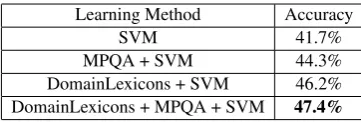
We conducted 4 experiments. In experiment 1, we used the conventional SVM algorithm, in which no lexicon knowledge was incorporated; we refer to this experiment as SVM. In experiment 2, we incorporated only the knowledge encoded in the domain independent MPQA opinion dictio-nary into SVM learning; we refer to this experi-ment as ‘MPQA + SVM’. In experiexperi-ment 3, we in-corporated only the knowledge encoded in the do-main specific lexicons we constructed into SVM learning; we refer to this experiment as
‘Domain-3The stop words we use include copulas and the following
words: take, takes, make, makes, just, still, even, too, much, enough, back, again, far, same
Lexicons + SVM’. In experiment 4, we incorpo-rated both the knowledge encoded in the MPQA and the domain specific lexicons we constructed into SVM learning; we refer to this experiment as ‘DomainLexicons + MPQA + SVM’. All of our results are based on 10-fold cross-validation, and they are summarized in Table 1.
The results in Table 1 show that incorporat-ing both the domain independent MPQA lexicon and the domain specific lexicons that we built achieves the best overall performance. Of these two types of lexicon, incorporating the domain specific lexicons is more effective, as they con-tributed the most to the improvement of the clas-sification accuracy. The improvement achieved by our approach is statistically significant withp
<0.000001 according to paired t-test.
Learning Method Accuracy
SVM 41.7%
MPQA + SVM 44.3%
[image:6.595.325.506.302.363.2]DomainLexicons + SVM 46.2% DomainLexicons + MPQA + SVM 47.4%
Table 1: Overall Performance Comparison
Our results reported in Table 2 further illustrate that incorporating lexicon knowledge with SVM learning significantly improves both the accuracy for camera aspect classification and the accuracy for polarity classification. Both improvements are statistically significant with p <0.000001 and p <0.05 respectively according to paired t-test.
Learning Method Aspect Accuracy Polarity Accuracy
SVM 47.1% 65.6%
DomainLexicons + MPQA + SVM 56.2% 66.8%
Table 2: Breakdown Performance Comparison
6 Conclusions
References
A. Andreevskaia and S. Bergler. 2008. When special-ists and generalspecial-ists work together: overcoming do-mian dependence in sentiment tagging. In Proceed-ings of ACL.
John Blitzer, Mark Dredze, Fernando Pereira. Bi-ographies, Bollywood, Boom-boxes, and Blenders. 2007. Domain adaptation for sentiment classifica-tion. InProceedings of the Association for Compu-tational Linguistics (ACL).
Chih-Chung Chang and Chih-Jen Lin, 2001.
LIBSVM: A Library for Support Vec-tor Machines. Software available at http://www.csie.ntu.edu.tw/ cjlin/libsvm.
Yan Dang, Yulei Zhang, and Hsinchun Chen. 2010. A lexicon enhanced method for sentiment classifi-cation: An experiment on online product reviews.
IEEE Intelligent Systems, 25.
A. Fahrni and M. Klenner. 2008. Old wine or warm beer: target-specific sentiment analysis adjectives. InSymposion on Affective Language in Human and Machine, AISB Convention.
Christiane Fellbaum, editor. 1998. Wordnet: An Elec-tronic Lexical Database. MIT Press, Cambridge, MA.
Michael Gamon. 2004. Sentiment classification on customer feedback data: noisy data, large feature vectors, and the role of linguistic analysis. In Pro-ceedings of the COLING.
V. Hatzivassiloglou and F. Sebastiani. 1997. Predicting the semantic orientation of adjectives. In Proceed-ings of ACL.
M. Hu and B. Liu. 2004. Mining and summarizing customer reviews. InProceedings of the KDD. V. Jijkoun, M.d. Rijke, and W. Weerkamp. 2010.
Gen-erating focused topic-specific sentiment lexicon. In
Proceedings of ACL.
S.-M. Kim and E. Hovy. 2004. Determining the senti-ment of opinions. InProceedings of the COLING. N. Kobayashi, K. Inui, Y. Matsumoto, K. Tateishi, and
T. Fukushima. 2004. Collecting evaluative expres-sions for opinion extraction. InProceedings of IJC-NLP.
Bing Liu. 2007. Web Data Mining. Springer, New York.
Prem melville, Wojciech Gryc, and Richard D. Lawrence. 2009. Sentiment analysis of blogs by combining lexical knowledge with text classifica-tion. InProceedings of the KDD.
Saif Mohammad, Cody Dunne, and Bonnie Dorr. 2009. Generating high-coverage semantic orienta-tion lexicons from overtly marked words and a th-easaurus. InProceedings of the EMNLP.
Bo Pang, Lillian lee, and shivakumar Vaithyanathan. 2002. Thumbs up? sentiment classification using machine learning techniques. InProceedings of the EMNLP.
A.M. Popescu and O. Etzioni. 2005. Extracting prod-uct features and opinions from reviews. In Proceed-ings of HLT/EMNLP.
C.J. Van Rijsbergen, S.E. Robertson, and M.F. Porter. 1980. New models in probabilistic information re-trieval. Technical report, British Library Research and Development Report, no. 5587.
Vikas Sindhwani and Prem Melville. 2008. Document-word co-regularization for semi-supervised sentiment analysis. In Proceedings of the ICDM.
Janyce Wiebe, Theresa Wilson, and Claire Cardie. 2005. Annotating expressions of opinions and emo-tions in language. Language Resources and Evalu-ation, 39.
Theresa Wilson, Janyce Wiebe, and Paul Hoffmann. 2005. Recognizing contextual polarity in phrase-level sentiment analysis. InProceedings of the HLT-EMNLP.
W.X. Zhao, J. Jiang, H. Yan, and X. Li. 2010. Jointly modeling aspects and opinions with a maxent-lda hybrid. InProceedings of EMNLP.
L. Zhou and P. Chaovalit. 2008. Ontology-supported polarity mining.Journal of the American Society for Information Science and technology, 59.