Tree Adjunction as Minimalist Lowering
Thomas Graf Department of Linguistics University of California, Los Angeles
3125 Campbell Hall
Los Angeles, CA 90095-1543, USA [email protected]
Abstract
Even though Minimalist grammars are more powerful than TAG on the string level, the classes of tree languages the two de-fine are incomparable. I give a constructive proof that if the standard Move operation in Minimalist grammars is replaced byReset Lowering, every TAG tree language can be generated. The opposite does not hold, so the strong generative capacity of Minimal-ist grammars with Reset Lowering exceeds that of TAG.
1 Introduction
The comparison of grammar formalisms with re-spect to their expressive power has been essen-tial to furthering our understanding of their inner workings (Weir, 1988; Joshi et al., 1991; Vijay-Shanker and Weir, 1994). Considering a formal-ism in isolation only takes us so far, it is by con-necting it to other proposals that we see which parts are indispensable, why this is the case, and how they grant the grammar its power.
In recent years, significant attention has been devoted to the comparison of TAG and Minimalist grammars (MGs; Stabler, 2011). These two for-malisms are interrelated in peculiar ways. MGs are weakly equivalent to MCFGs (Michaelis, 1998; Michaelis, 2001; Harkema, 2001) and thus subsume TAG on the string level. But with respect to the tree languages they generate, the two are in fact incomparable (Fujiyoshi and Kasai, 2000; M¨onnich, 1999; M¨onnich, 2006; M¨onnich, 2007; Kobele et al., 2007), due a profound difference in how trees are cut up and reassembled in the re-spective formalisms.
What gives TAGs an edge over MGs is the limited kind of context-free tree manipulation granted by tree adjunction. Tree adjunction slices a tree in half and “glues” it back together with new material inserted in the middle, similar to how context-free string languages insert new sub-strings inside an existing string. This allows TAGs to generate tree languages that satisfy certain context-free path conditions, e.g. that a branch must be of the formanbnwhen read from the root
towards the leaf.
In this paper, I show that the chasm between MGs and TAGs can be overcome by replacing the standard Move operation with Reset Lowering. The idea builds on earlier work of mine in Graf (2012), where I present a general schema for en-riching MGs with new variants of Move without increasing their weak generative capacity. Using Reset Lowering, it is straight-forward to translate (suitably preprocessed) TAG derivation trees into Minimalist derivation trees that encode the same derived trees (moduloempty nodes left behind by movement).
Organization. I first introduce MGs with Reset Lowering in Sec. 2. The presentation is slightly informal, but all technical details can be deduced from Graf (2012). The remainder of the paper is devoted to the translation from TAG to MGs (Sec. 3). After a few remarks on how a given TAG’s elementary trees can be brought in line with the kind of X0-like phrase structure template used by MGs (Sec. 3.2), I describe the actual translation in Sec. 3.3. I also discuss how the out-put of the translation can be guaranteed to be a well-formed Minimalist derivation tree language (Sec. 3.4). Some familiarity with TAG and MGs is presupposed on the reader’s part.
2 Minimalist Grammars with Reset Lowering
MGs are a highly lexicalized framework using two basic operations, Merge and Move. Merge combines two distinct trees and projects a label in an X0-style fashion, whereas Move applies to a single tree t, takes some subtrees oftand puts it into the specifier of the currently highest phrase oft. Every lexical item (LI) is associated with a sequence of Merge and Move features that need to be checked by these operations in the order that they occur in. Both types of features come in two polarities, positive and negative. By convention, every LIlhas exactly one negative Merge feature (itscategory feature), which all ofl’s positive po-larity features must precede and all other nega-tive polarity features must follow. If two LIs have matching features of opposite polarities as their first unchecked feature, the corresponding opera-tion is triggered. By the end of the derivaopera-tion, all features must have been checked off except for the category feature of the LI that projects the root of the tree, which must be a specifically designated
final category.
The MG apparatus can be viewed as a combi-nation of well-formedness conditions on tion trees combined with a mapping from deriva-tion trees to derived trees. Graf (2012) uses this perspective to generalize both components along several dimensions while keeping MGs within the bounds of MCFLs. Three parameters are of in-terest here. First, every positive featuref is also specified for directionality, indicating whether the subtree headed by the LI with the matching fea-ture for f is the left or the right daughter of the root of the newly constructed tree. Second, the size of the constituent carried along by an LI l that undergoes movement is no longer fixed to the entire phrase headed bylbut can be specified ex-plicitly for each feature. Third, the target site of Move is no longer restricted to a c-commanding position; any position that can be picked out by a formula of monadic second-order logic is suffi-cient.
The expanded feature system and the Minimal-ist lexicons one can build from them are defined as follows:
Definition 1. Let BASE be a non-empty finite set of feature names. Furthermore, OP := {merge,move}, POL := {+,−}, SIZE ⊂ N
fi-nite, and DIR := {λ, ρ} are the sets of
opera-tions,polarities,sizes, anddirectionality parame-ters, respectively. Afeature systemis a non-empty setFeat ⊆BASE×OP×POL×SIZE×DIR. Definition 2. Given a string alphabetΣand
fea-ture systemFeat, aMinimalist lexiconis a finite subset ofΣ× {::} ×Feat.
Note that the double colon serves only cosmetic purposes, and that features must still appear in the specific order described at the beginning of the section. Moreover, not all components are always meaningful: SIZEis irrelevant for all Merge fea-tures, DIRfor all negative polarity features.
Derivation trees play a central role in this pa-per. Their leaves are labeled by LIs, while binary branching nodes are labeled Merge and unary branching ones Move. The crucial difference be-tween derivation trees and derived trees is that movement is only indicated by the presence of a Move node marking its target site, while the sub-tree to be displaced remainsin situ(skip ahead to Fig. 1 for an example).
The main duty of derivation trees is to encode the operations of the Minimalist feature calculus. Counting from an LI l towards the root, the i-th node is associated to the i-th positive polar-ity feature ofl (if it exists). Every interior node mode must be associated to exactly one feature of exactly one LI — itsfeature associate— and every positive polarity feature of every LI must be a feature associate of exactly one node. The LI carrying an interior’s node feature associate is also called itslexical associate. Furthermore, there must be a matching feature for every inte-rior node’s feature associate, where two features
matchiff they agree on their name, operation, and size, but have opposite polarities.
In general, there will be many matching fea-tures, but only one of them can be involved in checking off an interior node’s feature associate. How this feature is determined varies between Merge and Move. For a Merge nodenwith lex-ical associate l, it is the category feature of the unique LIl0 6= l that is the lexical associate of a node immediately dominated bynin the deriva-tion tree. Forna Move node, on the other hand, the feature is determined viaoccurrences, where the definition of occurrences depends on the type of movement to be modeled.
movement used throughout this paper,Reset Low-ering. First, thek-root oflis the unique noden such that the shortest descending path fromntol has lengthk. The0-root oflislitself.
Definition 3. A Move nodemassociated to a fea-turef of sizekis apotentiali-occurrence ofliff thei-th negative Move feature oflmatchesfand the k-root of l c-commandsm in the derivation tree. It is a potential occurrence ofliff it is a po-tentiali-occurrence oflfor somei > 0. It is an
i-occurrence ofliff it is a potentiali-occurrence ofland there is nol0 6=lsuch that thek-root ofl c-commandsl0 andnis a potential occurrence of l.
Intuitively, Move nodenis ani-occurrence ofl iffI)lhas the right kind of feature, andII) the root of the subtree to be displaced c-commandsn(i.e. the target site), andIII) no other LI that is closer tonsatisfies requirementsI) andII).
Now the distribution of Move nodes can be reg-ulated by two conditions.
Move. For every LI l with negative Move fea-tures f1, . . . , fn, there exist distinct nodes
m1, . . . , mn such that mi (and no other
node) is thei-th occurrence ofl,1≤i≤n.
SMC. Every Move node is an occurrence of ex-actly one LI.
This ensures in a purely tree-geometric fashion that all movement features in the derivation get checked.1Given a grammarGwith lexiconL, its
Minimalist derivation tree languageis the set of all derivations that can be assembled from items inLand satisfy the conditions above.
Once the occurrences of all LIs l are known, the mapping from derivation trees to derived trees is straightforward. First, a branch is drawn from o to the respectivek-root of l, where ois the i-occurrence oflwith the highest value for i. Af-terwards, the branch from thek-root to its mother is removed, so thatois the only mother of the k-root now. When this has been done for all LIs, any remaining unary branching nodes are given the empty stringεas their second daughter. The proper linearization of the derivation tree is con-trolled by the directionality of the positive fea-1For Reset Lowering, it also implies that every LI has at most one negative movement feature of sizek(otherwise
every Move node c-commanded by itsk-root would count as an occurrence, in violation ofMove).
tures. Finally, it only remains to relabel the in-terior nodes by the distinguished symbols<and >, which point in the direction of the projecting head — an interior node is labeled<iff its feature associate has directionalityρ.
Let us finish with an example grammar for the languageanbn,n≥2. An easy way of generating
it is to create multiple instances of ab and then lower each σ ∈ {a, b} into the specifier of the next lowestσ. The grammar in Fig. 1, withf as its only final category, does just that. For the sake of succinctness, Merge features are given in lower case, Move features in upper case, polarities as superscripts, directionality as subscripts, and size in square brackets.
It should be easy to see that this grammar can be extended toan1. . . ankfor any choice ofk, prov-ing that MGs with Reset Lowerprov-ing trump TAG in terms of weak generative capacity (possible re-strictions will be hinted at in Sec. 3.3.6). The same holds for the weakly equivalent standard MGs, though, yet they cannot generate all TAG tree languages. The translation presented in the next section proves that MGs with Reset Lower-ing can.
3 The Translation Procedure 3.1 Overview
a1)a::A+ρ[0]a-lo− b1)b::Bρ+[0]a-lo+λ b-lo− a2)a::A+
ρ[1]a-lo− b2)b::Bρ+[1]a-lo+λ b-lo−
a3)a::A+ρ[0]b-lo+λ a-mid−A−[1] b3)b::Bρ+[0]a-mid+λ b-mid−B−[1]
a4)a::A+
ρ[1]b-lo+λ a-mid−A−[1] b4)b::Bρ+[1]a-mid+λ b-mid−B−[1]
a5)a::A+ρ[0]b-mid+λ a-mid−A−[1] b5)b::a-hi+λ b-hi−B−[0]
a6)a::A+ρ[1]b-mid+λ a-mid−A−[1] e)ε::b-hi+λ f− a7)a::b-lo+λ a-hi−A−[0]
a8)a::b-mid+λ a-hi−A−[0]
Merge
e Merge
b5 Merge
a8 Merge
Move
b3 Merge
Move
a3 Merge
Move
b2 Move
a2
>
ε >
ε >
ε >
ε >
ε >
<
<
b b b
<
<
[image:4.595.134.462.70.437.2]a a a
Figure 1: Top: Reset Lowering grammar foranbn,n
≥2; Bottom: derivation and derived tree fora3b3
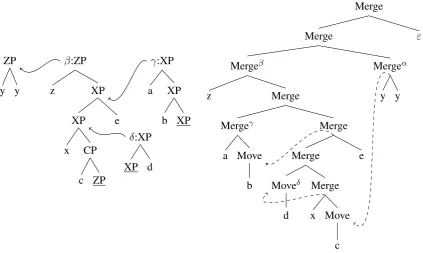
ZP
y y
β:ZP
XP
e XP
CP
ZP c x z
δ:XP
d XP
γ:XP
XP
XP b a
Merge
ε Merge
Mergeα
y y Mergeβ
Merge
Merge
e Merge
Merge
Move
c x Moveδ
d Mergeγ
Move
b a z
[image:4.595.84.508.472.725.2]not overgenerate. This is a simple task, though, thanks to the attractive closure properties of MGs (Graf, 2011; Kobele, 2011).
3.2 Step 1: Preprocessing
We already saw in Sec. 2 that the tree languages derived by MGs are somewhat peculiar in that they are strictly binary branching and follow a projection scheme inspired by X0-theory. While the usual binarization strategies can easily be ap-plied to TAG and need not be discussed here, im-posing projection on an arbitrary TAG is slightly more tricky. Since not all elementary trees of a given TAG may necessarily contain any LIs, there might be no upper bound on the length of the shortest descending path in a derived tree from some interior node to some LI. This is impossi-ble in MGs and thus needs to be prevented. A simple, albeit not particulary elegant solution is to insert empty LIs where necessary. How exactly one goes about this has no bearing on the transla-tion procedure as long as every interior node with a non-terminal symbol is a projection of some LI. Since every TAG is required to obey projection, it makes sense to introduce some extra notation to talk about trees more efficiently. The label of a node n is given by `(n). For every node n, its
head~(n)is the leaflthatnis a projection of. If tis a tree with rootr, then~(t) := ~(r). In the
other direction, π(l) := p1· · ·pn is the string of
all projections of l such that each p1 is the par-ent of l and each pi is immediately dominated
by pi+1, 1 ≤ i < n. A node n is a maximal
projectionofl iffl = nornthe last symbol of π(l). Note thatlcan be its own maximal projec-tion even though it is never included inπ(l). Parts
of trees will sometimes be specified via functional notation such thatf(a, b)is a tree in whichf im-mediately dominatesaandb.
The following terminology will be adopted to avoid confusion brought about the fact that TAG allows for terminal nodes to be decorated with non-terminal symbols: leafs labeled with termi-nal symbols will be referred to as LIs, while non-terminal is used exclusively for interior nodes. Keep in mind that thanks to the projection require-ment the only nodes with non-terminal symbols that aren’t part of some LI’s projection are foot nodes and substitution nodes.
3.3 Step 2: Translating TAG Derivations 3.3.1 Derivation Trees
The translationτ from TAGs to MGs operates at the level of derivation trees, which for TAG are defined as follows. Let E be some finite set of elementary trees andνsome function that assigns eache∈Ea unique name. Aderivation tree over Eis an ordered tree over the (unranked) alphabet
Σ := {ν(e)|e∈E} ×({ε} ∪A), whereA is the smallest set containing an address for every node in everye ∈ E (as a notational shorthand, eis often used instead ofν(e)where convenient). Since everye ∈ E is finite in size andE has fi-nite cardinality, A is finite, too, wherefore Σ is
indeed an alphabet. If nodenin derivation treet is immediately dominated by nodemsuch thatm andnhave labels hu, ai and hv, bi, respectively, that is to be interpreted as treevadjoining in tree u at the node p with address b (we require that this node exists inu). Oftenpwill simply be re-ferred to asb. The second component of a label isεiff it is the label of the root of the derivation tree. Furthermore, if nodesmandnare siblings, their labels must differ in their second component. That is to say, no two trees ever adjoin to the same node, which guarantees that the branching factor of derivation trees is bounded and that there is a unique derived tree language. Note that elemen-tary trees containing foot nodes and substitution nodes must have at least two nodes total. For ev-ery TAGGwith setEof elementary trees, it holds that its derivation tree language is a subset of the set of all derivations overE.
3.3.2 Single Elementary Tree
We start with the simplest case, a derivation treetthat consists of only one nodeu. Note that ucannot contain a foot node or substitution node, for thentwould not be well-formed. Hence every node inuis either an LI or part of the projection of some LI. We convertuinto an MG derivation in two steps.
For every LIninu,φ(n) :=h`(n),merge,−i. If n is a non-terminal and its left daugh-ter d is a maximal projection, φ(n) := h`(~(d)),merge,+, λi. Substitute ρforλifdis the right daughter ofn. Sinceuis binary branch-ing and every non-terminal inumust be a projec-tion of some LI,φis well-defined for all nodes in u.
let µ(n) := `(n) :: φ(p1)· · ·φ(pn) φ(n). For
all non-terminals n, µ(n) is the second compo-nent ofφ(n), which so far is restricted to Merge.
Asφbefore, µis well-defined for all ofu. This carries over to the standard extension of µfrom nodes to trees, which is denoted byµ. It is easy toˆ
see thatµˆmapsuto its corresponding MG deriva-tion. The required feature values are determined by φ — including values for the linear order of nodes — and then instantiated on the heads of the respective projections. Interior nodes are univer-sally labeled Merge. Therefore the derived tree encoded by the Minimalist derivationµˆis
identi-cal tou (under a deterministic relabeling of inte-rior node labels); we may safely setτ(t) := ˆµ(u).
3.3.3 Substitution
Now consider a derivation t in which trees v1, . . . , vn substitute into tree u at addresses
a1, . . . , an(and there is no vj =6 vi, 1 ≤ i ≤ n
that is dominated by u int). Thenu containsn distinct substitution nodess1, . . . , sn, wherenis
bounded by the size of u. By assumption (cf. Sec. 3.2) there are at least two nodes inu. Be-cause substitution nodes must be leaves, this en-tails that eachsi has a parentpi, which is the
pro-jection of some LI.
Letφ(pi) :=h`(~(vi)),merge,+, λ/ρiifsiis
the left/right daughter ofpi. In addition,µ(si) := i. Then τ(hu, ai(hv1, a1i, . . . ,hvn, ani)) is
the result of replacing each i in µˆ(u) by
τ(hvi, aii(t1, . . . , tk)), where t1, . . . , tk are all
the subtrees immediately dominated by vi in t,
k≥0. This yields once again a well-formed
Min-imalist derivation, as the feature instantiation of pi and~(vi) viaφensures for all1 ≤i ≤nthat
~(vi)is selected by~(pi).
3.3.4 Adjunction
Finally, suppose that trees v1, . . . , vn adjoin
into tree u at a1, . . . , an. Each vi contains a
(unique) foot nodefi, which has a mothermithat
is the projection of some LI. This holds because vi consists of at least two nodes and we
prepro-cessed all elementary trees in order to make them projective. Note that for every TAG, adjoiningv at the foot node ofuis equivalent to adjoininguat the root ofv, so we do not consider the case where aiis a foot node. Adjunction at substitution nodes
is superfluous for the same reason and usually for-bidden. The only remaining cases, then, are forai
to be an LI or some projection thereof.
The translation of vi is less involved than
that of u, so it makes sense to discuss it first. For some distinguished symbol, µ(fi) := .
The is used to mark the foot node fi for
deletion by τ. As for mi, we set φ(mi) :=
h◦,move,+,connection(vi)−1i, where ◦ is
some arbitrary feature name. This turnsmi into
a Move node that will serve as the landing site for a subtree inuas sketched in Fig. 2. The function connection(vi)determines the size of the
move-ment feature and returns integerniff the Merge node immediately dominating i in µˆ(u) is the
n-th projection of some node. In order to under-stand why this is the desired value, we need to look at the translation ofunext.
For eachaiinu, a Merge node must be added
immediately above it that serves in selecting vi.
These Merge nodes require new features on~(ai).
Moreover, ~(ai) must also carry the requisite
number of Move features to undergo lowering, and all of them must have the correct size value. This requires special definitions forµ(ai),φ(ai),
andµ(~(ai)), respectively. I only discuss the case
whereaiis an interior node. The procedure forai
an LI is almost the same (see Fig. 3).
The value of φ(ai) is the feature string
[φ]h`(~(vi)),merge,+, λi, where [φ] is what φ
would return ataiif it was a normal non-terminal
(see Sec. 3.3.2). The corresponding part of the Minimalist derivation isµ(ai) :=Merge(i,[µ]),
where[µ]is what µ would return atai if it was
a normal non-terminal. These notational contor-tions emulate the effect of treatingaias usual
ex-cept that a Merge node is added above it that vi
can be attached to.
Due to the complexities of the movement mechanism in the specification of~(ai), this part
is best split out into a separate component. Let ξ(x, n) :=h◦,move,−, δniif someaiis then-th
projection ofx, andεotherwise. The integerδnis
given by| {1≤j < n|ξ(x, j)6=ε} |. As a more compact notation, letξin(x) := ξ(x, n) ξ(x, n−
1)· · ·ξ(x, i + 1) ξ(x, i) be the string con-catenation of the outputs of ξ(x, i), . . . , ξ(x, n)
listed in reverse. Now for π(~(ai)) :=
p1· · ·pz, we define µ(~(ai)) := `(~(ai)) ::
φ(p1)· · ·φ(pz)φ(~(ai))ξ1z(~(ai)).
The peculiar formula forδnstems from a
fea-ture’s size plays an essential role in the mapping from derivation trees to derived trees by virtue of picking out the root of the moved subtree. For our purposes, a size value j should refer to the j-th projection of ~(ai) in u. But the mapping
to derived trees operates over Minimalist deriva-tion trees, and since µ adds new projections for ~(ai), that node’s j-th projection in u might be
itsk-th projection in the corresponding Minimal-ist derivation tree fragmentµˆ(u),k > j(see also Fig. 2). In order to correctly computej, though, it suffices to know how many of the lower projec-tions have been expanded into two Merge nodes rather one, which can be deduced from the num-ber of values that aren’t mapped to the empty string byξ.
There is still one minor problem pertaining to adjunction at the root node of u when u is also the root of the derivation tree t. In this case, ~(u)won’t get its category featurehl,merge,−i checked, so it cannot undergo movement. This can be fixed by adding another LI on top of the derivation, as was done for the example grammar in Fig. 1: Foraithe root ofu,uthe root oft, andf
some feature name,µ(ai) := Merge(Merge, ε ::
h`(~(ai)),merge,+, λi hf,merge,−i).
With these pitfalls out of the way, it only remains for us to assemble the individ-ual outputs of µ into a coherent derivation: τ(hu, ai(hv1, a1i, . . . ,hvn, ani)) is the result of
deleting every node labeledinµ(u)and
replac-ing eachias before.
3.3.5 Putting it All Together
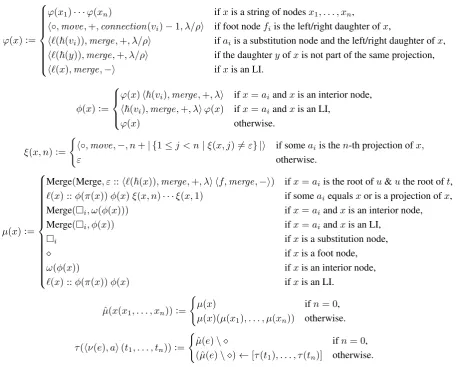
The full specification of the translation proce-dure is given in Fig. 3. For a little bit of extra rigor, φ has been split into two functions, while space restrictions forced the use of additional no-tational shorthands. The result of removing all in-stances offrom treeu is denoted byu\ , and u ← [t1, . . . , tn] is the tree obtained fromu by
replacing eachi byti. Given a featuref,ω(f)
is the second component off, i.e. the type of op-erationfregulates.
Several parameters must be kept track of in order for the functions to be well-defined. They are the current tree u, and its deriva-tional daughters v1, . . . , vi with their respective
addresses a1, . . . , an. In addition, computing
connection(vi)requires access to the derivational
mother o of u, or alternatively, storage of the
value during the computation ofo. The (locally bounded) passing around of these parameters is not made explicit in the definitions in order to minimize notational clutter.
3.3.6 Correctness
The correctness of the translation for single node derivations as well as instances of substitu-tion has already been established. It should also be clear that all cases of adjunction yield an out-put, soτ is at least well-defined. Moreover, these outputs are definitely Minimalist derivation trees. It still needs to be shown, though, that they are well-formed and that the intended derived tree can be obtained from them. The former depends on whetherMove and SMC are satisfied. The lat-ter follows rather straight-forwardly if this is the case.
The definition of Reset Lowering entails that every Move nodem is an occurrence for at most one LI. Otherwise, there would be two LIsl6=l0 whosek-th projections both c-commandm with-out at least one c-commanding the other, which is impossible (k is the size value of the feature as-sociate ofm). That there is at least one LIl for everymfollows from the definition of µ, which inserts the tree containingmas the sister of the k-root ofl. The corresponding negative movement is also instantiated onlat the right position of the feature string. ThusSMCalways holds.
Moveis satisfied, too, because LIl contains a negative movement feature iff it selects a tree con-taining the required Move nodem. Said tree can-not contain acan-nother LIl0thatmis a potential oc-currence for, because then there would also be an-other Move nodem0. This argument can be con-tinued until eventually there must be a Move node that isn’t an occurrence for any LI, or for more than one. Either case violates SMC, yielding a contradiction.
As a result of all this, the Move node in tree
ˆ
µ(vi)is an occurrence of~(ai), and for every
neg-ative Move feature on an LI there is an occurrence msuch that lowering tomyields the same derived tree as adjunction. That this ensures the gener-ation of the correct derived tree (modulo empty nodes left behind by movement) only requires a short proof by induction.
ϕ(x) :=
ϕ(x1)· · ·ϕ(xn) ifxis a string of nodesx1, . . . , xn,
h◦,move,+,connection(vi)−1, λ/ρi if foot nodefiis the left/right daughter ofx,
h`(~(vi)),merge,+, λ/ρi ifaiis a substitution node and the left/right daughter ofx,
h`(~(y)),merge,+, λ/ρi if the daughteryofxis not part of the same projection, h`(x),merge,−i ifxis an LI.
φ(x) :=
ϕ(x)h~(vi),merge,+, λi ifx=aiandxis an interior node,
h~(vi),merge,+, λiϕ(x) ifx=aiandxis an LI,
ϕ(x) otherwise.
ξ(x, n) := (
h◦,move,−, n+| {1≤j < n|ξ(x, j)6=ε} |i if someaiis then-th projection ofx,
ε otherwise.
µ(x) :=
Merge(Merge, ε::h`(~(x)),merge,+, λi hf,merge,−i) ifx=aiis the root ofu&uthe root oft,
`(x) ::φ(π(x))φ(x)ξ(x, n)· · ·ξ(x,1) if someaiequalsxor is a projection ofx,
Merge(i, ω(φ(x))) ifx=aiandxis an interior node,
Merge(i, φ(x)) ifx=aiandxis an LI,
i ifxis a substitution node,
ifxis a foot node,
ω(φ(x)) ifxis an interior node,
`(x) ::φ(π(x))φ(x) ifxis an LI.
ˆ
µ(x(x1, . . . , xn)) :=
(
µ(x) ifn= 0,
µ(x)(µ(x1), . . . , µ(xn)) otherwise.
τ(hν(e), ai(t1, . . . , tn)) :=
( ˆ
µ(e)\ ifn= 0,
[image:8.595.70.528.78.445.2](ˆµ(e)\ )←[τ(t1), . . . , τ(tn)] otherwise.
Figure 3: Definition of the translation from a TAG derivation t to the corresponding Minimalist derivation;
where multiple conditions are satisfied at once, only the highest one applies; see Sec. 3.3.5 for an explanation of notation.
MGs satisfying this condition are weakly equiva-lent to TAGs (as Graf, 2012 erroneously does). However, even with just one feature name Reset Lowering MGs can still generate an
1, . . . , ank for
arbitraryk. This is so because features with dif-ferent size values are considered distinct bySMC despite their identical feature name. For example, the grammar in Fig. 1 can be made to use only one feature name by having b merge with an empty head before selecting aso that the size value of its movement feature can always be one bigger than that ofa’s. If this loop-hole can be patched, though, a weak equivalence proof seems feasible.
3.4 Step 3: Intersection
The correctness of the translation only entails that the output of τ applied to a TAG derivation is a Minimalist derivation that can be mapped to the intended derived tree. Nothing so far
guar-antees that translating the TAG derivation tree language actually yields a Minimalist derivation tree language (MDTL), as not every set of well-formed Minimalist derivations is a well-well-formed MDTL. The closure of MDTLs under intersec-tion with regular tree languages (Graf, 2011; Ko-bele, 2011), however, makes it straight-forward to construct an MDTL from the output of the trans-lation.
It is a well-known fact that the image of a reg-ular tree language under a linear transduction is also regular (G´ecseg and Steinby, 1984), andτ is exactly such a (non-deterministic) transduction.2
As TAG derivation tree languages are regular, so is the tree language produced by τ applied to a given TAGGT. Now let GM be the MG whose
lexicon contains every LI that occurs in some tree
in τ(GT). The intersection of GM’s derivation
tree language with τ(GT) yields the MDTL of
some MG that generates the same derived trees asGT.
4 Conclusion
I have given a productive proof via a translation procedure that MGs with Reset Lowering instead of standard Move can generate all TAG tree lan-guages. I also showed that they are more powerful than TAGs on a string level, but a stronger version ofSMCmight actually be sufficient to make the two formalisms equivalent in this respect. For fu-ture work, it will be interesting to see if the trans-lation can be extended to generalizations of TAG such as the one in Rogers (2003). If so, this would be an indication that the relation between adjunc-tion and Reset Lowering isn’t merely accidental but provides a fresh perspective on TAG.
Acknowledgments
My sincerest thanks go to Ed Stabler and Michael Freedman for earlier discussions of the material, as well as the three anonymous reviewers for their helpful comments that lead to several improve-ments in the presentation of the material.
References
A. Fujiyoshi and T. Kasai. 2000. Spinal-formed context-free tree grammars. Theory of Computing Systems, 33:59–83.
Thomas Graf. 2011. Closure properties of minimal-ist derivation tree languages. In Sylvain Pogodalla and Jean-Philippe Prost, editors, LACL 2011, vol-ume 6736 ofLecture Notes in Artificial Intelligence, pages 96–111.
Thomas Graf. 2012. Movement-generalized minimal-ist grammars. In Denis B´echet and Alexander J. Dikovsky, editors,LACL 2012, volume 7351 of Lec-ture Notes in Computer Science, pages 58–73. Ferenc G´ecseg and Magnus Steinby. 1984. Tree
Au-tomata. Academei Kaido, Budapest.
Henk Harkema. 2001. A characterization of min-imalist languages. In Philippe de Groote, Glyn Morrill, and Christian Retor´e, editors, Logical As-pects of Computational Linguistics (LACL’01), vol-ume 2099 ofLecture Notes in Artificial Intelligence, pages 193–211. Springer, Berlin.
Aravind Joshi, K. Vijay-Shanker, and David Weir. 1991. The convergence of mildly context-sensitive grammar formalisms. In P. Sells, Shieber S. M., and
T. Warsow, editors, Foundational Issues in Natu-ral Language Processing, pages 31–81. MIT Press, Cambridge, MA, USA.
Gregory M. Kobele, Christian Retor´e, and Sylvain Sal-vati. 2007. An automata-theoretic approach to min-imalism. In James Rogers and Stephan Kepser, ed-itors,Model Theoretic Syntax at 10, pages 71–80. Gregory M. Kobele. 2011. Minimalist tree languages
are closed under intersection with recognizable tree languages. In Sylvain Pogodalla and Jean-Philippe Prost, editors,LACL 2011, volume 6736 ofLecture Notes in Artificial Intelligence, pages 129–144. Jens Michaelis. 1998. Derivational minimalism is
mildly context-sensitive.Lecture Notes in Artificial Intelligence, 2014:179–198.
Jens Michaelis. 2001. Transforming linear context-free rewriting systems into minimalist grammars.
Lecture Notes in Artificial Intelligence, 2099:228– 244.
Uwe M¨onnich. 1999. On cloning context-freeness. In Hans-Peter Kolb and Uwe M¨onnich, editors, Math-ematics of Syntactic Structure, pages 195–231. Wal-ter de GruyWal-ter, Berlin.
Uwe M¨onnich. 2006. Grammar morphisms. Ms. Uni-versity of T¨ubingen.
Uwe M¨onnich. 2007. Minimalist syntax, multi-ple regular tree grammars and direction preserving tree transductions. In James Rogers and Stephan Kepser, editors, Model Theoretic Syntax at 10, pages 83–87.
James Rogers. 2003. Syntactic structures as multi-dimensional trees. Research on Language and Computation, 1(1):265–305.
Edward P. Stabler. 2011. Computational perspectives on minimalism. In Cedric Boeckx, editor, Oxford Handbook of Linguistic Minimalism, pages 617– 643. Oxford University Press, Oxford.
K. Vijay-Shanker and David J. Weir. 1994. The equiv-alence of four extensions of context-free grammars.
Mathematical Systems Theory, 27:511–545. David Weir. 1988. Characterizing Mildly