Recurrent Neural Network with Word Embedding for Complaint
Classification
Panuwat Assawinjaipetch, Virach Sornlertlamvanich
School of Information, Computer, and Communication Technology (ICT),
Sirindhorn International Institute of Technology,
Khlong Nung, Khlong Luang District, Pathum Thani, Thailand
[email protected], [email protected]
Kiyoaki Shirai
School of Information Science,
Japan Advanced Institute of Science and
Technology (JAIST),
1-1 Asahidai, Nomi,
1-2 Ishikawa 923-1292, Japan
[email protected]
Sanparith Marukata
National Electronics and Computer Tech-
nology Center (NECTEC)
112 Phahonyothin Road, Klong Neung,
Klong Luang District,
Pathumthani, Thailand
[email protected]
Abstract
Complaint classification aims at using information to deliver greater insights to enhance user experience after purchasing the products or services. Categorized information can help us quickly collect emerging problems in order to provide a support needed. Indeed, the response to the complaint without the delay will grant users highest satisfaction. In this paper, we aim to deliver a novel approach which can clarify the complaints precisely with the aim to classify each complaint into nine predefined classes i.e. acces- sibility, company brand, competitors, facilities, process, product feature, staff quality, timing respec- tively and others. Given the idea that one word usually conveys ambiguity and it has to be interpreted by its context, the word embedding technique is used to provide word features while applying deep learning techniques for classifying a type of complaints. The dataset we use contains 8,439 complaints of one company.
1
Introduction
2
Related works
2.1 Text classification
The collection of complaints is clearly described in negative sense. Hence, sentiment analysis ap- proaches will not work efficiently for this task, especially for the methods which rely on the counts of positive and negative words. The similar work to us is a claim classification introduced by J. Park (2014). The high accuracy model that can distinguish; verifiable with evidence, verifiable without evi- dence and unverifiable claims, is achieved by using n-gram, handcrafted features and SVM. However, the feature preparing task required prior knowledge of the language. Moreover, the handcrafted fea- tures extraction is a very time consuming task and cannot be applied to every language because of the difference between grammars.
2.2 Word2Vec
The word embedding technique recently becomes the most dominant in terms of the power in expand- ing the meaning of each word by using its co-occurrence statistics of each word. In the previous half decade of the research since R. Collobert (2011), the results show that the word and phrase embeddings significantly boost the performance in many of NLP tasks such as syntactic parsing (D. Zeng, 2014) and sentiment analysis (R. Socher, 2013). Introduced by T. Mikolov (2013), Word2Vec has gained a lot of traction as it takes a very short time for training while providing a high quality of word embeddings information. The tool can be derived into two types that are skip-gram model or continuous bag-of-words model, with an optimization method such as negative sampling or hierar- chical softmax. As in the recent research on Word2Vec, we found that skip-gram with negative sampling is the best match to our data as the number of complaints is limited. This model shows a bet- ter performance compared to bag-of-words while negative sampling is a most efficient method to de- rive the word embedding. The objective function (Y. Goldberg, 2014) used to generate the word em- bedding is described in Equation (1) where w is the words, c is the set of contexts of word w. D is the set of all word and context pairs and D’ is a set of randomly negative samples.
(1)
2.3 Long Short-Term Memory
Considering complaint classification is a sequence prediction, RNN become much useful in terms of discovering the long-term dependencies. However, the learning of long-term dependencies with gradi- ent descent is very difficult as stated by Y. Bengio et al. (1994). The reason occurs from the vanishing gradient problem which causes the backpropagation through time to repeatedly multiply the gradient value. If the amplitude of the gradient is lower than one then the repetition of multiplying it will push this value towards zero. Therefore, the model cannot learn long-term dependency when we adjust a new value using gradient descent method. LSTM is kind of RNN which has been introduced since 1997 by S. Hochreiter et al. (1997) that prevents vanishing gradient from occurring. For LSTM, Cell state (Ct) are connected to three gates which are forget gate (ft), input gate (it) and output gate (ot) re-
spectively. Equation used to calculate these gates are shown in Equation (2), (3) and (4) respectively.
f
t=
sigmoid(W
f ∙[h
t-1, x
t] + b
f)
(2)
i
t=
sigmoid(W
i ∙[h
t-1, x
t] + b
i)
(3)
C¯t=
tanh(W
C ∙[h
t-1, x
t] + b
C)
C
t=
f
t* C
t-1+ i
t*
C¯to
t=
sigmoid(W
o ∙[h
t-1, x
t] + b
o)
2.4 Gated Recurrent Unit
[image:3.595.136.460.170.299.2]Gate Recurrent Unit is a method proposed recently by K. Cho et al. (2014), with the ability to capture the long-term dependencies as LSTM. Figure 1 shows the difference between GRU and LSTM that GRU uses one less gate than LSTM. LSTM has i, f and o as input, forget and output gates respective- ly. C and C¯ denote the current/new memory cell content. On the other hand, GRU only has r and z as reset and update gates. The h and h¯ are the current and candidate activation gates respectively.
Figure 1: Illustration of LSTM and GRU
The model is designed to make each recurrent unit to be able to adaptively capture dependencies in a different time scale. It is similar to LSTM unit by having gating units that calibrate the information flow at the inside unit without creating new memory cells. We can compute updated gate (z), reset gate (r), hidden state (h) and current state (st) of the GRU at time t using Equation (5), (6), (7) and (8).
For the pros and cons other than GRU has one less gate than LSTM which results that GRU consume less memory, there is no concrete proof shows superiority of one to another.
z
=
sigmoid(x
tU
z+ s
t-1W
z)
(5)
r
=
sigmoid(x
tU
r+ s
t-1W
r)
(6)
h
=
tanh(x
tU
h+ (s
t-1 ∙r)W
h)
(7)
s
t=
((1 - z)
∙h) + (z
∙s
t-1)
(8)
2.5 Our work
As discussed above, there are several attempts in using the neural network model with word embed- ding technique for basic task in NLP such as sentiment analysis and syntactic parsing i.e.
A. Severyn
(2015), C.N. dos Santos (2014) and M. Ghiassi (2013)
. However, there has a few research works using RNNs (S. Lai, 2015) and Bidirectional RNNs (O. Irsoy, 2014
) with word embedding for text classification rather than sentiment analysis. The current research of document classification still mostly uses the so-called TF-IDF as it is a straightforward approach, for example, the word such asstock tends to appear more in economic documents than politic documents. Also it can be efficiently implemented and be improved by gathering more data that related to it. However, Word2Vec is be- lievably considered to provide a better word features than TF-IDF.
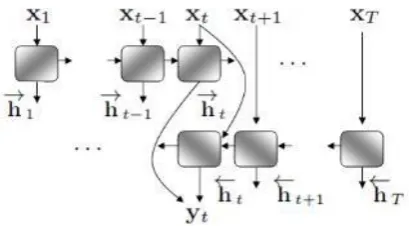
Figure 2: Unfold RNN for bidirectional.
3
Method
In our complaint classification model, the model must be able to distinguish the between nine classes that are Accessibility, Company brand, Competitor, Facility, Process, Product feature, Staff quality,
Timing and Others. Each input of the model is a text contains one complaint that is passed through the preprocessing step, embedding step, neural network layer, and max pooling the output to select the category which it belongs to. The complaint classes are defined as following.
Accessibility is the complaint regarding the rarity to acquire products or services.
Company brand is the complaint about reliability of the company.
Competitor is the complaint that mentions about the business competitor in terms of comparison.
Facility is a complaint related to the difficulty from the uses of products or services.
Process is a complaint about the complexity of the procedure.
Product feature is a complaint about promotions or privileges.
Staff quality is a complaint about human resource in the department.
Timing is a complaint about the waiting time during using products or receiving services.
Others are complaints which could not be classified in any group.
Our proposed method consists of the word segmentation, word representation generating and neural network modules that are sequentially applied.
3.1 Word Segmentation
Thai language has no punctuation marks and no spacing in a sentence. So in the preprocessing step,
word segmentation is one of the most crucial steps needed in order to be able to generate an input for Word2Vec. The successfully preprocessing result can lead to a high accurate word unit which is used to generate the word representation. On the other hand, the low accurate preprocessing results in a low accurate word representation and deteriorate a prediction model trained in the succeeding steps. Our preprocessing uses the existing dictionary to handle the word segmentation with error handling ex- pression such as typos prevention, unnecessary symbols and whitespaces removing.
3.2 Word Representation Generating
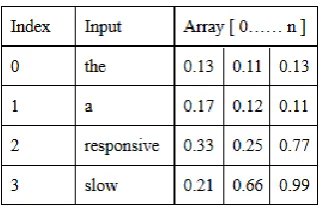
Table 1: Index mapping to the word and array representing each word.
3.3 Neural Network Layer
RNNs are introduced in our approach, it is important to keep input as a matrix shaped fit for training. The output from Word2Vec looks like a dictionary of each word mapped to a list of array.
The complaint sentences are usually not very long so we can take the longest sentence to determine the maximum number of word in a sentence. The sentences which are shorter than the maximum length must be padded1 to make it become 30 words sentence. Then we map these words to embed- ding layer and connect it directly to a hidden layer of 64 units of neural network models i.e. fnn, gru,
lstm, gru-gru, lstm-gru, gru-lstm and lstm-lstm. Finally, the outputs from our hidden layer are connect- ed to the softmax layer of predefined classes on top, of it as the shown in Figure 3.
Figure 3: a) Bidirectional LSTM/GRU. b) Single direction LSTM/GRU architectures for 9-classes complaint classification.
4
Experiment
To conduct an empirical evaluation of our proposed method, we compare it with the traditional TF- IDF model and also other popular machine learning model such as Feedforward Neural Network (FNN), LSTM and also try with a different combination of LSTM and GRU with the same training and test set.
F1 score is used to evaluate our result. With our data about 8,439 complaints annotated in nine clas- ses, we separate our data into 80% and 20% for training and testing respectively. Therefore, we have 6,755 and 1,684 sentences for using in training set and test set respectively.
By using Bag-of-Words with TF-IDF, we can get the F1 score for prediction reach only about 75%, which all of Embedding Layer with Neural Network hidden layer can completely surpass this F1 score after a few epochs of training.
[image:5.595.86.545.331.503.2]ding we can achieve is obtained by using 100 dimensions for word embedding with ADAM (D. Kingma, 2014) optimization.
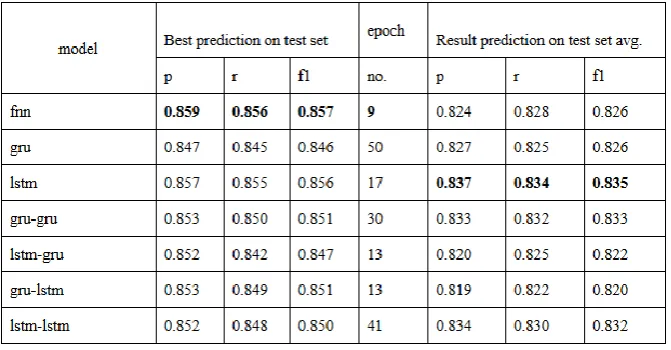
After running both training and test sets with fnn with 64 hidden units, the highest accuracy on training set can almost get a perfect score on training set with a fastest convergence, but, for a test set, it barely passed 80% which given the lowest F1 score among all other neural network models. By in- creasing the number of hidden units, the gap of F1 score between training set and test set keeps in- creasing.
[image:6.595.137.473.235.410.2]LSTM and GRU are experimented with the same number of hidden units. The F1 score of the pre- diction is clearly better than MLP. There is no doubt that it can find a long term dependency between words. In addition, the model is able to Figure out some combination order of words used to classify an output class. Also, it seems likely that GRU converges a little bit faster than LSTM, while the pre- diction is almost on par, but much more stable for a long term training as shown in Figure 4a.
Table 2: Comparison result of NN model between best and average results.
Furthermore, the lstm-lstm, gru-gru, lstm-gru and gru-lstm combinations are experimented in bidi- rectional architectures phase. The bidirectional GRU and LSTM are converged faster and more accu- rate than the composition between LSTM and GRU. Also, the F1 score is same as a single direction LSTM or GRU. However, the bidirectional models sometime provide better results than the single di- rection average results and also converge much faster as shown in Figure 4b.
Figure 4: Comparison of F1 score. a) FNN, LSTM and GRU. b) Combination of LSTM-GRU
5
Conclusion
In this paper, we present the word embedding used for complaint classification which combine with recurrent neural network LSTM and GRU with a single direction and also bidirectional. Our evalua- tion focuses on the comparison of F1 score between various combinations of bidirectional LSTM- GRU. Bidirectional recurrent neural network can surpass the traditional method, TF-IDF (75% F1 score) while using the same amount of training data. The usage time for training is dependent upon the processing unit. It requires about 2-3 hours for the training with a graphic processing unit NVIDIA 660M with 8 GB RAM with 64 word dimensions and 64 hidden units for each architecture. But the execution time requires a few second to predict each sentence.
The bidirectional model tends to work better when it is combined with the same kind of network. We consider this approach as our preliminary step for extending our research further to have better understanding in bidirectional GRU and LSTM characteristic.
Although, bidirectional approach shows no significant result comparing to those single direction GRU and LSTM, but it converges much faster. We also found that the misclassification occurs from the multi-class relevance sentence such as ‘The staff has a low responsiveness which results in the
process took so long’. The problem defined here is one of our consideration to replace the last activation layer of the model with sigmoid function instead of softmax function.
So, it is still too early to decide that the backward dependency is completely not needed. The model improvement could be achieved by an increment of corpus and a better preprocessing step. The recursive neural network is also one of our options, as it shows a very good result in a sentiment analysis task recently.
6
Acknowledgement
This research is financially supported by National Science and Technology Development Agency (NSTDA), National Electronics and Computer Technology Center (NECTEC), Japan Advanced Institute of Technology (JAIST), Sirindhorn International Institute of Technology (SIIT), Thammasat University (TU). Also, special thanks to Feedback180 Co., Ltd. for the corpus and verification of the experiment correctness.
References
L. Yao, A. Torabi, K. Cho, N. Ballas, C. Pal, H. Larochelle, A. Courville. 2015. Describing videos by exploiting temporal structure. In Proceedings of the IEEE International Conference on Computer Vision. pages 4507–4515.
Y. Kim, Y. Jernite, D. Sontag, A. M. Rush. 2015. Character-aware neural language models. arXiv:1508.06615.
S. Hochreiter, Y. Bengio, P. Frasconi, J. Schmidhuber. 2001. Gradient flow in recurrent nets: the dif- ficulty of learning long-term dependencies. In S. C. Kremer and J. F. Kolen, editors, A Field Guide to Dynamical Recurrent Neural Networks. IEEE.
J. Park, C. Cardie. 2014. Identifying Appropriate Support for Propositions in Online User Comments. Proceedings of the First Workshop on Argumentation Mining, pages 29–38, Baltimore, Maryland USA.
R. Socher, J. Bauer, C. D. Manning, A. Y. Ng. 2013. Parsing with Compositional Vector Grammars. ACL.
R. Socher, A. Perelygin, J. Y. Wu, J. Chuang, C. D. Manning, A. Y. Ng, C. Potts. 2013. Recursive Deep Models for Semantic Compositionality Over a Sentiment Treebank. EMNLP.
D. Zeng, K. Liu, S. Lai, G. Zhou, J. Zhao. 2014. Relation Classification via Convolutional Deep Neu- ral Network. In Proceedings of the 25th International Conference on Computational Linguistics (COLING), pages 2335–2344, Dublin, Ireland.
Y. Bengio, P. Simard, and P. Frasconi. 1994. Learning Long-Term Dependencies with Gradient De- scent is Difficult. IEEE Transaction on Neural Network. Vol. 5, No. 2.
S. Hochreiter, J. Schmidhuber. Long Short-Term Memory. Neural Computation 9 (8): 1735-1780, 1997.
K. Cho, B. van Merrienboer, D. Bahdanau, and Y. Bengio. 2014. On the properties of neural machine translation: Encoder-decoder approaches. arXiv:1409.1259.
M. Schuster, K. K. Paliwal. 1997. Bidirectional Recurrent Neural Networks. IEEE Transaction on signal processing. vol. 45. No. 11.
D. P. Kingma, J. L. Ba. 2015. ADAM: A method for stochastic optimization. ICLR 2015. arXiv:1412.6980.
R. Collobert, J. Weston, L. Bottou, M. Karlen, K. Kavukcuoglu, P. Kuksa. 2011. Natural Language Processing (Almost) from Scratch. Journal of Machine Learning Research, 12:2493-2537.
Y. Goldberg and Omer Levy. 2014. word2vec explained: deriving mikolov et al.’s negative sampling word-embedding method. arXiv:1402.3722.
S. Lai, L. Xu, K. Liu, J. Zhao. 2015. Recurrent Convolutional Neural Networks for Text Classifica- tion. In Proc. Conference of the Association for the Advancement of Artificial Intelligence (AAAI). O. Irsoy, C. Cardie. 2014. Opinion Mining with Deep Recurrent Neural Networks. In Proceedings of the 2014 Conference on Empirical Methods in Natural Language Processing (EMNLP), pp. 720– 728, Doha, Qatar. Association for Computational Linguistics.
C. N. dos Santos, Cicero, M. Gatti. 2014. Deep convolutional neural networks for sentiment analysis of short texts. In Proceedings of COLING 2014, the 25th International Conference on Computa- tional Linguistics: Technical Papers, pp. 69–78.
A. Severyn, A. Moschitti. 2015. Twitter sentiment analysis with deep convolutional neural networks.
In Proceedings of the 38th International ACM SIGIR Conference on Research and Development in Information Retrieval. pages 959–962.