Effect of Low Temperature Aging on Superelastic Behavior
in Biocompatible
TiNbSn Alloy
F. Nozoe
1, H. Matsumoto
1, T. K. Jung
1, S. Watanabe
1, T. Saburi
2and S. Hanada
1 1Institute for Materials Research, Tohoku University, Sendai 980-8577, Japan 2Osaka University, Suita 565-871, Japan
Superelasticity ofTi-16 at%Nb-4.8 at%Sn alloy consisting of non- (or minimal-) cytotoxic elements was investigated for biomedical applications as functions of deformation temperature and aging heat treatment after quenching. As-quenched Ti-16Nb-4.8Sn havingAf(the reverse martensitic transformation finish temperature) of 266 K exhibits superelasticity at human body temperature (310 K) with an elastic recovery strain of 3.2%.Afdecreases with increasing aging temperature in the range of 353 to 423 K or with increasing aging time at 423 K. It is confirmed from TEM observation and Young’s modulus measurements that!transformation occurs on aging at 423 K for 500 h. Stress for inducing martensitic transformation,M, increases with aging. Stress-strain curves showing superelasticity are quite similar to each other when as-quenched or aged samples are deformed at such temperatures that they have the sameM. It is concluded that maximum superelastic recovery strain can be obtained at intended temperature,e.g.human body temperature, inTi-Nb-Sn alloys by aging at relatively low temperatures. [doi:10.2320/matertrans.MER2007182]
(Received July 31, 2007; Accepted September 5, 2007; Published October 18, 2007)
Keywords: titanium-niobium-tin alloy, martensitic transformation, superelasticity, biomaterial, aging
1. Introduction
Recently, shape memory and superelastic behavior have been reported in many Ni-free Ti alloys, such as Ti-Mo-Al,1)Ti-Nb-Sn,2,3)Ti-Mo-Ga,4)Ti-Nb-Al,5,6)Ti-Nb7)and Ti-Nb-Zr-Sn8)to substitute for TiNi shape memory alloy. These studies originate from allergenic or carcinogenic problems which may be caused when Ni-containing alloys are implanted in the human body. Among the developed alloys,
Ti-Nb-Sn alloys are promising because of good biocom-patibility and excellent cold workability in contrast to TiNi alloys as well as other TiNb- and TiMo-based alloys. However,TiNbSn alloys have a higher melting temperature than TiNi alloys. Therefore chemical segregation of the constituent elements may occur during solidification of a large ingot. As shown by Takahashi et al.,2) martensitic
transformation temperatures (Ms and Mf) and its reverse
transformation temperatures (AsandAf) in TiNbSn alloys are
very sensitive to alloy composition in a similar manner to TiNi alloys. Although hot and cold heavy working, followed by heat treatment at elevated temperature, can lead to alloy homogenization, this approach may not be able to achieve the intended composition in a large ingot. In biomedical applications of shape memory or superelastic TiNbSn alloys, it is indispensable to establish to precisely control the transformation temperatures.
The objective of this paper is to examine the superelastic behavior of TiNbSn alloy and to establish alloy compo-sition and heat treatment procedures for superelasticity working at human body temperature for biomedical applica-tions.
2. Experimental Procedure
Ti-16 at%Nb-(4.0, 4.7, 4.8 and 4.9 at%Sn) alloys were arc-melted in an Ar atmosphere using high purity Ti (99.999 mass%), Nb (99.999 mass%) and Sn (99.999 mass%). Each button has a weight of about 80 g. Since weight changes
before and after the arc-melting were less than 50 mg, the alloy compositions will be denoted hereafter by nominal compositions. Oxygen content in the buttons was 100– 300 massppm and nitrogen and carbon contents were less than 100 massppm. The arc-melted buttons were homogen-ized at 1423 K for 24 h and then cold rolled to 1 mm thick plates for Young’s modulus measurement and 0.2 mm thick sheets for tensile test without intermediate anneals. Tensile specimens with20mm3mm0:2mm gage portion and Young’s modulus specimens, 50mm10mm1mm, were prepared by electro-discharge machining from the cold rolled plates or sheets, respectively. They were encapsuled in a quartz tube at a vacuum of less than1103Pa, solution
treated at 923 K for 30 min and then quenched in ice water. An average grain size obtained was about 15mm. Some specimens were aged at 333 to 423 K. Microstructures were observed by orientation imaging microscopy (OIM) and transmission electron microscopy (TEM) with constituent phases being identified by X-ray diffraction (XRD) utilizing Cu-K radiation (45 kV/40 mA). Recrystallization textures were measured by the conventional XRD back reflection method.
Martensitic and reverse transformation temperatures were measured by differential scanning calorimetry (DSC). Ten-sile tests were performed along the rolling direction on Shimadzu AG-IS MO equipped with a chamber in which temperature was automatically controlled below and above room temperature. Tensile strain was directly detected by a CCD camera outside the chamber. Young’s modulus was measured in the rolling direction at room temperature by the free resonance vibration method as a function of aging time at 423 K.
3. Results and Discussion
The composition dependence of the Ms and Af
Obviously, the temperatures are very sensitive to alloy composition and rapidly decrease with increasing Sn content. The similar tendency has been observed in shape memory Ti-Ni alloys by Miyazakiet al., where the temperatures decrease rapidly with increasing Ni content.9) According to their
results, a large superelastic strain recovery with almost no residual strain was obtained in Ti-Ni alloy at temperatures
2550K higher thanAf.9)Our preliminary experiment also
exhibited a considerably large recoverable strain at temper-atures 4050K higher than Af. Referring to the present
result in Fig. 1, therefore, Ti-16 at%Nb-4.8 at%Sn was selected as superelastic alloy exhibiting superelasticity at the human body temperature for biomedical applications. The alloy will be abbreviated to Ti-16Nb-4.8Sn hereafter.
Figure 2 shows (a) image quality map obtained by the EBSP analysis and (b) TEM diffraction pattern of Ti-16Nb-4.8Sn quenched from 923 K. Equiaxed fine grains with an
average grain size of 15mm are evolved, Fig. 2(a). Matsumoto et al. have found that metastable (Ti-35 mass%Nb)-4 mass%Sn alloy undergoes stress-induced martensitic transformation by rolling at ambient temperature and its reverse transformation is completed on heating up to 523 K.10)They showed that the microstructure after the heat
treatment consists of fine elongatedgrains along the rolling direction with a high density of dislocations. Therefore, the microstructure in Fig. 2(a) indicates recrystallized grains after the reverse transformation. TEM diffraction pattern in Fig. 2(b) displays fundamental bcc reflections with very weak diffuse!reflections which have been often observed in metastable Ti alloys.11) XRD analysis indicated that the quenched alloy is composed of a single bcc phase without!
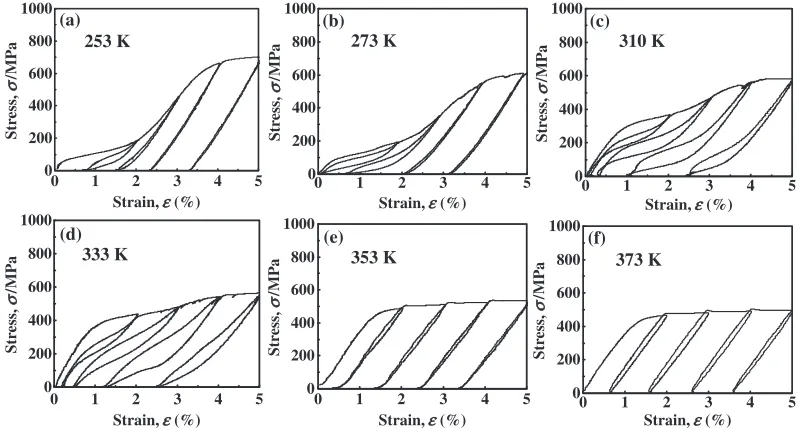
reflections, consistent with the TEM observation. Figure 3 shows stress-strain curves of as-quenched Ti-16Nb-4.8Sn at various deformation temperatures, where loading and un-450
200 350
300
250 400
150
T
emperatur
e,
T
/
K
3.5
Sn content, x /at. %
Ms and Af
5.0 4.5
4.0
Fig. 1 Transformation temperaturesAfandMsin Ti-16Nb-x Sn alloys as a function of Sn content.
25
µ
m
(a)
(b)
Fig. 2 (a) OIM image and (b)ð110Þ selected area electron diffraction
pattern of Ti-16Nb-4.8Sn sheet quenched from 923 K.
0 2 3 5
Strain,ε(%) 1000
800
600
400
0
Str
ess,
σ
/
MP
a
200 (d)
333 K
1 4
1000
800
600
400
200
0
0 2 3 5
Strain,ε(%) (e)
353 K
Str
ess,
σ
/
MP
a
1 4
1000
800
600
400
0 200
0 2 3 5
Strain,ε(%) (b)
273 K
Str
ess,
σ
/
MP
a
1 4 0 2 3 5
Strain,ε(%) 1000
800
600
400
200
0 (c)
310 K
Str
ess,
σ
/
MP
a
4 1
0 2 3 5
Strain,ε(%) 1000
800
600
400
0 200
(f) 373 K
Str
ess,
σ
/
MP
a
4 1
1000
800
600
400
200
0
0 2 3 5
Strain,ε(%) (a)
253 K
1 4
Str
ess,
σ
/
MP
a
[image:2.595.62.276.71.271.2] [image:2.595.306.548.72.234.2] [image:2.595.98.498.315.530.2]loading are repeated four times with increasing maximum applied strain to 2, 3, 4 and 5%. Since TiNbSn alloy has been found to undergo thermoelastic martensitic transforma-tion,2)the deviation from elastic linearity at an initial stage of
deformation in the stress-strain curves at temperatures of 253 to 333 K results from stress-induced martensitic transforma-tion, and total strain recovery at a few % applied strain is due to reverse martensitic transformation (superelasticity) and intrinsic elasticity. Superelasticity appears at temperatures from 253 to 333 K. Indeed at the human body temperature 310 K an applied strain of about 3% is almost completely recovered. In contrast, superelasticity disappears at 353 and 373 K and deformation proceeds at a constant flow stress of about 500 MPa at both temperatures.
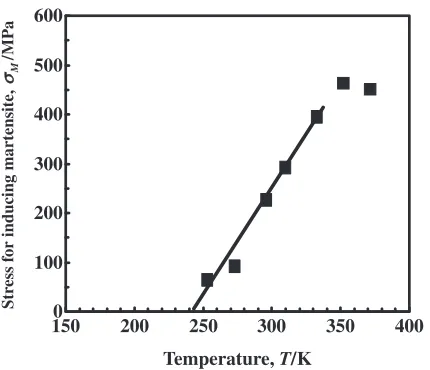
Figure 4 indicates that the stress for inducing the marten-sitic transformation (M) observed in the Ti-16Nb-4.8Sn
alloy obeys the Clausius-Clapeyron relationship when data at temperatures above 353 K is excluded. Extrapolation of this data to zero stress indicates that the Ms temperature
predicted, 244 K, is in good agreement with that determined by the DSC measurements, 238 K. The deviations from the expected linear relationship should be related to slip deformation in preference to the stress-induced martensitic transformation at temperatures above 353 K.
The superelastic strain defined in as-quenched Ti-16Nb-4.8Sn, Fig. 5, at various temperatures as a function of maximum applied strain when compared to that calculated from the sum of elastic strain and recovery strain by the reverse martensitic transformation in unloading, indicates that strains of 3.2% will be fully recovered at 310 K under a maximum applied strain of 3.5%. Further calculations of the expansion or contraction of lattice planes on transformation from the bcc to orthorhombic00 transformation12,13)in
Ti-16Nb-4.8Sn utilizing precisely measured lattice constants of
and003)found that the lattice will contract 3.4% in½100
00
and expand 3.3% in ½01000 and 0.27% in ½00100. Since
½011 is parallel to ½01000, the applied stress will induce
martensitic transformation most easily if asingle crystal of Ti-16Nb-4.8Sn is tensile tested in the½011direction and a strain of 3.3% will be recovered by the reverse martensitic
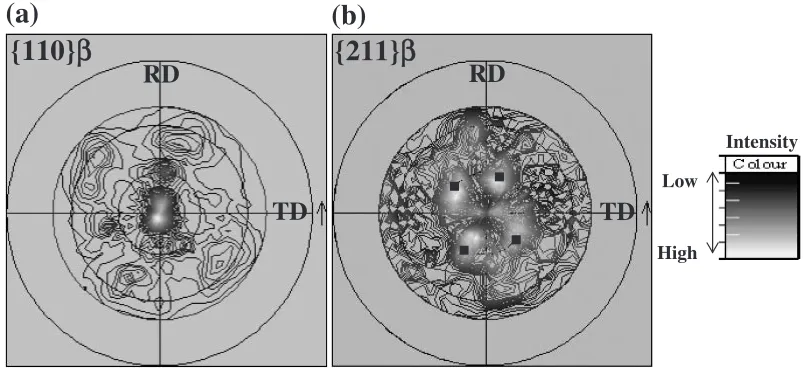
transformation on unloading. Since the experimentally determined superelastic strain of 3.2% is found from the stress-strain curve in Fig. 3 to contain an elastic strain of 1.5%, a recovery strain by the reverse martensitic trans-formation is estimated to be 1.7%. This value is much smaller than that predicted from the single crystal, 3.3%. The present work used polycrystalline specimens with the preferred ½117 recrystallization texture in the rolling direction, Fig. 6. Kim et al. have reported that the calculated trans-formation strain from to 00 depends on orientation and alloy composition.14) According to them, the maximum
transformation strain in Ti-22 at%Nb is 4.2% along the ½011 direction and decreases to 2.6% along [117]. It is roughly estimated, therefore, that the transformation strain along½117in Ti-16Nb-4.8Sn is about 2% or less, since the maximum transformation strain along ½011 is 3.3% as described above. Thus, the experimentally determined 1.7% recovery strain by the reverse transformation would be consistent with the theoretical prediction, considering the fact that the polycrystalline specimen with the preferred texture is used.
As already mentioned, superelasticity has been observed at the human body temperature using the arc-melted Ti-16Nb-4.8Sn button with a weight of 80 g. Chemical homogeneity at the intended composition was readily attained in such a small button by solution treatment after heavy cold rolling of buttons homogenized at high temperature. On the other hand, the chemical homogeneity at the intended composition for biomedical applications is not as easy achieved in larger commercial ingots in which segregation is apt to occur on solidification. Nevertheless, the chemical homogeneity is essential for successful application within the human body, since the transformation temperatures Ms and Af are very
sensitive to alloy composition as shown in Fig. 1. If the transformation temperatures can be changed by aging after solution treatment, the superelasticity at the human body temperature will be adjusted by aging even for sheets or wires prepared from a large ingot. Recently, we have found that DSC curves on heating and cooling are remarkably affected by maximum heating temperature after quenching when
1500 400
100 200 300 400 500 600
Temperature, T/K
Str
ess f
or inducing martensite,
σM
/
MP
a
350 300
250 200
Fig. 4 Temperature dependence of stress for inducing martensitic trans-formation for Ti-16Nb-4.8Sn.
273K 296K 310K 333K
Maximum strain, εMAX/%
Super
elastic strain,
ε SE
/%
1 2
1 5
4
3
2
5 4
3
[image:3.595.63.278.71.256.2] [image:3.595.318.533.75.248.2]conventional heating and cooling rates are adopted. That is, when heating temperature after quenching exceeded 423 K, a subsequent DSC curve on cooling was changed significantly. Then, aging effect on the transformation temperatures was examined by DSC measurements. Figure 7 shows DSC heating curves at various aging temperatures between 333 and 423 K with Af indicated by an arrow. The samples had
been quenched after solution treatment prior to aging in a DSC furnace for 30 min, after which they were cooled to 173 K to complete martensitic transformation and reheated.
As seen Af is not changed by aging at 333 K, while Af
decreases with aging at and above 353 K. Further studies in Fig. 8 show thatAf decreases with increasing aging time at
423 K. These observations suggest that some changes have occurred in the parentphase during aging at these relatively low aging temperatures.
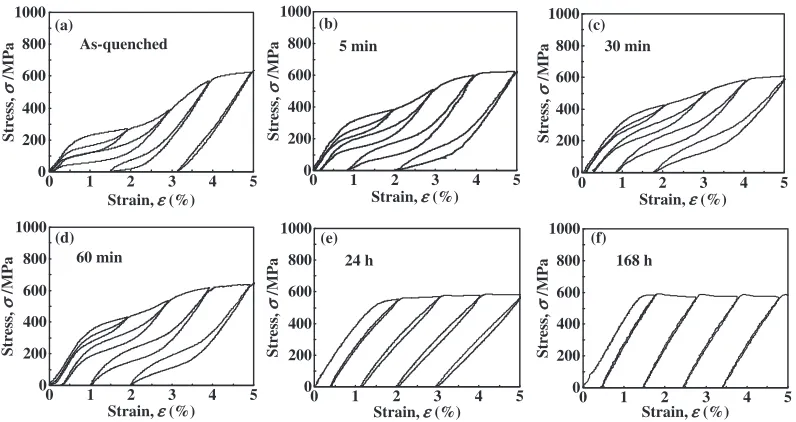
Figure 9 illustrates the influence of aging time at 423 K on the stress-strain curve behavior of Ti-16Nb-4.8Sn at 296 K. Superelasticity appears after aging for 0, 5, 30 min and 1 h, disappearing after aging for 24 and 168 h. M after aging
at 423 K for 5 and 30 min is plotted in Fig. 10 against deformation temperature along with M in Fig. 4 for
as-quenched alloy. It can be seen that the Clausius-Clapeyron relationship holds true in the aged alloys andMsdetermined
from the extrapolation of straight lines to zero stress decreases with increasing aging time. Furthermore, M
increases with increasing aging time. Figure 11 shows tensile
stress-strain curves for Ti-16Nb-4.8Sn (a) tested at 296 K after quenching, (b) tested at 273 K after aging at 423 K for 5 min and (c) tested at 253 K after aging at 423 K for 30 min, where the aging time and deformation temperature were selected so thatM values for (a), (b) and (c) are almost the
same, 220 MPa. Interestingly, the stress-strain curves in Fig. 11 are quite similar to each other, implying that the similar superelastic behavior can be obtained at lower temperature by low temperature aging. In other words the maximum superelastic strain at the human body temperature can be achieved by optimizing aging conditions, even though as-quenched alloy exhibits a large superelastic strain at temperature higher than the human body temperature. Accordingly, when chemical composition in a large ingot deviates from the intended composition after casting fol-lowed by homogenization, aging heat treatment allows us to precisely adjust Af for a maximum superelastic recovery
strain.
TEM observations were carried out to investigate some changes occurring during aging at 423 K. Unfortunately, no significant change in diffuse ! reflections was observed in diffraction patterns after aging at 423 K for 24 h, although superelasticity disappeared, Fig. 9(e). Since Young’s mod-ulus has been known to be very sensitive to the decom-position of metastablephase in Ti alloys, it was measured as a function of aging time at 423 K. The obtained result is shown in Fig. 12. It is obvious that Young’s modulus
Intensity
High Low
(b)
{211}
β
RD
TD
(a)
{110}
β
RD
TD
Fig. 6 Pole figure of as-quenched Ti-16Nb-4.8Sn, showing recrystallization texture.
150 200 250
0.04 W/g
As-STQ
333K-30 min 353K-30 min 373K-30 min 393K-30 min 423K-30 min
Temperature, T/K
Af Heating
Heat f
lo
w
350 300
Fig. 7 DSC curves indicating the effect of aging temperature onAffor Ti-16Nb-4.8Sn.
150 250 350
0.02 W/g
Heat f
lo
w
Temperature, T/K
As-STQ
423K -5 min aging 423K -30 min aging Af
300 200
[image:4.595.96.499.76.261.2] [image:4.595.64.275.302.409.2] [image:4.595.318.534.303.407.2]increases gradually even at the initial stage of aging. TEM observation was again carried out after more prolonged aging. Figure 13 shows ½110 electron diffraction pattern after aging at 423 K for 500 h. One can see clearly !
[image:5.595.100.498.72.283.2]reflections in addition to bcc fundamental reflections in contrast to the diffraction pattern of as-quenched alloy, Fig. 2. This observation is in good agreement with the recent experimental results reported by the present authors that both athermal and isothermal !precipitations increase Young’s modulus in metastable Ti alloys.15,16) Here, it should be noted that aging at 423 K decreasesMs, Fig. 10. The decrease
in Ms strongly suggests that the decomposition of phase
takes place during aging, that is, the solute content in the
phase matrix will be enriched and thereby the transformation temperatures will be decreased. Indeed, Takahashi et al. showed that the transformation temperatures of metastable
Ti-Nb-Sn alloy tend to be decreased by aging at intermediate temperatures of 673, 773 and 873 K after solution treatment at 1223 K.3)On the other hand, Moffat and Larbalestier have
investigated the microstructures of Ti-Nb alloys with differ-ent quench rates and compositions and revealed that!phase precipitates prevent martensitic transformation because of the competitive transformations.17)Tang et al.also showed that phase transformations in metastableTiNb-based alloys are sensitive to cooling rate and composition.18)Moreover, Takahashiet al.have observed that superelastic behavior of Ti-16%Nb-4.9%Sn is strongly affected by quenching
tem-240 400 500 400 300 200 100 0 200
Temperature, T/K
Str
ess f
or inducing martensite,
σM
/
MP
a
As-STQ
423 K-5 min aging 423 K-30 min aging
360 320
280
Fig. 10 Relation between temperature and stress for inducing martensitic transformation as a function of aging time at 423 K.
0 200 400 600 800 1000 0 Str ess, σ / MP a
Strain,ε(%) (a) 0 0 200 400 600 800 1000 (b) 0 200 400 600 800 1000 0 5 (c) 0 5 0 200 400 600 800 1000 (d) 0 200 400 600 800 1000 0 5 (e) 0 5 0 200 400 600 800 1000 (f) As-quenched 60 min Str ess, σ / MP a Str ess, σ / MP a Str ess, σ / MP a Str ess, σ / MP a Str ess, σ / MP a
Strain,ε(%)
Strain,ε(%)
Strain,ε(%) Strain,ε(%) Strain,ε(%) 5
4 3 2
1 1 2 3 4 5 1 2 3 4
4 3 2
1 1 2 3 4 1 2 3 4
30 min 5 min
168 h 24 h
Fig. 9 Stress-strain curves of Ti-16Nb-4.8Sn solution treated (a) and subsequently aged at 423 K for 5 min (b), 30 min (c), 60 min (d), 24 h (e) and 168 h (f).
0 200 400 600 800 1000
0 4 5
Strain,ε(%)
Str ess, σ / MP a (a)
0 4 5
0 200 400 600 800 1000 (b) 0 200 400 600 800 1000
0 4 5
(c) As-quenched
Tensile at 298 K
Aged at 423 K for 5 min Tensile at 273 K
Aged at 423 K for 30 min Tensile at 250 K
Str ess, σ / MP a Str ess, σ / MP a
Strain,ε(%) Strain,ε(%) 3
2
[image:5.595.63.279.337.512.2]1 1 2 3 1 2 3
[image:5.595.99.498.638.758.2]perature, i.e. quench rate.3)Therefore, it is suggested from
these results that the prevention of martensitic transformation by the preference of competitive !transformation depends on the amount of ! phase precipitates. That is, with increasing aging time to enhance ! transformation Ms
gradually decreases and prolonged aging completely sup-presses martensitic transformation even on cooling down to very low temperature.
As-described above, the transformation temperatures can be adjusted by controlling aging conditions at low temper-atures. The precise adjustment of Af by heat treatment is
industrially utilized in TiNi shape memory alloys.19) The transformation temperatures in the TiNi alloys are increased by aging at temperatures from 839 to 948 K, in contrast to this
work. The increase was found to result from the formation of solute-lean matrix through precipitation of Ni-rich interme-tallic compounds, Ti3Ni4or Ti11Ni14, which is different from
the formation of solute-rich matrix through!precipitation in this work.
Finally, it should be commented why ! precipitation occurs during aging at such low temperature, 423 K. The anomalously enhanced diffusion in the bcc lattice at low temperatures has been extensively studied and explained in terms of diffusion along short circuiting paths, such as dislocations and grain boundaries as well as diffusion associated with excess vacancies.20) However, the present bulk samples with 1 mm in thickness for Young’s modulus measurements were recrystallized during the solution treat-ment before quenching and the recrystallized grains with an average grain size of 15mmcontained a very low density of dislocations. Therefore, the fast diffusion mechanisms related to dislocations and grain boundaries can be ruled out. In addition, the vacancy-impurity association model21) is
in-applicable to the anomalous diffusion, since a recent study on positron annihilation has revealed that a concentration of quenched-in vacancies is negligibly small in TiNbSn alloy.22)It is interesting to note that isothermal!phase forms
even at room temperature for prolonged aging. Fan23) has
experimentally observed that to ! transformation in a rapidly solidified Ti-6Al-4V alloy occurs in the phase during aging at room temperature for 1 year. He used thin foils for the aging experiment, and hence!transformation would be enhanced by surface diffusion. Later, Fan and Miodownik24)investigated microstructural evolution in rap-idly solidified and consolidated Ti-7.5Mn-0.5B alloy and found that both thin foils and bulk samples undergo !
transformation during aging at room temperature for 6 months or 1 year. They showed that the transformation is more significantly accelerated in the thin foils than in the bulk samples. It is evident from these observations that !
transformation in metastablealloys can occur even at room temperature if sufficiently prolonged aging time is employed. As suggested by Sanchez and de Fontaine,25) diffusion at
room temperature in metastable Ti alloys might be enhanced above athermal ! transformation temperature,
T!, even thoughT!is below room temperature.
4. Summary
Superelasticity of Ni-free shape memory alloy based on the Ti-Nb-Sn ternary system was investigated as functions of deformation temperature, strain cycling and aging heat treatment. The obtained results are summarized as follows.
(1) Ti-16 at%Nb-4.8 at%Sn is selected to be superelastic alloy working at human body temperature (310 K), from the measured composition dependence ofAf.
(2) Clausius-Clapeyron equation holds in the temperature dependence of stress for inducing martensitic trans-formation.
(3) Maximum superelastic recovery strain of 3.2% is obtained at human body temperature, 310 K.
(4) Af is decreased by aging at relatively low temperatures
from 353 to 423 K and hence aging forAf adjustment
can lead to the maximum superelastic strain at 310 K.
102 103 104
100 101
30 40 50 60 70 80
Ageing time, t /ks
Y
oung’
s modulus,
E
/GP
[image:6.595.63.278.74.238.2]a
Fig. 12 Relation between aging time and Young’s modulus for Ti-16Nb-4.8Sn aged at 423 K after solution treatment at 923 K for 30 min.
ω
1
ω
1
ω
2
ω
2
Fig. 13 ð110Þselected area electron diffraction pattern of Ti-16Nb-4.8Sn
[image:6.595.49.289.291.568.2](5) ! precipitation occurs by aging at 423 K, which increases stress for inducing martensitic transformation and Young’s modulus.
Acknowledgment
The authors gratefully thank Osaka Titanium technologies Co., Ltd. for the supply of high purity titanium.
REFERENCES
1) C. Y. Lei, M. H. Wu, L. McD Schetky and C. J. Burstone: Proceedings of Displacive Phase Transformations and Their Applications in Materials Engineering, ed. K. Inoueet al.(TMS, 1998) p. 413. 2) E. Takahashi, T. Sakurai, S. Watanabe, N. Masahashi and S. Hanada:
Mater. Trans.43(2002) 2978.
3) E. Takahashi, S. Watanabe and S. Hanada: Shape memory and superelastic technologies: Engineering and biomedical applications, Monterey, USA, 2004, pp. 91–99.
4) H. Y. Kim, Y. Ohmatsu, J. I. Kim, H. Hosoda and S. Miyazaki: Mater. Trans.45(2004) 1090.
5) Y. Fukui, T. Inamura, H. Hodosa, K. Wakashima and S. Miyazaki: Mater. Trans.45(2004) 1077.
6) T. Inamura, Y. Fukui, H. Hosoda, K. Wakashima and S. Miyazaki: Mater. Trans.45(2004) 1083.
7) H. Y. Kim, S. Hashimoto, J. I. Kim, H. Hosoda and S. Miyazaki: Mater. Trans.45(2004) 2443.
8) Y. L. Hao, S. J. Li, S. Y. Sun and R. Yang: Mater. Sci. Eng.A441
(2006) 112–118.
9) S. Miyazaki, Y. Ohmi, K. Otsuka and Y. Suzuki: J. de PhysiqueC4
(1982) 255–260.
10) H. Matsumoto, S. Watanabe and S. Hanada: Mater. Trans.46(2005) 1070–1078.
11) S. L. Sass: J. Less-Common Metals28(1972) 157–173. 12) C. Baker: Metal Sci. J.5(1971) 92–100.
13) T. W. Duerig, J. Albrecht, D. Richter and P. Fischer: Acta Mater.30
(1982) 2161.
14) H. Y. Kim, Y. Ikehara, J. I. Kim, H. Hosoda and S. Miyazaki: Acta Mater.54(2006) 2419–2429.
15) S. Hanada, T. Ozaki, E. Takahashi, S. Watanabe, K. Yoshimi and T. Abumiya: Mater. Sci. Forum426–432(2003) 3103.
16) T. Ozaki, H. Matsumoto, T. Miyazaki, M. Hasegawa, S. Watanabe and S. Hanada: Proceedings of the Materials & Processes for Medical Devices Conference, ed. M. Helmus and D. Medlin (ASM, 2004) p. 197.
17) D. L. Moffat and D. C. Larbalestier: Metall. Trans.19A(1988) 1677– 1686.
18) X. Tang, T. Ahmed and H. J. Rack: J. Mater. Sci.35(2000) 1805–1811. 19) C. Wojcik: Proceedings of Shape Memory and Superelastic
Technol-ogies, Monterey, (2004, USA) p. 43.
20) A. D. Le Claire: Diffusion in Body-Centered Cubic Metals, (ASM, Metals Park, Cleaveland, 1965), pp. 3–25.
21) G. V. Kidson: Diffusion in Body-Centered Cubic Metals, (ASM, Metals Park, Cleaveland, 1965), pp. 329–347.
22) N. Nagai, T. Toyama, Z. Tang, M. Hasegawa, H. Matsumoto and S. Hanada: Scripta Materialia, Scripta Mater.54(2006) 1031–1034. 23) Z. Fan: Scripta Metall. Mater.31(1994) 1519–1524.
24) Z. Fan and P. Miodownik: Acta Mater.44(1996) 93–110.