A U T O M A T I C
A C Q U I S I T I O N
O F A L A R G E
S U B C A T E G O R I Z A T I O N
D I C T I O N A R Y
F R O M C O R P O R A
C h r i s t o p h e r D . M a n n i n g
Xerox P A R C and Stanford University
S t a n f o r d U n i v e r s i t y D e p t . of L i n g u i s t i c s , B l d g . 100 S t a n f o r d , C A 94305-2150, U S A I n t e r n e t : [email protected]
A b s t r a c t
This paper presents a new method for producing a dictionary of subcategorization frames from un- labelled text corpora. It is shown that statistical filtering of the results of a finite state parser run- ning on the output of a stochastic tagger produces high quality results, despite the error rates of the tagger and the parser. Further, it is argued that this method can be used to learn all subcategori- zation frames, whereas previous methods are not extensible to a general solution to the problem.
INTRODUCTION
Rule-based parsers use subcategorization informa- tion to constrain the number of analyses that are generated. For example, from subcategorization alone, we can deduce that the PP in (1) must be an argument of the verb, not a noun phrase mod- ifier:
(1) John put [Nethe cactus] [epon the table].
Knowledge of subcategorization also aids text ger- eration programs and people learning a foreign language.
A subcategorization frame is a statement of what types of syntactic arguments a verb (or ad- jective) takes, such as objects, infinitives,
that-
clauses, participial clauses, and subcategorized prepositional phrases. In general, verbs and ad- jectives each appear in only a small subset of all possible argument subcategorization frames.
A major bottleneck in the production of high- coverage parsers is assembling lexical information,
°Thanks to Julian Kupiec for providing the tag- ger on which this work depends and for helpful dis- cussions and comments along the way. I am also indebted for comments on an earlier draft to Marti Hearst (whose comments were the most useful!), Hin- rich Schfitze, Penni Sibun, Mary Dalrymple, and oth- ers at Xerox PARC, where this research was completed during a summer internship; Stanley Peters, and the two anonymous ACL reviewers.
such as subcategorization information. In early and much continuing work in computational lin- guistics, this information has been coded labori- ously by hand. More recently, on-line versions of dictionaries that provide subcategorization in- formation have become available to researchers (Hornby 1989, Procter 1978, Sinclair 1987). But this is the same method of obtaining subcatego- rizations - painstaking work by hand. We have simply passed the need for tools that acquire lex- ical information from the computational linguist to the lexicographer.
Thus there is a need for a program that can ac- quire a subcategorization dictionary from on-line corpora of unrestricted text:
1. Dictionaries with subcategorization information are unavailable for most languages (only a few recent dictionaries, generally targeted at non- native speakers, list subcategorization frames).
2. No dictionary lists verbs from specialized sub- fields (as in
I telneted to Princeton), but these
could be obtained automatically from texts such as computer manuals.3. Hand-coded lists are expensive to make, and in- variably incomplete.
4. A subcategorization dictionary obtained auto- matically from corpora can be updated quickly and easily as different usages develop. Diction- aries produced by hand always substantially lag real language use.
The last two points do not argue against the use of existing dictionaries, but show that the incom- plete information that they provide needs to be supplemented with further knowledge that is best collected automatically) The desire to combine hand-coded and automatically learned knowledge
suggests t h a t we should aim for a high precision learner (even at some cost in coverage), and t h a t is the approach adopted here.
D E F I N I T I O N S A N D D I F F I C U L T I E S
Both in traditional g r a m m a r and m o d e r n syntac- tic theory, a distinction is m a d e between argu- ments and adjuncts. In sentence (2), John is an argument and in the bathroom is an adjunct:
(2) Mary berated John in the b a t h r o o m .
Arguments fill semantic slots licensed by a particu- lar verb, while adjuncts provide information a b o u t sentential slots (such as time or place) t h a t can be filled for any verb (of the appropriate aspectual type).
While much work has been done on the argu- m e n t / a d j u n c t distinction (see the survey of dis- tinctions in Pollard and Sag (1987, pp. 134-139)), and much other work presupposes this distinction, in practice, it gets m u r k y (like m a n y things in linguistics). I will adhere to a conventional no- tion of the distinction, but a tension arises in the work presented here when j u d g m e n t s of argu- m e n t / a d j u n c t status reflect something other than frequency of cooccurrence - since it is actually cooccurrence d a t a t h a t a simple learning p r o g r a m like mine uses. I will return to this issue later.
Different classifications of subcategorization frames can be found in each of the dictionaries mentioned above, and in other places in the lin- guistics literature. I will assume without discus- sion a fairly s t a n d a r d categorization of subcatego- rization frames into 19 classes (some parameter- ized for a preposition), a selection of which are shown below:
IV TV
DTV THAT NPTHAT INF NPINF ING
P(prep)
Intransitive verbs Transitive verbs Ditransitive verbs
Takes a finite ~hal complement Direct object and lhaL complement Infinitive clause complement Direct object and infinitive clause Takes a participial V P complement Prepositional phrase headed by prep NP-P(prep) Direct object and P P headed by prep
subcategorization frame was not listed in the Cobuild dictionary (Sinclair 1987). The learner presented here finds a subcategorization involving from for all but one of these 7 verbs (the exception being ferry which was fairly rare in the training corpus).
P R E V I O U S
W O R K
While work has been done on various sorts of col- location information t h a t can be obtained from text corpora, the only research t h a t I am aware of t h a t has dealt directly with the problem of the a u t o m a t i c acquisition of subcategorization frames is a series of papers by Brent (Brent and Berwick 1991, Brent 1991, Brent 1992). Brent and Bet- wick (1991) took the approach of trying to gen- erate very high precision data. 2 T h e input was hand-tagged text from the Penn Treebank, and they used a very simple finite state parser which ignored nearly all the input, b u t tried to learn from the sentences which seemed least likely to contain false triggers - mainly sentences with pro- nouns and proper names. 3 This was a consistent strategy which produced promising initial results. However, using hand-tagged text is clearly not a solution to the knowledge acquisition problem (as hand-tagging text is more laborious than col- lecting subcategorization frames), and so, in more recent papers, Brent has a t t e m p t e d learning sub- categorizations from untagged text. Brent (1991) used a procedure for identifying verbs t h a t was still very accurate, but which resulted in extremely low yields (it garnered as little as 3% of the in- formation gained by his subcategorization learner running on tagged text, which itself ignored a huge percentage of the information potentially avail- able). More recently, Brent (1992) substituted a very simple heuristic m e t h o d to detect verbs (any- thing t h a t occurs b o t h with and without the suffix -ing in the text is taken as a potential verb, and every potential verb token is taken as an actual verb unless it is preceded by a determiner or a preposition other t h a n to. 4 This is a rather sim- plistic and inadequate approach to verb detection, with a very high error rate. In this work I will use a stochastic part-of-speech tagger to detect verbs (and the part-of-speech of other words), and will suggest t h a t this gives much b e t t e r results. 5
Leaving this aside, moving to either this last ap- proach of Brent's or using a stochastic tagger un- dermines the consistency of the initial approach. Since the system now makes integral use of a high-error-rate component, s it makes little sense
2That is, data with very few errors.
3A false
trigger
is a clause in the corpus that one wrongly takes as evidence that a verb can appear with a certain subcategorization frame.4Actually, learning occurs only from verbs in the base or -ing forms; others are ignored (Brent 1992,
p. 8).
SSee Brent (1992, p. 9) for arguments against using a stochastic tagger; they do not seem very persuasive (in brief, there is a chance of spurious correlations, and it is difficult to evaluate composite systems).
SOn the order of a 5% error rate on each token for
for other c o m p o n e n t s to be exceedingly selective a b o u t which d a t a they use in an a t t e m p t to avoid as m a n y errors as possible. R a t h e r , it would seem m o r e desirable to e x t r a c t as m u c h i n f o r m a t i o n as possible out of the text (even if it is noisy), and then to use a p p r o p r i a t e statistical techniques to handle the noise.
T h e r e is a m o r e f u n d a m e n t a l reason to think t h a t this is the right approach. Brent and Ber- wick's original p r o g r a m learned j u s t five subcat- egorization f r a m e s (TV, THAT, NPTHAT, INF and NPINF). While at the t i m e they suggested t h a t "we foresee no i m p e d i m e n t to detecting m a n y more," this has a p p a r e n t l y not proved to be the case (in Brent (1992) only six are learned: the above plus DTV). It seems t h a t the reason for this is t h a t their a p p r o a c h has depended u p o n finding cues t h a t are very accurate predictors for a certain subcategori- zation ( t h a t is, there are very few false triggers), such as pronouns for NP objects and to plus a finite verb for infinitives. However, for m a n y sub- categorizations there j u s t are no highly accurate c u e s / For e x a m p l e , some verbs subcategorize for the preposition in, such as the ones shown in (3):
(3) a. T w o w o m e n are assisting the police in their investigation.
b. We chipped in to buy her a new T V . c. His letter was couched in conciliatory
terms.
But the m a j o r i t y of occurrences of in after a verb are NP modifiers or non-subcategorized locative phrases, such as those in (4). s
(4)
a. He gauged s u p p o r t for a change in the p a r t y leadership.b. He built a ranch in a new suburb.
c. We were traveling along in a noisy heli- copter.
T h e r e j u s t is no high accuracy cue for verbs t h a t subcategorize for in. R a t h e r one m u s t collect cooccurrence statistics, and use significance test- ing, a m u t u a l i n f o r m a t i o n m e a s u r e or some other f o r m of statistic to t r y and judge whether a partic- ular verb subcategorizes for in or j u s t s o m e t i m e s
the stochastic tagger (Kupiec 1992), and a presumably higher error rate on Brent's technique for detecting verbs,
rThis inextensibility is also discussed by Hearst
(1992).
SA sample of 100 uses of /n from the New York Times suggests that about 70% of uses are in post- verbal contexts, but, of these, only about 15% are sub- categorized complements (the rest being fairly evenly split between NP modifiers and time or place adjunct PPs).
a p p e a r s with a locative phrase. 9 Thus, the strat- egy I will use is to collect as m u c h (fairly accurate) i n f o r m a t i o n as possible f r o m the t e x t corpus, and then use statistical filtering to weed out false cues.
M E T H O D
One m o n t h ( a p p r o x i m a t e l y 4 million words) of the New York T i m e s newswire was tagged using a ver- sion of Julian Kupiec's stochastic part-of-speech tagger (Kupiec 1992). l° Subcategorization learn- ing was then p e r f o r m e d by a p r o g r a m t h a t pro- cessed the o u t p u t of the tagger. T h e p r o g r a m had two parts: a finite s t a t e parser r a n t h r o u g h the text, parsing auxiliary sequences and noting com- plements after verbs and collecting h i s t o g r a m - t y p e statistics for the a p p e a r a n c e of verbs in various contexts. A second process of statistical filtering then took the raw h i s t o g r a m s and decided the best guess for w h a t subcategorization f r a m e s each ob- served verb actually had.
T h e f i n i t e state p a r s e r
T h e finite s t a t e parser essentially works as follows: it scans t h r o u g h t e x t until it hits a verb or auxil- iary, it parses a n y auxiliaries, noting whether the verb is active or passive, and then it parses com- plements following the verb until s o m e t h i n g recog- nized as a t e r m i n a t o r of subcategorized a r g u m e n t s is r e a c h e d ) 1 W h a t e v e r has been found is entered in the histogram. T h e parser includes a simple NP recognizer (parsing determiners, possessives, ad- jectives, n u m b e r s a n d c o m p o u n d nouns) and vari- ous other rules to recognize certain cases t h a t ap- peared frequently (such as direct quotations in ei- ther a n o r m a l or inverted, quotation first, order). T h e parser does not learn f r o m participles since an NP after t h e m m a y be the subject rather t h a n the object (e.g., the yawning man).
T h e parser has 14 states and around 100 transi- tions. It o u t p u t s a list of elements occurring after the verb, and this list together with the record of whether the verb is passive yields the overall con- text in which the verb appears. T h e parser skips to the s t a r t of the n e x t sentence in a few cases where things get c o m p l i c a t e d (such as on encountering a
9One cannot just collect verbs that always appear with in because many verbs have multiple subcatego- rization frames. As well as (3b), chip can also just be a IV: John chipped his tooth.
1°Note that the input is very noisy text, including sports results, bestseller lists and all the other vagaries of a newswire.
conjunction, the scope of which is ambiguous, or a relative clause, since there will be a gap some- where within it which would give a wrong observa- tion). However, there are m a n y other things t h a t the parser does wrong or does not notice (such as reduced relatives). One could continue to refine the parser (up to the limits of what can be recog- nized by a finite state device), but the strategy has been to stick with something simple t h a t works a reasonable percentage of the time and then to filter its results to determine what subcategoriza- tions verbs actually have.
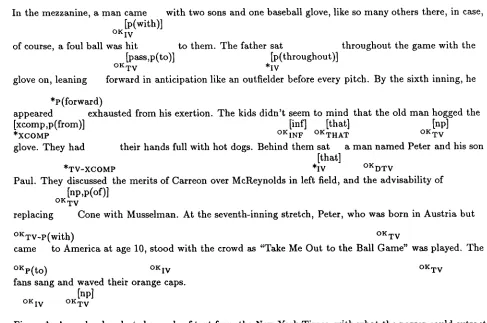
Note t h a t the parser does not distinguish be- tween arguments and adjuncts. 12 Thus the frame it reports will generally contain too m a n y things. Indicative results of the parser can be observed in Fig. 1, where the first line under each line of text shows the frames t h a t the parser found. Because of mistakes, skipping, and recording adjuncts, the finite state parser records nothing or the wrong thing in the m a j o r i t y of cases, but, nevertheless, enough good d a t a are found t h a t the final subcate- gorization dictionary describes the m a j o r i t y of the subcategorization frames in which the verbs are used in this sample.
F i l t e r i n g
Filtering assesses the frames t h a t the parser found (called cues below). A cue m a y be a correct sub- categorization for a verb, or it m a y contain spuri- ous adjuncts, or it m a y simply be wrong due to a mistake of the tagger or the parser. T h e filtering process a t t e m p t s to determine whether one can be highly confident t h a t a cue which the parser noted is actually a subcategorization frame of the verb in question.
T h e m e t h o d used for filtering is t h a t suggested by Brent (1992). Let Bs be an estimated upper bound on the probability t h a t a token of a verb t h a t doesn't take the subcategorization frame s will nevertheless appear with a cue for s. If a verb appears m times in the corpus, and n of those times it cooccurs with a cue for s, then the prob- ability t h a t all the cues are false cues is bounded by the binomial distribution:
m m!
n (m-
- B , ) m - -i = n
Thus the null hypothesis t h a t the verb does not have the subcategorization frame s can be rejected if the above sum is less than some confidence level C ( C = 0.02 in the work reported here).
Brent was able to use extremely low values for B~ (since his cues were sparse but unlikely to be
12Except for the fact that it will only count the first of multiple. PPs as an argument.
false cues), and indeed found the best performance with values of the order of 2 -8 . However, using my parser, false cues are common. For example, when the recorded subcategorization is __ NP P P ( o f ) , it is likely that the P P should actually be attached to the NP rather than the verb. Hence I have used high bounds on the probability of cues be- ing false cues for certain triggers (the used val- ues range from 0.25 (for WV-P(of)) to 0.02). At the m o m e n t , the false cue rates B8 in m y system have been set empirically. Brent (1992) discusses a m e t h o d of determining values for the false cue rates automatically, and this technique or some similar form of a u t o m a t i c optimization could prof- itably be incorporated into m y system.
R E S U L T S
T h e p r o g r a m acquired a dictionary of 4900 subcat- egorizations for 3104 verbs (an average of 1.6 per verb). Post-editing would reduce this slightly (a few repeated typos m a d e it in, such as acknowl- ege, a few oddities such as the spelling garontee as a ' C a j u n ' pronunciation of guarantee and a few cases of mistakes by the tagger which, for example, led it to regard lowlife as a verb several times by mistake). Nevertheless, this size already compares favorably with the size of some production M T systems (for example, the English dictionary for Siemens' M E T A L system lists a b o u t 2500 verbs (Adriaens and de Braekeleer 1992)). In general, all the verbs for which subcategorization frames were determined are in Webster's (Gove 1977) (the only noticed exceptions being certain instances of prefixing, such as overcook and repurchase), but a larger n u m b e r of the verbs do not appear in the only dictionaries t h a t list subcategorization frames (as their coverage of words tends to be more limited). Examples are fax, lambaste, skedaddle, sensationalize, and solemnize. Some idea of the growth of the subcategorization dictionary can be had from Table 1.
Table 1. G r o w t h of subcategorization dictionary
Words Verbs in Subcats Subcats Processed subcat learned learned (million) dictionary per verb
1.2 1856 2661 1.43
2.9 2689 4129 1.53
4.1 3104 4900 1.58
T h e two basic measures of results are the in- formation retrieval notions of recall and precision: How m a n y of the subcategorization frames of the verbs were learned and what percentage of the things in the induced dictionary are correct? I have done some preliminary work to answer these questions.
In the mezzanine, a m a n came with two sons and one baseball glove, like so m a n y others there, in case, [p(with)]
OKIv
of course, a foul ball was hit to them. T h e father sat t h r o u g h o u t the game with the
[pass,p(to)] [p(throughout)]
°KTv *IV
glove on, leaning forward in anticipation like an outfielder before every pitch. By the sixth inning, he
*P(forward)
appeared exhausted from his exertion. T h e kids didn't seem to mind t h a t the old m a n hogged the
[xcomp,p( from)] [inf] [that] [np]
*XCOMP OKINF OKTHAT OKTv
glove. T h e y had their hands full with hot dogs. Behind t h e m sat a m a n n a m e d Peter and his son [that]
*TV-XCOMP *IV OK DTV
Paul. T h e y discussed the merits of Carreon over McReynolds in left field, and the advisability of [np,p(of)]
OKTV
replacing Cone with Musselman. At the seventh-inning stretch, Peter, who was born in Austria but
OKTv-v(with ) OKTV
came to America at age 10, stood with the crowd as "Take Me Out to the Ball G a m e " was played. T h e
°KP(to) OKIv
fans sang and waved their orange caps.
[np]
OKIv OKTv
OKTv
Figure 1. A r a n d o m l y selected sample of text from the New York Times, with what the parser could extract from the text on the second line and whether the resultant dictionary has the correct subcategorization for this occurrence shown on the third line (OK indicates that it does, while * indicates t h a t it doesn't).
For recall, we might ask how m a n y of the uses of verbs in a text are captured by our subcate- gorization dictionary. For two randomly selected pieces of text from other parts of the New York Times newswire, a portion of which is shown in Fig. 1, out of 200 verbs, the acquired subcatego- rization dictionary listed 163 of the subcategori- zation frames t h a t appeared. So the token recall rate is approximately 82%. This compares with a baseline accuracy of 32% t h a t would result from always guessing TV (transitive verb) and a per- formance figure of 62% t h a t would result from a system t h a t correctly classified all TV and T H A T verbs (the two most c o m m o n types), b u t which got everything else wrong.
We can get a pessimistic lower b o u n d on pre- cision and recall by testing the acquired diction- ary against some published dictionary. 13 For this
13The resulting figures will be considerably lower than the true precision and recall because the diction- ary lists subcategorization frames that do not appear in the training corpus and vice versa. However, this is still a useful exercise to undertake, as one can at- tain a high token success rate by just being able to accurately detect the most common subcategorization
test, 40 verbs were selected (using a r a n d o m num- ber generator) from a list of 2000 c o m m o n verbs. 14 Table 2 gives the subcategorizations listed in the OALD (recoded where necessary according to my classification of subcategorizations) and those in the subcategorization dictionary acquired by my p r o g r a m in a compressed format. Next to each verb, listing just a subcategorization frame means t h a t it appears in b o t h the OALD and my subcat- egorization dictionary, a subcategorization frame preceded by a minus sign ( - ) means t h a t the sub- categorization frame only appears in the OALD, and a subcategorization frame preceded by a plus sign ( + ) indicates one listed only in my pro- gram's subcategorization dictionary (i.e., one t h a t is probably wrong). 15 T h e numbers are the num- ber of cues t h a t the program saw for each subcat-
frames.
14The number 2000 is arbitrary, but was chosen following the intuition that one wanted to test the program's performance on verbs of at least moderate frequency.
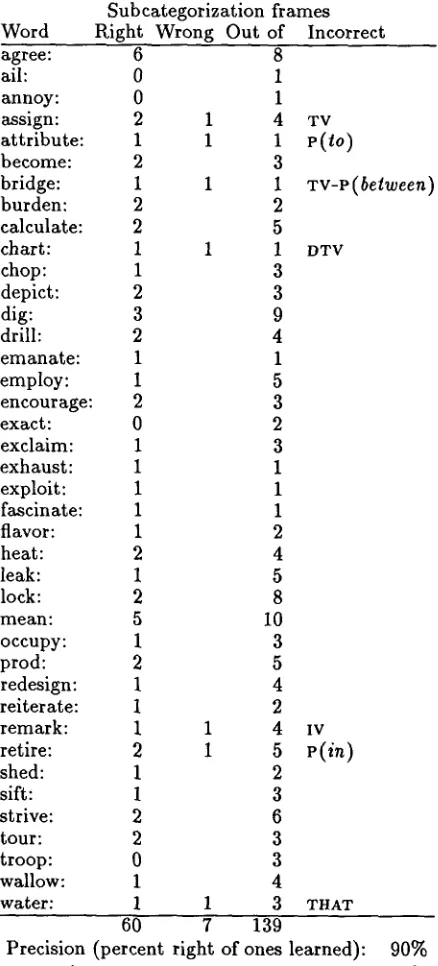
[image:5.612.47.534.52.375.2]egorization frame (that is in the resulting subcat- egorization dictionary). Table 3 then summarizes the results from the previous table. Lower bounds for the precision and recall of my induced subcat- egorization dictionary are approximately 90% and 43% respectively (looking at types).
The aim in choosing error bounds for the filter- ing procedure was to get a highly accurate dic- tionary at the expense of recall, and the lower bound precision figure of 90% suggests that this goal was achieved. The lower bound for recall ap- pears less satisfactory. There is room for further work here, but this does represent a pessimistic lower bound (recall the 82% token recall figure above). Many of the more obscure subcategoriza- tions for less common verbs never appeared in the modest-sized learning corpus, so the model had no chance to master them. 16
Further, the learned corpus may reflect language use more accurately than the dictionary. The OALD lists
retire to NP
andretire from NP as
subeategorized PP complements, but notretire in
NP.
However, in the training corpus, the colloca- tionretire in
is much more frequent thanretire
to
(orretire from).
In the absence of differential error bounds, the program is always going to take such more frequent collocations as subeategorized. Actually, in this case, this seems to be the right result. Whilein
can also be used to introduce a locative or temporal adjunct:(5) John retired from the army in 1945.
if in is being used similarly to
to
so that the two sentences in (6) are equivalent:(6) a. John retired to Malibu.
b. John retired in Malibu.
it seems that in should be regarded as a subcatego- rized complement of retire (and so the dictionary is incomplete).
As a final example of the results, let us discuss verbs that subcategorize for from (of. fn. 1 and Church and Hanks 1989). The acquired subcate- gorization dictionary lists a subcategorization in- volving from for 97 verbs. Of these, 1 is an out- right mistake, and 1 is a verb that does not appear in the Cobuild dictionary
(reshape).
Of the rest, 64 are listed as occurring with from in Cobuild and 31 are not. While in some of these latter cases it could be argued that the occurrences of from are adjuncts rather than arguments, there are alsoa6For example,
agree about did not appear in the
learning corpus (and only once in total in another two months of the New York Times newswire that I exam- ined). Whiledisagree about is common,
agree about
seems largely disused: people like to agree with people but disagreeabout topics.
Table 2. Subcategorizations for 40 randomly se- lected verbs in OALD and acquired subcategori- zation dictionary (see text for key).
agree: INF:386, THAT:187, P(lo):101, IV:77,
P(with):79,
p(on):63,-P(about),
--WHaih
--TV
a n n o y : --TV
assign:
TV-P(t0):19, NPINF:ll,
--TV-P(for),
--DTV, +TV:7
a t t r i b u t e : WV-P(to):67,
+P(to):12
b e c o m e : IV:406, XCOMP:142,--PP(Of)
b r i d g e : WV:6,+P(between):3
b u r d e n : WV:6, TV-P(with):5
c a l c u l a t e : THAT:I 1, TV:4, - - W H ,
--NPINF,
--PP(on)c h a r t : TV:4, +DTV:4
chop: TV:4,
--TV-P(Up),
--TV-V(into)
d e p i c t : WV-P(as):10, IV:9, --NPINGdig: WV:12,
P(out):8,
P(up):7,--IV,
--TV-P (in), --TV-P (0lit), --TV-P (over), --TV-P (up),
--P(for)
drill:
Tv-P(in):I4, TV:14, --IV, --P(FOR)
e m a n a t e :P(from ):2
employ: TV:31,--TV-P(on),--TV-P(in),--TV-
P(as), --NPINF
e n c o u r a g e : NPINF:IO8, TV:60, --TV-P(in)
exact:
--TV,
--TV-PP(from)
exclaim: THAT:10,--IV,--P0 exhaust: TV:12
exploit: TV:11 fascinate: TV:17
f l a v o r : TV:8,
--TV-PP(wiih)
h e a t : IV:12, TV:9, --TV-P(up), --P(up) leak:
P(out):7,
--IV, --P(in), --IV,
- - T V -P(tO)
lock:
TV:16, TV-P(in):16, --IV, --P(), --TV-
P(together),
--TV-P(up), --TV-P(out), --TV-P(away)
m e a n : THAT:280, TV:73, NPINF:57, INF:41, ING:35, --TV-PP (to), --POSSING, --TV-PP (as)
--DTV, --TV-PP (for)
o c c u p y : TV:17, --TV-P(in),
--TV-P(with)
p r o d : TV:4,Tv-e(into):3,
--IV, --P(AT),
--NPINF
r e d e s i g n :
TV:8,
--TV-P (for),
--TV-P(as),
--NPINF
r e i t e r a t e :
THAT:13, --TV
r e m a r k : THAT:7, --P(on),
--P(upon),
--IV, +IV:3,r e t i r e : IV:30, IV:9,
--P(from),
--P(t0),
--XCOMP,
+e(in):38
shed: TV:8,
--TV-P (on)
sift:
P(through):8,
--WV, --TV-P(OUT)
strive: INF:14,P(for):9,
--P(afler),
- e
(against),
- P(with),
--IVt o u r :
TV:9, IV:6, --P(IN)
t r o o p : --IV, - P 0 , [TV: trooping the color] wallow: P ( i n ) : 2 , - - I V , - P ( a b o u t ) , - P ( a r o u n d ) w a t e r : WV:13,--IV,--WV-P(down), -}-THAT:6
[image:6.612.321.552.80.714.2]Table 3. C o m p a r i s o n of results with O A L D
Subcategorization f r a m e s Word Right Wrong O u t of Incorrect
agree: 6 8
all: 0 1
annoy: 0 1
assign: 2 1 4 Tv
attribute: 1 1 1 P(/o)
become: 2 3
bridge: 1 1 1
wv-P(belween)
burden: 2 2
calculate: 2 5
chart: 1 1 1 D T V
chop: 1 3
depict: 2 3
dig: 3 9
drill: 2 4
e m a n a t e : 1 1
employ: 1 5
encourage: 2 3
exact: 0 2
exclaim: 1 3
exhaust: 1 1
exploit: 1 1
fascinate: 1 1
flavor: 1 2
heat: 2 4
leak: 1 5
lock: 2 8
mean: 5 10
occupy: 1 3
prod: 2 5
redesign: 1 4
reiterate: 1 2
r e m a r k : 1 1 4 IV retire: 2 1 5 P ( i n )
shed: 1 2
sift: 1 3
strive: 2 6
tour: 2 3
troop: 0 3
wallow: 1 4
water: 1 1 3 THAT
60 7 139
Precision (percent right of ones learned): 90% Recall (percent of O A L D ones learned): 43%
some unquestionable omissions f r o m the diction- ary. For example, Cobuild does not list t h a t
forbid
takes
from-marked
participial c o m p l e m e n t s , b u t this is very well a t t e s t e d in the New York T i m e s newswire, as the e x a m p l e s in (7) show:(7) a. T h e C o n s t i t u t i o n a p p e a r s to
forbid
the general, as a f o r m e r president who came to power t h r o u g h a coup,from
taking of- fice.b. Parents and teachers are
forbidden from
taking a lead in the project, and . . .
Unfortunately, for several reasons the results presented here are not directly c o m p a r a b l e with those of B r e n t ' s systems. 17 However, they seems to represent at least a c o m p a r a b l e level of perfor- mance.
F U T U R E
D I R E C T I O N S
This p a p e r presented one m e t h o d of learning sub- categorizations, b u t there are other approaches one m i g h t try. For d i s a m b i g u a t i n g whether a P P is subcategorized by a verb in the V NP P P envi- r o n m e n t , Hindle and R o o t h (1991) used a t-score to determine whether the P P has a stronger asso- ciation with the verb or the preceding NP. T h i s m e t h o d could be usefully incorporated into m y parser, b u t it r e m a i n s a special-purpose technique for one particular ease. Another research direc- tion would be m a k i n g the parser stochastic as well, r a t h e r t h a n it being a categorical finite state de- vice t h a t runs on the o u t p u t of a stochastic tagger. T h e r e are also s o m e linguistic issues t h a t re- main. T h e m o s t t r o u b l e s o m e case for any English subcategorization learner is dealing with prepo- sitional complements. As well as the issues dis- cussed above, a n o t h e r question is how to represent the subcategorization f r a m e s of verbs t h a t take a range of prepositional c o m p l e m e n t s (but not all). For example,
put
can take virtually any locative or directional P P c o m p l e m e n t , whilelean
is more choosy (due to facts a b o u t the world): [image:7.612.61.280.141.624.2](8) a. John leaned against the wall
b. *John leaned under the table
c. *John leaned up the chute
The program doesn't yet have a good way of rep- resenting classes of prepositions.
The applications of this system are fairly obvi- ous. For a parsing system, the current subcate- gorization dictionary could probably be incorpo- rated as is, since the utility of the increase in cov- erage would almost undoubtedly outweigh prob- lems arising from the incorrect subcategorization frames in the dictionary. A lexicographer would want to review the results by hand. Nevertheless, the program clearly finds gaps in printed diction- aries (even ones prepared from machine-readable corpora, like Cobuild), as the above example with
forbid showed. A lexicographer using this program
might prefer it adjusted for higher recall, even at the expense of lower precision. When a seemingly incorrect subcategorization frame is listed, the lex- icographer could then ask for the cues that led to the postulation of this frame, and proceed to verify or dismiss the examples presented.A final question is the applicability of the meth- ods presented here to other languages. Assuming the existence of a part-of-speech lexicon for an- other language, Kupiec's tagger can be trivially modified to tag other languages (Kupiec 1992). The finite state parser described here depends heavily on the fairly fixed word order of English, and so precisely the same technique could only be employed with other fixed word order languages. However, while it is quite unclear how Brent's methods could be applied to a free word order lan- guage, with the method presented here, there is a clear path forward. Languages that have free word order employ either case markers or agreement af- fixes on the head to mark arguments. Since the tagger provides this kind of morphological knowl- edge, it would be straightforward to write a similar program that determines the arguments of a verb using any combination of word order, case marking and head agreement markers, as appropriate for the language at hand. Indeed, since case-marking is in some ways more reliable than word order, the results for other languages might even be better than those reported here.
C O N C L U S I O N
After establishing that it is desirable to be able to automatically induce the subcategorization frames of verbs, this paper examined a new technique for doing this. The paper showed that the technique of trying to learn from easily analyzable pieces of data is not extendable to all subcategorization frames, and, at any rate, the sparseness of ap- propriate cues in unrestricted texts suggests that
a better strategy is to try and extract as much (noisy) information as possible from as much of the data as possible, and then to use statistical techniques to filter the results. Initial experiments suggest that this technique works at least as well as previously tried techniques, and yields a method that can learn all the possible subcategorization frames of verbs.
R E F E R E N C E S
Adriaens, Geert, and Gert de Braekeleer. 1992. Converting Large On-line Valency Dictionaries for NLP Applications: From PROTON Descrip- tions to METAL Frames. In
Proceedings of
COLING-92,
1182-1186.Brent, Michael R. 1991. Automatic Acquisi- tion of Subcategorization Frames from Untagged Text. In
Proceedings of the 29th Annual Meeting
of the ACL,
209-214.Brent, Michael R. 1992. Robust Acquisition of Subcategorizations from Unrestricted Text: Un- supervised Learning with Syntactic Knowledge. MS, John Hopkins University, Baltimore, MD. Brent, Michael R., and Robert Berwick. 1991. Automatic Acquisition of Subcategorization Frames from Free Text Corpora. In
Proceedings
of the ~th DARPA Speech and Natural Language
Workshop.
Arlington, VA: DARPA.Church, Kenneth, and Patrick Hanks. 1989. Word Association Norms, Mutual Information, and Lexicography. In
Proceedings of the 27th An-
nual Meeting of the ACL,
76-83.Gove, Philip B. (ed.). 1977.
Webster's seventh
new collegiate dictionary.
Springfield, MA: G. & C. Merriam.Hearst, Marti. 1992. Automatic Acquisition of Hyponyms from Large Text Corpora. In
Pro-
ceedings of COLING-92,
539-545.Hindle, Donald, and Mats Rooth. 1991. Struc- tural Ambiguity and Lexical Relations. In
Pro-
ceedings of the 291h Annual Meeting of the ACL,
229-236.Hornby, A. S. 1989.
Oxford Advanced Learner's
Dictionary of Current English.
Oxford: Oxford University Press. 4th edition.Kupiec, Julian M. 1992. Robust Part-of-Speech Tagging Using a Hidden Markov Model.
Com-
puter Speech and Language
6:225-242.Pollard, Carl, and Ivan A. Sag. 1987.
Information-Based Syntax and Semantics.
Stanford, CA: CSLI.Procter, Paul (ed.). 1978.
Longman Dictionary
of Contemporary English.
Burnt Mill, Harlow, Essex: Longman.Sinclair, John M. (ed.). 1987.
Collins Cobuild
English Language Dictionary.
London: Collins.