Changing the outcome
An explorative research on the relationship between the implementation process
and the improvement of study success.
Myrthe Angela Agterbos
Master student Public Administration University of Twente
Supervisors: Dr. H.F. de Boer
3
Foreword
This thesis is the final step in my educational career. After five years of Public Administration the moment has come where I will no longer be a student. This means losing part of my identity, but it also creates the possibility to develop a new identity for myself in the working field. I have been aspiring to work in higher education for some time now and this research has ensured this aspiration. I think I can be an asset to organizations in this field, because my knowledge about higher education has grown and, moreover, I still want to learn more.
I would like to especially thank my first supervisor, Harry de Boer, and my second supervisor, Hans Vossensteyn, for their time and effort they have invested in me over the past year and for their trust in me to successfully finish this thesis. They have helped me to overcome difficulties in this process and they have given me new input and perspectives, which have made me grown professionally and personally.
5
Content
Foreword ... 3
Summary ... 7
Chapter 1: The research plan ... 9
1.1 Introduction ... 9
1.2 Study success ... 9
1.3 Dropouts ... 10
1.4 Policy process ... 11
1.5 Research question ... 12
1.6 Research design ... 13
1.7 Structure of the thesis ... 14
Chapter 2: Context ... 15
2.1 Introduction ... 15
2.2 The WHW ... 15
2.3 Instruments ... 15
2.4 Selection ... 16
2.5 Secondary Education ... 17
2.6 Increasing demand ... 18
2.7 Belonging at the top ... 18
2.8 Committee “Ruim baan voor talent”... 19
2.9 Recent Reforms ... 20
2.10 BSA ... 21
2.11 Developments in graduation and dropouts ... 21
Chapter 3: Theoretical framework ... 25
3.1 Introduction ... 25
3.2 Implementation in general ... 25
3.3 Factors ... 26
3.3.1 Senior management style ... 27
3.3.2 Senior management team ... 27
3.3.3 Strategy and priorities ... 27
3.3.4 Vertical communication ... 28
3.3.5 Coordination across functions, businesses or borders ... 28
3.3.6 Leadership skills and development ... 28
3.4 Implementation factors and expectations ... 29
Chapter 4: Operationalization and selection ... 31
4.1 Factors in UAS ... 31
4.1.1 Senior management style ... 31
4.1.2 Senior management team ... 32
4.1.3 Strategy and priorities ... 32
4.1.4 Vertical communication ... 33
4.1.5 Coordination across functions, businesses or borders ... 33
4.1.6 Leadership skills and development ... 33
4.2 Selection ... 34
Chapter 5: Implementation of BSA at three UAS ... 36
6
5.2 UAS 1 ... 36
5.3 UAS 2 ... 38
5.4 UAS 3 ... 41
Chapter 6: Analysis and conclusions ... 44
6.1 Introduction ... 44
6.2 The Analysis ... 44
6.3 Answering the general research question... 45
6.4 Recommendations... 46
References ... 48
Appendixes ... 50
Appendix 1: Graduation rates Technical Education ... 51
Appendix 2: Dropout rates Technical Education ... 56
Appendix 3: Questionnaire mid-level management ... 61
Appendix 4: Questionnaire low-level management ... 65
Appendix 5: Data collection of UAS 1 ... 69
Appendix 6: Data collection of UAS 2 ... 71
7
Summary
Many policy initiatives are taken in higher education by the Dutch government in order to improve study success, such as excellence programs, intuition fee differentiation and selection methods. Considering these efforts, the question rises whether or not these initiatives taken by the Dutch government have improved study success in higher education.
Statistics show that average graduation rate of UAS has not improved. In fact, the average graduation rate has decreased. Moreover, the average dropout rate of UAS has remained more or less the same. There are, however, major differences in the graduation rates as well in the dropout rates of UAS. The BSA is one of the selection methods initiated by the Dutch government and the implementation process of the BSA will be the subject of analysis in this study. The BSA is an instrument for HEIs to inform a student about their study progress. HEIs can set a BSA-standard, which implies a minimum of study points that should be achieved by a student after a year. Based on the individual results of students a positive or (binding) negative advice is given by HEIs to their students about the (dis)continuation of a study program.
The implementation process of policies like the BSA is an institutional factor which is expected to influence study success. Hence, this explorative research focusses on answering the following research question:
“To which extent are improvements in study success of UAS study programs the result of particular factors of implementation processes of the BSA?”
Here, study success is defined in terms of graduation rates and dropout rates. This study will focus on technical study programs because the demand of the labour market for technical employees has increased and is still increasing. Therefore there is a need to improve the study success to meet these demands.
According to the theory of Beer and Eisenstat (2000) there are six factors which affect the implementation process. These factors are (1) senior management style, (2) senior management team, (3) strategy and priorities, (4) vertical communication, (5) coordination of tasks and functions and (6) leadership skills and development. On their turn the factors affect the quality of direction, learning and implementation as follows. The senior management style and senior management team affect the quality of direction; the strategy and priorities and the vertical communication affect the quality of learning; and the coordination of tasks and functions and the leadership skills and development affect the quality of implementation.
The factors of the implementation process are operationalized for UAS. Based on this operationalization pre-structured interviews are held with people involved in the implementation process of the BSA. The aim is to explore the effect of these factors in the implementation process of the BSA on study success of UAS study programs. In order to determine the effect of these factors the answers of respondents are qualified on a Likert-scale. We expect that if all factors are positively present, the effect will be an improvement in study success.
Based on the development in graduation rates and dropout rates of technical study programs there are three UAS selected. These three UAS are all multidisciplinary and have at least 20.000 students in
total. The study programs that are selected for the case studies are Civiele Techniek (CT), Technische
8
Based on the results obtained in this study we cannot conclude that improvements in study success of UAS study programs are the result of particular factors of the implementation process of the BSA. In none of the case studies both the graduation rate and the dropout rate improved. Moreover, we only expected rates to improve or remain the same but some rates have worsened. Also there are alternative explanations for developments in study success, like student-related factors, study-related factors and policy and system-study-related factors. These factors could also very well explain the developments in study success.
There does seem to be some kind of pattern in graduation rates; the UAS with the most positive results also has the most improvements in graduation rates; the UAS with the least positive results also has the least improvement in graduation rates. For dropout rates there does not seem to be such a pattern. Therefore it is hard to say what the exact effect of factors in the implementation process of the BSA is.
9
Chapter 1: The research plan
1.1 Introduction
Over the past decades the Dutch government aimed to improve graduation rates and reduce
dropout rates at Higher Education Institutions (HEIs). An example of their efforts is the law “Wet op
het Hoger onderwijs en Wetenschappelijk Onderzoek” (Law on Higher Education and Scientific research, further: WHW) which was issued in 1992. This law provides a set of rules on admissions for
students in higher education and sets an upper limit to the number of admissions, called ‘numerus
fixus’ (Onderwijsraad, 2000, p. 202). Another instrument as a result of this law is the so called ‘Bindend Studie Advies’ (BSA). This is an instrument for HEIs to inform a student about their study progress. Based on the individual results of students a positive or (binding) negative advice is given by HEIs to their students about the (dis)continuation of a study program (Onderwijsinspectie, 2009,
p. 75). Despite such efforts the graduation rates and dropout rates for Dutch hogescholen
(Universities of Applied Science, further: UAS) did not improve significantly.(Committee on Future Sustainability of Dutch Higher Education System, 2010, p. 76).
This study aims to identify factors in the implementation process of policies in higher education, which can contribute to a better effectiveness of reforms. This chapter will first define study success and dropouts and will explain the policy process with an instrumental approach. It will then formulate the research question followed by the research design.
1.2 Study success
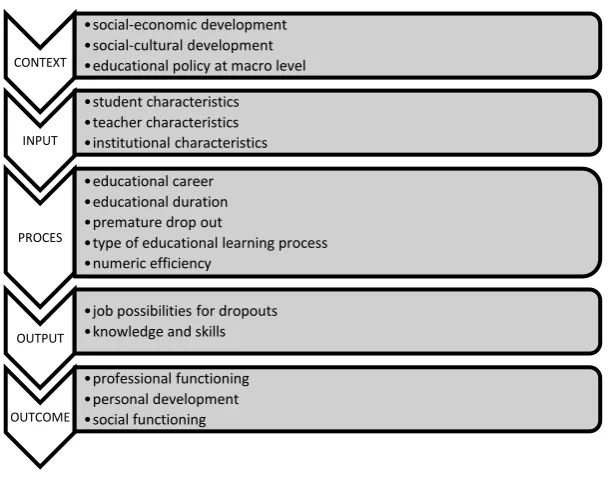
[image:9.595.71.378.455.694.2]Study success rates have many aspects. A relatively broad definition is given by the Social Economical Council (SER), an important advisory body for the Dutch government. The SER considers study success as an educational production process, which is displayed in figure 1.
Figure 1: Educational production process (SER, 1990, p. 16)
The SER defines study success in terms of the accomplishment of three main goals of education, which in figure 1 is represented as the outcome of the production process (SER, 1990, p. 15). The three goals of education are:
CONTEXT
•social-economic development •social-cultural development •educational policy at macro level
INPUT
•student characteristics •teacher characteristics •institutional characteristics
PROCES
•educational career •educational duration •premature drop out
•type of educational learning process •numeric efficiency
OUTPUT
•job possibilities for dropouts •knowledge and skills
OUTCOME
10
1. Individual: contribution to personal development;
2. Social-cultural: preparation for social functioning;
3. Social-economic: preparation for professional functioning.
In this, graduation is just one of the aspects that contribute to a successful education. Other aspects for example are the educational career and development of students (SER, 1990, p. 17).
The definition of the SER is broad and complete but difficult to measure. Hence, in this study, a more simple (and limited) definition of success will be used; study success rate is defined as the percentage of students that graduate within a particular period after they started their studies (Onderwijsinspectie, 2009, p. 18). This will be further referred to as graduation rates. In this report when spoken of study success it will mean graduation rates and dropout rates, because according to the definition of the SER it contains (at least) both. The definition of the dropouts will be presented in the following paragraph.
1.3 Dropouts
In 2009, the Onderwijsinspectie published a report titled “Werken aan een beter rendement”, in
which the results of six case studies selected from different HEIs have been presented
(Onderwijsinspectie, 2009, pp. 16-17). In this report dropout is defined as ‘dropping out from the
initial study’. Through a literature review the Onderwijsinspectie states there are four categories of
[image:10.595.144.453.445.612.2]factors which influence the risk for students to drop out (Onderwijsinspectie, 2009, p. 19), namely (1) student-related factors, (2) study-related factors, (3) institution-related factors and (4) policy and system-related factors. Although this report explains the four factors mostly in terms of risks for dropouts, these factors can also have an influence on graduation rates.
Figure 2: Conceptual diagram of dropout factors (Onderwijsinspectie, 2009, p. 25)
Student-related factors: These factors are related to characteristics and needs of students. Reasons for students to drop out include: a study does not meet the expectations of a student; they cannot keep up the pace and level; they are too young; they do not feel connected with the study and teachers; and they are not sufficiently challenged (Onderwijsinspectie, 2009, p. 74). Reasons for delay are barriers within the institutions; lack of student guidance; difficulties of finalizing a bachelor or master assignment and secondary activities of students (Onderwijsinspectie, 2009, p. 75).
11
through interview at the gate; small groups; and individual tutoring with help of the BSA (Onderwijsinspectie, 2009, p. 75). Adversative factors are springboard studies, parking studies, labour shortage, studies with cultural problems, English bachelors and a strong growth of students which sets the staff-student ratio under pressure (Onderwijsinspectie, 2009, pp. 68-69). Springboard studies are study programs of UAS that students choose to only follow the first year in order to get to a research university.
Institution-related factors: These factors are related to the structure of the institution and the governance of HEIs. There are a number of success factors for a high graduation rate. Essentially, this means control of graduation by the Executive Board (hereafter EB); an organizational culture where educational and professional development of teachers is highly rated; and a strong educational concept in which attention is given to institution-wide feasibility (Onderwijsinspectie, 2009, p. 76). Weaknesses are the internal funding and the supply area of the institution (Onderwijsinspectie, 2009, p. 70). The internal funding is based on choices of the EB, which may have an adversely effect on a study program. The area of supply revolves around the environment of the institution and the possibility that there are many low educated people in this area.
Policy and system-related factors: These factors are related to national laws and regulations. Factors that contribute to a high graduation rate are incentives in the current student financing (grant/scholarship/loans); project funding by the state; and long-term performance agreements with
the VSNU (representatives of universities) and the HBO-raad (representatives of UAS) or the Ministry
of OCW (Onderwijsinspectie, 2009, pp. 65-66). Impediments at the national level are the decline in the final level (Dutch, mathematics and English) in secondary education, admission of students to WO with a HBO propaedeutic diploma while the experience is that the level of these students is too low; government funding is shrinking; state funding to the second cash flow (research) is diminishing and low tuition fees which are at the expenses of small-scale education (Onderwijsinspectie, 2009, pp. 70-72).
1.4 Policy process
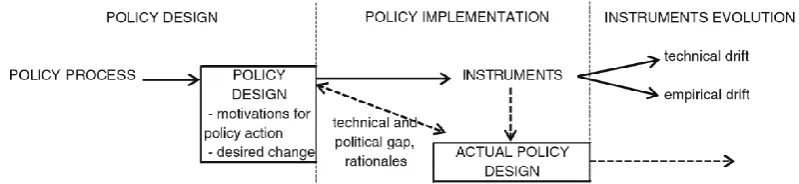
[image:11.595.97.497.637.729.2]As discussed in the introduction, despite of the effort made by the government, study success has remained more or less the same. Reforms do not seem to have the desired effect or maybe do not have an effect at all. This raises the question how these reforms are put into action. Reale and Seeber (2012) narrated the policy process from an instrumental approach. The instrumental approach distinguishes three key moments in the policy process:
12
1. Policy design process: the design is based on “a set of motivations and justifications for policy
action” influenced by existing and emerging paradigms. The more relevant actors are involved, the higher chance of producing a coherent and accepted policy, with adequate instruments.
2. Policy implementation: “motivations become institutionalized into rationales for action”.
Translating policy into policy tools has its limitations, which is called the technical gap. The difference between the ideal and the actual policy design is called the political gap.
3. Instrument evolution: Instruments may evolve technically and/or empirically. The technical drift
is caused by the sophistication of instruments and the possible trigger for automatic patterns of action. The empirical drift is caused by transformation to fit to the context or is “gradually shaped to be coherent with the dominant steering paradigm”.
(Reale & Seeber, 2012, p. 5)
This approach depicts that the implementation process can be an important reason for a possible discrepancy between the intentions of a policy and the actual policy outcome.
1.5 Research question
Study success (graduation and dropout rates) of students in higher education has been a problem for years, despite several measures taken. A potential reason for failure for reforms that aim to improve study success is that they are not implemented as intended. Another reason can be that the reform itself – in terms of its policy ‘theory’ – is wrong. As indicated above it is likely that the approach taken during the implementation process will partly determine the outcome of the process. In this study we will focus on the implementation process, and in particular a measure that aims to increase graduation rates and to reduce dropout rates. We will address the implementation process within
the UAS of the policy measure “Bindend Studie Advies” (BSA). The BSA has been introduced in 1994
(SER, 1993, p. 45). It is always been an optional instrument for HEIs to use, but when used, it is obligated to meet the conditions that are written down in the WHW (Woelders, Visser, & Rijksbaron, 2013).
This results in the following general research question:
“To which extent are improvements in study success of UAS study programs the result of particular factors of implementation processes of the BSA?”
The following research questions will be used to answer the general research question:
1. What have been the developments in with respect to study success over the last ten years in
the Netherlands in the UAS-sector?
2. Which factors are important for a successful implementation of the BSA-policy?
3. How do the implementation factors explain success or failure of the BSA-policy that aims to
enhance study success?
13
well as dropout rates (Ministerie van OCW, 2005, p. 40). It can shorten the duration of dropouts, which makes education more effective, and it can stimulate the accomplishments of students.
1.6 Research design
The goal of this research is to explore if the implementation of the BSA-policy in UAS has improved study success. Exploration on this subject is useful because despite many policy reforms that have been introduced for HEIs to improve study success, the rates have stayed more or less the same. Causes for this are not really clear. Therefore this research is an explorative study (Babbie, 2007, p. 88).
The practical research will exist out of two parts, a quantitative and qualitative part. First a quantitative study will be conducted in order to select the case studies, which will be study programs of UAS. The starting point is to look at graduation and dropout rates of study programs of UAS. Data
will be abstracted from the HBO-raad. The HBO-raad has statistics on graduation and dropout rates
of every study program at every UAS and for this study the statistics of technical study programs will be used. From the statistics a comparison will be made and three UAS will be selected; one with high improvements in graduation rates but low improvements in dropout rates, one with low improvements in graduation rates but high improvements in dropout rates and one that is more in the middle. This will be followed by the selection of three study programs that are given at all three UAS. The units of analysis, the what or whom being studied, (Babbie, 2007, p. 94) will be the implementation process of the BSA.
Case studies will be done at the selected study programs of the selected UAS. This will entail a second type of research, a qualitative analysis about why and how policy reforms were implemented. In order to collect the data for this qualitative research, relevant institutional and program level policy makers, administrative officers and academics will be interviewed. People that are entrusted with relevant tasks towards policy reforms and the implementation of these reforms will be selected for the interviews. These people will be the units of observation. The interviews will be pre-structured in order to keep the interviews focused on policy reforms, the implementation process and the effectiveness of the reforms. Because it is hard to compare answers given by respondents about their attitude and behaviour towards the implementation process, a Likert-scale is used to qualify the answers that are given. The Likert-scale is seen as a reliable method to measure attitudes and behaviour, but this also means that when formulating questions and qualifications for answers the following rules should be considered (SurveyMonkey, 2013):
The numbers on the scale should be labelled.
The scale should be unipolar, for example from very to not at all.
The scale should be uneven, preferably from 1 to 5.
The distance between answer possibilities should be the same.
The scale should cover the full continuum of possible responses.
Avoid propositions with agree or disagree because of risk for bias.
14
1.7 Structure of the thesis
15
Chapter 2: Context
2.1 Introduction
This chapter will answer the first research question of this study:
“What have been the developments with respect to study success over the last ten years in the Netherlands in the UAS-sector?”
It will first provide a background for the reader about policy reforms in higher education that has been undertaken by the Dutch government in order to improve graduation rates and dropout rates. The starting point will be the introduction of the WHW in 1992, which will be explained in the next paragraph. From there on an overview will be given of the main policies that are initiated in order to improve study success in the following twenty years. After this the developments in graduation rates and dropout rates will be discussed.
2.2 The WHW
In 1992, the Tweede Kamer (Dutch House of Commons) adopted the Law on Higher Education and
Scientific Research (WHW)) and this law became effective in 1993 (Onderwijsraad, 2000, p. 202). The WHW provided the Minister of OCW with new possibilities for rules for admission of students at universities. The minister is enabled to restrict the number of study places if the chances of finding a
job are small in a particular field, also called numerus fixus (SER, 1991, p. 28). The WHW also covers
other forms of admission (SER, 1991, p. 29). For example, HEIs can obligate two final exam courses for admission. When the number of applicants for a particular direction exceeds the capacity, a lottery will be held in order to determine who will be admitted. The SER (SER, 1991, p. 29) gives the following advice on this matter:
"The Council believes that a system where admission is subject to the composition of the examined courses and the corresponding grades is preferable to a system of lottery. (...) Regulation of the inflow of students by setting entry requirements will make the application of numerus fixus less necessary."
In 1993 a slight decrease was observed in the graduation rates of higher education (SER, 1993, pp.
20-21). Especially, students with a HAVO background require more time to finish their studies and/or
are more likely to dropout. Moreover, the percentage of unemployed higher educated people increased. Yet according to the Minister of OCW there was an increasing demand for higher educated people (SER, 1993, p. 33). The Minister stated that the increase of participation in higher education should develop in the same direction as the development of employment opportunities. Studies with poor employment prospects should be discouraged. Studies with good employment prospects are mainly technical and natural sciences and these should be encouraged. The importance of selective development of participation in higher education is hereby increased.
2.3 Instruments
16
numerus fixus, but this instrument also comes with some disadvantages. When students are not selected for their preferred study program, they might choose a so-called parking study in order to start with the study of their choice later on. This goes at the expenses of the graduation rates. Also because of higher enrolment in other studies the capacity of these studies has to be increased - as
laid down in the WHW. Finally, the establishment of the numerus fixus can have the disadvantage
that more students go abroad. The SER (1993, p. 37) has a somewhat different opinion then before
concerning admission rules which will make the application of numerus fixus less necessary:
"Another possibility for central control is the use of different admission rules for various disciplines. The Council does not favour this, they believe that in principle diplomas of MBO, HAVO and VWO should give you access to HBO and WO (only VWO)."
The instruments that can be used for motivation are (1) selling points and (2) providence of information (SER, 1993, p. 36). Selling points are mainly instruments like differentiation in tuition fees, student financing (grant/scholarship) and course duration. Separately these differentiations have a limited impact on study choice, but the expectation is that when these three instruments are offered in a coherent package the influence on study choice will increase. This changed position of student financing can contribute to a more controlled participation in higher education, an improved graduation rate and the limitation of government funding. Informing as an instrument seems to have little influence on study choice, because it is handed in the final stage of secondary education, while the choice of a particular curriculum - and thus a certain direction - is made at an earlier stage.
2.4 Selection
In addition to the instruments mentioned above, a possible other instrument to increase graduation rates is selection (SER, 1993, p. 41). The SER gives his opinion about the following three selection
moments in Advies HOOP 1994:
1. Admission to higher education;
2. Selection in the first year (propaedeutic phase);
3. Selection in the further course of the study.
When admission is set by characteristics of students, according to the SER (SER, 1991, p. 44) the following criteria must be met:
The characteristics must be relevant to the study program;
Whether or not the relevant characteristics are present shall be determined objectively;
Selection may not include characteristics that are influenced by training or can be learned.
17
The third selection moment concerns the proposal of the Minister to link study progress to study financing. If a student on a yearly basis achieves less than 25 per cent of the credits, the financing will be converted into a loan. The SER however is concerned that this may lead to students choosing an "easy study" in order to avoid financial risks and that this instrument therefore may have an improper influence on study choice.
In the report Ontwerp HOOP 1996 many reforms announced by the government are related to cuts in higher education (SER, 1995, p. 7). These reforms mainly aim to reduce the study duration of students in order to cut down the cost of higher education. The SER (1995, p. 7) states:
"The reforms are not intended to increase the quality, effectiveness and efficiency of education or to maintain accessibility, they have the primary purpose of making the cuts possible. (...) The necessity of improving the effectiveness and efficiency in order to reduce the costs is recognized by the Council. A reduction of the costs however should be a result and not a pre-imposed task."
The SER also addresses selective admission, or entrance selection, in Advies HOOP 1996. This would
only be desirable if there is a national numerus fixus. In addition, demands for admission should be
based on similar indicators, without students from HAVO or MBO being disadvantaged in comparison
to students from VWO (SER, 1995, p. 9).
2.5 Secondary Education
The Stuurgroep Profiel Tweede Fase has been established in 1993 (Onderwijsraad, 2000, p. 22). This committee was entrusted with the development of new study profiles in secondary education to improve the transition to higher education. This would eventually also improve graduation rates (Commisie Onderwijsvernieuwingen, 2008, p. 9). In principle, the SER was in favour of this proposition, as long as successfully completing such a study profile results irrefutably in admission (SER, 1993, pp. 43-44).
In 1996 the Procesmanagement Voortgezet Onderwijs (PMVO) is appointed as the successor of the
Stuurgroep Profiel Tweede Fase (Commisie Onderwijsvernieuwingen, 2008, p. 48). The PMVO continues the work of the committee and this resulted in the Law Profiles Secondary education, which is adopted in 1997 by the Second Chamber and introduces the Second Phase into secondary education (Onderwijsraad, 2000, p. 22). Starting at the first of August 1998, the profiles will be introduced and secondary schools who need more time may also introduce the profiles in August 1999 (Commisie Onderwijsvernieuwingen, 2008, p. 53). Looking back at the introduction and the actual purpose of the profiles, a better connection between secondary and higher education to increase the graduation rates, there are different opinions (Commisie Onderwijsvernieuwingen,
2008, pp. 62-63). The Tweede Fase Adviespunt notes in an evaluation report that the connection is
indeed improved and the number of dropouts has declined. The number of switchers however has
increased slightly. The Raad van Organisatie-Adviesbureaus (ROA) finds that the introduction of the
Second Phase promotes the flow of the "Royal Route". This means that more students from HAVO
will choose for HBO (UAS) and more students from VWO will choose for WO (universities of academic
18
2.6 Increasing demand
The report Ontwerp HOOP 2000 (Ministerie van OCW, 1999, p. 17) claims there is an increasing
demand for higher educated people. Partly by social and technological developments, the completion of a study in higher education is increasingly important. Moreover, the flow from secondary education to higher education has increased (Ministerie van OCW, 1999, pp. 24-25). Yet many students from VWO choose more often for HBO over WO. This should change by improving the connection between VWO and WO.
The government wants to improve the graduation rates by making it possible for HEIs to offer studies in a flexible way (Ministerie van OCW, 1999, pp. 26-27). This flexible design makes inflow and through flow possible, which should result in less dropouts. Also, a new funding model that will be introduced in 2000 should provide incentives for high graduation rates, because it is characterized with a strong performance orientation.
Another point that is raised in the report Ontwerp HOOP 2000 (Ministerie van OCW, 1999, pp. 30-32)
is to improve the connection between MBO and HBO. An abbreviated pathway in HBO studies will offer an attractive study program for MBO students, but also for employers, because of the shortage of employees with a HBO level. The ultimate goal of improving this connection is to increase graduation rates.
In 2005 one of the main objectives of the Ministry of OCW is to increase the participation in higher education by 50 per cent (Ministerie van OCW, 2005, p. 29). This way the demand of the labour market can possibly be achieved by 2012. It is of importance that the graduation rates also increase otherwise there still will be a lack of higher educated people. The aforementioned BSA is again seen as an important instrument to increase these rates (Ministerie van OCW, 2005, p. 40). It can increase the effectiveness of education because it shortens the duration of dropouts. UAS often use these instruments, but among universities of science there are only two institutions that use this tool.
2.7 Belonging at the top
In 2004 there is a slight decrease in the graduation rates of universities of academic science (Ministerie van OCW, 2004, p. 38). The rates of UAS remain fairly constant. The SER considers that the graduation rates should drastically increase in order to be included into the international top where the Netherlands now badly occupies a middle position. Again selection as a part of the admission policy for HEIs is seen as an instrument that can increase graduation rates (Ministerie van OCW, 2004, p. 39). Not only would this be an incentive for students from secondary education to acquire a study place, but it would also make students more conscious of their study choice. The goal is to get the right student at the right place. Tuition fee differentiation is also seen as a useful tool for increasing the graduation rates and the quality of education (Ministerie van OCW, 2004, p. 40). When an institution is allowed to increase the tuition fee it would provide opportunities regarding diversity and excellence in study provision.
19
sufficient (correct) information and adequate knowledge of their own capabilities. This also ensures that more and more students find the right place in higher education.
The strategic agenda Het hoogste goed (Ministerie van OCW, 2007a, p. 5) again emphasized that for
the international position of the Netherlands it is important for higher education to score above average. The tension between quality and quantity is an issue and the Ministry of OCW believes that HEIs should work hard to improve the quality of education through an ambitious learning culture. Essential for the growth of the number of graduates is to reduce the dropout rate (Ministerie van OCW, 2007a, p. 33). Several reasons for dropouts are given:
1. Students follow studies for which they do not have the capabilities or motivation.
2. Students do not feel connected to the education or challenged by the education.
Solutions that are offered are good information, better matching between students and studies, a variety of educational opportunities and intensive support.
2.8 Committee
“Ruim baan voor talent”
The Committee “Ruim baan voor talent” is set to perform several experiments in the field of
admission policies in the period of 2004-2007 (Ministerie van OCW, 2004, p. 68). This mainly corresponds with three types of experiments:
1. Experiments with lower tuition fees;
2. Experiments with higher tuition fees;
3. Experiments with new forms of selection.
It is important that institutions actually provide an obvious added value when they experiment with higher contributions and new selection forms (Ministerie van OCW, 2004, p. 68). In addition, selection may not lead to a reduced level and quality of the inflow and may not harm the value of
previous education (MBO, HAVO or VWO).
In December 2007 the Committee gives their final conclusions in the report ‘Wegen voor Talent’. The
conclusions are summarized below (Ministerie van OCW, 2007b, pp. 33-34):
“Differentiation in higher education can ensure that challenging and inspiring education is available for each student.”
“Matching leads to better academic results of students and a higher success rate, and thus less loss of talent.”
“Matching has the greatest chance of success in small organized courses, where the student and the teacher ‘can look each other into the eyes’, the student is involved and tries to get the maximum out of themselves.”
The Minister of OCW responded to this report in May 2008. Entrance selection would have no predictive value and therefore does not contribute to the matching process (Ministerie van OCW,
2008, p. 4). There are some exceptions - such as small-scaled education and studies with a numerus
20
months studying (Ministerie van OCW, 2008, p. 5). Tuition fees differentiation can only be used in exceptional cases like small-scaled education. The assumption is that the choice for a certain study should be based on substantive arguments rather than on financial reasons. Furthermore, the
Minister enables students to request a so called ‘collegegeldkrediet’ (Ministerie van OCW, 2008, p.
6), which is a loan to cover tuition fees. This makes it possible to keep experimenting with tuition fees differentiation. Experiments with flexible admission will no longer be continued because this instrument misses the actual target group.
In response to the report the Minister has seven proposals for matching and differentiation (Ministerie van OCW, 2008, p. 2):
Matching:
1. Individual study choice interviews across all HEI’s.
2. Study programs with small-scale, intensive and residential education may use
selection.
3. Studies with a numerus fixus can expand their selection opportunities (“decentralized
selection”)
4. Selection for a certain track within a study program may take place starting three
months after the beginning of the study.
Differentiation
5. Study programs with small-scale, intensive and residential education may have a
higher tuition fee.
6. On-going experiments with selection and tuition fee differentiation will be continued.
7. Space will be offered for selection and tuition fee differentiation within the
FES-program for excellence.
2.9 Recent Reforms
In the strategic agenda Kwaliteit in verscheidenheid (Ministerie van OCW, 2011) graduation rates and
the associated factors are again an important topic. A new reform is making it possible for UAS to set admission rules for MBO students (Ministerie van OCW, 2011, p. 16). This should prevent dropout of students who have opted an unrelated follow-up study. Here, the aim is to improve the quality of the study choice by:
Informing based reliable information and good career orientation and study choice guidance;
Forward the notification date for enrolment and widespread adoption of study choice
interviews;
Promoting broad bachelor programs.
21
The agreements are among others related to a quality impulse, increasing the quality of teachers and the intensification of study programs (Ministerie van OCW, 2011, pp. 19, 23, 29).
Recent developments have made it possible for HEIs to use the BSA not only in the first year but also in the years after (Rijksoverheid, 2013). This instrument is believed to increase the quality as well as graduation rates. The effectiveness is tested in the next few years due to experiments at HEIs.
2.10 BSA
Because the implementation of the BSA-policy is the subject of analysis in this study, this paragraph will explain the policy more extensively in terms of how this instrument can be used by HEIs.
The BSA (Bindend Studie Advies) can be literally translated into binding study advice. It is an
instrument for HEIs to inform a student about their study progress. They are able to reject students if they do not reach the BSA-standard that is set for the followed study program (Onderwijsraad, 2000, p. 226). The standard is set at a minimum amount of study points which a student at least should achieve after a certain period of time (Stichting Adviesgroep Bestuursrecht, 2013). The amount of study points is linked to a course and the maximum amount a student can gather over one year is sixty points. The standard can be set institution-wide or study program specific. A nuance in the policy is the opportunity to take personal circumstances into account when deciding on a specific student and formulating the advice.
The desired and expected effect of the BSA is that graduation rates will increase (Ministerie van OCW, 2005, p. 40). The idea is that students are more likely to be motivated to work in order to avoid being rejected from the study program. Also it makes is possible to shorten the duration of dropouts, which results in more effective education. The latter could however have a negative side-effect. Because students can be rejected after one year, the dropout rates after one year could also increase instead of decrease. Ideally the policy should also minimize these effects (SER, 1993, pp. 46-47).
2.11 Developments in graduation and dropouts
This section particularly addresses the first research question. To give an impression of the effect of these policy measures this paragraph will show the developments in graduation rates and dropout rates. For this the most recent statistics available will be used. This means that for graduation rates we will use the statistics for the cohorts of students that entered UAS study programs between 2002 and 2006. The cohort for these students is five years. For the dropout rates we will use the statistics for the cohorts of students that entered UAS study programs between. The cohort for these students is one year.
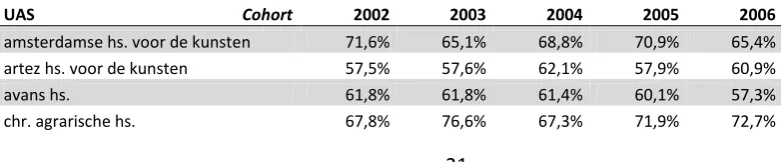
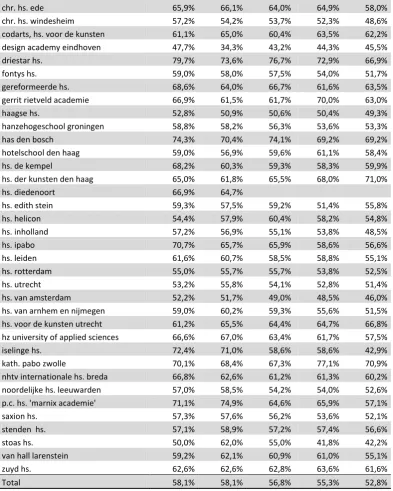
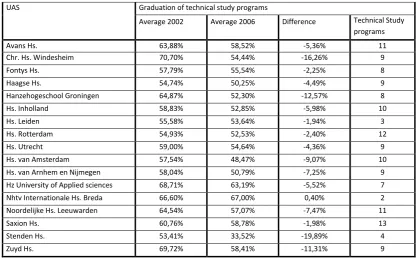
[image:21.595.69.460.704.785.2]The rates that are presented will not show the study success for every study program separately, but are aggregated numbers of graduation rates and dropout rates for every UAS. Table 1 depicts the graduation rates for all UAS in the period 2002-2006. Table 2 depicts the dropout rates for all UAS in the period 2006-2010.
Table 1: Graduation rates of UAS (HBO-raad, 2012a)
UAS Cohort 2002 2003 2004 2005 2006
22
chr. hs. ede 65,9% 66,1% 64,0% 64,9% 58,0% chr. hs. windesheim 57,2% 54,2% 53,7% 52,3% 48,6% codarts, hs. voor de kunsten 61,1% 65,0% 60,4% 63,5% 62,2% design academy eindhoven 47,7% 34,3% 43,2% 44,3% 45,5% driestar hs. 79,7% 73,6% 76,7% 72,9% 66,9% fontys hs. 59,0% 58,0% 57,5% 54,0% 51,7% gereformeerde hs. 68,6% 64,0% 66,7% 61,6% 63,5% gerrit rietveld academie 66,9% 61,5% 61,7% 70,0% 63,0% haagse hs. 52,8% 50,9% 50,6% 50,4% 49,3% hanzehogeschool groningen 58,8% 58,2% 56,3% 53,6% 53,3% has den bosch 74,3% 70,4% 74,1% 69,2% 69,2% hotelschool den haag 59,0% 56,9% 59,6% 61,1% 58,4% hs. de kempel 68,2% 60,3% 59,3% 58,3% 59,9% hs. der kunsten den haag 65,0% 61,8% 65,5% 68,0% 71,0% hs. diedenoort 66,9% 64,7%
hs. edith stein 59,3% 57,5% 59,2% 51,4% 55,8% hs. helicon 54,4% 57,9% 60,4% 58,2% 54,8% hs. inholland 57,2% 56,9% 55,1% 53,8% 48,5% hs. ipabo 70,7% 65,7% 65,9% 58,6% 56,6% hs. leiden 61,6% 60,7% 58,5% 58,8% 55,1% hs. rotterdam 55,0% 55,7% 55,7% 53,8% 52,5% hs. utrecht 53,2% 55,8% 54,1% 52,8% 51,4% hs. van amsterdam 52,2% 51,7% 49,0% 48,5% 46,0% hs. van arnhem en nijmegen 59,0% 60,2% 59,3% 55,6% 51,5% hs. voor de kunsten utrecht 61,2% 65,5% 64,4% 64,7% 66,8% hz university of applied sciences 66,6% 67,0% 63,4% 61,7% 57,5% iselinge hs. 72,4% 71,0% 58,6% 58,6% 42,9% kath. pabo zwolle 70,1% 68,4% 67,3% 77,1% 70,9% nhtv internationale hs. breda 66,8% 62,6% 61,2% 61,3% 60,2% noordelijke hs. leeuwarden 57,0% 58,5% 54,2% 54,0% 52,6% p.c. hs. 'marnix academie' 71,1% 74,9% 64,6% 65,9% 57,1% saxion hs. 57,3% 57,6% 56,2% 53,6% 52,1% stenden hs. 57,1% 58,9% 57,2% 57,4% 56,6% stoas hs. 50,0% 62,0% 55,0% 41,8% 42,2% van hall larenstein 59,2% 62,1% 60,9% 61,0% 55,1% zuyd hs. 62,6% 62,6% 62,8% 63,6% 61,6% Total 58,1% 58,1% 56,8% 55,3% 52,8%
The first thing that stands out is that the average graduation rate of all UAS together has decreased with more than 5% from 2002 till 2006. Looking at UAS separately, almost every UAS has decreased developments in graduation rates. The UAS who do have increased graduation rates are mostly UAS with monodisciplinary education, which means that they only offer study programs in a certain sector, like arts or agricultures. Another thing that stands out is that there can be a major difference
between the rates of UAS. For example in the cohort of 2006 the lowest rate is 42.2% (Stoas Hs.) and
[image:22.595.69.463.71.563.2]the highest rate is 72.7% (Chr. Agrarische Hs.), while the average is 52.8%.
Table 2: Dropout rates of UAS (HBO-raad, 2012b)
UAS Cohort 2006 2007 2008 2009 2010
23
avans hs. 17,0% 17,2% 13,8% 14,7% 13,7% chr. agrarische hs. 11,5% 15,1% 11,6% 14,3% 22,0% chr. hs. ede 18,3% 19,8% 16,0% 17,9% 17,3% chr. hs. windesheim 19,7% 18,7% 17,7% 17,0% 17,5% codarts, hs. voor de kunsten 16,3% 18,4% 12,6% 13,2% 18,1% design academy eindhoven 9,7% 10,7% 12,8% 8,4% 22,5% driestar hs. 12,6% 14,4% 9,7% 8,5% 15,4% fontys hs. 17,9% 19,2% 16,9% 16,8% 17,3% gereformeerde hs. 19,9% 21,0% 18,7% 19,3% 22,8% gerrit rietveld academie 17,1% 13,8% 12,2% 13,1% 10,1% haagse hs. 17,1% 16,0% 14,3% 14,8% 15,6% hanzehogeschool groningen 14,9% 15,0% 12,9% 13,7% 14,4% has den bosch 15,3% 19,1% 15,8% 19,6% 13,9% hotelschool den haag 9,3% 7,6% 8,0% 6,2% 9,8% hs. de kempel 17,3% 19,3% 13,4% 14,0% 12,5% hs. der kunsten den haag 9,9% 12,5% 12,8% 14,2% 14,2% hs. edith stein 17,4% 21,7% 21,5% 22,7% 20,4% hs. helicon 21,0% 23,1% 19,3% 28,3% 23,9% hs. inholland 18,9% 19,3% 15,8% 17,4% 18,7% hs. ipabo 20,8% 28,5% 18,1% 21,5% 16,5% hs. leiden 16,4% 17,1% 13,3% 14,6% 16,8% hs. rotterdam 15,6% 15,9% 13,4% 13,9% 14,5% hs. utrecht 18,0% 18,6% 17,5% 16,8% 16,0% hs. van amsterdam 18,3% 18,4% 16,4% 17,6% 16,5% hs. van arnhem en nijmegen 18,9% 19,2% 16,3% 16,5% 16,9% hs. voor de kunsten utrecht 13,6% 14,9% 13,0% 13,1% 14,2% hz university of applied sciences 17,9% 16,4% 15,5% 17,2% 15,1% iselinge hs. 24,1% 17,2% 17,7% 14,4% 23,0% kath. pabo zwolle 14,5% 13,0% 14,4% 8,0% 13,8% nhtv internationale hs. breda 14,6% 16,4% 13,3% 14,4% 15,0% noordelijke hs. leeuwarden 17,5% 16,1% 13,2% 13,8% 12,6% p.c. hs. 'marnix academie' 18,5% 16,0% 14,6% 8,2% 17,4% saxion hs. 16,4% 15,5% 14,7% 14,8% 16,4% stenden hs. 16,2% 17,4% 17,1% 16,0% 16,9% stoas hs. 27,3% 28,0% 20,7% 18,6% 27,1% van hall larenstein 17,1% 18,0% 16,9% 16,8% 19,7% zuyd hs. 14,1% 16,5% 14,0% 14,2% 13,9%
Total 17,2% 17,5% 15,3% 15,7% 16,1%
The first thing that stands out is that the average dropout rate of the 2010 cohort is only marginally lower than the cohort of 2006. However, in between those years the dropout rates have been lower and so compared to the previous two years, dropout rates have somewhat increased. Looking at specific UAS there is not a clear pattern, some UAS have their dropout rates reduced and others have their dropout rates increased. Another thing that stands out is the difference between dropout rates of UAS, although these rates are closer to each other than the graduation rates of UAS. The highest
dropout rate for example of cohort 2010 is 27.1% (Stoas Hs.) and the lowest rate is 9.8% (Hotelschool
24
About the developments in study success of UAS can be stated that:
Overall graduation rates have not improved; on the contrary, the average of all UAS is
decreased.
There are major differences in graduation rates of different UAS.
Dropout rates have been reduced and increased again, which eventually has resulted in the
rates remaining more or less the same.
There are also many differences in dropout rates of different UAS.
25
Chapter 3: Theoretical framework
3.1 Introduction
This chapter will answer the second research question for this study:
“Which factors are important for a successful implementation of the BSA-policy?”
Higher education is seen as a “relatively under-researched field” (Kohoutek, 2012, pp. 1-2). There are no widely accepted approaches on how to implement new policies in higher education. Hence, this chapter will therefore first explore general implementation theories and will then focus on identification of the factors that affect the chances on successful implementation. These factors will be used to describe some expectations about how these factors are presented in UAS and to analyse the implementation process of reforms on study success within the selected programs of UAS.
3.2 Implementation in general
Implementation studies in higher education are frequently based on a framework designed by Cerych and Sabatier which uses a top-down, staged approach (Kohoutek, 2012, p. 10). However this approach has also been highly criticized because it does not explain the real-life implementation process adequately (Gornitzka, Kyvik, & Stensaker, 2005, p. 43). Implementation analysis in general can be approached from two angles; (1) the top-down perspective and (2) the bottom-up perspective (Sabatier, 2005, p. 19).
The top-down perspective is a vertical approach in which policy decisions are made by an authoritative leader (Colebatch, 2009, p. 35). For public policy to pass through there are three major stages where changes take place, namely (1) policy formulation, (2) policy implementation and (3) policy reformulation (Gornitzka, Kyvik, & Stensaker, 2005, p. 39). Implementation in this perspective means carrying out a policy decision (Sabatier, 2005, p. 19).
The bottom-up perspective is a more horizontal approach in which policy decisions are made through interaction among actors (Colebatch, 2009, p. 35). The implementation method for the bottom-up approach provides a mechanism that starts from the low-level management to the top-level management of policy makers (Sabatier, 2005, p. 23). It starts by identifying the network of actors in order to assess the importance and necessity of governmental reforms. This is done by out-mapping the goals, strategies, activities and contacts of actors in the network. From these contacts the actors that are involved in planning, financing and executing reforms at the local, regional and national level are identified through which the implementation structure becomes clear.
26
According to the instrumental approach analysing the implementation process of policies means “focusing on how they are put into action, and the conditions under which success or failure in achieving the expected results ensue” (Reale & Seeber, 2012, p. 2). Implementation should be seen as an evolution, because it is a continuous process of reformulation and redesigning. Instruments are means to realise policy objectives and are seen as institutions, which reveal the real choices of policies (Reale & Seeber, 2012, pp. 3-4).
3.3 Factors
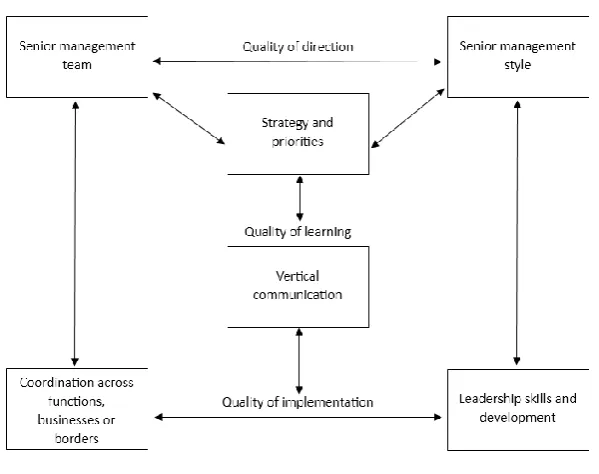
There are six different factors of importance in the implementation process according to Beer and Eisenstat (2000, pp. 31-35). These factors are (1) senior management style; (2) strategy and priorities; (3) senior management team; (4) vertical communication; (5) coordination across functions, businesses or borders; and (6) leadership skills and development. Each factor can contribute - directly or indirectly - to the success or failure of the implementation process. The following figure will show how these factors interact with each other.
[image:26.595.149.449.308.545.2]The interaction between these factors determines the quality of three aspects, namely the quality of direction, learning and implementation (Beer & Eisenstat, 2000, pp. 32-34). The senior management team and their management style influence the quality of the direction that is given to the organization. The higher the quality of the direction, the better the team will be coalesced and the better it will work together. The quality of learning of the organization depends on the communication and the establishment of strategy and priorities. The higher the quality of learning is, the better the upward communication within the organization is and the more employees will work to accomplish goals. There are two factors which influence the quality of implementation which are the coordination of the organization and the (potential) leadership skills and development. The higher the quality of implementation is, the more there will be collaboration among managers from different levels. It will resolve differences of perspective.
27 3.3.1 Senior management style
If this factor is positively present in the implementation process, the senior management style embraces top-down direction and bottom-up influence (Beer & Eisenstat, 2000, p. 35). This means that direction is given from the senior management and feedback is used to improve the direction. This can be seen as a more horizontal approach in which policy decisions are made through interaction among actors (Colebatch, 2009, p. 35). The implementation method for this approach provides a mechanism that moves from street-level bureaucrats to the top of policy makers (Sabatier, 2005, p. 23).
When the senior management style is only top down or laissez-faire, this factor is negatively present in the implementation process (Beer & Eisenstat, 2000, p. 32). Implementation in this perspective simply means carrying out a policy decision (Sabatier, 2005, p. 19). Top-down is a vertical approach in which policy decisions are made by an authoritative leader (Colebatch, 2009, p. 35). This approach or the more ‘wait and see’ approach (laissez-faire) can result in “discomfort with conflict, frequent absences to manage an acquisition and use of the top team for administrative matters rather than focused strategic discussions” (Beer & Eisenstat, 2000, p. 33). Senior teams are bypassed by the management, which prevents them from becoming an effective team.
3.3.2 Senior management team
If this factor is positively present in the implementation process, the senior management functions as an effective team with general-management orientation (Beer & Eisenstat, 2000, p. 35). This will provide for a common voice through constructive conflict which is needed to implement the strategy. In this process of constructive conflict different interests are gathered in order to create support among people and a power base for change, mostly through win-win situations, political games, power plays and by using negotiating tactics (de Caluwe & Vermaak, 2003, pp. 45-46). When there is an ineffective senior management team, this factor is negatively present in the implementation process (Beer & Eisenstat, 2000, pp. 32-33). This will result in a top team that does not cooperate and only works within their own silos because of the fear for losing power. Senior teams are bypassed by the senior management, which prevents them from becoming an effective team. This causes a lack of development of coordination at lower levels. It can also cause a lack of support which will result in resistance to change (implementation process) among the people involved (de Caluwe & Vermaak, 2003, p. 45).
3.3.3 Strategy and priorities
If this factor is positively present in the implementation process, the strategies and priorities are clear and are formulated by the top team after discussion with lower levels (Beer & Eisenstat, 2000, p. 35). This again shows a more horizontal approach which has been explained in the senior management style. A clear strategy provides a causal theory about “how to effectuate social change” (Sabatier, 2005, p. 19). Clear priorities provide for standards of evaluation as well as for legal resources for change agents. A clear strategy and clear priorities are therefore seen as necessary conditions for successful implementation. It provides a rational design for the implementation process (de Caluwe & Vermaak, 2003, p. 46).
28
are bypassed by the management, which prevents them from becoming an effective team. The strategy is unclear, because there are no choices made about what to do and what not to do. Middle managers therefore cannot collaborate effectively.
3.3.4 Vertical communication
If this factor is positively present in the implementation process, there is an open vertical communication and there are open dialogues about effectiveness (Beer & Eisenstat, 2000, p. 35). This way feedback can be given about the senior management in order to create learning situations where can be experimented with more effective ways of acting (de Caluwe & Vermaak, 2003, p. 48). By creating these learning situations people can be allowed and feel supported to take responsibility for their own learning about the new situation after the change is implemented in order to improve their ways of acting.
When there is poor vertical communication, this factor is negatively present in the implementation process (Beer & Eisenstat, 2000, pp. 32-34). It will result in a lack of candid discussion with senior managers about possible threatening and embarrassing issues. If the vertical communication is blocked, it will also prevent the organization and its people from learning. This is because people do not feel motivated nor supported to experiment with new behaviour and are not able to learn from each other because of the lack of communication (de Caluwe & Vermaak, 2003, p. 49).
3.3.5 Coordination across functions, businesses or borders
If this factor is positively present in the implementation process, there is effective coordination (Beer & Eisenstat, 2000, p. 35). Teamwork should take place across divisions, functions, localities and businesses. For coordination to be effective it is necessary to have clear strategies and priorities. This way, lower-level managers are able to exercise independent judgment. Clear strategies and priorities also provide a rational design for the implementation process in which there is a clear structure and reasonable control over the steps that are undertaken (de Caluwe & Vermaak, 2003, pp. 46-47). When there is poor coordination across functions, businesses or borders, this factor is negatively present in the implementation process (Beer & Eisenstat, 2000, pp. 32-34). This will result in competing strategies within an organization and people that are battling for the same resources. Senior teams are bypassed by the management, which prevents them from becoming an effective team. Managers across functions, businesses or borders are not able to collaborate effectively with one another if the senior management has conflicting strategies and priorities which push the managers in different directions. This may cause the managers and/or the senior management to lose sight of the intended result (de Caluwe & Vermaak, 2003, p. 47)
3.3.6 Leadership skills and development
29
have to have certain political skills to facilitate communication and negotiation (de Caluwe & Vermaak, 2003, p. 46).
When there is inadequate down- the-line leadership skills and development, this factor is negatively present in the implementation process (Beer & Eisenstat, 2000, pp. 32-34). This will result in the lack of skills of lower-level management to lead change and no training or support is provided by the management to develop such skills. In these cases most of the time the general manager alone sees the whole picture which will cause a top-down approach with little or no bottom-up influence.
3.4 Implementation factors and expectations
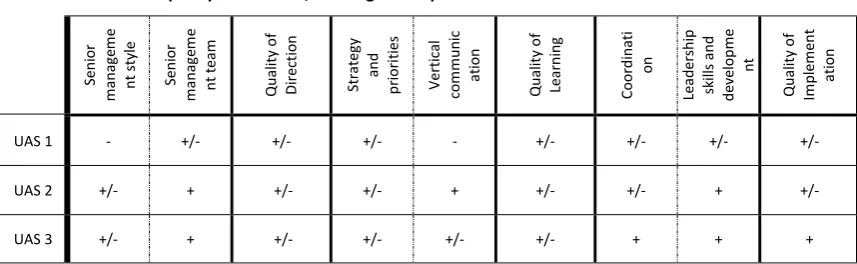
The theoretical framework gives six factors that are considered to be important for the success or failure of an implementation process. These factors will be used for the analysis of the BSA-policy. Based on the theory and literature of the previous chapters, some expectations can be made which are depicted in Table 3.
1. Senior management style
2. Senior management team
3. Strategy and priorities
4. Vertical communication
5. Coordination across functions, businesses or borders
6. Leadership skills and development
[image:29.595.57.563.593.738.2]If a factor is marked (+), it means the factor will have a positive effect on the implementation process of the BSA. If a factor is marked (+/-), it means the effect of the factor will not be optimal on the implementation process of the BSA. If a factor is marked (-), it means the factor has a negative effect on the implementation process of the BSA. Based on the factors the effects of the quality of direction, learning and implementation on the implementation process of the BSA are determined. The following applies to the graduation rates and dropout rates. If it is marked (+) it means the rates are expected to be improved as a result of the implementation process of the BSA. For graduation rates this means an increase in rates and for dropout rates this means a decrease in rates. If it is marked (?) the outcome is expected to be uncertain as a result of the implementation process of the BSA. If it is marked (0) there is no effect expected as a result of the implementation process of the BSA.
Table 3: Expectations
Se ni o r m an ag em ent st yl e Se ni o r m an ag em ent te am Qu al it y o f D ir ec ti o n St rat eg y a nd pr io ri ti es Ve rt ic al co m m un ic at i on Qu al it y o f Le ar ni ng C o o rdi na ti o n Le ad er sh ip sk ill s an d de ve lo pm ent Qu al it y o f Im pl em ent at i
on Graduation rates Dropout rates
Expectat
ion 1 + + + + + + + + + + +
Expectat
ion 2 +/- +/- +/- +/- +/- +/- +/- +/- +/- ? ?
Expectat
30
Expectation 1
If all factors have a positive effect on the implementation process of the BSA, the effects of the quality of direction, learning and coordination will also be positive. There is expected to be success of the BSA-policy. In turn this would imply that the implementation process of the BSA-policy has a positive effect on study success, which means that graduation rates will increase and dropout rates will reduce.
Expectation 2
If the factors do not have an optimal effect on the implementation process of the BSA, the effects of the quality of direction, learning and implementation will also be not optimal. There is expected to be some success of the BSA-policy. In turn this would imply that the effect of the implementation process of the BSA on study success is not optimal. There are probably some improvements in graduation rates and dropout rates, but it is also possible that there will barely be an effect notable.
Expectation 3
31
Chapter 4: Operationalization and selection
4.1 Factors in UAS
A general structure of an UAS is needed in order to translate the factors of the implementation process to day-to-day practice in UAS. Therefore an organogram will be used based on the WHW, chapter 10 (Stichting Adviesgroep Bestuursrecht, 2013), and several organograms of UAS. It is displayed in figure 5.
According to the WHW (Stichting Adviesgroep Bestuursrecht, 2013) the Supervisory Board (SB) is responsible for the supervision on the execution of activities and authorities of the Executive Board (EB). The EB is responsible for administrative and management regulations and has the possibility to
transfer authorities to the faculty council. According to the Onderwijsinspectie (2009, p. 76) the EB
should also have control on graduation rates for a positive effect. The SB and (mainly) the EB should be seen as the top-level management. The Central Representative Advisory Council (CRAC) gives advice to the EB and discusses the policy that is pursued. The CRAC will further ensure the general state of affairs within the UAS together with the support departments. The CRAC and the support departments should be seen as the mid-level management.
This research will focus for the most part on study programs and how specific reforms are set into place. This means that there will be zoomed in on the faculty level. Every faculty will have a faculty council, consisting of at least a director and study program managers. The director is responsible for a cluster of study programs and the related teachers and gets direction from the executive board. The manager is responsible for a certain study programs and everything that is related to that program. The faculty council (director and managers) should be seen as the low-level management. For every factor - discussed in the previous paragraph - the expectations of a success situation will be described below. Also some questions will be formulated for every factor which will make it possible to measure it.
4.1.1 Senior management style
[image:31.595.160.392.193.403.2]If this factor is positively present in the implementation process, the top-level management has a hierarchical structure with a reciprocal character. When implementing a reform the EB has to give
32
direction to the staff of the UAS, which shows the vertical aspect in a UAS. This is followed by feedback from the mid- and low-level management on the reform and/or the way it was carried out to by the director of the faculty and the managers of the study program, which shows the horizontal aspect in a UAS. The goal is to improve the direction and the management of the UAS/faculty/study program.
To what extent has there been consultation about the policy between the EB and the
executors/implementers of the BSA policy?
To what extent did the EB listen to suggestions from those who execute/implement the BSA
in the preparatory phase?
To what extent do study programs have freedom in the policy to implement it in their own
way?
The role of the EB can be seen as:
o Active/passive
o Involved/detached
o Stimulating/demotivating
o Open/closed
o Clear/unclear
o Decisive/indecisive
4.1.2 Senior management team
If this factor is positively present in the implementation process, the top-level management most likely is unambiguous and explicit about policies. The management will have a general background but probably also has some affinity with education. Through constructive conflict a general consent about how to handle/implement a certain reform can be created. By accepting feedback from the low-level management an ‘expert view’ on the strategy and priorities is given which allows the reform to adapt to the environment of the UAS/faculty/study program.
To what extent has the EB been unambiguous about the way the BSA was propagated?
To what extent did the EB explicitly stated what was expected of those involved with respect
to this policy?
To what extent is the BSA executed in accordance with the intention?
4.1.3 Strategy and priorities
If this factor is positively present in the implementation process, the top-level management has a clear strategy on how to implement the reform and explain the priorities which should be focused
on. According to the Onderwijsinspectie (2009, p. 76) this should have a strong educational concept
in order to contribute to graduation and dropout rates. The manager has to apply the strategy on the study program and must communicate this with the teachers involved. By explaining the strategy to the teachers they will be more understanding and more likely to endorse/embrace the strategy. By using clear priorities tasks are provided for managers and teachers to fulfil. This improves the quality of learning directly, which means more chance of reaching the goal where the reform is aiming at.
To what extent are the goals of the policy formulated in accordance with the SMART-method
(Specific, Measurable, Acceptable, Realistic and Time-bound)