U n i v e r s i t y o f T w e n t e .
M a s t e r T h e s i s
Data b a s e G r o u p
Efficient Query Evaluation on
Probabilistic XML Data
Derived from a glue process with skeleton & flesh
Paul Stapersma
5th December 2012
Committee:
“All the ideas in the universe can be described by words. Therefore, if you simply take all the words and rearrange them randomly enough times, you’re bound to hit upon at least a few great ideas eventually.”
Abstract
In many application scenarios, reliability and accuracy of data are of great importance. Data is often uncertain or inconsistent because the exact state of represented real world objects is unknown. A number of uncertain data models have emerged to cope with imperfect data in order to guarantee a level of reliability and accuracy. These models include probabilistic XML (P-XML) –an uncertain semi-structured data model– and U-Rel –an uncertain table-structured data model. U-Rel is used by MayBMS, an uncertain relational database management system (URDBMS) that provides scalable query evaluation. In contrast to U-Rel, there does not exist an efficient query evaluation mechanism for P-XML.
In this thesis, we approach this problem by instructing MayBMS to cope with P-XML in order to evaluate XPath queries on P-XML data as SQL queries on uncertain relational data. This approach entails two aspects: (1) a data mapping from P-XML to U-Rel that ensures that the same information is represented by database instances of both data structures, and (2) a query mapping from XPath to SQL that ensures that the same question is specified in both query languages.
We present a specification of a P-XML to U-Rel data mapping and a corresponding XPath to SQL mapping. Additionally, we present two designs of this specification. The first design constructs a data mapping in such way that the corresponding query mapping is a traditional XPath to SQL mapping. The second design differs from the first in the sense that a component of the data mapping is evaluated as part of the query evaluation process. This offers the advantage that the data mapping is more efficient. Additionally, the second design allows for a number of optimizations that affect the performance of the query evaluation process. However, this process is burdened with the extra task of evaluating the data mapping component.
Preface
As a scholar, I had a wide interest for many specialties such as finance, physics and mathematics. Consequently, I had no idea what study would intrigue me the most. I participated in a promotion project in which I was accompanied by a senior student who showed me his daily life at the campus in Enschede. This opportunity resulted in me becoming a Computer Science (CSC) student at the University of Twente.
In my first year as student, I came in contact with various interesting fields of computer science such as telematics, security and databases. As a result, I started in the same year with a second Bachelor’s program in Telematics. Additionally, I participated in extracurricular activities and became member of the CSC promotion team. This time, it was my turn to show scholars the student life.
At the end of my bachelor, I was asked to introduce a reporter to several researchers in the field of CSC. During this activity, I came in contact with Maurice van Keulen, my first supervisor of this graduation project. He sketched the reporter his field of research by which he indirectly introduced me to the field of uncertain databases. At that time, I had to select a topic for my final Bachelor project. I asked Maurice if I could participate in one of his research projects as part of my Bachelor project. This was the start of a wonderful collaboration.
I continued my study with a master in security. This turned out to be a bad match. After a switch from security to databases, I had to pleasure to work with Maurice once again on two projects that build on my initial Bachelor project. The rough diamonds we found during these projects were the input for this graduation project.
During my graduation project, many people asked me what my research is about. Most of the times, I try to explain the concept of an uncertain database management system and sometimes I add an application scenario to this explanation. One day, I was walking with my dad in the park. He told me that I had to find an application scenario that had to be appealing to people. The next two weeks, I found myself building a solver for nonogram puzzles with solely URDBMS technology. One solution to such puzzle is found in Figure 1. Unfortunately, I was unable to put my thoughts of this new idea on paper. However, this finding has convinced me that URDBMS technology has a promising future.
1. Veiligheidsspeld
2. Konijntje 3. Molen
4. Paraplu 5. Slak 6. Insect op blaadje
6
SDMTEST_008.indb 6 5/22/2012 2:58:48 PM
Acknowledgements
I would like to thank a few people for their support during the course of my graduation project in which this thesis has been written. First of all, I would like to thank my supervisors: Maurice, Maarten en Jan. Maurice, I really appreciate the freedom you gave me to mastermind my own thoughts and help me conquer most of the challenges in this research project and earlier projects. I will miss our long discussions and brainstorm sessions about how to take our projects to the next level. Maarten, you amazed me with your skills to put a complex idea on paper in just a few lines. In the time we spent, you taught me the basics of how to formalize my own ideas. The 26th letter of the alphabet will always help me remind me of this. Jan, thank you for all the support on realizing a full grown P-XML DBMS prototype & benchmark. Also your crash course in C helped me master MayBMS.
I would also like to thank my fellow year students: Lesley Wevers, Harold Bruintjes, Ronald Burgman, Gerjan Stokkink, Bj¨orn Postema, Ferry Olthuis and Daan van Beek. They have provided me with a pleasant environment at the fifth flour. I like to acknowledge Harold in particular for his contributions to the image processing in this thesis, the high-fives and the many coffee breaks.
I would like to thank Matthias Bosch for helping me getting my thoughts on paper. I experienced that the gap between knowing something and explaining something can be huge. Matthias helped me bridge this gap.
Contents
1 Introduction 1
1.1 Motivation . . . 1
1.1.1 Introduction to uncertainty management . . . 1
1.1.2 Application scenarios of uncertainty management . . . 2
1.1.3 Uncertainty management for XML . . . 3
1.2 Research questions . . . 3
1.3 Global approach to show correctness . . . 4
1.4 High level design . . . 7
1.5 Scope . . . 8
1.5.1 Suitable URDBMS for XPath processing . . . 8
1.5.2 Probabilistic XML model . . . 8
1.5.3 XPath support . . . 8
1.6 Contributions . . . 9
1.7 Outline . . . 9
I
Prologue
11
2 Preliminaries 13 2.1 An abstract view on database mappings . . . 132.2 Introduction to XML . . . 13
2.2.1 Extensible Markup Language . . . 13
2.2.2 XPath expressions . . . 14
2.3 XML into RDBMS mappings . . . 15
2.3.1 Shared Inlining, a schema-based mapping of XML to relational databases . 16 2.3.2 XPath Accelerator, a schema-less mapping of XML to relational databases 18 2.4 Introduction to uncertain databases . . . 21
2.4.1 Interpretation of an uncertain database in terms of possible worlds . . . 21
2.4.2 Granularity of uncertainty . . . 21
2.5 Probabilistic XML, an uncertain semi-structured data model . . . 21
2.5.1 P-XML model of Van Keulen et al. . . 22
2.5.2 Query evaluation on P-XML data . . . 23
2.6 Views, unmaterialized and materialized . . . 23
3 From P-XML to U-Rel, the Detour 25 3.1 From P-XML to C-XML . . . 26
3.2 From C-XML to Unode . . . 27
3.3 From Unode to Urow . . . 29
3.4 From Urow to URel . . . 29
3.5 Summary . . . 32
II
Specification
35
4 Abstraction of an Uncertain Data Model 37 4.1 Analogy with pattern matching . . . 374.2 An abstract formalism of a data model . . . 38
4.3 The U-Relational model adheres to the possible worlds semantics . . . 43
4.4 Analogy with pattern matching continued . . . 44
4.5 An abstract formalism of an uncertain data model . . . 45
4.6 Query evaluation on uncertain data . . . 47
4.7 U in the big picture . . . 50
ii CONTENTS
4.8 Summary . . . 51
5 Probabilistic XML expressed in an Abstract Formalism 53 5.1 Probabilistic XML data structure . . . 53
5.2 P-XML adheres to the possible worlds semantics . . . 55
5.3 Viability . . . 56
5.4 C-XML data structure . . . 57
5.5 P-XML to C-XML mapping . . . 58
5.5.1 Data mapping . . . 58
5.5.2 Query mapping . . . 59
5.6 C-XML into U mapping . . . 60
5.6.1 Data mapping . . . 60
5.6.2 Query mapping . . . 61
5.7 Summary . . . 62
6 U-Rel expressed in an Abstract Formalism 63 6.1 U-Relational model . . . 63
6.1.1 U-Relations adhere to the possible world semantics . . . 64
6.2 U-Rel expressed inU . . . 64
6.2.1 Data mapping . . . 64
6.2.2 Query mapping . . . 65
7 Mapping of Nodes to Rows 67 7.1 Data mapping . . . 67
7.2 Query mapping . . . 68
III
Design
69
8 P-XML into URDBMS Data Mapping 71 8.1 Construct a c-document from flesh & skeleton . . . 718.2 First design of P-XML into URDBMS mapping from flesh & skeleton . . . 72
8.3 Mapping of the skeleton into a URDBMS . . . 73
8.4 Mapping of the flesh into a URDBMS . . . 73
8.4.1 Flesh mapping requirements . . . 73
8.4.2 ASI[XA], a new XML into RDBMS mapping designed as flesh mapping . . 74
8.5 Summary . . . 76
9 Introduction to Relational Gluing 77 9.1 Phases . . . 77
9.2 Dependency handles . . . 77
9.3 G-Join . . . 78
9.4 Don’t care choice . . . 79
9.5 Depth . . . 80
9.6 Summary . . . 81
10 Glue Processes 83 10.1 Flavours of glue method application . . . 83
10.1.1 Batch based application . . . 83
10.1.2 Partition based application . . . 84
10.1.3 Precomputed chaining . . . 84
10.2 Categories . . . 85
10.2.1 Flesh driven glue methods . . . 86
10.2.2 Skeleton driven glue methods . . . 90
CONTENTS iii
10.3 Glue administering . . . 94
10.3.1 Document oriented gluing, Administering a glue process to the data mapping process . . . 95
10.3.2 Query result oriented gluing, Administering a glue process to the query mapping process . . . 96
10.3.3 Qualitative comparison between document oriented and query result oriented gluing . . . 97
10.4 Tree-aware uncertainty management . . . 97
10.5 Summary . . . 100
IV
Validation
101
11 Overview of MayBMS & Optimizations 103 11.1 Repair-key statement . . . 10311.1.1 From inconsistency to uncertainty . . . 103
11.1.2 Implementation details . . . 104
11.1.3 Small benchmark on repair-key statement . . . 104
11.1.4 Multi-union approach . . . 105
11.1.5 Benchmark on multi-union approach applied to repair-key . . . 108
11.2 XPath Accelerator vs. Abstract Shared Inlining . . . 110
11.3 Glue methods . . . 111
12 Experiments 113 12.1 Goal . . . 113
12.2 Experimental setup . . . 113
12.2.1 Test sets . . . 113
12.2.2 Query workload . . . 115
12.2.3 Database optimizations . . . 116
12.2.4 Test platform . . . 116
12.2.5 Obtaining benchmark results . . . 116
12.3 Experimental results . . . 118
12.3.1 Experimental results for P-XML into URDBMS data mappings . . . 118
12.3.2 Experimental results for XPath evaluation by a URDBMS . . . 122
12.3.3 Conclusions . . . 128
13 Related Work 131 14 Conclusions & Future Work 133 14.1 Summary . . . 133
14.2 Evaluation of research questions . . . 134
14.3 Research goal achievement . . . 135
14.4 Future work . . . 135
Bibliography 136 A Proofs 141 A.1 Closest node . . . 141
B SQL queries to perform glue process 143 B.1 Glue by Possibility Parent Reference . . . 143
B.2 Glue by Sandwich . . . 143
B.3 Glue by Closest Descendant . . . 144
iv CONTENTS
C Benchmark Details 145
C.1 Query Workload . . . 145
C.2 Indices for query evaluation . . . 147
C.3 DTD of IMDb data set . . . 152
C.4 Normalized speedups for XPath query evaluation by a URDBMS . . . 152
C.4.1 Experimental results for query evaluation on increasing data set size . . . . 152 C.4.2 Experimental results for query evaluation on increasing amounts of uncertainty154 C.4.3 Experimental results for query evaluation on a real world uncertain test set 154
D Retrospect on expressiveness 157
Acronyms 159
Chapter 1
Introduction
1.1
Motivation
In many application scenarios, reliability and accuracy of data are of great importance. Data is often uncertain or inconsistent because the exact state of represented real world objects is unknown. Therefore, data imperfections have to be managed by information systems in order to guarantee a level of data quality. One way to accomplish this is with uncertainty management. Uncertainty management allows an information system to cope with data that is imperfect. We provide an introduction to uncertainty management in Section 1.1.1.
In addition, uncertainty management lends itself for other applications like using user feedback in data management systems in order to improve data quality or trustworthiness of information systems. We elaborate on the diversity of applications for uncertainty management in Section 1.1.2.
In many application scenarios of uncertainty management, information is described in a semi-structured data model. As a consequence, research introduced several probabilistic XML (P-XML) data models that allow for uncertain semi-structured data storage. Section 1.1.3 provides a more detailed motivation for uncertain semi-structured data models. We claim that the state of art does not provide an efficient query evaluation mechanism for P-XML that is scaled up to practice. This is the main motivation for our approach to build an efficient query evaluation mechanism for P-XML data.
1.1.1
Introduction to uncertainty management
In many application domains, data is generally assumed to be complete, correct and conform to reality. These idealistic assumptions are reflected by the expectations of users, who presume their systems to know everything they want to know, and developers who design their systems to be based on perfect data. It is unrealistic to live up to these expectations since a lot of data generally contains many types of imperfections.
A survey on uncertainty management [39] classified several classes ofdata imperfection. We borrowed their example to illustrate these classes which are found in Table 1.1. Various types of data imperfection may coexist, such as in: John is probably not very tall. The author noted that the names assigned to the different classes are used in many existing taxonomies of imperfection, however, slightly different classifications are used in other works.
Class Example: John’s tallness
No imperfection 183cm.
Absence/Missing values Not known.
Non-specificity Between 180 and 190cm. 183 or 184 or 185cm.
Vagueness Not very tall.
Uncertainty Perhaps, 183cm.
Inconsistency 183 and 184 and 185cm.
Error 170cm.
Table 1.1: The main recognized classes of data imperfection
Reasons why data is inexact or not reliable could be one of the following: (1) some data is inexact due to the nature of its origin, (2) data derived from inexact data is also inexact, (3) decisions cannot always be made with only the data at hand, by which a system is forced to make
2 1.1. MOTIVATION
an educated guess with all the consequences that will entail, (4) statistical operations give results with some probability, (5) an approximate answer close to the exact answer can be computed quickly while the exact answer can be computed in the background or not at all in case the approximate answer is sufficient [52].
By its very nature, data imperfections affect the reliability and accuracy of a data source. Hence, they have to be managed in a sensible way. As argued by Halevy [25], standard data management tasks should include a notion of accuracy and reliability in order to provide a level of data quality. We refer to this kind of management asuncertainty management.
The terminology uncertainty management seems misplaced, since uncertainty management implies to manage only uncertainty imperfections, while it should give a notion of the reliability and accuracy of data. However, inconsistency can be interpreted as being uncertain about which of the conflicting values is correct [25, 49]. A similar interpretation can be applied to the discrete case of the non-specificity imperfection class in case only one value is known to be correct. Hence, many classes of data imperfection can be managed. The term ‘data quality management’ would seem more suitable, since more classes of data imperfection are managed with uncertainty management than solely the uncertain class.
If we return to the example in Table 1.1, we can treat the inconsistency inJohn’s tallness is
‘183 and 184 and 185 cm.’ asJohn’s tallness is ‘Perhaps, 183cm.’ or ‘Perhaps 184cm.’ or ‘Perhaps
185cm’. We can apply a similar treatment to the example of the non-specificity class with the
knowledge that John only has one single tallness to obtain the same result.
1.1.2
Application scenarios of uncertainty management
Reliability and accuracy of data are of great importance in many application domains. Inexact data can be enriched with self-describing information about their reliability or accuracy, called uncertain data. The use of uncertain data can be exploited in several application domains. Widom [52] mentions the following candidates: scientific data management, sensor data management, data deduplication, profile assembly, privacy preservation, approximate query processing, hypothetical reasoning and online query processing.
According to Halevy [25], uncertainty management is one of the challenges that arise in enter-prise and government data management as a result of system architectures characterized by loosely connected heterogeneous data sources.
Lynch [38] argues that uncertainty management should also be applied to information retrieval systems which deal with databases that are only assumed to be trustworthy and accurate, and are treated as such. Uncertainty management should indicate to what extent these assumptions are correct.
By its very nature, uncertain data allows systems to manage multiple states. Such a property can be very useful in application scenarios where hard decisions have to be made with little information at hand, because the decision making process can be postponed until sufficient information is available. In the meantime, multiple states are managed, one for each possible outcome of the decision. Examples of application scenarios that use uncertain data for the postponing of hard decisions are duplicate detection: the detection of duplicate tuples corresponding to the same real-world entity [4, 42, 49], named entity disambiguation [24], information extraction [49, 31], data cleaning [13], data coupling/fusion [49], data integration [50], natural language processing: interpreting a natural language by building a syntax tree out of sentences [40, 15].
Most promising seems the integration of user feedback functionality with data management systems that support uncertainty management. The ability of users to interact with a data management system can greatly improve data quality as demonstrated by Kuperus [36] and Van Keulen et al. [50]. This field of research is identified by Halevy [25] as a key tenet that allows data management systems to evolve by learning from human attention. Halevy referred to this field as
CHAPTER 1. INTRODUCTION 3
1.1.3
Uncertainty management for XML
In many application scenarios of uncertainty management, information is described in a semi-structured model, because this data model provides the means to store data that lacks a rigid structure of schema. Nierman [41] states that in the types of applications where uncertainty is an issue, much of the data are not easy to represent in a relational model, even ignoring issues of uncertainty. Therefore, it is not remarkable that leading work on P-XML [41, 46, 2, 18, 29, 34, 44] all motivate the need for an uncertain semi-structured model by example of application. The flexibility of a semi-structured model and the fact that its most used representative, the eXtensible Markup Language (XML) model, is the emerging open standard for data storage and exchange over the Internet, make it attractive to investigate an extension to the XML model with uncertainty [18, 41, 34].
The above mentioned motivates an extension of the XML model with uncertainty. As a result, several data models have been introduced in research to store uncertain semi-structured data. Kimelfeld et al. [32] give an abstract view on the P-XML models of [3, 28, 29, 18, 34, 16, 45, 50]. They categorize these models in several P-XML families, which have different levels of expressive power. Document instances of a P-XML model are referred to as p-documents.
A data model goes hand in hand with a corresponding query evaluation mechanism. After all, what is the point of storing data if it cannot be used? The above mentioned P-XML models lack an efficient query evaluation mechanism. As a consequence, application scenarios of uncertainty management cannot take full advantage of P-XML models.
1.2
Research questions
We identify our problem statement as follows:
There does not exist an efficient query evaluation mechanism for P-XML that is scaled up to practice.
The main goal of this research projects is to contribute to efficient and scalable query evaluation on P-XML data. Van Keulen et al. [50] propose the following approaches to build a P-XML DBMS:
1. Instruct an XML-DBMS to cope with uncertainty.
2. Instruct an uncertain relational database management system (URDBMS) to cope with XML.
In order to contribute to efficient and scalable query evaluation on P-XML, we consider both approaches as alternative solution directions. Most research on uncertain data management focuses on relational databases [52, 35, 6, 27, 43, 9, 14]. Multiple full grown URDBMSs descend from this research that enable efficient query evaluation on uncertain relational data. We use uncertain relation technology to enable efficient query evaluation on P-XML data. Thus, we select the second approach to conduct this research. Additionally, this approach is motivated by URDBMS developers who have shown an interest towards P-XML [43].
Before we formulate our research questions, we specify a questions inherently related to our research goal.
Q: Which URDBMSs are suitable to evaluate XPath queries on P-XML data and which of those is most suitable?
We answer this question in Section 1.5.1.
We derive the following research questions from our main research goal.
4 1.3. GLOBAL APPROACH TO SHOW CORRECTNESS
We consider data in an uncertain data structure to represent a set of possible worlds. Furthermore, we consider a query specified in some query language to represent a question. We specify a P-XML into URDBMS data mappingf such that the same set of possible worlds is represented under f
and we specify an XPath to SQL mapping such that the same question is asked underg. As a consequence, if we ask the same question to the same set of possible worlds, we are bound to get the same answer, however, this answer is represented differently.
We have the obligation to show that the same set of possible worlds is represented under f
and that the same question is asked underg. We devote Part II of this thesis to formalize a set of data mappings and query mappings that allow the same question to be asked to different data representations. We obtain the specification off as the sequentially composition of these data mappings. Analogously, we obtain the specification ofg as the sequential composition of these query mappings.
RQ2: How do we efficiently map P-XML data into a URDBMS?
RQ3: How do we efficiently evaluate XPath queries on P-XML data on a URDBMS?
In Part III of this thesis, we present two designs for database mapping (f,g) wheref is a P-XML into URDBMS data mappingg is an SQL to XPath mapping.
The first design is based on the specification of (f,g) –the answer of RQ2. This design uses a traditional SQL to XPath mapping and a data mapping that represents the set of possible worlds represented by a p-document as a set of U-Relations.
The second design extendsg with a component of f such that the data mapping is made more efficient, but query evaluation is burdened with an extra task.
In part IV of this thesis, we present a number of optimizations for both design and conduct a performance study on both.
1.3
Global approach to show correctness
This section provides an introduction to Part II of this thesis and is intended for those interested in our specification of a correct P-XML into URDBMS data mapping and corresponding XPath to SQL mapping. This section can be skipped for those only interested in the implementation and design aspects of both mappings.
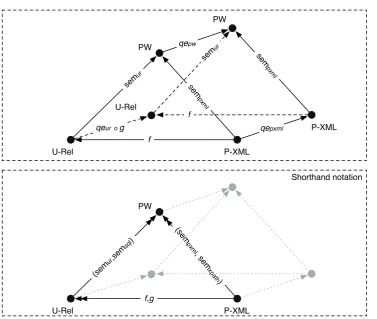
In order to specifyf –a P-XML into URDBMS data mapping– and corresponding g –a XPath to SQL mapping–, we have the obligation to specify the semantics of f and g, and show that our specification conforms to these semantics. A high level illustration of the semantics off and
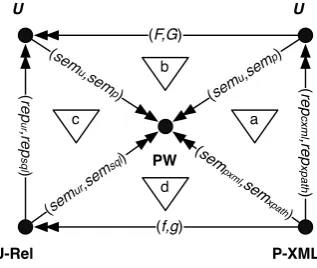
g is found in Figure 1.1. This figure shows a diagram constructed of nodes and edges. Nodes represent data models and edges represent mappings from one data model to another. We derive a specification forf andg from a series of mappings that are illustrated in Figure 1.2. Analogously to Figure 1.1, nodes represent data models and edges represent mappings. We discuss both figures in more detail below.
CHAPTER 1. INTRODUCTION 5
f
U-Rel P-XML
qepxml
sem
ur
se m
pxml
PW
U-Rel
qeur o g
f qepw
se m
pxml
sem
ur
PW
f,g
U-Rel P-XML
(sem
ur,se
msq
l)
(se m
pxml
,se
m
xp ath)
PW
P-XML
[image:17.595.117.495.100.419.2]Shorthand notation
Figure 1.1: The semantics of a P-XML to U-Rel mapping
Query evaluation in Figure 1.1 The front view and rear view of Figure 1.1 are connected with different query evaluation mechanisms, denoted as qe. We consider query evaluation on a data structure as a function that takes a query and a database as input and returns the result of that query evaluated on that database. For example, the query evaluation mechanism qepxml takes a P-XML query and a p-document and returns the result of that query evaluated on that document instance such that a following query can be evaluated on the result of a preceding query. Likewise, query evaluation onPW and U-Rel return a result that conforms to the data structure on which a query is evaluated. For completeness, we note that queries forqepxml are specified in the XPath query language and queries forqeur are specified for the SQL query language.
Query results in Figure 1.1 The rear view of 1.1 denotes the data structures that derive from query evaluation. For example, the result ofqepxml conforms to the P-XML data structure. Since the P-XML data structure has the semantics of a set of possible worlds, the result ofqepxml has the semantics of a set of possible answers, each provided by one of the possible worlds represented by the p-document used as input. Hence, the possible worlds semantics that apply to data structures apply to query answers derived from these data structures as well.
6 1.3. GLOBAL APPROACH TO SHOW CORRECTNESS
P-XML U-Rel
PW
(f,g) (se
m
pxml
,se mxp
ath) (sem
u,se
mp) (se
mu ,se
mp )
(sem ur,se
msql)
(
re
p
cxml
,re
p
xp
a
th
)
(
re
p
ur
,re
p
sq
l
)
(F,G)
U U
a b
c
[image:18.595.207.366.112.246.2]d
Figure 1.2: Derive the specification of f andg from a set of mappings
From problem statement to research goal We construct a P-XML to U-Rel database mapping as tuple (f,g) with a data mapping f and query mapping g. Data mapping f maps p-documents –database instances of P-XML– to U-Relations –database instances of U-Rel– such that (1) the set of possible worldspw represented in P-XML is semantically equivalent to the set of possible worldspw0 represented in U-Rel –illustrated as the triangle (f,semur, sempxml) that is the front view of Figure 1.1–, and (2) the semantics of the answer of a query q evaluated on
pw represented by a p-document is semantically equivalent to the answer ofq evaluated onpw
represented by a set of U-Relations –illustrated as the triangle (f,semur,sempxml) that is the rear view of Figure 1.1. We useg to translate the XML variant of a queryq to an SQL variant ofq
such thatqepxml(dpxml,qxpath)≡qeur(f(dpxml),g(qxpath)) wheredpxml is a P-XML data set1.
How to achieve research goal Our goal is to show that our specification off andgsatisfies the above mentioned two properties such that (f,g) forms a database mapping. In order to accomplish this goal, we have to show that each side of the diagram in Figure 1.1 commutes2. We accomplish
this with an extension of Figure 1.1 to Figure 1.2. Each double headed arrow with parameters (x,y) denotes a database mapping constructed as a data mappingx and query mappingy such that
x commutes under query evaluation. We identify trianglesa,b,c andd. Each of these triangles refers to the triangle constructed as the three closest nodes; trianglesa,b,c andd are solely used for naming convention. The short hand notation of Figure 1.1 corresponds with triangled that is constructed of the nodes U-Rel, P-XML andPW. Our approach to show correctness of (f,g) is as follows: (f,g) forms a database mapping ⇐triangled commutes⇐trianglesa,bandc commute.
Idea behind this approach The extension of Figure 1.1 to Figure 1.2 is based on the following. Previous work of Antova [5] shows the construction of a URDBMS as a traditional relational database management system (RDBMS) extended with an uncertainty management mechanism such that the resulting URDBMS adheres to the possible worlds semantics. Since this mechanism is proven to extend the traditional relational data model to manage multiple states, we exploit it for other purposes: we define an abstract formalism of a traditional data model, denoted with R, and extend it with a similar uncertainty management mechanism in order to obtain U, an abstract formalism of an uncertain data model. Since U and the URDBMS of Antova share a similar uncertainty management mechanism, they integrate the possible worlds model likewise. We useU to show commutativity by each of the sides in Figure 1.1. We accomplish this as follows: we express P-XML inU and refer to the result asUnode. Likewise, we express U-Rel inU and refer to
1The precise behaviour off andg is: f−1(qe
ur(f(dpxml),g(qxpath))) =qepxml(dpxml,qxpath) wheredpxml is a P-XML data set
2Commutative property of a diagram: all directed paths with the same start and end point lead to the same
CHAPTER 1. INTRODUCTION 7
the result asUrow. Since one formalism is used to express P-XML and U-Rel, a database mapping between the two provides the foundation to define a P-XML to U-Rel database mapping.
We use Figure 1.2 as leitmotif for Part II of this thesis in order to answer the research question requests for correctness of our approach.
1.4
High level design
This section provides an introduction to Part III of this thesis and is intended for those interested in our design of a P-XML into URDBMS data mapping and corresponding XPath to SQL mapping. This section can be skipped for those only interested in the high level approach to obtain a correct specification of both mappings.
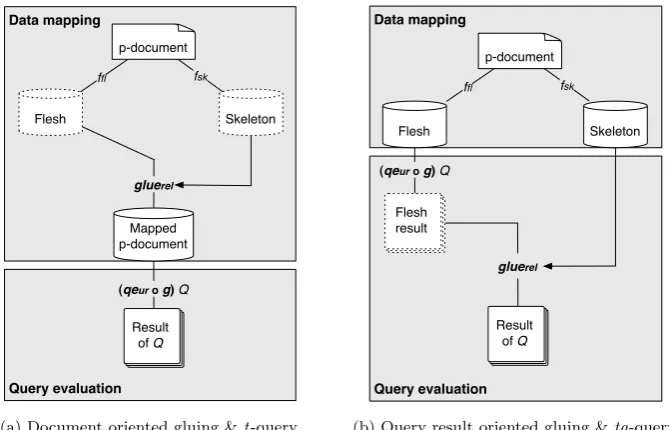
We design two P-XML into URDBMS data mappings with corresponding an XPath to SQL mapping. Both designs are illustrated on a high level in Figures 1.3a and 1.3b. They give the same results for XPath evaluation on P-XML data.
Query evaluation Data mapping
Flesh Skeleton
p-document
Result of Q Mapped p-document
gluerel
(qeurog) Q ffl fsk
(a) Document oriented gluing &t-query
Query evaluation Data mapping
Flesh Skeleton
(qeurog) Q
gluerel
Flesh result
Result of Q
p-document
ffl fsk
[image:19.595.135.470.313.528.2](b) Query result oriented gluing &tg-query
Figure 1.3: Two designs for a PXML into URDBMS mapping
First design of a P-XML to U-Rel mapping A high level illustration of our first design is found in Figure 1.3a. We first describe the design of the data mapping. A p-document is divided into flesh and skeleton. The flesh is constructed of all ordinary nodes of a p-document. The skeleton is constructed of all distributional node of a p-document. A flesh mapping (ffl) maps ordinary nodes into a URDBMS. Analogously, a skeleton mapping (fsk) maps distributional nodes into a URDBMS. Next, the result offfl andfsk are merged together with a glue process –denoted asgluerel. The result of gluerel represents the same set of worlds as the original p-document. We refer to a glue process that is applied as part of the data mapping as a document oriented (DO) glue process.
8 1.5. SCOPE
Second design of a P-XML to U-Rel mapping A high level illustration of our second design is found in Figure 1.3b. This figure shows many similarities with our first design. We construct the data mapping as a mapping of ordinary nodesffl and a mapping of distributional nodesfsk. We do not design the data mapping in such a way that the results of ffl and fsk are merged in order to make the data mapping more efficient.
We design the query mapping as a traditional XPath to SQL mapping –denoted as g– that includes a glue process –denoted as gluerel. We refer to SQL queries derived from this query mapping design as tg-queries and we refer to a glue process as part of the query mapping as a query result oriented (QRO) glue process.
1.5
Scope
In Section 1.3, we sketch an approach to specify a P-XML into URDBMS database mapping. In order to use this specification in practice, we propose a design for a particular URDBMS and a particular P-XML data model. We select a URDBMS in Section 1.5.1 and a P-XML data model in Section 1.5.2. Additionally, in Section 1.5.3, we select a representative subset of XPath for which we show support.
1.5.1
Suitable URDBMS for XPath processing
Most research on uncertain data management focuses on RDBMS technology. They offer a solution to store uncertain table-structured data. Examples of URDBMSs are Trio [52], MayBMS [35, 6, 27], Monte Carlo Database System (MCDB) [43], Mystiq [9], Orion [14] and ULDBs [7, 17, 4].
For scalable and efficient XPath processing, we are interested in a full grown implementation of a URDBMS. Only three candidates satisfy this criteria: Trio, MayBMS and MCDB. MCDB was not available at the start of this research and therefore, we did not consider MCDB. We consider Trio and MayBMS to be suitable URDBMSs for XPath processing.
Hollander et al. [26] made an attempt to build a P-XML database on top of Trio. Their benchmark results show that XPath queries do not scale well. Furthermore, their research identified problems with Trio managing large data sets. There is no research known that investigated XPath evaluation on P-XML data with MayBMS apart from our first attempt in previous work [48]. Based on the previous, we identify MayBMS as the most suitable URDBMS to evaluate XPath queries on P-XML data.
1.5.2
Probabilistic XML model
Multiple P-XML data models exists. In Section 2.5, we refer to the research of Kimelfeld et al. that categorizes different P-XML data models in different P-XML families based on their their expressive power. It holds that a data mapping exists from less expressive data models to more expressive data models without a data blowup. However, such a data mapping does not exists the other way around.
Earlier work [50] addresses the similarities between the uncertainty distribution of MayBMS and the P-XML model of Van Keulen et al. [50]. This P-XML model is member of thePrXML{ind,mux}
family [33]. In this thesis, we specify and implement a P-XML into URDBMS mapping for the P-XML data model of Van Keulen et al.
1.5.3
XPath support
In this section, we describe a representative subset of XPath with which we conduct our research.
• Our approach is based on the schema-based mapping Shared Inlining (SI). As a consequence, only p-documents with an associated Document Type Definition (DTD) are supported3.
CHAPTER 1. INTRODUCTION 9
• We use a representative subset of the XPath language for which we show correctness and efficient evaluation. We define this subset as:
– Relative location steps and absolute location steps.
– The following XPath axes: child, descendant, descendant-or-self, ancestor-or-self, an-cestor, parent, following-sibling, preceding-sibling, following, preceding, attribute, self.
– Node tests.
– Zero or more predicates.
– Boolean expressions (OrExpr, AndExpr, EqualityExpr, RelationalExpr).
– Numeric expressions (AdditiveExpr, MultiplicativeExpr, UnaryExpr).
– Lexical structures that are also supported by PostgreSQL 8.3.3.
– String functions that are also supported by PostgreSQL 8.3.3.
In previous work [48], we show feasibility for a P-XML into URDBMS mapping based on the schema-less XML into RDBMS mapping XPath Accelerator (XA) [19]. Unfortunately, benchmark results show undesired query evaluation behaviour: simple XPath queries evaluated on relative small data sets performed poorly. We suspected the RDBMS not to cope with the element encoding of XA. In the light of this previous research, we were motivated to use a different element encoding in order to improve query evaluation performance. This resulted in a new XML into RDBMS mapping that we use as foundation for our P-XML into URDBMS data mapping.
1.6
Contributions
The aim of this work is to present a specification for P-XML into URDBMS data mapping f and corresponding XPath to SQL mappingg such that XPath queries on P-XML data are evaluated as SQL queries on a URDBMS.
• We present multiple designs off andg.
• We propose to evaluate one component of f as part of the query evaluation process such that the evaluation of f as well as the query evaluation process are more efficient in most scenarios.
• We validate performance of f and performance of XPath evaluation with an extensive per-formance study on real world data and synthetic data. Benchmark results show XPath query execution times of a few milliseconds on data sets ranging from 105 nodes to 106nodes for a
diversity of XPath expressions.
1.7
Outline
This thesis consists of four parts.
Part I — Prologue Part I consists of two chapters. Chapter 2 presents a number of topics that form the background information of this work such as an introduction to XML, RDBMS, XML into RDBMS mappings, the possible worlds model and uncertain databases. Chapter 3 presents a high level overview of our approach to specify a P-XML into URDBMS data mapping and corresponding XPath to SQL mapping with which XPath queries on P-XML data are evaluated as SQL queries on a URDBMS.
10 1.7. OUTLINE
that represents a tree-structure data model. Chapter 6 presents our advancing understanding of a database mapping from U-Rel toUrow –Urow isU that represents a table-structured data model. Chapter 7 presents our advancing understanding of a database mapping fromUnode toUrow.
Part III — Design Part III consists of three chapters. Chapter 8 presents a design of a P-XML into URDBMS data mapping. This design follow the specification of a P-XML into URDBMS mapping in Part II. This design is based on a dichotomy of p-documents to flesh and skeleton which are mapped into a URDBMS separately. The flesh of a p-document is constructed of solely ordinary node, the skeleton is constructed of solely distributional nodes. Chapter 9 presents the tools to merge the results of the flesh mapping and the skeleton mapping. This merging process is referred to asgluing. Chapter 10 presents multiple glue methods and glue method applications with which glue processes are constructed. Our first design of a P-XML into URDBMS data mapping incorporates a glue process as part of the data mapping. Our second design incorporates a glue process as part of the query mapping.
Part I
Prologue
Chapter 2
Preliminaries
This chapter covers several topics that we consider as background information. Most topics –such as XML, XPath, RDBMSs, SQL– are generally known in the field of databases. We also describe less familiar topics that are related to this research. These topics include the XA approach and the SI approach –two XML into RDBMS mappings–, an introduction to the possible worlds model and uncertain databases.
2.1
An abstract view on database mappings
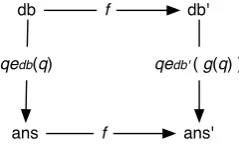
Database mappings allow queries specified in one data model to be evaluated by the query evaluation mechanism of another data model. A database mapping is constructed of a data mapping with a corresponding query mapping. A data mapping maps content of one data structure to another data structure. A data mapping solely provides an approach to store the same data in a different representation. In order to take advantage of such a representation, a query mapping is required that allows a question specified in one language to be asked in another language such that the same questions can be asked to different data representations. A query mapping g corresponds with a data mappingf if the result of a queryq evaluated on one data structuredb is similar to the result of another query q0 evaluated on another data structure db0 such that q0 =g(q) and
db0 =f(db) for eachdbandq.
Figure 2.1 provides an abstract view on database mappings for a data mappingf with corres-ponding query mapping g. If we apply data mapping f to db, we retrievedb0. Likewise, if we apply data mappingf toans, the result of a query evaluated ondb, we retrieveans0. Queries are evaluated with a query evaluation mechanism, denoted with qe. The diagram in Figure 2.1 has the commutative property, which means that:
f(qe(db,q)) =qe0(f db,g q)
We define a database mapping as the double (f,g) that satisfies the commutative property.
db db'
ans ans'
f
f
[image:25.595.241.361.511.583.2]qedb(q) qedb'( g(q) )
Figure 2.1: Visualization of a database mapping
2.2
Introduction to XML
2.2.1
Extensible Markup Language
XML is a semi-structured data model that represents information as a tree. In this section, we specify XML with a schema. Therefore, we first postulate a collection of nodes and a collection of text:
[NODE,TEXT]
14 2.2. INTRODUCTION TO XML
SchemaABS-XML defines XML-related data structures as follows:
ABS-XML
rootnode:NODE
xmlnodes,textnodes,ordnodes:NODE
edge,/parent:NODENODE
/child:NODE #NODE
/ancestor,/ancestor-or-self:NODE#NODE
/descendant,/descendant-or-self:NODE#NODE
getTag:NODE TEXT
getPCData:NODETEXT
hXMLnodes,textnodesipartitionordnodes
ranedge∩textnodes=
/parent=edge
/ancestor=edge+
/ancestor-or-self=edge∗
/child=edge∼
/descendant= (edge∼)+
/descendant-or-self= (edge∼)∗
domgetTag=XMLnodes
domgetPCData=textnodes
XML ABS-XML
rootnode∈XMLnodes
domedge=ordnodes\ {rootnode}
Schema XML specifies document instances of XML as a tree. Edges represent the child/parent-relationship between nodes in the p-document. The XML-schema distinguishes two node kinds: XML nodes xmlnodes and text nodestextnodes. Nodes of one of these two node kinds are referred to as ordinary nodes, denoted as ordnodes. The function getTag is defined for the former and returns the tag of an XML node. Nodes that have the same tag are of the same element type. The functiongetPCData is defined for the latter and returns the PCData value of text nodes.
We capture most XPath axes as a mutual relation between nodes based onedges. The semantics of these axes are found in Table 2.1. We highlight: the child axis is the inverse of the parent axis, the ancestor axis is the transitive closure of the parent axis and the ancestor-or-self axis is the reflexive transitive closure of the parent axis.
Exterior to the XML-schema, we define a path as a sequence of nodes such that from each of its nodes there exists an edge to the next node in the sequence. Any path between two nodes is unique in a tree. We denote a path from a node n to a node m as ↑n,m. We writen ∈ ↑m,l to state that node n lies on path ↑m,l. We write ↑n to denote a path from n to the root of a document (including p-documents and possible documents). All nodes that lie on ↑n define the ancestor-or-self axis ofn.
2.2.2
XPath expressions
Tree-traversals in XML-documents are specified in XPath [8]. We give a simplified XPath syntax:
XPATH::= ‘/’,(step,‘/’)∗
step::=axis::nodetest[pred]∗
axis::=/parent|/child|. . .
nodetest::=name | ∗
CHAPTER 2. PRELIMINARIES 15
Axisα Result
self v
child child nodes of nodev
descendant recursive closure of child
descendant-or-self union ofchildanddescendant
parent parent node ofv
ancestor recursive closure of parent
ancestor-or-self union ofancestorand self
following nodes followingv in document order
preceding nodes preceding v in document order
following-sibling followingwith same parent asv
preceding-sibling precedingwith same parent asv
attribute attribute nodes of v
namespace namespace nodes ofv
Table 2.1: Semantics of axisαsupported by XPath (stepv/α). (table is borrowed from [19])
XPath expressions specify tree-traversals via two parameters: (1) a context node, which is the starting point of the tree-traversal, and (2) a sequence of location steps (step) syntactically separated with a/-sign. Each location step takes a set of context nodes as input and returns a set of nodes that serve as context nodes on which the following location step is evaluated. The result of the last-mentioned location step is the result of the tree-traversal. Location steps are of the form/axis::nodetest[predicate]∗ where (1)axisis one of the listed axes in Table 2.1, (2)
nodetestspecifies a node test that is either a filter that restricts the result of a location step to contain solely nodes of the element type specified byname or no filter in case of the∗-symbol is used, and (3)predicateconstrains the result of a location step with a test to which the output of a location step has to conform to. The test itself is defined as either (1) an XPath expression preceded with a dot-symbol that denotes the XPath expression to process nodes that satisfy the node test, (2) an XPath expression that starts at the root, or (3) a Boolean expression that has to evaluate to true.
2.3
XML into RDBMS mappings
In essence, XML into RDBMS mappings make an attempt to evaluate XPath queries on XML data as SQL queries on relational data. Relational databases are optimized for querying on large amounts of table-structured data. Hence, query evaluation on XML contents stored in an RDBMS can profit from RDBMS technology if a corresponding XPath to SQL query mapping is defined. We presume the XML into RDBMS mappings referred to in this section to comply with the commutative property we discussed in Section 2.1.
XML into RDBMS mappings can be categorized as schema-based or schema-less. The former requires a schema that describes the structure of a family of XML-documents, the latter does not. A schema can be of two types: a DTD or an XML Schema. In case the structure of an XML-document is conform to the defined structure of a schema, we say the XML-document is
valid. Hence, a schema-based mapping can process XML-document in case it knows the associated
schema. In contrast, a schema-less mapping can process any XML-document.
16 2.3. XML INTO RDBMS MAPPINGS
2.3.1
Shared Inlining, a schema-based mapping of XML to relational
databases
Shared Inlining (SI) [47] is a schema-based XML into RDBMS mapping that makes use of a DTD. The basic principle behind SI is that an XML-document is assumed to contain many XML nodes of the same element type. This makes it attractive to store these nodes together in the same table as illustrated in Figure 2.2. The danger in this approach is that if an XML-document contains many element types, many tables will be created. The idea behind inlining is that some nodes don’t require a separate table, but can share a table. As an additional advantage, the evaluation of the parent/child axis is free of execution costs in case parent and child nodes reside in the same table.
a
b
c
a
element
b b
element
c c c
element
b
c c
element element
Figure 2.2: Abstract view on SI
We describe SI slightly different than the work it is introduced in [47]. We consider SI to be defined in three parts: (1) a relational storage structure to which an input XML-document is mapped, (2) an inlining principle, and (3) an encoding for the XML data structure. For reuse purposes, we define the abstract data structure Abstract Shared Inlining (ASI[ENC]) as the first two parts of SI and a parameterENC –an encoding for the XML data structure. In Section 8.4.2, we introduce a new XML into RDBMS approach that is based on ASI[ENC].
Relational data structure We consider an XML-document to contain nodes of various element types:
N1, . . . ,Nn :NODE
hN1, . . . ,Nnipartitionallnodes
Symbol Ni denotes a set of nodes that are of the same element type. The element type of an XML node is defined by its tag. For example, <car/>denotes an XML node of the element type
car. Text nodes are considered to have an element type as well that is related to their parent. For example, “Mustang” in<car>Mustang</car>is considered to be a text node of element type
car.pcdata 1.
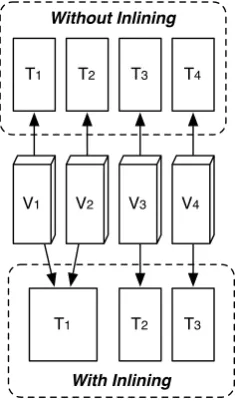
The principle behind SI is that each element type involved in a mapping should have its own table such that nodes of a specific element type are stored at the same location. We refer to the table to which nodes of a specific element type N are mapped as the element table of N. We consider the functiongetT() to return the table that is assigned to a specific element type. If we ignore the inline principle,getT() defines a one-to-one correspondence between element tables and element types. However, the inline principle reduces the number of element tables if the structure of an XML-document satisfies certain inline rules. This is illustrated in Figure 2.3. The main benefit of the SI data-structure is that element types are efficiently found during query evaluation.
1In the original work of Shared Inlining [47], text nodes are not taken into account. Instead, “mustang” in
CHAPTER 2. PRELIMINARIES 17
With Inlining Without Inlining
V1 V2 V3 V4
T1 T2 T3
T1 T2 T3 T4
Figure 2.3: Relational data structure of SI
Inlining principle The inlining principle of Shanmugasundaram [47] defines nodes of different element types to be stored in the same table if they satisfy certain requirements specified by the set ofinline rules defined in [47]. The advantages of the inline principle are efficient storage and no execution costs for the evaluation of the parent/child axis that involve element types that reside in one table. In order to take advantage of the inlining principle, a schema is required to validate these rules for element types that share the parent/child-relation is that a data structure needs to be created in advance which takes inlining into account.
LetN andN0be two different element types. The first inline rule specifies that nodes ofN and
N0 share the parent/child-relationship with a multiplicity of at most 1. In other words, each node inN has at most one child node of element typeN0. The second inline rule states that element typeN must have an indegree of 1 in the DTD. In other words, all nodes inN0 have a node inN
as their parent.
In order to make inlining more intuitive, we explain inlining as element types that share the guest/host-relationship. This relationship is defined as: a host should always be present in order for a guest to visit. The host/guest-relationship is an analogy for the parent/child-relation between element types that satisfy the traditional inlining rules. In the light of relational tables, multiple nodes are stored in one row if a node of the host element type is present. We illustrate this relationship with an example.
<enc>
-<enc> <enc>
elems of N'
<enc> <enc>
elems of N
[image:29.595.243.361.109.310.2]N Element table of N N'
Figure 2.4: Visualization of the inlining principle
18 2.3. XML INTO RDBMS MAPPINGS
say“N0 is inlined with N ”, we define N to serve as host andN0 to serve as guest. In order for
a node of element typeN0 to be represented in a row ofT, a node of element typeN should be
represented in the same row as well. This principle is illustrated in Figure 2.4. On the left, we have all nodes of element typeN; on the right, we have all nodes of element typeN0. If we inline
N0 with N, we store nodes of both element types in the element table ofN that is illustrated in the middle.
To elaborate on inlining, a host is allowed to have multiple host/guest-relationships with different element types, and a guest element type may also take the role of host to invite other element types to start a guest/host-relationship with. Note that there is a subtle difference between the two. We illustrate this difference based on our previous example.
We introduce element typeN00unequal toN andN0. In caseN00has the guest/host-relationship withN0and a node inN00is represented in a row, then a node inN0and a node inN also have to be represented in the same row. This requirement is not in effect ifN00 has a guest/host-relationship withN, since only a node inN has to be represented in the same row.
It can be proven that whatever element types have the guest/host-relationship with one another in an element table, there is exactly one host element type that is not guest of any other element type. We refer to this element type as the master element type of its element table. All other element types that reside in the same element table as the master of that element table areslave
element types. In case of Figure 2.4, element typeN is the master of the element table depicted
in the middle.
Encoding for XML data SI represents nodes as follows:
• Nodes of an element type that serve as master and do not have a text node as child are represented ashelemID:integer,parentCODE:integer,parentID:integer,isroot:booleani.
• Nodes of an element type that serve as slave and do not have a text node as child are represented ashelemID:integeri.
• Nodes of an element type that serve as master and have a text node as child are represented as helemID:integer,pcdata:texti.
• Nodes of an element type that serve as slave and have a text node as child are represented with the PCData-value of their text node childhpcdata:texti.
In this encoding, (1)elemID:integerrepresents a unique identifier for XML nodes, (2)parentCODE:
integer refers to the element type of the parent, (3)parentID:integer provides a pointer to the
parent node, (4) isroot : boolean is used to identify the root of an XML-document, and (5)
pcdata:text maps PCData.
2.3.2
XPath Accelerator, a schema-less mapping of XML to relational
databases
XPath Accelerator (XA) [19, 23, 22, 20, 21] is an encoding for XML-data that has been specifically designed to support the evaluation of XPath queries with relational database technology. The XA approach is known under slightly different element encodings. The latest work on XA [21] studied the application of the XA approach to off-the-shelf RDBMSs without a change of the underlying database kernel. In this section, we provide a summary of this work and consider each reference to XA to point to this work specifically.
Data encoding The XA approach uses thepre-orderrank,size andlevel of XML nodes to map the tree-structure of XML-documents onto a table-structure.
CHAPTER 2. PRELIMINARIES 19
• The size of an XML node is defined as the number of nodes of the subtree rooted at that XML node excluding the XML node itself.
• The level of an XML node is defined as the number of nodes that reside in the ancestor axis of that XML node.
g h
content content
d
b c
a
e
f
content
b e
i
i j
j start/stop
(1)
(3) (2)
(4)
(5)
(6)
(7) (8) (9)
(10) (12)
(13)
(15) (14)
(16) (11)
(18) (id,attrval) (17)
Figure 2.5: Counter-clockwise traversal of the perimeter of an XML-document starting at the root
To support further XPath axes and node tests, the mapping of a node n is accomplished as:
n 7→ hpre n,size n,level n,tag n,kind ni
where the tag-name tag of n saves the element type ofn , and the type ofn is associated with the node kind ofn. A node kind can be of the types: XML node(elem),XML-attribute(attr),
PCData. The mapping of Figure 2.5 onto a table-structure is found in Figure 2.6. PCData values and attribute values are stored in the right table ‘Contents’. All other information is stored in the left table ‘Accel’. Table ‘Contents’ has foreign keys to entries in ‘Accel’ such that text nodes are associated with PCData and attributes are associated with associated attribute values.
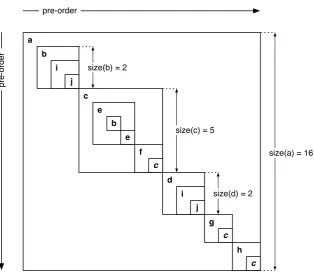
To make this encoding more intuitive, we represent each node as square boxes in a two-dimensional plane, illustrated in Figure 2.7. The order of identifiers corresponds with the document order of nodes. The embedded nature of boxes corresponds with the embedded nature of nodes.
Query Evaluation XA [21] has been specifically designed to support the evaluation of XPath axes with relational database technology. The following axes are evaluated by an RDBMS with a combination of simple range conditions and equality conditions. Letc be a context node andn be an arbitrary node in an XML-document:
n∈c/descendant ⇔ pre(c)<pre(n)≤pre(c) +size(c)
n∈c/descendant-or-self ⇔ pre(c)≤pre(n)≤pre(c) +size(c)
n∈c/child ⇔ pre(c)<pre(n)≤pre(c) +size(c) ∧ level(n) =level(c) + 1
n∈c/ancestor ⇔ pre(n)<pre(c)≤pre(n) +size(n)
n∈c/ancestor-or-self ⇔ pre(n)≤pre(c)≤pre(n) +size(n)
n∈c/parent ⇔ pre(n)<pre(c)≤pre(n) +size(n) ∧level(c) =level(n) + 1
n∈c/preceding ⇔ pre(n) +size(n)<pre(c)
n∈c/following ⇔ pre(c) +size(c)<pre(n)
n∈c/self ⇔ pre(c) =pre(n)
0
18 3 - pcdata
3 0 'id' attr
17
'h' 1 2
16 pcdata
pcdata
15 3 0
-elem 1
14 2 'g'
'i' 2
0
elem
pre size
elem tag 'a'
elem 'i'
5
3
'j'
'e'
elem
2
elem 16
1
4 'b'
0 13
7
2
4
2
pcdata 4
0
0 'b'
'f'
elem 1
2
4 3
12
elem
'j'
9 elem
1 2
11
2 1
5 0 3
10
elem
4 1
-4
elem
elem kind
'e' 3
level
6
elem 'c'
3 8
'd'
content
18
pre text
17 10
attrval
15 content
content
Table Accel Table Contents
Figure 2.6: The result of the XA approach applied to Figure 2.5
a
c
h f
e b
i
c
j
c
b e
d i
j
g
c
pre-order
p
re
-o
rd
e
r
size(c) = 5
size(d) = 2 size(b) = 2
[image:32.595.146.461.412.685.2]size(a) = 16
CHAPTER 2. PRELIMINARIES 21
2.4
Introduction to uncertain databases
We introduce the concept of an uncertain database as
2.4.1
Interpretation of an uncertain database in terms of possible worlds
The concept of an uncertain database originates from the possible worlds model. This model is founded on the fact that uncertainty in data makes it impossible to define what precisely the real world is. However, there is a notion of whatpossible worldsexist given the available information at hand, and the actual world is considered to be one of them. A single possible world is considered to be a set of objects. An object may be part of multiple possible worlds. The set of possible worlds of which an object is member is called the world setof that object.
An uncertain database is designed to store a compact representation of a set of possible worlds. Each possible world is represented as a complete state of the database. Since an ordinary database has solely one state, it can be viewed as a single possible world [25]. In order to represent possible worlds, database objects are annotated with information that describes the world set of that object. We use the term uncertainty distribution to refer to this kind of information. The uncertainty distribution of an uncertain database captures how database objects are randomly selected in an uncertain database.
Important to note: in theory, queries that apply to traditional databases also apply to uncertain databases: a traditional query executed on a traditional database results in one (certain) answer; a traditional query evaluated on an uncertain database results in a set of possible answers, each provided by one of the possible worlds.
2.4.2
Granularity of uncertainty
We introduce the terminology Unit of Choice (UoC) to refer to the granularity of uncertainty in an uncertain database. We use a relational database to illustrate this concept: a relational database stores table-structured data, which we describe as a grid data structure consisting of rows and columns. A URDBMS can be designed to support rows as unit of choice, by which multiple possible presentations of rows could be stored. Another possibility is to design a URDBMS to support columns as unit of choice. As a consequence, multiple presentations of columns can be stored. A third option is the use of row-attributes as unit of choice, which we define as the intersection of rows and columns. A URDBMS adopting a granularity of uncertainty at the attribute level stores rows with different attribute representations.
Consider the following tuples (the sign ‘|’ should be read as an OR-separator to define possibil-ities):
(Barack Obama,{Emperor|President})
(Barack Obama, Emperor)|(Barack Obama, President)
Both tuples represent the same two possible presentations. However, they differ in unit of choice, since the former tuple supports attributes to have multiple representations while the latter allows tuples to have multiple representations. The question which of the two representations is con-sidered to be correct cannot be answered with the available information at hand. We consider this ignorance as uncertainty.
2.5
Probabilistic XML, an uncertain semi-structured data
model
22 2.5. PROBABILISTIC XML, AN UNCERTAIN SEMI-STRUCTURED DATA MODEL
g h
content content
d
b c
a
e f
content
b e
i i
j j
0.9 0.1
0.3 0.7
0.4 0.6
0.2 0.8
1
2
3
[image:34.595.209.397.106.237.2]4
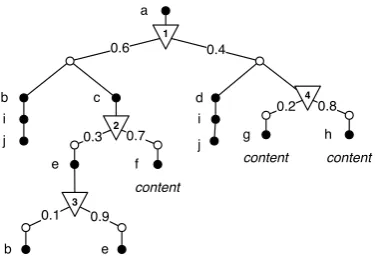
Figure 2.8: Probabilistic XML tree
All probabilistic XML models introduce new node kinds to enrich the traditional XML encoding. These node kinds are referred to asdistributional nodes; fictive nodes that specify how their children are randomly selected in a p-document [33, 46]. Distributional nodes annotate their descendants with knowledge of which possible worlds they are member. Distributional nodes come in four different flavors: ind-type,mux-type,exp-type,cie-type. These flavors together make it possible to express any document expressed in one of the known P-XML data models. Note that the individual P-XML models may use different terminology to refer to these four distributional node kinds.
In future chapters, distributional nodes refer to possibility nodes and probability nodes that we introduce in the next section.
2.5.1
P-XML model of Van Keulen et al.
In this research, we use the P-XML data model of Van Keulen et al. [50] – member of the
PrXML{ind,mux} family [33] – as foundation for this research. This data model is based on two
kinds ofdistributional nodes: (1)probability nodes(O) to represent different choice points; places in an XML-document where choices have to be made, and (2) possibility nodes(◦) to represent alternatives of which a choice point may select its pick. We refer to the selection of an alternative by a choice point as thechoice of that choice point. The likeliness of an alternative to be selected is captured with a probabilityp that satisfy 0<p≤1. Choices are mutually exclusive; the sum of the probabilities of all choices associated with one choice point is equal to 1.
An example p-document is found in Figure 2.8. We use this example as a running example in future chapters. This example has four choice points to which we refer asv1, . . . ,v4. Choice points
restrict the membership of their descendants to be part of a possible world. For example, node
ntag=d has one ancestor choice point v1. In order forntag=d to be part of a possible world, the second possibility child ofv1 with probability 0.4 has to be selected. We refer to possibility nodes
asdi,j wherei refers to its parent choice pointvi andj to thenth alternative ofvi counted from left to right. Nodentag=h has two ancestor choice pointsv1 and v4. Both have to choose their
right alternatived1,2andd4,2 in order forntag=h to be member of a possible world. If we assume independence of the selections ofd1,2andd4,2, the likelihood forntag=hto be part of a possible world is equal to the product of both possibility nodes to be selected: P(d1,2)·P(d4,2) = 0.4·0.8 = 0.32.
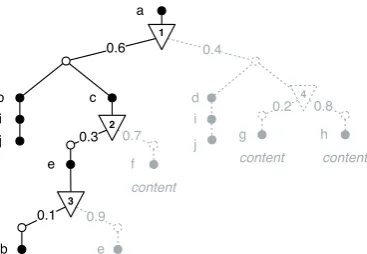
A p-document represents a set of possible worlds. In order to retrieve a possible world, one alternative has to be selected for each choice point by which all unselected alternatives are discarded. The result is apossible document; a p-document that represents exactly one possible world where each probability node has exactly one child possibility node. Arandom documentis distilled out of a possible document by removing all distributional nodes whereby children of selected alternatives are connected to the closest non-distributional node. Since distributional nodes are removed in the retrieving process of a random document, they are considered to be fictive nodes.
CHAPTER 2. PRELIMINARIES 23
g h
content content
0.2 0.8
d 0.4
f
content
0.7
0.9
e
i
j 0.6
b c
a
e 0.3
0.1
b i j
1
2
3
4
(a) Single possible world representation
d
f
content
e
i
j g h
content content
0.2 0.8
0.4 0.6
0.3 0.7
0.9 0.1
b
b c
a
e i j
1
2
3
4
[image:35.595.211.395.106.233.2](b) Random document
Figure 2.9: Possible world extraction
this example, the left alternative of each choice point is selected. As the figure illustrates, the choice to select the left alternative of choice pointv4 does not change the resulting possible document.
The random document associated with this possible document is found in Figure 2.9b.
The set of possible worlds of which a node is member is referred to as the world set of that node. A world set is described with a set of choices or alternative selections. We refer to the set of choices that identify the world set of a node as its world set descriptor (WSD).
2.5.2
Query evaluation on P-XML data
Query evaluation on P-XML is discussed in the work of Van Keulen et al. [51]. They derive query evaluation from the possible worlds model. This model is the foundation for uncertain databases and is discussed in Section 2.4.1. In essence, an uncertain database represents a set of possible worlds. Each possible world corresponds with one state of the database. The result of a query evaluated on a set of possible worlds is a set of possible answers, each provided by one of the possible worlds separately. An uncertain database based on P-XML has to adhere to the possible worlds semantics. Therefore, one inefficient approach to support query evaluation on p-document is to evaluate an XML-query on each possible world represented by that p-document separately and merge the results into a set of possible answers.
2.6
Views, unmaterialized and materialized
24 2.6. VIEWS, UNMATERIALIZED AND MATERIALIZED