www.editada.org
Informatics, 11(1), Jan-April 2020, 50-58. ISSN: 2007-1558.
_______________________________________________________________________________________
© Editorial Académica Dragón Azteca S. de R.L. de C.V. (EDITADA.ORG), All rights reserved.
Development of the NASA-TLX Multi Equation Tool to Assess Workload
Ángel Fabián Campoya Morales1, Juan Luis Hernández Arellano1, Elvia Luz González Muñoz2, Aidé
Maldonado Macías1
1 Universidad Autónoma de Ciudad Juárez 2 Universidad de Guadalajara
[email protected] [email protected] [email protected]
Abstract. The NASA-TLX method has been used more than 20 years to assess mental workload. NASA-TLX is a multidimensional technique to provide a score based on six subscales: mental demand, physical demand, temporal demand, performance, effort, and frustration level. Although some researchers have developed software to facilitate the application of the method, all the versions created use a single form of evaluation. Throughout a literature review, four different equations to apply NASA-TLX where identified. The objective of this investigation is to develop the NASA-TLX Multi Equation Tool (MET) programmed with the four different equations. The software was created in HTML format with JavaScript. As a result, the software shows the workload assessment with the four different equations.
Keywords: NASA-TLX, method, mental, workload, ergonomic, software, development, human, factors, multidimensional, tool.
Article Info
Received Sep 26, 2018 Accepted Sep 11, 2019
1
Introduction
Nowadays, modern complex systems demand high requirements or workload from the workers, new technologies have introduced to cover the task demands which are considered as hard or very hard, both linked with high demands of production [1]. However, an excess of automation in the processes can lead to the elimination of humans, and despite it, not to reduce the workload. At the same time, the workload can increment from low to high levels of demand that go beyond human cognitive capacities and decision-making capacities. The mental workload can be identified when the tasks demand to be alert and concentrated on an activity or a group of activities during a period of time [2]. Another problem associated with the evaluation and measurement of the mental load is the null definition of units of measure [3]. If we understand the workload as "the set of psycho-physical requirements to which the worker is subjected throughout the working day", we have to admit that making a correct assessment of the task implies to consider the two aspects reflected in the definition, the physical and the mental aspects since both coexist in variable proportion in any task [4].
1.1
Context of the Investigation
The workload produced by an activity is composed of both physical and mental workload [5], and it is a construct that involves the capacity of the human to interact with complex systems considering the equipment, the training, the organizational, the environmental limitations, among others. Because of this, the workload implies different perceptions and responses by the workers [6]. Any task requires a specific level of attention and concentration depending on the signals and requirements to be addressed, the inferences to be made, the level of accuracy of the response, and the organizational aspects, especially those that refer to the organization of the working time.
51
The aim of this paper is to propose the development of the NASA-TLX Multi Equation Tool to assess workload, using HTML and JavaScript for the created software, who is explained in this paper. The rest of this paper is organized as follows: Section 2 describes the assessment and methods for mental workload, section 3 describes the NASA-TLX Multi Equation Tool, section 4 presents the results, section 5 presents the discussion and section 6 describes the conclusions of this paper.
2
Assessment of Mental Workload
2.1
Effects of Mental Workload
Current jobs require that people attend multiple tasks at the same time, make decisions, and solve problems effectively in stable and emergency situations. The increasing role of technology and the use of complex procedures have led to a greater demand imposed in the worker [11]. The cognitive demands imposed during the performance of many jobs have made the concept of mental load acquired significant importance of multiple research areas. Increasingly, the current working conditions have resulted in high levels of workload, mental fatigue, and stress causing a decrement of performance and attention. At the same time, another effect is the number of errors, forgetfulness, and confusion increasing the probability of accidents or negative alterations during the tasks performed [12], [13], [14]. [15], [16], [17], [18].
Also, the negative or harmful consequences for worker´s health should not be forgotten. For example, the decrease in labor motivation, emotional instability (irritability, anxiety, depressive states), low self-esteem, somatic, and sleep disturbances or increased consumption of tobacco, drugs, and alcohol [19]. However, in recent years, a certain degree of agreement has been reached regarding the content of the subjective mental workload, and the result is three large dimensions or factors: (a) the aspects related to the temporal pressure of the task (time available, time needed); (b) the amount of processing resources demanded by the task (mental, sensory, type of task, etc.) and (c) the aspects of an emotional nature (fatigue or frustration) [20].
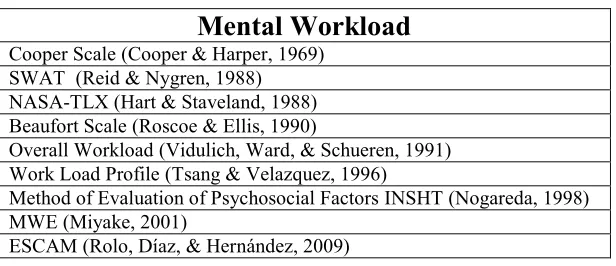
[image:2.612.154.462.388.521.2]To assess the mental workload, different methods and techniques have been developed during the last 50 years. Table 1 shows the most common methods found in the literature.
Table 1. Methods to Assessment of Mental Workload
Mental Workload
Cooper Scale (Cooper & Harper, 1969) SWAT (Reid & Nygren, 1988) NASA-TLX (Hart & Staveland, 1988) Beaufort Scale (Roscoe & Ellis, 1990)
Overall Workload (Vidulich, Ward, & Schueren, 1991) Work Load Profile (Tsang & Velazquez, 1996)
Method of Evaluation of Psychosocial Factors INSHT (Nogareda, 1998) MWE (Miyake, 2001)
ESCAM (Rolo, Díaz, & Hernández, 2009)
2.2
NASA-TLX Method
2.2.1 Fundament
NASA-Task Load Index (TLX) was developed by Hart & Staveland [21] and distinguishes six dimensions of workload: mental demand, physical demand, temporal demand, performance, effort, and frustration, from which a global index of the mental load is calculated. In various laboratory and field investigations, NASA-TLX has proven to be reasonably easy to use and reliably sensitive to experimentally important manipulations over the past 20 years, specifically, in different levels of effort. The six subscales provide independent information about its structure [22], [23], [24], [25]. [26], [27], [28], [29], [30], [31].
52
Fig. 1. NASA-TLX evaluation Phases. Adapted from Hart & Staveland (1988)
2.2.2 Applications.
NASA TLX has been successfully used to assess workload in various environments such as aircraft cockpits [32], command [33], control [34], and communication workstations [35], supervisory and process control [36], and simulations and laboratory tests [37], [38]. Also, one of the most important applications of NASA-TLX has been to validate new methods and techniques to assess workload [39], fatigue [40], and stress [41].
2.3
Software to Apply NASA-TLX
53
Table 2. Software Developed to Apply NASA-TLX
Name of the software
Authors
Country
Visual Studio App (Cao, Chintamani, Pandya, & Ellis, 2009) United States Pocket PC Version (Cao, Chintamani, Pandya, & Ellis, 2009) United States
Windows Version (Cao, Chintamani, Pandya, & Ellis, 2009) United States
Flash-Player Version (Sharek, 2009) United States
Desktop Version (Hart, 2006; Sharek, 2009) United States
Online Web Version (Sharek, 2011) United States
JAVA-Script Version (Sharek, 2011) United States
App in iOS (Gore & Kim, 2017) United States
3
NASA-TLX Multi Equation Tool
3.1
Development
The NASA-TLX Multi Equation Tool (MET) was developed using the original version of the method [21] and the three formulas mentioned in the next section. The tool includes HTML code and JavaScript, starting with programming variables like results, scales, and a description for each of these scales that the subject should read before rating. An array is required to store the data, a function for saving the scales and creation of the tables, etc. During the use of the program, every data is stored in a temporal file. In the end, the program calculates the mental workload and shows 4 different results representing the formulas explained in the next section. The 4 different formulas were added to the program code; they use an equation to calculate the final score showed to the user at the end.
3.2
Different Formulas for NASA-TLX
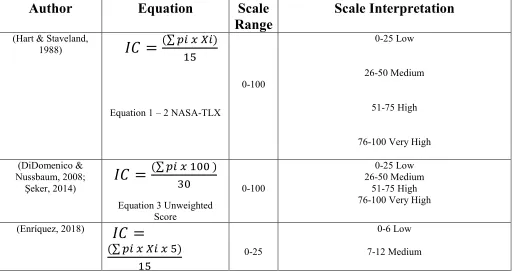
As already mentioned, four different equations to apply the NASA-TLX method have been identified in the literature [43], [21], [45]. The equations provide different general results and interpretations depending on the scale used. Table 3 shows the four different formulas identified, the authors, and the year of development.
Table 3. Equations Identified
Author
Equation
Scale
Range
Scale Interpretation
(Hart & Staveland,
1988)
𝐼𝐶 =
(∑ 𝑝𝑖 𝑥 𝑋𝑖)
15
Equation 1 – 2 NASA-TLX
0-100
0-25 Low
26-50 Medium
51-75 High
76-100 Very High
(DiDomenico & Nussbaum, 2008;
Şeker, 2014)
𝐼𝐶 =
(∑ 𝑝𝑖 𝑥 100 )
30
Equation 3 Unweighted Score
0-100
0-25 Low 26-50 Medium
51-75 High 76-100 Very High
(Enríquez, 2018)
𝐼𝐶 =
(∑ 𝑝𝑖 𝑥 𝑋𝑖 𝑥 5)
15
0-25
0-6 Low
[image:4.612.51.564.448.719.2]54 Equation 4 Scale assessment
(Scale 5) NASA-TLX
13-18 High
19-25 Very High
Where: IC: Load Index Ci: Weighted score a: Weight
b: Raw rating
15 Number of binaries comparisons
Pi: Weight obtained for each dimension in the binary table (weighting) Xi: Score obtained by the dimension in the evaluation stage
4
Results
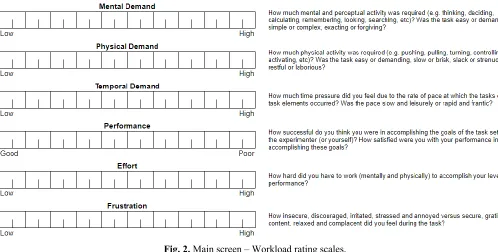
[image:5.612.51.549.386.638.2]Figure 2 shows the main screen of the software NASA-TLX Multi Equation Tool (MET) where the user or the evaluator feeds the workload scores of the six items considered by the method. In this case, a Visual Analog (VA) scale with two expressions (at the left: low/good; at the right: high/poor) divided into 20 points was used.
Fig. 2. Main screen – Workload rating scales.
55
Fig. 3. Workload Evaluation screen – Frustration vs Effort screen.
Equal to Figure 3, in Figures 4 and 5 the comparison between Performance and Frustration and Mental Demand and Effort, respectively, are shown.
Fig. 4. Workload Evaluation screen – Screen of example 2 of the 15 combinations of questions.
Fig. 5. Workload Evaluation screen – Screen of example 3 of the 15 combinations of questions.
56
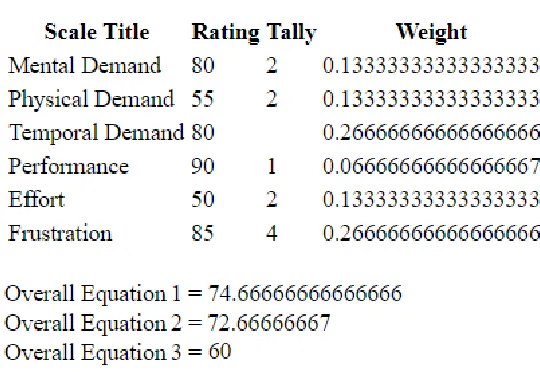
Table 4. Final results of the 4 equations
5
Discussions
Through the JavaScript language, the software performs the capture of data and the operations, which gives a result presented in detail to the user. The code contains more than fifty lines that allow its operation. Also, it is possible to add new functions in the software in the future. This software was created using the full and original version of the existing NASA-TLX method [21], adapted to an HTML version for better management in any computational field. It was modified to add the different equations presented in this article [43], [44], [45].
Because it can be accessed online through a web browser, this software could be used in any device like PC, tablets, and cellphones. Former versions only include after install the software in a personal computer in limited operating systems and fulfilling hardware requirements.
Compared to other existing software, who only calculate one final result based on the original method, this software presents the four different final scores of mental workload. The final score shows, in detail, the six factors evaluated during the different stages of mental workload evaluation, showing the value of each factor, the weighing, and the rating.
6
Conclusions
The main contribution of the NASA-TLX MET is the inclusion of the 4 different equations identified in the literature. This advantage helps researchers to get reliable data and to perform comparisons among many variables such as tasks, genders, jobs, shifts, teams, occupations using the four different equations. Also, another advantage of this software is the possibility to evaluate any task in any work environment, just needs to adopt the text part according to the needs to evaluate.
Because the results are not deployed on the same scale, the comparison of the results among the four different formulas identified can be only visually. In order to develop a statistical comparison, a data transformation is needed. This is an opportunity to improve the software in the short term. Another point to improve is the possibility of including users and saving data to manage records. The use of the software during a qualitative evaluation allows faster and more accurate results, in this case, using a traditional standard method to evaluate mental workload. This software can be upgraded for use in any cellphone using an HTML browser, also it has the possibility for adding new evaluation methods for a better and complete evaluation.
7
References
1. Demands, J., & De-, J. (2018). Job Demands, Job Decision Latitude, and Mental Strain: Implications for Job Redesign Author: Robert A. Karasek, Jr. Source: Administrative Science Quarterly, Vol. 24, No . 2 (Jun, 1979), pp. 285-308 Published by: Sage Publications, 24(2), 285–308.
57
3. Sam Pedro García María, & Joaquin, S. G. (2010). Diseño y Validación de un Modelo de Evaluación por Competencias en la Universidad.
Tesis, 434. Retrieved from
http://www.tdx.cat/bitstream/handle/10803/5065/mjgsp1de1.pdf;jsessionid=418125BAAD288E301CA5D42738263EF9.tdx2?sequence= 1http://www.tdx.cat/bitstream/handle/10803/5065/mjgsp1de1.pdf;jsessionid=418125BAAD288E301CA5D42738263EF9.tdx2?sequence =1
4. Clotilde Nogareda Cuixart. (1998). NTP 179: La carga mental del trabajo: definición y evaluación. Instituto Nacional de Seguridad e Higiene En El Trabajo, (Cuadro I), 1–6.
5. DiDomenico, A., & Nussbaum, M. A. (2011). Effects of different physical workload parameters on mental workload and performance. International Journal of Industrial Ergonomics, 41(3), 255–260. https://doi.org/10.1016/j.ergon.2011.01.008
6. Jung, H. S., & Jung, H. S. (2001). Establishment of overall workload assessment technique for various tasks and workplaces. International Journal of Industrial Ergonomics, 28(6), 341–353. https://doi.org/10.1016/S0169-8141(01)00040-3
7. Hart, S. G., & Wickens, C. D. (1990). Workload Assessment and Prediction. Manprint, 257–258.
8. Hernández-Arellano, J. L., Serratos-Perez, J. N., & Maldonado Macías, A. A. (2017). Identification and Assessment of Mental Tasks Using Task Flowcharts, (January), 1–19. https://doi.org/10.4018/978-1-5225-1974-4.ch001
9. Moreno, B. (2015). Ergonomía y Psicosociología. Programa Técnico En Prevención de Riesgos Laborales - UGT, 1, 1689–1699. https://doi.org/10.1017/CBO9781107415324.004
10. Schibye, B., Hansen, A. F., Søgaard, K., & Christensen, H. (2001). Aerobic power and muscle strength among young and elderly workers with and without physically demanding work tasks. Applied Ergonomics, 32(5), 425–431. https://doi.org/10.1016/S0003-6870(01)00034-5
11. Stanton, N., Hedge, A., Brookhuis, K., Salas, E., & Hendrick, H. (2005). Handbook of Human Factors and Ergonomics Methods. Handbook of Human Factors and Ergonomics Methods. https://doi.org/10.1201/9780203489925
12. Alferez-Padron, C., Maldonado-Macías, A. A., García-Alcaraz, J., Avelar-Sosa, L., & Realyvasquez-Vargas, A. (2018). Workload Assessment and Human Error Identification During the Task of Taking a Plain Abdominal Radiograph: A Case Study. Advances in Cognitive Engineering and Neuroergonomics, 1. https://doi.org/10.1201/b12313
13. Barker, L. M., & Nussbaum, M. A. (2011). Fatigue, performance and the work environment: A survey of registered nurses. Journal of Advanced Nursing, 67(6), 1370–1382. https://doi.org/10.1111/j.1365-2648.2010.05597.x
14. Geiger-Brown, J., Rogers, V. E., Trinkoff, A. M., Kane, R. L., Bausell, R. B., & Scharf, S. M. (2012). Sleep, sleepiness, fatigue, and performance of 12-hour-shift nurses. Chronobiology International, 29(2), 211–219. https://doi.org/10.3109/07420528.2011.645752 15. Hernández-Arellano, J. L., Serratos-Perez, J. N., & Maldonado Macías, A. A. (2017). Identification and Assessment of Mental Tasks Using
Task Flowcharts, (January), 1–19. https://doi.org/10.4018/978-1-5225-1974-4.ch001
16. Hernández Arellano, J. L., Maldonado Macías, A. A., & Balderrama Armendáriz, C. O. (2018). Physiological and Subjective Responses Associated to Physical and Mental Load in a Simulated Task. Revista Ciencias de La Salud, 16(Special Issue), 52–63. https://doi.org/10.12804/revistas.urosario.edu.co/revsalud/a.6843
17. Lauridsen, O., & Tonnesen, T. (1991). Injuries related to the aspects of shift working. A comparison of different offshore shift arrangements: Lauridsen, O., and Tonnesen, T.J Occupat Accidents, 1990, bd12.1–3, 167–176, 8 refs. Applied Ergonomics, 22(4), 278–279. https://doi.org/http://dx.doi.org/10.1016/0003-6870(91)90280-U
18. Maldonado Macias, A., Ramírez, M. G., & García, J. L. (2009). Ergonomic Evaluation of Work Stations Related With the Operation of Advanced Manufacturing Technology Equipment: Two cases of study. Xv Congreso Internacional De Ergonomia Semac. Retrieved from http://semac.org.mx/archivos/congreso11/EVAL5.pdf
19. Sluiter, Croon, Meijman, & Frings-Dresen. (2003). Need for recovery from work related fatigue and its role in the development and prediction
of subjective health complaints. Occupational and Environmental Medicine, 60(>90001), 62i – 70.
https://doi.org/10.1136/oem.60.suppl_1.i62
20. Annett, M. (1998). Handedness and cerebral dominance: the right shift theory. The Journal of Neuropsychiatry and Clinical Neurosciences, 10(4), 459–469. https://doi.org/10.1176/jnp.10.4.459
21. Hart, S. G., & Staveland, L. E. (1988). Development of NASA-TLX (Task Load Index): Results of Empirical and Theoretical Research. Advances in Psychology, 52(C), 139–183. https://doi.org/10.1016/S0166-4115(08)62386-9
22. Aguirre Martínez, R. (2010). Valuación ergonómica de carga mental y factores de riesgo psicosocial del trabajo, en sprofesionales, técnicos y adminsitrativos de un centro de rehabilitación de salud mental privado. Rev Chil Terapia Ocupacional, 17, 85–97.
23. Dalmau Pons, I. (2007). Evaluación de la carga mental en tareas de control: técnicas subjetivas y medidas de exigencia, 482.
24. DiDomenico, A., & Nussbaum, M. A. (2008). Interactive effects of physical and mental workload on subjective workload assessment. International Journal of Industrial Ergonomics, 38(11–12), 977–983. https://doi.org/10.1016/j.ergon.2008.01.012
25. Dorrian, J., Baulk, S. D., & Dawson, D. (2011). Work hours, workload, sleep and fatigue in Australian Rail Industry employees. Applied Ergonomics, 42(2), 202–209. https://doi.org/10.1016/j.apergo.2010.06.009
26. González Muñoz, E., & Gutiérrez Martinez, R. E. (2006). Factor De Riesgo En Industria Electronica. Revista Latinoamericana de Psicología,
38(2), 259–270. Retrieved from
http://www.scielo.org.co/scielo.php?script=sci_arttext&pid=S0120-05342006000200003&lng=en&nrm=iso
27. Jung, H. S., & Jung, H. S. (2001). Establishment of overall workload assessment technique for various tasks and workplaces. International Journal of Industrial Ergonomics, 28(6), 341–353. https://doi.org/10.1016/S0169-8141(01)00040-3
28. Mehta, R. K., & Agnew, M. J. (2011). Effects of concurrent physical and mental demands for a short duration static task. International Journal of Industrial Ergonomics, 41(5), 488–493. https://doi.org/10.1016/j.ergon.2011.04.005
58
30. Miyake, S. (2001). Multivariate workload evaluation combining physiological and subjective measures. International Journal of Psychophysiology, 233–238.
31. Wierwille, W. W., & Casali, J. G. (1983). A Validated Rating Scale for Global Mental Workload Measurement Applications. Proceedings of the Human Factors and Ergonomics Society Annual Meeting, 27(2), 129–133. https://doi.org/10.1177/154193128302700203
32. Cooper, G. E., & Harper, R. P. (1969). The Use of Pilot Ratings in the Evaluation of Aircraft Handling Qualities. Advisory Group for Aerospace Research and Development Neuilly-Sur-Seine, AGARD-567, 1–56.
33. Dorrian, J., Baulk, S. D., & Dawson, D. (2011). Work hours, workload, sleep and fatigue in Australian Rail Industry employees. Applied Ergonomics, 42(2), 202–209. https://doi.org/10.1016/j.apergo.2010.06.009
34. Rolo, G., Díaz, D., & Hernández, E. (2009). Desarrollo de una escala subjetiva de carga mental de Trabajo. Revista de Psicología del Trabajo y de Las Organizaciones, 25(1), 29–37. https://doi.org/10.4321/S1576-59622009000100004
35. Huggins, A., & Claudio, D. (2018). A performance comparison between the subjective workload analysis technique and the NASA-TLX in a healthcare setting. IISE Transactions on Healthcare Systems Engineering, 8(1), 59–71. https://doi.org/10.1080/24725579.2017.1418765 36. Sugarindra, M., Suryoputro, M. R., & Permana, A. I. (2017). Mental workload measurement in operator control room using NASA-TLX.
IOP Conference Series: Materials Science and Engineering, 277(1). https://doi.org/10.1088/1757-899X/277/1/012022
37. Enríquez, D. C. (2018). Comparativa Kinect Vs MYO Aplicando la Prueba Nasa-TLX en un Entorno de RVI para Resumen, 39(128), 300– 317.
38. Malekpour, F., Malekpour, A. R., Mohammadian, Y., Mohammadpour, Y., Shakarami, A., & Sheikh Ahmadi, A. (2014). Assessment of mental workload in nursing by using NASA-TLX. The Journal of Urmia Nursing and Midwifery Faculty, 892–899.
39. Eva, D. R., Susana, R. V., Jesús, M. G., & Lourdes, L. M. (2010). Estudio Psicométrico del Índice de Carga Mental NASA-TLX con una Muestra de Trabajadores Españoles. Revista de Psicología del Trabajo y de Las Organizaciones, 26(3), 191–199. https://doi.org/10.5093/tr2010v26n3a3
40. Bustamante, E. A. (2008). Measurement Invariance of The Nasa TLX. Proceedings of the Human Factors and Ergonomics Society 52nd Annual Meeting, 580–584.
41. Zheng, B., Jiang, X., Tien, G., Meneghetti, A., Panton, O. N. M., & Atkins, M. S. (2012). Workload assessment of surgeons: Correlation between NASA TLX and blinks. Surgical Endoscopy, 26(10), 2746–2750. https://doi.org/10.1007/s00464-012-2268-6
42. Hart, S. G., & Staveland, L. E. (1988). Development of NASA-TLX (Task Load Index): Results of Empirical and Theoretical Research. Advances in Psychology, 52(C), 139–183. https://doi.org/10.1016/S0166-4115(08)62386-9
43. Enríquez, D. C. (2018). Comparativa Kinect Vs MYO Aplicando la Prueba Nasa-TLX en un Entorno de RVI para Resumen, 39(128), 300– 317.
44. Vidulich, M. a., Ward, G. F., & Schueren, J. (1991). Using the Subjective Workload Dominance (SWORD) Technique for Projective Workload Assessment. Human Factors: The Journal of the Human Factors and Ergonomics Society, 33(6), 677–691. https://doi.org/10.1177/001872089103300605