2018, Volume 5, e4169 ISSN Online: 2333-9721 ISSN Print: 2333-9705
DOI: 10.4236/oalib.1104169 Mar. 12, 2018 1 Open Access Library Journal
Endogenous Forest Development Paradigm:
Challenging Current Forest Conservation
Practices in Ghana
Thomas Agana, Millar Katherine Kaunza, David Millar
Faculty of Integrated Development Studies, University for Development Studies, Tamale, Ghana
Abstract
The centre of Ghana development is land that plays a vital role. This article focused mainly on the rapid land degradation and deforestation due to bush fires, poorly managed grazing, farming and agricultural conversion, current forest/woodland governance systems and major policy gaps that were identified. A combination of methods used included: Extensive study of secondary lite-rature/reports/programmes/write-ups (from 1999-2004), key informant inter-view: a one-on-one interview with Government Officials, 7 responsible for forest management, Forestry, Commission and Traditional Institutions (men-10, women-5), elders-6, and functionaries-4 living in the community, phased as-sertion. The study recommend Forest Management System needs to be evolved that includes the management and development of sacred groves, shrines, sa-cred bodies and natures, and totems; associated with indigenous agricultural practices and seeds, indigenous agro-ecological management practices, indi-genous tree and vegetation management practices, indiindi-genous livelihood de-velopments and human activity systems which are both enhancing and mili-tating against biodiversity conservation and development encourage and sys-tematically develop traditionally protect areas/plants/animals (TPAs). Attention should be paid to conservation of: 1) sacred groves; 2) burial grounds and spi-ritual lands; 3) sacred water bodies and fauna; 4) totemic animals; 5) tradi-tional cultural practices; 6) farming systems; 7) traditradi-tional crop varieties; 8) home gardens; 9) graze-lands and rest lands; 10) wild fruits supply systems.
Subject Areas
Biochemistry, Environmental Sciences
Keywords
Endogenous, Forest, Forest Development, Conservation, Forest Conservation, How to cite this paper: Agana, T., Kaunza,
M.K. and Millar, D. (2018) Endogenous Forest Development Paradigm: Challenging Current Forest Conservation Practices in Ghana. Open Access Library Journal, 5: e4169.
https://doi.org/10.4236/oalib.1104169
Received: November 20, 2017 Accepted: March 9, 2018 Published: March 12, 2018
Copyright © 2018 by authors and Open Access Library Inc.
This work is licensed under the Creative Commons Attribution International License (CC BY 4.0).
DOI: 10.4236/oalib.1104169 2 Open Access Library Journal Savanna, Ecological
1. Introduction: Forest in the Northern Savanna Zone
The Northern Savanna lies within the Guinea Savanna and the Sudan Savanna ecological zones. As in many areas in Africa (for example Burkina Fasso) with similar ecological systems, savanna woodlands provide valuable environmental services and provide critical refuge for native biodiversity, and protection for soil and water resources against degradation. The northern savanna zone of Ghana supports about 20 percent of the national population and supplies about 70 per-cent of Ghana’s total demand for firewood and charcoal estimated at about 16
million m3. The northern savanna zone also provides medicinal plants, roofing
grasses, fencing poles, and fruits (for example, shea-nut, an increasingly impor-tant export commodity). Savanna bush meat, including various indigenous ro-dents, antelopes, reptiles and gastropods, is an important source of animal pro-tein (providing about 12 percent of the rural communities’ propro-tein consump-tion) and revenue for local impoverished communities. The savanna woodlands also have beneficial effects on the local climate and constitute a natural barrier to the desiccating harmattan winds from the Sahara, helping to maintain a favorable microclimate for agricultural production, and protect major rivers and water bodies vital for the rest of Ghana.
The Sudan and Guinea savanna zones include the northern, drier, two-thirds of the Ghana, where the main economic activities are the production of annual crops (cereals, legumes, and root crops), cotton and livestock. At the beginning of the last century, woodlands were estimated to cover about 9.4 million hec-tares of the northern savanna zone, supplying mainly wood fuel and a small amount of building poles for local use. While the northern savannas are home to about one third of wildlife species in Ghana, annual bushfires affect 50 per-cent of the savannas, destroying species of flora and fauna and reducing biodi-versity.
As in the high forest of Ghana, forest management in the northern savanna has been plagued with a number of constraints, which have limited rationaliza-tion of its potential and threatened its sustainable use over time. The forest and wildlife administrations are weak, with overlapping institutional responsibilities; there is insufficient involvement of communities in the management of the re-sources, coupled with negligible economic returns to the land and resource owners. There has been a lack of inter-agency coordination in planning and monitoring of natural resource use.
be-DOI: 10.4236/oalib.1104169 3 Open Access Library Journal ing threatened. Major causes are the expansion of agriculture into these regions, combined with over-grazing, bushfires, and inappropriate crop management. Reports indicate that in Burkina Faso there are full programmes addressing is-sues of conservation, enhancement and sustainable utilization of land, forest, sudano-savanna woodland and wildlife resources in active collaboration and consultation with rural communities and other rural institutions.
The savanna zones are also under tremendous pressure from growing human and livestock populations, agricultural expansion, inappropriate farming prac-tices, woodland degradation, bush fires, and introduction of new crop varieties that are replacing indigenous varieties. Land degradation associated with loss of vegetation and inappropriate farming practices is a serious problem and is iden-tified in the Ghana National Environmental Action Plan (NEAP) as one of the major environmental issues in Ghana.
Local communities and traditional authorities own all forest and savanna woodland reserves in Ghana and the government’s role is to manage these re-sources in trust for the people. The key issues in natural resource management in Ghana are land and forest degradation and loss of flora and fauna biodiversi-ty. These result from unsustainable harvesting levels in both the high forest (timber extraction) and savanna zones (poles/wood fuel and medicinal plants) and unsustainable land use practices especially crop farming and livestock graz-ing.
2. The Conceptual Discussions
Fulani (Fulbe) herdsmen are often accused of being primary agents of desertifi-cation in the Sudan-Sahelian zones of West Africa [1] (Bourliere, 1983; Scholes and Walker, 1993). As an increasing number of pastoralists migrate towards the southern savanna region, it is widely assumed that their pastoral activities will reduce forest cover through overgrazing and uncontrolled burning. There are alternative images of the environmental impact of savanna pastoralists by argu-ing that their herd and range management practices result, in the long term, in
the expansion of tree cover [2] (Cline-Cole and Madge, 2000; Bassett and
Boutrias, 2000). The contradictions are largely due to flawed models of land degradation in semi-arid areas to wetter savannas [3] (Fairhead and Leach, 1994; 1996). It is worth noting that Silvopasturism is an age old practice that has ex-isted with indigenous African Communities for centuries. It is common practice to put herds of cattle into forest reserves to reduce biomass to reduce bushfires,
open up reserves for better production of timber, and enhance silviculture [4]
(Walters-Bayer et al., 1986).
Ni-DOI: 10.4236/oalib.1104169 4 Open Access Library Journal geria has instituted “Grazing Reserves” from which farmers are restricted. These are reserved spaces for livestock raisers and, at the sametime, are as where tree cutting is interdicted [7] (Clason and Sharrow, 2005); [8] (De-Gomez, 2006). The creation of these silvo-pastoral reserves was not the outcome of the applica-tion of ecological theory to the effects of livestock raising in savannas. Instead, it was’ the dramatic reduction of grazing areas in the north of the country which forced authorities to offer some spatial compensation to livestock raisers. In the savannas of Burkina Faso, forest reserves were created in the form of linear bands that effectively divide rangelands. The boundaries of these reserves are drawn in such away that herders have difficulty moving from one grazing area to another. Herders complain of a severe policing of these forest zones which often results in fines and the seizure of cattle.
Trees and livestock raising are intimately related in West Africa. For example, in the Sahel region, shrubs are browsed not only by small ruminants but also by cattle. When trees attain too great a height, herders turn into wood cutters by climbing trees and cutting leafy branches to give to their animals waiting below. The contribution of trees to cattle diets is especially important during the dry
season when animals are momentarily deprived of herbaceous pastures [9]
(Griffis et al., 2001; Kolb, 2006). Ancient agro-pastoral civilisations ofWestAfrica depended onhighquality pasture grasses that were supplemented by treeforage. The symbol ofthis alliance between cattle and trees is the Acacia albida,acentral feature of regional agrarian civilisations [10] (Waters-Bayer and Taylor-Powell, 1986).
It is important to revisit the existing perceived contradiction between received wisdom (which is indigenous knowledge) and scientific views as regards the
en-vironmental impact of savanna pastoralism [11] (Stam, 2004). There is
increas-ing evidence which suggests that, over the long term, herd and range
manage-ment practices encourage an expansion in tree cover [12] (Shepperd, 2000;
Miller et al., 2005).
3. Methodology
This research started with an extensive investigation into reports and documen-tation of the Savanna Resource Management Project (SRMP)—a World Bank Project. These documentations span (6 years, from 1999 till 2004) and it was ob-tained from Ministry of Land and Forestry (Savanna Resource Management Project Database)-ICT search Machine. The findings were supplemented with survey and stakeholder consultations [13] (Creswell, 2007; Creswell, 2009). The final outcomes were triangulated with Key Informant Interviews using Phased
Assertion [14] (Yin, 2003). Open-ended questionnaires were used during the key
informant interviews. The duration of the interview varied because of the open-ended questionnaires, but on average, 2 to 3 hours per respondent. The key informant interview was conducted after the reconnaissance and main re-search as in-depth studies.
DOI: 10.4236/oalib.1104169 5 Open Access Library Journal
Extensive study of secondary literature/reports/programmes/write-ups (from
1999-2004).
Key Informant Interview. A one-on-one interview with Government
Offi-cials, 7 responsible for forest management, Forestry Commission and Tradi-tional Institutions (men-10, women-5), elders-6, and functionaries-4 living in the community.
Phased Assertion/Confrontational Dialogue as a way of triangulating and
cross-validating the findings.
4. Findings: Factors Influencing Savanna Forest Loss
1) Land Degradation and DeforestationAbout 30% to 40% of the total land area of Ghana experiences some form of land degradation. The main problems experienced are deforestation, over-grazing, water pollution, inadequate supplies of potable water, poaching, habi-tat destruction, and soil erosion (specifically: sheet erosion through surface runoff, rill erosion in impermanent and shifting micro-channels and gully ero-sion in permanent channels). In Ghana, land degradation and deforestation, are on-going processes in all parts of the country at various scales and intensi-ties. It is estimated that between 1938 and 1981, the area of closed forest in
Ghana was reduced by 64% from 47,000 km2 to 17,200 km2 and open woodland
declined by 37% from 111,000 km2 to 69,800 km2 [15] (Schols and Walker, 1993).
The threat of desertification is however more prevalent in the Guinea and Su-dan savanna zones of the Northern, Upper-East and Upper-West regions where the aridity index is 0.6, around 80,000 km2 in Upper East and parts of Northern
region are considered prone to desertification processes [16] (Environmental
Protection Agency, 2002). This is from secondary information and is indexed between 0 and 1. So, higher humidity is towards 1 and lower humidity (dry-ness) is towards 0. The more dry it is means 0 and the less dry (wet) it is, means 1.
Current maps of human induced land degradation highlight particularly se-vere degradation in the far north-east of Ghana, in Upper East Region.
2) Bush Fires
unpalata-DOI: 10.4236/oalib.1104169 6 Open Access Library Journal ble forage which is not useful to the large numbers of livestock. Biodiversity is also lost and the whole habitat which supports wildlife and large numbers of ecologically interdependent species are destroyed.
3) Poorly Managed Grazing
Just as human numbers have increased over the years so has the population of livestock, especially cattle, sheep and goats. The Guinea and Sudan savanna zones carry most of Ghana’s livestock population. Densities of cattle may range
from 77 to 103 per km2 in the Bawku and Lawra districts respectively. The
pop-ulation increase has led to overgrazing of marginal lands. During the dry season, there is grazing pressure leaving most of the land bare except for a few withering brown perennial grass cover. The adverse consequences of overgrazing is a gen-eral deterioration in the quality and value of the grazing land, soil compaction due to trampling especially at water points, erosion by wind and water and a re-duction of the productivity capacity of the range land.
The problem of overgrazing is compounded by cross-border pastoralism in which cattle herders from drier parts of the West African sub-region move southwards during the dry season, towards the more humid parts to graze their herds. These cross border movements do not only increase the livestock popula-tion of the savanna region tremendously, they worryingly, have led to sometimes violent clashes between crop farmers and pastoralists.
4) Farming and Agricultural Conversion
Agriculture in the desertification-prone zone is largely based on smallholder farms characterized by low input technologies and low output. Under these con-ditions, nutrient mining and exposure of the soil to erosion are common features of the farming system. Apart from farming, the demand for fuel wood and other wood products has led to degradation of woodland and forest over extensive areas. This is mainly through harvesting of poles for building purposes, fuel wood, charcoal production, bush fires, road construction, mining, sand and gravel winning.
4.1. Current Forest/Woodland Governance Systems
The woodland management systems currently promoted in Ghana include the following: [the following is a mix of areas with legal status like parks, conceptual things such as corridors, proposed special biodiversity conservation areas (birds/butterflies/monkeys), extremely and local household initiatives such as herb garderns. Other specific programmes include:
− Permanent protected forest (Forest Reserves).
− Wildlife Reserves (including National Parks, Resource Reserves, and Strict
Nature reserves).
− Zoological gardens.
− Community Resource Management Areas (CREMAs).
− Globally Significant Biodiversity Areas (GSBAs).
DOI: 10.4236/oalib.1104169 7 Open Access Library Journal
− Biological Corridors (cross-border).
− Off-reserve Area Management.
− Development of Herbal Gardens.
− Sanctuaries and lagoon protection.
− River banks and Sea defense systems.
The protected area management system comprising the wildlife reserves and to a lesser extent forest reserves, represents the most organized biodiversity con-servation method in the savanna zone. The maintenance of these systems fall mainly within the ambit of governmental institutions which are usually resource constrained and notoriously focused on the forest regions.
4.2. Civil Society and Forest Management
There are very few Non-governmental Organizations and Civil Societies in-volved in total Forest Management in northern Ghana. Each NGO/Civil Society identifies an aspect of forest and wildlife management and develops it as such. Hence here too there are no policies and concerted strategies for forest man-agement. Some of these are:
BURN;
CECIK;
TAAP;
ACDEP;
ZOFA;
ZANSILARI;
TUDRIDEP;
HYPO SANCTURY WECHAIU (Community);
HYPO SANCTURY TUMU (Community);
JEFISI REPTILE SANCTURY (Community);
SAMOA FOREST AND WILDLIFE RESERVE (Community).
The major per-occupation and motivation for the involvement of the NGOs is largely agricultural; issues of food security, agriculture and natural resource man-agement issues. An investigation into their forest manman-agement strategies almost invariably ends with agricultural management strategies. Hence policy and strategy gaps are even more prominent with the NGO sector than for Govern-ment. There is the need to address this gap for the NGO sector.
4.3. Major Policy Gaps Identified
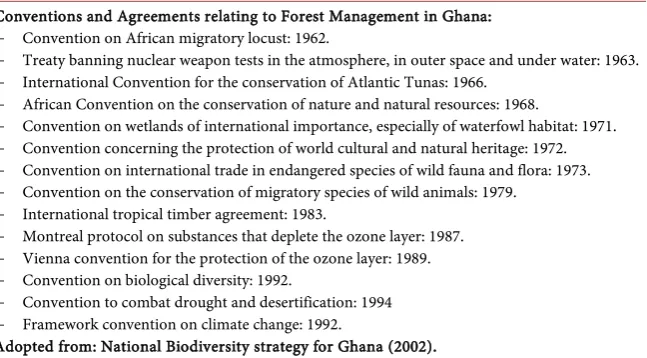
The general impression is that forests in Northern Ghana are enjoying conserva-tion policies rather than policies to manage and develop them. Meanwhile these forest are being degraded by bushfires, mining, logging, charcoal burning, and uncontrolled herding. Hence there are no policy positions utilizing the reserves in an agreed upon management regime as is required by standard silvocultural
practices (Table 1). This is a major handicap to the current forest management
DOI: 10.4236/oalib.1104169 8 Open Access Library Journal
Table 1. Some international conventions and policy frameworks for Ghana.
Conventions and Agreements relating to Forest Management in Ghana: − Convention on African migratory locust: 1962.
− Treaty banning nuclear weapon tests in the atmosphere, in outer space and under water: 1963. − International Convention for the conservation of Atlantic Tunas: 1966.
− African Convention on the conservation of nature and natural resources: 1968.
− Convention on wetlands of international importance, especially of waterfowl habitat: 1971. − Convention concerning the protection of world cultural and natural heritage: 1972. − Convention on international trade in endangered species of wild fauna and flora: 1973. − Convention on the conservation of migratory species of wild animals: 1979.
− International tropical timber agreement: 1983.
− Montreal protocol on substances that deplete the ozone layer: 1987. − Vienna convention for the protection of the ozone layer: 1989. − Convention on biological diversity: 1992.
− Convention to combat drought and desertification: 1994 − Framework convention on climate change: 1992.
Adopted from: National Biodiversity strategy for Ghana (2002).
From various policy and policy-type documents governing forest
manage-ment systems the general observation is that there is very little reference made to northern savanna forest. Hence specific requirements of this region engender specific policy and strategic references. The lack of recognisition of the specific needs for savanna forest management and conservation is a gen-eral policy gap that needs to be addressed.
As discussed in earlier chapters, it is common practice to put herds of cattle
into forest reserves to reduce biomass; and in so doing, reduce bushfires, open up reserves for better production of timber, and enhance silviculture. A policy to support livestock – forest integration does not exist.
Various indigenous forest conservations practices within the cultures of
northern Ghana are not given the necessary policy attention and hence there are no strategies to enhance them as part of a holistic, integrated forest man-agement programme.
The nearness of the region to neighboring Burkina Faso, Ivory Coast, and
Togo has its influences on forest management in the region. The cross-border issues are regularly referred to by communities living in this area. There are no forest management policies that deal with the cross-border influences.
At the District level, the District Assemblies are mandated to fashion out
by-laws to regulate various developmental activities in their communities. Forest management does not appear to be a priority hence the regulatory systems for this do not exist and so there are no resource allocations for it. There is no policy linkages between roles identified for traditional authority, community stakeholders and the District Assembly for forest management. There is the need to give policy backing to a link between such institutions and forest management. In doing this the involvement of local people should go beyond forest-fringing communities being part of forest and wildlife management as is the case now to a wider inclusion and integration of all stakeholders far and near.
manage-DOI: 10.4236/oalib.1104169 9 Open Access Library Journal ment. Marketing of forest products and by-products that could be a motiva-tion for sustainable management is not foreseen by any northern savanna policy document. Issues of commercialization, export interests, and primarily the role of timber in the local and international economy are highlighted by policy. Value-addition and marketing linkages that could be a motivation for sustainable harvesting and use of plant and animal species as is done in some countries within the Sub-region is yet to receive policy attention for northern Ghana.
With respect to wildlife, policy actions emphasize conservation over and
above utilization. Also how to evolve a ‘people-centered’ wildlife manage-ment after realizing the role plaid by indigenous protection systems has not been sufficiently elaborated. The case has not also been made for a stronger linkage between wildlife and forest management for the savanna region. Though recognized in a couple of policy statements, it has not been hig-hlighted as critical especially for northern Ghana.
There is no policy position on savanna forest with respect to scenic beauty,
tourism potential, scientific and research purposes, and teaching and learn-ing as in educative purposes generally. Heritage preservation, conservation, and promotion should be part of such a policy.
For the savanna region, the policy focus should be on the effect of small scale (legal and illegal) mining on forest cover, vegetation, and land and therefore biodiversity. These are the prime support systems for forest management and the potential effect of poorly managed mining on biodiversity and the envi-ronment. But policy does not address this critical area for northern Ghana.
There is no policy effort addressing or committed to making a linkage
be-tween forest management and woodfuel utilization (even with respect to harvesting regimes and modalities). The need for energy, especially for rural communities, is on the increase. Such communities cannot afford alternative energy forms hence an over-dependence of woodfuels. Woodfuels also serve as a major source of income for the rural woman the harvesting of which depletes the forest.
There are no policies and hence action strategies on Non-Timber/Non-Woody
Forest Products (NTFPs) for the savanna regions of Ghana. The fact is that NTFPs have been grossly under-valued for northern Ghana. It appears they do not exist or they do not have any significance for Government. However these are of critical importance and have a huge potential for economic growth for especially the rual poor. There is the need for policy recognition for this and action strategies evolved to develop NTFPs [16] (Field survey, 2016).
5. Conclusions
DOI: 10.4236/oalib.1104169 10 Open Access Library Journal bodies and natures, and totems; associated with indigenous agricultural practices and seeds, indigenous agro-ecological management practices, indigenous tree and vegetation management practices, indigenous livelihood developments and human activity systems that are both enhancing and militating against biodiver-sity conservation and development.
Forest management strategies for the northern savanna region can be most effective where there is a paradigm shift of focus—from the current emphasis on Forest Conservation to Forest Management and Development (exclusions to re-sponsible inclusions): Also from Forest Management per se to Endogenous For-est Management (EFM)—putting traditional authorities (even alien herdsmen), communities and local people as centre-stage and a focus on cultural diversities that impact on management and utilization of forests. Such a perspective gives due recognition for the several Traditional Protected Areas (TPA). The evidence shows that this perspective of forest management does not exist so far.
The “starting-from-within” concept (endogenous development—the pro-posed paradigm shift for forest management) will compel us to re-look at our forest policies and management strategies by:
Starting with the indigenous management structures and systems that already
exist in a community.
Cultural roles and relevance as “enabling environments” for forest
manage-ment.
A people-centered choice of species types and combinations.
Indigenous marketing systems, networks, and products.
Culturally relevant forms of value-addition and systems for such.
Profits and benefit-sharing systems that have elements of reciprocity
arrange-ments, in-kind, individually, family level, and larger collectivities.
Seriously considering the integration of herdsmen into our forest reserves
with a strict silvocultural practice regime.
6. Recommendation
Integration of Fulaini/ Fulbe herdsmen, who take care of both their cattle and cattle owned by Ghanaians, into our forest reserves under the following terms:
Based on agreed upon management practices in silvoculture that with both
protect and enhance the integrity of the reserves.
Reduce biomass and hence reduce intensity of destructive bushfires.
Prune and provide ideal tree population for large timber production with
pruned materials for livestock feeding.
Rejuvenate degraded areas in the reserves and also broadcast leguminous
fod-der species for the supplementary feeding of livestock (Styllozanthis).
Practice health and husbandry of both forests and livestock.
Pay agreed taxes in-kind or in-cash to the District Assemblies abutting the
forest reserves as internally generated revenues.
recogni-DOI: 10.4236/oalib.1104169 11 Open Access Library Journal tion be given to traditional conservation practices that have persisted over sever-al hundreds of years (including herd management). Even though earlier popula-tion densities were low, natural resources appeared “limitless” and hunting and farming practices did little damage to the environment, traditional laws and practices on conservation were still in-place. These laws and practices, some of which persist to date, tended to protect the ecology in three main ways:
1) By protecting specific ecosystems and land types. 2) By protecting particular plant/animal species.
3) By regulating the exploitation of plant and animal resources (Taboo days, close seasons).
A few of the possible activities that could be promoted form and Endogenous Forest Management perspective include the following:
Promotion of alternative resource management systems (the role of
indigen-ous knowledge, indigenindigen-ous institutions, and indigenindigen-ous management systems).
Forest management and tourism (also cultural tourism, festivals and social
occasion and biodiversity).
Forest management and medicinal plants and animals (linking this to local
and external markets).
Forest management and alternative livelihood/income substitution activities
(NTFPs and NWFP).
An integrated programme of bio-cultural diversity, agriculture, agro-forestry,
forest management, water body management, soil fertility improvement, fi-shery, wildlife.
Indigenous forms of species preservation, germplasm preservation,
protec-tion of “indigenous hot spots” and endangered species.
To encourage and systematically develop traditionally protect areas/plants/animals (TPAs), attention should be paid to conservation of:
Sacred groves.
Burial grounds and spiritual lands.
Sacred water bodies and fauna.
Totemic animals.
Traditional cultural practices.
Farming systems.
Traditional crop varieties.
Home gardens.
Graze-lands and rest lands.
Wild fruits supply systems.
References
[1] Bourfiere, F. (Ed.) (1983) Tropical Savannas. Ecosystems of the World, No. 13. [2] Clason, T. and Sharrow, S. (2005) Silvopastoral Practices. In: Garrett, H.E., Rietbeld,
DOI: 10.4236/oalib.1104169 12 Open Access Library Journal
Five Approaches. 3rd Edition, Sage, Thousand Oaks CA.
[4] Creswell, J.W. (2009) Research Design. 3rd Edition, SAGE Publications, Inc., Thousand Oaks.
[5] De-Gomez, T. (2006) Guidelines for Thinning Ponderosa Pine for Improved Forest Health and Fire Prevention. University of Arizona Cooperative Extension, Publica-tion AZ1397.
[6] Fairhead, J. and Leach, M. (1994) Contested Forests: Modern Conservation and Historical land Use in Guinea’s Ziama Reserve. African Affairs, 93, 481-512.
https://doi.org/10.1093/oxfordjournals.afraf.a098756
[7] Fairhead, J. and Leach, M. (1996) Enriching the Landscape: Social History and the Management of Transition Ecology in the Forest-Sanana Mosaic of the Republic of Guinea. Africa, 66, 14-36. https://doi.org/10.2307/1161509
[8] Gottfrid, G.J. and Severson, K.E. (1994) Managing Pinyon-Juniper Woodlands.
Rangelands, 16, 234-236.
[9] Griffis, K.L., Crawford, J.A., Wagner, M.R. and Moir, W. (2001) Understory Diver-sity in Ponderosa Pine Forest Stands of Various Management Histories in Northern Arizona. Forest Ecology and Management, 146, 239-245.
https://doi.org/10.1016/S0378-1127(00)00461-8
[10] Kolb, P.F. (2006) Forestland Grazing: Understory Forage Management.
[11] Miller, R.F., Bates, J.D., Svejcar, T.J., Pierson, F.B. and Eddleman, L.E. (2005) Biol-ogy, EcolBiol-ogy, and Management of Western Juniper. Oregon State University Agri-cultural Experiment Station, Technical Bulletin 152.
[12] Shepperd, W.D. (2000) Manipulations to Regenerate Aspen Ecosystems. Sympo-sium Proceedings on Sustaining Aspen in Western Landscapes, 13-15 June 2000, RMRS-P-18, Grand Junction, Colorado, 355-366.
[13] Stam, B.R. (2004) Quantifying Losses of Understory Forage in Aspen Stands on the Dixie and Fishlake National Forests. M.S. Thesis, Utah State University, Logan, Utah.
[14] Schols, R.J. and Walker, B.H. (1993) An African Savanna: Synthesis of the Nylsvley Study. Cambridge University Press, Cambridge.
https://doi.org/10.1017/CBO9780511565472
[15] Waters-Bayer, A. and Taylor-Powell, E. (1986) Settlement and Land Use by Fulani Pastoralists in Case Study Areas’, in ILCA. Livestock Systems Research in Nigeria’s Sub-Humid Zone. ILCA, Addis Ababa, 213H.26.