A Thesis Submitted for the Degree of PhD at the University of Warwick
http://go.warwick.ac.uk/wrap/73116
This thesis is made available online and is protected by original copyright. Please scroll down to view the document itself.
THE CHEVALLEY GROUPS
Demetris I. Deriziotis
~':~ .. " /' , t ~ i l
~Thesis submitted for the degree of Ph.D. at the University of Warwick.
December, 1977
Boston Spa, Wetherby West Yorkshire, LS23 7BQ www.bl,uk
ORIGINAL COpy TIGHTLY
AUTHOR
~.
1,
rex-\2..,·o
1.,'
S Degree7k ..
1>,
Date'of DepositTITlE
~~
~
i~ ~'~
{jj
-/WL
I agree that this thesis shall be available in accordance with the regulations governing University of Warwick theses and subject to the following conditions:
1. Date of availability.*
(either date of deposit or date within five years thereafter)
2. Photocopying permitted. (Single copies for study purposes only)
(maximum period of restriction is five years)
YES/)l6
I agree that the summary of this thesis may be submitted for publication with effect from*
(either date of deposit or date within five years thereafter).
Author's signature ~
~
*N.B. Any proposal to restrict access to the thesis and/or publication of ·the
Summary for any length of time needs approval and must be made by the
candidate in writing to the Academic Registrar at the earliest opportunity.
See paragraphs 9 and 11 of 'Requirements for the Presentation of Research
Theses'.
---USER'S DECLARATION
(i) I undertake not to quote or make use of any information from this thesis
without making due acknowledgement to the author.
(ii) I further undertake to allow no-one else to use this thesis while it is in my care.
TABLE OF CONTENTS
ACKNOWLEDGE1ffiNTS
INTRODUCTION
CHAPTER 1 - NOTATION AND DEFINITIONS
1.1. The Chevalley groups
1.2. Tori
CHAPTER 2 - CENTRALIZERS OF SEMI-SIMPLE ELEMENTS IN
i i i
iv
1
1
5
THE ALGEBRAIC GROUPS G. 12
.
2.1. The affine Weyl group and the extended Dynkin
diagram
2.2. The pI-rational points in C
.
0
2.3. The main theorem on "centralizers
CHAPTER 3 - THE BRAUER CO~WLEX
3.1. Definition of the Brauer complex
3.2. The a-invariant.points and their properties
CHAPTER 4 - CENTRALIZERS OF SEMI-SIMPLE ELEMENTS IN THE FINITE CHEVALLEY GROUPS
4.1. Review of Carter's work
4.2. Application of the Brauer complex to the
structure of Ga.
CHAPTER 5 - THE ORDERS OF THE CONNECTED CENTRALIZERS OF SEMI-SIMPLE ELEMENTS IN. THE FINITE
13
17
20
29
30
33
42
43
46
EXCEPTIONAL CHEVALLEY GROUPS. 55
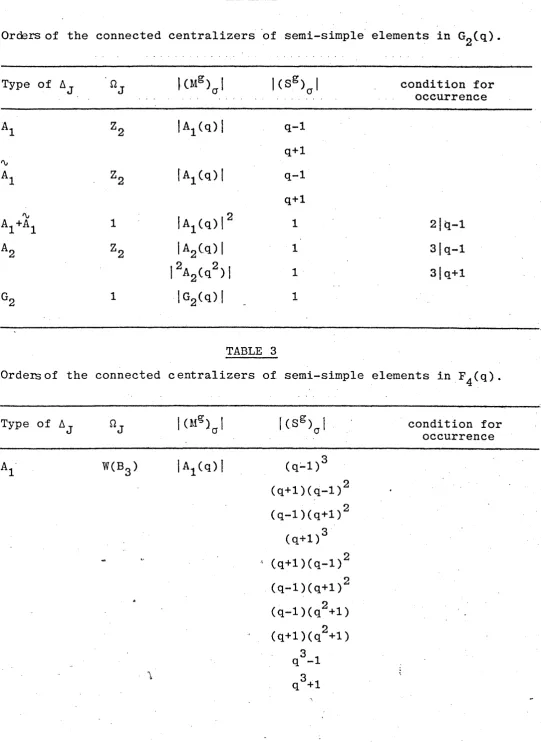
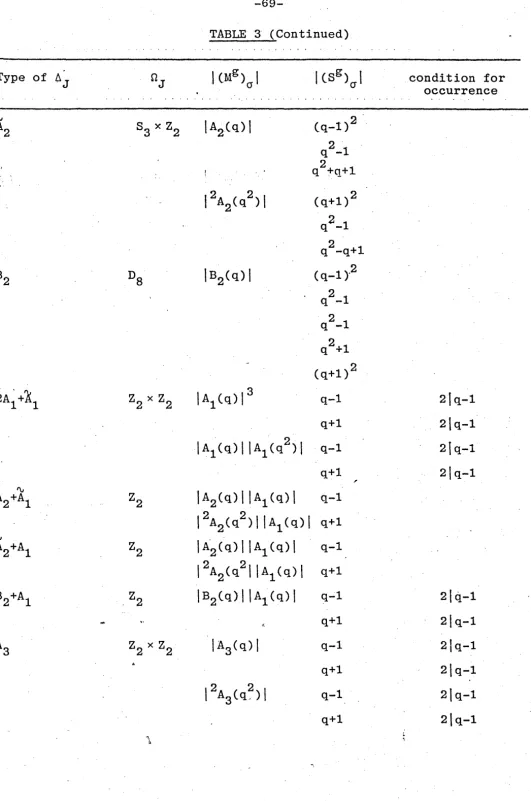
TABLE 2 - Orders of the connected centralizers of
semi-simple elements in G2(q) 67
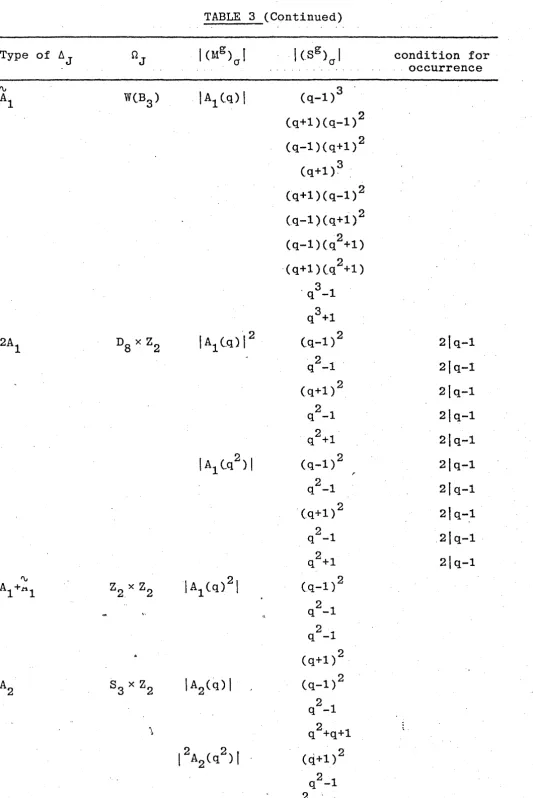
TABLE 3 - Orders of the connected centralizers of
semi-simple elements in' F 4 (q) 67
TABLE 4 - Orders of the connected centralizers of
semi-simple eleme~ts in E6(q) 70
TABLE 5 - Orders of the connected centralizers of semi-simple element~ in E
7(q) 74
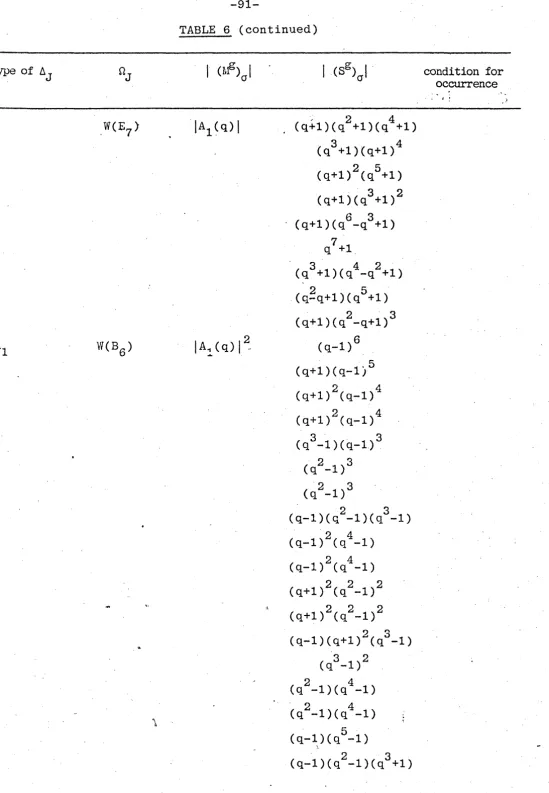
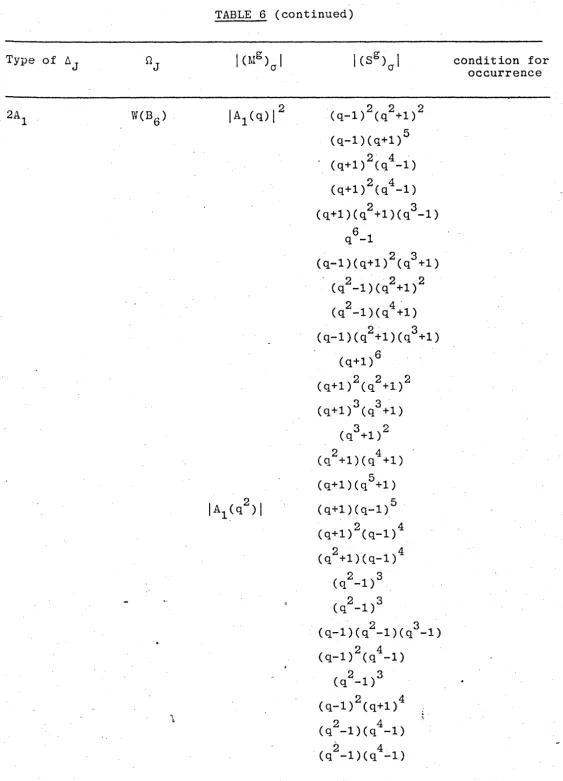
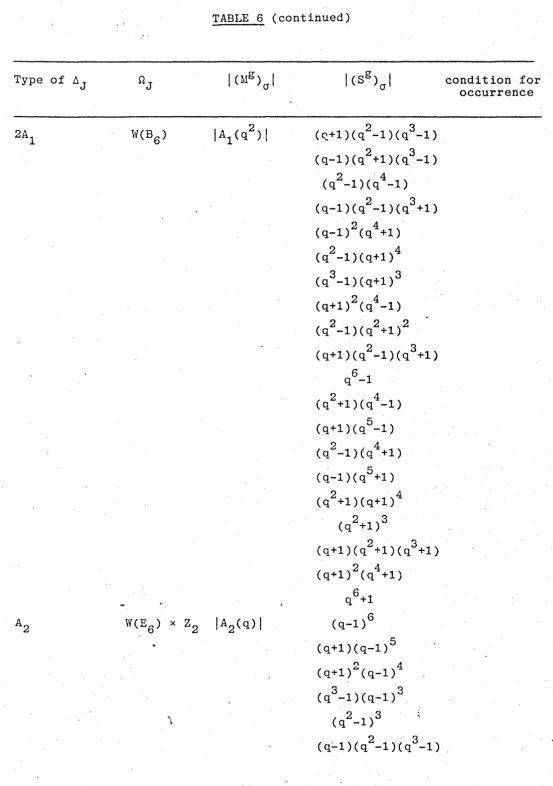
TABLE 6 - Orders of the connected centralizers of
semi-simple elements in E8(q) 89
CHAPTER 6 - THE BRAUER COMPLEX AND THE NUMBER OF
a-STABLE SEMI-SIMPLE CONJUGACY CLASSES
IN A GIVEN FAMILY 118
ACKNOWLEDGEMENTS
It is a pleasure to express my deep gratitude to
my research supervisor Professor R. W.Carter for instilling
in me the beauty of algebraic groups ~nd attempting to teach
me the advantages of thinking clearly. His continued patient
advice, encouragement and friendliness has been greatly
appreciated during the past four years of my studies in
.
Warwick.
I am grateful to my family for the financial and
moral support granted to me during my studies.
Finally, I would like to thank Terri Moss for the
INTRODUCTION
This thesis, is concerned with the determination of the
connected centralizers of semi-simple elements in a Chevalley
group. To deal with this problem we shall use the recent
work of R. Carter [6] and a new tool for the study of a~gebraic
groups - the so called Brauer complex. This complex has been
first defined by J. Humphreys [11] in,the context of the
modular representation theory of ,the finite Chevalley. groups
of universal type. Now, in our version, the Brauer complex
can be also used for the ordinary representation theory of
the finite Chevalley groups of adjoint type. For, Deligne
and Lusztig in their fund~mental work [9] have constructed
for these groups certain families of irreducible complex .
representations whose degrees can be obtained if we knriw what
subgroups of.the finite Chevalley groups are the·connec~ed
centralizers of semi-simple elements.
The thesis is organized as follows. ,
In Chapter 1 we introduce notation, definitions and a
general background for the theory of Chevalley groups adequate
for the rest of the discus~ion in the thesis. In particular
we emphasize the properties Of' the semi-simple conjugacy classes
in the Cheval ley groups developed by Springer and Steinberg in
~ "
the seminar E of [2].
In ~hapter 2 we discuss the relation between the semi-simple
conjugacy classes of a Chevalley group of universal ty~e and the
affine Weyl group. This "relation along ~ith a result in [6] will
enable us to obtain information about the structure of the
1
connected centralizers of semi-simple elements in any algebraic
.. \
In Chapter 3 the Brauer complex is introduced. This
complex is used 'to obtain a geometrical picture of the a-stable
semi-simple conjugacy classes, where a is the Frobenious map.
This is given in Theorem 3.4. A consequence of this theorem
is that the number of a-stable semi-simple classes is q1.
(R,
=
rank of the group) " a well k~own' result.Chapter 4 begins with a review of Carter's recent work [6].
Then we relate this work with the 'Brauer complex. This will
give the necessary material to determine the orders of the
connected centralizers of semi-simple elements in the' finite
'Chevalley groups.
Chapter 5 gives the tables for the orders of the connected
centralizers in the finit~ exceptional groups. A considerable
amount of detailed work was involved in the compilation of these
tables which has not been included in the thesis. However a
number of. examples are given to illustrate the sort of calculations
involved. These tables .together with the results in [7] give a
complete list of all the connected centralizers of semi-simple
elements for all finite Chevalley groups.
The thesis ends with Chapter' 6. In this last chapter we
discuss how the Brauer complex can be used to compute the number
of semi-simple classes in a finiteChevalley group of universal
type whose centralizers are conjugate. From this discussion we
...., ,',
can easily determine these numbers for groups of rank::; 2, which'
are already known .
...
Throughout th~ thesis we denote by Z, Z+, ~, R, ~ respectively
the integer, the positivS integer, the rational, the real and the
complex numbers.
\
To the best of the author's knowledge, those results in this
Notation and d~finitions
1.1. The Cheva11ey $roups
Let g be a simple complex Lie algebra of rank ~ and H~ a
Cartan subalgebra in g. We denote by (,) the Killing form of g.
This is a non-degenerate form on g. The set of all non-zero
roots of g with respect to H~ will be denoted by Q. For each
root r in Q we define the (unique) element hr of .H~ by (h,b
r )
=
2r(h)
(r, r)' for all h· ~ H~, where
<,
>
is the transfer of (,) onH~-the
dual space ofH~.
Let QV·be the set of all vectors hr'*
*
r e' ~ • We consider the real subspaces H
=
!)a,and H=
l1a
of*
vH~ and H~ generated by Q and ~ respectively. The restrictions
*
of (,) and
< ,)::
on Hand H are symmetric, posi tive definite bilinear,
*
vforms and thus Hand Hare Eulidean spaces . . The sets Q and ~
*
are indecomposab~e and reduced root systems in Hand H respectively,
The set ~v is said to be the dual root system of~. The elements
in ~v are called coroots. We fix a fundamental basis
v . { }
Then the basis'~
=
h.;r. E ~. ~]. of H
v
is a fundamental basis in ~ , where hi is the coroot associated
with r.. In ~ there is a unique root r -called the highest root
1 0 ~
of Q which has the property such that if r =
r
n.r. ando i=1 l. ~
r
=
L m.r. is any root in ~, then n. ~ m. for all i=
1, ... ,~.1 ~ 1 ~ 1
We shall~call ni's the coefficients of the highest root. Finally,
in ~ there can be only two root lengths and in case we" have two
distinct lengths, we spe~k of long and short roots. In particular,
v
the dual root system t . We consider now the dual bases
{A.;i=l, ... ,l} and'{Y.;i=l, ... ,l} of ~v and ~ respectively.
1 1 '
*
The linear funct~ons Ai'~ in H are called the fundamental ~eights
and the elements y. 's in H, the fundamental coweights. We denote
1 1 1
respectively by P, X, Y and' the Z-lattices t Zr., I Z A
l. ,
1 1 1,
1 1
t Zh. and t Z y.. We shall call these lattices, the root lattice~'
1 1 1 l '
the ~eight lattice the dual root lattice and the dual ~eight
lattice respectively. The linear functions on H which belong in
X will be called:weights~'while the elements i n ' aoweights.
The quotient groups
~
and~
are isomorphic in duality over thegroup
~/Z.
The relation matrix of~
is the inverse of the Cartanmatrix CA .. ), where A .. = r.Ch.) i,j = 1,2, ••• ,1, and the relation
lJ lJ 1 J
matrix of
~ i~
the inverse of the transpose of (Aij ).
Let now V be a finite dimensional faithful g-module. Then
V as anH~-module has a decomposition V = e V , where p'ruris over
p p
X and Vp = {v' E V/hv = p(h)v, for all h E H~}. The weights p
for which Vp
1
0 are called the weights of H~ on V or simply theweights of V.
By definition an admissible lattice M of V is a Z-form of
xn
a basis of V stable under the action of the elements ~ r E ~,
n.
+
n E Z , where {x , r E t , h
l.,i=l, ... ,l} has been chosen to be
, r
a Che~allej basis of g. Notice that there exists a Z-form U
z
of the universal, enveloping algebra U of g-called the Kostant form
of U-which results . the existence of an admissible"lattice in V.
Now for each r e ~,. we have x V c V + . Thus the action
r 1-1- l l r
of xr on V affords a nilpotent endomorphism of V.' So we can
1 00 xn
r
define the automorphism exp xr = t n! on V, which is unipotent,
n=O since exp x -1 is nilpotent.
Now let ~q be a field of q elements, fixed ~orever, and
K
its algebraic closure. Let k be any field between ~ andK.
q
Since M is admissible, exp(x . r ~
til
is an automorphism of theZ-module M ~ Z~~], where u is an indeterminate. Thus
exp(x
r ~ u' ~ lk) is an automorphism of M ~ Z[u] ~ k. Let t be
an element of k. ,Then we define a homomorphism of"M ~ Z[n] ~ k
into M ~ Z[t] ~ k ~ M ~ k such that u -+- t. Through this
homomorphism we get an automorphism X~I ~(t)
=
exp(xr ~ t ~ lk)ofVk
=
M ~ k.The group G (k) generated by all x (t)(r E ~, t E k)
v r , v , ' ,
is called the Cheval. l.ey g~oup of type (g, II, k), where rr = 11 (V) is
the Z-lattice generated by the weights of V. Up to isomorphism
the groups G (k) depend only on the Z-lattice 11(V). , ' , ' v So i t is
more reasonable to denote the above group by Grr(k). On the other
hand, if we are given ~ Z-lattice 11 between X and P, then there
exists 'a finite dimensional faithful g-module V such that IT= TI(V).
Thus there are as many Chevalley groups of types (g,TI,k) as
Z-lattices there are between X and P.
Now every Chevalley group Grr(K) is a connected algebraic
group defined over the prime field of K, being generated by its
connected subgroups Xr
=
~r,TI(t);t
E K:> - called the root subgroups... "
- each of which is isomorphic to the additive group K.
A non-abelian connected algebraic group G defined over K which
possesses no closed connected normal subgroups is called simpl.e
(is not simple as abstract group but it can have only finite
normal subgroups).
A connected algebraic group G defined over K is called
semi-simple if it is the (almost) direct product of simple groups.
That is G
=
G1 ... Gk, for some k > 0, where Gi , i=
l, ... ,k, aresimple connected algebraic groups such that each G. intersects
l.
the product of the remaining members Gj,j
1
i, in a central(hence finite) subgroup.
Cheval ley has shown that every simple connected algebraic
group defined over K is isomorphic Cas an algebraic group) to an
algebraic group of, the form Grr(K) and ·each of the groups GrrCK) is·
a simple connected algebraic group. This identification of the
simple connected groups can be extended to the semi-simple connected
groups defined over K. Fo~ this we have just to replace t~e Lie
algebra g by a semi-simple one.
Among the Chevalley groups. we snaIl distinguish two particular
types of groups. These are the groups GX(K) and Gp(K); the former
is called simply connected (or the Cheval ley. group of universal type)
and the latter adjoint. We shall denote them by G sc and G a d
respectively. The group G sc covers all the groups GrrCK) in the .
sense that each Grr(K) is isomorphic with the factor group Gsc/N,
where N is some subgroup of the centre Z of G In particular
sc
G d ~ G /Z is simple as rn abs~ract group. "The collection
a SG
{Grr(Kl; X~. IT ~ p} is calle~ the isog~ny class of type (g,K).
Given a Chevalley group G
=
GrrCK) and a subfield k of K, then thegroup .GrrCK) is its own· derived subgroup and it is the derived
subgroup of the group of k-rational points of G, i.e. the group
G n GL(M·~k). "\
If G = G , then G Ck)' = G n GL(M ~ k).
1.2. Tori
In what follows by G we shall denote a simple Chevalley
group GII(K).
A torus of G is a closed subgroup which is isomorphic to a
direct product of s copies of K*, for some s > 0, where K* is the
multiplicative gr.oup·of K. A maximal torus of G is one contained
in no other, so that s is equal to 1, the rank of G.
A standard maximal torus used for the study of G is
constructed as follows. Let us denot~ by A(II) the group
*
Hom (II,K). Every element X'in A(X) gives rise to an element of
Z
A(II) by restriction. However, not every element of A(II) need be
the restriction of some element of A(X). We consider the group
A'(TI) of all elements of A(TI) which can be extended to elements'
of A(X). For each r. E
~
and z. E K*, we define the elements1 1
X II 'of A'(TI) by Xr.,z. ,TI(~) =
ri,zi' 1 1
Then
each element X of A'(TI) is written uniquely in the form
R.
TIX TI where z.
=
X(A.), i=
1,2, •.. ,R.. Let ~1' ~2'···'~n1 r. ,z. , 1 1 1 1
be the weights of a fixed basis of the admissible lattice M. Then
for each X e A'(TI) we define the diagonal matrix heX) =
diag(X(~l)' ... , X(~n)). From the Chevalley theory heX) e G,' for
..., ",
all X E A'(TI). On the oth~r hand, for each r. E ~, we see that
1
*
the group generated by h(X . II)' z. E K , is isomorphic with
.. ri,zi' 1
R.
*
*
K . Since X = TIx TI for some z. E K , we also have h(X)
=
1 r.z., , 1 1 1
R.
TI'h(X . ) (uniquely expre~sible).
1 ri,zi,rr Thus the group ~(X); X 6 A' (II ~
\
*
a maximal torus in G. We shall denote this torus by T .
o
also that A'(IT) ~ T under the map h : X ~ h(X) .
. 0
We see
For a subfield k of K, T is diagonalizable over k, that
o
is, .the group T (k) of the k-rational points of T is isomorphic
o 0
*
with the direct product of i copies of k . We say that T is a
. 0
k-split· torus of G.
.*
Let X(T ) = Mor(T ,K ) be the group of K-rational characters
o 0
of T. For each ~ E TI, we correspond an element 9 of X(T ) defined
o ~ a
by ¢~(h(X»= X(~), for all X E
A'(n).
This correspondencedefines an isomorphism of IT onto X(T ) and we can identify (and
o
so will do) X(T ) with IT. In particular, each root r in ~ is in
a
.'
X(T ) (under the identification) and the root system ~ of g is
o
also called the root system of G with respect to T .
o
*
A K-rational homomorphism y from K into T is called
one-o
parameter subgroup of T. The set of these is denoted by yeT ).
o a
For any two elements'Yl'Y2 E Y(T
o)' one defines the element
*
y = Yl + Y2 by yet) = Yl(t)Y2(t), t E K. Thus yeT ) becomes an
o
additive group.
Let w., i = 1, ... ,i be the elements of X(T ) .defined by
1 0
w
i (t1,t2, ... ,ti ) = tie Then wi is a basis of X(To). For each
*
*
~ E X(T
o) and y E Y(To)' the compos:!.tion map ~o y. K ~ K is
rational, and so there is an integer n such that (~ 0 y)(t) = t n
*
<"
for all t E K ·This allows one to define a Z-pairing
,
X(To) . x Y(T ) ~
. 0 Z by
<
ll, y) = n, whenever (11 c: y)(t) = tn
,
t E K
*
..Under this pairing X(T ) and Y(T ) become dual Z-modules. The dual
o 0
basis of·w., i = l, ... ~i is formed by the elements y.,i=l,.~., i
1 .. . 1
i -* .: th
which correspond to each t· E K , the element· of T . whose the i
coordinate is t and the other ones equal to 1.
called the lattiae of one-parameter subgroups.
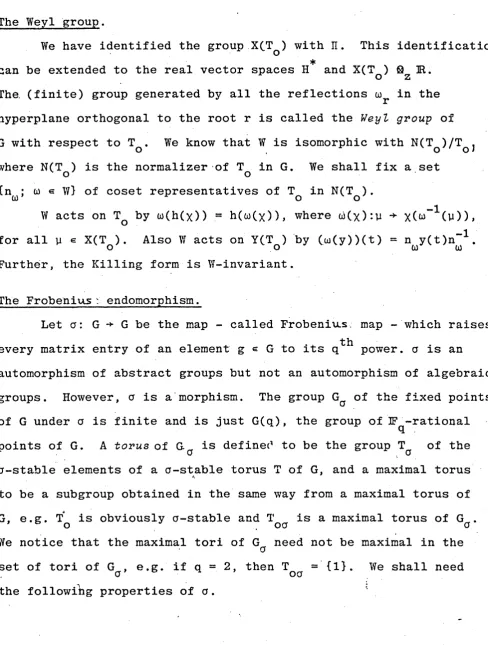
The Weyl 'group.
Y(T ) will be
o
We have identified the group,X(T
o) with TI. This identification
*
can be extended to the real vector spaces Hand X(T ) 9 R.
o z
The (finite) group generated by all the reflections w r in the
hyperplane orthogonal to the root r is called the Weyl group of
G with respect to T. We know that W is isomorphic with N(T )/T J
0 0 0
where NeT) is the normalizer-of T in G. We shall fix a,set
o 0
'{n · 00 e W} of coset representatives of T in NeT ).
00' 0 0
W acts on To by w(h(X»
=
h(w(X», where ~(X):\.1for all ~ € X(T ).
o Also W acts on yeT ) by (w(y»(t) ,0
Furth~r, the Killing form is W-invariant.
The Frobe'nius: endomorphism.
-1
-+ x(w (U»,
-1
=
n y(t)n •w 00
Let a: G + G be the map - called Frobenius, map -'which raises
° t f I G t °t th °
every matr1x en ry 0 an e ement g € 0 1 S q power. a 1S an
automorphism of abstract groups but not an automorphism of algebraic
groups. However, a is a'morphism. The group Ga of the fixed points
of G under a is finite and is just Geq), the group of~-rational
q
points of G. A torus of G. is define(~ to be the group T of the
cr " cr
a-stable elements of a a-stable torus T of G, and a maximal torus
'\
to be a subgroup obtained in the same way from a maximal torus of
G, e.g.
i
o is obviously a-stable and T 00 is a maximal torus of Gnv •We notice that the maximal tori of G
a need not be maximal in the
set of tori of Go' e.g. if q = 2, then Toa ='{1}. We shall need
[image:16.535.34.523.133.779.2](1)
(2)
(3)
a acts on X(T
O) (via its transpose) and
a(ll )
=
qll and aCyl=
qy, II E: X(T ), y E:0
is extended to the real vector spaces
a commutes' with the action of W on T .
o
a leaves stable each root subgroup X .
r
ax net)
=
x n(tq), for all t E: K.r, r,
on YCTo) by
Y(To ) · This action
*
H and H.
In fact we have
(4) For each element g of G there exists an element g' of G
-1
such that g = g'a(g') .
The property (4) is a consequence of the following theorem.
Lang's basic theorem:
Let G be a connected linear algebraic group and a an
endomorphism (in the sense of algebraic 'groups) of G onto G such
that the subgroup G
a of G of the fixed points of a is finite.
Then the map f:g
~
ga(g)-l of G into G is surjective.We recall that in a connected algebraic group over K (and
so in G) any two maximal tori are conjugate. However, this is
not so for G
a, where the'situation is described as follows. Let
us denote by n the set
ot
all maximal tori in G. G acts onn
byconjugation. Also a acts on n such that a(Tg)
=
(aT)a(g). Letn be the-set of all maximal tori stable under a. For T E n
a '.\ a
and g e: G
a, we hav·e a(T
g)
=
(aTf(g)=
Tg,
i.e. Tg e na.
Thus,.
G
a acts on na
.
. For the setn
a \G a of the orbits of this actionProposition 1.1. ([2]).
There is a bijection of no\Go onto the set of the conjugacy
classes of W. This bijection is given by
We will see in §4.1. that Proposition 1.1 is a special case of
a general result in [6].
Twisting
Referring t~ Lang's basic theorem, for each 00 € W, we can find ,
-1
some g e: G such that nw = g-l a (g).' Then we have
T~
o(g)=
Toor Tg = To~g) Since oTo = T we have oCT g)
=
(aT )~(g) == rf1(g)o 0 • 0 0 o . 0 ' ·
Thus T g = oCT g), i.e. T g = T E na. Conversely, let T e: no;
o 0 0
then.there exists some g e: G such that T = T g. Hence
o
a(Tog)
=
aT = T or (OTo)oCg) = Toa(g) = T, i.e. Toa(g) '= T=
Tog;T 'g_l,a(g) g-la(g)
that is 0
=
To· Therefore = nw . E. NG(To) for some
w e: W. So all the maximal tori in G fixed by a can be obtained
from T by "twisting" by some w €
0
w.
Let T be obtained. by T by otwisting by w e: W, where n = g -1 o(g). If we
00 identify'T with T . 0
according to the inner automorphism Int g; then the original action
of a' on Tis eq ui valent to t hat 0 f woo on T. Fo r if t e: T , an d
o 0
. -1
correspo~ding~y t l
E T such that gtg = t l , then:
Int go"'( woo) (1:) =. Int go(woa)\\Int g -1 (t')=Int(gn o(g) -1 )(a(t'))
w
=
a 0 Int get). Hence the following diagram commutes:
Int g T
0 ~ T
l
w~
al-
,la
T
•
T0 ,
The above identification is carried out to the character groups
*
X(T) and X(T ) under the isomorphism Int g o : X(T) ~ X(T ) defined
0
*
by Int g (l))(t) = ~(Intg(t)). Under this identification the new
action of a(via its transpose) on X(T
o) is given by
a(~)
=
qw(~) , for all ~'E X(To).We finish this section by stating some well known facts
concerning the semi-simple conjugacy classes in G and Ga.
In general, if' A is a group, B a subgr~up of A and s an
element of A, we' denote the conjugacy class of s in A (resp. in B)
by [s]A (resp. by [s]B). We put also CAts) (resp. CB(s)) to denote
the centralizer of s in A (resp. in B).
We recall that every semi-simple element (i.e. diagonalizable)
of G'is contained in a maximal torus and every torus, of course,
consists of semi-simple elements. Thus every conjugacy class
consisting of semi-~imple elements can be represented by an element
of T , as the maximal tori are all conjugate to each other in G.
o
This holds true for Ga. That is, every a-stable semi-simple element
is contained in a a-stable maximal torus. In particular, the
connected centralizer CG(x I)o(i.e. the connected component 'of CG(x)
containing 1) of a a-stable semi-simple element xis a-stable and
has the same rank as G. The study of this kind of groups will be
one of the~entral purp~ses' in our work.
For the semi-simple conjugacy classes in G we have the
following proposition.
Proposition 1.2. ([2])
'\
There is a bijection from the set of the semi-simple conjugacy.
'\
classes to the set T /W cif the orbits of the actiort of W on T
This bijection is given by [t]G + ~, where ~ denotes the orbit
of the element t of T6• In fact, [t]G on To
=
t.Now the connection of the semi-simple conjugacy classes
in G and Gaois as follows.
Proposition 10.3. ([2]).
(a). Every a-stable semi-simple conjugacy class in G contains
an element fixed by a.
(b). If G
=
Gsc' then every two semi~simple elements in Go whichare conjugate in G, they are conjugate in Ga as well. Therefore
.. in this case (using (a», we have a 1-to~1correspondence between
the a-stable semi-simple conjugacy classes of G and the ones in Go.
Continuing to assume G
=
Gsc ' we see by oProposition 1.2. and 1.3.that the W-orbits in T
0 fixed by 0 correspond to semi-simple
conjugacy classes also fixed by cr and so to the ones of G cr- In
other words, an element t of T o is conjugate to an· element of G cr
if and only if We 0 fixes t for some w e: W.
To this end we state the following proposition taken from
[2] :
Proposition 10
.4_
'"'Let x e: T
o ·Then the classes of maximal tori fixed by 0
CHAPTER 2
CENTRALIZERS OF SEMI-SIMPLE ELEMENTS IN THE
ALGEBRAIC GROUP G.
From now, unless otherwise indicated, G will denote the
simply connected group Gsc in an isogeny class of Chevalley
groups. The reason for this assumption will become clear at the
end of this chapter~ Thus in this case we have X :: X(To) and
Y :: Y(T o).
In the present chapter we exploit an exact sequence used by
G. Lusztig in his .work for the ordinary representation theory of
Ga. The analysis of this sequence will allow us to associate to
a semi-simple conjugacy class of G a certain point of the
sc
fundamental region of the action of the affine Weyl group on H.
Then this will give a criterion for being a connected r~ductive
sub~roup of G the 6entralizer (being connected in G) of some
semi-simple element. This involves the extended Dynkin diagram in a
way as Borel-de Siebenthal and Dynkin [10] independently obtained
all the connected reductive subgroups of maximal rank in G. Recent
work by Carter [6] allows to extend this criterion to any group in
the isogeny class of G. This criterion is aimed principally for
the first step for finding the orders of the possible connected
centralizer~ of semi-simplt elements in 3
0 •
It~is purposeful to begip first with the affine Weyl group
and the extended Dynkin diagram of the root system 9.
2.1. The affine Weyl group and the extended Dynkindiagram
We consider the Euclidean space H = ~ ~ ffi.· We denote by
H (r E ¢,k € Z) the hyperplane of H defined by H k={h e H;r(h)=k}.
r,k r,
Also we denote by 00 the reflection mapping of H onto itself with
r,k
respect to H k. Thus
r,
We denote by d(h) for each h € H the translation mapping defined by
d(h)v = v + h, v e H.
Then we have oor,k = d(khr ) oor .
Let us denote by D the group consisting of the translations of the
form d(y),y € Y. Now using the obvious relation ood(h)oo-1 = d(oo(h»,
(00 E W, h e H), we see that DW is a subgroup of the group of all
affine transformations of·H onto itself. Obviously we have D n W = {lll
and as dewey) E D, for all w E Wand y E Y we see that DW is the
semi-direct product of D by W.
We shall denote DW by Wand call.it the affine Weyl group of ¢.
a.
The set of all hyperplanes H
r , k' (r e ¢,. k e Z) is 'stable under Wa •.
In fact we have
Now the union
U
H k is a closed subset of H. Hence· its complementr
,
k r,H -
U
H 'r
,
k ... r,k is an open subset of H. Any connected component C ofH -
8
Hr •kopen simple~
is an open simplex,· called alcove. One of them is the
C = {h E H/r.(h) > 0, i = l,2, ... ,i, r (h) < l}.
0 1 0
Let us denote by 10 the set "{0,1,2, ..• ,i}. For each i =f 0, i e I J
o
we put H.
called'the
r't
H HJ =j€J jer.(h) = 0
J
walls of C .
a For a proper subset J of 10' we let
set of points h in H satisfying
> 0, for 0
f
i1
J . and r o . (h)=
1We denote byFJ the
for 0
i
j E J, riCh)if 0 E J, ro(h) < 1 if 0
1
J. Then FJ is an open simplex in the
space HJ·with vertices the points
~
n. y., i ].1
J, where n; ....affine
~ .
is the ith coefficient of ro and Yo
=
O. We see that F<)=
Co=
lJ
FJ - a.disjoint union of simplices - where Co denotesJi
10
the closure of Co. The simplices F
J , J.
1
10 are called the facesof .Co and the subsets J the typei of the faces.
With the above notation, W is characterised by the following
a. proposition.
Proposition 2.1.([3]).
(a) W is a Coxeter group on generators W l' wr , ... ,w which
a . . r o ' . 1 r9.,
are precisely the reflections in the walls of C • a
(b) W acts simply - transitively on the set of all alcoves~
a. . The
closed simplex Co is taken to be the fundamental region of the action
of Wa. on H. Thus the collection {w(Co); W E
'U
of closed simplicesforms a tessellation of H, which is parametrized by W -itself. a.
Let W be an element of W .. Then the closed simplex w(e ) also
a. . . 0
c~n be chosen ~s the fundamental region of W , with respect to ~hich
a..
the Coxeter generators of Ware the elements a. ,\ ooWr.w -1 ,]. = . 1,2, ... ,~
l-·-1
and woo 100
r o ' Using this fact, one can define an acti6n of W a. on
the set of all pairs (C,p) by wc.(C,p)
=
(w(C),wpw -1 ), where C isa closed simplex obtained from Co under Wa.' and p a Coxeter generator
of W with respect to C. _a. Now each W -orbit of this set of pairs a.
intersects each of the {C} x n(C) in exactly one pair, where n(C)
denotes the set of Coxeter generators of W with respect to C. a,
Since {C} x n(C) has 1 + 1 elements we have 1 + 1 orbits. So the
set I can also be identified with the set of the above i + 1 orbits.
0 '
Thus each element of W a, induces the identity map on I , 0 since fixes
each orbit.
It is clear now that the action of Wa, on H does not affect the
types of the faces, i.e. the face w(FJ ) of w(C ), for all o w e W , a,
is of type J as Wa, acts trivially on 1
0 •
I\,. .
Let us consider now the group W of all affine transformations
of the form d(y)w, (y e ',we W). We know that the elements of , are
I\,.
vertices of alcoves (called special points). This means W permutes
I\,.
the alcoves.
I\,.
WOo is a subgroup of W. In fact, w(Hr,k)
=
Hr',m,(w E W, r,rl
I\,.
normal in W.
-1
e ~Jk,m E Z) implies ww kW = W I ' i.e. W is
r, r ,m a,
Let
~
be the subgroup of~
fixing C .~
is called theo
fundamenta~ group of ~ and is characterized by the following
properties, (see [3])~
(a)
~
consists of the elements d(y .)0., where jJ J runs over the
set {j e: I
In.
=
1} and o.=
w.w Wo being the unique element ofo J J J 0'
maximal length in W and w. the one in the subgroup generated by
J
all w , i r
'f
j.i
(b) ~ acts by conjugation on Via, and permutes its generators
w
ro,l,w;l'·. ;'Wr1 in such a way that ri(hk )
=
rpj(i)(h~(k)' i,k E,I o 'where P. is the permutation on I induced by the element d(y.)a ..
I\,.J .. 0 J J ,
Thus W is the semi-direct product of W by ~ and we have the
a.
isomorphism CXl -+ 'f
IY
given by d(y.)a. -+ y. + Y.J J J
I\,.
Let now~' l1 be, the set,' {-r 6' r l ' . . . , r 1} · We call exten'ded Dynkin'
(a) the set 10 is the set of vertices
(b) the vertex i is joined with the vertex j, for j
f
i, byri(hj)rj(hi ) edges.
(c) whenever two vertices i and j are joined by more than one
edge then we add an arrow pointing to the vertex which corresponds
to the shorter root of the two roots ri and rj (or -r j if j
=
0).Without abuse of language, we shall say "the extended Dynkin
IV
diagram 6." of ~.
IV
Let ~J be the subset of 6. consisting of the roots r.,
J j e: -J,
where J is a proper subset of I o· Let ~J be the subroot system of
~ generated by
Wr .' r j e: b. J • J
IV
6.
J and WJ the Weyl subgroup of W generated by all
The graph- obtained by omitting the vertices i E I -J
o
of il is called the Dynkin diagram bJ of ~J. Notice that there may
be more subroot systems in ~ of different types from the eJ's, but
here we shall confine ourselves only to ~J's, J ~ 1
0 •
Let L be a permutation on a subset J of 1
0 • We say that T is
a symmetry of ~J if ri(h
k)
=
rT(i)(hT(k» for all i,k e: J. e.g. eachelement of ~ other than the identity induces a distinct symmetry
IV
on ~, whereas each element of Wa induces the trivial one. This kind
of symmetries combined with the FrobeniU,s-.., endomorphism give rise
to the twisted (or Steinberg) groups which we will meet in Chapter 4.
IV
Finally, for ~J ~ ~, Autw(~J) denotes the group of symmetries
on ~ J inauced "by the elements "of W. To find _ the orders of the
possible centralizers of semi-simple elements in G we shall need a _
Proposition 2.2. ([5])
(a) OJ is isomorphic to NW(WJ )/
W
J
(b) WJ is a normal subgroup of OJ and ~e have
°J/w
l ~ NW(WJ)/w. xwi:
~ Autw(tlJ ),
J J J
where
~v~
is the Weyl· group of the orthogonal to~
J subroot sy"stem4?~.
We shall see later in Chapter 5, as a result of our calculations,
that w~ has always a complement. in nJ.(this has been verified for the
classical groups in [7]).
2.2. The p'-rational points in Co.
Let us denote by Qp' the local ring of the rational numbers
{ s n ~ }
at the prime p, i.e. Qpl
=
p m/s € N,m,n € Z, p~m,n. The mapping. Sll
pS n'~ e2TI1P
m'
is a homomorphism of the additive group Q , ontom p
the set.of all mth-roots of unity, for all m, (rn,p)
=
1. The kernelof this homomorphism is the group Z of integers. Thus we have the·
exact sequence
o Z
o.
Therefore, also
(1)
o
y y ~ ~p' ois an exact se~uence of Z-rnodules (as Y is flat and Y ~ Z ~ Y).
Now as K~is'a~gebraically closed field of characteristic p > 1, we
.\
*
U
*
*
have K
=
~ e and K ~ Q '/Z.eeJN q p
The lemma which follows will give a parametrization of the
semi-simple conjugacy classes of G by certain points in the ,fundamental
region C of W. This parametrization will be of great use in the
a a.
'.~ ,
Lemma 2030
*
Let <p be aJ\cmomorphism of Q. t , onto K. Then there
p "
exists a surjective homomorPhismtof Y
~ ~
fP onto A(X) = Hom(X,K ) A (y. )
*
=
<f>(rri ) ~,
gi von by Ey i ~ tr°i -+-
ITx
y . ~¢ Crr. )' where Xy. ®¢ (:IT. ) (A)1. 1. . 1.. 1..
Proof:
We consider the map Y x ~pT -+- Hom(X,Q'pf /Z) given by
(y,''IT) -+- X(Y':'1l')' where X(y,rr)(A) = ~(Y)·7T mod Z. Since we obviously
have X
=
(Yl +y 2 ,If ) X ( . y 1 J rr ) X ( Y 2 ,'IT ) J ' Y X ( ,1T . 1.f. 1r ~') 2
=
X ( Y J Tr'l ) X ( Y ,n· 2 )' theabove map induces a unique homomorphism of Y ~~pl onto HOm(X'~pt/Z)
.,
given by Ey. ~ 7r..
1. 1. -+- X Ey .. ~',r. mod Z
=
ITX y. ~,", .. modz:
".~here1. 1. 1. ~
"
for all A' € X if and only if Ly. ~ 11". € Y f:;} 1 :: Y and since we
1. 1.
already know from (1) that Hom(X,~p t /Z)~
y
~ (~.p t /Z) ~ Ye
Q.p t /Y
the above map is surjective.. Therefore, under <f> we have the
*
surjective homomorphism Y ~ ~ , -+- Hom(X,K ) given as required:
. p
Now taking into account the isomorphism h:A(X) -+- Tot we have the
following Corollary.
... "
Corollary 2.4.
(a)~ Every.element of To is of the form h(X y ) for some y 6 Y ~ Q~r.
(b) The semi-simple conjugacy classes of G.correspond naturally
Proof:
(a) Straightforward from the lemma.
(b) Let heX ), heX ) be two elements of To for some Y1 J Y 2 € Y ~ Q.pt.
Y1 Y2
By 1.2 we know that heX ) and heX ) are G-conjugate if. and only if
Y1 Y2.
w(X ) = X ,for some w € Wo Let Y1 = L:Y i ~7ciJ Yi € Y,1T i € t~p.t.
Yl Y2
Then we have W(Xy1)(A) =
rr~(TIi)
wi
(A)(Y i )=rr~(ii)A(W(Yi»
=X~(Yl)(A).
for all A€ X. Thus heX ) is G-conjugate to' hex ) if and only if
Y 1 ' Y2
xW(Y
1)
=
XY2' ,i.e. xW(Y1)-Y2=
1. That is, w(y1 ) - Y2 € Y which.means that'Y
1 is Wa-conjug~te ·to Y2• Now as every semi-simple
element of G is conjugate to some element of T we get the o
requirement.
We represent the W -orbits of Y ~ Q t by the points in
a p
y ~ Qpt n Co and we call these points the p'-rational. po~nts in
C. In particular, the pt-rational points in C which lie in C o
0 0
will be called reguZar ~t-rational points. With this terminology
we can restate ,2.4eb) in a form as follows.
Corollary 2.4.(bt )
The ,semi-simple conjugacy classes in G are parametrized by
the pt~rational points'in Co~
Having established this parametrization, we are in a position now
to study the structure of the centralizers of semi-si.mple
elements· by means of the pt'-rational points.' This we do in the
2.3. The main theorem on Centralizers.
Let us first introduce some further notation which we shall use in the present section.
Given X € h(X), we denote by ~X the set of roots r € ~ annihilated
by X. Thus ~ = {r € ~; x(r) = 1} ={r € ~;r(t) = 1} where
X
t =,h(X) - the element of T corresponding to X. Obviously,~'
o X
is a sUbroot·system of ~. Let W denote the Weyl subgroup of W
X
generated by the reflections w , r € ~. If J is a proper subset
r X
of I , then W J will denote the subgroup of the affine Weyl group
o a,
Woo generated by all w , j € J and w 1 if 0 € J. Finally, for
rj r o '
a point y € C we denote by W the stab.ilizer of y ·in Woo.
' 0 a,y
With the above notation we have the f9llowing lemma.
Lemma 2'05.
For J t I c ' the grnup'W a,J is finite and in fact W a,J for some y € C •
o
Proof:
=
W a,y'The only element in the group of translations D which fixes a point in H is the identity. On the other hand, since J is a
proper subset of I , the' set (\ H. is not empty. Thus D n W J
=
{l}o j€J J a,
So the map W + Wt d(y).·~ + w is injective on W J. This proves
, a a, .
the fi.rst part of the lemma. For the equality W a,J
= W
. a,y seeNo Bourbaki [3] p.p. 75 ~ssertion (I).
Having~in mind Corollary 2.4 we can now describe, by means
of the pI-rational points the centralizer of an element of T in
o Wo Thi~ is~given in the following proposition.
Proposition 20 6.
Let't ~ heX ) be an element of T as in Corollary 2.4,
o Yo 0
where y is a pI-rational point in C. Then the stabilizer
of Yo is isomorphic with the group WXy
=
<
wr.; r( to)=
1) - theo
centralizer of t in W.
o·
Proof:
We have the exact sequence
f
1 ~'Y ~ W ~ W--+- 1
a
where f:d(y)ow -+- w, for y E Yo f is injective on every finite
subgroup of W 'l· We prove that f(W ) = W 0 In fact, let
'l,yo Xy
0
r E ~ 0 Then Xy (r) = n¢(7ro)r(Yi)
=
1, where Yo=
LYi 9ir°i ,
Xy . 1
0 0
(Yi E Y, TIi EQpt). Thereforer(y) E Z which implies that
d(r(y)h)w E W T h u s w E f(W ) for all r E ~ ,which
r r a y · r ' a Y X
, 0 ' 0- y
o
means that W ~ f(Wa y ). Conversely, let w E f(W ). Then
Xy . ' 0
o a,yo
for some y E Y one has d(y) w E W 0 Let us write d(y) w as
a,yo
a product of reflections relative to the walls of Co passing through
y · o· (*) d(y)
and only if
0 0 0 w , i . E
r. J
1.
I •
o Thus in (*) i j
f
0 ifJ
o and i.
= 0
if and only if ro(yo)=
.J
r. (y )
1 •.
Therefore in. both cases we have X (r .. ) =ITCP(nk ) 1j k
Yo 1J
=
1, where·y =: LYk ~ 'Tr
k o Hence r. 1. € ~ • Thus we have f(w ) E W I for
Xy r. Xy
J.
0 1j 0
j
=
1,0 •• ,s. This shows that w E W and so f(W .) c W •Xy 'l,yo
-
Xy0 . 0
The first part of the proof. shows that W
a,yo ~ W a as required.
Yo
We apply now the above proposition to the centralizers of
~
A connected algebraic group C is called reductive if it
can be decomposed C = MS with M a semi-simple group and S a
central toruso In this decomposition S is uniquely determined
as the identity component of the centre of C and M is the derived
group of C or else as the largest semi-simple subgroup. The
following theo~em is due to Steinberg [2]0
Theo'rem2070
In any semi-simple simply-connected group G the centralizer
of every semi-simple element is a connected reductive subgroup.
Moreover, if t is an element of a maximal torus T, then
CG(t)
~<T,
Xr/r(t)=
l),wh~re
Xr are the root subgroups withrespect to the torus T.
We observe that CG(t) and G have the same rank since T c CG(t)o ..
Now by-2.6 and 2.7 we have the following Corollary.
Corollary 20 80
-Let t be a semi-simple element in G. Then the centralizer
CG(t) of t is the (unique) maximal torus T con~aining t (i.e. t is
regular) if and onl~ if the pi-rational point y which corresponds
. 0
to the conjugacy class [t]G is regular.
Now we have the following Proposition which characterizes
the centralizers of se~i-simple elements in G.
Proposition 20 9.
Except for a finite number of primes, a connected reductive
subgroup G10f maximal rank in G is the connected centralizer of
. '\
ase~i-simple element of G if and only if some proper subset of
I\"
the roots in ~ is equivalent under W to a fundamental basis of the
Proof:
Let G1
=
CG(s), s being a semi-simple element inG. We mayassume that G~ contains the torus To' since otherwise if T is a
maximal torus in G1 we can identify under an inner automorphism
of G, the torus T with To and so the root.system ¢(T) with
¢
=
¢ (T ) 0 Let x be the pI -rational point in C' n Y @ d\. whicho 0 0 ~~f
corresponds to the conjugacy class [s]Go Then the element t
=
heX )o Xo
* .
is the element of T corresponding to the element X of IIom(X,K )
. 0 Xo
*.
under the isomorphism h.:Hom(X,K ) -+ T 0
o We have seen that the root
IV
system of the centralizer CG(to) is generated by the r00ts in 6
which define the hyperplane .. on which Xo lies. Since to E: [slG'
G
1 is co~jugate to CG(to) and'~n' element which conjugate them may be taken to be in NG(T
o). For the root subgroups we have
-1
nwXrnw
=
Xw(r)' for all r € ¢ and w € W 0 Thus' in our case, thissays that the root system of G
1 is W-conjugate to that of CG(to)
(by our assumption, at the.beginning of the proof, the W-conjugation
may be followed by an isomorphism of root systems induced by an
inner automorphism of G). ThUS, some fundamental system of roots
'V
of G
1 is W-conjugate to a proper subset of ~.
Conversely, suppose that the root system ¢l of a connected
reductive subgroup G1 of maximal rank.in G is W-conjugate to S0me
IV
subroot system of ¢ generated by a proper subset of 6 •. We want
to show that~G1 is the centralizer of some semi-simple element in
G. With'what we have seen before, this is equivalent to show the
following.' If F is the set
of
all faces FJ of Co such that 6J is
W-conjugate to a fundamental basis of ~1' then for ~some J, FJ
'\
of primes)D By definition, a point ,x lies on the face F
J if
(1)
(2)
x = I: s . Y ., s. > 0,
\j
i € I -J andi€I-J 1 1 1 '
I:
i€I-J
s.n.' < 1
1 1 '
s.n. = 1
1 1 J
if 0
¢
Jif 0 € J,
where I
=
~o-{O} " and the ~i ~.s are the coefficients of the highest root with respect to ~.Writing x in terms of the coroots we have from (1):
,1. ~ d ) h
\..:d ~
s . . . . ,
where d is the determinant:-i€I-J l J l J
of Cartan mat~ix and d .. are the (j,i) entries of the transpose Jl
matrix of the inverse of the Cartan matrix_ Thus x is a pI-rational point if and only if the coefficients x.
1
=
1d i€I-J I: s.d .. in 1 Jl (l)fare in Q I_ On the other hand, we have to consider only rational
p
solutions in order that the Xi'S are in Qp1 • Each rational solution of (2) certainly will define a finite set of primes, that is, those primes p ,for which the xi1s are ~ot in Qp,t. So we have to' exclude only the primes which are divisors of the greatest common divisor of the least common multiples of the denominators of the x.'s of
1
each rational solution of (2). Thus for each F
J of F we obtain
~ ~
a finite set of primes, say, QJo 'F~nallYI considering the
IV
The above Proposition has been already verified in Carter's
paper [7], for the classical groups. This paper al~o gives the
primes which have to be excluded for each F in the classical
groups 0 We give below the table of these primes referred in
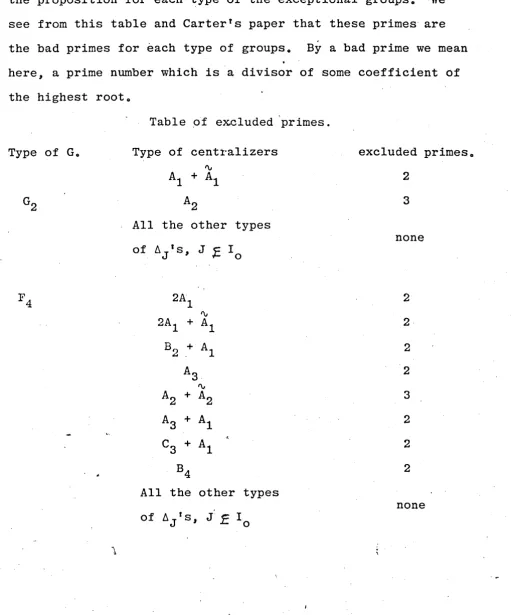
the proposition for each type of the exceptional groupso 'We
see from this table and Carter's paper that these primes are
the bad primes for ~ach type of groups. By a bad prime we mean
here, a prime number which is a divisor of some coefficient of
the highest root.
Table .of excluded ·primes.
Type of G. Type of cent l"al i zers excluded primes.
I\"
Al + Al 2
A2 3
All the other types
none of ~JIS, J ): I
0
:F
4 2AI 2
I\"
2AI + Al 2·
B2 + Al 2
A3 2
I\"
A2 + A2 3
A3 + Al 2
C3 + Al 2
B4 2
All the other types
none
of ~J's,
J f
I0
[image:34.545.23.535.172.787.2](continued)
Type of G
'E
7
ES
p'
).
Type of centralizers
4Al
A3 + 2Al
3A 2
A5 + Al
All the other types
[4A l ] I
5A l
[A
3 + 2\]'
3A 2
A3 + 3Al
[A
5 + A ]' 1 2A3
2A3 + Al
A5 + A2
D4 + 2Al
A7
D6 + Al
All the 1ther types
of fj. J 's, J
l-
J o·5A l
A2 + 4Al
3~2
A3 + 3Al
D4 + 2A' 1
3A
2 + Al
excluded primes
(continued) .
Type of G Type of centralizers
A3 + A2 + 2Al
2A3 + Al
A5 + 2Al
A5 + A2
[A ]" 7
D4 + A3
D5 + 2Al
D .+
6 Al
A5 + A2 + Al
2A4
A7 + Al
As
D5 + A3
DB
E6 +. A2
E7 + Al
All the other. types
of ~JtsJ J j: 10
excluded primes
2
2
2.
3
2
2·
2
2
2 and 3
5
2
3.
2
2
3
2
none
We state now the f~llowing proposition due to R. Carter [6]
by means of which Proposition 209 holds true, for any Cheval ley
Pr·o·p·o'S i t i·on· ·2 0 10. [ 6 ]
'V
: Le1=. G, G ).be isogenous Chevalley groups with root system tl>
tV 'V
and G
with root system <Pl. Then Gl is the connected centralizer of
IV
some semi-simple element of G if and only if G1 is the connected
IV
centralizer of some semi-simple element of G.
Now 2.9 and 2.10 give the following theorem.
Theorem.2.11.
..
If the characteristic of the field K is good, then a
connected reductive subgroup G1 of a Chevalley group G is the
connected centralizer of some semi-simple element of G if and
IV
only if some proper subset of the roots in ~ is equivalent under
W to a fundamental basis of the root system of .G1.
For a proper subset J of 10 we denote by C
J the set of all
connected centralizers of semi-simple elements of G which are
G-conjugate to the connected centralizers whose root system is
<P
J . With this notation the following Corollary is an immediate
consequence of Theorem 2.11.
Corollary 2.12.
Every connected centralizer ofa semi-simple element in a
Chevalley group G is in some CJ ' J ~ 1
0 .
This Corollary will be needed in Chapter 4 for the first.
step to parametrize the families 'of the "semi'simple" irreducible
CHAPTER 3
THE BRAUER COMPLEX
We have seen in 1.3. that there ,is a 1-1 correspondence
between the o-stable semisimple'conjugacy classes of G and the
ones of Ga. So by 2.4(b') we obtain a certain finite number of
points in C which parametrize the above classes. Thus it is , 0
natural to look for properties which characterize these points,
e.g. we could ask how are these points distri~uted in Co or even
what are their coordinates ,in terms of q. In the present
chapter we introduce the main tool to find these properties
which we use systematically ~n the next part of the thesis
concerned with the semi-simple classes in Go- This is an
~-dimensional complex in H (~
=
dim H). As an abstract geometricalobject this complex is the same as the Brauer complex which has
been suggested by Humphreys in [ll]"for the solution of the
"decomposition" problem of the modular representation theory of
Go. The name it bears comes from the Brauer tree of A
1(q) (in
Humphreys version).
I take here the opportunity to thank my supervisor Professor
R. Carter who stimulated me to use the Brauer compiex in order
to find, the deg'rees of the "seml-simple" characters of the finite
Chevalley groups.
3.1. Defini tioD of the Brauer 'complex
For a positive integer n we consider the group of translations
1
qnD which we denote Dn. We form the affine reflection group
D W
=
n
The groups VI
a ,n.'
+
n € ,Z , have the same properties as the
affine Weyl group Wa,O
=
W .
a We enumerate some of' them and weintroduce the notation which we shall use for the simplices,
hyperplanes etc. corresponding to these groups.
(a) W is a Coxeter group on generators
w , •••
,w anda,n , r1 , rR,
w ,1
r o)qn
-(b) The fundamental region of the action of W on H is the
a,n closed simplex
',c:{ no = 1 C ==:'{h € H/r
1" (h)
VL qn 0
1
Let d(qnY)w be an element of W a,n
'Lr:'
,y the open simplex1
~ 0, r ( o h ) S -n' i q , = 1,..., R, } ,
Then we shall denote by
If w, c'W, y', c Y and m € E, then the element w' (resp~ y') will
be called the relative orientatfon (resp. position) of
,q ~ m + ( t) with respect to pfnw:·,_y·
Uw w, q y w y ~
u.
, , " 1 '
The open simplices
tt: '
(w € W, Y € Y) will be denoted by,y
K) and called the (w,y)-alcoves. In particular the simplex
'v1w, y
(c) The cOllection·{~,y/w ~ W, Y ~ y} forms a tesselation of H
parametrized by W· itself.
a,n
Let Ln denote the set of hyperplanes H z , (r
r,_
~ ~,z
~ Z).qn
Then we have
as well as Wa,n C Wa ,n+l for all n ~
m.
The faces
Ofa.~
are the open simplices~n
FJ ,. J.
£-
10'denoted by F~, e.g. F~ is the face FJ of Co of type J. Also
here we say that the face F~ is of type·J. The face of typeJ
of Qn° will be denoted by F
J
n As for· the affine Weyl group
w,y ,w,y
.we have the following property for W
a,n
(e) The action of W . on H does not affect the types of the
a,n
faces ~fGL~, i.e. the face W(F~) of w(~), for all w E: Wa,n' is
of type J .
. As C is an i-dimensional simplex we see (because of volume
o
reasons) that it can be filled up by exactly qi (w,y)-alcoves.
We make now the following definition for the Brauer complex.
Definition ... 3.1. "
We call Brauer complex and denote it by B , the set of all
a
faces of (w,y)~alcoves which are "in C .
o
So we can speak of (wJ~)-alcoves of the Brauer complex. ·These
are the Q-dim~nsional faces of B. We draw below the Brauer complex
BO for the types A
2 , B2 and G2, where .we show how the various faces
are distributed in Co for q
=
3. a, band c denote the face$ of .dimension 0, d, e·and f the faces of dimension 1 and g the face
of dimension 2.
Ct..
3.2. The a-invariant points and thei~ properties
We have seen that every semi-simple class of G giveS rise
to a pI-rational point in C. In particular every semi-simple
o
class of G gives·rise to a point in Co. We make for these
points the following definition.
Definition 3.2.
The pI-rational points in C which correspond to the
o
a-stable semi-simple conjugacy classes of G will be called the
a-invariant points in C .
o
The following proposition. gives
a
necessary and sufficient.condition for a point xo.to be a-invariant.
Proposition 3.3.
Let x be a p'rational point in C
o 0 Then x o is a a-invariant
point in C if and only if x _ qw(x
o) mod Y, for some. w c
w.
o 0
Proof:
Suppose first that Xo is a a-invariant point. Lett o x · = heX )
o
be the element of the torus To which represents the a-stable
semi-simple class corresponding to x as in.2.~(br). Thus also the
. 0
... '.', ...
element aCt)
=
t q = hCX ) is in this class. By 2.~(b) the·o 0 q~ 7
points x and qx are in the same W -orbit. Suppose that the point
o . 0 a
Xo lies in the closure of the (~,y)-~lcove ~,y' for somew € W,
Y € Y. Then the point qx
o lies in the closed simplex w(C~) + y~
-1 -1
-Thus the point qw (xo)-w (y) is the unique point in Co which
determines the W -orbit of qx. But since x a 0 o . lies in Co and is in
-1 -1
tne same Wa-orbit as qxo ' we m~st have Xo = qw (xo)-w (y). This
gives the result in one direction. Conversely, let Xo be a
P,' -rational po·int in Co and let Xo = qw(xo) + y, for some w, E: W,
Y E: Y. Then we have Xio =Xqw(x
o) as~ = 1. Therefore, to = h(Xxo)
= h(Xqw(x )) =
w(t~)o
Thus't~
is in the W-orbit to of to and soo
to is a a-invariant W-orbit.
a-stable class as required.
By 1.3 this means that [ t ] is a
o G
Notice that if we work backwards in the second part of the
proof we obtain the first. For; as x is a-invariant point by
o
definition the class [t ] , t
o G 0 = h(Xx ), is a-stable and so by o
1.3, t and w(tq) are conjugate for some w E: W.
o , 0 . Thus X Xo = Xqw(x )
0
which implies ~ ~ qw(x )mod' Y . . But the above proof of 3.3. points
o 0
oat for what ~lements w E: Wand y E: Y we have Xo = qw(x
o)+ y.
The question now is how the a-invariant points are distributed
in Co. To answer this we shall relate the a-invariant points with
the Brauer complex. We will see below that the a-invariant points
have'to lie on faces in the Brauer complex which lie on faces of
C of the same type and each face in the Brauer complex contains
o
~ «
at most one a-invariant point. More precisely,. this is desc~ibed