CALABASH CHALK CHRONIC DIET CONSUMPTION ELEVATES
ANXIETY AND PAIN PERCEPTION
Bright I. Owhorji1, Udemeobong E. Okon2 and Eme E. Osim2*
1
Department of Physiology, Faculty of Medical Sciences, Abia State University, Uturu, Nigeria.
2
Department of Physiology, Faculty of Basic Medical Sciences, College of Medical Sciences, University of Calabar, Nigeria.
ABSTRACT
Consumption of calabash chalk is a common practice in Nigeria as well as other parts of Africa, especially among pregnant women. Nevertheless, calabash chalk contains lead (Pb) and arsenic which are thought to be harmful to the brain and responsible for cognitive dysfunction. It is therefore conceivable that calabash chalk consumption may affect other neuronal activities in the body such as anxiety and pain. Therefore, this present research study investigated the effects of consumption of this form of pica on anxiety and pain perception in mice. Forty-five (45) Swiss white mice of mixed sex were randomly assigned into 3 groups of 15 mice each. Group 1 served as control, while groups 2 and 3 received low and high doses of calabash calk diets respectively. Feeding lasted for 30 days. Anxiety levels of the mice were assessed with the aid of elevated plus maze and light-dark transition box as well as elevated plus maze, while response to pain stimuli were studied using hot plate and formalin tests. The results showed that the calabash chalk diet-fed mice had significantly increased (p< 0.05) close arm duration and stretch attend posture compared to control. Pain perception was significantly increased in the calabash chalk diet-fed mice compared to control. Consumption of calabash chalk elevates anxiety and pain perception in mice. These actions may be as a result of its lead and arsenic content.
KEYWORDS: Calabash chalk, Lead, Arsenic, Anxiety, Pain.
Volume 7, Issue 12, 82-94. Research Article ISSN 2277– 7105
Article Received on 25 April 2018,
Revised on 15 May 2018, Accepted on 05 June 2018
DOI: 10.20959/wjpr201812-12652
*Corresponding Author
INTRODUCTION
Geophagia, the practice of ingesting clay, chalk or dirt.[1,2] is a practice occurring both in animals and also humans of all races.[3,4] This practice is less frequent in developed societies but occurs mostly among pregnant women and children.[4] The engagement of people in this practice is for various reasons; a part of regular diet, pleasure, religious beliefs or medicinal purposes.[5]
Calabash chalk is one of such geophagic material prevalently consumed in Nigeria as well as other West African countries. It is also identified by various names including Calabar stone in English, Ndom by the Ibibios/Efiks and Nzu by Igbos of Nigeria.[6] It occurs naturally and is available in a variety of forms including powder, moulded shapes and blocks.[7] It is consumed by all sexes and mostly pregnant women as a remedy for morning sickness.[8] It is also used in facial masks and soap.[7]
Calabash chalk is reported to have Aluminium silicate hydroxide- Al2Si2O5(OH)4 as its major
component. This is a member of the Kaolin clay group[9]. Multi-elemental analysis was able to quantify 22 elements in calabash chalk including lead at a mean concentration of approximately 40mg/kg[9]. Other metals identified included Iron, aluminium, potassium, titanium, chromium, manganese, zinc, nickel as well as the metalloid arsenic[7,9,10] In addition, a range of persistent organic pollutants were identified in calabash chalk including alpha lindane, endrin, endosulphan 11 and p,pI- dichlorodiphenyl dichloroethane (DDD).[9]
Research studies on calabash chalk revealed hepatic sinusoidal enlargements, gastrointestinal damaging and anaemic effects.[6] Lead and even arsenic constituents of calabash chalk have been reported to be associated with nervous and brain damages as well as learning and behavioural dysfunctions in animals and humans.[6]
MATERIALS AND METHODS
Preparation and storage of experimental diet
Calabash chalk was procured as a large block from a local market in Calabar and pulverized with manual grinder to obtain a fine powder. The powder was kept in dry and air-tight rubber container from which calabash chalk diets were prepared. Ten percent (10%) calabash chalk diet was prepared by mixing 1 g of calabash chalk with 9 g of rodent chow. This served as low dose. Twenty percent (20%) calabash chalk diet was prepared by mixing 2g of calabash chalk with 8 g of rodent chow. This was high dose.
Experimental Animals
Forty-five (45) white mice weighing between 22 – 35 g were used for this study. They were kept in well ventilated room at room temperature (28 + 2oC) and humidity (85 + 5%). The animals were kept in a normal 12/12 light/dark cycle and allowed to acclimatize for two (2) weeks before commencement of experiments. They were granted access to feed and clean drinking water ad libitum.
Experimental Design
The fort-five mice were assigned into 3 groups of 15 each. Group 1 served as the control and was fed rodent chow only. While group 2 was fed low dose calabash chalk diet, group 3 received high dose calabash chalk diet. The animals were placed on their respective diets for 30 days with their body weights assessed after every 3 days. Approval for the use of the animals was obtained from the College Ethical Committee of the Faculty of Basic Medical Sciences, Abia State University Uturu, in accordance with the internationally accepted principles for laboratory animal use and care as found in the European Community guidelines (EEC Directive of 1986; 86/609/EEC).
Assessment of Anxiety
Elevated Plus Maze
Prior to the test, all the arms, surfaces and sides were cleaned with methylated spirit to eliminate olfactory clues, fecal boll and urine. Each mouse when tested, was placed in the central square of the maze such that the mice faced an open arm away from the experimenter upon placement. Immediately after placement, a stop watch was started and the mouse was allowed to explore the apparatus for 5 minutes. The test sessions were recorded and videotaped.
Behaviours scored included; close arm entry frequency and duration, open arm duration, grooming frequency and stretch attend posture.
Light-dark Transition Box
The light-dark transition box is an apparatus for testing for unconditioned anxiety. It is based on the conflict between exploring in a new environment and aversion of rodents to bright light.[14] As described by Costal et al.[15], this apparatus consists of two chambers. The small chamber (18 x 27 cm) is painted black and makes up 2/5 of the box. The larger chamber (27 x 27 cm) is painted white and makes up 3/5 of the box (Bourin and Hascoet, 2003). A door (7.5 x 7.5 cm) located at the floor level in the center connects the two chambers. The floor of the apparatus is covered in Plexiglas and divided into 9 x 9 cm squares. The apparatus was located in a room (2 x 5 m) and lit by 60 watt red lamp for background lighting. The mice are allowed 5 minutes to explore the box.
Behaviours scored included; light chamber duration, stretch attend posture, transition and grooming duration.
Assessment of Pain perception
Hot Plate test
Formalin test
A noxious substance, formalin (2.5% solution) was injected into the plantar surface of hind paw of mice.[18] The animal reacted to the formalin injection by licking and flinching the injected hind paw. The frequency and the duration of hind paw licks were recorded over a period of one hour. A higher frequency of hind paw lick indicated increased pain perception and a lower frequency indicated decrease in the pain perception. Similarly, a longer frequency and duration of flinching of hind paw showed increase in pain perception, while a shorter frequency and duration showed a decrease in pain perception. These experiments were done in two phases namely: acute phase (phase I) and chronic phase (phase II).Tests done within 5 minutes represented the acute phase and tests conducted 30 minutes after phase I represented the chronic phase or phase II.
Statistical Analysis
All data obtained were analyzed by one way analysis of variance followed by post hoc student’s T-test using the SPSS Computer program. Results are presented as mean + SEM and p value less than 0.05 was considered statistically significant.
RESULTS
Effect of consumption of calabash chalk diet on anxiety
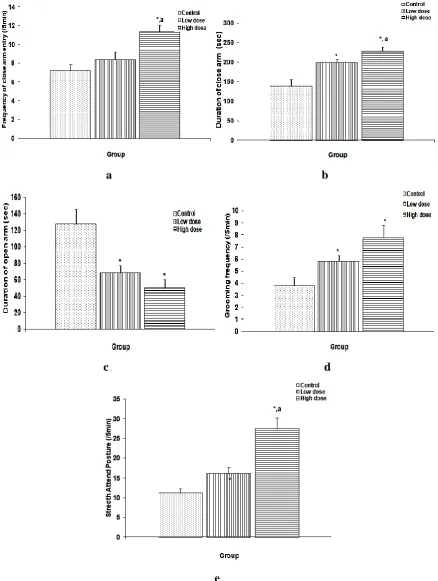
In the elevated plus maze test for anxiety, the close arm entry frequency of the low dose group was not significantly different compared to control, but that of the high dose group was significantly higher (p< 0.05) compared to both control and low dose groups (Fig. 1a). The close arm duration of the low dose group was significantly higher (p< 0.05) compared to the control. The value for the high dose group was significantly higher (p< 0.05) compared to both low dose and the control groups (Fig. 1b).
Open arm durations for both the low dose and high dose groups were significantly lower (p< 0.05) compared to the control (Fig. 1c). The frequencies of grooming of both the low and high dose groups were significantly higher (p< 0.05) compared to the control (Fig. 1d). The stretch attend posture of the low dose group was significantly higher compared to the control (p< 0.05). The value for the high dose group was significantly higher (p< 0.05) compared to both control and low dose groups (Fig. 1e).
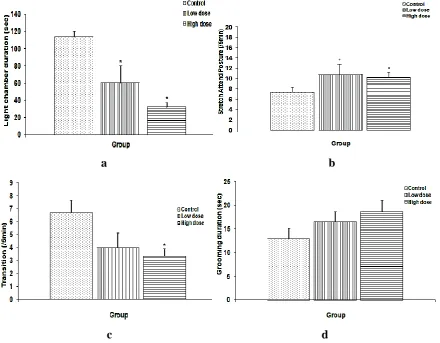
The stretch attend postures of both low dose and high dose groups were significantly higher (p< 0.05) compared to control (Fig. 2b).
The transition of the low dose group was not significantly different compared to control (Fig.
2c), whereas the value for the high dose group was significantly lower (p< 0.05) compared to control. The grooming durations of both the low and high dose groups were not significantly different compared to the control (Fig. 2d).
Effect of consumption of calabash chalk diet on pain
In the hot plate test for pain, the latency of jump of the low dose group was not significantly different compared to control. However, the value for the high dose group was significantly lower (p< 0.05) compared to both control and low dose groups (Fig. 3).
In the formalin test, the frequency of hind paw licks, during the acute phase was significantly higher (p< 0.05) in the low dose group compared to control. The high dose group had significantly increased hind paw licks compared to both control and low dose groups (p< 0.05). A similar trend was observed during the chronic phase, although no significant difference was observed between the two test groups (Fig. 4a). Duration of hind paw lick of the low dose group during the acute phase was significantly higher (p< 0.05) compared to control. The value for the high dose group was significantly higher (p< 0.05) compared to both control and low dose groups. The trend was similar during chronic phase (Fig. 4b).
a b
c d
e
Fig. 1: Effects of calabash chalk diet consumption on (a) frequency of close arm entry (b) duration of close arm (c) duration of open arm (d) grooming frequency (e) stretch attend posture in the elevated plus maze test of the different experimental groups.
Values are mean + SEM, n=15.
[image:7.595.80.519.72.654.2]a b
c d
Fig. 2: Effects of calabash chalk diet consumption on (a) light chamber duration (b) stretch attend posture (c) transition and (d) grooming duration in the light-dark transition box test of the different experimental groups.
Values are mean + SEM, n=15.
*=p<0.05 vs control.
[image:8.595.79.520.74.417.2] [image:8.595.185.414.545.676.2]a b
Fig. 4: Effects of calabash chalk diet consumption on (a) hind paw lick frequency and (b)
hind paw lick duration in the formalin tests of the different experimental groups. Values
are mean + SEM, n=15.
*=p<0.05 vs control; a=p<0.05 vs low dose.
a b
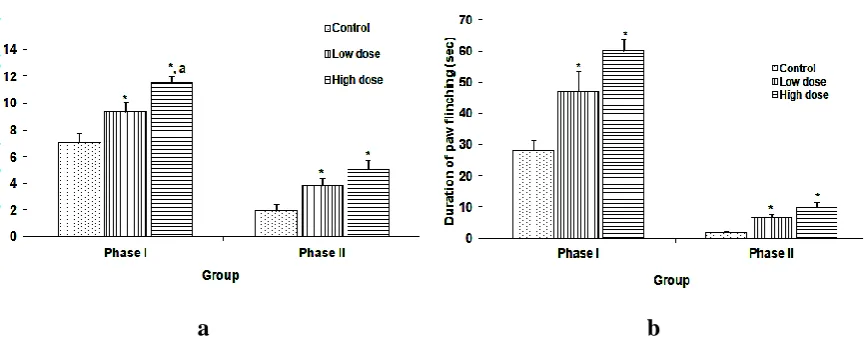
Fig. 5: Effects of calabash chalk diet consumption on (a) frequency of hind paw flinching and (b) duration of hind paw flinching in the formalin tests of the different experimental groups. Values are mean + SEM, n=15.
*=p<0.05 vs control; a=p<0.05 vs low dose.
DISCUSSION
[image:9.595.83.517.351.522.2]groups were significantly lower than control. Since fearful mice tend to avoid open areas, this result also suggests anxiogenic tendencies of calabash chalk diet.
Increased risk assessment behaviour such as stretch attend posture (SAP) is indicative of increased anxiety anxiety levels.[19] Results obtained showed significantly increased stretch attend postures and grooming frequencies in the two calabash chalk diet groups compared to control. These results further highlighted the anxiogenic effects of calabash chalk diet.
In the light-dark box test, the light chamber duration of the mice fed calabash chalk diets was significantly lower compared to control. This implies increase in anxiety levels of the mice because fearful mice spend less time in brightly illuminated spaces. Increased grooming duration and SAP of mice are pointers to increased anxiety levels. As observed in this study, calabash chalk diet-fed mice had increased grooming duration and SAP compared to control. This meant that they were more afraid than the control group of mice. Furthermore, mice fed with the two calabash chalk diets made fewer transitions between the chambers of the light-dark box. This result confirms the anxiogenic effects of calabash chalk diet. The report of this study is in contrast to the study of Ekong et al[6] which reported the anxiolytic effects of calabash chalk especially at high doses.
The well known neurotoxicant, lead which is present in large quantities in calabash chalk and responsible for adverse cognitive and behavioural effects[20] may be the culpable agent responsible for the increased levels of anxiety observed in this study. Lead might have induced anxiety since it inhibits synthesis and reuptake of Gamma amino butyric acid (GABA) or dopamine which are neurotransmitters that reduce anxiety.[21] This interference reduces the level of these inhibitory neurotransmitters and thus explains the increased anxiety levels observed in this study.
In the hot plate test, latencies of jump of the high and low dose groups of mice were significantly shorter than in control mice that consumed normal rodent chow only, indicating that it took shorter time for calabash chalk diet-fed mice to perceive pain than control mice.
frequencies of hind paw licking and flinching together with duration of hind paw licking and flinching were all significantly higher in the calabash diet-fed mice than control following formalin injection.
This increased pain perception might be attributed to the arsenic content of calabash chalk. This may be so, because arsenic has been reported to modulate macrophage activity, thus producing an over-expression of cyclooxygenase-2 (COX-2) and resulting in an increase in prostaglandin E2 (PGE2) concentrations in endothelial cells which increases pain
perception.[23] The findings of our study with respect to pain are in agreement with a study by Aguirre-Banuelos et al.[23] which reported increased pain perception following arsenic exposure. In conclusion, consumption of calabash chalk diet elevates anxiety and pain perception in mice. If these results are applicable to man, the practice of consumption calabash chalk consumption should be strongly discouraged since the attendant effects following such diet consumption could impair nervous function notably, increase in anxiety and pain perception.
CONFLICT OF INTEREST
The authors have no conflicts of interest.
REFERENCES
1. Halsted JA. (Geophagia in man: it’s nature and nutritional effects). Am J Clin Nutr, 1968; 21(12): 1384 – 1393.
2. Young SL, Wilson MJ, Mill D, Hillier S. (Towards a comprehensive approach to the collection and analysis of pica substances, with emphasis on geophagic materials). PLoS One, 2008; 3(9): e3147.
3. Gilardi JD, Duffrey SS, Munn CA, Tell LA. (Biochemical functions of geophagy in parrots: Detoxification of dietary toxins and cytoprotective effects). J Chem Eco, 1999; 25: 897 – 922.
4. Brand CE, De Jager L, Ekosse GE. (Possible health effects associated with human geophagic practice: an overview). Med Tech SA, 2009; 23(1): 11–13.
5. Reilly C, Henry J. (Geophagia: Why do humans consume soil)? Nutr Bull, 2000; 25(2): 141 – 144.
7. Moses BE, Emma EJ, Christopher CM, Enobong IB, Theresa BE. (Effect of calabash chalk on the histomorphology of the gastro-oesophageal tract of growing wistar rats. Malays J Med Sci., 2012; 19(1): 30 – 35.
8. Grigsby RK, Thyer BA, Waller RJ, Johnston GA. (Chalk eating in middle Georgia: a culture-bound syndrome of pica). South Med J., 1999; 92(2): 190 – 192.
9. Dean JR, Deary ME, Gbefa BK, Scott W. (Characterisation and analysis of persistent organic pollutants and major, minor and trace elements in calabash chalk). Chemosphere, 2004; 57(1): 21 – 25.
10.Ekong MB, Ekanem TB, Sunday AO, Aquaisua AN, Akpanabiatu MI. (Evaluation of calabash chalk effect on femur bone morphometry and mineralization in young wistar rats: A pilot study). Intern J Appl Med Res., 2012; 2(2): 107 – 110.
11.Okon UE, Erigbali PP, Osim EE. (Comparative effects of antiepileptic agents Dichrostachys glomerata ethanol extract and carbamazepine on seizures and anxiety in mice). Journal of Advances in Medicine and Medical Research, 2017; 24(4): 1 – 10. 12.Lister RG. (The use of a plus maze to measure anxiety in the mouse).
Psychopharmacology (Berl), 1987; 92(2): 180 – 185.
13.Brown RE, Corey SC, Moore AK. (Differences in measures of exploration and fear in MHC-congenics 57BL/6J and B6-H2K mice). Behav Gen, 1999; 29(4): 263 – 271.
14.Bourin M, Hascoet M. (The mouse light/dark box test). Eur J Pharm, 2003; 463(1-3): 55 – 65.
15.Costall B, James BJ, Kelly ME, Naylor RJ, Tomkins DM. (Exploration of mice in a black and white test box: klidation as a model of anxiety). Pharmacology, Biochemistry and Behaviour, 1989; 32(3): 777 – 785
16.Le Bars D, Gozairu M, Cadden SW. (Animal models of Nociception). Pharmacological Reviews, 2001; 53(4): 597 – 652.
17.Bertollo CM, Oliveira AC, Rochas LT, Costa KA, Nascimento EB, Coelho MM. (Characterization of the anti-nociceptive and anti-inflammatory activities of riboflavin in different experimental models). Eur J Pharmacol, 2006; 547(1-3): 184 – 191.
18.Lee IO, Jeong YS. (Effects of different concentrations of formalin on paw edema and pain behaviors in rats). J Korean Med Sci, 2002; 17(1): 81-85.
20.Bouchard M, Bellinger DC., Weuve J, Matthews-Bellinger J, Gilman SE, Wright RO, Schwartz J, Weisskopf MG. (Blood lead levels and major depressive disorder, panic disorder and generalized anxiety disorder in U.S. young adults). Arch Gen Psychiatry, 2009; 66(12): 1313 – 1319.
21.Flora G, Gupta D, Tiwari A. (Toxicity of lead – A review with recent updates). Interdiscip Toxicol, 2012; 5(2): 47 – 58.
22.Erigbali PP, Okon UE, Ofem EO, Osim EE. (Consumption of plantain suppresses pain and enhances social behaviour in mice). Nutrition and Food Science, 2018; 48(3): 406-417. DOI: 10.1108/NFS-10-2017-0224.