www.wjpr.net Vol 4, Issue 05, 2015.
1729
PHYTOCHEMICAL ANALYSIS AND ANTIBACTERIAL ACTIVITY
OF LEAVES OF
SOYMIDA FEBRIFUGA
(ROXB.) A.JUSS
*Sandhya Bhoyar and Sharad Biradar
Research and Post Graduate Studies, Department of Botany, Dnyanopasak College Parbhani 431401 (M.S).
ABSTRACT
Soymida febrifuga (Roxb.) A. Juss belonging to the family Meliaceae
traditionally used for the treatment of various diseases. The objectives of the present study to evaluate the antibacterial efficacy and phytochemical screening of leaves of Soymida febrifuga (Roxb.) A.Juss. The antibacterial efficacy was performed by using disc
diffusion method and phytochemical screening was carried out by dilution of extract 1gm/ml respectively. The results shows that the antibacterial activity of acetone and methanol leaves extract shows maximum inhibition against pathogenic bacteria like Klebsiella pneumonae (38mm) and Pseudomonas aureginosa (37mm) at its
higher concentration. The distilled water extract also shows more activity against Pseudomonas aureginosa (35mm) at 10mg/disc. The amoxicillin was used as standard drug. All the extracts show moderate activity against all the pathogenic bacteria. The preliminary phytochemical screening shows the presence of alkaloids, flavoinoids, saponins, tannins, carbohydrates, terpenoids, and amino acids. It can be concluded that the Soymida febrifuga leaves may possess excellent antibacterial property because it contains rich
phytochemicals.
KEYWORD: Phytochemical analysis, antibacterial assay, MIC, Soymida febrifuga.
INTRODUCTION
The history of plants being used for medicinal purpose is probably as old as the history of mankind. India is a nation blessed with rich heritage of traditional systems of medicine and rich biodiversity with 15 agro-climatic zones.[1] Wild plant species are excellent source of wide range of biochemicals. Indian medicinal plants have been used to treat diseases for
Volume 4, Issue 5, 1729-1737. Research Article ISSN 2277– 7105
Article Received on 05 March 2015,
Revised on 28 March 2015, Accepted on 18 April 2015
*Correspondence for
Author
Sandhya Bhoyar
Research and Post
Graduate Studies,
Department of Botany,
Dnyanopasak College
www.wjpr.net Vol 4, Issue 05, 2015.
1730 thousands of years. Medicinal plants constitute the main source of new pharmaceuticals and health care products.[2] The use of medicinal plants in industrial societies is mainly for extraction and to obtain several drugs from these plants. Extraction and characterization of several active phytocompounds from these green factories have produces high activity profile drugs.[3] It is believed that crude extract in medicinal plants are biologically more active than isolated compounds due to their synthetic effects.[4] Secondary metabolites of plants having the defense mechanism against predation by many micro organisms, insect and herbivores. [5] Secondary metabolites such as alkoloids, flavonoids, tannins, and phenolic compounds have been established as the bioactive compounds of plants.[6] Herbal medicines have become more popular in the treatment of many diseases due to popular belief that green medicine is safe, easily available with less side effects. The aim of the present study is to screen the
phytochemicals in the leaves and antibacterial activity of the leaves of Soymida febrifuga (Roxb) A.Juss.
Soymida febrifuga (Roxb) A.Juss is an indigenous lofty deciduous medicinal tree found
frequently on dry stony hills. Leaves are paripinnately clustered at the end of twings, petioles, swollen at base, leaflets opposite, coriaceous, and ovate to lanceolate with entire margin.[7] Flower is greenish white in colour, large terminal or oxillary divertically branched panicles
often equating the leaves. Fruits are 2.5 to 6 cm long black woody in colour , obovoid in shape with 5 celled and 5 valved with winged seeds. Heartwood is dark blood red to reddish brown in colour. Bark occurs in the form of half quills of red brown colour and has astringent and anti-periodic properties.[8-10]
Medicinal uses
In Ayurveda the bark is used to remove „Vata‟, tridosha, fever, cough, asthma, blood
impurities, ulcers, leprosy, and dysentery. In unani system it is astringent to bowels and useful in fever. It is bitter tonic, antiperiodic, antimalarial and used against rheumatic swellings. The decoction of bark has bitter resin used to cure vaginal infection, rheumatic pains and stomach pains. It is also useful in treatment of dental diseases, uterine bleedings, haemorrhage and as anticancer agent. [11] Decoction of bark also useful for the treatment of gum infection, tongue sores, and for fixing loose teeth.[8]
www.wjpr.net Vol 4, Issue 05, 2015.
1731 MATERIALS AND METHODS
Collection of Plant Material
The fresh leaves of Soymida febrifuga were collected from Kandhar tahsil of Nanded district and authenticated by Botanical Survey of India, Pune. The collected sample was washed with tap water to remove soil particles and dirt. The plant material was shade dried and powdered by using electronic grinder.
Preparations of extract
About 30-40 gm powder of leaves was extracted with different solvents by using Soxhlet apparatus until the extractive was clear. The extracts were concentrated with water bath at 500 c then the semi-solid extracts were stored in refrigerator at 40c for further use.
Phytochemical screening
The extracts were subjected for phytochemical screening by dissolving them in respective solvents (1gm/ml). The extracts show the presence of Alkaloids, Flavonoids, Saponins, Tannins, Terpeniods, Carbohydrates and Amino acids.[13][14]
Test for Alkaloids: To the test solution, add 1% Hcl and any of mayor‟s reagents, Wagner‟s reagent or dragendroff”s reagent added. A creamish or brownish red or orange precipitate
indicates the presence of Alkaloids.
Test for Flavonoids: To the test solution of each extracts added 5 ml of dilute ammonia solution followed by addition of concentrated H2 SO4. a yellow color in each extract indicates
the presence of Flavonoids.
Test for Tannins: Few drops of ferric acid solution were added to the test solution and there is the formation of brownish green or blue black coloration indicates presence of Tannins.
Test for Saponins: Extracts were diluted in 5ml distilled water and shakes vigorously and formation of a stable persistent froth which indicate presence of Saponins.
Test for Terpenoids: To the test solution 2 ml of chloroform and 3 ml of H2SO4 was
www.wjpr.net Vol 4, Issue 05, 2015.
1732 Test for Carbohydrates: The test solution was boiled on water bath and 1ml of fehling‟s solution A and B were added respectively. A red precipitate indicates presence of Carbohydrates.
Test for Proteins: To the extracts few drops of concentrated nitric acid added. Formation of yellow colour shows the presence of Proteins.
Test Micro-organisms: The microbial strains E. coli MTCC (443), Salmonella typhii MTCC (734), Klebsiella pneumonae MTCC (2653), Pseudomonas aureginosa MTCC (424), Staphylococcus aureus MTCC (96), Shigella flexinari MTCC (1457), were obtained from Institute of Microbial Technology (IMTECH), Chandigarh.
Preparation of Disc: 10mm discs were prepared and sterilized in autoclave. These discs were soaked in different concentrations of extracts like Petroleum ether, Ethanol, Methanol, Acetone and Distilled water. The standard drug Amoxicillin was used as control.
Determination of Antibacterial Activity
Antibacterial activities of the Soymida febrifuga leaves extract were determined by agar disc diffusion method.[15] Nutrient agar was prepared for the study. Each plate of Nutrient agar was swabbed with each bacterial strain by using sterile glass spreader. The soaked dried discs were placed on the surface of each inoculated plate. The plates were allowed for diffusion for half an hour and then transferred to incubator at 370c for 24 hours. Standard disc of Amoxicillin were also placed as positive control and acetone was used as negative control. The antibacterial activity of leaves extracts was determined by measuring the diameter of zone of inhibition in mm.
Minimum Inhibitory Concentration
For determination of MIC, different concentrations of plant extracts prepared ranges from 2 to 10 mg/disc. Each concentration of plant extracts were tested against the different bacterial pathogens and the inoculated plates were incubated for 24 hours. Antibacterial activity was assigned by measuring the zone of inhibition around the disc. Amoxicillin was used as standard.
RESULT AND OBSERVATION
www.wjpr.net Vol 4, Issue 05, 2015.
1733 Terpeniods, Carbohydrates and Amino acids in all the extracts. The alkaloids were found only in petroleum ether extract. Flavonoids are not found in the ethanol and acetone extract. Tannins were present in all extracts except petroleum ether extract. Terpenoids were not found in Actone and Distilled water extract (Table-1).
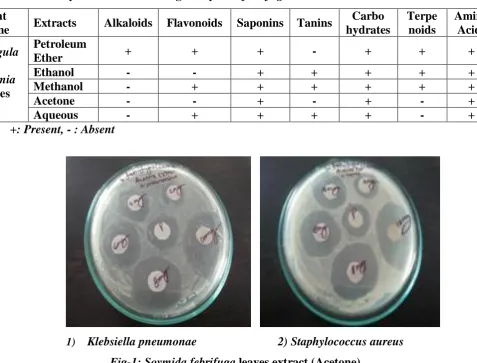
The antibacterial activity of Soymida febrifuga leaves extracts with different concentrations against all test bacterial strains exhibits that the Acetone leaves extract shows greatest effect on Klebsiella pneumonae (38 mm) at 10 mg/disc followed by Staphylococcus aureus (36 mm) fig-1(1,2), Shigella flexinari and Eschrichia coli (28mm), salmonella typhii (26mm) but Pseudomonas aureginosa (16mm) shows moderate activity, Table-2.
The methanol leaves extract also displayed maximum inhibitory growth against pseudomonas aureginosa (37 mm) followed by Klebsiellaa pneumonae (33 mm) fig-2(1,2), Staphylococcus
aureus (30 mm), Salmonella typhii and Escherchia coli (27 mm) and Shigella flexinari (20 mm) at its higher concentrations i.e 10 mg/disc
The distilled water extract also shows marked inhibition at it‟s higher concentration against the bacterial strains like pseudomonas aureginosa (35 mm), Escherchia coli (32 mm), Staphylococcus aureus and Shigella flexinari (30mm) Klebsiella pneumonae (21 mm) and Salmonella typhii (20 mm).
The Ethanol and Petroleum ether extract also shows good antibacterial activity against S.aureus (32mm) and E.coli (31mm) respectively at higher concentrations where as it shows
less activity against S.aureus (30mm), K.pheunomonae (23mm), P.aureginosa (22mm), Sh.flexinari (21mm). But it shows very less activity against S.typhi (18 mm).
Table: 1 Antibacterial assay of Soymida febrifuga leaves
Plants Solvents Conc.
Mg/disc
Pathogens ( zone of inhibition in mm)
E.coli S.typhii K.pneumoniae P.aeruginosa S.aureus Sh.flexinari
Soymida febrifuga
(leaves)
Petroleum Ether
2 16 - - - 17 -
4 20 - - - 21 -
6 21 - 15 16 23 16
8 28 16 19 19 25 19
10 31 18 23 22 30 21
Ethanol
2 - - - - 15 -
4 - - - - 19 -
6 16 15 - - 25 -
www.wjpr.net Vol 4, Issue 05, 2015.
1734 Table 2: Phytochemical screening of Soymida febrifuga leaves
Plant
Name Extracts Alkaloids Flavonoids Saponins Tanins
Carbo hydrates
Terpe noids
Amino Acids
Pergula ria daemia
leaves
Petroleum
Ether + + + - + + +
Ethanol - - + + + + +
Methanol - + + + + + +
Acetone - - + - + - +
Aqueous - + + + + - +
+: Present, - : Absent
[image:6.595.62.540.342.705.2]
1) Klebsiella pneumonae 2) Staphylococcusaureus
Fig-1: Soymida febrifuga leaves extract (Acetone)
10 23 25 20 20 32 20
Methanol
2 - 14 - 15 18 -
4 17 22 - 21 20 -
6 22 23 16 23 22 -
8 23 25 25 33 27 19
10 27 27 33 37 30 20
Acetone
2 - - 16 - 19 17
4 16 15 22 - 26 20
6 19 19 26 - 28 24
8 22 23 30 14 30 25
10 28 26 38 16 36 28
Aqueous
2 - - - 17 15 -
4 14 - - 18 16 16
6 20 - 18 20 25 24
8 23 17 20 30 27 25
10 32 20 21 35 30 30
www.wjpr.net Vol 4, Issue 05, 2015.
1735
1) Pseudomonas aureginosa 2) Klebsiella pneumonae
Fig-2: Soymida febrifuga leaves extract (Methanol)
DISCUSSION
The plant Soymida febrifuga is a medicinal plant which has been in use for a long period of time for the treatment of bacterial infections. The present study was undertaken to determine the phytochemical and antibacterial activity of leaves of Soymida febrifuga. The Acetone and Methanol extracts shows much inhibition against all test bacterial strains in comparison with the reference antibiotic Amoxicillin. Among the extracts Acetone extract shows significant inhibitory activity against all test organisms (Table-2). Plant based antibacterial activity have enormous therapeutic potential as they can serve the purpose with lesser side effects that are often associated with synthetic antibacterial.[16] The results of preliminary phytochemical screening of Soymida febrifuga shows the presence of different plant metabolites like
Alkaloids, Flavonoids, Saponins, Tannins, Terpeniods, Carbohydrates and Amino acids. Erlier study of Sato et al; 1950 and Liu et al; 2001 states that the secondary metabolites (phytochemicals ) bear antibacterial properties, the phytochemical crude extract along with antibiotics may enhance the inhibitory activity against the micro organisms.[17,18]
Several studies have been carried out to understand the potential bioactivity of plants, Deba et al; 2008 states that antioxidant and antimicrobial properties of various plant extracts are of
great interest in research in food industry because of their use as natural additives emerged
from growing tendency to replace synthetic antioxidant and antimicrobials with natural ones.[19]
www.wjpr.net Vol 4, Issue 05, 2015.
1736 The primary benefits of using plant based medicines are comparatively safer than synthetic alternatives, as pure chemicals have non target adverse effects on health, whereas phytochemicals have instances of traditional uses as ethnic medicines.
CONCLUSION
From the overall results it can be concluded that the Acetone and methanol extract of Soymida febrifuga leaves have excellent antibacterial activity against Klebsiella pneumone
and Pseudomonas aureginosa. So the plant studied here can be seen as a potential source of new useful drugs. The phytochemical characterisation of the extracts for the identification of effective bioactive compounds and quality standards are necessary for further study.
ACKNOWLEDGEMENTS
Authors are thankful to Dr. P. L. More, Principal, Dnynopasak College, Parbhani and also thankful to Dr. Ashok Bhonsale, Department of Micro biology, Veterinary College, Udgir for their constant inspiration and providing necessary facilities.
REFERENCES
1. Kumar A, Saluja A AK, Shah UD, Mayavanshi AV (Pharmacological potential of
Albizzia Alebbec: A review), Pharmacog Rev, 2007; 1:171-174.
2. Ivanova D; Gerova D, Chervenkov T and Yankova T, (Polyphenols and antioxidant
capacity of Bulgarian medicinal plants). J. Ethnopharmacol, 2005; 96:145-150.
3. Mandal V, Mohan Y and Hemalatha S, (Microwave assisted extraction-an innovative and
promising extraction tool for medicinal plant research). Pharmcog Rev, 2007; 1: 7-18. 4. Jana S and Shekhawat GS, (Phytochemical analysis and antibacterial screening of in vivo
and in vitro extracts of Indian medicinal herb: Anethum graveolens), Res. J. Med. Plant, 2010; 4: 206-212.
5. Cowan MM, (Plant products as antimicrobial agents). Clin. Microbiology Rev, 1999; 12: 564-582.
6. Zakir Ullah, Ali Rehman, Najeeb Ullah, Shakeel Ahemed Khan, Shahid Ullah Khan and
Ijaz Ahemed, (Antibacterial study of Phyla nodiflora Linn. “Journal of Chemical and Pharmaceutical Research), 2013; 5: 86-90.
7. Kishore K, Chiruvella, Arifullah M, Gayathri D, Rama gopal G, Raghavan C
www.wjpr.net Vol 4, Issue 05, 2015.
1737 8. Kirtikar KR, Basu BD and An I.C.S. “Indian Medicinal Plants”; 2nd edition; edited, revised, enlarged and mostly rewritten by E. Blatter, J. F. Calus and K. S. Mhaskar, Bishen Singh; Dehradun, India 1984; 1:559-560.
9. Nadkarni KM, “Dr. K. M. Nadarni‟s Materia Medica”; revised and enlarged by Nadkarni AK; Bombay Popular Prakashan, 1976; 1161.
10. “The wealth of India” (Raw materials); Publication and Information Directorate CSIR;
New Delhi; Vol. IX-Rh-SO, 1988; 471-472.
11. Ambaye RY, Indap MA, Panse TB (Identification of methyl angolensate in the bark of Soymida febrifuga (Roxb) A. Juss). Cur Sci, 1971; 40: 158-159.
12. Cragg GM and David JN, (Natural product drug discovery in the next millennium) Pharm. Biol., 2001; 39: 8-17.
13. Harbone JB Phytochemical Methods, (Chappnan and Hall Ltd. Londan), 49-188.
14. Trease GE and Evans WC Pharmacognocy 13th edition (Balliere Tindall, London), 1989; 176-180.
15. Kirby MM, Baur AW, Sherris JC, Tuurck M (Antibiotic susceptibility testing by a
standardized single disc method) Journal of clinical pathology, 1996; 45: 493-496.
16. Lutterodt GD, Ismail A, Basheer RH, Baharudin HM, (Antimicrobial effects of Psidium
guajava extracts as one mechanism of its antidiarrhoeal action) “Malaysian J Med Sci” 1999; (6): 17-20.
17. Sato M, Tsuchiya H, Miyazaki T, Ohyama M, Tanaka T and Linuma M, (Antibacterial
activity of flavonostilbens against methicillin-resistant Staphylococcus aureus. Lett). App. Microbiol., 1995; 21: 219-222.
18. Liu IX, Durham DG and Richards ME, (Vancomycin resistance reversal in Enterococci
by flavonoids). J. Pharm. Pharmacol., 2001; 53: 129-132.
19. Deba, F, Xuan TD, Yasuda M, and Tawatu S, (Chemical composition and antioxidant, antibacterial and antifungal activities of the essential oils from Bidens pilosa Linn). Var. Radiata. Food Control, 2008; 19: 346-352.
20. Baravalia Y, Kaneria M, Vaghasiya Y, Parekh J and Chanda S, (Evaluation of antioxidant