
warwick.ac.uk/lib-publications
Original citation:
Hofman, Piotr , Lasota, Slawomir , Lazic, Ranko, Leroux, Jerome , Schmitz, Sylvain and Totzke,
Patrick (2016) Coverability trees for petri nets with unordered data. In: 19th International
Conference on Foundations of Software Science and Computation Structures (FoSSaCS),
Eindhoven, The Netherlands, 2-8 Apr 2016. Published in: Lecture Notes in Computer Science,
9634 pp. 445-461.
Permanent WRAP URL:
http://wrap.warwick.ac.uk/75834
Copyright and reuse:
The Warwick Research Archive Portal (WRAP) makes this work by researchers of the
University of Warwick available open access under the following conditions. Copyright ©
and all moral rights to the version of the paper presented here belong to the individual
author(s) and/or other copyright owners. To the extent reasonable and practicable the
material made available in WRAP has been checked for eligibility before being made
available.
Copies of full items can be used for personal research or study, educational, or not-for profit
purposes without prior permission or charge. Provided that the authors, title and full
bibliographic details are credited, a hyperlink and/or URL is given for the original metadata
page and the content is not changed in any way.
Publisher’s statement:
“The final publication is available at Springer via
http://dx.doi.org/10.1007/978-3-662-49630-5_26
."
A note on versions:
The version presented here may differ from the published version or, version of record, if
you wish to cite this item you are advised to consult the publisher’s version. Please see the
‘permanent WRAP url’ above for details on accessing the published version and note that
access may require a subscription.
for Petri Nets with Unordered Data
Piotr Hofman1,i, S lawomir Lasota2,ii, Ranko Lazi´c3,iii, J´erˆome Leroux4,
Sylvain Schmitz1,iv, and Patrick Totzke3,iii
1 LSV, ENS Cachan & CNRS, Universit´e Paris-Saclay, France 2
University of Warsaw, Poland
3 DIMAP, Department of Computer Science, University of Warwick, UK 4
LaBRI, CNRS, France
Abstract. We study an extension of classical Petri nets where tokens carry values from a countable data domain, that can be tested for equal-ity upon firing transitions. These Unordered Data Petri Nets (UDPN) are well-structured and therefore allow generic decision procedures for several verification problems including coverability and boundedness. We show how to construct a finite representation of the coverability set in terms of its ideal decomposition. This not only provides an alternative method to decide coverability and boundedness, but is also an impor-tant step towards deciding the reachability problem. This also allows to answer more precise questions about the reachability set, for instance whether there is a bound on the number of tokens on a given place (place boundedness), or if such a bound exists for the number of different data values carried by tokens (place width boundedness).
We provide matchingHyper-Ackermannbounds on the size of cover-ability trees and on the running time of the induced decision procedures.
1
Introduction
Unordered data Petri nets (UDPN [15]) extend Petri nets by decorating tokens
with data values taken from some countable data domainD. These values act as
pure names: they can only be compared for equality or non-equality upon firing transitions. Such systems can model for instance distributed protocols where process identities need to be taken into account [21]. UDPNs also coincide with the natural generalisation of Petri nets in the framework of sets with atoms [3]. In spite of their high expressiveness, UDPNs fit in the large family of Petri net extensions among thewell-structuredones [1, 7]. As such, they still enjoy decision
i
Partially funded by the Polish National Science Centre grant 2013/09/B/ST6/01575 and by Labex Digicosme, Universit´e Paris-Saclay, project VERICONISS.
ii
Partially funded by the Polish National Science Centre grant 2012/07/B/ST6/01497.
iii Partially supported by the EPSRC grant EP/M011801/1. ivPartially supported by the ANR grant ANR-14-CE28-0005
ordered data Petri nets [15]
Fωωω-complete [11]
decidable coverability and termination
ordered data nets [15]
Fωωω-complete [11]
ν-Petri nets [21]
Fω≤?≤Fωω
unordered data nets [15]
Fωω-complete [20]
affine nets [10]
Fω-complete [26, 6]
unordered data Petri nets [15]
F3≤?≤Fωω
Petri nets
ExpSpace-complete [17, 19]
+whole-place
+order
+order
+fresh
+whole-place
+data
+data +whole-place
decidable
[image:3.595.139.481.112.283.2]place boundedness
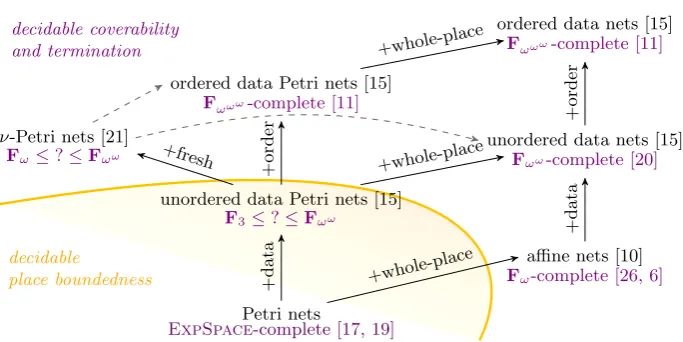
Fig. 1.A short taxonomy of some well-structured extensions of Petri nets. Complexities in violet refer to the coverability and termination problems, and can be taken as proxies for expressiveness; the exact complexities of coverability and termination inν-Petri nets and UDPNs are unknown at the moment. Place boundedness is decidable below the yellow line and undecidable above. As indicated by the dashed arrows, freshness can be enforced using a dense linear order or whole-place operations.
procedures for several verification problems, prominently safety (through the
coverability problem) and termination.
Unordered data Petri nets have an interesting position in the taxonomy of well-structured Petri net extensions (see Fig. 1). Indeed, all their extensions forgo
the decidability of the reachability problem (whether a target configuration is
reachable) and of theplace boundednessproblem (whether the number of tokens
in a given place can be bounded along all runs): this is the case of ν-Petri
nets [21] that allow to create fresh data values, of ordered data Petri nets [15]
that posit a dense linear ordering onD, and ofunordered data nets[15] that allow
to perform ‘whole-place’ operations, which move and/or duplicate all the tokens from a place to another. By contrast, it is currently open whether reachability is decidable in UDPNs, and a consequence of our results in this paper is that place boundedness is decidable—which is a significant first step if we wish to adapt to UDPNs some of the known algorithms for reachability in Petri nets [18, 13].
Contributions. In this paper, we show how to construct finitecoverability trees
for UDPNs, adapting the existing construction of Karp and Miller [12] for Petri nets. Such trees are constructed forward from an initial configuration like
reach-ability trees, but approximate the latter byaccelerating sequences of transitions
and explicitly manipulating limits of reachable configurations as downwards-closed sets (see Sec. 4.1). We rely for all this on a general theory for
represent-ing downwards-closed sets as finite unions of ideals developed by Finkel and
Coverability trees contain a wealth of information about the system at hand, and allow to answer various coverability and boundedness questions—allowing us to derive a new result: the place boundedness problem is decidable for UDPNs, and so are its variants, like place width- and place depth boundedness (see Sec. 2). We also establish in Sec. 5 matching ‘hyper-Ackermannian’ lower and
upper bounds on the size of UDPNs coverability trees. This yields Fωω upper
bounds for the already mentioned decidable problems in UDPNs, in terms of
the fast-growing complexity classes (Fα)α from [23]. These complexity results
rely largely on the work of Rosa-Velardo [20] on the complexity of coverability in unordered data nets. Due to space constraints, most proof details are omitted
but can be found online in the full version of the paper available from https:
//hal.inria.fr/hal-01252674.
Related Work. A coverability tree construction has already been undertaken by
Rosa-Velardo, Martos-Salgado, and de Frutos-Escrig [22] in the case ofν-Petri
nets, and inescapably there are many similarities between their work and ours. Our construction does however not merely remove freshness constraints from theirs: (1) we start anew and rely on a strong invariant on the form of ideals in UDPN coverability trees, which leads to significant simplifications but would be markedly difficult to extract from Rosa-Velardo et al.’s construction, and (2) coverability trees are not necessarily finite forν-Petri nets (place boundedness is indeed undecidable [21]), which means that our termination argument and complexity bounds are entirely new considerations.
Like Rosa-Velardo et al. [22] we rely on the work of Finkel and Larrecq [9] on forward analysis of well-structured systems. Finkel and Goubault-Larrecq provide in particular an abstract generic procedure, but without guar-antee of termination in general, and their framework needs to be instantiated for each specific class of systems.
2
Model
Our presentation of unordered data Petri nets differs from the original one [15] on
two counts: we work with an equivalent formalism with more of avector addition
system[12] flavour, and because we need to work with ideals we define the syntax and the semantics on extended configurations, which allow for infinitely many different data values and infinite counts.
LetZandNdenote the sets of integers and non-negative integers respectively,
and complete them asZω
def
=Z] {ω}andNω
def
=N] {ω}with a new top element
ω with ω > zandz+ω=ω+z=ω for all zin Z. Given a dimension kin N,
we denote the projection into theith component of a vectorv∈Zk
ω byv[i] and
define the product ordering and sum overZk
ωcomponentwise:u≤vifu[i]≤v[i]
for all 1≤i≤k, and (u+v)[i] def= u[i] +v[i] for all 1≤i≤k. We write0for the vector with 0 on all components.
and summed pointwise: f ≤g if f(d) ≤g(d) for all d in D, and (f+g)(d)def=
f(d) +g(d) for alldin D. As usual we writef < g iff ≤gand f(d)< g(d) for
some din D. For a subsetK ⊆ {1, . . . , k} we writefK for the projection off
into components inK: for alldinD,fK(d)
def
= (f(d))K. Thesupportof a data
vectorf isSupp0(f)
def
={d∈D|f(d)6=0};f isfinitely supported ifSupp0(f) is
finite. We say that a data vector f isnon-negative iff(d) belongs toNkω for all
dinD. It isfinite iff(d) belongs toZk for alldand it is finitely supported.
We call bijectionsσ:D→D(data) permutations and writef σ for the
com-position of a permutationσand a data vectorf. If two data vectorsf, gsatisfy
f = gσ for some permutation σ, we say f and g are equalup to permutation
and writef ≡g.
In the sequel we will consider sets of data vectors that are finite up to
per-mutation: a setX of data vectors is finite up to permutation if there is a finite
subset X0 of X such that every f ∈ X is equal up to permutation to some
f0∈X0. Note that ifX is closed under permutations thenX0can be used as its finite presentation; any such finite setX0 we callrepresentative ofX.
Definition 2.1 (UDPN).An unordered data Petri net(UDPN) is a finite set T of finite data vectors. Atransitionis a data vectortdef=f σ, wheref ∈ T andσ
is a data permutation. There is a stepf −→t gbetween non-negative data vectors
f, gifg=f+tfor some transitiont. Note that this enforces thatf(d) +t(d)≥0
for alldinDsinceg is non-negative. We simply writef →− g iff −→t g for some transitiont and let−→∗ denote the transitive and reflexive closure of−→.
A configuration is a finite non-negative data vector f, i.e. f(d) belongs to
Nk for all d in D, and f(d) = 0 for almost all d in D. We write Confs for the set of configurations and note that Confs is closed under UDPN steps. The
reachability set from a given vectorf is defined as
Reach(f)=def{g∈Confs|f −→∗ g}. (1)
Observe that UDPNs over any domain with cardinality|D|= 1 are classical
vector addition systems [12]. Notice also that, the set of transitions in an UDPN
is finite up to permutations of D and that the step relation is closed under
permutations: For every non-negative data vectorf, transitiontand permutation
σwe have that
f −→t g impliesf σ −→tσ gσ. (2)
Example 2.2. For the domainDdef=Nandkdef= 2, consider a 2-dimensional UDPN
T ={t1, t2}, with vectorst1, t2 defined as t1: 07→(1,0) andt1:n7→(0,0) for
alln >0, andt2: 07→(−1,−1),t2: 17→(1,1) andt2:n7→(0,0) for alln >1. The configuration f0 with f0 : 0 7→ (1,1) and f0 : n 7→ (0,0) for n > 0, has infinitely manyt1-successors. Namely,gi
def
p1 p2
t1
x t2
x x
[image:6.595.226.392.118.159.2]y y
Fig. 2.A place/transition representation of the UDPN of Ex. 2.2 in the style of [21, 11]. Different data values are depicted though differently coloured tokens in places (the circles), and through differently named variables in transitions (the boxes and arrows).
σi that swaps 0 and i ∈D. However, there are only two such successors up to
permutation becausegi≡gj for alli, j >0. The reachability set off0is
Reach(f0) =
g
∃d1, d2, . . . , dm∈D∃n1, n2, . . . , nm∈N
g(d1) = (n1,1) and∀1< i≤m, g(di) = (ni,0), ∀d∈D\ {d1, d2, . . . , dm}g(d) = (0,0)
. (3)
In the sequel, we present UDPNs only up to permutation in matrix form by juxtaposing the vectors from their finite supports: we writet1 def= 1
0
, t2def=
−1 1
−1 1
and f0 def= 1 1
. The t1-successors of f0 are g0 = 2
1
and gi =
1 1 + 1 0
=1 1
1 0
for i6= 0. The latter is depicted in Fig. 2 in the style of coloured place/transition nets. The reachability set of f0 can be written asReach(f0) =
n0n1··· nm
1 0 ··· 0
|m≥0, n0, . . . , nm≥1 .
Embeddings. We say that a data vectorf embeds into a data vectorgand write
f v g (resp. f @ g) if there exists an injection π:D → D such that f ≤ gπ
(resp. f < gπ). The injection π itself is called anembedding (of f into g) and a permutation embedding in case it is bijective. Given a set of configurationsC, itsdownward-closure ↓C is{f ∈Confs | ∃g∈C . f v g}, and as usual a setC
isdownwards-closed if↓C=C.
Finitely supported data vectors are isomorphic to finite multisets of
vec-tors in Zkω when working up to data permutation. Moreover, on permutation
classes of finitely supported data vectors, the embedding ordering coincides with the usual embedding ordering over finite multisets of vectors; in consequence, UDPN configurations are well-quasi-ordered by the embedding ordering. Thus an UDPN defines a quasi-ordered transition system (Confs,−→,v), which
satis-fies a (strong)compatibilitycondition as shown in the following lemma. Together
with the fact that (Confs,v) is a wqo, this entails that it is a well-structured
transition system in the sense of [1, 7].
Lemma 2.3 (Strong Strict Compatibility). Let f, f0, g be configurations. If f v f0 (resp. f @ f0) and f −→ g, then there exists a configuration g0 with
f0−→g0 andgvg0 (resp.g@g0).
Proof. Consider a finite data vector t such that f −→t g, and a permutation
π of D such that f ≤ f0π (recall that, when working with finitely supported
g0 def= f0+tπ−1 satisfies f0 tπ−1
−−−→g0 andg ≤g0π. Indeed, for alld in D, noting
edef=π(d),
g(d) =f(d) +t(d)≤f0(π(d)) +t(d) =f0(e) +t(π−1(e)) =g0(e) =g0(π(d)).
Furthermore, assuming f < f0π, for at least onedin Dthe above inequality is
strict.
Decision Problems. For the purpose of verification, we are interested in standard
decision problems for UDPN, includingreachability (doesf −→∗ ghold for given
configurationsfandg?),coverability(given configurationsf, g, does there exists
g0wgs.t.f −→∗ g0?), andboundedness (isReach(f) finite up to permutation?).
While the decidability of reachability remains open, well-structuredness of UDPN (and some basic effectiveness assumptions) implies that the coverability and boundedness problems are decidable using the generic algorithms from [1, 7]. In fact, decidability holds more generally for ordered data Petri nets [15, Thm. 4.1]. For the coverability problem, Rosa-Velardo [20, Thm. 1] proved an HyperAckermann upper bound (Fωω in the hierarchy from [23]; see Sec. 5),
while Lazi´c et al. [15, Thm. 5.2] proved aTowerlower bound (F3in the same
hierarchy). The complexity of the boundedness problem has not been studied before. Furthermore, the following, more precise variant of boundedness called
place boundedness was not known to be decidable:
Input: An UDPN, a configurationf, and a set of coordinatesK⊆ {1, . . . , k}.
Question: Is{gK |g∈Reach(f)} finite up to permutation?
In the presence of an infinite data domainD, place boundedness can be
fur-ther refined: even if infinitely many configurations are reachable, the system can still be bounded in the sense that there exists a bound on the number of different data values in reachable configurations; Rosa-Velardo and de Frutos-Escrig [21] call thisbounded width. Similarly, there may exist some bound on the multiplici-ties with which any data value occurs, while the number of different data values
is unbounded; Rosa-Velardo and de Frutos-Escrig [21] call thisbounded depth.
We formalise the resulting decision problems in our notation as follows. The
place width boundedness problem is given as:
Input: An UDPN, a configurationf, and a set of coordinatesK⊆ {1, . . . , k}.
Question: Is{|Supp0(gK)| |g∈Reach(f)} finite?
Theplace depth boundedness problem is the following:
Input: An UDPN, a configurationf, and a set of coordinatesK⊆ {1, . . . , k}.
Question: Is{gK(d)|g∈Reach(f), d∈D} finite?
If the answer to the depth (width) boundedness problem is positive we call those
Example 2.4. From the initial configurationf0 =1 1
, the UDPN from Ex. 2.2
can reach any configuration of the formn
1
innmanyt1-steps, all exercised on
the same data value. Similarly, any configuration of the form 1 1··· 1
1 0··· 0
with a
support of size n+ 1 can be reached after a sequence of ntransitions t1, each
exercised on a different data value. Consequently, the first component is neither depth nor width bounded.
However, any reachable configurationgwill satisfyP
d∈Dg(d)[2] = 1. In Petri
net parlance, there is always exactly one token in the second place. The system is thus place bounded forKdef={2}.
The main contribution of this paper is the effective computability of a suitable abstraction of the classical coverability tree construction [12] for UDPNs. This provides a way to decide all variants of the boundedness problem mentioned above. We summarise the consequences of our construction below.
Theorem 2.5. In UDPNs, place depth boundedness implies place width bounded-ness. In consequence, place depth boundedness coincides with place boundedbounded-ness.
Theorem 2.6. The boundedness, place boundedness, and place width bounded-ness problems for UDPNs are in Fωω, i.e. in HyperAckermann.
Let us emphasise the importance of decidability of place boundedness: first, the problem is undecidable in all the extensions of UDPNs in Fig. 1. Moreover, in the case of Petri nets, the decidability of place boundedness plays a crucial role in the decidability proofs for reachability [18, 13, 14, 16], hence Thm. 2.6 provides one of the basic building blocks for future attempts at proving the decidability of reachability for UDPNs.
3
Simple Ideals
A key observation about all decision problems mentioned in the previous section is that they do not require computing the reachability set: they can all be solved
given some suitable representation of thecover [9], defined as
Cover(f)def=↓Reach(f), (4)
forf the initial configuration. Indeed, coverability reduces to checking whether
g∈Cover(f), boundedness to checking whetherCover(f) is finite up to permu-tation ofD, and place boundedness to checking whether{gK |g ∈Cover(f)}
is finite up to permutation of D. The main property of the coverability tree we
construct in Sec. 4 is that we can extract a suitable representation ofCover(f).
Ideals and Clovers. We refer the reader to the work of Finkel and Goubault-Larrecq [8, 9] for details; it suffices to say that downwards-closed sets of con-figurations can be represented as finite unions of so-called configuration ideals.
set of configurations; this last condition means that, iff andf0are configurations
in J, then there exists h in J with f v h and f0 v h. Crucially for
algorith-mic considerations, a configuration ideal J can in turn be represented as the
downward-closure
J =↓gdef={h∈Confs |hvg} (5)
of a non-negative data vector g having a finite range: g(D) is a finite subset
of Nk
ω. We can check that every such↓g is a configuration ideal (see [8, 9] for
the converse): it is non-empty and downwards-closed by definition, and we can check it is also directed. Indeed, iff,f0are configurations andπ,π0are injections
with f ≤ gπ and f0 ≤ gπ0, then since f and f0 are finitely supported we can
assumeπ and π0 to be permutations, and we can define a configurationh≤g
such that f ≤ hπ and f0 ≤ hπ0: set h as the pointwise least upper bound
h(d)[i]def= max(f(π−1(d))[i], f0(π0−1
(d))[i])≤g(d)[i] for alldand 1≤i≤k.
Cover(f), being downwards-closed, is represented by a finite set of represen-tations of configuration ideals, calledClover(f) by Finkel and Goubault-Larrecq:
Cover(f) =[{↓g|g∈Clover(f)}.
Clover(f) is determined uniquely up to permutation, and containsv-maximal data vectors g satisfying ↓g ⊆ Cover(f); for further details see [8, 9]. In the following we identify a configuration idealJ =↓g with its representationg.
Remark 3.1 (Ideals for Petri nets). For readers familiar with Karp and Miller’s coverability trees for Petri nets, observe that configuration ideal representations
generalise the notion of ‘extended markings’, which are vectors in Nk
ω. Also, Clover(f) for a Petri net can be computed as the set of vertex labels in its coverability tree—this will also be our case.
Simple Ideals. Crucially, it turns out that we do not need general configura-tion ideals for our coverability trees for UDPNs. We only need to consider the downward-closures↓gof non-negative vectorsg(cf. (5)), where the set of vectors appearing infinitely often asg(d), whend ranges overD, is a singleton {I} for some vectorI in{0, ω}k (instead of a finite subset of
Nkωfor general
configura-tion ideals). Put differently, given such a vector I, we define the I-support of
a data vector f as SuppI(f) def
= {d ∈ D | f(d) 6= I}, and define an I-simple ideal (representation) as a non-negative data vector with finite I-support. In
particular, a finitely supported non-negative data vector is a0-simple ideal. We
write M, N, . . . to denote simple ideals. A simple ideal M can be represented
concretely as a pairM =hm,Iiwherem is the finite multiset of vectors inNk ω
obtained fromM by restriction to itsI-support.
Example 3.2. We represent simple ideals similarly as configurations, using the
additional last column for theIpart. Continuing with the UDPN of Ex. 2.2, its
cover is the downward-closure of a single I-simple ideal:
Clover(f0) =ω
1
ω0
, Cover(f0) =↓ω
1
ω0
,
Note that UDPN steps mapI-simple ideals to I-simple ideals. Lemma 3.3 formally states the relation between steps of ideals and steps of configurations
in the downward closures. The next lemma shows thatI-simple ideals can only
have finitely many successors up to permutation. This property will later be used to define coverability trees of finite branching degree.
Lemma 3.3. Let M, M0 be I-simple ideals such that M −→M0. Then for every configuration c0 ∈ ↓M0 there exist configurations c ∈ ↓M and c00 ∈ ↓M0 with
c−→c00 andc0vc00.
Proof. SupposeM −→t M0 for a finite data vector t. The data vectorf def=c0−t
satisfiesf ≤Mbutf(d) can possibly be negative for some data valued; therefore we can not simply putcdef=f. A way to fix this is to definec by
c(d)[i]def= max(0, x(d)[i]), for alld∈Dand all coordinatesi.
Thus defined, c satisfies c ≤ M, and setting c00 def= c+t satisfies c0 ≤ c00 as required.
Lemma 3.4. Let M be a simple ideal. The set {N |M −→N} of successors of
M is finite up to permutation and has a representative with cardinality bounded by (|SuppI(M)|+ maxt∈T |Supp0(t)|)!· |T |2.
Proof. Consider an UDPN defined by the finite setT of data vectors. Fix anI
-simple idealM, and denote byStheI-support ofM. We will be now considering
S-permutations, by which we mean those data permutationsπthat satisfyπ(d) =
d for all d ∈ S. Equality and finiteness up to S-permutation can be defined
exactly as for plain permutations.
A crucial but simple observation is that the set of transitions of the UDPN
is finite up to S-permutation. Indeed, assume wlog. that S is disjoint from the
supports of all vectors in T. Consider the finite set T0 that contains all data
vectorstσ, wheret∈ T and permutationσ swaps some subset ofS with some
subset of the support of t. Then every transition of the UDPN is of the form
t0π, where t0 ∈ T0 and π is an S-permutation. Regarding the size of this new
UDPN, there are at mostP
t∈T(|S|+|Supp0(t)|)! such permutations σ, hence |T0| ≤P
t∈T(|S|+|Supp0(t)|)!· |T |.
Now we use the extension, to simple ideals, of the closure of the step relation under permutations, cf. Eq. (2), to derive a strengthening of our claim, namely
finiteness of the successors of M up to S-permutations. Consider an arbitrary
stepM t
0π
−−→N ofM; by Eq. (2) we get
M =M π−1 t
0
−→N π−1
(the equality holds as π is an S-permutation). Therefore N is equal up to S
A consequence of our construction of coverability trees in Sec. 4, and of the complexity analysis conducted in Sec. 5, is the following core result:
Theorem 3.5. Given an UDPN and an initial configuration f, an ideal repre-sentation Clover(f)of Cover(f)is computable inFωω. Furthermore, Clover(f)
contains only simple ideals.
Theorem 3.5, together with the following proposition, easily imply Theo-rems 2.5 and 2.6 (belowClover(f)K
def
={gK|g∈Clover(f)}):
Proposition 3.6. FixK⊆ {1, . . . , k}. An UDPN is width-bounded iff Clover(f)K contains only finitely supported vectors. An UDPN is depth-bounded iff Clover(f)K contains only finite vectors.
Proof. The former equivalence, as well as the if direction of the latter one, follow by finiteness ofClover(f)K. It remains to argue that place depth-boundedness
forcesClover(f)Kto contain only finite vectors. Indeed, a non-finite simple ideal
has necessarilyω at some component, which implies depth-unboundedness.
The remaining part of the paper is devoted to the proof of Thm. 3.5. In Sec. 4, we present an algorithmic construction of the coverability tree, and show its termination and correctness. Then in Sec. 5 we provide upper and lower bounds on the size of the coverability tree.
4
Representing a Cover
We will show that, analogously to the classical construction of Karp and Miller [12] for vector addition systems, the cover set of any UDPN configuration can be
ef-fectively represented in the form of a finite coverability tree, where nodes are
labelled by simple ideals.
For a given initial ideal the construction of a coverability tree amounts to
iteratively computing successors (up to permutation), applying symbolic
accel-erationsteps when a strictly dominating pairM @M0appears on a branch, and terminating a branch if a label embeds into one of its ancestors.
4.1 Accelerations
The idea behind acceleration steps is that due to monotonicity (Lem. 2.3), any finite sequence of steps
M0 t1
−→M1 t2
−→. . . tk
−→Mk (6)
such thatM0 @Mk can be extended indefinitely. Such an unfolding may have
two distinct kinds of effect: Firstly, it may unboundedly increase components in
data values already contained in the initial I-support (we call this effectdepth
acceleration). Secondly, it may increase an unbounded number of ‘fresh’ data values, outside of the initial I-support (we call this effectwidth acceleration). Our construction only accelerates increasing sequences as above when there is a
As a building block we shall use the usual vector acceleration: for two non-negative vectors v,v0 ∈ Nkω with v0 ≤ v, define a new vector acc(v0,v), for
1≤i≤kby:
acc(v0,v)[i]def=
(
v[i], ifv0[i] =v[i],
ω, ifv0[i]<v[i].
Definition 4.1 (Depth and Width Acceleration).ForI-simple idealsM0,
M and a permutationπwithM0< M π, or equivalentlyM0π−1< M, the depth
acceleration ofM0, M, π is theI-simple ideal defined by
Mdepth(d)
def
=acc(M0(π−1(d)), M(d)), for all data valuesd∈D.
Ford∈Dsuch thatM0(π−1(d)) =I< M(d), putId def
=acc(M0(π−1(d)), M(d));
the width accelerationof M0, M, π, dis theId-simple ideal defined by
Mwidth(d)
def
=
(
Id, if M(d) =I
M(d), otherwise,
By definition,M < Mdepth, Mwidth.
4.2 Coverability Trees
By Lem. 3.4 we can compute for anyI-simple idealM asuccessor representative,
namely a finite set such that every successor of M is equal up to permutation
to some element of this set.
For the sake of simplicity, we choose a conservative policy of application of accelerations: first, a proper nesting is imposed, in the sense that two different accelerated paths are either disjoint, or contained one in the other; second, a depth-accelerated path can not contain another accelerated path, while a
width-accelerated path can. However, as width accelerations strictly increase the I
part, a width-accelerated path is never contained in another accelerated path. Therefore the only allowed inclusion is when a depth-accelerated path is included in a width-accelerated one.
Definition 4.2 (Coverability Tree). Acoverability tree is a tree with nodes labelled by simple ideals such that the following criteria are satisfied.
1. A node with labelN is a leaf iff it has an ancestor with labelN0wN. 2. Otherwise, suppose an interior node N has an ancestor N0 such that both
N0, N are I-simple and N0 @N. Let P denote the path from N0 to N in the tree, includingN0 andN.
(a) SupposeN0(π−1(d)) =I< N(d)for some permutationπwithN0π < N
andd∈D; and for every node inP that is a depth acceleration of some nodesM0, M, bothM0 andM belong toP. ThenN has exactly one child labelled by the width acceleration ofN0, N, π, d.
(b) Otherwise, if P contains no acceleration then N has exactly one child labelled by the depth acceleration of N0, N, π, for some permutation π
3. Otherwise, if a node N satisfies none of the above criteria then its set of children is the successor representative ofN.
Remark 4.3. Note that Def. 4.2 does not determine the coverability tree
unam-biguously: the choice of a permutationπin points 2(a) and 2(b) is not unique.
Remark 4.4. The condition in point 1 in Def. 4.2 implies that no branch of a coverability tree contains two different nodes with the same label. We identify a node with its label in the sequel.
Example 4.5. We pick some coverability tree for the UDPN from Ex. 2.2 rooted
in the configurationf0. There is a branch with labels (up to permutation)
f0=
1
1
00
, f1=
2
1
00
, f2=
ω
1
00
, f3=
ω1
0 1
00
, f4=
ω1
0 1
ω0
, f5=
ω1 1
0 1 0
ω0
,
wheref2is a depth acceleration (off0, f1),f4 is a width acceleration (off0, f3),
and all other nodes are the result of successor steps from their parent. The node
f5 is a leaf becausef5vf4.
Correctness. A coverability tree is finite (termination), and represents the cover of its root node (completeness and soundness). These required properties are proven in detail in the full paper:
– Finitenessis proven by first exhibiting a wqo for the specific type ofI-simple ideals that appears on coverability trees. This wqo depends on the existence
of permutation embeddings, a property that on its own does not induce
a well-quasi-ordering over the set of all I-simple ideals. Our termination
argument is further refined to derive complexity bounds; see Sec. 5.2.
– Thecompletenessproof relies on the monotonicity of steps over simple ideals, and shows that all the elements inCover(f) are covered by some simple ideal in any coverability tree.
– Soundnessis the most delicate property to establish. Its crux is that neither width nor depth accelerations may take us outside the cover of the initial configuration.
5
Complexity Bounds
In the section, we prove lower and upper bounds on the resources needed by the construction of the coverability tree. We refer the reader to [25, 24] for gentle introductions to the techniques employed to prove these results. The enormous
complexities involved in our construction require to usefast-growing complexity
classes [23], which we present succinctly in Sec. 5.1 and in more details in the full paper, before showing hyper-Ackermannian upper and lower bounds in sec-tions 5.2 and 5.3.
5.1 Fast-Growing Complexity
In order to express the non-elementary functions required for our complexity statements, we shall employ a family of subrecursive functions (hα)αindexed by
Ordinal Terms. We use ordinal termsαinCantor Normal Form (CNF), which can be written as termsα=ωα1+· · ·+ωαnwhereα1≥ · · · ≥α
nare themselves
written in CNF. Using such notations, we can express any ordinal belowε0, the
minimal fixpoint ofx=ωx. The ordinal 0 is obtained whenn= 0; otherwise if
αn= 0 the ordinalαis asuccessor ordinalωα1+· · ·+ωαn−1+ 1, and ifαn >0
the ordinal αis a limit ordinal. We usually writeλto denote limit ordinals.
Fundamental Sequences. For allxin Nand limit ordinalsλ, we use a standard
assignment of fundamental sequences λ(0)< λ(1)<· · ·< λ(x)<· · ·< λ with
supremumλ. Fundamental sequences are defined by transfinite induction by:
(γ+ωβ+1)(x)def=γ+ωβ·(x+ 1), (γ+ωλ0)(x)def=γ+ωλ0(x). (7)
For instance,ω(x) =x+ 1,ω2(x) =ω·(x+ 1),ωω(x) =ωx+1, etc.
The Hardy Hierarchy. Leth:N→Nbe a strictly increasing function. The Hardy
functions (hα:N → N)α are defined by transfinite induction on their ordinal
indices by
h0(x)def=x , hα+1(x)def=hα(h(x)), hλ(x)def=hλ(x)(x). (8)
Observe thathk(x) for a finitekis simply thekth iterate ofh. For limit ordinals
λ,hλ(x) performs a form of diagonalisation: for instance, settingH(x)def
=x+ 1
the successor function, Hω(x) =Hx+1(x) = 2x+ 1,Hω2(x) = 2x+1(x+ 1)−1
is a function of exponential growth, while Hω3 is a non elementary function
akin to a tower of exponentials of height x, Hωω is a non primitive-recursive
function with growth similar to the Ackermann function, and Hωωω is a non
multiply-recursive function characteristic of hyper-Ackermannian complexity.
Complexity Classes. Following [23], we can define complexity classes for compu-tations with time or space resources bounded by Hardy functions of the size of
the input. We concentrate in this paper on theHyperAckermanncomplexity
class. LetFMR denote the set of multiply-recursive functions and lethbe any
multiply-recursive strictly increasing function, then [23, Thm. 4.2]:
HyperAckermanndef=Fωω=
[
m∈FMR
DTime(hω ωω
(m(n))) (9)
is the set of decision problems solvable with resources bounded by an
hyper-Ackermannian function applied to a multiply-recursive functionmof the size of
the input. This class is closed under multiply-recursive reductions, and several problems are known to be complete for it (see Sec. 6.2 of [23] for a survey), including coverability in unordered data nets [20].
5.2 Upper Bounds
We focus on the worst-casenorm of the constructed simple ideals, from which
Norms of Simple Ideals. For a vector u in Zkω, its norm is its maximal
fi-nite absolute value: kvk def
= max{|v[i]| | 1 ≤ i ≤ k∧ v[i] 6= ω}. Observe that, if I is in {0, ω}k, then kIk = 0. For an I-simple ideal M, and thus
for finitely supported ones in particular, we define its norm as the maximum between the cardinality of its support and the maximal norm of its vectors:
kMk def= max{|SuppI(M)|,kM(d)k | d ∈ D}. Note that the vectors for data
d outside the support have all norm 0. In the full paper, we exhibit a bound
B def= hωωk+3(kf0k) on the norms of all the simple ideals constructed in a
cov-erability tree rooted byf0 as defined in Def. 4.2, whereh also depends on the
UDPN:
Theorem 5.1. The norms of the simple ideals in a coverability tree rooted in a configuration f0 for a k-dimensional UDPNT are bounded by hωωk+3(kf0k), whereh(x)is an elementary function of x,k, andkT k.
The main technical ingredients for Thm. 5.1 are combinatorial statements on
the lengths of so-called controlled bad sequences proven by Rosa-Velardo [20,
App. A] for finite multisets of vectors of natural numbers. Our proofs require however a substantial amount of work on top of that of Rosa-Velardo’s for two
reasons: we work with extended vectors inNk
ω, and use permutation embeddings
rather than just plain embeddings.
Relating Norms with Sizes and Complexity. The norm kMk ≤ B of a simple
idealM is directly related to the size of its concrete binary representation: the
latter needs at most kMk ·k·(dlogkMke+ 1) bits for the I supported part of
the ideal and k bits for the I vector itself. We can also bound the length of
the branches in our coverability trees: there are indeed at most (B+ 2)kB·2k
different simple ideals with norm ≤B, and no two interior nodes on a branch
are labelled by the same ideal due to condition 1 in Def. 4.2 (see Rem. 4.4). Finally, by Lem. 3.4, the branching degree of the coverability tree is bounded by an exponential function (B+kT k)!· |T |2 in B and the size of T. These three
observations combined allow to bound the size of the coverability tree:
Theorem 5.2 (Size of Coverability Trees). The size of a coverability tree built from an initial configuration f0 for a k-dimensional UDPN T is bounded
by an elementary function of B,k, and the size of T.
Theorem 5.2 along with Eq. (9) and the completeness and soundness of
cov-erability trees yields the proof of Thm. 3.5, using the fact that Fωω is closed
under elementary reductions [23, Thm. 4.7].
5.3 Lower Bounds
Theorem 5.3 (Hyper-Ackermannian Coverability Trees). There exists families ofO(k)-sized UDPNs(Tk)k andO(k+ logn)-sized initial configurations
(fk,n)k,n, whose coverability trees are of size at leastHω
ωk (n).
Hardy Computations. As detailed in the full paper, we prove Thm. 5.3 by
‘imple-menting’ the computation of Hardy functions Hωωk in nets T
k. The main idea,
first developed in [11, 24], is to see the equations in (8) for 0< α as rewriting rules operating on pairs (α, n):
(α+ 1, n)→(α, n+ 1), (λ, n)→(λ(n), n). (10)
Note that a sequence (α0, n0)→ (α1, n1) → · · · →(αi, ni) → · · · of rewriting
steps maintains Hαi(n
i) =Hα0(n0) for all i, and must eventually terminate at
some rank`withα`= 0 sinceαi> αi+1 for alli, and thenn`=Hα0(n0).
Using a natural representation of ordinals α < ωωk as finite multisets of
vectors also employed by Rosa-Velardo [20], a pair (α, n) can be encoded as a
configuration ofTk, and the rewriting rules of (10) can be implemented on such
codes by steps of Tk. This is however not a perfect implementation: many
in-correct computations yielding results different fromHωωk
(n) =Hωωk−1·(n+1)
(n)
are possible. The crucial point is that there exists aperfect computation inTk,
of length at least Hωωk(n). Furthermore, this computation does not allow any
acceleration step, and has therefore to occur as such in any coverability tree.
6
Concluding Remarks
In this paper, we have presented a procedure to construct coverability trees for UDPNs in the style of Karp and Miller [12]. This yields decision procedures for coverability and several variants of the boundedness problem including place-boundedness, depth- and width place-boundedness. Besides its interest for the formal verification of UDPNs, this paves the way towards future attempts at proving the decidability of reachability along the lines developed for Petri nets in [18, 13, 14, 16].
We have derived hyper-Ackermannian upper bounds on the complexity of our construction, and shown that such enormous complexities are actually attained
on some UDPNs. Note that this however doesnot provide a lower bound
– on the size ofClover(f), for which the best known bound is an Ackermannian
lower bound adapted from the case of Petri nets [4], nor
– on the complexity of the various boundedness problems on UDPNs, for which
the best lower bound is hardness forTower=F3, adapted from the
cover-ability problem [15].
We actually suspect that much lower complexities that HyperAckermann
could be obtained for the coverability and boundedness problems. For instance, in the case of Petri nets, coverability trees have a worst-case Ackermannian
size [4, 6], but coverability, boundedness, and place-boundedness are all
References
1. Abdulla, P.A., ˇCer¯ans, K., Jonsson, B., Tsay, Y.K.: Algorithmic analysis of pro-grams with well quasi-ordered domains. Inform. and Comput. 160(1–2), 109–127 (2000)
2. Blockelet, M., Schmitz, S.: Model-checking coverability graphs of vector addition systems. MFCS 2011. LNCS, vol. 6907, pp. 108–119. Springer (2011)
3. Boja´nczyk, M., Klin, B., Lasota, S.: Automata theory in nominal sets. Logic. Meth. in Comput. Sci. 10(3:4), 1–44 (2014)
4. Cardoza, E., Lipton, R.J., Meyer, A.R.: Exponential space complete problems for Petri nets and commutative semigroups: Preliminary report. STOC’76. pp. 50–54. ACM (1976)
5. Demri, S.: On selective unboundedness of VASS. J. Comput. Syst. Sci. 79(5), 689– 713 (2013)
6. Figueira, D., Figueira, S., Schmitz, S., Schnoebelen, Ph.: Ackermannian and primitive-recursive bounds with Dickson’s Lemma. LICS 2011. pp. 269–278. IEEE Press (2011)
7. Finkel, A., Schnoebelen, Ph.: Well-structured transition systems everywhere! Theor. Comput. Sci. 256(1–2), 63–92 (2001)
8. Finkel, A., Goubault-Larrecq, J.: Forward analysis for WSTS, part I: Completions. STACS 2009. LIPIcs, vol. 3, pp. 433–444. LZI (2009)
9. Finkel, A., Goubault-Larrecq, J.: Forward analysis for WSTS, part II: Complete WSTS. Logic. Meth. in Comput. Sci. 8(3:28), 1–35 (2012)
10. Finkel, A., McKenzie, P., Picaronny, C.: A well-structured framework for analysing Petri net extensions. Inform. and Comput. 195(1–2), 1–29 (2004)
11. Haddad, S., Schmitz, S., Schnoebelen, Ph.: The ordinal recursive complexity of timed-arc Petri nets, data nets, and other enriched nets. LICS 2012. pp. 355–364. IEEE Press (2012)
12. Karp, R.M., Miller, R.E.: Parallel program schemata. J. Comput. Syst. Sci. 3(2), 147–195 (1969)
13. Kosaraju, S.R.: Decidability of reachability in vector addition systems. Proc. STOC’82. pp. 267–281. ACM (1982)
14. Lambert, J.L.: A structure to decide reachability in Petri nets. Theor. Comput. Sci. 99(1), 79–104 (1992)
15. Lazi´c, R., Newcomb, T., Ouaknine, J., Roscoe, A., Worrell, J.: Nets with tokens which carry data. Fund. Inform. 88(3), 251–274 (2008)
16. Leroux, J., Schmitz, S.: Demystifying reachability in vector addition systems. LICS 2015. pp. 56–67. IEEE Press (2015)
17. Lipton, R.: The reachability problem requires exponential space. Tech. Rep. 62, Yale University (1976)
18. Mayr, E.W.: An algorithm for the general Petri net reachability problem. Proc. STOC’81. pp. 238–246. ACM (1981)
19. Rackoff, C.: The covering and boundedness problems for vector addition systems. Theor. Comput. Sci. 6(2), 223–231 (1978)
20. Rosa-Velardo, F.: Ordinal recursive complexity of unordered data nets. Tech. Rep. TR-4-14, Departamento de Sistemas Inform´aticos y Computaci´on, Univer-sidad Complutense de Madrid (2014),http://antares.sip.ucm.es/frosa/docs/ complexityUDN.pdf
22. Rosa-Velardo, F., Martos-Salgado, M., de Frutos-Escrig, D.: Accelerations for the coverability set of Petri nets with names. Fund. Inform. 113(3–4), 313–341 (2011) 23. Schmitz, S.: Complexity hierarchies beyond Elementary. ACM Trans. Comput.
Theory (2016),http://arxiv.org/abs/1312.5686, to appear
24. Schmitz, S., Schnoebelen, Ph.: Algorithmic aspects of WQO theory. Lecture notes (2012),http://cel.archives-ouvertes.fr/cel-00727025
25. Schmitz, S., Schnoebelen, Ph.: The power of well-structured systems. Concur 2013. LNCS, vol. 8052, pp. 5–24. Springer (2013)
![Fig. 2. A place/transition representation of the UDPN of Ex. 2.2 in the style of [21, 11].Different data values are depicted though differently coloured tokens in places (thecircles), and through differently named variables in transitions (the boxes and arrows).](https://thumb-us.123doks.com/thumbv2/123dok_us/9486609.454815/6.595.226.392.118.159/transition-representation-dierent-dierently-thecircles-dierently-variables-transitions.webp)
