A Workflow-Based Failure Recovery in Web Services
Composition
Omid Bushehrian1, Salman Zare2, Navid Keihani Rad1 1
Department of Computer Engineering and IT, Shiraz University of Technology, Shiraz, Iran; 2Department of Computer Engineering and IT, Tehran University, Kish, Iran.
Email: {bushehrian, navid.keihanirad}@sutech.ac.ir, [email protected]
Received November 20th, 2011; revised December 25th, 2011; accepted January 9th, 2012
ABSTRACT
In previous researches in the field of supporting reliability and fault tolerance in web service composition, only low le- vel programming constructs such as exception handling (for example in WSBPEL) were considered. However we be-lieve that the reliability and fault tolerance for composite services must be handled at a higher level of abstraction, i.e. at the workflow level. Therefore a language and technology independent method for fault-tolerant composition of web ser- vices is needed. To do this, a fault tolerant workflow is built in which the execution order of the services is determined such that upon a service failure a recovery process with the lowest cost is started. The cost of a service failure includes the cost of failed service and the total costs of roll-baking the previously executed services which are dependent on the failed service. In this article a FSP language is applied to formally specify the workflow.
Keywords: Fault Tolerance; Service Oriented Architecture; Service Composition; Finite State Process
1. Introduction
Nowadays SOA architecture is used as a platform for accessing to data and services in distributed form. Ser-vice Composition in this architecture is a way to obtain more complicated services by combining the functional-ity of individual services [1,2]. The main problem here is the fault tolerance and recovery of failures while execut-ing a composite service [3,4]. In the situation of usexecut-ing a composite service, different faults may occur that mainly causes a service to fail [5]. However a fault-tolerant ser-vice composition is the one that ends up the whole trans-action in a safe state upon a service failure where the related services are also rolled-back appropriately. Con-sider a service composition in arranging an itinerary. If the “Flight Reservation” service is failed all other com-mitted services such as “Hotel Reservation” should be roll-backed. Therefore in a fault-tolerant service compo-sition each set of related services may form a transaction for which the atomicity property is a must and by failing one of them, others have to be rolled-back. However for some services the roll-back operation may not be avail-able or only availavail-able partially. Therefore failing a ser-vice may cause the whole composition ended up in an inconsistent execution due to the violation of atomicity property. To model this limitation, each service within the composition is associated with a “roll-back cost” which its value is an indicator of the amount of impact on
the whole composition resulted from requesting the “roll- back” operation for that service. If a service supports the roll-back operation, its associated roll-back cost is zero otherwise some value is considered for this cost. For example if the “Flight Reservation” is not a roll-back supporting service, its rollback cost will be equal to the whole ticket price. In addition to the roll-back costs, for each service within the composition it should be deter-mined on which services this service is dependent. The dependency here is the roll-back dependency and is de-fined as follows: Service Sj is dependent on service Si
when failure of Si must start roll-backing of Sj (if already
executed).
these important questions are not addressed. There are many previous works that apply fault tolerance techni- ques at different levels of abstractions to create a fault- tolerant web service composition [6-8]. For example in some languages such as WS-BPEL [1] low level pro-gramming constructs like exception handling is provided to support fault tolerance for service composition. How-ever, we believe that the support for reliability and fault tolerance should be considered at the higher level of ab-straction: the workflow level. In addition to this short-coming, the previous studies poorly addressed the robust recovery management once a failure happens.
In this paper these shortcomings are addressed by pro- posing a method to automatically build a workflow con- sidering the services transactional properties that not only is specified at the high degree of abstraction (and hence language independent) but also supports robust failure re- covery.
2. Related Work
In the field of web services reliability and fault tolerance, the previous researches are divided into four main groups [6]:
1) Improvement of the web service reliability in the architectural definition level;
2) Assessment of the system fault tolerance with error injection;
3) Analysis of properties of the second generation web services;
4) Definition of the reliability assessing models of the web service-based systems.
Articles related to the first category generally have used the old reliability techniques for web services which increase the fault tolerance by using redundant services in the architecture; moreover none of them presented a formal method. In the second category error injections for the fault tolerance support have been used [9,10]. Stu- dies in the third category basically include reliability e- valuation of the second generation web services, i.e. WS- Reliable Messaging [11], WS Security and WS-Atomic Transaction [11]. In the fourth category, web service ba- sed systems generally are created by composing the simp- ler services according to a work-flow. The reliability of the workflow is evaluated considering the individual ser- vices reliability in the workflow. In some researches, the “Markov chain” has been used to model the system be- haviour. The probability that the Markov chain comes to a final state from a start state with some limited state de- pends on the other movements, which means it depends on the reliability of the other states [12]. In [13] to auto- matically compute the overall QoS of a workflow, a ma- thematical model and an algorithm (SWR algorithm) are proposed. To support the composition of Web services,
they also have presented an ontology-based solution in which a discovery mechanism is applied to find Web ser- vices with desired interfaces and operational metrics, and to assist designers in resolving heterogeneity issues among Web services. In [14] to achieve a higher reliability in a composite web service system, it is proposed to decrease the failure rate and increase the repair rate. In this paper a method for calculating the MTTF (Mean Time to Failure) of composite web based on the workflow composition pattern is presented. In [14] a formal verifycation ap-proach of the workflow-based composite web services is presented. And it has been translated to the BPEL4WS primitives. In [8] they have used EXTRA (Exception han-dling + TRAnsaction), a hybrid fault-tolerant mechanism which combines exception handling and transaction tech-niques to improve the reliability of composite services. The first one (exception handling) tries to repair fault and let composite services to continue. The second one (transaction) ensures composite services to terminate in a consistent state when faults are not repairable. They have also presented FACTS framework, which present an integrated environ-ment for specification, verification, and execution of fault tolerant composite services. However, in their work the termination cost of non-cancellable service in a service composition is not taken into account.
3. The Methodology
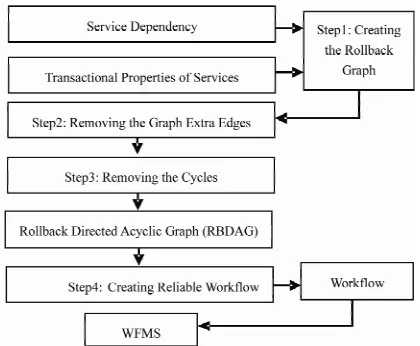
[image:2.595.319.529.544.717.2]Our proposed methodology for creating a fault-tolerant workflow for web service composition is illustrated in
Figure 1. The first step is to create a Rollback graph
considering the service dependencies. Service Sj is
de-pendent on service Si when failure of Si must start roll-
backing of Sj(if already executed). The set of all depen-
dent services on Si is depicted by Rollback [i]. In the Ro-
llback graph each vertex Si represents a service and each
edge (Si, Sj) represents the existence of a rollback rela-
tionship between Si and Sj. The second step is to remove
the useless edges from the Rollback graph to avoid de- fining unnecessary dependencies in the subsequent steps. If there is a path from A to C via other services in the Ro- llback graph and there is also a direct edge (A, C), this direct edge should be deleted (Figure 2). The third step is to remove the cycles within the rollback graph, first the cycles are located, and then for each cycle, the order of the services for which the average rollback cost is the lowest, is determined considering the failure probability and the rollback cost corresponding to each service. At the end of the third step a Rollback DAG (RBDAG) is ob- tained. The final step is to use the prerequisite dependen- cies in the RBDAG to create the fault-tolerant workflow which is specified in FSP language [15,16].
4. Cycle Elimination
Each cycle within the Rollback graph represents a set of services with the atomicity property, i.e. once one of them fails; the previously executed ones should be roll-backed. To minimize this rollback cost the order of services in the cycle with the minimum cost is selected and then the cycle is eliminated to form a DAG. For each permutation r of the services, the probability of the failure at position k is denoted by P (r, k) and is computed as follows:
, 11
1
* ki k
i
P r k P P (1)
where Pi is the failure probability of service Si. The
av-erage rollback cost for permutation r then is calculated as follows:
11 , * 1
Avg _ Cost r
knP r k
mkCm (2)where Cm denotes the rollback cost corresponding to
ser-vice Sm.
Now it is possible to determine the permutation ropt for
which the value of Avg_Cost (ropt) is minimum. After the
best order is specified we can remove that cycle from Rollback graph.
5. Workflow Creation RULES
In order to translate services to an FSP model, the fol-lowing rules are used:
R1: Corresponding to each service in RBDAG create a FSP process.
A
B
C
A
B
C
Figure 2. Removing extra edges.
R2: If service wj is prerequisite for service wi in the
RBDAG,create another process called lock. The lock pro- cess prevents process i from starting until j is finished.
For each service wk in RBDAG, If the immediate
predecessor of k, denoted by Pred (wk) is a member of
Rollback [wk], it must be roll-backed once k is failed: R3: To start roll-backing of Pred (wk) only after wk
enters its failed state, a lock process named Rlockk is created
and added to the FSP model. This process prevents Pred (wk) from entering to its roll-back state unless wk enters
its failed state.
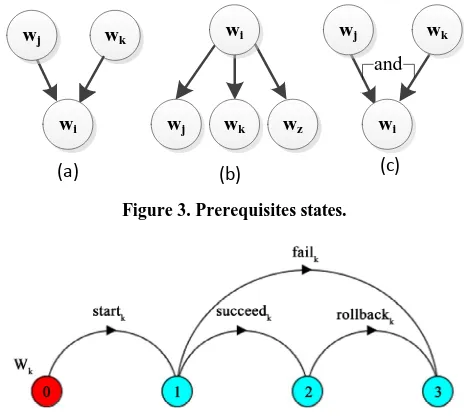
If there are more than one successor for a given ser- vice wi, (Figure 3(a)) the corresponding lock process
(step 2) should be created such that all the successors start theirs executions just after wi is finished
success-fully. If there is more than one predecessor for wi(Figure 3(b)), the lock process should be created to allow the execution of wi only when all its predecessors are
fin-ished successfully. In some cases, the rollback of wi is
dependent on the failure of two or more services together. This concept is shown in RBDAG like Figure 3(c).
For each service (wk) an FSP process with four actions
is defined as shown in Figure 4.
First the service is in state 0 and moves to state 1 by start_k action, and then if it fails, it will move to the final state 3 and if it succeeds, it goes to state 2. If after the successful termination of wk, another service wiwhich
belongs to the same cycle as wk, fails, then wk should be
roll-backed and goes from state 2 to state 3.
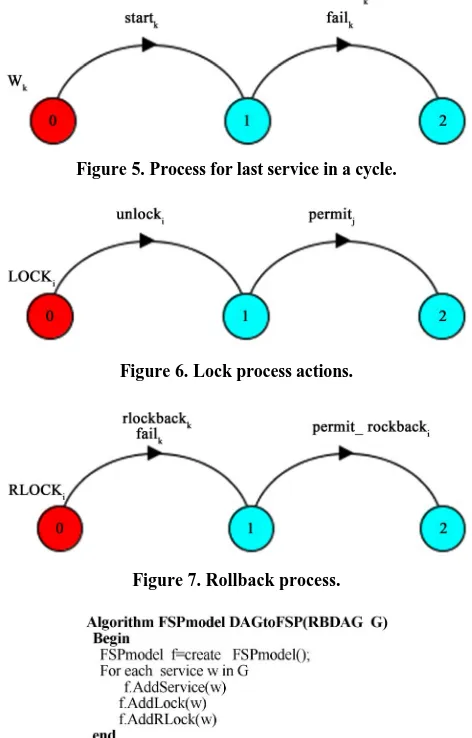
However if wk is not a member of any cycle in the
Rollback graph or it is, but after removing the cycle it was placed at the last position in the optimal order, the rollback never happens after successful termination of wk
because according to rule R2, it starts only after all its dependent services in the cycle are terminated successfully.
wk
and
(a) (b) (c)
wj
wi
wi
wj wk wz
wj wk
[image:3.595.306.539.516.724.2]wi
Figure 3. Prerequisites states.
This kind of service has actions as shown in Figure 5. The lock process mentioned in rule R2 is a FSP pro- cess with two states as shown in Figure 6.
The Rlockk process mentioned in rule R3 is a FSP
process with three states as shown in Figure 7. The Rlockk
goes to state 1 once wkis failed or roll-backed. At state 1,
the rollbacki action is ready to fire assuming that wiis the
service which is dependent on wk (i.e. wi has to be
roll-backed upon wk unsuccessful termination).
6. Translation Algorithm
Figure 8 shows the Translation Algorithm in which G is
a Rollback Directed Acyclic Graph (RBDAG). This al-gorithm creates a process for each service. If service wi is
prerequisite for service wj a lock process is created and
added to the FSP model. For each service wkin RBDAG,
a subset of Rollback [k] which is predecessors of wk in
[image:4.595.54.290.346.715.2]RBDAG, must be rollback. To do this, a Rlock process is also added to the set of FSP processes.
Figure 5. Process for last service in a cycle.
Figure 6. Lock process actions.
Figure 7. Rollback process.
Figure 8. Transformation Algorithm.
6.1. AddService() Function
The procedure AddService(), adds a service to the FSP model according to the rule R1, which described in Sec- tion 5. It gets a service like wk and checks whether wk is
the last service in the order of services in its cycle. If so, then it creates a process without a rollback action:
wk= (startk →(failk →STOP|succeedk→STOP)).
when wk is not a member of any cycle the created process
is also as above.
If wk is not the last service in the order of services in
its cycle, it should be roll-backed once its successor ser- vices in RBDAG (belonging to a same cycle) fail: wk = (startk →(failk →STOP|succeedk→rollbackk→STOP)).
6.2. AddLock() Function
The function AddLock(), adds a Lock process to the FSP model according to the rule R2, which described in Sec- tion 5. The getAllpre (wk) function, gets all the prerequi-
site services of wk in RBDAG. If the result is only one
process wi, the following code is added to the FSP model:
Lockk = (unlocki→permitk→STOP)/{succeedi/unlocki,
startk/permitk}).
If there is more than one prerequisite service, the start of the wk depends on the successful termination of all its
prerequisite services:(w1wn):
Lockk = (unlock1→…→unlockn→permitk→STOP)
/{succeed1/unlock1,…, succeedn/unlockn, startk/permitk}.
6.3. AddRLock() Function
The AddRLock() function, adds the Rlockk processes to
the FSP model according to the rule R3, described in Section 5. This lock controls the execution of the roll- back action of wk. If wk, is the last service in the order of
services of a cycle or it is not a member of any cycle, no Rlock process is needed because there is no rollback ac- tion in the definition of wk process. Otherwise the roll-
back action of wk should be executed once the service on
which wkdepends, fails or rollbacks:
RLockk = (r_unlockk→permit_rollbackk→STOP)
/{faili/r_unlockk, rollbacki/r_unlockk,
rollbackk/permit_rollbackk}.
There are situations where the rollback of wk only is
required when a set of services (w1wn) fail together
(Figure 3(c)). At these situations, the following Rlock
process is added to the FSP model:
RLockk = (r_unlock1→r_unlock2→…→r_unlockn→
permit_rollbackk→STOP)
/{fail1/r_unlock1, fail2/r_unlock2,…, failn/r_unlockn,
7. Case Study: Travel Agency
A travel agency uses the following services to arrange an itinerary:
w1: Granting Visa Service w2: Flight Reservation Service w3: Hotel Reservation Service
In order to create a fault-tolerant workflow correspon- ding to the composition of these services, the methodo- logy described in Section 3 is used. For each service the rollback set is defined as follows:
Rollback[w1] = {w2,w3}
Rollback[w2] = {w1,w3}
Rollback[w3] = {w1,w2}
Using the above Rollback sets the Rollback graph is created (Figure 9):
The next step is to remove the useless edges from the Rollback graph. After removing these edges the graph shown in Figure 10 is resulted.
In the next step, first the cycles in the above graph are located, and then the average rollback cost corresponding to each order of services in a cycle is calculated. The following failure probabilities and rollback costs for ser-vices are assumed:
P1 = 40%, P2 = 50%, P3 = 10% C1 = 100, C2 = 80, C3 = 30
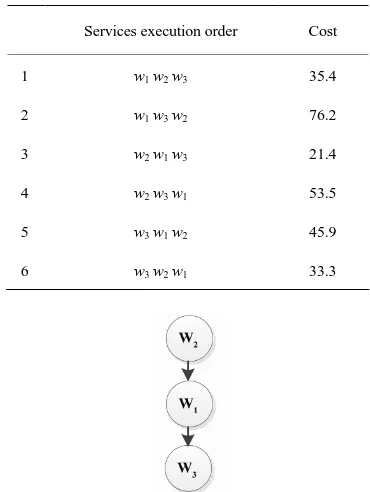
There are three services in this example therefore 3! different orders of services are possible. Corresponding to each order a rollback cost is calculated using formula (2) as listed in Table 1.
According to the above table the best order for com- position of w1, w2 and w3 is: w2, w1, w3. The resulted
RBDAG is shown in Figure 11.
By using the prerequisite dependencies in the resulted RBDAG, the workflow specified in FSP language is created as follows:
Figure 9. Prerequisites states.
[image:5.595.329.514.99.345.2]Figure 10. Edges deleted graph.
Table 1. Calculated costs.
Services execution order Cost
1 w1w2w3 35.4
2 w1w3w2 76.2
3 w2w1w3 21.4
4 w2w3w1 53.5
5 w3w1w2 45.9
6 w3w2w1 33.3
Figure 11. Resulted RBDAG.
7.1. Creating Processes
w1 = (start1 → (fail1 → STOP |succeed1 → rollback1
→ STOP)).
w3 = (start3 → (fail3 → STOP |succeed3 → STOP)). w2 = (start2 → (fail2 → STOP |succeed2 → rollback2
→ STOP)).
7.2. Creating Locks
Lock1 = (unlock2→permit1→STOP)
/{succeed2/unlock2, start1/permit1}.
Lock3 = (unlock1 → permit3 → STOP)
/{succeed1/unlock1,start3/permit3}.
7.3. Create RLocks
RLock1 = (r_unlock1→permit_rollback1→STOP)
/{fail2/r_unlock1, rollback2/r_unlock1, rollback1/
permit_rollback1}.
RLock3 = (r_unlock3→permit_rollback3→STOP)
/{fail1/r_unlock3, rollback1/r_unlock3,
rollback3/permit_rollback3}.
Figure 12 shows the final workflow in LTSA, which
is achieved from composition of processes in our case study.
8. Discussion
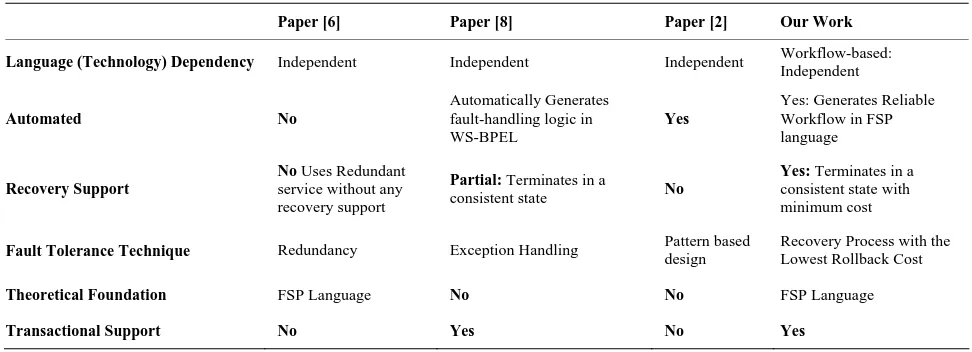
In Table 2, three different methods in the field of suppo-
Figure 12. Services composition workflow in LTSA.
Table 2. Comparing different methods for fault-tolerant web service composition.
Paper [6] Paper [8] Paper [2] Our Work
Language (Technology) Dependency Independent Independent Independent Workflow-based: Independent
Automated No
Automatically Generates fault-handling logic in WS-BPEL
Yes
Yes: Generates Reliable Workflow in FSP language
Recovery Support
No Uses Redundant service without any recovery support
Partial: Terminates in a
consistent state No
Yes: Terminates in a consistent state with minimum cost
Fault Tolerance Technique Redundancy Exception Handling Pattern based design
Recovery Process with the Lowest Rollback Cost
Theoretical Foundation FSP Language No No FSP Language
Transactional Support No Yes No Yes
an algorithm for automatically creating a fault tolerant workflow from the service dependencies, due to its rigo- rous theoretical foundation. The last factor is the transa- ctional support which indicates whether a method con- siders the concept of atomic transactions in a composi- tion or not. We have presented a method to automatically build a fault-tolerant workflow considering the service transactional properties (Each cycle in the Rollback graph is composed of a set of services with the atomicity requirement).
The first factor is the language or technology depen- dency. All four methods including ours are language in- dependent. The second factor is the support for an auto- mated method to generate the fault-tolerance mechanisms from the high level specifications. Our proposed method supports automatic generation of reliable workflow from rollback dependencies. The third factor is the recovery support, which means if a service fails how the composi-tion continues in order to terminate in a consistent state. The first method uses redundant services without any recovery support. The second method tries to terminate the composition in a consistent state. In contrast, in our work a rollback method for failed services with mini-mum cost is supported. The forth factor is the fault tol-erance technique applied by each method. The fifth fac-tor is the existence of a theoretical foundation to sup- port the fault tolerance or recovery. The first method uses the FSP language to be able to evaluate the correctness of its model. We also have used the FSP language as a for- mal language as a workflow specification language for assessing the correctness of the resulted workflow. The FSP language chosen in this paper, allowed us to present
9. Verification Approach
The presented algorithm in the previous section for trans- lating RBDAG to FSP verifies that it is possible to fully automate the workflow generation task (our first research question stated in the introduction part). Since FSP is a technology independent workflow specification method and also it is based fully on a rigorous theoretical back- ground, the second and third research questions (men- tioned in the introduction section) are also answered.
[image:6.595.54.540.281.457.2]flow always terminates in a consistent state, i.e. that upon the failure of service Si all its rollback-dependent services
like Sjin the RBDAG are terminated in their roll-back
state (state 3 in Figure 4). To show this, from step III of the translation algorithm, the following process is created for Sj:
RLockj= (r_unlockj → permit_rollbackj → STOP)
/{faili/r_unlockj, rollbacki/r_unlockj,
rollbackj/permit_rollbackj}.
The synchronization part specifies that upon a failure (faili action) or roll-back (rollbackiaction) of Si, the per-
mit_rollbackjaction is fired which is synchronized with
the rollbackj action of Sj and it means that eventually
after Sj entered to state 2 (succeeded state), it cannot stay
in this state due to that fact that rollbackjactionis ready
to fire.
10. Conclusions and Future Works
The fault tolerance in the web service composition usua- lly is supported by the exception handling constructs at the language level. However using the workflow tech-nology for composing web services with fault tolerance consideration provides a language independent solution. The FSP language chosen in this paper, allowed us to pre- sent an algorithm for automatically creating a fault to- lerant workflow from the service dependencies, due to its rigorous theoretical foundation. The resulted workflow executes or rollbacks the services in the composition in an order such that the minimum rollback cost is incurred upon the service failures in the composition.
REFERENCES
[1] D. Jordan and J. Evdemon, “Web Services Business Process Execution Language Version 2.0, OASIS Stan-dard,” 2009.
http://docs.oasis-open.org/wsbpel/2.0/serviceref
[2] Gartner, “Emerging SOA Patterns in the Enterprise,” 2009.
http://www.infoq.com/news/2008/08/gartner-emerging-so a-patterns
[3] Q. Yu, X. Liu, A. Bouguetta and B. Medjahed, “Deploy-ing and Manag“Deploy-ing Web Services: Issues, Solutions, and Directions,” The VLDB Journal, Vol. 17, No. 3, 2008, pp. 537-572. doi:10.1007/s00778-006-0020-3
[4] V. Issarny, F. Tartanoglu, A. Romanovsky and N. Levy, “Coordinated forward Error Recovery for Composite Web Services,” Proceedings of 22nd International
Sym-posium on Reliable Distributed Systems, 6-18 October
2003, pp. 167-176. doi:10.1109/RELDIS.2003.1238066
[5] H. P. Chen and Z. Y. Wang, “A Fault Detection Mecha- nism for Fault-Tolerant SOA-Based Applications,” Ma-
chine Learning and Cybernetics, 2007 International Con-
ference, Hong Kong, 19-22 August 2007, pp. 3777-3781.
[6] C. Luigi, R. Luigi, M. Nicola and S. Sergio, “Web Ser-vices Workflow Reliability Estimation Through Reliabil-ity Patterns,” Security and Privacy in Communications
Networks and the Workshops, 2007, SecureComm 2007,
3rd International Conference, Hong Kong, 17-21
Sep-tember 2007, pp. 107-110.
[7] T. Hu, M. Guo, S. Guo, H. Ozaki, L. Zheng, K. Ota and M. Dong, “TTF of Composite Web Services,” Parallel
and Distributed Processing with Applications (ISPA),
2010 International Symposium, Taipei, 6-9 September 2010, pp. 130-137.
[8] A. Liu, Q. Li, L. Huang and M. Xiao, “FACTS: A Framework for Fault-Tolerant Composition of Transac-tional Web Services,” Services Computing, IEEE
Trans-actions, Vol. 3, No. 1, 2010, pp. 46-59.
doi:10.1109/TSC.2009.28
[9] N. Looker and J. Xu, “Assessing the Dependability of OGSA Middleware by Fault-Injection,” Proceedings of
the 22nd International Symposium of Reliable Distributed
Systems, 6-18 October 2003, pp. 293-302.
doi:10.1109/RELDIS.2003.1238079
[10] N. Looker, M. Munro and J. Xu, “A Tool for Depend-ability Analysis of Web Services,” Proceedings of the
28th Annual International Conference of Computer
Soft-ware and Applications, Hong Kong, 28-30 September
2004, pp. 120-123.
[11] A. L. Goel, “Software Reliability Models: Assumptions, Limitations, and Applicability,” IEEE Transactions on
Software Engineering, Vol. SE-11, No. 12, 1985, 1411-
1423. doi:10.1109/TSE.1985.232177
[12] V. Grassi, “Architecture-Based Dependability Prediction for Service-Oriented Computing,” Proceedings of WADS, Edinburgh, 25 May 2004, pp. 279-299.
[13] J. Antonio and S. Cardoso, “Quality of Service and Se-mantic Composition of Web Services,” Ph.D. Dissertation, Department of Computer Science, University of Georgia, Athens, 2002.
[14] D. Bianculli, C. Ghezzi and P. Spoletini, “A Model Checking Approach to Verify BPEL4WS Workflows,”
IEEE International Conference on Service-Oriented Com-
puting and Applications, Newport Beach, 19-20 June
2007, pp. 13-20.
[15] H. Foster, S. Uchitel, J. Magee and J. Kramer, “Model- Based Verification of Web Service Compositions,”
Pro-ceedings of the 18th IEEE International Conference of the
Automated Software Engineering, Montreal, 6-10 October
2003, pp. 152-161.