warwick.ac.uk/lib-publications
A Thesis Submitted for the Degree of PhD at the University of Warwick
Permanent WRAP URL:
http://wrap.warwick.ac.uk/88528
Copyright and reuse:
This thesis is made available online and is protected by original copyright.
Please scroll down to view the document itself.
Please refer to the repository record for this item for information to help you to cite it.
Our policy information is available from the repository home page.
Application of Graph Theoretical Methods to The
Functional Connectome of Human Brain
by
Soroosh Afyouni
Thesis
Submitted to the University of Warwick
for the degree of
Doctor of Philosophy
Institute of Digital Healthcare
Contents
List of Tables v
List of Figures vi
Acknowledgments xii
Declarations xv
Abstract xvi
Chapter 1 Introduction 1
1.1 Thesis Objectives and Organisation. . . 2
1.2 Main Contributions . . . 4
Chapter 2 Background: From Cajal to Connectome 6 2.1 Human Brain Neuroimaging . . . 6
2.2 Complex Networks . . . 9
2.3 Network Neuroscience . . . 15
2.3.1 Microscale Connectome: Axon Terminals and Dendrites . . . 16
2.3.2 Mesoscale Connectome: Neurons and Minicolumns . . . 16
2.3.3 Macroscale Connectome: Regions of Interest and Pathways . . . . 17
2.3.4 Reproducibility and the dead Salmon . . . 21
2.3.5 Summary . . . 22
Chapter 3 Topological Changes in a Network of the Functional Connectivity of the Human Brain in Schizophrenia 23 3.1 Methods . . . 24
3.1.1 Constructing Network of Functional Connectivity . . . 24
3.1.3 Integration Measures . . . 26
3.1.4 Segregation Measures . . . 26
3.1.5 Network null models . . . 29
3.1.6 Small-worldness . . . 30
3.1.7 Cost-Efficiency . . . 30
3.1.8 Centrality Measures . . . 31
3.1.9 Rich Club . . . 32
3.1.10 Disruption Plots . . . 34
3.2 Data . . . 34
3.2.1 Sample . . . 34
3.2.2 Resting-State fMRI Acquisition and Preprocessing . . . 35
3.3 Results. . . 35
3.3.1 Changes in Edge Weights During Schizophrenia . . . 35
3.3.2 Cost-Efficiency . . . 37
3.3.3 Global Measures: Integration, Segregation and Complexity . . . 38
3.3.4 Centrality Measures in Healthy and Schizophrenia . . . 41
3.3.5 Disruption plots of local centrality measures. . . 44
3.3.6 Changes in Modular Structure during Schizophrenia . . . 45
3.3.7 Changes in Rich Club Organization in Schizophrenia . . . 49
3.4 Discussion. . . 55
3.4.1 Summary . . . 58
Chapter 4 Understanding a Rich Club with a Stochastic Block Model: A Connectome Study of Resting-State Schizophrenia 60 4.1 Methods . . . 62
4.1.1 Stochastic Block Model (SBM) . . . 62
4.1.2 Generalised Linear Stochastic Block Model (GL-SBM). . . 65
4.1.3 Rich Block . . . 67
4.1.4 Degree Analysis . . . 74
4.2 Simulation Methods. . . 75
4.2.1 Validation Methods . . . 75
4.3 Data . . . 77
4.4 Results. . . 77
4.4.1 Simulations . . . 77
4.4.2 Het-SBM on rs-fMRI of Healthy and Schizophrenic Subjects. . . . 80
4.4.3 A Rich Block for rs-fMRI Schizophrenia . . . 82
4.5 Discussion. . . 89
4.6 Summary . . . 92
Chapter 5 Impact of Autocorrelation on Topological Features of Functional Con-nectivity of the Human Brain 93 5.1 Methods . . . 96
5.1.1 Functional Connectivity as a Correlation Matrix. . . 96
5.1.2 Correction Factor . . . 97
5.1.3 Naive Correction . . . 97
5.1.4 Autoregression and Autocorrelation . . . 98
5.1.5 Bartlett’s Correction - Markov Process. . . 98
5.1.6 Bartlett’s Correction - General Process. . . 99
5.1.7 Family of Heterogeneous Bivariate Corrections (HetBiv) . . . 100
5.1.8 Monte-Carlo Correction . . . 103
5.1.9 Method Comparison . . . 103
5.1.10 Network Thresholding . . . 104
5.1.11 Graph Theoretical Measures . . . 105
5.2 Data . . . 105
5.2.1 Human Connectome Project . . . 105
5.2.2 Autism Brain Imaging Data Exchange . . . 106
5.2.3 Brain Parcellation Schemes . . . 107
5.3 Results. . . 110
5.3.1 Effect of Autocorrelation on Brain Cortical and Sub-cortical Regions110 5.3.2 Results of the Correction Methods Validation . . . 112
5.3.3 Effect of Autocorrelation Correction on Statistical-Thresholding . . 114
5.3.4 Effect of Autocorrelation Correction on Graph Theoretical Mea-sures of Statistical-Thresholding . . . 115
5.3.5 Effect of Autocorrelation Correction on Graph Theoretical Mea-sures of Density-Thresholding . . . 122
5.4 Discussion. . . 133
5.5 Summary . . . 137
B.2 Stochastic Blockmodel . . . 145
B.3 Coherent and Combinatory Blocks . . . 147
B.4 Projection of Estimated Het-SBM Block Assignments on the Brain Surface 148 B.5 Rich Block of C.Elegans Micro-sclae Connectome . . . 149
B.6 Degree Exceptionality on Group-Level Het-SBM Parameters . . . 150
Appendix C Heterogeneous Bivariate Estimation of Sample Correlation Variance152 C.1 Mean and Variance of Inner Product of Two Random Variables . . . 152
C.2 Unibased-HetBiv vs Bartlett’s HetBiv . . . 153
C.3 Effect of Curbing in HetBiv Corrections . . . 156
C.4 Effect of Shrinking in HetBiv Corrections . . . 158
Appendix D List of Publications 161 D.1 Chapter 3 . . . 161
D.2 Chapter 4 . . . 161
D.3 Chapter 5 . . . 162
List of Tables
3.1 Porportion of nodes in each module that contributes to the RC organisation
of healthy subjects . . . 50
3.2 Porportion of nodes in each module that contributes to the RC organisation
of Schizophrenic subjects . . . 50
5.1 Disruption indices, as discussed in section 3.1.10, of RSNs of three atlases
(Power2011, AAL2 and Yeo17) for the NoGSR case of local measures in
Statistical Thresholding. . . 118
5.2 Disruption indices, as discussed in section 3.1.10, of RSNs of three atlases
(Power2011, AAL2 and Yeo17) for the NoGSR case of local measures in
Statistical Thresholding. . . 119
5.3 Disruption indices, as discussed in section 3.1.10, of RSNs of three atlases
(Power2011, AAL2 and Yeo17) for the GSR case of local measures in
Den-sity Thresholding. . . 126
5.4 Disruption indices, as discussed in section 3.1.10, of RSNs of three atlases
(Power2011, AAL2 and Yeo17) for the NoGSR case of local measures in
Density Thresholding. . . 127
B.1 List of blocks and the percentage that each anatomical region participated
List of Figures
2.1 A.Headline of the NYT report regarding the Moreno’s presentation
(Cour-tesy of The New York Times). B.Network of blog-to-blog interaction in
2004 US election. Red nodes represent pro-democrat blogs and blue nodes
represent pro-republican blogs. Reproduced from Adamic and Glance (2005) 11
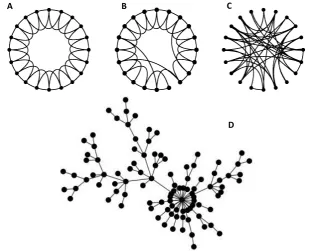
2.2 A.a lattice network with Dirac Delta degree distribution B.a smallworld
network (SW model). C.a random network with Poisson degree
distribu-tion (ER model)D.a Scale-Free network with power-law degree distribu-tion (BA model). Reproduced from Watts and Strogatz (1998) and Barab´asi
et al.(2009).. . . 14
2.3 Cartoon presentation of a small-world network, with modular structure and a strongly connected core which mediates the modules. Reproduced from
Bullmore and Sporns (2012a). . . 15
2.4 Google Trends representing the interest in the topic ’connectome’ over a
period of 12 years (Jan 2004 - Aug 2016). Spikes (shocks) in the search
trend are marked with a brief description. . . 16
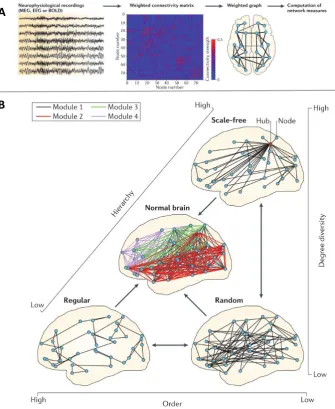
2.5 A. Common procedure for constructing the functional connectome. B.
Topological description of the human brain, suggesting the human
connec-tome is located between three topological extremes (random, lattice and
scale-free). Reproduced from Stam (2014) . . . 18
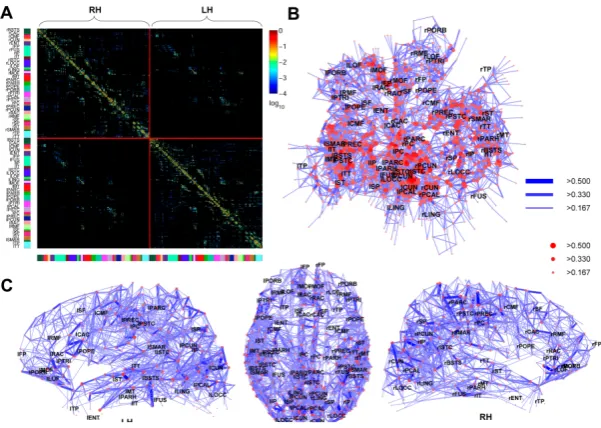
2.6 Hagmann et al 2008 description of structural connectome: A.Adjacency
matrix of the structural connectome of healthy brains. B.Topological pre-sentation of nodes configured based on Kamada-Kawai force-spring layout
C.Spatial reconfiguration of figure B with brain region coordinates. Repro-duced from Hagmannet al.(2008) . . . 20
3.2 Projections of edges that were found to be significantly decreased during
schizophrenia by NBS. Results the NBS over different thresholds were
shown in each panel. . . 36
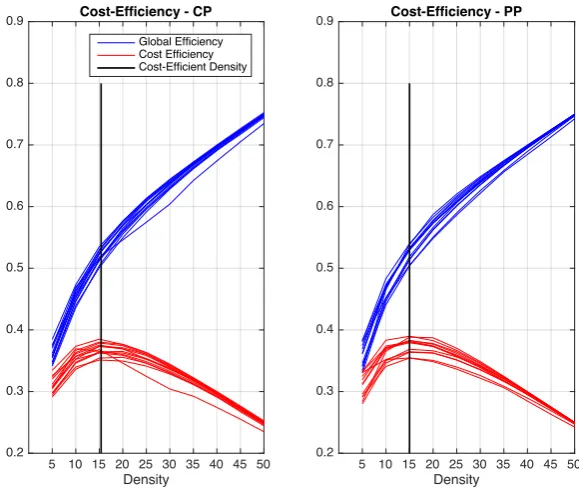
3.3 Cost efficiency of brain networks in Healthy (Left) and Schizophrenic (Right).
Global efficiency of each subject is shown in blue and cost-efficiency is shown in red. The mean cost-efficient density for each group is shown with a vertical black line. . . 37
3.4 Global measures of segregation, integration and complexity. Panel A. shows
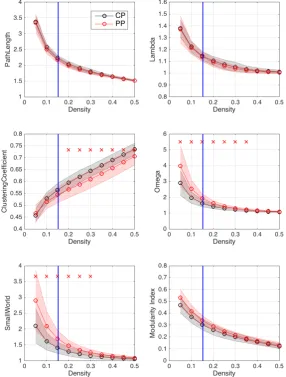
the global measures for the level of integration: path length (Left) and nor-malised path length (Right). Panel B. shows global measures for segre-gation: clustering coefficient (Left) and normalised clustering coefficient (Right) and maximised modularity index (Bottom) Panel C. shows the small-world index as a measure of complexity . . . 40
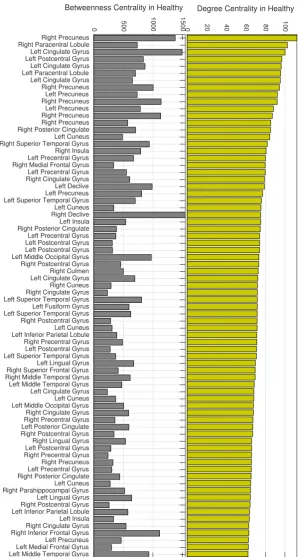
3.5 Degree (top) and betweenness (bottom) centrality for averaged across healthy
subjects. . . 42
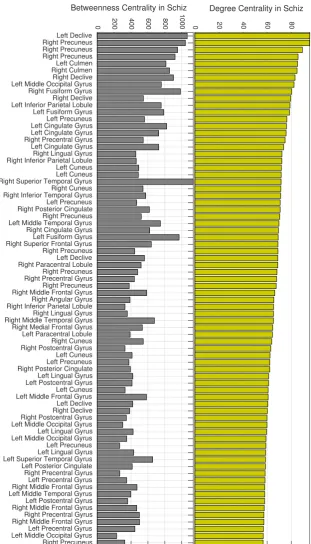
3.6 Degree (top) and betweenness (bottom) centrality for averaged across Schiz
subjects. . . 43
3.7 Disruption plots of Degree centrality (Left), Betweenness centrality
(Mid-dle) and Local Efficiency (Right) . . . 44
3.8 A. Modularity index across different scales for both empirical and
ran-domised networks in healthy (Left). Module configurations on re-arranged
group-averaged network of healthy (Right).B.Modularity index across dif-ferent scales for both empirical and randomised networks in schizophrenia (Left). Module configurations on re-arranged group-averaged network of
schizophrenia (Right).. . . 46
3.9 Projection of individual nodes and their module assignments on a transpar-ent surface of the human brain. . . 47
3.10 A river-plot shows the overlap between modular structure of healthy and
schizophrenia subjects. . . 48
3.11 Similarity between node assignments of modularity algorithm across
sub-jects of healthy (Left) and schizophrenia (Right) . . . 49
3.13 Interaction between RC organisation and rest of the network via feeder and
local connections. A. Analysis of density between feeder, local and RC
nodes as well as between healthy and schizophrenia subjects. B.
Analy-sis of Local efficiency of local, feeder and RC nodes as well as between
two groups. C.Analysis of Betweenness Centrality of feeder, local and RC nodes. Red asterisks indicate significant differences.. . . 52
3.14 NRCC of healthy (Top) and schizophrenia (Bottom), as decribed in section 3.1.9. Nodes that were identified as significantly different were marked with a red asterisk . . . 53
3.15 NRCI of healthy (Top) and schizophrenia (Bottom), as decribed in section 3.1.9. Nodes which were identified as significantly different were marked with a red asterisk . . . 54
3.16 Similarity between Rich Club Identity matrices across individuals across
healthy (Left) and schizophrenia (Right) . . . 55
4.1 Rich Block detection procedure on a toy connectivity rate matrix, ˆΠ, and
its null model,ΠNull, were shown, representing a network of 300 nodes and
Q = 15. Binomial Mixture densities used to generate degree distributions of two arbitrary RB organisation of 4 (A) and 11 (B) illustrated. The results of RB detection suggest that H0 : fk(ρi) > fNullk (ρi) is significant, while
similar hypothesis fails to be rejected on the 11th RB organisation. . . 71
4.2 A.Connectivity probability matrix of a toy network with 15 (equal-sized) blocksB.Simulated network. C.shows the RB coefficients, for this net-work. It is notable how the RB coefficients could differentiate between the blocks with the same expected degree but different patterns of connectivity. 72
4.3 Flowchart of calculation Rich Block and group inference between two groups.
Rectangles indicate process, parallelogram shows data. Blue indicate pro-cesses that should be under taken on control and red for patient. Also note
that colourful sections should be repeated for each individual, however, we
only depicted this process for oneΠper group. . . 73
4.4 Shows probability density functions of how the proposed Tensor Null Model
4.5 Shows results of RB estimation for both coefficient and organisation. Each
column represent networks with different size and each row represent net-works with different block numbers. In each subplot, the left-hand bar re-spresent the coefficient of deterministic (r2) between the RC and RB coef-ficients and right-hand bar represent the Adjusted Rand Index between the
RC and RB organisations.. . . 79
4.6 Shows results of the Degree Exceptionality on simulated networks. Each
column represents networks of different sizes and each row represents net-works of different block numbers. The number of hubs in each network was defined as 10% of the number of blocks. . . 80
4.7 Connection probability matrix of controlAand Schizophrenic patientsB.
CandDare sorted connection probability matrices based on the decreasing expected degree of each block. . . 82
4.8 illustrates a circular layout of the group-averaged probability connection
matrix,Π, of the controlsAand patientsB. Detected RBs are located in the middle of the layout. For the sake of visualisation, we only drew the top
30% of the strongest connections. . . 83
4.9 Shows the Rich Block Identity (RBI) of controls (top) and patients
(bot-tom). The yellow cells indicate that block qfor subject sis a significant Rich Block. Red asterisk indicates statistical differences between two RBIs. 84
4.10 AandCshows Block-wise Rich Block Coefficient (BRBC) in control and
patient respectively.BandDshows mean of each column in A and B. Red asterisk shows statistical significance between mean of RB values of two groups. . . 85
4.11 A. illustrates the organisation of the local and feeder connections along with RB in a synthetic adjacency matrix. B. Illustrates the difference in
density of the RB connection individuals in healthy and schizophrenia. C.
Shows the feeder density of individuals in healthy and schizophrenia
sub-ject groups. D.Shows the local density between individuals of healthy and schizophrenia. The red asterisk indicates the statistical difference. . . 86
4.12 AandBare binary matrices of the DE effect in healthy and schizophrenia
groups. BandD are the expected degree of each block for the individu-als in the control and patient group. Red asterisk indicates the statistical difference and red rectangles indicate the degree exceptional blocks. . . 87
5.1 A,B,DGroup-averaged correlation length for Yeo17, AAL2 and Power2011, respectively.C.Volume of the ROIs across the parcellation schemes. . . 110
5.2 Association between correlation length and four different parcellation schemes (e.g. Yeo17, AAL2, AAL, CC200) of three different scanning sites (e.g.
Yale, NYU, USM and HCP) with and without GSR. 111 111
5.3 KS statistics of a family of HetBiv corrections as well as existing methods for each acquisition site and parcellation scheme. The grey lines represent
the reference line. . . 112
5.4 False-positive rate of family of HetBiv corrections as well as existing meth-ods for each acquisition site and parcellation scheme. The acquisition site
has been identified by the titles.. . . 114
5.5 Histogram of the Fisher-transformed correlation coefficients after density thresholding with Naive and HetBiv correction for the degree of freedom. . 115
5.6 Network density of networks with Naive and HetBiv corrections. Each
subplot shows the results for the choice of GSR and parcellation scheme. The red asterisk shows statistically significant results. . . 116
5.7 Global graph theoretical measures of networks with Naive and HetBiv
cor-rections. Each subplot shows the results for choice of GSR and parcellation
scheme. Red asterisk shows statistically significant results. . . 117
5.8 Disruption plots of the changes in the local measures (Degree Centrality, Betweenness Centrality and Rich Clubs) of the networks with statistical
thresholding due to HetBiv correction. All of the x-axises represent the
average of the measure across groups and all of the y-axises represents the differences in the values between the two groups. 123 . . . 123
5.9 Change rates between global measure of network with Naive correction and
HetBiv correction. Each column is a parcellation scheme and each row is global graph theoretical measure. Red circle indicates the statistical
sig-nificance between the two correction in case of NoGSR. Black cross
indi-cates the statistical significance between the two correction in case of GSR. Vertical lines show cost-efficient densities over different choices of GSR
and correction methods. corrected, GSR (dashed blue);
HetBiv-corrected, NoGSR (dashed green); Naive-HetBiv-corrected, GSR (solid black); Naive-corrected, NoGSR (solid red). All of the x-axis shows the density,
5.10 Disruption plots of changes in local measures (Degree Centrality,
Between-ness Centrality and Rich Clubs) of network with density thresholding due
to HetBiv correction. All of the x-axises represent the average of the mea-sure across groups and all of the y-axises represents the differences in the
values between the two groups. 132 . . . 132
A.1 illustrates the anatomy of the human brain including the lobes and the areas within each lobe. . . 143
B.1 Visualisation of block on MNI surface of the human brain. For the sake of
visualisation, we show only 5 or 6 blocks per each brain surface. . . 148
B.2 Non-normalised RC (solid grey) and RB with optimal Q (marked blue) and
fixed Qs (marked red,green,magenta and black) . . . 150
B.3 Illustrates estimated PDF of the group-averaged connection probability
ma-trix for controls (left) and patients (right). The red asterisk at the top of each
Poisson component indicates degree exceptionality. Also the expected de-gree of each component involved in estimation of the dede-gree distribution of
each group is listed respective to their colour. . . 151
C.1 KS Statistics of HetBiv methods. Each subplot represents a cohort: HCP
(Top Left), NYU (Top Right), USM (Bottom Left) and Yale (Bottom Right). 154
C.2 False-positive rates of the HetBiv methods. Blue vertical lines represent the
5%α-level and red vertical lines represent 2.5%α-level. . . 155
C.3 KS statistics of each curbing coefficient across different acquisition sites
and parcellation schemes. . . 156
C.4 False-positive rate analysis of each curbing coefficient across different ac-quisition sites and parcellation schemes. . . 157
C.5 KS statistics of each shrinking coefficient across different acquisition sites and parcellation schemes. . . 158
C.6 False-positive rate of each shrinking coefficient across different acquisition
Acknowledgments
First and foremost, I wish to thank my supervisors; Professor Thomas Nichols and Professor
Theodoros Arvanitis, not only for their valuable time, ideas and funding, but also for giving
me the opportunity to feel like a contributing member of a strong team (which was not
always the case). You, consciously and subconsciously, taught me how to be persistent,
skeptical and creative throughout the scientific process. Your patience during our Thursday
meetings shaped me as a researcher, and I genuinely hope that I was worth the investment.
I would also like to thank Dr Andrew Bagshaw. If it was not for your support and
patience during the early stages of my PhD, I would have not been able to accomplish
what I presented in this thesis. On these lines, I would also like to thank past and present
members of the Multimodal Imaging Group at the University of Birmingham; specially
Dr Joanne Hale for her suggestions and contributions. I am also thankful to Dr Dragana
Pavlovi´c for her constant patience when walking me through various complex statistical
models. Grateful acknowledgements to Professor Edward Bullmore, as well as members of
Human Brain Mapping Unit at the University of Cambridge (specially Dr Petra V´ertes and
Dr Emma Towlson), for your stimulating ideas and suggestions.
My time at the University of Warwick was made enjoyable in large due to the
en-ergetic, collaborative and jolly spirit of past and present members of the Institute of Digital
Healthcare and the Statistical Neuroimaging Group at the Department of Statistics. You
were not only colleagues and officemates, but also friends. Thank you for bearing my
often-miserable face and my constant complaints during the difficult period of writing this
thesis. I would also like to thank Dr Ahmed Fetit and Dr Sarah Keung for helping me edit
this thesis.
Division of Brain Sciences at Imperial College London and Guarantors of Brain. I would
also like to thank Institute of Advanced Study at University of Warwick that made me sure
that I will not be unemployed after submitting this thesis.
Also, I would like to thank Ms Mehrnoush Sarafan, whose kindness, understanding
and patience tremendously helped me during my PhD. I should also thank my friends, who I
grew up with, but then later scattered across different countries; however distant, you never
discounted our friendship. You are a living evidence of a possible, significant correlation
between millage and friendship. Thanks for your support and for all the banter.
To mum, dad and Shokouh for everything. During the difficult moments of this
PhD, and throughout my whole life, I was constantly reminded that there is a safe haven
calledHome, where I am offered unconditional love and a cup of freshly brewed tea. I am
Declarations
I, Soroosh Afyouni, hereby declare that except where specific reference is made to the
work of others, the contents of this dissertation are original and have not been submitted in
whole or in part for consideration for any other degree or qualification in these, or any other
Universities. This dissertation is the result of my own work and includes nothing which is
the outcome of work done in collaboration, except where specifically indicated in the text.
• Parts of Chapter 3 were presented in Organisation for Human Brain Mapping (OHBM)
annual meeting in 2014.
• Chapter 4 is based on a pre-printed manuscript, which will be shortly submitted for
publication. Parts of this chapter were presented during OHBM annual meetings in
2015 and 2016.
• Chapter 5 is based on a pre-printed manuscript, which will be shortly submitted for
publication. This work is presented as an abstract in OHBM annual meeting in 2016.
Soroosh Afyouni
Abstract
Chapter 1
Introduction
When observing advances in biology, one could argue that modern neuroscience was ignited
by a series of investigations conducted by Santiago Ramon y Cajal in the late 19th Century. Upon analysing thousands of microscopic samples gathered from bird cerebellum and adult
vertebrate nervous system, Cajal found that neurons tend to interact with each other via
a contiguousprocess (Swanson and Lichtman,2016). At the time, this contradicted the conventional way of treating brain circuitry as acontinuouscollection of neurons.
Interestingly, long before Cajal’s findings, there were reports that suggested the
presence of interaction between distinct brain cortex areas and functions. Such relation-ships were confirmed several years later after a revolution in neuroimaging technologies.
Functional localisation of brain activities unveiled that hundreds of thousands of neurons in
a spatially constrained area are involved in a task (e.g. motor process) and can be seen as the inception of the notion of segregation in the brain (Edelman,1987). However, further
examination of brain functions, such as attentional mechanisms, showed that carrying out a
single task involves several spatially distributed brain areas, which facilitate the functional task through a mediation between them (Edelman,1993). The aforementioned findings
sug-gest that function of the human brain is built upon a simultaneous coexistence of anatomical
segregationand functionalintegration.
Emergence of new interdisciplinary fields, such as complex system sciences, has
motivated neuroscientists to establish a computational framework combining Cajal’s
doc-trine and the segregated/integrated nature of the human brain. Proposing ‘Neural Com-plexity’ was one of the earliest attempts to formulate the coexisting anatomical dependence
(segregation) and functional independence (integration) (Tononiet al.,1994). Neural Com-plexity uses Information Theoretical techniques to quantify the presence of thecomplexity
in the vertebrate brain, by capturing the interplay between segregation and integration of
pres-ence of a balance between these two tendencies. Neural Complexity, later, was elaborated
to a more sophisticated quantification tool, called Integrated Information Theory, which
at-tempts to explain the mind-body problem and eventually the hard problem of consciousness (Harnad,1994).
Despite graph theory being a relatively old branch of mathematics, it is not until
long ago that it was recognised as a powerful tool for modelling system complexities. It represents agents of a system asnodesand interaction between them asedges. Despite its
apparent simplicity, graph theory showed that it is able to model extremely complex systems
such as, human social behaviour (Fararo and Sunshine,1964;Klovdahlet al.,1994; New-man,2001). Mammalian brains are also not an exception as being one of the most complex
yet unknown natural systems. Application of graph theoretical methods has demonstrated
strong evidence in modeling the segregation, integration and eventually complexity of the brain networks. Presence of segregation has been confirmed by network clustering
tech-niques, which suggest that the brain networks follow a modular and hierarchical topological
structure (Meunieret al.,2010). Also, the presence of relatively short fiber tracts, which mediates the brain regions, confirms the integrative nature of the human brain (Spornset al.,
2004). Modular structures, which are connected via short paths, confirm the constant bat-tle between segregation and integration and, analogous to Neural Complexity, suggest the
presence of the ‘small-world’ phenomenon within the human brain (Bassett and Bullmore,
2006).
Throughout the last decade, advancements in field of graph theory have gone far
beyond deterministic measures of segregation, integration and complexity. Today,
examina-tion of the latent structures within a network, by using stochastic graph theoretical methods, can unveil extensive amounts of information about current network states, as well as future
(generative) network behaviour (Karrer and Newman,2011). Therefore, it is important to
maintain a sturdy bridge between the fields of graph theory and neuroscience, aiming to maximise discoveries that can be delivered by computational brain modelling.
1.1
Thesis Objectives and Organisation
The primary aim of this thesis is to contribute to bridging the two disciplines by firstly,
showing that graph theory is able to deliver valuable information about the structure and
function of the human brain and therefore can be used as a plausible bio-marker to detect the alteration in the brains of patients with neuro-psychiatric disorders. Secondly,
demon-strating that newly-proposed stochastic block modelling methods can be used to gain a
domain aiming to empower the application of graph theory for understanding complex
phe-nomena. Fourthly, tackling the current challenges in constructing brain networks by
elimi-nating the nuisance variances by estimating the effect of correlated noises that exist in time series of brain functional activities.
In chapter 2, we begin by giving a brief description of brain imaging methods,
specifically, Functional Magnetic Resonance Imaging. This is followed by a short history and summary of network sciences. Eventually, we give a summary about combination of
these two disciplines which is known as ’connectome’. Graph theoretical methods that are
mentioned in this chapter are cross-referenced to a deeper theoretical discussion throughout the thesis.
In chapter 3, we demonstrate how the fundamental understanding of the human
brain can be examined by graph theoretical measures. Additionally, we investigate how more sophisticated metrics can help us to gaine a better understanding of human brain
function. Ultimately, we illustrate how graph theory can be considered as a bio-marker to
detect the alterations in the brain networks of patients with schizophrenia.
In chapter 4, a newly proposed Stochastic Block Model is used to investigate how
this graph theoretical method can be used to describe topological properties of brain func-tional connectivity. Addifunc-tionally, we introduce a novel method, Rich Block, to detect highly
connected network cores. This method is an interpretation of the traditional Rich Club with
the use of Stochastic Block Models. We also introduce a framework to conduct multi-subject statistical inference between patient and healthy control groups. Further to Rich
Block, we also propose Degree Exceptionality which can be used to detect the hubs as well
as their alterations during the disease. These methods are applied to the functional con-nectivity of Schizophrenic patients to demonstrate how they can be used as bio-markers to
track alterations during the disease.
In chapter 5, we investigate how correlated noise can affect the functional connec-tivity maps and, consequently, topological description of the human brain. We focus on
addressing the dependencies between BOLD signal data-points, due to the presence of
au-tocorrelation effects in BOLD signals. We show that the effect of this specific category of noise on the human cortex is rather heterogeneous. To mitigate this effect we propose
a novel technique to estimate the nuisance variance of correlation coefficients, called the
Heterogeneous Bivariate Correction Factor (HetBiv-correction). We demonstrate how this technique out-performs existing methods in correcting for the effects of autocorrelation.
In addition, we show how HetBiv-correction can be helpful in revealing the topological
features of functional connectivity maps.
In conclusion, in chapter 6, we summarise the findings of this work and argue that
the function of the human brain. However, as a young interdisciplinary field, it is
sub-jected to several challenges and limitations and employing it requires careful and rigorous
analysis.
1.2
Main Contributions
In this work, we make a number of contribution to the field of network neuroscience:
• Incentivised by lack of statistical techniques to conduct group inference between the Rich Club configuration of functional connectome across subjects, we proposed a
statistical framework, which accounts for within group variability in the analysis of traditional Rich Club configuration. This novel approach differentiates between Rich
Club coefficients and Rich Club organisation to maximise the detection power
be-tween two groups. We used a previously published data set with a new brain par-cellation scheme to demonstrate how this technique can be used to fill in the gaps of
between-group inference in the detection of changes in patients with schizophrenia. The methods proposed help the network neuroscientists to conduct group inference
between the RC organisation and coefficients of the healthy and patient groups.
• As the Rich Club techniques are known to be highly sensitive to the degree of nodes, we combined a traditional Rich Club detection technique with SBMs. This
combina-tion, named Rich Block, can be seen as a complimentary method to SBMs as long as they assume that the probability that a node makes a connection follows a Bernoulli
distribution. In addition to accounting for high degree centrality in the formation of
‘clubs’, Rich Block also differentiates between nodes of a club which has the same degree centrality but different profile of connectivity.
• In addition to accounting for the profile of connectivity, by using a newly proposed Multi-Subject Stochastic Block Models, Rich Block can also be used to account for
within group variability in both coefficients and the organisation of Rich Blocks and therefore facilitates the group inference between groups. Using multi-subject SBM
also provides a unique opportunity to account for the effect of nuisance covariates
in between group comparisons. Accounting for the covariates helps researcher in the community to conduct more reliable hypothesis tests. We apply Rich Blocks to
a group of healthy and schizophrenic subjects and show how the changes in their network cores can be detected by Rich Block.
the context of SBM, we proposed Tensor Null Models (TNM) which represent a
structure-free expected connectivity rate between estimated blocks. This null model
is independent of empirical network, and therefore, facilitates the statistical inference between the null RB organisation and the estimated RB organisation.
• Topological properties of the functional connectivity can be drastically influenced by inevitable temporal confounds, such as correlated noise, which can easily jeopardise
the independency between observations and inflate the sampling variance. Moti-vated by the lack of methods for mitigating the effect these temporal confounds, we
propose a novel method, named HetBiv-correction, to estimate the sampling
vari-ance of correlation coefficients. By employing the Kolmogrov-Smirnof statistics and false-positive rates, we validated the proposed method using inter-subject scrambling
method. The results of validation suggest that the HetBiv outperforms, in regards to
both shape of the distribution and tails, the existing methods by estimating a more ac-curate sampling variance. For instance, in the HCP cohort, the KS statistic was found
to be 0.003 and the false-positive rate of the proposed methods completely overlaps
with both 0.01 and 0.05α-levels.
• In addition to inflated sampling variance, our investigations suggest that the effect of temporal confounds is not spatially homogeneous across the brain, and existing
ho-mogeneous approaches may sacrifice the sensitivity and specificity level for a simpler
temporal model. On the contrary, HetBiv-correction estimates this variance for every connections and therefore accounts for the effect of spatial heterogeneity of temporal
Chapter 2
Background:
From Cajal to Connectome
In this chapter, we briefly discuss the advancement in human brain imaging techniques and how they can help to gain a better insight about functional and structural configuration of
the human brain. We follow with a brief introduction to graph theory and examples of how it can be used as a mathematical model to describe natural phenomena. Eventually,
we discuss the emerging field of network neuroscience, which is centered on employing
graph theoretical methods and advancing imaging techniques to deliver a comprehensive description of the human brain.
2.1
Human Brain Neuroimaging
Non-invasive recording of brain neuronal activities is, undoubtedly, one of the most
re-markable milestones in neuroscience, aiming to understand the function and structure of
the human brain mechanisms. It is now a few decades since the Electroencephalogram (EEG), as the first non-invasive method of recording brain electrophysiology and function,
helped neuroscientists to monitor human brain activities. Despite the fine-scale temporal
resolution that this recording method provides for investigating the superficial areas of the brain such as motor or visual systems, it was shown that the majority of human brain
activi-ties happen in deeper parts of the brain, where it is impractical for EEG techniques to reach
them or at least deliver reliable information about them. These limitations encouraged re-searchers to seek more sophisticated methods of brain structural and functional mapping of
the human brain, through biomedical imaging.
tech-niques ranged from radiation-based imaging techtech-niques, such as Computer Tomography
(CT) and Positron Emission Tomography (PET) scanning, to more advanced imaging
meth-ods, such as Magnetic Resonance Imaging (MRI), which can provide high spatial resolution images of the function and structure of the brain (Pennyet al.,2011).
Functional Magnetic Resonance Imaging (fMRI), which is the main interest of this
thesis, has gained enormous attention since its introduction, in the 1990’s. This biomedi-cal imaging method works by monitoring the changes in demand for oxygenated blood of
the brain regions. Activation of different brain regions is measured by
blood-oxygenation-level-dependent (BOLD) contrasts. BOLD fMRI signals are typically acquired using an echo-planar imaging technique (Westbrook and Roth,2011) which is formed by applying a
Radio Frequency (RF) pulse in the presence of a static magnetic field to selectively excite
and encode magnetisation vectors (Lauterbur,1973). After a fraction of a second, the exci-tation is turned offand the reaction of water molecules is recorded in a k-space during their
relaxation phase. Inverse Fourier transformation then translates the acquired information
from the frequency domain to the time domain (Westbrook and Roth, 2011). This proce-dure is repeated over a specific period of time to record the dynamics of the brain activities.
This procedure results in a BOLD signal representing functional activation of a small iso-morphic cubical (normally 23mm) volume of the brain called avoxel. It is worth noting that
BOLD signals are not direct measures of the brain functional activities but, rather, a
repre-sentation of its neurovascular coupling into hemodynamic changes (Roche and Commins,
2009).
Although until the early 1990s, fMRI was mainly used as a tool to measure
task-dependent activations of the brain, an extraordinary finding reshaped the research on the function of the brain. In 1995,Biswal et al.(1995) discovered that task-free brain scans also demonstrate a level of activation in certain frequency bands which is called
resting-statebrain (Raichle and Snyder,2007). They argued that the majority of the brain regions are constantly active in a frequency band of 0.01−0.1HZ, which later led to the realisation
that the brain energy level increase by only≈5% (Raichle and Snyder,2007) during a task.
The introduction of resting-state brain imaging facilitated the discovery of a range of brain functional networks (RSNs) such as the Saliency Network (Foxet al.,2005) and most im-portantly the Default Mode Network (DMN) (Shelineet al.,2009), which is known to be active when a subject is awake, but not performing any specific task. The groundbreaking realisation about RSNs roots, down to the fact that the anatomical regions, which are
in-volved in RSNs, are spatially spread around the brain whilst consistently acting together.
To date, neuroscientists have discovered more than 7 well-established RSNs, as well as 17 sub-networks from a Visual and Somatomor network to a Frontoparietal and Limbic
evidence of a resting-state brain, the physiological meaning of a resting-state brain is still
the subject of an ongoing debate since there are studies, which show that resting-state
os-cillations may have been caused by cardiac (Birnet al.,2006) and respiratory oscillations (Chang and Glover,2009).
Acquired BOLD signals, in the time of scanning, are far from being ready to be
considered as a reliable description of brain activities and require undertaking a number of pre-processing steps to remove the variances that may have been merely caused by noise
and which confound during the scan. The pre-processing steps can be summarised in five
stages.
Slice timing correction: fMRI scans are a collection of 3D snap-shots of the brain
for each time-point over the scanning session. Each of the 3D images is reconstructed from
a number of 2D slices, however, the timing between these slices may differ between subjects and scan sessions. Slice timing correction aims to temporally align these slices between all
subjects (Hensonet al.,1999).
Motion Correction:Acquiring each 3D image may take up to a couple of seconds;
during this time even a smallest head movement can cause propagative disturbance in the
analysis of functional MR images (Van Dijk et al., 2012). Regardless of how a subject can manage to stay still inside the scanner, physiological functions, such as cardiac and
respiratory processes, can cause movements between slices, which makes it vital to
cor-rect the spatial mis-alignment between the slices. This effect is typically eliminated by a method called Rigid Body Realignment (RBR) (Ashburneret al.,2003). Further to the tra-ditional method of correcting the head movement, there are several complimentary methods
for motion correction such as motion scrubbing (Poweret al.,2014) FMRIB’s ICA-based Xnoiseifier (FIX)1(Salimi-Khorshidiet al.,2014) and spike wavelet analysis (Patelet al.,
2014).
Registration:After spatial alignment, each subject’s scan remains in its own scanner
coordinate space, however, it is important to transform all the scans into the same, standard,
coordinate space. Therefore, registration is performed to transform all images to a standard
space (Pennyet al.,2011). Further to global alignment, it also helps to remove the anatom-ical difference between subjects such as differences in size and surface of the brain. One of
the widely-established examples of standard spaces, which we use throughout this thesis,
is formed by averaging anatomical scans of 152 subjects. This standard template is called MNI-152 (which stands for Montreal Neurological Institute) (Collinset al.,1995).
Spatial and Temporal Smoothing: These two classes of smoothing are used to
im-prove the signal-to-noise ratio (SNR) and, therefore, the sensitivity in later statistical in-ference. Spatial smoothing is performed by applying a 3D Gaussian kernel to the images
(Penny et al., 2011). However, the choice of bandwidth of this kernel is crucial as the choice of large bandwidths can blur the image whereas small bandwidths may not be eff
ec-tiveWanget al.(2005). Further to spatial smoothing, temporal smoothing was also shown to improve the data quality. Although it is recommended to only apply high-pass
filter-ing and avoid low-pass filterfilter-ing as there is evidence that information relies on the lower
frequencies (Van Essenet al.,2012).
For extended discussion about effect of GSR; see chapter5 Global Signal Regression (GSR): GSR is, undoubtedly, one of the most
contro-versial topics in fMRI pre-processing. In 2009, GSR seemed to be an intuitive way of
removing the effect of natural processes such as cardiac and respiratory functions as well as nuisances caused by white matter and CSF in the BOLD signal (Foxet al.,2009). However, not long after the initial proposal, it was shown that regressing the global signal might
re-move physiologically meaningful information (Murphyet al.,2009). As GSR is currently a subject of ongoing debate, it is normally advised to report the results for both cases with
and without GSR. Moreover, recently, several other methods have been proposed to remove
nuisance variances without removing the meaningful physiological information (Carbonell
et al.,2011;Behzadiet al.,2007).
Although this work is centred on fMRI, MRI capabilities are far beyond merely functional imaging. One of the well-known methods for structural imaging of the
hu-man brain is diffusion-weighted MRI (DWI), which produces contrast in MR images based
on random motion of the water molecules, or as conventionally named Brownian Motion (Westbrook and Roth,2011). This technique facilitates the monitoring of the diffusion of
water molecules and consequently detecting the anatomical features of the brain tissues.
Today, a special form of DWI, Diffusion Tensor Imaging (DTI), is widely used to detect the axonal fibre tracts within the white matter of the human brain. Other techniques for
struc-tural imaging such as conventional (T1 and T2 weighted) images of the human brain also
revealed useful information about brain lesions, as well as more sophisticated information on grey matter structure such as cortical thickness. For a detailed discussion about DTI
techniques see (Hagmannet al.,2006).
2.2
Complex Networks
In its simplest form, a network is a collection of dots and lines joined together to model
a phenomenon. In mathematics, a collection of these joined dots and lines is also called
graphand the area of studying the interaction between these entities is a comprehensive
branch of mathematics calledgraph theory. In graph theory terminology, each of the dots
The term ’graph’ was first coined by Sylvester in a paper published in the
Ameri-can Journal of Mathematics in 1878 titledOn an application of the new atomic theory to
the graphical representation of the invariants and covariants of binary quantics(Sylvester,
1878). However, the notion of representing the entities of a system with nodes and edges
travels back to a century before Sylvester’s paper, in 1736, where Leonhard Euler, a Swiss
mathematician, was trying to solve the then famous K¨onigsberg bridge problem. The prob-lem was about how one can cross all seven bridges in K¨onigsberg without crossing a bridge
more than once. Euler formulated the problem as a collection of nodes (shores) and bridges
(edges) and found that such a path is impossible (Euler,1741). His finding was formulated later as the first theorem in graph theory, which was named after himself. An Euler path
crosses all the nodes without visiting any edges twice.
Since Euler’s time, graph theory has been well established in the modelling of em-pirical data in different branches of science and technology. One of the many example of
this exploitation is power grid networks, which are networks of high-voltage transmission
lines that provide long-distance transport of electrical power within and between countries (Dobsonet al.,2007). In a power grid network, generating stations and electrical dispatches are analogues to nodes, while transmission lines are represented by edges. Although, ab-stracting the large-scale power grid to a collection of nodes and edges may seem to be
over-simplifying a system with such a scale of complexity, this model can carry extraordinarily
complicated information such as the flow of electricity in each submission line in addition to the capacity of each generating/dispatch post which varies across regions. One common
incident that can be examined by a power grid network iscascade failureof transmission
lines, which happens when a failing power line en-routes its electricity flow to other power posts and cause them to overflow and, consequently, fail too. This effect can be propagated
in the system and cause major failure in power transmission system. Beside monitoring
the network resilience in power grid networks, it also aid the authorities to have a better insight of the networktopologywhich is the configuration of nodes and edges regardless of
geography.
A more sophisticated example of applying graph theory to empirical networks is social networks, where graph theory attempts to deliver a comprehensible representation
of highly complicated human behaviours. Among different disciplines, social sciences,
un-doubtedly, had the largest contribution to the field of network sciences. This contribution ignited in 1933 with Jacob Moreno, a Romanian social scientist, presented a network of
re-lationships between individuals attending a conference taking place in New York (Moreno,
1934). His work was featured in the New York Times (see Figure 2.1) shortly after his presentation and drew the attention of other researchers to regard graph theory as a viable
or occasionally groups of people, and edges represent relationships between them (Bernard
et al., 1991). However, the definition of a ‘relationship’ between individuals may range from merely being in the same school to being friends, which can be determined by mea-suring amount of time two people spend together over a short period of time.
A B
Figure 2.1: A.Headline of the NYT report regarding the Moreno’s presentation (Courtesy of The New York Times).B.Network of blog-to-blog interaction in 2004 US election. Red nodes represent pro-democrat blogs and blue nodes represent pro-republican blogs. Reproduced fromAdamic and Glance(2005)
Thirty years after Moreno’s presentation, in 1963, Stanley Milgram, an
experimen-tal psychologist, made an extraordinary contribution to the field by introducing a concept called six degree of separation2 (Milgram, 1967). He was interested in measuring how
many steps (later coined as geodesic distance) it takes someone to reach another randomly
selected, unknown individual. He posted packages to 96 randomly chosen individuals in Omaha, Nebraska. Packages contained a fake Harvard passport, his home institution, and a
note asking the recipient to re-send the package to the target individual. The target individ-ual was one of the Milgram’s friends based in Boston. The recipients were informed with
full name and postal address of Milgram’s friend however, they weren’t allowed to directly
post the package to him, but to post the package to one of their close friends. The next recipients were asked to record the sender and receiver in the package and repeat the
pro-cess until the package reach Milgram’s friend in Boston. One sixth of the packages finally
found their way to Milgram’s friend; which, by considering the distance and the randomly selected candidates, was a remarkably high number. Milgram then examined thepaththat
each of the packages travelled to get to his friend and concluded that a distance between
2This term was not used by Milgram in his original paper. It was coined after a play at Broadway titled ‘six
two randomly chosen people is approximately six people. Another striking observation
about Milgram’s experiment is that although the recipients belonged to tightcommunities
in remote areas of Omaha, they nonetheless found their way to the Milgram’s friend in Boston. Six degree of separation was later formulated mathematically as thesmall-word
phenomenon (Watts and Strogatz,1998) in networks, where each node belongs to a
segre-gated community (Omaha vs. Boston), but there are still some shortcuts which guarantee a relatively short geodesic distance between each pair of nodes. Although his conclusion is
based on a small number of people and there are controversies about his candidates’
selec-tion criteria, it still motivated other researchers, as well as himself, to continue his work on finding the average shortest path length between nodes of a extraordinarily large network
(Bernardet al.,1988;Kleinberg,2000).
For technical discussion of measuring level of segregation see section 3.1.4 For technical discussion of measuring level of integration see section 3.1.3
Although the study of social networks initially started by Moreno, it was not lim-ited to Milgram’s experiment or the small-world phenomenon. Today, thanks to the Internet,
social networks can be studied over extraordinarily large scales with fewer prefixed
assump-tions. Nowadays, graph theoretical methods are not only practical tools to investigate one of the most complicated within-species interactions, they are also a plausible mathematical
model to tackle challenges such as organised crimes (Krebs,2002) and human trafficking (Milward and Raab,2002).
Since 1736, there have been enormous advancements in the field of graph
the-ory. These advancements go beyond the application of conventional methods to empirical networks to modelling the behaviour of latent structures hidden in a network byrandom
graphs. The first random graph that aimed to model real-life phenomena was introduced
byErd¨os and R´enyi(1959) and independently bySolomonoffand Rapoport(1951). Later, this model was named after these two Hungarian mathematicians. The Erd˝os-R´enyi
ran-dom graph model (ER) works under the assumption that all nodes of a network have equal
probabilities to be connected. This assumption leads to an approximation of a Poisson de-gree distribution3. This model has been the most widely studied network model since its
introduction. However, recent findings demonstrate that it fails to completely replicate the
structure of the real-life networks. For example, ER models fail to model the structures which are present in natural systems and, therefore, it can not capture the effect of hubs
within a network (Albert and Barab´asi,2002).
For technical description of Small-World phenomenon; see section 3.1.6
Decades after the ER model was introduced, in 1998, Watts and Strogratz intro-duced a model for ‘small-world’ networks (SW) based on Milgram’s six degree of
separa-tion model (Watts and Strogatz,1998). SW models capture the reconciliation of
simultane-ous segregation and integration of connectivity profiles within a network, which was shown to be the case in several natural phenomena such as affinity groups, seismic networks etc.
The degree distribution of SW models sits between a Dirac Delta function (a perfect lattice
or regular network) and a Poisson distribution (ER model). Networks with SW structures
are more likely to exhibit a collection of highly connected nodes, which facilitate the inte-gration between segregated sub-networks. In some special cases, these hubs tend to exhibit
significant connectivities to each other. Such tightly connected sub-networks of hubs have
conventionally been referred to as aRich Club(Colizzaet al.,2006a). Figure2.3illustrates a modular structure and Rich Club organisations on synthetic networks.
For technical description of Rich Club organisation; see section 3.1.9
The SW model
was introduced with the aim of modelling the evolution of rewiring between nodes within
a network with a fixed number of nodes, and it cannot be considered as a generative model. Moreover, the degree distribution of the SW model is not as homogeneous as the ER model,
it still fails to model networks with highly connected nodes (e.g. the Internet, an aviation
network).
A year after the Watts-Strogats model, Barabasi and Albert introduced a generative
model for networks (BA) (Barab´asiet al.,2009). Degree distribution of BA networks fol-lows a power-law, where a large majority of the nodes have a small number of connections, but very few of the remaining nodes enjoy an extremely large number of connections. The
BA model also predicts that the new attachments of preferential nodes are more likely to happen to those highly connected nodes rather than nodes with a lower rate of connectivity.
In graph theory terminology, this effect is commonly referred to as ‘richer gets richer’ or a
‘cumulative advantage’. However, the BA model fails to account for segregation that exists in real-life networks such as a group of friends in a social network. Figure2.2shows the
topological features of these models by synthetic networks.
The aforementioned drawbacks that are common in representing networks using conventional graph theory models motivated network scientists to investigate a more
gener-alised form of random graphs. The ER model emerged from a simple model that considers
all nodes to have an equal probability of forming connection, to a sophisticated stochastic model which divides the network into several subsets and allow each subset to have a
dif-ferent rate of connection, however, it still assumes that each of these subsets still follows a
certain distribution (Fienberg and Wasserman,1981). This class of modelling with random graphs, which is known as theStochastic Block Models (SBM), uses mixture models and an
unknown latent variable to estimate the degree distribution of empirical networks. SBMs
were shown to be a prominent set of tools for modelling network behaviour, however, they are not free of limitations. One of the fundamental issues in SBMs is the need to find an
optimal number of subsets that a network can be divided into.
For a technical description of Stochastic
Although, Daudin et al.
(2004) introduced an autonomous method to obtain the optimal number of blocks for a cer-tain type of SBMs, it still remains an open question for more general applications. SBMs
requires testing the all permutations of the random network. Bayesian (Bernardo et al.,
2003) and frequentist (Jaakkola,2001) variational methods, as well as other methods based
on heuristic search (Olhede and Wolfe,2014), were shown to be useful in order to rectify the computational burden, but they are still far behind the simpler modelling methods, in
terms of computational feasibility.
A B C
[image:32.595.164.477.198.449.2]D
Figure 2.2: A.a lattice network with Dirac Delta degree distributionB.a smallworld network (SW model).C.a random network with Poisson degree distribution (ER model)D.a Scale-Free network with power-law degree distribution (BA model). Reproduced fromWatts and Strogatz(1998) and
Barab´asiet al.(2009).
Applications of Graph theory are not merely limited to modelling real-life phenom-ena. For instance, it was recently shown that graph theory can also be useful when
inte-grating different types and, consequently, facilitate the statistical inference between them.
One of the well-known examples ismultilayer networks (Kivel¨aet al.,2014). Multilayer networks are not a new concept in the field of network science, as they were introduced
in late 90’s. For example, Carven and Wellman (Craven and Wellman,1973) introduced
’networks of networks’ and few years later, in 1987, David Krackhardt (Krackhardt,1987) demonstrated their application in social networks. However, it is only recently that they
have been drawing an enormous amount of attention and have been used to integrate
in-formation in several fields of research, such as the modelling of air traffic (Monechiet al.,
of contexts. For example, in a temporal context, each layer can be a representation of a
snap-shot of an event, where the nodes of layer are repetitive across layers, whereas edge
dynamics tend to be different from one layer to another. In a spatial context, multilayer networks can represent different versions of interaction between nodes regardless of their
chronological orders. Nevertheless, such networks are not free of flaws since the
depen-dencies and coupling between the layers, which are vital for determining model structure, are still unknown. However, recent efforts have been made to combine Multilayer
Net-works and Stochastic Block Models for investigating the dynamics of network structures
(Valles-Catalaet al.,2016;Pavlovicet al.,2015).
Figure 2.3:Cartoon presentation of a small-world network, with modular structure and a strongly connected core which mediates the modules. Reproduced fromBullmore and Sporns(2012a)
2.3
Network Neuroscience
Within the past two decades, studying the coupling between the function and structure of
complex systems has been the focus of several mathematical and engineering disciplines.
Examples of such a complex systems can range from human socio-behaviour systems to patterns of spreading rumors and disease. The brain is, also, one such complex system
which, despite the enormous advancements in field of neuroscience, has not been fully
un-derstood in terms of its structural and functional coupling. Since graph theory was shown to be useful in formulating this relationship, neuroscientists have employed this branch of
mathematics to model the connections within the human brain. A wide range of imaging
techniques that aim to capture the function and structure of the brain also help neuroscien-tists gain a better insight regarding temporal and spatial characteristics of the human brain.
The first attempts at using network sciences as a theoretical tool to examine the
connec-tivity of the human brain date back to the 90s by (Watts and Strogatz,1998;Younget al.,
1992;Felleman and Van Essen,1991;Bressler and Ding,1999). However, describing
a paper by Sporns, Tononi and Kotter titled The Human Connectome: A Structural
De-scription of the Human Brain(Spornset al.,2005). Sporns et al argue that describing brain connectivity can be done in three hierarchical spatial levels: micro, meso and macro scales.
Spornset al2005 published NIH awarded$30m toHuman Connectome Project
In
te
re
st
o
ve
rti
m
e
(%
)
Figure 2.4: Google Trends representing the interest in the topic ’connectome’ over a period of 12 years (Jan 2004 - Aug 2016). Spikes (shocks) in the search trend are marked with a brief description.
2.3.1 Microscale Connectome: Axon Terminals and Dendrites
In the context of this thesis, microscaleis the study of human brain structure in its most
finest scale: at the neuron level, by employing electron or light microscopy techniques. Spornset. al.argue that this level of description is technically impossible for a human brain
with a high number of neurons and synapses and may also be physiologically unnecessary
as there is evidence that the functional description of human brain activities cannot be boiled down to a single neuron but to activities of a population of neurons (Stepanyants et al.,
2002). The only attempts to map a brain at such a fine scale is the brain of the Canorhabditis
elegans worm, which was first published in 1988 (Kenyon,1988) and it was later improved in 2010 (F´elix and Braendle, 2010). The worm’s brain was sliced into several ultrathin
layers and then electron microscopy techniques were used to identify 6,393 tracks between
302 neurons of the worm’s brain. There are several studies about properties of network architectures of the C.elegans that confirm that the worm’s brain is a complex system, as
it shows a balance between network integration and segregation (Latora and Marchiori,
2001). In addition, it was also shown that the worm’s brain has highly connected nodes and is consequently a rich club organisation (Towlsonet al.,2013).
2.3.2 Mesoscale Connectome: Neurons and Minicolumns
Mesoscaleis a higher spatial level of studying the human brain that involves the tracing
of axonal projections with different methods of neuroanatomical marking and the
micro-analysing of cells and tissues of the brain slices. Axonal tracing methods of mescoscale investigations reveal a subset of a cortical structure called ‘mini-columns’. It was shown
(Buxhoeveden and Casanova,2002). Mapping mini-columns is technically infeasible for
the human brain, therefore, studying the mesocale brain is confined to merely mapping
scat-ter regions of the human brain in a very limited number of individuals. However, in 2006, the Allen Institute for Brain Sciences (ABI) released a unique, publicly available mesoscale
atlas of the mouse brain (Lein et al., 2007). They used a viral strategy to identify the pathways between different regions of the mouse brain. Each part of the mouse brain was injected with viruses which express green fluorescent protein when a low magnitude current
passes through them. The viral injection and current passing through the pathways reveals
the minicolumns between different regions (Leinet al.,2007). The mesoscale connectivity map of the mouse brain is extraordinarily valuable as it is known that the mouse and the
human brain fundamentally share the same cortical structures, particularly in sensory,
mo-tor, emotion and learning/memory system (Leinet al., 2007). ABI also accompanied the mesoscale connectivity map with a gene co-expression map of the corresponding regions
which helps researchers link the genomic characterisation of the brain with a close-to-reality
map of a brain. Recently published studies about the ABI mouse brain show that it has sim-ilar topological properties as the C.elegans microscale connectivity map. It has a modular
hierarchical structure where modules are tightly connected to each other via a small number of nodes that form a Rich Club organisation (Rubinovet al.,2015). Furthermore, another study suggests that there is a strong link between the pattern of connectivity between ’elite’
nodes of the mouse brain and its corresponding gene co-expression pattern of connectivity (Fulcher and Fornito,2016).
2.3.3 Macroscale Connectome: Regions of Interest and Pathways
AMacroscaledescription of the brain is the highest level of examination of a brain
connec-tivity map. In a macroscale connectome, the brain is divided to several Regions of Interest
(ROIs). Although Sporns and colleagues argue that the connectome is the study of the structure of the brain, which he believes to be a derivation of function, the term
‘connec-tome’ widens its wing over all other forms of connectivity maps. Today, the functional
connectome is as popular as structural connectome as it has shown promising evidence of how the human brain functions. The choice of ROI heavily depends on the modality chosen
to record brain activities. For a brief
discussion about of parcellation schemes; see section5.2.3
For example, the natural resolution of macroscale connectome
maps tends to be as large as the number of voxels (≈100k nodes), however, it can be dec-imated to dozens (or hundrands) of nodes according to parcellation schemes. Figure2.5
A
[image:36.595.153.489.107.517.2]B
Figure 2.5: A.Common procedure for constructing the functional connectome.B.Topological de-scription of the human brain, suggesting the human connectome is located between three topological extremes (random, lattice and scale-free). Reproduced fromStam(2014)
These schemes can be derived from prior knowledge of the brain anatomy (anatom-ical atlas) (Tzourio-Mazoyer et al.,2002) or data-drive techniques (functional atlas) (Yeo
et al., 2011). On the other hand, the choice of ROIs in Electromagnetic imagining meth-ods (EEG,MEG) is limited by the number of superficial channels (or electrodes) that were used to record the brain activities (Stam and Reijneveld, 2007). It is also worth noting
that, contrary to other connectome scales which are confined to merely a single brain, the
intra-subject variabilities.
Analysis of the macroscale functional connectomics of the human brain is one of
the connectome areas which draws the most attention. The formation of edges between each pair of regions (or channels) is determined by the measure of temporal dependencies, such
as the family of correlation or information theory measures (Smithet al.,2011a). Besides the temporal dependencies for forming an edge between two nodes, more sophisticated methods, mostly inspired from economics, help neuroscientists measure the causation
be-tween nodes which results in an directed functional connectome. (Roebroecket al.,2005) However, due to computational impracticalities producing directed graphs of the brain is limited to dozens of nodes at best (Costaet al.,2015).
One of the very first attempts to use graph theory to describe macroscale functional
connecivity maps was done by Stam (2004), who used MEG recordings of five healthy subjects to examine whether the network of functional connectivity follows a small-world
model. In his network, nodes were defined as 126 MEG channels and edges were defined as
the synchronisation likelihood between all pair-wise combinations of channels. He argued that in all five MEG frequency bands the connectivity networks demonstrate a small-world
behaviour. The intensity of the phenomenon, however, varies from one bandwidth to an-other.
Soon after Stam’s paper, several other studies showed consistency across different
modalities such as EEG (Micheloyanniset al.,2006) and fMRI (Ferrariniet al.,2009). To date, there has been a lot of effort to unveil other graph theoretical features of the
func-tional connectomics. For example, it is well established that the funcfunc-tional connectome has
a hierarchical modular structure (Meunieret al., 2010), which demonstrates a segregated nature of the human brain, but in the meantime, a small number of hubs, which are also
highly connected to each other, forms a Rich Club (RC) organisation (Van Den Heuvel
and Sporns,2011). It was shown that the RC organisation acts as a backbone to the func-tional connectome (van den Heuvel et al., 2012a) and facilitates integration in the brain (Xu et al., 2010).
For technical description of cost-efficiency; see section 3.1.7
Furthermore, an extraordinary finding from functional connectomics
shows that the functional connectome is acost-efficienttopology (V´erteset al.,2011; Bas-settet al.,2009;Achard and Bullmore,2007). In other words, it is constrained by a trade-off between minimisation of wiring cost and topology. Surprisingly, the findings about the
hu-man brain’s macroscale functional connectome are consistent with topological structures that were reported from other species, over different spatial scales. For example, almost
every connectome study, regardless of the modality or scale, reports a level of complexity
which was raised from a constant battle of integration and segregation tendencies. Addi-tionally, the realisation that the human brain is cost-efficient in its rewiring strategies is