Manuscript version: Author’s Accepted Manuscript
The version presented in WRAP is the author’s accepted manuscript and may differ from the published version or Version of Record.
Persistent WRAP URL:
http://wrap.warwick.ac.uk/130973
How to cite:
Please refer to published version for the most recent bibliographic citation information. If a published version is known of, the repository item page linked to above, will contain details on accessing it.
Copyright and reuse:
The Warwick Research Archive Portal (WRAP) makes this work by researchers of the University of Warwick available open access under the following conditions.
© 2019 Elsevier. Licensed under the Creative Commons Attribution-NonCommercial-NoDerivatives 4.0 International http://creativecommons.org/licenses/by-nc-nd/4.0/.
Publisher’s statement:
Please refer to the repository item page, publisher’s statement section, for further information.
Efficiency in contamination-free machining using
microfluidic structures
Carlo Ferria,1
, Timothy Mintona,∗
, Saiful Bin Che Ghania,2
, Kai Chenga
a
Brunel University, AMEE - Advanced Manufacturing and Enterprise Engineering, Kingston Lane, Uxbridge, Middlesex, UB8 3PH, UK
Abstract
The plastic deformation of the material in the chip formation and the friction
when the chip slides on the rake face of the insert generate heat. The heat
generation is responsible for a temperature rise of the chip, of the insert and of
the newly created surface on the workpiece. Adhesion and diffusion between
the chip and the insert are thus facilitated with detrimental effects on the
tool wear. A cooling system based on microfluidic structures internal to the
insert is considered in this study as a means of controlling the temperature
at the chip-insert interface. The coolant and the part never enter in contact.
Hence contamination of the part by coolant molecules is prevented. The
aim of this study is to identify and to quantify the effect of the cutting
parameters on the effectiveness of the internal cooling system. To measure
this effectiveness an efficiency ratio r is defined as the percentage of the
∗Corresponding author. Tel.: +44 1895 267945; fax: +44 1895 267583.
Email address: [email protected](Timothy Minton) 1Present address: Via XI Febbraio 40, 24060 Castelli Calepio, BG, Italy
mechanical power actually needed at the tool to remove material that is
thermally dissipated by the internal flow of the coolant. Similarly, a specific
efficiency ratio r’ is also defined by considering the mechanical power per
volume flow rate of the material removed and the dissipated thermal power
per volume flow rate of the coolant. Both r andr’ are then analysed in a 33
factorial experiment within the space of the technological variables depth of
cut, feed rate and cutting speed. The cutting trials were conducted in turning
operations of AA6082-T6 aluminium alloy. Linear Mixed-effects models were
fitted to the experimental results using the maximum likelihood method. The
main finding was that the efficiency ratior depends only on the feed rate and
the cutting speed but not on the depth of cut. An interaction effect of the
feed rate and the cutting speed on the efficiency was also found significant.
Higher efficiency is attainable by decreasing cutting speed and feed rate.
The maximum efficiency predicted in the technological region investigated
was 10.96 %. The specific efficiency once log-transformed was found linearly
increasing with the depth of cut and the feed rate, whereas being insensitive
to the cutting speed.
Keywords: Cutting temperature, internally-cooled tool, contamination-free
machining, dry machining, Linear mixed-effects statistical models
1. Introduction
1
Dry cutting of key engineering materials is the epitome of sustainability in
2
metal cutting. The removal of metal working fluids (MWF) from the
ma-3
chining processes is of benefit to the machine operator, swarf recycling and
4
ultimately the environment. Reducing the temperature of the cutting tool
and workpiece is one of the main purposes of the MWF, together with
facil-6
itating the removal of the chip from the machining area. Using an external
7
supply of coolant makes it difficult for the fluid to penetrate into the tool-chip
8
contact area. It is also difficult to quantify the amount of heat transferred
be-9
tween the cutting edge and the MWF. Dry machining removes the externally
10
supplied coolant from the machining process at the expense of the cooling
11
effect it provides. Although this method is acceptable for certain materials
12
like aluminium, it may be problematic for high strength materials and
cer-13
tain grades of aluminium which contain harder elements like silicon. High
14
temperatures which are uncontrolled due to lack of cooling can cause high
15
wear rates and can dramatically reduce the useful life of the tooling insert.
16
In some extreme cases the tool can become damaged not via traditional wear
17
mechanisms but through deformation of the cutting edge [1]. Monitoring
18
of the cutting temperature is a well-established research goal and has been
19
presented using many differing technologies including an embedded
thermo-20
couple [2], the tool-work thermocouple [3], the calorimetric method [4], an
21
embedded sensor film [5] and optical methods [6, 7]. Some of these methods
22
are not applicable when using an external coolant supply. Dry machining
23
allows the monitoring of the tool/chip temperature via the tool-work
ther-24
mocouple [3] or optical methods [6, 7]. These methods however require time
25
consuming setups or expensive auxiliary equipment and are hence better
26
suited to a laboratory environment.
27
The method of indirect cooling is known in the area of metal cutting and has
28
been steadily increasing in popularity since 1970 when Jefferies published the
29
idea of an internally cooled single-point cutting tool [8]. The main benefit
of the internally cooled tool is the indirect application of a cooling effect
31
to the tool-chip interface. Previous research in the field of indirect cooling
32
methods has shown that it is possible to reduce significantly the cutting
tem-33
perature. In particular, Ferri et al.[9] compared the chip temperature in dry
34
turning of the aluminium alloy AA6082-T6 when using conventional and
in-35
ternally cooled tools. Their main finding was that the internally-cooled tools
36
appeared increasingly effective in containing the chip temperature while
in-37
creasing the depth of cut. In a research effort jointly sponsored by the US
38
Environmental Protection Agency and the Department of the Army, Rozziet
39
al. [10] patented a device to cool indirectly the tool-chip interface by
creat-40
ing micro-channels and a finned heat exchanger within the tool suitable for
41
the use with cryogenic fluids (typically liquid Nitrogen). Sanchez et al. [11]
42
proposed a similar apparatus where the cooling fluid flowing within the tool
43
evaporates in proximity of the cutting edge, with the latent heat being
pro-44
vided by heat transfer with the tool-chip interface. In a condenser outside
45
the tool holder, the fluid is then condensed again. The resulting liquid phase
46
is re-conveyed within the tool, thus realising a close-loop circulation of the
47
coolant. Liang et al.[12] studied the use of the heat pipe technology in
turn-48
ing operations. A heat pipe is a heat conductor in which the latent heat
49
of evaporation is used for heat transfer purposes in experimental situations
50
where differences in temperature are small. Moreover, a heat pipe operates
51
without any external power supply. Shu et al. [13] presented a study based
52
on the finite element method to simulate numerically turning operations in
53
presence of both liquid coolant flowing in channels internal to the tool and a
54
heat pipe. Uhlmann et al.[14] compared wet machining, dry machining and
machining with an internally-cooled tool. They investigated the influence
56
of different coolant temperatures on the tool flank wear (VB) and on the
57
workpiece surface roughness. Their main finding is that the tool wear in dry
58
machining appears larger than in the other cases. They tested
internally-59
cooled tools with coolant temperatures of 20 ◦C and -10 ◦C. The tool flank 60
wear in both these cases and in the wet machining were most similar. The
61
internally-cooled tool with coolant at 20 ◦C appeared only slightly less worn 62
(cf. figure 3 in Uhlmann et al. [14]).
63
Moreover, internally cooling the tool also provides the unique possibility
64
to manipulate the cutting temperature without necessarily changing core
65
machining parameters such as the cutting speed, the feed rate or the depth
66
of cut. Whilst specifically focusing on a closed loop coolant supply within
67
the tool shank, the introduction of two additional control variables such as
68
the coolant supply flow rate and the coolant temperature can be deployed to
69
affect the metal removal process. The concept of a coolant supply within the
70
cutting tool itself also presents a great opportunity to quantitatively assess
71
the thermal energy that the coolant conveys away from the cutting zone. The
72
metal cutting process generates high heat and large thermal gradients [3].
73
According to Micheletti (cf page 203 in [15]), heat is almost instantaneously
74
generated where work is done during cutting. Thus, the location of the heat
75
sources is identified in the areas where the work due to the plastic deformation
76
of the metal and to the friction of the chip on the rake face happen. If the
77
tool is not in ideal conditions, i.e. if it is not perfectly sharpened, friction
78
work also happens between the surface of the workpiece and the clearance
79
face of the tool (also known as flank face) [15]. Boothroyd [16] measured the
temperature distribution and constructed isotherm patterns in the workpiece,
81
the chip and the tool by making joint usage of infra-red photography and
82
thermocouples. From those measurements, Boothroyd was also able to derive
83
the heat transferred into the chip, the tool and the workpiece. Boothroyd’s
84
results, displayed in the table on page 797 in [16], appear consistent with
85
those reported by Micheletti (cf page 209 in [15]): most of the heat generated
86
during the cutting process is transferred into the chip, say about 60 and 80
87
%, depending on the machining conditions; the remaining part is transferred
88
into the tool and into the workpiece in similar proportions.
89
When the coolant flows internally to the insert and close to the cutting edge,
90
a part of the generated heat is transferred into the coolant and away from the
91
cutting zone. The heat transfer occurred is evidenced through the increment
92
of the coolant temperature which is also instrumental to its measurement.
93
This can all be achieved without the contamination of the tool and of the
94
workpiece which instead occurs with external coolant supplies. For this
rea-95
son the authors used in the title and elsewhere the terms ‘contamination-free
96
machining’. At first sight, this may appear as an oxymoron. In fact, for
97
a metal cutting process to happen a tool must enter in contact with the
98
workpiece. The cutting edge of the insert must be harder than the material
99
to cut. Thus cutting edge and workpiece are of different materials. It is a
100
reasonable expectation that during the cutting process a proportion of the
101
material worn off the flank face (clearance face) of the tool will contaminate
102
the workpiece at least on a sub-micrometre scale. Thus, strictly speaking, as
103
long as flank wear exists on the tool, a cutting process is always most likely
104
to pollute the workpiece with tool material. The term ‘contamination-free’
is therefore to be considered within these limitations.
106
In some cases reducing the temperature of the workpiece or cutting insert
107
by too great a margin might be a problem. For example, if there is a strong
108
work-hardening effect on the material the cutting forces may increase
dra-109
matically and induce additional issues with the surface finish and the surface
110
integrity [17]. Another issue might be a thermal shock of the cutting insert.
111
However, the manipulation of the coolant flow rate and/or the coolant
tem-112
perature would make the management of these events possible. The benefits
113
of a reduced cutting temperature appear to out-weigh the potential
trou-114
bles by far. An increase in tool life is possible and a control of the critical
115
temperature above which thermally induced wear mechanisms take place is
116
achievable [18]. In this study, a tool system is designed and manufactured to
117
cool the cutting insert by the adduction of the coolant in the proximity of the
118
cutting insert via microfluidic structures within the tool. These structures
119
prevent any possible contact between the coolant and the part. A cooling
120
efficiency ratio is then defined and computed in a range of experimental
con-121
ditions defined by the triplets of machining parameters cutting speed (vc), 122
feed rate (f) and depth of cut (ap). This efficiency ratio denotes the portion 123
of the total machining power which is transferred to the coolant in the form of
124
thermal power. From a conceptual point of view, establishing experimentally
125
how this efficiency ratio depends on (ap, f, vc) provides other researchers a 126
further potential means of validating their theories regarding the thermal
127
characteristics of the machining process. From a practitioner’s point of view,
128
this efficiency ratio can become a useful instrument in the selection of the
129
coolant flow rate and coolant temperature at the inlet of the tool system. For
example, cutting speed, feed rate and depth of cut may be set to comply with
131
productivity requirements and/or the optimisation of some cost function. By
132
setting the triplet (ap, f, vc), the power request for machining a given ge-133
ometry from a given blank is uniquely determined. The knowledge of the
134
efficiency ratio of the cooling system for the selected triplet (ap,f,vc) allows 135
then the practitioner to know how much thermal power would be transferred
136
away by the cooling system, had he or she set the flow rate and the inlet
137
temperature of the coolant to the same values of this investigation. Prior to
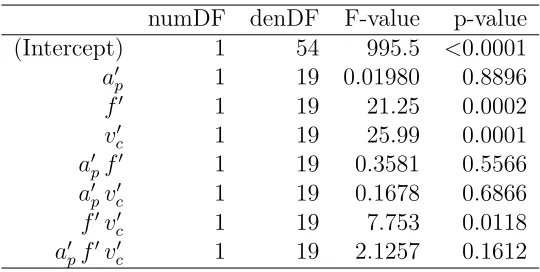
138
any actual machining, the efficiency ratio can therefore suggest to the
prac-139
titioner whether the flow rate and the inlet temperature of the coolant may
140
need increasing or decreasing in order to balance the mechanical power and
141
have a thermally steady machining condition. More in general, this study of
142
the efficiency ratio may constitute a stepping stone towards the formulation
143
of a performance objective function (e.g. cost, profit) to be optimised in the
144
newly established penta-dimensional technological space of depth of cut, feed
145
rate, cutting speed, coolant flow rate and coolant inlet temperature.
146
2. Experimental set-up
147
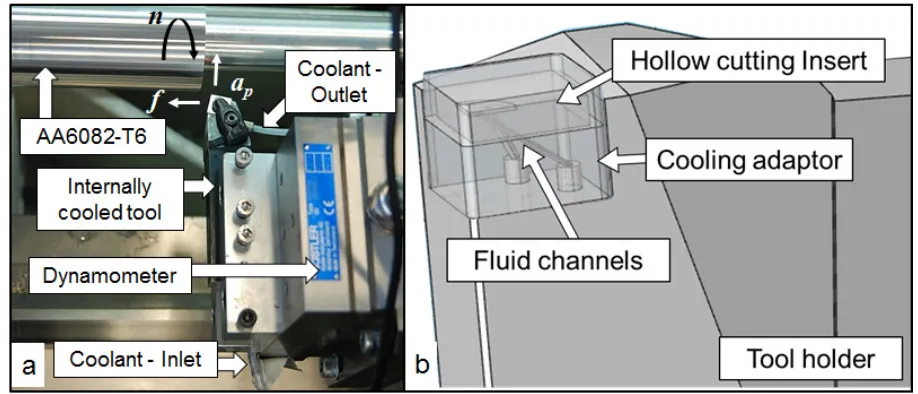
The tool has been assembled and secured to a dynamometer as shown in
148
Figure 1. The dynamometer was a three component Kistler type 9257B
149
which had been attached to the tool turret of an Alpha Colchester Harrison
150
600 Group CNC lathe.
151
[Figure 1 about here.]
The workpiece material chosen for this study was Aluminium 6082-T6
(0.7-153
1.3 % Si and 0.6-1.2 % Mg). This aluminium alloy is readily available and
154
widely used in numerous applications, an additional benefit is the low
me-155
chanical property demands on the tooling insert and therefore yields a low
156
wear rate. A cylindrical workpiece of 65 mm diameter and 450 mm length
157
was used. The internally cooled tool was enhanced in its measuring
capabil-158
ity by mounting K-type thermocouples. These were installed within the inlet
159
and the outlet pipes, close to where these pipes enter the tool body. These
160
sensors measured the inlet/outlet coolant temperatures. They were linked to
161
a PC via a National Instruments NI 9213 thermocouple input device. Data
162
from the thermocouples and the dynamometer were collected and transferred
163
to Labview prior to the analysis.
164
The internally cooled tool was comprised of the tool shank, a cooling adaptor
165
and a hollow insert, as shown in Figure 1. The tool shank was an off the
166
shelf model manufactured by Sandvik (CSBNR 2525M 12-4) which had been
167
enhanced with designed fluid channels machined inside it. The adaptor block
168
has been custom machined in mild steel. The cutting inserts were once
169
again an off the shelf -item produced by Hertel (SNUN 120408, Tungsten
170
Carbide WC with 6 % Cobalt). These were modified using electro discharge
171
machining to create a hollow with a 1 mmwall thickness. The coolant was
172
flowing from a central reservoir which contains approximately one litre of
173
coolant. From here it flowed through silicone tubing to a micro-diaphragm
174
pump from KNF-Neuberger (NFB 60 DCB). Upon exiting the pump, the
175
coolant then flowed to and around the part of the circuit enclosed within the
176
tool and finally back to the reservoir.
The volume flow rate of the coolant (Q) was approximately 0.3 L/min for all
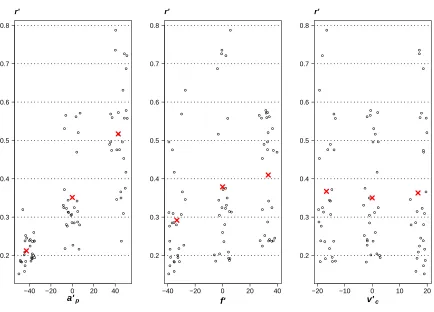
178
the tests, i.e. in SI units Q = 0.3/60 000 m3/s. The coolant was a 25 % in 179
volume liquid solution of Ethylene Glycol in water. The specific heat (Cp) 180
and the density (ρ) of the coolant were considered essentially constant and
181
approximately equal to 3850 J/kg K and 1040 kg/m3, respectively. The 182
choice of using a 25 % Ethylene Glycol aqueous solution rather than water
183
was conservatively made to benefit from the ebullioscopic elevation of the
184
boiling point of the mixture. A bi-phase vapor-liquid flow within the
inter-185
nal microfluidics structures is in this way slightly less likely to take place.
186
This choice however adversely affects the efficiency of the cooling system.
187
For the same volume flow rate and for the same increment of temperature,
188
a coolant comprised of the Ethylene Glycol solution would exchange heating
189
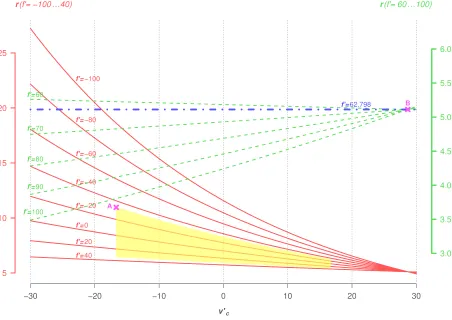
power with the insert less than water would do. In the range of the tested
ex-190
perimental conditions, clean water has in fact comparable density but higher
191
specific heat than the mixture used (approximately ρwater = 1000 kg/m3 and 192
Cp,water = 4184 J/kg K , albeit they both are not constant).
193
3. Design of the Experiment
194
The temperature of the coolant at the inlet (Tin) and at the outlet (Tout) 195
of the insert, together with the cutting and the thrust forces (Fc and Ft, 196
respectively) were measured in a set of experimental conditions defined by
197
three technological variables: the depth of cut (ap), the feed rate (f) and 198
the cutting speed (vc). These variables assume numerical values. They have 199
been therefore considered as continuous rather than categorical variables.
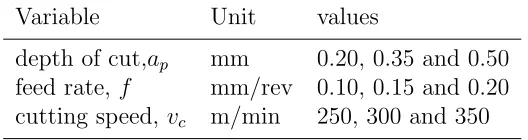
Each variable was assigned three values (Table 1). Thus a limited region was
201
identified in the space (ap, f, vc). 202
[Table 1 about here.]
203
Cutting trials were performed in the resulting 33
experimental conditions
204
(treatments). In each treatment, the cutting test was replicated three times.
205
thus the total number of tests accrued to 81. A unique label was given
206
to each treatment. Then, a permutation of the 27 labels was randomly
207
generated out of 27! possible label permutations. The treatments were run
208
in the order defined by such a permutation. All the three cutting trials
209
for a given treatment were performed in the same machine set-up. A full
210
randomisation of the cutting tests would have requested a new machine
set-211
up (different or equal to the latest) for each single cutting test. The set-up
212
time of the machine made a full randomisation of the 81 tests impracticable.
213
4. Modelling and Analysis
214
The thermal power exchanged between the coolant and the insert during
ma-215
chining ( ˙Q) causes the temperature of the coolant at the insert outlet (Tout) 216
to be higher than at the insert inlet (Tin, which is approximately equal to the 217
ambient temperature). By the application of the first law of thermodynamics
218
to the open system made of the coolant flowing in the microfluidic structures
219
within the insert, the following equation is derived for the steady state:
220
˙
From the measurements of the cutting force (Fc) and the thrust force (Ft), the 221
cutting powerPc =Fc (vc/60) and the thrust powerPt=Ft (f /1000) (n/60) 222
were calculated. In these expressions, n denotes the angular speed of the
223
blank in revolutions per minute, whereas the other coefficients have been
224
introduced to express the power in watt. To explore the relationship between
225
the efficiency of the internally-cooled tool and the machining conditions, a
226
definition of efficiency ratio r is introduced as follows:
227
r = 100 Q˙
Pc+Pt
(2)
In equation (2), the efficiency ratio r represents the percentage of the power
228
needed to remove material from the blank that is thermally transferred by the
229
flow of the internal coolant. Alternatively, r can be described as the scaled
230
ratio of the heat transfer rate associated with the flow of the coolant and the
231
mechanical power used at the tool to remove material from the workpiece.
232
In other words, The coefficient r does not represent some measurement of
233
efficiency of the cutting process, but a measurement of efficiency of the
in-234
ternal cooling system. The idea behind this approach is that the internal
235
cooling apparatus is more efficient the more thermal power it can remove
236
from the system tool/chip/workpiece per unit of power in input to such a
237
system, regardless of how this input power is then distributed between the
238
workpiece, the chip and the tool. In this view, the efficiency of a machine
239
tool in converting electrical power into mechanical power available at the tool
240
is also not relevant.
241
A specific efficiency ratio r’ is also introduced as follows:
242
Ps =
Pc+Pt
(ap/1000) (f /1000) (vc/60)
r′ = 100Q/Q˙
Ps
(4)
The numerical coefficients in Equation (3) were introduced to convert the
243
measured technological variables to the si units (m, m/rev and m/s). In 244
equation (4), the ratio r’ represents the percentage of the total machining
245
power per unit of volume (m3) of material removed from the blank in the unit 246
of time (s) that is thermally dissipated by a unit of volume flow rate (m3/s) 247
of the coolant. Both the dimensionless ratios r and r’ have been considered
248
as two response variables separately analysed. The measuring procedure for
249
r and r’ is the same for all the treatments.
250
Improving the efficiency merit by increasing the coolant mass flow rate ( ˙m=
251
Qρ), by identifying more efficient coolant fluids (with higher Cp), by refrig-252
erating the coolant (i.e. reducing Tin in Equation (1)) are all actions that 253
can be thought of, but that were not within the scope of this study. Hence
254
such actions were not taken. For example, the usage of cryogenic media such
255
as nitrogen and carbon dioxide has been reported in other cooling systems
256
such as high pressure jet cooling systems (cf page 311 – 338 in [19]).
Op-257
posite to the internally-cooled tool presented in this investigation, in those
258
systems the cryogenic coolant is a consumable: it evaporates rather than
259
being re-circulated in a closed-loop.
260
The parameters involved in the construction of a statistical model may
261
have desirable statistical proprieties if the independent variables are centred
262
around zero. Typically, intercepts and slopes are more likely to be
uncorre-263
lated if the independent variables are centred (cf. for example Pinheiro and
264
Bates [20], page 34). Also, dimensionless independent variables facilitate the
transformation of the data, which is often necessary in the construction of a
266
model. For these reasons, dimensionless, centred, independent variables were
267
defined as follows:
268
a′
p = 100
ap−0.35
0.35 ; f
′ = 100f−0.15
0.15 ; v
′
c = 100
vc−300
300 (5)
The equations (5) define the per cent deviations from the central point
269
(ap,c, fc, vc,c) = (0.35 mm, 0.15 mm/rev, 300 m/min), which is the centre of 270
the investigated region in the space of the technological variables.
271
[Figure 2 about here.]
272
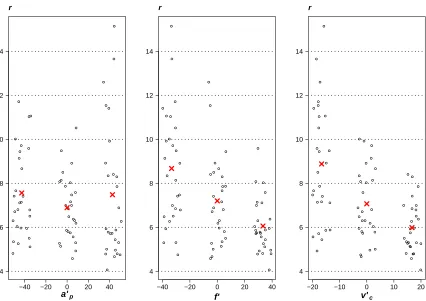
The diagram of the ratio r versusa′
p, f′ and vc′ is displayed in Figure 2. The 273
abscissae of the data have been increased by a random amount to avoid
over-274
lapping points and thus increasing the readability of the figure (a procedure
275
called jittering). In the same figure the sample mean of the data for each
276
value of the pertinent independent variable has been designated by a cross.
277
A qualitative visual analysis of Figure 2 raises the suspicion that the
dimen-278
sionless depth of cut a′
p does not significantly affect the efficiency ratio r, 279
whereas the dimensionless feed rate f′ and the dimensionless cutting speed 280
v′
c may do. When either f′ or vc′ increases the efficiency ratio r’ appears to 281
deteriorate. Also, the variability ofr may be significantly inflated at higha′
p,
282
low f′ and low v′
c. Interaction plots (not shown here for brevity) were also 283
constructed but they did not exhibit any pattern either strongly pointing to
284
or strongly ruling out any significant second order interaction.
285
Running the experiment in 27 experimental units (alias blocks), each
coin-286
cident with a treatment, suggests introducing a random effect in the model
to account for physical events or circumstances that may lurk within an
ex-288
perimental unit while the tests are performed. For example, the portion of
289
the blank being machined in an experimental unit may have micro-structural
290
and mechanical proprieties slightly different from those of other experimental
291
units. Without the introduction of a random effect, the likely effect of these
292
properties on the measured response would then be unduly attributed in part
293
to the independent variables.
294
A preliminary tentative model of the experimental data is as follows:
295
rijkl =β0+β1a′p,i+β2fj′+β3vc,k′ +β4a′p,ifj′+β5a′p,iv′c,k+β6fj′v′c,k+β7a′p,ifj′vc,k′ +bijk+εijkl
(6)
where the subscripts i = 1, . . . ,3, j = 1, . . . ,3, k = 1, . . . ,3 and l = 1, . . . ,3
296
represent the different depths, feed rates, cutting speeds and replications
297
of the tests, respectively. The β’s are eight unknown parameters of the
298
model, bijk’s are the 27 non-observable random variables associated with the 299
corresponding experimental units, εijkl are the 81 non-observable random 300
variables that model the random error. It is then assumed that all the random
301
variables in equation (6) are independent, identically distributed and normal
302
with constant variance, namely: bijk ∼ N(0, σb2), εijkl ∼ N(0, σ2), where 303
the standard deviationsσb and σ are two further unknown parameters of the 304
model. Under these assumptions, the ten model parameters are estimated
305
using the maximum likelihood method (ml) as implemented in the library
306
nlme [21, 20] of r, a free language and run-time environment for statistical 307
computing and graphics [22]. The significance of the terms associated to the
308
technological variables that enter Equation (6) by the β’s has been tested
309
sequentially in the order they appear in the model and conditionally on the
estimate of σb (cf. Pinheiro and Bates [20], 89-92). A term is added in the 311
model only if such an inclusion reduces significantly the variability of the
312
predicted errors. The test was performed using the anova() function of the
313
nlme library.
314
[Table 2 about here.]
315
The results of the tests displayed in Table 2 support the conclusion that
316
Equation 6 does not fit the data any better than the following simpler model
317
equation, which is thus to be preferred:
318
rijkl =β0+β2fj′ +β3vc,k′ +bijk+β6fj′vc,k′ +εijkl (7)
The library nlme allows the experimenters to predict the observed response
319
values by the fitted model, both at population level, i.e. ˆE [rijkl] = ˆE [rij] = 320
ˆ
β0+ ˆβ2fj′+ ˆβ3vc,k′ + ˆβ6fj′v′c,kand at experimental unit level, i.e. ˜E [rijkl|bijk] = 321
˜
E [rijk|bijk] = ˆβ0 + ˆβ2fj′ + ˆβ3vc,k′ + ˆβ6fj′vc,k′ + ˜bijk (with E[X] designating 322
the expected value of X, ˆα the estimate of the parameter α and ˜X, the
323
predictor of the random variable X). In this second case, the best linear
324
unbiased predictors ˜bijk of the random effects are also calculated (BLUEs, 325
cf. Pinheiro and Bates [20], 94). In turn, predictions of the non-observable
326
errors can thus be computed and are usually referred to as residuals, namely:
327
˜
εijkl = rijkl −E [˜ rijk|bijk]. Departures from the hypotheses underlying the 328
model are diagnosed by the graphical analysis of the residuals.
329
[Figure 3 about here.]
330
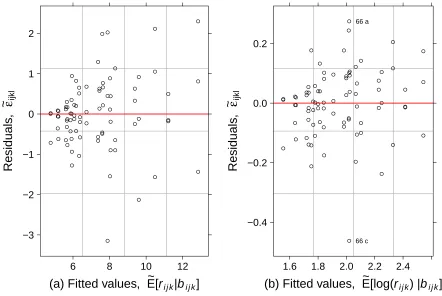
In part (a) of Figure 3 the dispersion of the residuals around the zero appears
331
to increase with the values fitted by the model of Equation (7). Such an
observation is inconsistent with the assumed equal variance of the errors (σ2). 333
To overcome the violation of this hypothesis, the response is logarithmically
334
transformed in the following new model:
335
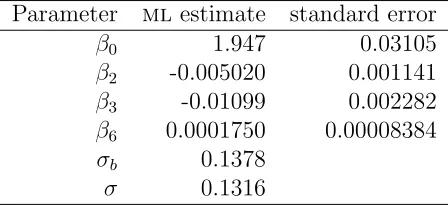
log(rijkl) =β0+β2fj′+β3vc,k′ +β6fj′vc,k′ +bijk+εijkl (8)
An equivalent representation of equation (8) is given by its multiplicative
336
form:
337
rijkl =eβ0eβ2f
′
jeβ3v′c,k
eβ6fj′vc,kebijkeεijkl (9)
More details regarding suitable transformations of the response to overcome
338
observed departures of the assumed homoscedasticity of the errors in the
339
case of linear models are presented by Faraway (cf pages 53–58 in [23]). The
340
parameters in Equation (8) and (9) have been estimated as in the previous
341
cases using thenlme library (Table 3). The adequacy of the fitted model has
342
been assessed with the Akaike Information Criterion (AIC), formally defined
343
by AIC =−2 logLik + 2npar, where logLik = 29.70 is the log-Likelihood of 344
the fitted model (i.e. the maximum log-Likelihood) andnpar= 6 is the num-345
ber of parameters estimated in the model, thus AIC =−47.39 (cf Pinheiro
346
and Bates [20], pages 10, 83, 84).
347
[Table 3 about here.]
348
In part (b) of Figure 3 the residuals of the model involving the log-transformed
349
efficiency ratio r appear to have a dispersion around zero that is markedly
350
less dependant on the fitted values than in the original model with
untrans-351
formed response (part (a) of Figure 3). Also, two residuals labelled ‘66 a’
352
and ‘66 c’ in part (b) of the same figure are noticeably lying quite far apart
from the majority of the others. The two labels indicate that these two
resid-354
uals have been obtained as the first and third replicate of the treatment 66,
355
which corresponds to ap = 0.5 mm, f = 0.1 mm/rev and vc = 300 m/min 356
(a′
p = 42.86, f′ = −33.34, vc′ = 0). No specific reason has been identified 357
for the two associated experimental results to cause this outlying situation.
358
Thus there was no reason for excluding the two experimental results from
359
the analysis. Moreover, even doing so, the resulting fitted model did not lead
360
to significantly different estimates of the parameters. Namely, the confidence
361
intervals for corresponding parameters in the two models were overlapping.
362
The fact that these two residuals were obtained in the same experimental
363
unit instils the suspicion that the uncontrollable unknown reason causing
364
the outlying of the two residuals may be related to the specific experimental
365
unit. In this sense, the two outlying residuals reinforce the motivations for
366
introducing the random effects bijk in the model of the experimental results. 367
Without random effects as in the following model equation:
368
log(rjk) = β0+β2fj′ +β3v′c,k+β6fj′vc,k′ +εjk (10)
the residuals appear inconsistent with the assumption of errors (εijkl) char-369
acterised by zero mean and equal variance.
370
[Figure 4 about here.]
371
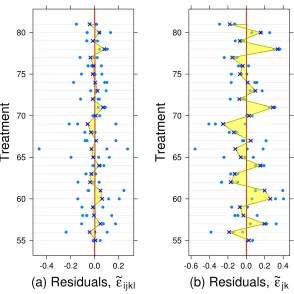
In Figure 4, when the random effects bijk are part of the model (cf. part (a) 372
of the figure), the three residuals corresponding to each experimental
condi-373
tion (treatment) have a sample mean that is close to zero. Otherwise, they
374
have not (cf. part (b) of the figure). The deviation of such a sample mean
375
from zero is what the random effect of a treatment is specifically meant to
account for. Moreover, in part (b) of the figure, 15 of these sample means
377
are negative, whereas 12 are positive. This symmetry in the distribution of
378
the realised random effects is consistent with the assumed normality of the
379
random effects. Q-Q plots have also been constructed and did not contradict
380
dramatically the assumed normality of both residuals and random effects for
381
the model of Equation (8). The figures were not included for sake of brevity.
382
In addition, in Figure 4 the dispersion of the realised residuals around their
383
mean is visibly smaller when the random effects are included in the model
384
(part (a) of the figure). All these qualitative observations have been
substan-385
tiated by testing the hypothesisσb = 0. Under the not-disproved assumption 386
of normality of both random effects and errors, a likelihood ratio test was
387
conducted using a Monte Carlo approach. A short script was implemented
388
in r to obtain an empirical distribution of the test statistics. 50 000 realisa-389
tions of the test statistics were simulated in pseudo-random numerical tests.
390
The p-value obtained was less than 0.00002 and led therefore to reject the
391
hypothesis σb = 0. 392
The values of the specific efficiency ratio r’ versus the dimensionless
techno-393
logical variablesa′
p,f′ andvc′ are displayed in Figure 5. From the observation 394
of this figure, there is some strong suspicion that the specific efficiency
ra-395
tio r’ increases substantially with the dimensionless depth of cut. Possibly,
396
also increments of the dimensionless feed rate may moderately improve r’,
397
whereas the dimensionless speed of cut appears as hardly having any effect
398
on r’. In Figure 5 it can also be noticed that increasing the dimensionless
399
depth of cuta′
p appears to inflate the dispersion of ther’ values around their 400
a′
p mean.
[Figure 5 about here.]
402
A quantitative analysis confirmed these initial intuitions. By following the
403
same methods and procedures as in the case of the efficiency ratio r, Such
404
an analysis ultimately led to the following model equation:
405
log(r′
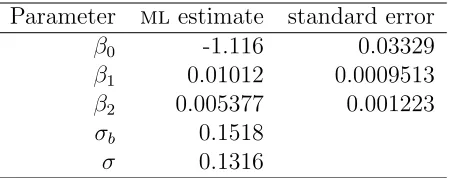
ijkl) =β0+β1a′p,i+β2fj′ +bijk+εijkl (11)
The ml estimates of the parameters for the model in Equation (11) are
406
displayed in Table 4. The corresponding AIC is -45.28, the maximum
log-407
Likelihood is 27.64 and npar = 5. 408
[Table 4 about here.]
409
5. Discussion
410
The fixed effects part of the model of Equation (8) and (9) allows predictions
411
to be made regarding the typical efficiency ratio ˆE [rijkl] when the technolog-412
ical variables are set within the experimental region investigated. Figure 6
413
provides an operational graphical representation of this model to assist its
414
interpretation.
415
[Figure 6 about here.]
416
In such a figure, the yellow or light-grey transparent area respectively in
417
colour and black-and-white print represents the region of the technological
418
parameters experimentally explored. For any dimensionless feed rate in that
419
area, increasing the cutting speed deteriorates the expected efficiencyr. The
420
maximum expected efficiency ratio in the area is 10.96 % and is obtained
at the minimum feed rate and minimum cutting speed investigated (point
422
A, at the corner of the yellow/light-grey region in Figure 6). The variable
423
v′
c enters the model with a coefficient that is approximately the double in 424
absolute value of that associated with f′ ( ˆβ
3/βˆ2 ∼= 2). This supports the 425
idea that the efficiency ratio r is more sensitive to per cent variations in
426
cutting speed rather than in feed rate. The positive interaction coefficient
427
( ˆβ6) is about one fifth of that of f′ and one tenth of that of v′c (both taken 428
in absolute value). Hence for positive f′ the degree of sensitivity of the 429
expected efficiency ratio r to v′
c is slightly less than what implied by ˆβ3 430
alone. In the experimental region investigated, however, this sensitivity to
431
v′
c is always larger than that to f′. When both f′ and vc′ are positive or 432
both are negative, the increment in efficiency ratio obtained by reducing
433
both f′ and v′
c is less than the sum of the increments that can be obtained 434
by reducing f′ and v′
c separately. The situation is reversed when f′ and 435
v′
c are of opposite sign. Any statement based on the extrapolation of the 436
model outside of the experimental region investigated needs per se further
437
experimental campaigns to be substantiated. However, an examination of
438
the behaviour of the model outside the region investigated experimentally
439
(the yellow/light-grey highlighted area in Figure 6) may assist the planning
440
of future experiments. In Figure 6, it is observed that when considering
441
f′ < −33.333 the sensitivity of the expected efficiency to the cutting speed 442
is increased greatly. When instead 33.333 < f′ < 62.798, increments in 443
cutting speed still decrease the efficiency, but less and less. The value ¯f′ = 444
−βˆ3/βˆ6 = 62.798 is where any vc′ is expected to be equally efficient, namely 445
¯
r =eβˆ0− ˆ
β2βˆ3
ˆ
r is increasing and no longer descreasing with v′
c. The effect of vc′ on the 447
efficiency ratio is reversed because of the interation term in the model. The
448
point B in Figure 6 is the stationary saddle point of the model.
449
The above analysis indicates that in the investigated area and likely in large
450
areas beyond it (up to f′ <62.798), the cooling system is more efficient, the 451
smaller the cutting speed and the feed rate are. Hence, the cooling system
452
is more efficient the smaller the mechanical power needed for the machining
453
operation is. A decrease in machining power is accompanied with a less than
454
proportional decrease in power dissipated by the cooling system.
455
Opposite to the case of the efficiency ratio r, the expected values of the
456
specific efficiency ratio r’ synthesised in Equation (11) do not exhibit any
457
dependence on the cutting speed v′
c. They do however display a dependence 458
on the depth of cut a′
p which does not exist for the ratio r. In contrast 459
with the ratio r, the log-transformed specific efficiency r’ does appear to be
460
linear in the significant independent variables. Otherwise stated, there is no
461
significant interaction between the two independent variables.
462
The model of Equation (11) shows that a unit volume flow rate of coolant
463
dissipates more thermal power out of the mechanical power needed to
gener-464
ate a unit volume flow rate of chip when the depth of cut and the feed rate
465
are larger. This conclusion seems consistent with the intuition that when
466
the contact tool-workpiece is larger the thermal exchange between workpiece
467
and tool is facilitated. Therefore more power can be dissipated into the tool
468
and then into the cooling system. Large depths of cut and large feed rates
469
increase the theoretical cross section of the chip (i.e. the cross section prior to
actual removal of the chip from the part). So therefore they do increase the
471
contact region tool-workpiece. The expected specific efficiency r’ is sensitive
472
to variations of depth of cut approximately twice as much it is to variations
473
of feed rate ( ˆβ1/βˆ2 ∼= 2). Whereas the depth of cut does not have any signif-474
icant effect on the efficiency r, increasing it appears to improve the specific
475
efficiency r’.
476
6. Conclusions
477
Microfluidic structures internal to the tool have been designed and
manufac-478
tured to convey the flow of coolant in the near proximity of the cutter edge.
479
The part and the coolant never enter in contact. Contamination of the part
480
by molecules of the coolant is thus prevented.
481
The designed and manufactured internally-cooled tool system enabled heat
482
transfer from the cutting zone of the insert to the flow of the liquid coolant.
483
Measurements of cutting force, thrust force, coolant temperature at the inlet
484
and at the outlet of the tool system were taken in a 33experimental conditions 485
defined by the depth of cut, the feed rate and the cutting speed. Each
486
condition was replicated three times.
487
An efficiency ratior and a specific efficiency ratior’ were respectively defined
488
as the percentage of the whole machining power that is transferred to the
489
coolant and as the percentage of machining power per volumetric flow rate
490
of material removed that is transferred to a unit volume flow rate of the
491
coolant.
Linear mixed-effects statistical models were fitted to the experimental results
493
using the maximum likelihood method. The analysis revealed that the
effi-494
ciency ratio r depends exponentially on the cutting speed and on the feed
495
rate, whereas it does not depend on the depth of cut. Within the
investi-496
gated experimental region, the less the cutting speed and the feed rate are,
497
the higher the expected efficiency ratios r are. The maximum expected
effi-498
ciency is therefore obtained at fmin = 0.10 mm/rev and vc,min = 250 m/min 499
and is equal to 10.96 %. A significant interaction effect of cutting speed and
500
feed rate on the efficiency ratio r was also identified. The specific efficiency
501
ratio r’ was instead found exponentially depending on the depth of cut and
502
the feed rate with no significant interaction effect. In other words, the log(r′) 503
was found to be linearly increasing with the depth of cut and the feed rate.
504
Acknowledgements
505
This study is dedicated to the memory of Gualberto Ricci Curbastro for
506
no small amount of personal inspiration. The investigation was performed
507
within the scope of the collaborative research project ‘Self-learning control of
508
tool temperature in cutting processes’(ConTemp) funded by the European
509
Commission 7th Framework Programme (Contract number:
NMP2-SL-2009-510
228585). The authors gratefully acknowledge the committed support of all
511
the technical staff in the AMEE Department at Brunel University. Particular
512
gratitude goes to Mr Paul Yates for his help in the cutting trials.
513
[1] V. P. Astakhov, The assessment of cutting tool wear, International
Jour-514
nal of Machine Tools and Manufacture 44 (6) (2004) 637 – 647.
[2] J. M. Longbottom, J. D. Lanham, Cutting temperature measurement
516
while machining a review, Aircraft Engineering and Aerospace
Tech-517
nology 77 (2005) 122–130.
518
[3] E. M. Trent, P. K. Wright, Chapter 5 - heat in metal cutting, in:
519
Metal Cutting (Fourth Edition), fourth edition Edition,
Butterworth-520
Heinemann, Woburn, 2000, pp. 97 – 131.
521
[4] Y. Quan, Z. He, Y. Dou, Cutting heat dissipation in high-speed
machin-522
ing of steel based on the calorimetric method, Frontiers of Mechanical
523
Engineering in China 3 (2) (2008) 175–179.
524
[5] A. Basti, T. Obikawa, J. Shinozuka, Tools with built-in thin film
thermo-525
couple sensors for monitoring cutting temperature, International Journal
526
of Machine Tools and Manufacture 47 (5) (2007) 793 – 798.
527
[6] G. Cohen, P. Gilles, S. Segonds, M. Mousseigne, P. Lagarrigue, Thermal
528
and mechanical modeling during dry turning operations, The
Interna-529
tional Journal of Advanced Manufacturing Technology 58 (1-4) (2012)
530
133–140.
531
[7] H. Young, T. Chou, Investigation of edge effect from the chip-back
tem-532
perature using IR thermographic techniques, Journal of Materials
Pro-533
cessing Technology 52 (24) (1995) 213 – 224.
534
[8] N. Jeffries, R. Zerkle, Thermal analysis of an internally-cooled
metal-535
cutting tool, International Journal of Machine Tool Design and Research
536
10 (3) (1970) 381 – 399.
[9] C. Ferri, T. Minton, S. Bin Che Ghani, K. Cheng, Internally-cooled tools
538
and cutting temperature in contamination-free machining, Proceedings
539
of the Institution of Mechanical Engineers, part C: Journal of
Mechani-540
cal Engineering Science(accepted for publication. OnlineFirst, 13 March
541
2013). doi:10.1177/0954406213480312.
542
[10] J. C. Rozzi, W. Chen, E. E. J. Archibald, Indirect cooling of a cutting
543
tool, USA Patent US 8,061,241 B2 (2011).
544
[11] L. E. A. Sanchez, V. L. Scalon, G. G. C. Abreu, Cleaner machining
545
through a toolholder with internal cooling, in: Proceedings of the 3rd
546
International Workshop Advances in cleaner production, Vol. 3, San
547
Paulo, 2011.
548
[12] L. Liang, Y. Quan, Z. Ke, Investigation of tool-chip interface
temper-549
ature in dry turning assisted by heat pipe cooling, The International
550
Journal of Advanced Manufacturing Technology 54 (1-4) (2011) 35–43.
551
[13] S. Shu, S. Chen, K. Cheng, Investigation of a novel green internal cooling
552
in turning application, in: Electronic and Mechanical Engineering and
553
Information Technology (EMEIT), 2011 International Conference on,
554
Vol. 3, 2011, pp. 1156–1159.
555
[14] E. Uhlmann, P. F¨urstmann, M. Roeder, S. Richarz, F. Sammler, Tool
556
wear beaviour of internally cooled tools at different cooling liquid
tem-557
peratures, in: Proceedings of the 10th Global Conference on Sustainable 558
Manufacturing, Istanbul, Turkey, 2012.
[15] G. F. Micheletti, Tecnologia Meccanica - Il taglio dei metalli, Vol. 1,
560
UTET, 1977, (in Italian).
561
[16] G. Boothroyd, Temperatures in orthogonal metal cutting, Proceedings
562
of the Institution of Mechanical Engineers 177 (29) (1963) 789–810.
563
[17] E. M. Trent, P. K. Wright, Chapter 9 - machinability, in: Metal
Cut-564
ting (Fourth Edition), fourth edition Edition, Butterworth-Heinemann,
565
Woburn, 2000, pp. 251 – 310.
566
[18] J. Kopac, M. Sokovic, S. Dolinsek, Tribology of coated tools in
conven-567
tional and {HSC} machining, Journal of Materials Processing
Technol-568
ogy 118 (13) (2001) 377 – 384.
569
[19] E. M. Trent, P. K. Wright, Metal Cutting, 4th Edition,
Butterworth-570
Heinemann, Oxford, 2000.
571
[20] J. C. Pinheiro, D. M. Bates, Mixed-Effects Models in S and S-Plus,
572
Springer, 2000.
573
[21] J. Pinheiro, D. Bates, S. DebRoy, D. Sarkar, R Development Core Team,
574
nlme: Linear and Nonlinear Mixed Effects Models, r package version
575
3.1-103 (2012).
576
[22] R Development Core Team, R: A Language and Environment for
Sta-577
tistical Computing, R Foundation for Statistical Computing, Vienna,
578
Austria (2011).
579
[23] J. J. Faraway, Linear Models with R, 1st Edition, Texts in Statistical
580
Science, Chapman & Hall/CRC, 2004.
List of Figures
582
1 (a) The experimental set-up for the cutting trials. (b) A 3-D
583
model of the assembled internally cooled tool system. . . 29
584
2 The ratio r versus the dimensionless technological variables
585
a′
p, f′ and v′c. The abscissae have been jittered. The cross 586
designates the sample mean for each of the three groups of
587
data in each panel. . . 30
588
3 Residuals versus fitted values (alias predicted values) (a) of
589
the simplified model (Equation (7)) (b) of the log-transformed
590
simplified model (Equation 8 or 9). . . 31
591
4 The realisations of the non-observable residuals versus the
val-592
ues fitted by (a) the model that includes the random effects
593
(Equation 8) (b) the model that does not include the
ran-594
dom effects (Equation 10). The average for each treatment is
595
identified by the points ’X’. The shadow area underlying the
596
segments joining these averages facilitate the visualisation of
597
the different amount of violation of the assumed zero mean for
598
errors of the two models. . . 32
599
5 The ratio r’ versus the dimensionless technological variables
600
a′
p, f′ and v′c. The abscissae have been jittered. The cross 601
designates the sample mean for each of the three groups of
602
data in each panel. . . 33
603
6 The expected value of the efficiency ratio r versus the
di-604
mensionless cutting speed v′
c for selected f′ values ranging 605
from -100 to 100. The highlighted area in yellow/light-grey
606
in colour/black-and-white print represents the experimental
607
region investigated. The point A identifies the maximum
ef-608
ficiency in that area. The point B identifies the stationary
609
saddle point. The thicker dotted and dashed line is horizontal
610
(iso-efficient line). . . 34
−40 −20 0 20 40 4
6 8 10 12 14
a’p
r
−40 −20 0 20 40
4 6 8 10 12 14
f’ r
−20 −10 0 10 20
4 6 8 10 12 14
v’c
[image:31.595.124.550.190.491.2]r
Figure 2: The ratio r versus the dimensionless technological variablesa′
p, f′ andvc′. The
(a) Fitted values, E~[ri j k|bi j k]
Residuals
,
ε
~ ijkl
−3 −2 −1 0 1 2
6 8 10 12
(b) Fitted values, E~[log(ri j k) |bi j k]
Residuals
,
ε
~ ijkl
−0.4 −0.2 0.0 0.2
1.6 1.8 2.0 2.2 2.4
66 a
[image:32.595.111.553.204.500.2]66 c
(a) Residuals,
~
ε
ijklTreatment
55 60 65 70 75 80
-0.4 -0.2 0.0 0.2
(b) Residuals,
~
ε
jkTreatment
55 60 65 70 75 80
[image:33.595.115.409.215.509.2]-0.6 -0.4 -0.2 0.0 0.2 0.4
−40 −20 0 20 40 0.2
0.3 0.4 0.5 0.6 0.7 0.8
a’p
r’
−40 −20 0 20 40
0.2 0.3 0.4 0.5 0.6 0.7 0.8
f’ r’
−20 −10 0 10 20
0.2 0.3 0.4 0.5 0.6 0.7 0.8
v’c
[image:34.595.118.552.186.498.2]r’
Figure 5: The ratior’ versus the dimensionless technological variablesa′
p,f′andv′c. The
Figure 6: The expected value of the efficiency ratiorversus the dimensionless cutting speed
v′
cfor selectedf
′values ranging from -100 to 100. The highlighted area in yellow/light-grey
List of Tables
612
1 Technological variables and their values. . . 36
613
2 Sequential tests of the hypotheses for the significance of the
614
independent variables and their interactions both listed in the
615
first column. ‘numDF’ and ‘denDF’ are the numerator and
616
denominator degrees of freedom, respectively. The p-values
617
are expressed in fractions of the unity rather than in per cent. 37
618
3 mlestimates of the parameters for the model with Equation 8
619
or 9. For the estimators of theβ’s the standard errors are also
620
shown. . . 38
621
4 ml estimates of the parameters for the model with
Equa-622
tion 11. For the estimators of the β’s the standard errors
623
are also shown. . . 39
Table 1: Technological variables and their values.
Variable Unit values
depth of cut,ap mm 0.20, 0.35 and 0.50
feed rate, f mm/rev 0.10, 0.15 and 0.20
numDF denDF F-value p-value
(Intercept) 1 54 995.5 <0.0001
a′
p 1 19 0.01980 0.8896
f′ 1 19 21.25 0.0002
v′
c 1 19 25.99 0.0001
a′
pf′ 1 19 0.3581 0.5566
a′
pv′c 1 19 0.1678 0.6866
f′v′
c 1 19 7.753 0.0118
a′
[image:38.595.170.440.303.439.2]pf′v′c 1 19 2.1257 0.1612
Parameter mlestimate standard error
β0 1.947 0.03105
β2 -0.005020 0.001141
β3 -0.01099 0.002282
β6 0.0001750 0.00008384
σb 0.1378
[image:39.595.193.417.332.435.2]σ 0.1316
Parameter mlestimate standard error
β0 -1.116 0.03329
β1 0.01012 0.0009513
β2 0.005377 0.001223
σb 0.1518
[image:40.595.194.419.338.427.2]σ 0.1316