University of Warwick institutional repository: http://go.warwick.ac.uk/wrap
A Thesis Submitted for the Degree of PhD at the University of Warwick
http://go.warwick.ac.uk/wrap/66060
This thesis is made available online and is protected by original copyright. Please scroll down to view the document itself.
Enhancing Teaching and Learning through
Distributed Leadership: a case study in Higher
Education
by
Sarah Edwards
MA Educational Leadership and Innovation
A thesis submitted in partial fulfilment of the requirements for
the degree of
Doctor in Education (EdD)
The University of Warwick, Institute of Education
Table of Contents
Page
Table of Contents ... i
Declaration ...iii
Abstract ... iv
List of Tables ... v
List of Figures ... v
List of Appendices ... vi
List of Abbreviations ... vi
Chapter 1.0 Introduction ... 1
1.1 Background and research rationale ... 1
1.2 Institutional context of the study ... 12
1.3 Overall aim and research questions for the study ... 18
Chapter 2.0 Literature review ... 20
2.1 Chapter introduction ... 20
2.2 Leadership and Higher Education ... 22
2.3 The Higher Education context ... 33
2.4 Distributed Leadership ... 36
2.5 Distributed Leadership – key concepts ... 43
2.6 Teacher Leadership ... 56
2.7 The perceived benefits and challenges of the Distributed Approach ... 69
Chapter 3.0 Methodology ... 82
3.1 Choice of research design ... 83
3.2 The case study approach... 85
3.3 Sampling strategy ... 97
3.4 Data collection and analysis ... 101
Chapter 4.0 Findings and Discussion ... 108
4.1 Data from semi-structured interviews ... 108
4.2 Interviews with academic staff ... 109
4.3 Interviews with staff in formal leadership positions ... 130
4.4 Findings from questionnaire survey ... 141
Chapter 5.0 Further analysis and discussion ... 147
5.1 The influence of HE Policy on teaching and learning.... 148
5.2 The Leadership framework and reflection of Distributed Leadership in Practice ... 157
5.3 Drawing parallels with Teacher Leadership ... 169
5.4 A model for an Effective Leadership Framework ... 182
Chapter 6.0 Conclusions and Recommendations ... 186
6.1 Conceptual Frameworks and the development of Distributed Leadership theory ... 186
6.2 The Political context of HE and influence on Teaching and Learning ... 189
6.3 Formal leadership approached and Distributed Leadership in practice ... 191
6.4 Drawing parallels with Teacher Leadership theory ... 192
6.5 Continuing Professional Development and formal leadership training ... 194
6.6 Recommendations ... 196
References ... 200
Bibliography... 223
Declaration
Enhancing Teaching and Learning through Distributed
Leadership: a case study in Higher Education;
Abstract
List of Tables
Page
Table 1.1 Terms of Reference for Teaching and Learning Group ... 15
Table 2.1 An emerging view of leadership ... 30
Table 2.2 Aspect of Subject Leader roles ... 62
Table 2.3 Distributed leadership in practice... 78
Table 3.1 Questionnaire design and justification ... 94
Table 3.2 Applied presentation of quantitative data ... 104
Table 4.1 Profile and length of service – academic staff ... 109
Table 4.2 Application for a formal leadership role……….124
Table 4.3 Profile and length of service – formal leaders………...…...130
Table 5.1 Evidence aligned with literature – leadership tasks …………...159
List of Figures Figure 1.1 Key themes of the Learning and Teaching Strategy ... 14
Figure 1.2 The Organisational Structure of UC ... 16
Figure 2.1 Theoretical framework for the literature review ... 21
Figure 2.2 Terminologies related to distributed leadership... 42
Figure 2.3 The centrality of distribution ... 43
Figure 2.4 Frameworks of Distributed Leadership ... 51
Figure 3.1 Applied SWOT analysis of positionality ... 87
Figure 3.2 Literature assessment ... 89
Figure 4.1 Probability plot around length of service………..……….141
Figure 4.2 Histogram around information of policy………...142
Figure 4.3 Histogram around strategy……….….143
Figure 4.4 Histogram around developments affecting role………143
List of Appendices
Appendix A Thesis work plan example Appendix B Copy of questionnaire
Appendix C Illustrations of constant comparative enquiry Appendix D Example transcript – formal leadership Appendix E Example transcript – academic staff Appendix F Interview Schedule – academic staff Appendix G AMT sub-groups
List of Abbreviations
UC University College
AMT Academic Management Team SMT Senior Management Team SL Senior Lecturer
HEA Higher Education Academy QAA Quality Assurance Agency NSS National Student Survey KIS Key Information Set
Chapter 1.0 Introduction
1.1 Background and research rationale
This thesis is submitted to satisfy requirements for the Doctorate in Education (Warwick Institute of Education, 2012). The research aims to satisfy the learning outcomes of the Doctoral Programme, whilst developing an in depth understanding of specific areas of interest. Prior to studying for doctoral qualification the author completed the MA Educational Leadership and Innovation, also at the University of Warwick.
The overall aim of this extended study is to critically review the conceptual and empirical literature on Distributed Leadership in order to identify how the approach may be perceived to enhance the learning and teaching function within a given Higher Education setting.
teaching and learning, with the institution providing Further Education through to Masters level courses (UC, 2013). The institution does not take part in the Research Excellence Framework (Research Excellence Framework, 2014); however many of its degrees are accredited by a Russell Group University (Russell Group, 2014).
The Higher Education context
Within the last ten years, policy developments relating to the Higher Education sector have had significant influence on areas such as employability (Leitch, 2006), widening participation (DfES, 2006) and university-business collaboration (Wilson, 2012). However, it has been argued (Bolden, 2011) that none has had a greater impact than the Browne Review (Browne, 2010) in which key approaches to funding brought about the subsequent marketisation of the sector (Molesworth, 2010). The most significant changes were brought about within the framework of the White Paper for Higher Education ‘Students at the heart of the system’, (Department for Business, Innovation and Skills, 2011).
profile of the National Student Survey (National Student Survey, 2013) suggests that teaching in the Higher Education sector will likely be scrutinised like never before.
One specific policy development in this changing environment was the ‘Provision of Information about Higher Education’ (Hefce, 2011). The statement of policy intended to set out how information about HE courses is made more accessible and useful, and also highlighted how the ‘National Student Survey’ would be developed (UC, 2011).
The need for effective leadership
Gosling et al. (2009) suggest that it is crucial that those in the sector are in a position to respond appropriately and effectively to ongoing changes:
Combined with the need to deliver high quality teaching and research and engage more actively with business and the community it is, perhaps, unsurprising that ‘good leadership’ is increasingly espoused as a strategic and operational imperative within the sector.
(Gosling et al, 2009, p5)
of Higher Education in developing countries (Huang, 2007). Alongside these wider issues, many of the empirical studies of leadership in Higher Education are presented as they apply to position and authority. For example, previous accounts have included Smith (2002) who writes about the role of the Head of Department in British Universities, and Pritchard (2000) about developing Managers in Universities and Colleges. More recently, Morley (2013) addresses the role of women and positions of authority in Higher Education leadership.
The study of position and authority, and the resulting ‘power and influence’ (Bolden, 2011) is reflected in the study of the traditional trait, situational and transformational theories of leadership (Northouse, 2013). However, the growth of the concept of ‘greedy work’, (i.e the increased responsibility and complexity that leadership roles represent), has contributed to a renewed and pragmatic interest in sharing leadership responsibility (Harris, 2008). To this end, Distributed Leadership has emerged as a concept whose ‘time has come’ (Gronn, 2008, p141) and one which offers a popular ‘post-heroic’ representation of leadership (Badaracco, cited in Bolden, 2011). Indeed, its popularity has meant that Distributed Leadership ‘has become the normatively preferred leadership model in the 21st century (Bush, 2013).
Since Gronn (2000) outlined the concept of Distributed Leadership in an article entitled ‘Distributed Properties: A New Architecture for Leadership’
inroads into particular areas of theory and practice’ (Bolden, 2011). In part, this is because Distributed Leadership proposes a concept that represents a suitable alternative to the extremes of either leadership as individual agency, or as a result of system design and role structures (Bolden, 2011).
Harris (2008) suggests that a core concept of Distributed Leadership is that:
leadership is not the preserve of the individual, but is a fluid or emergent property rather that a fixed phenomenon. This moves beyond trying to understand leadership through actions and beliefs of single leaders to understanding leadership as a dynamic organisational entity.
(Harris, 2008, p173)
Whilst this approach has seen increased prominence in increasingly complex school structures (Harris, 2009), ‘empirical studies of distributed leadership are still in relatively short supply’ (Harris, 2008, p173). In particular, the research base for Distributed Leadership in Higher Education, compared to the school sector is less prolific.
The Distributed approach is also suggested as one way of working toward shared goals and mobilising leadership across the organisation (ibid). However, ‘whilst the literature increasingly claims that leadership in Universities is widely distributed, how it works in practice is little understood and studied’ (Bolden et al, 2009, p299).
In ‘mobilising leadership across the organisation’ it is important to consider the overall leadership capacity of an organisation. However, empirical studies around Distributed approached in Higher Education have invariably focussed on subjects who are already holding formal leadership positions, such as Deans, and Department Heads. As the authors themselves (Gosling et al, 2009) recognised:
all interviews were conducted with holders of formal academic or administrative posts, ranging from Head of School/Department and School Manager/Administrator to VC and Registrar (or equivalent). In effect, therefore there is a layer of leadership that has not been engaged with (i.e that which occurs below formal leadership at the School/Department level)
(Gosling et al, 2009, p17)
As Bryman (2007) has previously concurred:
These less formal roles have attracted far less attention among higher education leadership researchers who have mainly concentrated on institutional, school/faculty and departmental leadership.
Bryman (2007, p16)
That said, this is an area of emerging research; for example, recent studies have drawn upon the role of Professorial leadership (Evans, 2013) and around the newly created roles of Academic lead (Floyd and Fung, 2013). However, a holistic study of both formal and practitioner level as it pertains to the Distributed approach has not yet been put forward. This study therefore seeks to address this gap in research.
The Distributed Model
In studying leadership in educational establishments, it is acknowledged that the majority of literature around Distributed Leadership has been written in the schools context (see Harris, 2003, Spillane et al., 2004 for examples). In this regard, ‘the ‘so what’ of distributed leadership is the recognition that the core task of the formal leader is to support those with the expertise to lead, wherever they reside within the organisation’ (Harris, 2013, p551). Not surprisingly, interest around the Distributed approach has been growing in respect of addressing the complexities of leading in the Higher Education sector (e.g van Amjeide, et al, 2009, and Gosling et al., 2009). In particular, ‘for formal leaders seeking improved organisational performance and better outcomes the challenge is to create the conditions where professional knowledge and skills are enhanced, where effective leadership exists at all levels, and where the entire organisation is working interdependently in the collective pursuit of better outcomes’ (Harris, 2013, p551). In the context of this particular thesis, the focus of ‘enhancing professional knowledge and skills’ is the teaching and learning function.
Conceptual approach and rationale
positions (ibid). To address this perceived gap in the research, this research engages both those in formal leadership and the academic community. Indeed, as Distributed Leadership is purported to be a collective process which engages ‘all levels’ (Spillane et al., 2004) it seems appropriate that empirical research which takes a multi-level approach will usefully add to the research evidence.
Justification of Key concepts
Whilst the concept of Distributed Leadership provides the main theoretical underpinning for this study, the notion of ‘Teacher Leadership’ has also been considered as there are some important connections and overlaps between distributed leadership and teacher leadership (Harris, 2003). In reviewing this aspect of literature it is noted that Muijs and Harris (2007) suggest that:
Teacher leadership is conceptually closely linked to distributive leadership, but is narrower, being concerned exclusively with the leadership roles of teaching staff, whilst simultaneously being broader than many practical operationalisations of distributed leadership that have often concentrated on formal positional roles.
(Muijs and Harris, 2007, p113)
studies of academic leadership in Higher Education (Bolden et al, 2012). However, whilst studying the MA Educational Leadership and Innovation (University of Warwick), and in particular the theory around Distributed and Teacher Leadership, it was perceived by the author that there were parallels to be drawn between this area of theory and the professional workplace in question.
Richards (2012) in discussing leadership of learning in HE suggests that:
A major distinguishing feature between school-based educational leaders and HE academics is that for the former teaching is core and central to the whole institution and every activity must further that goal. In the case of the latter teaching is only one of the university’s core businesses.
(Richards, 2012, p84)
Countering this, whilst University College operates within the Higher Education sector, teaching is core and central to the whole institution and the primary activity for academic staff is teaching and learning (UC, 2013).
In taking forward any research, it is important that a clear conceptual framework is established. That said, one of the challenges of Distributed Leadership is identifying what is really meant by the term. Hartley (2007, p202) suggests that ‘its conceptual clarity is questionable whilst Harris (2008, p175) recognises that positions of ‘conceptual fluidity’ have meant that distributed leadership can be misleading because of the possibility of ‘meaning all things to all people’ (Spillane, 2006, cited in Harris, 2008, p174). The question also arises as to what Distributed Leadership might actually look like in practice.
As such, the author will attempt to provide a comprehensive framework for key concepts in a systematic literature review before exploring perceived evidence of Distributed Leadership in practice through primary research. The specific approach and resulting methods are further discussed in the Methodology Chapter.
Whilst interest in distributed leadership is intensifying, it is important to recognise the role that further research can play. Bennet et al. (2003) cautioned against the ‘enthusiasm’ of the new concept, suggesting that:
it is important that a sound research programme be established to
examine and influence the ways in which it is developed, and to
assess its effectiveness.
In addition to considering the necessary research programmes required to underpin a ‘new’ concept, one of the most frequent assertions of the ‘new’ thinking about leadership is that context is important (Simkins, 2005). Therefore, in addition to the complex context of the Higher Education sector already outlined, it is thought helpful at this stage to outline the institutional context of the case study.
In considering ethical guidelines for this study (BERA, 2004) and to ensure anonymity, the case study institution shall be referred to as ‘University College’ where appropriate.
1.2 Institutional context of the study
University College has a background of vocational, Higher and Further Education courses, with its origins being traced back to the late Nineteenth Century (Quality Assurance Agency, 2009). Since that time it has undergone a number of key changes; significantly, in 1993, (as result of the 1992 Further and Higher Education Act) the College was removed from the control of the local authority and then became part of the Further Education Sector. This new found independence brought many opportunities including additional funding, together with the ability to increase course provision and student numbers.
financial resources effectively (University College, 2012). In 2002 the College was re-designated as a Higher Education Institution and in 2007 achieved another milestone in being awarded its own taught degree awarding powers by the Privy Council. Most recently, University College has been awarded full University status (Harrison, 2012). The college has approximately 2400 undergraduates enrolled. By 2015, the college aims to increase its numbers to over 3500 undergraduate students, and this combined with postgraduate, Further Education students and the provision of apprenticeships will increase the profile of the college and help maintain competitive advantage.
The Learning, Teaching and Assessment Strategy (UC, 2012) informs the wider strategic planning process, curriculum plans and individual programme plans, whilst supporting a number of other key strategic documents such as the Human Resources Strategy, Research Development Strategy and Widening participation strategy. It contains the mission statement of the college, as well as outlining other commitments that include ‘ensuring that staff are supported to develop appropriate skill sets to meet the needs of UC and its students’ (UC, 2012, p2).
The background for the strategy (UC, 2012) notes that:
Learning and teaching are core activities. University College is committed to supporting its staff in the application or appropriate learning and teaching methods in line with its objective of attaining high quality and excellence in terms of teaching. The quality of learning and teaching has been recognised through independent audit, not least by the QAA and OFSTED.
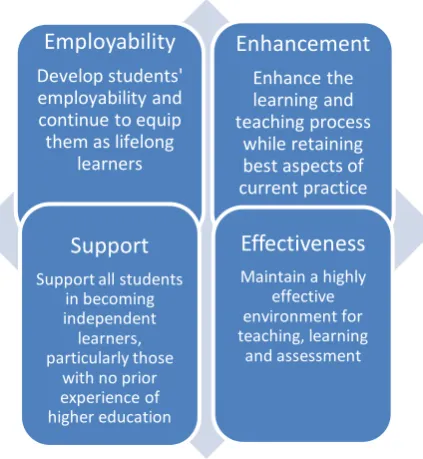
This focus on teaching and learning can be considered at odds with many Higher Education institutions where ‘traditionally research and teaching are usually considered complementary in a university’s raison d’etre’ (Ball, 2007, p451). Four key themes help focus action in relation to the strategy; these are illustrated in Figure 1.1
Figure 1.1 Four key themes of the Learning and Teaching Strategy
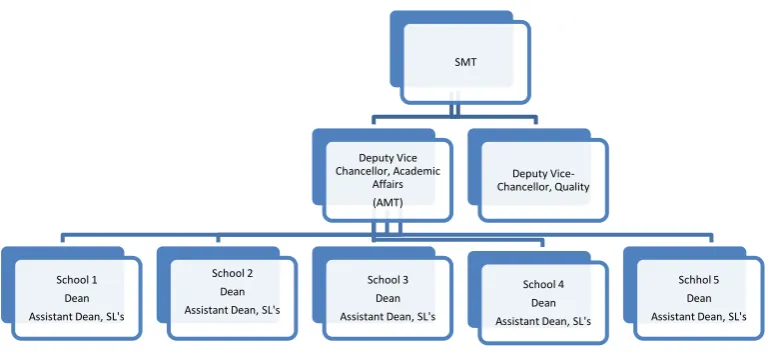
The strategy is operationalized by the Academic Management Team (AMT) of the institution, which in turn is led by the Deputy Vice-Chancellor for academic affairs. It is also worth noting that in part to support the strategy, a number of Senior Lecturer positions (for Teaching and Learning Enhancement) have been recently appointed. The role is intended to concentrate on ‘improving standards and supporting others,
Employability
Develop students' employability and continue to equip them as lifelong
learners Enhancement Enhance the learning and teaching process while retaining best aspects of current practice
Support
Support all students in becoming independent learners, particularly those
with no prior experience of higher education
Effectiveness
Maintain a highly effective environment for teaching, learning
providing expertise, and promoting innovative methods of delivery’ (UC, 2012). These responsibilities are intended to be undertaken whilst working closely with Assistant Deans and teaching groups to enhance quality, question current systems and provide structure to be able to disseminate good practice across University College. In addition, to support the teaching and learning function, a Teaching and Learning Group exists with specific remits outlined in Table 1.1 below.
As mentioned earlier, this study looks at the distributed approach to leadership from a multi-layer perspective. It will encompass interviews from Deputy Vice-Chancellors, Deans and Assistant Deans, alongside academic staff. For the purpose of this study, the role of ‘academic’ may also be presented as ‘Senior lecturer’, ‘Lecturer’, or ‘Programme Manager’, this being titles for those with an academic role within University College. The organisational structure of UC, as it relates to teaching and learning is illustrated in Fig. 1.2.
Table 1. 1 Terms of Reference for Teaching and Learning Group To promote and share effective approaches to learning and teaching across schools
To research and share innovative approaches to learning and teaching To identify practices, resources and environments that enhance
learning and teaching
To consider and raise awareness of different pedagogical approaches To provide a forum to discuss best practice in learning and teaching To support and advise on the use of ICT and e-learning and flexible delivery to enhance learning and teaching
Figure 1.2. The Organisational Structure of UC in relation to Teaching and Learning
The academic role is that of lecturer, tutor and programme manager, each academic having responsibility for a particular course of study at either undergraduate or postgraduate level. Full time teaching staff typically have 22 contact hours each week with students. In addition to teaching, many staff are encouraged to develop their research skills through official programmes at Masters or Doctoral/PhD level, and/or through working with industry partners on a consultancy basis.
By implication, whilst not having any official ‘leadership’ title, academic staff are actively involved in research and consultancy that in turn can affect programme and curriculum development, as well as teaching and programme delivery. It is suggested that they undertake a number of leadership functions that could usefully contribute toward the
SMT
Deputy Vice Chancellor, Academic
Affairs (AMT)
School 1 Dean Assistant Dean, SL's
School 2 Dean Assistant Dean, SL's
School 3 Dean Assistant Dean, SL's
School 4 Dean Assistant Dean, SL's
Schhol 5 Dean Assistant Dean, SL's Deputy
[image:24.595.114.499.173.349.2]development of institutional policy and increased effectiveness in practice. It is also suggested that there are a number of practitioners who demonstrate leadership capacity within their existing roles, but who (for various reasons) choose not to aspire to any formal leadership role i.e ‘reluctant leaders’ (Gleeson and Knights, 2008).
1.3 Overall aim and research questions
Specifically, the overall aim of this study will be to critically review how a Distributed Leadership approach may enhance teaching and learning within a specific UK Higher Education setting.
In order to frame the research, the following research questions are set: 1. What are the existing conceptual frameworks for the study of Distributed Leadership within the context of the UK Higher Education sector?
2. What are the main theoretical characteristics of the Distributed Leadership approach?
3. To what extent might Teacher Leadership theory may be applicable within a Higher Education setting?
4. How might Higher Education Policy around Teaching and Learning influence a Distributed approach within a specific case study setting in Higher Education?
5. How is Distributed Leadership evidenced within Teaching and Learning Practice within the case study setting?
6. What specific measures may enhance how teaching and learning is lead within a specific educational institution?
providing a basis on which to put forward recommendations both for the institution in question and for future research.
Chapter 2.0 - Literature Review
2.1 Chapter Introduction
This literature review aims to bring together and summarise both the empirical evidence and theoretical concepts of the topic areas of study (Punch, 2006). As such, it will seek to address the following research questions;
1. What are the existing conceptual frameworks for the study of Distributed Leadership within the context of the UK Higher Education sector?
2. What are the main theoretical characteristics of the Distributed Leadership approach?
3. To what extent might Teacher Leadership theory may be applicable within a Higher Education setting?
4. How might Higher Education Policy around Teaching and Learning influence a Distributed approach within a specific case study setting in Higher Education?
Thomas (2011) suggests that, in essence, the literature review:
looks at what other enquiries have been done on this (your topic) or related topics and helps you to understand their contribution to your own question.
(Thomas, 2011, p194)
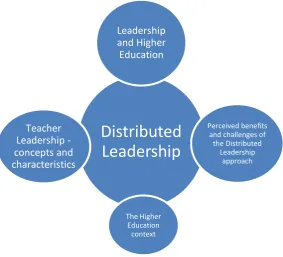
together with empirical evidence from research in this area. It has also been necessary to consider contextual issues around the Higher Education sector. As such, a systematic review of the literature has elicited the following key themes; Leadership and Higher Education; the Higher Education Context; Distributed Leadership; the conceptual frameworks and characteristics of Teacher Leadership, and the perceived benefits and challenges of the Distributed Leadership approach. These themes will be explored within the literature review, and as way of illustration, are shown as a theoretical framework in Figure 2.1 below.
Figure 2.1. Theoretical framework for the literature review
Distributed
Leadership
Leadership and Higher Education
Teacher Leadership - concepts and characteristics
The Higher Education
context
Perceived benefits and challenges of
the Distributed Leadership
2.2 Leadership and Higher Education
Defining Leadership
As outlined in the introduction, ‘good leadership’ is increasingly seen as pivotal in the operational and strategic success of Higher Education institutions (Hefce, 2012). Eastwood (2012), in reviewing the changing nature of the sector, proposed:
the challenge that we now collectively face is how we lead and manage the sector through a period of probably unprecedented turbulence
(Eastwood, 2012, p1)
However, what determines leadership is widely contested and debated (Richmon and Allison, 2003). Leithwood et al (1999) suggest that there is no agreed definition of the concept of leadership, whilst Cuban (1998, p190) says that “there are more than 350 definitions of leadership but no clear and unequivocal understanding as to what distinguishes leaders from non-leaders.”
In terms of the UK Higher Education sector, (Hefce 2012) define leadership as:
Agreeing strategic direction in discussion with others and communicating this within the organisation; ensuring that there is the capability, capacity and resources to deliver planned strategic outcomes; and supporting and monitoring delivery. As such this embraces elements of governance and elements of management.
Whilst providing a starting point, this definition does little in determining ‘who’ is doing the leading, and the processes through which the desired ‘strategic outcomes’ are achieved. In terms of who leads, Grint (2005) notes that the position of authority is a contested area that makes leadership hard to define; is the leader in charge (with formally allocated authority) or in front (i.e. with informal influence)?
management’. However, some authors go some way to explaining that the two concepts, whilst linked, are not necessarily the same (Middlewood and Abbott, 2012).
Nahavandi, (2000, cited in Middlewood and Abbott, 2012) for example, suggests that:
Whereas leaders have long term and future-oriented perspectives and provide a vision for their followers that looks beyond their immediate surroundings, managers have short term perspectives and focus on routine issues within their own immediate departments or groups
(Middlewood and Abbott, 2012, p13)
Blackmore (2012, p270) also suggests some distinction for the leadership role in stating that ‘Leadership is sometimes distinguished from management or administration in that leaders are said to be transformative – that is they enable people not just to do the same things better, but to do things better, at a different level’.
Leadership study approaches in Higher Education
Within the study of leadership and management, Burnes (2009) suggests that researchers in educational leadership may approach their study in one of three ways; primarily focussed on the personal characteristics and traits of the leader; focussed on the leader-follower situation, or taking a contextual approach to leadership and management within a specific organisation or climate.
Whilst providing some framework for leadership study, literature suggests that studies more often include multiple elements of these approaches. Bryman (2007), in discussing the effectiveness of leadership in Higher Education looks at the both the traits and characteristics of leaders at both institutional and departmental level, and also reviews these in the context of their respective organisations. His findings (ibid, p2) summarise the importance of the following facets of leadership at both departmental and institutional levels:
Providing direction
Creating a structure to support the direction
Fostering a supportive and collaborative environment
Establishing trustworthiness as a leader
Having personal integrity
Having credibility to act as a role model
Providing communication about developments
Representing the department/institution to advance its cause(s) and networking on its behalf
Respecting existing culture while seeking to instil values through a vision for the department/institution
Protecting staff autonomy
Bryman (2007) also adds that:
What seems to lie at the heart of this list is the need for the leader to create an environment or context for academics and others to fulfil their potential and interest in their work. The significance of fostering a collegial climate of mutual supportiveness and the maintenance of autonomy do seem to be a particular desiderata in the academic context
Bryman (2007, p2)
Bryman’s findings (2007, p3) also suggest clear implications about how not to lead, indicating that the following traits ‘are likely to cause damage’:
Failing to consult
Not respecting existing values
Actions that undermine collegiality
Not promoting the interests of those for whom the leader is responsible
Being uninvolved in the life of the department/institution
Undermining autonomy
Bryman (2007) also draws on the work of further authors in terms of effective traits and characteristics. For example Benoit and Graham (2005) suggest that the effective characteristics of an academic leader in Higher Education include having a clear sense of direction and strategic vision, as well as acting as a role model and fostering a supportive environment for staff. Ambrose et al (2005), in assessing faculty satisfaction, see department heads needing to communicate well about the direction the department is going, as well as treating academic staff fairly and with integrity.
Much of the literature around leadership is written in the personal context with the ‘formal leader’ in mind. Ball (2007) notes that:
Leadership is closely associated with change and leaders are often viewed as being necessary for responses to change in the environment and agents of change amongst colleagues or subordinates.
Ball (2007, p450)
and Moshavi (2002, cited in Bryman, 2007) further identified some distinguishing features of the two approaches.
Assumptions of a formal leadership position have also provided a platform for a number of further leadership definitions. Northouse (2013, p3) concludes that leadership ‘tends to be considered as a process whereby an individual influences a group of individuals to achieve a common goal’, whilst Yukl (2002) suggests that:
Most definitions of leadership reflect the assumption that it involves a social influence process whereby intentional influence is exerted by one person over other people to structure the activities and relationships in a group or organisation.
Yukl (2002, p3)
In determining a ‘common goal’, one prevailing assumption of an effective leader is that they provide vision for their followers. Middlehurst (1993, p11 cited in Bryman, 2007) draws on the account of a department head who says that ‘leadership is the development of a vision which dictates the framework within which one seeks to move. Without vision you can’t continue’ (ibid, p11).
Academy (Blackmore, 2012). The Leadership Foundation for Higher Education (LFHE, 2013) focus broadly on university leadership issues (ibid) whilst the UK Higher Education Academy (HEA) provide support to promote university teaching, learning and curriculum change (Blackmore, 2012). The British Educational Leadership Management and Administration Society (BELMAS, 2013) also plays a part in engaging practitioners and researchers alike to improve educational practice through effective leadership study.
Emerging concepts of leadership
In spite of the focus on the individual that still seems prevalent (Bryman, 2007) there is now evidence to suggest that there is a move away from leadership as an individual phenomenon, to that of leadership as an
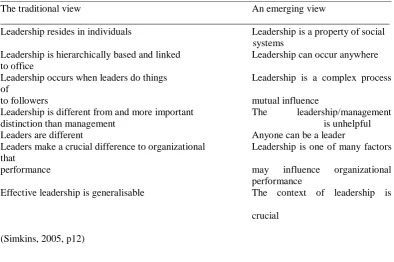
[image:38.595.113.508.396.658.2]activity borne out of relationships within different educational settings, (Bolden 2011). This has resulted in a number of normative approaches. Gunter (2001), for example, has argued that leadership is a relationship understood through experiences, whilst the research of Simkins (2005) reflects changes in the leadership approach within a model of the ‘traditional’ verses ‘emerging’ view of leadership (see Table 2.1).
Table 2.1 An emerging view of leadership
__________________________________________________________________________________________________
The traditional view An emerging view
______________________________________________________________________________ Leadership resides in individuals Leadership is a property of social systems
Leadership is hierarchically based and linked Leadership can occur anywhere to office
Leadership occurs when leaders do things Leadership is a complex process of
to followers mutual influence
Leadership is different from and more important The leadership/management distinction than management is unhelpful Leaders are different Anyone can be a leader
Leaders make a crucial difference to organizational Leadership is one of many factors that
performance may influence organizational performance
Effective leadership is generalisable The context of leadership is crucial
(Simkins, 2005, p12)
acknowledgement that leadership as a function can be embedded across the wider organisation, and that it is in the sector’s interest that there be a shift of focus on individual leaders (and their development) to an approach that targets leadership across the organisation (Gosling et al, 2009). This approach has also formerly been promoted by Spillane et al. (2004) who observe that:
From a distributed perspective, leadership practice takes shape in the interactions of people and their situation, rather than from the actions of an individual leader.
(Spillane et al., 2004, p3)
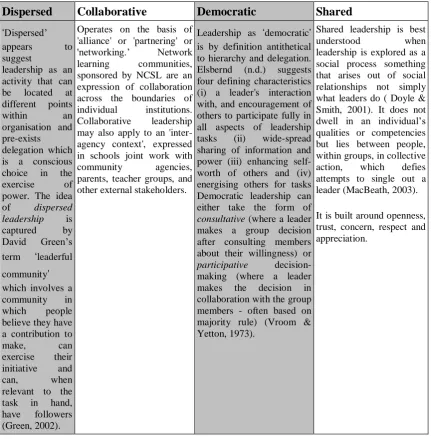
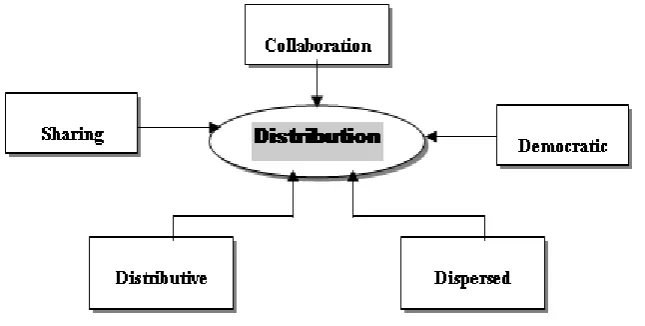
In studying leadership as a collective process, emerging concepts of leadership have embraced a number of approaches, including dispersed, collaborative, democratic and shared (Oduro, 2004). The commonality in these approaches is that all ‘project an element of distribution’ (Oduro, 2004, p10). These approaches will further be discussed later in this literature review.
essence, these concepts reflect the leadership activity of the teacher leader, so commonplace in the school literature, (Harris, 2003) but gaining ground in the Higher Education context. As Blackmore (2012) suggests:
If we see teaching as being not only about the subject content but also about enabling students to develop the capacity to think and write in a rigorous and autonomous way, to develop their own perspectives and their own voices, then not only is teaching an act of leadership but these desired outcomes start to look like aspects of leadership too.
(Blackmore, 2012, p269)
That said, empirical studies of Distributed Leadership have so far failed to take into account a holistic account of the role of both formal leaders and the leadership activity of academic staff within a Higher Education setting. In reviewing Distributed Leadership across a number of Higher Education institutions, Gosling et al (2009, p17) recognised that they had not engaged with leadership ‘which occurs below formal leadership at the School/Department level’. This reflects a gap in the literature which this study seeks to address.
2.3 The Higher Education context
For Cuthbert (2006, cited in Blackmore, 2012) universities are characterised by problematic goals in that there is no universally shared view of the purpose of higher education. There is also fluid participation, referring to the tendency for academic staff not to relate very closely to the ‘home’ institution, but often to be better networked with colleagues in other institutions (Blackmore, 2012).
In terms of how leadership works, local circumstances also need to be taken into account. Knight and Trowler (2001, p8, cited in Blackmore, 2012) encapsulated this point when they observed that, ‘much of the work of leading is contingent…it involves dealing with the specifics of a time, a place and a set of people’.
According to Knight and Trowler, (2001):
Universities have not one but many cultures: they are characterized by a shifting multiple cultural configuration so that norms, values and taken-for-granted practices and attitudes may be as different from department to department…as they are between one university and the next.
Knight and Trowler, (2001, p40)
impact of prevailing circumstances within an organisation. This may be seen of particular value in looking at the current Higher Education sector, where ‘prevailing circumstances’ seem to be changing rapidly.
In aiming to outline the features of ‘good departmental and team leading in Higher Education’ Knight and Trowler (2001, p45) indicate that workgroups are microsocially constructed and often fractured, and that in some cases, transactional, or transformational techniques are preferred over distributed leadership. They do acknowledge however, that ‘Leadership in higher education at the department level and below is best when it is distributed across the workgroup rather than being located solely in the person of one individual’ (p176). However, according to Lumby et al (2005):
Though a transactional style is considered to be the most effective way to improve organisational performance, line managers are more often seen as employing transactional approaches. Distributed leadership is often distribution of operational responsibilities rather than a distribution of power.
Lumby et al (2005, p1)
adopt principles from other sectors and that ‘Over the past few decades traditional principles of academic leadership and collegial forms of governance have been rapidly replaced by managerial principles adopted from the private sector’ (van Ameijde et al, 2009 p764). Also, in terms of the complexity of work teams, many organisations increasingly depend upon cross functional, self-managing work teams to deal with the growing complexities of work and to sustain their competitiveness (Cummings and Worley, 2004, p341, cited in van Ameijde et al, 2009). This could be aligned with teams at department, or cross-institutional levels.
However, earlier accounts of teams in Higher Education suggest an alignment with a distributed approach; Shackleton (1995) suggested that in reality there are those at low levels in a hierarchy who do not have ‘leader’ within their job title, who may exercise leadership. This is also recognised by Ball (2007) who, when discussing academic staff suggests:
These may be the real leaders who informally influence groups towards goals that those in formal leadership positions do not wish to pursue. So leadership could adopt a collective form. If expectations exist related to leadership within a group…these may apply to more than one ‘leader’ and individuals may even generate their own leadership dimensions.
Ball (2007, p455)
organisation which depends on high-level professional skills operates most efficiently if there is a substantial measure of collegiality in its management procedures’.
Bush (2003, p62) contends that the collegial approach sits within the wider context of the distributed model which can be described as “a normatively preferred approach which may be described as shared, distributed, dispersed, collaborative or collegial”. Others have argued that Distributed Leadership provides little more than a rhetorical function as opposed to any accurate description of leadership practice (Gosling et al, 2009).
That given, the growth of Distributed Leadership study is marked (Hartley, 2010) and with reference to the Higher Education sector has been put forward as one way of addressing the changing landscape and achieving organisational effectiveness. The specifics of the Distributed approach will now be outlined in the next section.
2.4 Distributed Leadership
Origins of a theory
as a group quality’ (Gibb, cited in Gronn, 2000, p324). Gronn (2002) also mentions Gibb’s work in citing his dualism of distributed and focused leadership. He suggests however, that instead of dualisms which are somewhat unhelpful, (creating hard and fast categories) a ‘useful option is to interpret Gibb’s suggestions as end points of a continuum or a duality of possibilities’ (ibid, p53). Bolden (2009) suggests that the ideas proposed by Gibb (1954, cited in Bolden, 2009) perhaps lay dormant whilst there was an ‘appetite for accounts of ‘new leadership’ founded on ‘transformational’ and/or charismatic’ leadership by senior executives that dominated scholarly and practitioner literature during this period (Bolden, 2011, p253).
Some authors make a tentative claim to earlier origins. For example, Oduro (2004) in presenting research of headteachers in schools suggests that:
To the contrary to the claim of existing research-based literature (e.g Gronn, 2002) that the first known reference to distributed leadership was on the field of social psychology in the early 1950’s, the origin of distributed leadership can be traced to 1250 B.C.
Oduro (2004, p15)
Bearing in mind that context is important, this very early example citing Jethro’s model (Oduro, 2004) is perhaps, at the very least, a loose interpretation of one of the most influential ideas to emerge in the field of
Bolden (2011) suggest that one of the most influential articles in terms of the concept of Distributed Leadership was put forward by Peter Gronn in 2000. In proposing ‘a new architecture for leadership’ he outlined that Distributed Leadership had the potential to address the ‘trouble with existing dualisms’; and what he saw as the two broad polarities of leadership thinking; those being the ‘ideal type’ of transformational leadership and its associated ‘apogee of individualism’ (Gronn, 2000, p317) and the other managerial leadership reasserted by ‘systematic properties and role structures’ (ibid, p317).
This conceptual paper was in part, in response to the ‘hijacking’ of leadership literature which had preceded, and in particular, the notion of the ‘heroic leader’ (Bolden, 2011). In turn, it provided a platform for the seemingly prolific growth of this ‘alternative model of leadership’ (Harris, 2008, p173).
Prominence in current field
is continuing to gain favour, and has become ‘the normatively preferred leadership model in the 21st century’ (Bush, 2013, editorial).
Harris (2011) also recognises that the concept is not an idea devoid of critique. Whilst it has been agreed that the concept may be disparate and hard to define (Bennet et al, 2003), it has nevertheless become well established in the literature as a key theory in educational leadership. Indeed, since Gronn’s preliminary taxonomy (Gronn, 2002), and the subsequent debates around the concept, ‘it has turned into something of a social movement’ (Hartley, 2007, p202). Whilst developing from an area of study that has experienced a growth spurt that ‘would do any teenager proud’ (Leithwood et al, 2009, p269), this particular view of leadership:
appears to have weathered an initial stage of conceptual
exploration, is now well into a phase of empirical investigation and may shortly be entering a period when some sense of its impact (and the difference, if any, that it makes) will become clearer. In short, distributed leadership displays a number of the hallmarks of survival.
(Gronn, 2008, p 141)
leadership and post- heroic accounts that seem to have dominated the latter half of the 20th century (Bolden, 2009). However, its growth might also offer an appropriate model that addresses the increasingly ‘greedy work’ (Harris, 2003) of educational establishments both in the schools, and the Higher Education sector; the complexities of which have been highlighted in the previous section. It would be fair to say that the whilst the majority of literature around Distributed Leadership has been written in the schools context (see Harris, 2003, Spillane, 2006), there is a growing body of literature around Distributed Leadership in the Higher Education sector (e.g van Amjeide, et al, 2009, and Bolden et al., 2009).
Gosling et al (2009), in reviewing ‘Collective Leadership’ in Higher Education, have produced a substantial report into the collective nature of leadership in Higher Education, with a focus on the Distributed Model. They propose that there is no straightforward way to lead and manage HEIs. Rather ‘There is very properly a constant experimentation, and
That said, Gosling et al, (2009) recognise that:
distributed leadership is an effective term within HE because it resonates both with the experiences and expectations of university staff. It embraces notions of collegiality and autonomy while addressing the need for management. However it performs a rhetorical function that may well outstrip its ability to hold up under scrutiny as a true descriptor of leadership practice within the sector
(Gosling et al, 2009 p303).
Whilst the evidence base for Distributed Leadership is evolving, what is apparent is that there are competing and sometimes conflicting interpretations of the term (Harris, 2008). In particular, in reframing the way we think about leadership (Bolden, 2011), there are substantial overlaps between Distributed Leadership and other similar concepts, namely, shared leadership (Pearce and Conger, 2003), collaborative leadership (Wallace, 2002) and participative leadership (Vroom and Yago, 1998, cited in Harris, 2003). Some of these concepts, as put forward by Oduro (2004) are illustrated in Figure 2.2 below.
Figure 2.2 Terminologies related to distributed leadership (Oduro, G.K.T, 2004, p13)
Dispersed Collaborative Democratic Shared
‘Dispersed’ appears to suggest
leadership as an activity that can be located at different points within an organisation and pre-exists delegation which is a conscious choice in the exercise of power. The idea of dispersed leadership is captured by David Green’s term ‘leaderful community’ which involves a community in which people believe they have a contribution to make, can exercise their initiative and can, when relevant to the task in hand, have followers (Green, 2002).
Operates on the basis of 'alliance' or 'partnering' or 'networking.’ Network learning communities, sponsored by NCSL are an expression of collaboration across the boundaries of individual institutions. Collaborative leadership may also apply to an 'inter-agency context', expressed in schools joint work with community agencies, parents, teacher groups, and other external stakeholders.
Leadership as ‘democratic’ is by definition antithetical to hierarchy and delegation. Elsbernd (n.d.) suggests four defining characteristics (i) a leader's interaction with, and encouragement of others to participate fully in all aspects of leadership tasks (ii) wide-spread sharing of information and power (iii) enhancing self-worth of others and (iv) energising others for tasks Democratic leadership can either take the form of
consultative (where a leader makes a group decision after consulting members about their willingness) or
participative decision-making (where a leader makes the decision in collaboration with the group members - often based on majority rule) (Vroom & Yetton, 1973).
Shared leadership is best understood when leadership is explored as a social process something that arises out of social relationships not simply what leaders do ( Doyle & Smith, 2001). It does not dwell in an individual’s qualities or competencies but lies between people, within groups, in collective action, which defies attempts to single out a leader (MacBeath, 2003). It is built around openness, trust, concern, respect and appreciation.
[image:50.595.95.527.140.580.2]Fig. 2.3 The centrality of distribution in post-heroic leadership terms (Oduro, G.K.T, 2004, p14)
With conflicting and sometimes overlapping views then, what is important is that we need to observe leadership activity from ‘within a conceptual framework’ (Spillane, 2004, p4). For Distributed Leadership, this means that a very clear conceptual understanding is required (Gosling et al, 2009). Some concepts of the Distributed approach will now be explored further.
2.5 Distributed Leadership – key concepts
[image:51.595.147.470.150.313.2]In terms of definitions, those of Distributed Leadership are wide ranging. As Bennett et al (2003) state:
There are few clear definitions of distributed or devolved leadership and those that exist appear to differ from each other, sometimes widely and sometimes more in nomenclature than in essence.
Bennett et al (2003, p8)
Bennet et al (2003) contend that one of the most restrictive definitions is from Kayworth and Leidner (2000, cited in Bennet et al, 2003); they define Distributed leadership as leadership from a remote (physical) location, using only technological means of communication (e-mail, web-based etc.) This, however, fails to take into account differing means of interaction and the social dimension of activity theory so often mentioned in the literature. As Thorpe et al. (2011) note:
Crucially, Distributed Leadership is considered as a social phenomenon with a context integral to its understanding and indeed constitutive of the practice of leadership, concerned with thinking and actions in situ. The focus therefore is on conjoint actions rather than role or position.
(Thorpe et al, 2011, p241)
the distributed leadership perspective is designed to frame a programme of research that will analyse leadership activity and generate evocative cases for practitioners to interpret and think about as part of their on-going leadership practice.
Spillane (2004, p4)
These activities are recognised by Bolden et al (2009) in that the increasing awareness of social relations in the leadership contract has in turn given rise to this ‘new’ school of leadership thought which can be referred to as ‘shared’, ‘collective’ or ‘distributed’ (Bolden et al, 2009, p8). This also, in part reflects the arguments that in the widest theoretical sense, the distributed leadership approach is thought to be borne from Social Practice theory which also gave rise to situational, contingency and collegial models (Knight and Trowler, 2001). The situational aspects of the scholarly community are also one of the reasons put forward by Gronn (2002) in explaining the need for a distributive perspective:
The most compelling reason why the scholarly community requires a distributed perspective on leadership is that the idea more accurately reflects the division of labour which confronts fieldworkers and is experienced on a daily basis by organisation members
Gronn (2002, p429)
review, Bennet et al (2003) were able to put forward three distinctive elements, or characteristics of the concept of distributed leadership which in turn help give some conceptual clarity:
Firstly, distributed leadership ‘highlights leadership as an emergent property of the group or network of interacting individuals. This contrasts leadership as a phenomenon which arises from the individual’…..Secondly, distributed leadership suggests openness of the boundaries of leadership……and thirdly, distributed leadership entails the view that the varieties of expertise are distributed across the many, not the few.
Bennet et al (2003, p7)
The authors suggest that it is the ‘emergent property’ and affiliated ‘conjoint activity’ (Gronn, 2002) that will underpin the concept. The term conjoint activity is key to understanding the complexity of the approach. It was Gronn (2002) who suggested that there are two broad meanings of distributed leadership in the scholarly community; firstly numerical, or aggregated leadership behaviour and secondly concertive action. The second behaviour is seen as most significant for Gronn (2002), as in essence it means that distributed leadership is more than the sum of its parts (Bennet et al, 2003) and that there is strong influence in group members acting in concert. Beyond this, Gronn, (2002, pp4-5, cited in Bennet et al, 2003) observes three main patterns in the concertive action domain;
1) Spontaneous collaboration concerning tasks; leadership is evident in the interaction and relationships in which people with different skills, expertise and from different organisational levels ‘coalesce’ to pool expertise
3) Institutionalisation of structures of working together, e.g committees.
Theoretical frameworks and taxonomies
Spillane’s work (2004) emphasises the context in which leadership is enacted. Drawing upon the concepts of distributed cognition and activity theory (Bennet et al, 2003) the argument is presented that cognitive activity is ‘stretched’ across the group, and that leadership can therefore be found within both formal and non-formal positions and within particular areas of expertise.
Bennet et al (2003) note of Spillane’s concepts of distributed leadership:
In other words, it involves the study of how it is carried out as well as what it is. From this perspective, leaders need to be involved in defining tasks as well as executing them, and this activity required the active deployment of individual’s espoused theories and theories in use. Leadership is, then, to be understood as it unfolds from the perspective of practitioners through to their theories in use.
Bennet et al (2003, p23)
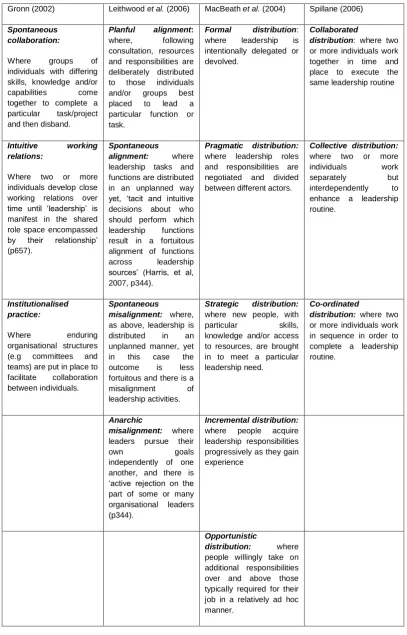
A further framework for distributed leadership is provided by MacBeath et al (2004, cited in Gosling et al, 2008, p11) who identify six ways in which the distributed approach takes place in practice.
This includes;
Formal distribution (via ad hoc delegation to meet demands and challenges)
Pragmatic distribution (via ad hoc delegation to meet demands and challenges)
Strategic distribution (based on the planned appointment of individuals to contribute positively to the development of leadership in the organisation
Incremental distribution (devolving more responsibility as people demonstrate their ability to lead)
Opportunistic distribution (people willingly extending their roles and taking the initiative to lead)
Cultural distribution (where leadership is assumed rather than given, shared organically and opportunistically and is embedded in the organisational culture).
These, he suggests were aligned with four leadership functions: direction setting, people development, organisational re-design and instructional management. Leithwood et al (2009) were particularly interested in the engagement of ‘non administrator leaders’, identifying that informal leaders made a high contribution to the three of the four leadership functions. ‘Thus, in relation to direction setting, once a vision was in place, these informal leaders tended to perform the on-the-ground battle for the hearts and minds of colleagues. If, however, leaders were to perform in this way, there still had to be regular monitoring by principals. Distributed leadership, it seemed, depended on ‘effective forms of focused leadership – leading the ‘leaders’ (Leithwood et al, 2007, cited in Gronn, 2008, p55).
These they suggest are:
1. That DL is a blueprint for leadership and management 2. That DL negates the role of principal
3. That from a Distributive perspective, everyone is a leader 4. DL is only about collaborative situations
Figure 2.4 .Frameworks of Distributed Leadership, (from Bolden, 2011, p258)
Gronn (2002) Leithwood et al. (2006) MacBeath et al. (2004) Spillane (2006)
Spontaneous collaboration:
Where groups of individuals with differing skills, knowledge and/or capabilities come together to complete a particular task/project and then disband.
Planful alignment: where, following consultation, resources and responsibilities are deliberately distributed to those individuals and/or groups best placed to lead a particular function or task.
Formal distribution: where leadership is intentionally delegated or devolved.
Collaborated
distribution: where two or more individuals work together in time and place to execute the same leadership routine
Intuitive working relations:
Where two or more individuals develop close working relations over time until ‘leadership’ is manifest in the shared role space encompassed by their relationship’ (p657).
Spontaneous
alignment: where leadership tasks and functions are distributed in an unplanned way yet, ‘tacit and intuitive decisions about who should perform which leadership functions result in a fortuitous alignment of functions across leadership sources’ (Harris, et al, 2007, p344).
Pragmatic distribution:
where leadership roles and responsibilities are negotiated and divided between different actors.
Collective distribution:
where two or more individuals work separately but interdependently to enhance a leadership routine.
Institutionalised practice:
Where enduring organisational structures (e.g committees and teams) are put in place to facilitate collaboration between individuals.
Spontaneous
misalignment: where, as above, leadership is distributed in an unplanned manner, yet in this case the outcome is less fortuitous and there is a misalignment of leadership activities.
Strategic distribution:
where new people, with particular skills, knowledge and/or access to resources, are brought in to meet a particular leadership need.
Co-ordinated
distribution: where two or more individuals work in sequence in order to complete a leadership routine.
Anarchic
misalignment: where leaders pursue their
own goals
independently of one another, and there is ‘active rejection on the part of some or many organisational leaders (p344).
Incremental distribution:
where people acquire leadership responsibilities progressively as they gain experience
Opportunistic
[image:59.595.106.514.136.772.2]In terms of practice, Bush (2003, p52) argues that ‘one aspect is clear – the distributive model provides for stakeholders to become involved in decision making’; this theme has earlier been studied by Koopman and Wierdsma (1998) who identify shared decision making by a superior and his or her employees as one benefit of the participative process. Further perceived benefits of the approach will be discussed later in this chapter.
Distributed Leadership in practice – the empirical evidence
In reviewing the emergence of Distributed Leadership, Hartley (2007) criticised the lack of empirical research within the field. Levin (cited in Harris, 2008, p173) also has put forward that ‘there are many viewpoints in the field and very little solid research supporting them. Much of what parades as research is opinion garbed in the language of research’.
It is recognised that one challenge is that Distributed Leadership can mean ‘all things to all people’ (Harris, 2003a, p313) and as such there is difficulty in identifying any clear focus in terms of conceptual frameworks. Additionally:
while distributed leadership tends to be seen as a normatively good things,, it has also been contested…..most notably because of the complexities of who does the distribution and who is in receipt of the distribution.
(Gunter and Ribbines, 2003, cited in Harris, 2008 p172)
However, Gronn (2008, p154) identifies that ‘at least.by de-monopolising leadership and potentially increasing the sources and voices of influence in organisations beyond just one, distributed leadership has helped widen the span of employee and member participation’. Harris (2003, cited in Bush et al, 2003) in defending the empirical evidence for Distributed Leadership also draws attention to the widening participation of leadership in suggesting that the distributed leadership approach:
‘essentially involves both vertical and lateral dimensions of leadership practice. Distributed Leadership encompasses both formal and the informal forms of leadership practice within its framing, analysis and interpretation. It is primarily concerned with the co-performance of leadership and the reciprocal interdependencies that shape the leadership practice. This co-leadership can involve both formal and informal leaders, it is not an ‘either/or’.