D E T E C T I O N O F W E B B A S E D C O M M A N D & C O N T R O L
C H A N N E L S
m a r t i n wa r m e r
November
2011
A B S T R A C T
Recent malware allows criminals to remotely control computers using Com-mand & Control (C&C) channels. These channels are used to perform crim-inal activities using infected computers. These activities pose a threat to both the user of the infected computer and other computer users on the network. This threat can be mitigated by detecting C&C channels on the network. In this thesis we attempt to improve the detection capabilities for web based C&C channels. We provide a survey of current C&C channel detection tech-niques and study the behaviour of web based C&C channels. Based on these results, we propose three new techniques for detecting HTTP and HTTPS based C&C channels. We evaluate these techniques and provide an overview of their detection capabilities.
C O N T E N T S
1 i n t r o d u c t i o n 1
1.1 Introduction on malware . . . 1
1.1.1 Botnets . . . 1
1.1.2 Targeted attacks . . . 1
1.1.3 Scope of the malware problem . . . 2
1.1.4 Model of operation for bots . . . 2
1.1.5 Detection & reaction . . . 3
1.1.6 Network traffic generated by bots . . . 4
1.1.7 Network protocol usage of bots . . . 4
1.2 Problem statement . . . 5
1.2.1 Research questions . . . 5
1.2.2 Layout of the thesis . . . 6
2 c u r r e n t c&c c h a n n e l d e t e c t i o n m e t h o d s 7 2.1 General overview . . . 7
2.2 C&C channel detection techniques . . . 9
2.2.1 Blacklisting based . . . 9
2.2.2 Signature based . . . 9
2.2.3 DNS protocol based . . . 10
2.2.4 IRC protocol based . . . 11
2.2.5 HTTP protocol based . . . 11
2.2.6 Peer to peer protocol based . . . 12
2.2.7 Temporal based . . . 12
2.2.8 Payload anomaly detection . . . 13
2.2.9 Correlation based . . . 14
2.3 Discussion . . . 15
2.4 Research directions . . . 17
3 p r o t o c o l i n t r o d u c t i o n 19 3.1 HTTP . . . 19
3.2 TLS . . . 19
3.2.1 Handshake . . . 20
3.2.2 Application data transfer . . . 22
3.2.3 Observable features . . . 22
4 c o l l e c t i n g a n d a na ly s i n g c&c t r a f f i c 25 4.1 Collecting malware traffic . . . 25
4.1.1 Collecting malware . . . 25
4.1.2 Setting up the lab . . . 26
4.1.3 Basic analysis of observed network traffic . . . 27
4.2 Encrypting C&C traffic using TLS . . . 27
4.2.1 Lab setup . . . 29
4.2.2 Limitations of tunnelling . . . 29
4.2.3 Data normalization . . . 30
4.3 Analysis of traffic datasets . . . 30
4.3.1 Legitimate traffic dataset . . . 30
4.3.2 Analysis of TLS malware traffic . . . 31
4.3.3 Analysis of legitimate TLS traffic . . . 31
4.3.4 Analysis of HTTP malware traffic . . . 35
vi c o n t e n t s
4.3.5 Analysis of legitimate HTTP traffic . . . 36
4.4 In-depth malware analysis . . . 36
4.4.1 Malware source code analysis . . . 36
4.4.2 In depth analysis of the samples generating TLS traffic 38 4.4.3 Analysis of metasploit reverse_https traffic . . . 39
4.5 Summary of malware observations . . . 40
5 p r o p o s e d c&c c h a n n e l d e t e c t i o n t e c h n i q u e s 41 5.1 Machine learning-based TLS classification . . . 41
5.1.1 Approach . . . 41
5.1.2 Details . . . 42
5.1.3 Selected machine-learning algorithms . . . 42
5.2 Spoofed User-Agent detection . . . 43
5.2.1 Approach . . . 43
5.2.2 Details . . . 45
5.3 2ν-gram based anomaly detection . . . 46
5.3.1 Approach . . . 46
5.3.2 Details . . . 47
6 e va l uat i n g d e t e c t i o n t e c h n i q u e s 49 6.1 Evaluation method . . . 49
6.2 Detecting TLS C&C traffic based on initial request size . . . . 49
6.2.1 Preparing the data for machine learning . . . 49
6.2.2 Testing by using machine learning software . . . 50
6.2.3 Detection results . . . 51
6.2.4 Possible improvements . . . 53
6.2.5 Conclusion . . . 53
6.3 Spoofed User-Agent detection . . . 54
6.3.1 Building a model of legitimate browsers . . . 54
6.3.2 Fingerprint discussion . . . 55
6.3.3 Detection results . . . 57
6.3.4 Possible improvements . . . 60
6.3.5 Conclusion . . . 61
6.4 2ν-gram based anomaly detection . . . 61
6.4.1 Training . . . 62
6.4.2 Detection results . . . 62
6.4.3 Possible improvements . . . 62
6.4.4 Conclusion . . . 64
7 c o n c l u s i o n 65 7.1 Answering the research sub-questions . . . 65
7.2 Answering the research question . . . 67
7.3 Future research . . . 67
7.3.1 Machine learning-based TLS classification . . . 67
7.3.2 Spoofed User-Agent detection . . . 67
7.3.3 2ν-gram based anomaly detection . . . 68
a ov e r v i e w o f m a lwa r e f a m i l i e s a na ly s e d 69
b b r o w s e r f i n g e r p r i n t s 71
1
I N T R O D U C T I O N
1.1 i n t r o d u c t i o n o n m a lwa r e
Malicious software, also known as malware, has existed for almost as long as computers are around. A lot of effort has been put into stopping mal-ware over the years but malmal-ware still remains a problem. Everyday, a huge amount of malware is released. For example, Symantec encountered more
than 268 million malware samples in 2010 [31], which amounts to more
than8 samples per second. Keeping up with this number of samples is a
challenge.
According to a report by ENISA [40] the motivation of malware
creat-ors has shifted from showing off technical skills or trying to gain fame to financial gain. This change also marks a shift in the functionality and soph-istication of malware. Traditionally, when a piece of malware like a virus was released the creator only could wait for a message in the media or an anti-virus update, to see that the virus succeeded in infecting computers. With the widespread adoption of the internet, malware is now able to con-tact its creator after it infects a computer. The attacker can thus monitor and control the spread of the virus. More importantly, the attacker can also re-motely control the infected computers. This allows him to profit from his creation by, for example, stealing data from the infected machines.
1.1.1 Botnets
Botnets consist of computers infected with malware which are called bots. These bots connect to a C&C infrastructure to form a bot network or botnet. The C&C infrastructure allows the attacker to control the bots connected to it. This gives the attacker the ability to use these bots for his own financial gain.
The ENISA report [40] mentions several methods used by criminals to
make money using a botnet. Bots can be instructed to steal user data, (finan-cial) credentials or credit card details from the infected computers. This data may be used to empty the victims bank account or impersonate the victim and, for example, take out a loan in his or her name. Bots can be used to visit websites and automatically click on advertisements; thus generating profit for the website owner which is paid per advertisement click. A large group of bots can be used to perform a Distributed Denial of Service (DDoS) attack and bring down a server. This can be used to extort from website owners, who can be asked to pay "protection money". Criminals also sell bot access to other criminals. Access usually consists of the ability to send spam via bots, perform a DDoS attack or gain control of the C&C infrastructure for other purposes.
1.1.2 Targeted attacks
In the case of a targeted attack the attacker wants to infect a specific target. This is quite different from the regular botnets we have described above, where the criminal is not interested in which machines she infects. The goal
2 i n t r o d u c t i o n
of a targeted attack can be to steal certain data from the target or sabotage target systems. This is achieved by infecting one or just a few computers with malware which contacts a C&C server. The C&C server allows the at-tacker to remotely control the infected computers. The control functionality can be used to infect other computers or search for documents the attacker is interested in. After the data of interest has been found the attacker gives instructions to exfiltrate the data. The exfiltration usually happens via a channel separate from the C&C channel.
Detecting targeted attacks is much harder than detecting untargeted at-tacks. The malware is only sent to a few targets, making anti-virus detection unlikely, as antivirus vendors are unlikely to obtain a sample of the malware. Detecting the C&C traffic also becomes harder as Intrusion Detection Sys-tem (IDS) signatures for malware are unlikely to be available and the C&C infrastructure is less likely to appear on any blocklists. Thus, detection of targeted attacks relies heavily on heuristics or human inspection.
Recently targeted attacks have also been known under the name Ad-vanced Persistent Threats (APT). This is an organized attack with the goal of stealing information, where the attacker has large resources and tries to maintain a persistent presence on the compromised systems. As the de-scription indicates, an APT is a form of a targeted attack and also involves malware controlled via a C&C server.
Operation Aurora is an example of a targeted attack that was published in January2010. It involved malware infections in at least34companies and hu-man rights groups including large companies like Google, Northrop Grum-man and Dow Chemical [23]. The goal of this attack seemed to be stealing intellectual property and politically sensitive information from the infected companies and organisation. Ghostnet [26] is another example where mal-ware was used. In this case the malmal-ware was used to spy on the Tibetan Government in Exile.
1.1.3 Scope of the malware problem
Malware is associated with huge economic losses. According to an ITU study [18], the total economic loss attributed to malware in 2006is estim-ated to be US$13.2billion in direct damages, with estimates of up to US$ 67.2billion for indirect and direct damages for2005in the U.S. alone. Even a single piece of malware can cause large damages if the wrong computer
gets infected. For example, in February 2010 a small marketing firm lost
US$164,000due to one computer infected with the Zeus bot [48].
One of the reasons for the huge losses related to malware is the large number of computers that get infected. Microsoft reported [14] that in the second quarter of2010, it removed bots from6.5million computers around the world. In march2010the Spanish police arrested three men suspected of running a13million pc botnet [29]. One of the three arrestees was caught in possession of 800,000personal credentials. Given these numbers it is clear that malware constitutes a widespread problem.
1.1.4 Model of operation for bots
One way to decompose the operation of bots is to split it into two phases: theinfection phaseand theworking phase.
Theinfection phaserequires malicious code to be executed on at least one
1.1 i n t r o d u c t i o n o n m a lwa r e 3
tricked into executing a malicious program. This can, for example, happen under the pretence that a certain program is required to view a video or there is an important update for some piece of software. Malicious code can also be executed automatically, for example when an infected USB drive is inserted into a computer. Whereas executing programs is often considered dangerous, viewing documents is usually considered safe, as documents are not supposed to contain any code. However, programs used to open documents often contain bugs which can result in execution of code inside the document. Thus, when an user opens a specially crafted document, a bug can be triggered, allowing malware to be installed on his computer. This whole process can happen in the background without the user noticing it.
Theworking phasebegins after a computer has been infected. The malware
will contact the C&C server notifying the server that it has been installed and asking for new instructions. In some cases the bot also sends the results of an initial set of instructions which were packaged with the bot. This can, for example, include stealing login credentials and uploading them when first contacting the C&C server, thus providing valuable information even if the bot is quickly removed. The bot will continue to contact the C&C server regularly, asking for new commands or sending the results of a previous command.
1.1.5 Detection & reaction
Bots can be detected at two different levels, thenetwork levelor thehost level.
At thehost level, bots can be detected during infection. During an infection
the malware installs itself on the computer and makes sure it will start again after reboot. To do so, the malware has to write a copy of itself on a local disk. An on-access virus scanner may detect this. Similarly, adding itself to a list of programs which automatically starts may trigger behavioural based detection mechanisms. However, malware can disable virus scanners or use a rootkit to hide itself from virus scanners. This makes it impossible to guarantee detection after malicious code has started running even if the virus is known by the virus scanner.
At thenetwork level, bots are harder to detect during the infection phase.
Malicious code can be obfuscated and sent over a legitimately used protocol. For example, a pdf document transferred via IMAP as an email attachment is in most cases a legitimate document. However, emails with the same docu-ment format and protocol can also be malicious. Thus, detection at network-level would require a virus scanner which scans all documents sent over the network. Systems for scanning all traffic sent over the network have been proposed [56]. However, they can not be used in the case of encrypted con-nections. Furthermore, they are a lot less efficient than the alternative of scanning all files at the host given the large bandwidth of current networks and limited processing time. Network level detection has the advantage of being able to manage detection at a central location instead of managing detection software on all networked devices.
4 i n t r o d u c t i o n
Once malware is detected it can be removed from the infected computer(s) by using specialized removal tools or by reinstalling the computer. This protects users from having their data or credentials stolen by malware. It also helps network administrators as malware generating malicious traffic might cause their internet connection to be blocked or blacklisted.
1.1.6 Network traffic generated by bots
The network traffic generated by bots can be separated into several categor-ies.
The first category is theinfection related traffic. This is the traffic generated
during the infection of a host. This can for example include the download of malware via a legitimate protocol. However, the traffic can also be absent in case the malware propagates via a physical device like an USB drive.
The second category is C&C traffic. This is the traffic generated by the
bot when it tries to obtain new commands from the C&C infrastructure. The commands are usually simple and involve only small data transfers. However, the criminal does not want to wait very long before a bot executes his command, therefore the bot frequently has to check for new commands.
The third category is malicious traffic generated as a result of the
com-mands received. The traffic generated depends on the command received but can include sending spam, sending DDoS traffic or exfiltrating data from the infected computer.
1.1.7 Network protocol usage of bots
Current malware generates traffic for a variety of different protocols. A pa-per that analyses samples submitted to the Anubis platform [19] reports that the most used protocols by malware are HTTP, IRC and SMTP. SMTP is mostly used to send spam, while HTTP and IRC are mostly used for C&C. Symantec reported [31] that in2010, of all command & control servers they detected, "10percent were active on IRC channels and60percent on HTTP". Thus, HTTP is currently the most used C&C protocol. HTTP and IRC are plaintext protocols, but malware may encode data before sending it in a pro-tocol compliant message. This makes it harder to analyse what is being sent over the network.
A small group of malware uses TLS to encrypt (some of) their communic-ation. In a paper about malware analysed using Anubis [19],0.23% (796) of the samples used TLS. Interesting to note is that almost all of the TLS traffic is described as HTTPS traffic. Furthermore, in the paper it is noted that most of the samples fail to complete the TLS handshake. This may indicate that the malware does not actually implement TLS, but merely communicates on a port which is normally used for TLS connections.
1.2 p r o b l e m s tat e m e n t 5
Many computers connect to the Internet via a proxy, router or firewall. This allows these computers to make outgoing connections, but receiving incoming connection is often not possible. Malware authors take this into account by making malware connect to C&C infrastructure they can control, instead of connecting directly to the malware. Some networks only allow outgoing traffic to certain ports. For example, it is common to only allow port25connections to a designated mail server in order to (be able to) block
outgoing spam. Almost all networks allow access to the web over port80
(HTTP) and port443(HTTPS). Thus, malware often uses these ports to con-nect to the C&C infrastructure.
Encrypted traffic on port443has two main peculiarities. First, port443is usually not blocked by corporate border firewalls, to allow users to browse the World Wide Web. Secondly, payload-based Network Intrusion Detection Systems cannot monitor HTTPS traffic, as the contents are encrypted. This makes it an ideal C&C channel.
1.2 p r o b l e m s tat e m e n t
This research aims at detecting malware-infected desktop computers by passively observing network traffic generated by these computers to and from the Internet. In other words, we aim to detect command and control channels masquerading as legitimate web traffic.
We focus on detecting malware at the network level because this provides a centralized solution. No software has to be installed on the hosts and detec-tion is automatically enabled for all hosts on the network. This is especially useful when users connect their own devices to the network and therefore security measures cannot be guaranteed to be present or up-to-date on such devices.
Current techniques for detecting C&C channels are designed for detect-ing known malware or large botnets. They are not designed to detect very small botnets or single pieces of malware used in a targeted attack. To de-tect these threats a dede-tection technique is needed which can distinguish legitimate traffic from C&C channels. The focus is on detecting C&C chan-nels masquerading as web traffic. Web traffic is allowed almost everywhere, whereas other kinds of traffic are often blocked, for example, in corporate environments. Furthermore, traffic is generated to a variety of destinations when browsing the Internet.
Current detection techniques are based on inspection of the contents of network traffic. As malware authors want to evade detection they are likely to use encrypted C&C traffic more often. An obvious choice for an
encryp-ted protocol is to use TLS on port 443, which is used for encrypted web
traffic.
1.2.1 Research questions
de-6 i n t r o d u c t i o n
tection of C&C traffic more difficult. To the best of our knowledge, there is no detection technique that can detect malware by observing encrypted C&C traffic on port443or can generically detect single instances of HTTP C&C traffic.
Therefore, the main research question is:
How can we distinguish C&C web traffic from legitimate web traffic in both the encrypted and unencrypted case?
To address the research question, we tackle the encrypted and unencryp-ted cases separately. We address the first case by selecting and benchmark-ing different classification and anomaly detection techniques which can dis-tinguish encrypted C&C traffic from legitimate encrypted traffic. We ad-dress the second case by designing and benchmarking different anomaly detection techniques which can distinguish C&C web traffic from legitimate web traffic.
By further problem decomposition we therefore extract the following re-search sub-questions:
1. How can a dataset of C&C web traffic be obtained?
2. How prevalent is the usage of HTTP based C&C channels in malware? What are distinguishing characteristics of HTTP C&C traffic?
3. How prevalent is the usage of C&C channels on port443in malware? How prevalent are TLS or SSL C&C channels in malware?
4. Which method works best to distinguish legitimate TLS or SSL traffic from TLS or SSL C&C channels? What detection and false positive rates can be achieved?
5. Which method works best to distinguish legitimate HTTP traffic from C&C HTTP traffic? What detection and false positive rates can be achieved?
6. How do we set-up proper experiments to measure both the "detection rate" and the "false positive rate" of each technique?
1.2.2 Layout of the thesis
2
C U R R E N T C & C C H A N N E L D E T E C T I O N M E T H O D S
Many methods for detecting C&C channels have been proposed. These methods range from signature based detection to automatic correlation of network traffic patterns. This chapter contains a short survey of current C&C channel detection methods.
2.1 g e n e r a l ov e r v i e w
Many of the C&C channel detection techniques focus on detecting C&C channels using a specific protocol. Therefore, the detection techniques in this survey are grouped per protocol. In this way we aim at comparing the different approaches taken to detect similar C&C channels. Besides protocol-specific techniques, several protocol-independent techniques are also included. These techniques are grouped by the underlying principle used for detec-tion. In this way we aim at comparing different techniques based on the same principle. For each group we will briefly describe the general working principles, together with the main advantages and disadvantages.
An overview of the detection techniques in this survey can be found in table2.1. This table also specifies the following attributes for each detection technique.
d e s c r i p t i o n A very short description of what the technique is based on.
For more details the reader is referred to the corresponding paragraph or the reference provided.
s e t u p d ata The input needed to train or set-up the detection algorithm.
Most detection techniques which require training data need legitim-ate or C&C traffic to built a model of such traffic. Other algorithms require known C&C traffic signatures or blacklists. A large set of tech-niques require no setup data, relying only on heuristics embedded in the detection algorithm.
g r o u p d e t e c t i o n Techniques which are group based are designed for
detecting groups of hosts with similar C&C traffic. By grouping hosts these methods are able to filter out false positives and thus generate fewer false positives. However, group detection methods are unable to detect single instances of bots, requiring multiple hosts to be infected with the same bot before they can detect it.
g e n e r i c d e t e c t i o n Techniques which are generic are able to detect bots
which were unknown during their training or setup phase. Generic detection techniques are useful because new bots are created everyday. Non-generic detection methods require a lot of work to keep up to date for detection of the newest bots and provide a time window dur-ing which bots are not detected. However, generic detection methods have the disadvantage that they generate false positives when trying to detect unknown bots.
m a l i c i o u s t r a f f i c Some techniques rely on detection of malicious traffic
for C&C channel detection. Using malicious traffic, these methods
2.2 c&c c h a n n e l d e t e c t i o n t e c h n i q u e s 9
duce the number of false positives they generate. However, their de-tection is limited to bots which generate malicious traffic. Thus, bots acting as proxy or stealing data from the local computer are not detec-ted.
pay l oa d i n s p e c t i o n Techniques which rely on payload inspection for
C&C channel detection. This has the advantage that more information is available for detecting C&C channels. However, the disadvantage is that payload inspection requires more resources. Furthermore, pay-load inspection does not help for detection of encrypted C&C chan-nels, as properly encrypted data is indistinguishable from random data.
2.2 c&c c h a n n e l d e t e c t i o n t e c h n i q u e s 2.2.1 Blacklisting based
A simple technique to limit access to C&C infrastructure is to block access to IP addresses and domains which are known to be used by C&C servers. There are several blacklists available which contain domain names and IP addresses of C&C servers like the Zeus Tracker [12] or AMaDa [1]. More general blacklists are also available which list sites hosting malware like "malware domain list" [6] and "malware domains" [7].
The advantage of using blacklisting is that it is simple to implement. Fur-thermore, blacklisting rarely produces any false positives, given that the blacklists are maintained properly. The disadvantage of using blacklisting is that it requires malware researchers to maintain an up to date list of all domains and IP addresses associated with malware. This has two main drawbacks. First, it is expensive to build the blacklist as this requires manual work. Second, the technique creates a "window of opportunity" for attackers during which new C&C servers are not blocked.
2.2.2 Signature based
A popular technique for detecting unwanted network traffic is to use a sig-nature based Intrusion Detection System (IDS). Such a system tries to match the traffic it observes to descriptions of known unwanted traffic called signa-tures. This allows the IDS to detect unwanted traffic as long as a signature is available.
10 c u r r e n t c&c c h a n n e l d e t e c t i o n m e t h o d s
there is always a time window before the signature is released, in which malware can operate without detection.
2.2.3 DNS protocol based
A bot needs to know the IP address of the C&C infrastructure to communic-ate. This address can be hard-coded in the bot or it can be retrieved from a domain name. Using a domain name provides more flexibility as it allows the attacker to change the IP address easily.
The domain names requested by a host can be monitored for C&C traffic detection. Villamarín-Salomón and Brustoloni [61] have shown that a host which is repeatedly requesting a domain name which doesn’t exist is more likely to contain malware. These requests may indicate that the malware is trying to reach a C&C server which has been taken down. Another indica-tion of C&C traffic proposed by Choi et al. [24] is a group of hosts requesting a new domain name at the same time. This may happen when several hosts are part of a botnet and a new C&C domain is setup, for example, because a previous C&C domain gets taken down. A different approach is taken by NOTOS [15], a system which tries to estimate the likelihood that a domain is being used for malicious purposes. To do this, many features like network information, DNS zones, black- and whitelists are combined to calculate a reputation score.
Maintaining a DNS server and C&C server at a fixed address increases the chance that it will be taken down. Therefore, bot creators have started using fast-flux domains [41]. These are domains for which the owner rapidly changes the IP address to which a domain points and, optionally, the IP address of the DNS server as well. Caglayan et al. [22] have proposed a method for detecting fast-flux domains using multiple DNS responses. They take into account the Time To Live (TTL) of the domain, the number of unique responses seen, and the geographic dispersion of the IP addresses in the responses. By combining this data they are able to detect fast-flux domains in real-time.
Instead of just using DNS to find the C&C server, bots can also use DNS as C&C protocol. Bos et al. [21] have proposed a system to detect DNS based C&C channels based on the entropy of DNS responses. Replies from C&C servers often contain encrypted and encoded data, which has a higher entropy than regular DNS responses.
The advantage of using DNS based systems is that DNS traffic is low bandwidth and low volume, thus only a tiny amount of the total network traffic needs to be analysed. Except for the technique of Bos et al. [21], these techniques don’t detect the actual C&C traffic, but the DNS request(s) used to lookup the C&C server. As a consequence, these techniques can not detect C&C channels if the domain looks normal. Thus, bot creators can avoid detection by using a DNS infrastructures similar to a regular webhoster in combination with a legitimate sounding name. Another way they may avoid detection is to not use DNS at all, but use IP addresses to connect to C&C servers.
2.2 c&c c h a n n e l d e t e c t i o n t e c h n i q u e s 11
2.2.4 IRC protocol based
Traditionally, Internet Relay Chat (IRC) has been used for C&C of botnets. Therefore, several bot detection techniques have been proposed which look for specific features in IRC traffic or try to distinguish human from bot-generated IRC traffic. One of the early examples of such a system is Rishi [35] which scores IRC nicknames using a set of rules to detect C&C traffic.
A botnet detection system has been proposed by Binkley and Singh [20] which clusters computers by IRC channel. This automatically groups bots using the same IRC channel for C&C. For each cluster, the network is mon-itored to detect TCP SYN scans and a cluster is marked as infected if scan-ning activity is detected. Thus, the system is able to detect IRC based bots performing TCP SYN scans.
A system by Karasaridis et al. [45] collects flow level data for all hosts which have triggered a suspicious behaviour detection system. By cluster-ing this data, C&C infrastructures can be detected under the assumption that constant IP addresses are used. This allows for detection of bots and the associated C&C server given that the bots are performing suspicious activities which can be detected.
Other approaches have focused on separating IRC traffic into traffic gen-erated by humans and bots. SVM classification on non payload data like packet histogram size and direction has been reported to provide 95% ac-curacy [47]. Others have used flow data to perform similar classifications achieving high (30-40%) false positive and (10-20%) false negative rates [49].
Focussing on a specific protocol, IRC based techniques can take advant-age of specific properties of IRC traffic. This allows them to, for example, group traffic per IRC channel even if the IRC channel is on a server which is also used for legitimate IRC traffic. IRC based detection techniques have been around longer than any other detection technique. This gives them the overall advantage that these techniques have had more time to be improved. The disadvantage is that only IRC based bots can be detected. There are currently many more HTTP based botnets than IRC based botnets, which limits the set of bots that can be detected.
2.2.5 HTTP protocol based
Xiong et al. [66] have proposed a technique to detect HTTP C&C traffic using user interaction. The technique analyses requested websites statically, to obtain all domains linked to in the page. These domains are added to the whitelist and any requests to a domain not on the whitelist requires user confirmation. It is claimed that after training, this system will only occasionally require users to confirm new domains. The disadvantage of this system is that it requires users to make informed decisions. For example, most users will find it difficult to determine whether a request made by an automatic updater is legitimate. These requests are often generated in the background and may not contain the program or vendor name in the domain. Furthermore, if whitelists are shared between users, the mistake of a single user can allow malware on all computers to access a C&C server.
12 c u r r e n t c&c c h a n n e l d e t e c t i o n m e t h o d s
bot. Such sites can be detected by measuring the timing of the requests. Bots usually run on slower desktop computers with slower Internet connections. Thus, they will respond slower than an average server. As the requests are redirected, the difference in response time is even larger. A disadvantage of this technique is that it will detect all websites hosted on slower serv-ers. Thus, it may block legitimate websites hosted on a broadband Internet connection.
2.2.6 Peer to peer protocol based
A small selection of bots uses a peer to peer (P2P) protocol [60] for its C&C channels, instead of using, for example, a HTTP or IRC server-based C&C channel.
François et al. [32] have shown that P2P networks can be detected and dis-tinguished from each other. To detect these networks they generate a graph of hosts talking to each other and calculate the "pagerank" of each node and cluster the nodes. This provides detection of separate P2P networks, but al-though their work focuses on detecting P2P botnets, they do not provide any method to distinguish legitimate P2P networks from P2P botnets.
Yen and Reiter [67] provide a method to distinguish P2P C&C traffic from file-sharing P2P traffic. The detection is based on the combination of several behaviours observed for C&C P2P channels. They use the volume of data
transferred, the peer churn in the P2P network and the timing between
requests as distinguishing behaviours.
Noh et al. [52] propose another method to distinguish legitimate and C&C P2P traffic. They collect and cluster flows of both legitimate and C&C traffic. The attributes of these clustered flows are then compressed into a7-bit state. Using these compressed states, a Markov model is built for each cluster. Peer to peer C&C traffic is detected by comparing the observed traffic with the Markov models of both legitimate and C&C traffic. If the traffic is similar enough to previously seen C&C traffic it is flagged as C&C traffic.
The first two techniques described above provide generic detection of P2P networks, which is a first step for detecting P2P C&C traffic. While the method of Yen and Reiter [67] can distinguish file-sharing and C&C P2P traffic, it may generate false positives for legitimate non file-sharing P2P networks. Thus, it may, for example, detect P2P VoIP calls on the Skype network or P2P money transfers using Bitcoin. The method of Noh et al. [52] avoids this problem, but can only detect P2P C&C traffic which is similar to the P2P traffic which was used for training. A disadvantage of these techniques is that malware may avoid detection by (ab)using a legitimate P2P network.
2.2.7 Temporal based
2.2 c&c c h a n n e l d e t e c t i o n t e c h n i q u e s 13
Giroire et al. [34] have designed a detection system which measures the temporal persistence of traffic. The system attempts to find hosts which keep connecting to the same server. Bots are likely to keep connecting to the same C&C server as long as it is online, thus persistent connections may be used to detect C&C channels. The methods measures persistence at several different time-scales using timeslots. This provides detection for regular connections even if the timings are randomized within an interval.
The advantage of using a timing based approach is that it is protocol inde-pendent, requiring only that the bot regularly sends or receives traffic from a C&C server. However, legitimate software may also sent regular requests, leading to false positives. These legitimate regular connections need to be filtered using a whitelist, which may, for example, contain regular checks for new mail or software updates. The disadvantage of time based detec-tion systems is that a significant amount of work is required to maintain a whitelist.
2.2.8 Payload anomaly detection
Payload Anomaly detection is based on the assumption that it is possible to build a model of legitimate traffic content. Any network traffic not con-forming to this model is considered anomalous. Given a perfect model of legitimate traffic such a system should be able to detect all C&C and other non legitimate traffic. However, practical systems are limited by the model-ling technique chosen and the availability of representative legitimate data.
One of the early systems proposed is PAYL [63] which builds a model
based on the byte frequency distribution of the traffic contents. For every combination of traffic length and port number, a model is generated. This diversifies the model to support multiple protocols and request types. How-ever, mimicry attacks have been published [30] which allow an attacker to build an attack with the correct distribution. More advanced models have been proposed which try to model the distribution of n-grams efficiently forn > 2. Approximations of n-gram probability distributions have been
made using Support Vector Machines (SVM) [53], Hidden Markov
Mod-els (HMM) [16] and bloom filters [64]. Modelling the data using n-grams forn > 2 makes mimicry more difficult and allows the model to include keywords used in the protocols monitored. Detection techniques based on tokenization of the data contents have also been proposed using, for ex-ample, Discrete Finite Automata (DFA) to build a model of legitimate HTTP traffic [44].
14 c u r r e n t c&c c h a n n e l d e t e c t i o n m e t h o d s
generated traffic. If this traffic is generated by the same software it would have a very low diversity, thus making it likely that it is detected.
The biggest advantage of using anomaly detection techniques is that they are capable of detecting new C&C channels. However, building a good de-tection model can be difficult, especially when C&C traffic uses the same protocol and keywords as legitimate traffic. Most of the current anomaly detection system are designed to detect attacks on servers. Thus, their per-formance for detecting C&C channels remains an open question. The tech-nique proposed by Lu et al. [50] has shown good performance for detecting IRC based C&C channels. However, its performance for other protocols is unknown. Furthermore, it can not detect single bots as it is a based on de-tecting groups of bots.
Bothunter [36], described in section 2.2.9, uses n-gram based anomaly detection as part of its detection system. As the standalone performance of this anomaly detection system is not discussed in the paper about Bothunter, it is not included in this section.
2.2.9 Correlation based
One method to reduce the number of false positives for bot detection is to require several correlated events before raising an alert. This allows the system to use events which by themselves have a high false positive rate. However, by requiring multiple events the system is able to filter out most false positives. The events may be correlated for a single host or for a group of hosts.
Bothunter [36] is a system which combines multiple events for a single host and raises an alert if the events match its bot behaviour model. The events are generated using IDS signatures (see2.2.2) as well as payload and scanning anomaly detection systems. The payload anomaly detection sys-tem is based on an approximation of then-gram distribution of the traffic. Once a single host has generated a sufficient sequence of events which match the behaviour model, it is flagged as a bot infection by Bothunter.
In a botnet, multiple bots are controlled via the same C&C server. Correla-tion between hosts can provide a way to detect a group of bots connected to the same C&C server. Botsniffer [38] is an example of such a system which groups hosts logged on to the same IRC channel or contacting the same webserver. If enough of the hosts in such a group perform similar malicious activities within a certain time-frame, the group is marked as being part of a botnet. Thus, bots are detected using spatio-temporal correlations between hosts. A more generic variant of Botsniffer is called Botminer [37] which works similarly but groups by server IP address. This has the advantage of being more efficient, as well as being able to detect centralized C&C servers independent of protocol.
2.3 d i s c u s s i o n 15
section pros cons
2.2.1Blacklisting Low false positive rate Easy to implement
Needs update for every new C&C server
2.2.2Signatures Low false positive rate Easy to implement
Needs update for every new C&C protocol or implementation
2.2.3DNS Protocol agnostic
detection of suspicious domains
Only detects domain based C&C servers
2.2.4IRC Good detection of
suspicious IRC usage
IRC getting less popular as C&C channel
2.2.5HTTP Protocol specific detection
for most popular C&C protocol
Methods are obtrusive or only detect fast-flux C&C
2.2.6P2P Can distinguish separate
P2P networks
No generic way to distinguish legitimate from C&C P2P network 2.2.7Temporal Can detect most C&C
channels
Many false positives for legitimate periodic traffic
2.2.8Anomaly Can in principle detect all unencrypted C&C traffic
Unclear if it works well for C&C channels
2.2.9Correlation Few false positives Requires multiple
detection events, may miss malware
Table2.2: Overview of C&C channel detection technique groups
However, a bot which does not generate malicious traffic may still have a significant impact by, for example, stealing online banking credentials.
2.3 d i s c u s s i o n
After presenting the main approaches proposed in scientific publications to detect C&C traffic, we will discuss the pros and cons of each group of detection techniques in this section. We provide an overview of the pros and cons of each group in table 2.2 and go into detail in the rest of this section.
Blacklisting and signature based techniquesboth focus on detecting known
16 c u r r e n t c&c c h a n n e l d e t e c t i o n m e t h o d s
most commonly used in practice, due to their low false positive rates. Few false positives make it possible to manually investigate alerts or automatic-ally block traffic without significantly hindering legitimate traffic.
DNS and IRC based techniquesare the oldest types of technique in this
sur-vey that can detect new C&C servers and implementations without requir-ing updates. Publications of these techniques date back to2006. Having been public for a long time, these techniques have been improved over the years. This suggests that these techniques might be ready for production use. In the case of DNS based techniques, for example, a commercial product [4] based on NOTOS [15] is already available. From a practical perspective, the IRC based techniques are not as interesting as DNS based techniques, as their scope of use is limited by the scarceness of IRC based C&C channels [31].
HTTP based techniquesare still very limited in their detection capabilities.
Current techniques either require user interaction or limit detection to fast-flux hosted C&C servers. In the first case, the user is asked to decide whether a request is legitimate or C&C traffic when an alert is generated. Most users will find this difficult, as they have no understanding of the technical details of HTTP. In the second case, a large group of C&C servers is ignored by limiting detection to fast-flux servers. The limitations of current techniques make it unlikely that they are usable as practical C&C channel detection techniques.
P2P based techniques show the ability to detect separate P2P networks. However, their ability to distinguish legitimate and C&C P2P networks is still limited. Current techniques can only distinguish file-sharing and C&C networks or detect the P2P behaviour of specific malware. In the first case, false positives for legitimate non file-sharing P2P networks are a problem. In the second case, a database of known C&C P2P behaviour needs to be maintained, leading to similar difficulties as for signature based techniques. Thus, current techniques provide a starting point for C&C channel detec-tion, but still have significant weaknesses that prevent them to be successful in practice.
Temporal based techniquesprovide a good detection rate for C&C channels.
However, they generate many false positives for legitimate software with periodic behaviour. A whitelist may be used to filter out these false posit-ives. However, creating such a whitelist takes a significant amount of work, as all periodic traffic has to be checked before it is added to the whitelist. As new software and servers are installed, new legitimate periodic traffic may appear, requiring the whitelist to be updated. Thus, maintaining the whitelist also takes a significant amount of work.
Anomaly based techniquesmight in theory detect all C&C traffic. However,
little research has been published focusing on detection of C&C channels. Thus, it remains unknown how well anomaly detection works for C&C chan-nel detection.
Correlation based techniqueshave the big advantage that they generate few
2.4 r e s e a r c h d i r e c t i o n s 17
2.4 r e s e a r c h d i r e c t i o n s
In this chapter, we have described many different C&C channel detection techniques and discussed their advantages and disadvantages. Based on this discussion, we derived the focus of this thesis.
We focus on detecting HTTP based C&C channels because60% of C&C channels are HTTP based [31] and current techniques have significant dis-advantages. None of the current techniques is able to detect the majority of C&C traffic without active participation of users. Thus, we focus on design-ing a HTTP based detection technique which can detect the majority of C&C traffic passively.
Closely related to HTTP is HTTPS, which secures HTTP traffic by wrap-ping it in a TLS session. HTTPS traffic has two main peculiarities. First, it is usually not blocked by (corporate) firewalls as it is needed to browse the world wide web. Second, payload inspection based detection systems can-not monitor HTTPS traffic, as the contents are encrypted. Switching from HTTP to HTTPS requires few changes for malware authors, thus if payload inspection based systems are deployed, HTTPS might become a popular C&C protocol. The temporal detection techniques are the only techniques which may be able to generically detect HTTPS C&C traffic. However, the large number of false positives they generate makes it unlikely that these techniques will be used in practice. Therefore, we focus on designing a de-tection technique for HTTPS based C&C channels.
3
P R O T O C O L I N T R O D U C T I O N
In this chapter, we give a short explanation of how HTTP and TLS work. This explanation is intended to provide some basic insight in how these protocols work. It is, however, not intended to be a complete description of either protocol. The exact specification of both protocols can be found by looking up the respective RFCs. If the reader is familiar with both protocols (s)he can skip to chapter4.
3.1 h t t p
The HyperText Transfer Protocol (HTTP) is a text based network protocol designed for retrieval of webpages. To retrieve a webpage the client has to send a request to the server. The server replies with the (dynamically generated) file specified in the request.
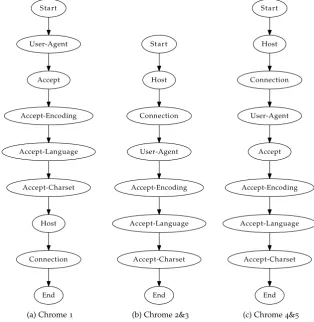
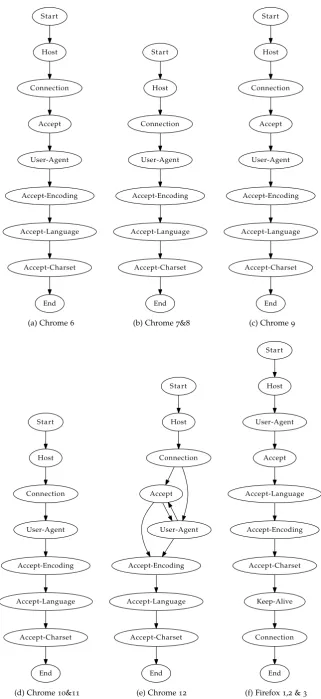
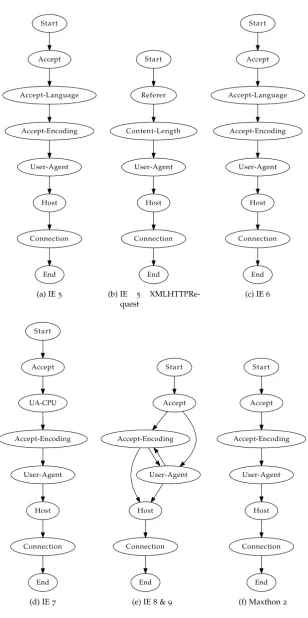
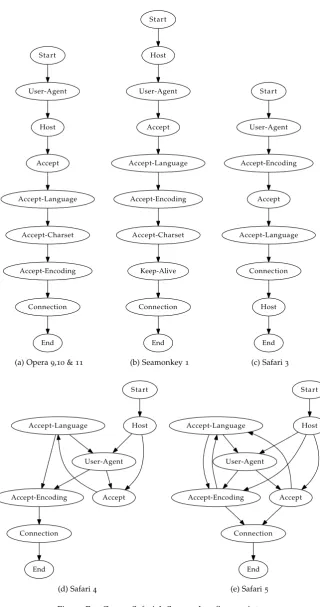
A HTTP requests consists of a request line followed by one or more head-ers. The request line consists of three parts: the method, the URI and the protocol version. A standard request for the root document looks likeGET / HTTP/1.1. This request specifies the get method to retrieve the file associated with the URI/. The request line is followed by one or more headers which are specified as a line containingName:Value. The headers are interpreted based on their (case-insensitive) name thus their order is not significant. Only the Host header is a required request header in the HTTP1.1 specific-ation. All other headers are optional, but most HTTP clients include many other headers. A description of a few common headers is given below.
a c c e p t specifies the mime-types the client is able to handle
a c c e p t-e n c o d i n g specifies the encodings the server may use in the reply
c o n n e c t i o n specifies whether the server should close the connection after
sending the reply
h o s t specifies the domain name for the request
u s e r-a g e n t contains a string identifying the client version and name
3.2 t l s
Transport Layer Security (TLS) is a protocol that provides a secure commu-nication channel between two parties. It can provide authentication of both parties and ensures confidentiality and integrity of the data transferred. TLS has been designed to provide these features for any protocol which can run over TCP. Thus running HTTP over TLS (a.k.a. HTTPS) provides a secure version of the plaintext HTTP protocol.
Authentication of the parties is possible using (x.509) certificates. Usage of these certificates is optional and in practice the server always provides a certificate, while it is rare for a client to provide a certificate. After the server has been authenticated, the client can communicate securely with the server and can, for example, provide a username and password over the secured connection.
20 p r o t o c o l i n t r o d u c t i o n
Netscape started development of what would become TLS under the name Secure Sockets Layer (SSL). SSL 2.0 was the first version released in 1994, quickly followed by SSL3.0in1995because of security problems. After SSL3.0was released Netscape handed over development to the Internet En-gineering Task Force (IETF) which continued development under the name TLS. TLS1.0is the result of the continued development of SSL3.0. It is
back-ward compatible and internally uses the version number 3.1 as protocol
version. The term TLS in this thesis should be interpreted as referring to both SSL (3.0) and TLS.
3.2.1 Handshake
A TLS sessions starts with a handshake during which authentication takes places and session keys are exchanged. The client begins by sending a Client-Hellomessage. This message contains a random number and specifies which
TLS version, ciphersuites and compression methods the client supports. A ciphersuite is a combination of a key exchange, an encryption and a MAC al-gorithm for use in TLS. (TLS1.2ciphersuites also include a pseudo random function.)
The server chooses a TLS version, ciphersuite and compression method from the ClientHellomessage to use for the session. AServerHellomessage
is sent as response which contains another random number and the selec-ted TLS version, ciphersuite and compression method. The server may op-tionally send Certificate, ServerKeyExchange and CertificateRequest messages
followed by aServerHelloDonemessage. TheCertificatemessage can be used
by the server to authenticate itself using a x.509certificate. If an ephemeral key exchange algorithm is selected, aServerKeyExchangemessage is sent
con-taining key material from the server. If the client is required to authenticate itself using a certificate, the server sents aCertificateRequestmessage.
Now the client has all data needed to complete the key exchange, com-pute the secret keys and sent theClientKeyExchangemessage. The contents
of this message depend on the key exchange algorithm which is designed such that only the server can use the message to determine the secret keys. If the server requested a client certificate the client sends its certificate in a Cer-tificatemessage before theClientKeyExchangemessage which is followed by
a CertificateVerifymessage for signing certificates. After these messages the
client sends aChangeCipherSpecmessage. This indicates that from that point
on, all messages from the client will be encrypted and authenticated using the secret keys. The first encrypted message is aFinishedmessage containing
data the server uses to verify that the key exchange and authentication were successful.
The server uses theClientKeyExchangemessage to compute the secret keys.
It sends aChangeCipherSpecmessage indicating that from that point on, all
its messages will also be encrypted. This message is followed by an encryp-tedFinishedmessage to allow the client to verify that the key exchange and
authentication were successful.
Besides the complete handshake described above, a shorter handshake, also known as a resumed handshake, is possible. During the complete hand-shake the server may send a session identifier in the ServerHello message.
When the client makes another connection shortly after the first one it may include this session identifier in its ClientHello message. If the server still
3.2 t l s 21
client server
ClientHello −→
←−
ServerHello Certificate*
ServerKeyExchange* CertificateRequest* ServerHelloDone Certificate*
ClientKeyExchange CertificateVerify* ChangeCipherSpec Finished
−→
←− ChangeCipherSpec
Finished
Application Data ←→ Application Data
* Optional message
Figure3.1: The full TLS Handshake
messages. The client only has to respond with aChangeCipherSpecand Fin-ishedmessage to conclude the handshake. This shortened handshake is more
efficient both in computation and traffic generated because no expensive cryptographic operations have to be performed and fewer messages have to be exchanged.
The TLS handshake is transmitted as cleartext with the exception of the
Finished messages. Thus anyone watching the network can read the
mes-sages and for example determine the ciphersuite used. If a TLS session is open for a long time one of the parties may want to exchange new keys and request a renegotiation. This starts the handshake protocol again in the middle of an TLS session. In this case the handshake messages are encryp-ted using the available keys, thus someone watching the network will not be able to read the messages.
client server
ClientHello −→
←−
ServerHello ChangeCipherSpec Finished
ChangeCipherSpec
Finished −→
Application Data ←→ Application Data
22 p r o t o c o l i n t r o d u c t i o n
Type Version Length (Compressed)
Data MAC (Padding)
encrypted
Figure3.3: TLS Record
3.2.2 Application data transfer
The record protocol is used to transport all messages in a TLS session. The record protocol provides confidentiality and integrity for all messages sent. Only the initial handshake messages are sent in plaintext as no keys are available before the first ChangeCipherSpec message. Application data, for
example, HTTP traffic is also protected using the record protocol as this is sent as anApplicationDatamessage.
For every message, the record protocol performs the following operations before transmitting the message as a TLS record. If a compression method has been negotiated during the handshake, the message data is first com-pressed. A MAC is added to allow the recipient to check the integrity of the data. The data and MAC are padded to a multiple of the blocksize if a blockcipher is used for encryption. The result is encrypted using the ne-gotiated cipher. The encrypted data is put in a TLS record with the type of message, the TLS version and the length of the encrypted data in plaintext. The resulting record is sent over the network.
All data sent using the record protocol is encrypted, authenticated and possibly compressed. The encryption makes sure that no one except the other party is able to read the messages. While the MAC makes sure that the record they receive has been sent by the other party.
3.2.3 Observable features
Even though all application data is encrypted before transmission some in-formation can still be determined by observing TLS traffic. The messages for the initial handshake are sent in plaintext. Thus any observer can read theClientHello,ServerHelloandCertificatemessages. TheClientHellomessage
is interesting because it contains the ciphersuites, compression methods and TLS extensions supported by the client. This may be used to (partially) identify the client implementation as different implementations support dif-ferent ciphersuites and compression methods.
TheCertificatemessage(s) contain the certificate(s) used for authentication.
In practice the server always authenticates itself, thus its certificate is avail-able. This certificate may be used to determine the host name and organisa-tion of the server. However, as the IP address of the server is already known, this may provide little information. The certificate also contains a signature of the Certificate Authority (CA), which may be used to check the validity of the certificate. Client certificates are rarely used in practice, but if they are used, they may be used to uniquely identify the person or computer on the clientside.
The ServerHello message contains the TLS version, ciphersuite and
3.2 t l s 23
is made up of the length of the (compressed) data, the MAC and any pad-ding. (In TLS1.1 and later an Initialization Vector may also be part of the length.) The ciphersuite specifies the MAC algorithm used and thus the size of the MAC. In case the ciphersuite specifies a stream cipher no padding is used and the size of the (compressed) data can be obtained by simply subtracting the MAC length from the record length. As compression is im-plemented in very few clients this will usually give the exact length of the application data. In case a block cipher is used an approximation of the application data length can be made. The padding is allowed to be up to 256bytes long, but for efficiency reasons the padding is usually between1 byte and the blocksize long (8 or 16bytes). Thus if a block cipher is used the length of the application data rounded up to the nearest blocksize can usually be determined.
Besides observing the length of application data, the timing and direction ofApplicationDatarecords can be observed as well. This may allow for
4
C O L L E C T I N G A N D A N A LY S I N G C & C T R A F F I C
4.1 c o l l e c t i n g m a lwa r e t r a f f i c
No dataset containing C&C traffic is available to study C&C traffic or evalu-ate detection techniques. Therefore, in this chapter we focus on creating and analysing a dataset of C&C traffic. This dataset is created by collecting mal-ware and running it in a controlled environment where the network traffic can be captured.
4.1.1 Collecting malware
The first step to creating a dataset of C&C traffic is to collect malware which generates such traffic. This was done by collecting samples for malware families which have been reported to use TLS and by collecting a large set of malicious documents.
Only a small subset of malware uses TLS for its C&C traffic, as was de-scribed in section 1.1.7. Therefore, we have decided to focus on collecting malware families for which TLS usage or C&C traffic on port443 was doc-umented. To this end, we have performed a search on the websites of a variety of anti-virus and security companies to find all malware families for which they have documented usage of TLS or port443. The resulting list of malware families and usage references is included in appendix A. For each of these families, samples were downloaded from Offensive Computing [9] or from the site documenting TLS usage. Where necessary, these samples were unpacked or decrypted to obtain an executable.
According to Annual Global Threat Report 2009[13], "the vast majority of modern malware encounters occur with exposure to compromised web-sites". While the report also notes that PDF files compromised80% of the web-encountered exploits in4thquarter of2009. According to Symantec [59], malicious PDF files are not only distributed via websites but are also distrib-uted via mass-mailing or targeted attacks. Thus, malicious PDF documents are an important source of malware infections.
Because malicious PDF documents are a significant infection vector for current malware, we have focused on collecting a large set of malicious documents. The malware dropped by these documents is relatively recent and should provide a selection of malware an average user is likely to be infected by. Furthermore, as the documents are relatively recent, they are likely to use HTTP for their C&C channel, as HTTP is currently the most used C&C protocol [31].
The collected set of malicious documents is a combination of malicious PDF and office documents which have been sent via email or offered for download on a website. The set of documents consists mostly of documents
obtained from Contagio [3] combined with some documents obtained from
other websites. These documents are known to be malicious and thus likely to drop malware when opened. According to the descriptions on Contagio, some of these documents have been used in targeted attacks. As data ex-filtration and C&C channels have been documented to use HTTPS in the case of targeted attacks [46], a few of these documents might also use TLS.
26 c o l l e c t i n g a n d a na ly s i n g c&c t r a f f i c
Virtualbox
Control script
Network VM additions M A L W A RE
Windows XP Adobe Reader Microsoft Office
O B S E R V E R Linux Tcpdump
Inetsim
Figure4.1: Lab setup
While searching malware and malicious documents several forums were encountered were source code of bots was offered. The source code of these bots was downloaded and is analysed in section4.4.1.
4.1.2 Setting up the lab
A controlled environment has been setup to run the collected malware samples and capture the network traffic they generate. This environment consists of two virtual machines connected via a virtual network. One ma-chine is used to run the malware, the other is used to observe all network traffic. We refer to the first machine as themalware machineand to the second
machine as theobserver machine. Themalware machineruns Windows XP and
is used to run malware executable programs and view malicious documents. To view the malicious documents several major versions of Microsoft Of-fice and Adobe Reader were installed. The use of several major versions increases the possibility of observing malicious behaviour. The malicious code in some documents might depend on a bug in an older version, or simply crash the viewer if not opened with the expected version of the ap-plication. All PDF documents were opened using adobe Adobe Reader6,7, 8and9. All Microsoft Office documents were opened using Microsoft Office 2000, XP,2003and2007.
Theobserver machineruns Linux and provides all network simulation and
capturing abilities. An Internet connection is simulated using inetsim [5]. Inetsim provides a range of (fake) servers including DNS, HTTP, HTTPS and SMTP servers. These servers will for example respond to all HTTP and DNS requests generated by samples. All network traffic to and from the
malware machineis captured using tcpdump [11].
4.2 e n c r y p t i n g c&c t r a f f i c u s i n g t l s 27
4.1.3 Basic analysis of observed network traffic
Using the lab setup described in the previous section, all collected samples were run and their network traffic was captured. The captured network traffic is analysed in this section.
Out of the sixteen malware families we analysed, only eight produced traffic on port443and no traffic was observed on any other port assigned to carry TLS traffic. Only four of these eight families actually use TLS. The
other four families use a custom protocol on port 443 and can be easily
detected by an IDS which checks for valid TLS records.
Interesting to note is that no TLS traffic was found for most of the obtained malware families, even though these families have been described to use TLS by malware researchers. The most likely explanation for this difference is that the researchers only classified the traffic using port number instead of the actual contents. Another explanation would be that the researchers studied a different variant of the malware than the obtained variants. Most samples were obtained by searching for the malware name thus it is quite likely that different malware samples of the same family were used than the one studied by the researcher mentioning TLS usage.
In total7842malicious PDF documents were opened and 47(0.6%)
doc-uments dropped malware which generated traffic on port 443. None of
these samples used the TLS protocol, but instead they used HTTP (40%
19samples) or a custom protocol (60%28 samples). However, one sample
was capable of generating TLS traffic if triggered by opening a web browser (see section4.4.2).
Out of301malicious office documents, 18(6%) dropped malware which
generated traffic on port443. However, the TLS protocol was not used. In-stead,40% (7) used HTTP and the rest used a custom protocol.
The HTTP traffic generated by the malicious documents was almost all
over port80. Only a few samples used HTTP over port 443 or port 8080
(the alternative HTTP port). Thus, in general the malware in the malicious documents generated protocol compliant requests over the correct port.
The protocols used by the malware were determined using OpenDPI [10]. Which is a tool designed to detect the protocols used on a network using deep packet inspection. After removing the traffic generated by Windows, only HTTP remained as a protocol with significant usage, with10out of16 malware families,28.2% of office documents and86.7% of PDF documents generating HTTP traffic. TLS traffic was only observed for the four
previ-ously mentioned malware families. Besides HTTP, a further3malware
fam-ilies generated SMTP traffic and 2 families generated FTP and IRC traffic. The remaining malware traffic is all classified as unknown and most likely uses a custom protocol for C&C traffic.
4.2 e n c r y p t i n g c&c t r a f f i c u s i n g t l s
28 c o l l e c t i n g a n d a na ly s i n g c&c t r a f f i c
family name nr.of
samples
port 443 used
tls traffic observed
http traffic
(any port)
Agobot 49 No No Yes
Ghegbot 19 Yes No Yes
Hydraq 4 Yes No No
Mebroot 56 Yes Yes No
Mega-D 14 No No No
NTESSESS 1 Yes Yes No
PingBed 2 Yes Yes No
Pushdo 50 No No Yes
Ramnit.C 25 Yes No Yes
Routrobot 24 No No Yes
Rustock 28 No No Yes
Spybot.worm.gen.p 50 No No No
Spyeye 26 Yes No Yes
Swrort 26 Yes Yes Yes
Tdss 60 No No Yes
Zeus 54 No Noa Yes
Total 488 8Yes
8No
4Yes
12No
10Yes
6No
a Supports TLS but TLS usage was not observed for in the wild samples (see section4.4.1)
Table4.1: Summary of traffic observed per malware family
document type
port 443 traffic
http on port 443
http
(any port)
nr.of
samples
Office 18(6.0%) 7(2.3%) 85(28.2%) 301
PDF 47(0.6%) 19(0.2%) 6.802(86.7%) 7.842
Table4.2: Summary of observed traffic from malicious documents
port office documents pdf documents
80 68 6751
443 7 19
8080 4 17
Other 6 15
4.2 e n c r y p t i n g c&c t r a f f i c u s i n g t l s 29
Virtualbox
Control script
Network VM additions M A L W A R E
Windows XP Adobe Reader Microsoft Office
O B S E R V E R Linux Tcpdump
Inetsim stunnel
T L S E ND P O IN T Linux Inetsim(http)
Stunnel
TLS Network
Figure4.2: Lab setup for TLS tunnelling
using actual malware traffic and provides traffic similar to the traffic if TLS support would be added to the malware.
4.2.1 Lab setup
The TLS tunnelled C&C traffic is generated using a setup similar to the one described in section4.1.2. The setup consists of themalware, theobserverand theTLS endpoint machinesThemalware machineruns Windows XP and is used
to execute the malware. Theobserver machine runs linux and provides
net-work simulation, capturing and TLS tunnelling capabilities. Netnet-work simu-lation and capturing are done using inetsim and tcpdump. The TLS tunnel receives all HTTP traffic and sends it over a TLS connection to the TLS
endpoint machine. The TLS endpoint machinedecrypts the TLS traffic and
sends it to its local inetsim webserver. The observer machine captures both the unencrypted HTTP traffic and the TLS tunnelled HTTP traffic for later analysis.
All malware families and documents which generated HTTP traffic dur-ing analysis were selected. These samples were opened on the malware ma-chine and the TLS tunnelled traffic was captured. The TLS traffic used the
TLS_RSA_RC4_WITH_MD5 ciphersuite which is the ciphersuite preferred
by most servers[57]. Compression is explicitly disabled as the only major browser to support it is Google Chrome1.
4.2.2 Limitations of tunnelling
Generating TLS C&C traffic by tunnelling HTTP C&C traffic has the disad-vantage that exactly the same TLS implementation and configuration is used for all samples. Therefore, this information can not be used to evaluate a de-tection method, as the dede-tection method may detect the lab setup instead of the C&C traffic itself. The TLS handshake is ignored as its observable attributes are fixed by the lab setup.
The timing of different records in the TLS traffic depends on the virtual network of the lab setup. The timing on the virtual network is likely to be
30 c o l l e c t i n g a n d a na ly s i n g c&c t r a f f i c
ferent from the timing on a real network. Therefore, timing measurements can not be used for evaluation of detection techniques.
Ignoring the handshake and timing means that only the size application data records can be used for detection. The application data records sent to the server contain the HTTP C&C requests sent by the malware. The content of the replies depend on the configuration of inetsim. Therefore, the replies from the server are ignored. Any detection method evaluated using this data set can thus only use the application data records sent to the server.
4.2.3 Data normalization
As described in section3.2.3 the size of application data transferred using TLS can be observed by anyone on the network. In the lab setup no com-pression and a stream cipher are used, thus the exact size of the application data can be obtained. The application data sent to the server are HTTP re-quests, thus the size of the HTTP requests generated by the malware can be measured. If the C&C server would use a block cipher the measured size might be up to16bytes larger.
Some malware keeps reconnecting to the C&C infrastructure if it doesn’t understand the response generated. In the lab setup the responses are gen-erated using inetsim by providing a file of the requested type. Thus, the responses do not contain any recognizable instruction which makes certain malware reconnect many times per second. The large number of TLS ses-sions generated by this process can significantly change the statistical prop-erties of all sessions. Therefore the sessions are filtered per sample and only unique sessions in terms of initial request size are kept. The result of this process is a list of request sizes for each sample.
4.3 a na ly s i s o f t r a f f i c d ata s e t s
In this section we analyse the collected C&C traffic for both HTTP and TLS (tunnelled) traffic. A network dataset containing legitimate traffic is also introduced. This dataset is used to compare legitimate and C&C traffic at-tributes and behaviour.
4.3.1 Legitimate traffic dataset
Network traffic captured at a university network is used as a source of le-gitimate traffic for evaluation and training purposes. The network capture consists of data generated during a week in a university network. Students and employees are allowed to connect their own devices to this network. The devices connected to the network range from cellphones to computers running a variety of operating systems. These devices run a large range of applications which have generated HTTP and TLS traffic.