Munich Personal RePEc Archive
EDB Eurasian Integration Yearbook 2013
Vinokurov, Evgeny
EDB Centre for Integration Studies
2013
Online at
https://mpra.ub.uni-muenchen.de/61618/
Eurasian
intEgration
YEarBook
Eurasian Integration Yearbook
annual publication of the Eurasian Development Bank
Eurasian Integration Yearbook 2013. – Almaty, 2013. – p. 394 ISBN 978-601-7151-39-3
Annual publication of the Eurasian Development Bank
Edited by Evgeny Vinokurov
the Eurasian Development Bank is an international financial institution established to promote economic growth and integration processes in Eurasia. the Bank was founded by the intergovernmental agreement signed in January 2006 by the russian Federation and the republic of kazakhstan. tajikistan, Belarus, armenia and kyrgyzstan joined the Bank in 2009-2011. Electric power, transportation infrastructure and high-tech and innovative industries are key areas for Bank’s financial activity. in line with its Сharter, the Bank views economic integration in the post-soviet space and greater Eurasia as the top-priority of its research work.
ISBN 978-601-7151-39-3 УДК 339.9 ББК 65.428 Eurasian Development Bank, 2013 Eurasian Development Bank
Address:
220, Dostyk ave., almaty, 050051, republic of kazakhstan, telephone: +7 (727) 244 40 44, Fax: +7 (727) 244 65 70, 291 42 63 E-mail: [email protected]
http://www.eabr.org
Coordinator:
gulnaz imamniyazova, EDB
Design, layout, and printing:
ruan Publishing Company
the EDB’s special acknowledgements go to tatyana ossennikova, Botakoz kassimova, stas Myong, Ekaterina kopylova, Hannah Dyson, Jonathan Elliot and stephany Droop for translating and editing materials for the Yearbook in English.
no part of this publication may be reprinted or reproduced or utilised in any form, including reprinting and recording of any kind, without due reference to this publication. the views expressed in this publication are those of author and do not necessarily reflect the views of the Eurasian Development Bank.
Edited by Evgeny Vinokurov, EDB
Advisory Council: Sailau Baizakov,
Insitute for Economic Research, Astana Michael Emerson,
Centre for European Policy Studies, Brussels Valery Geets,
Institute for Economic Forecasting, Kyiv Ruslan Grinberg,
Insitute of Economy RAS, Moscow Ivan Korolev,
Institute for World Economy and International Relations RAS, Moscow Luk Van Langenhove,
United Nations University, Bruges Johannes Linn,
Brookings Institute, Washington Liu Huaqin,
Chinese Academy of International Trade and Economic Cooperation, Beijing Katlijn Malfliet,
Catholic University of Leuven Ivan Samson,
University of Grenoble II Leonid Vardomskiy,
Institute of Economy RAS, Moscow Vladimir Yasinskiy,
EDB, Almaty
Eurasian Integration Yearbook
annual publication of the Eurasian Development Bank
Contents
List of Figures and Tables 6
List of Abbreviations 12
GREEtINGS
igor Finogenov, Chairman of the EDB 14
EuRASIAN ECoNoMIC uNIoN-2015:
DEEpENING AND WIDENING REGIoNAL INtEGRAtIoN
1. pragmatic Integration 15
Evgeny Vinokurov
2. Eurasian partnership: potential Instruments for External
Relations of the Eurasian Economic union 28 alexander knobel, Vladimir Pereboyev
3. tajikistan and the Customs union:
Challenges and opportunities 50
Michael Demidenko
4. Labour Migration and Human Capital in Kyrgyzstan
and tajikistan: Impact of Accession to the SES 68 Evgeny Vinokurov, Vladimir Pereboyev
5. Integrated Foreign Exchange Market in CIS:
From theory into practice 89
alexei kuprin, Victoria Mishina
6. Analysis of trade and production Linkages between Border Regions of Russia and Kazakhstan:
Impact of Customs union and Single Economic Space 102 Leonid Limonov, nina oding, Denis kadochnikov,
Lev savulkin and andrei anisimov
MoNItoRING INtEGRAtIoN pRoCESSES
7. Integration Sentiment in post-Soviet Countries:
Status and Dynamics 127
ContEnts
8. Shifts in Sector Structure of Mutual Direct Investments
of the CIS Countries 148
alexey kuznetsov
9. Belarusian Commodity Distribution Companies
in CIS Countries 158
Yuriy kvashnin
ADVANCING FuNCtIoNAL ECoNoMIC CoopERAtIoN 10. Energy Security and Water Resources Management
in transboundary River Basins in Central Asia 168 Vladimir Yasinskiy, alexander Mironenkov, tulegen sarsembekov
11. Grain Sector: potential of Eurasian Integration and objectives
of Economic policy 181
andrei anisimov, arkadyi Zlochevskiy, rudolf Bulavin, Evgeny gan, irina kobuta, alexander korbut
12. Developing Commodity Exchange trading in the Single
Economic Space 196
natalia Maximchook
13. Mechanical Engineering in the Single Economic Space
of Russia, Kazakhstan and Belarus 233
ardak tashenov
2012: DAtA AND REVIEWS
14. CIS Region Countries: A Slowdown in 2012 and the prospects for Moderate Acceleration in the Medium term 253 kairat Beisenov, Elvira kurmanalieva
15. Chronicle of Eurasian Regional Integration 2012 271 natalia Maqsimchook
16. Multilateral Development Banks: overview of Activities
in 2012 329
Yulia sterligova
information for authors 377
List of Figures and tables
FIGuRES
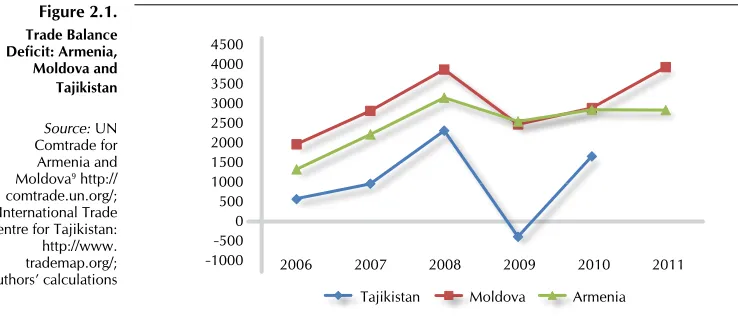
Figure 2.1. trade balance deficit: armenia, Moldova
and tajikistan 36
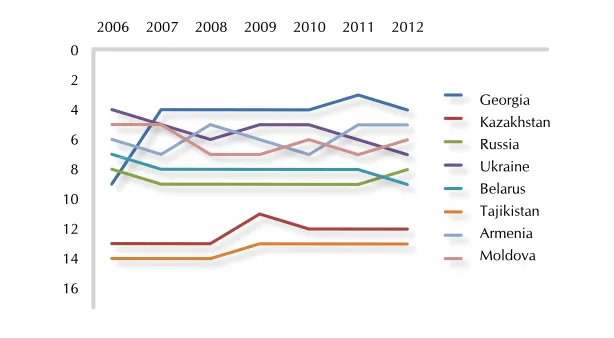
Figure 2.2. global Competitiveness index 37 Figure 2.3. Ease of Doing Business: Fsu countries’ rankings
on trading across borders 38
Figure 2.4. Ease of Doing Business: Fsu countries’ rankings
on investor protection 39
Figure 3.1. Dynamics of inflation, real gDP growth, capital investment and domestic savings
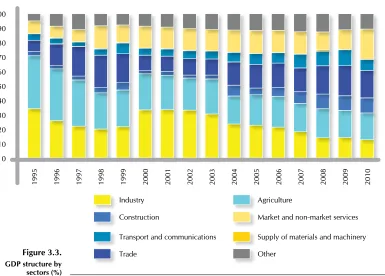
of the republic of tajikistan 51 Figure 3.2. Ministry of Finance of the republic of tajikistan 52 Figure 3.3. gDP structure by sectors 54 Figure 3.4. industrial output structure in 2010 55 Figure 3.5. additional gDP growth potential from the accession
of tajikistan to the Cu-sEs 60
Figure 3.6. gDP growth in percentage vs. growth in factor
productivity 64
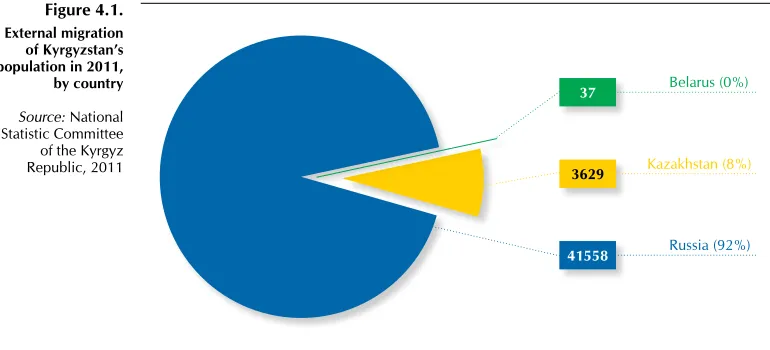
Figure 4.1. External migration of kyrgyzstan’s population in 2011 70 Figure 4.2. reasons for labour migration 72 Figure 4.3. sources of assistance and support 73 Figure 4.4. Labour migration and the broader economy:
multiple channels of impact 74
Figure 4.5. net inflow of money transfers into kyrgyzstan 75 Figure 4.6. average monthly income of kyrgyz labour migrants
in russia and kazakhstan 75
Figure 4.7. occupations of labour migrants 76
Figure 4.8. Education level 77
Figure 4.9. Plans with respect to labour migration 78 Figure 4.10. Main problems for labour migrants 80 Figure 4.11. the distribution of tajik workers by occupation 83 Figure 5.1. Moscow Exchange’s FX market average daily
trading volume 93
Figure 5.2. geographical breakdown of russian interbank (a) usD/ruB spot transactions and
(b) Eur/usD swap transactions, by non-resident
List oF FigurEs anD taBLEs
Figure 5.3. Client transactions and the number of clients
registered in the Moscow Exchange’s currency market 97 Figure 5.4. Foreign exchange market turnover by categories
of participants/clients 2012 97
Figure 5.5. average daily trade in CnY/ruB at the Moscow
Exchange 98
Figure 6.1. Bilateral trade between russia and kazakhstan 104 Figure 6.2. the significance of bilateral trade for russia
and kazakhstan 105
Figure 6.3. the volumes of foreign trade of the russian and kazakh border areas, as a percentage of the overall foreign trade of russia
and kazakhstan 106
Figure 6.4. Foreign trade, in percent of gDP/grP of russia,
kazakhstan and their border areas 107 Figure 6.5. the commodity structure of exports by region
in 2010 108
Figure 6.6. the commodity structure of imports, by region
in 2010 109
Figure 6.7. the commodity structure of exports and imports of the border areas of russia and kazakhstan
in 2010 110
Figure 6.8. the number of migrants from kazakhstan to russia
and from russia to kazakhstan 111 Figure 6.9. the regional structure of the grP of the border
regions of russia and kazakhstan 112 Figure 6.10. two-way investment between russia and kazakhstan 113 Figure 6.11. Fixed capital investment by entities involving
foreign capital 114
Figure 6.12. the December-over-December consumer price
index 115
Figure 6.13. Electricity prices 116
Figure 6.14. Changes in average annual prices of 95-octane
gasoline 116
Figure 6.15. Per capita money income 117 Figure 7.1. Countries grouped by priority geopolitical vector 132 Figure 7.2. Dependence of migration preferences on age
(ukraine’s data) 133
Figure 7.3. to which of the listed countries would you go to
study (or send your children to study)? 134 Figure 7.4. With which countries should our state or companies
cooperate in the scientific and technical fields, e.g. conduct joint studies and exchange findings,
Figure 7.5. From which countries should our country receive capital and investment, and invite companies and business
people to set up businesses in our country? 136 Figure 7.6. Which of the listed countries, in your opinion,
are friendly to our country (i.e. could be expected
to support us in times of need)? (three directions) 137 Figure 7.7. Which of the listed countries, in your opinion,
are friendly to our country (i.e. could be expected
to support us in times of need)? 138 Figure 7.8. isolationist sentiment in the countries covered
by the projects (average sums of the “no such country exists” and “Difficult to say” boxes for
questions asked in each country) 139 Figure 7.9. Belarus, kazakhstan and russia formed
the Customs union, which eliminated customs duties between these three countries,
and the single Economic space (effectively a common market). What is your assessment
of this decision? 141
Figure 7.10. Belarus, kazakhstan and russia formed the Customs union, which eliminated customs duties between these three countries, and the
single Economic space (effectively a common market). Do you think our country should join them? 141 Figure 7.11. attitude towards the Cu and the sEs and answers
to the question about preferred goods 142 Figure 7.12. attitude towards the Cu and the sEs, and answers
to the question about preferred goods 143 Figure 7.13. Would you say that your country has on balance
benefited from being a member of the European
Community (Common Market), or not? 144 Figure 7.14. Examples of different types of integration sentiment
dynamics 145
Figure 8.1. Mutual FDi stock structure of the Cis countries
and georgia at the end of 2008 by industries 152 Figure 8.2. Dynamics of mutual FDi of the Cis countries
and georgia in 2009-2012 153
Figure 8.3. Mutual FDi stock structure of the Cis countries
and georgia at the end of 2012 by industries 154 Figure 9.1. structure of the Belarusian commodity distribution
network with Belarusian capital 161 Figure 9.2. numbers of CDn companies with Belarusian capital 162 Figure 10.1. Dynamics of electricity production in Central asian
List oF FigurEs anD taBLEs
Figure 10.2. natural gas production 173 Figure 10.3. oil drilling, including gas condensate 174
Figure 10.4. Coal mining 174
Figure 11.1. Croppage 182
Figure 11.2. Crop yield 183
Figure 11.3. the sEs+ grain policy outline 187 Figure 11.4. arrangement of CEs+ grain clusters 190 Figure 12.1. regulation of the futures market in the usa 200 Figure 12.2. global volume by category 203 Figure 12.3. global futures and options volume 203 Figure 12.4. Volume of contracts traded and/or cleared
in January-July 2012 205
Figure 12.5. global futures and options volume by region 212
Figure 12.6. number of exchanges 216
Figure 12.7. selected performance indicators of russian
commodity exchanges 217
Figure 12.8. Exchange turnover in cash commodities 217 Figure 12.9. trade volumes by type of operation 218 Figure 12.10. number of commodity exchanges in kazakhstan 221 Figure 12.11. trade sessions conducted 221 Figure 12.12. Volume of transactions 222 Figure 12.13. trade volumes by type of operation 223 Figure 13.1. Major flows of mechanical engineering production
between the sEs countries in 2008–2011 247 Figure 13.2. Major flows of mechanical engineering products
between the sEs countries in 2008-2011 250 Figure 14.1. Economic growth and oil prices 254 Figure 14.2. Economic growth in the Cis 254 Figure 14.3. Current account of BoP 256
Figure 14.4. Foreign debt: gross 256
Figure 14.5. state budget: balance, accrued total 257 Figure 14.6. Monetary policy: CPi growth 258 Figure 14.7. Forecast of growth of Cis economies: gDP consensus
forecast 259
Figure 14.8. savings and investments: private investments and savings (sp-ip), state budget (sg-ig),
current account (X-M) 259
tABLES
table 2.1. Export pattern similarity index: armenia, Moldova and tajikistan and the Customs union
member states 36
table 2.2. average tariffs in armenia, Moldova, tajikistan and the Customs union single customs tariff
by commodity group 39
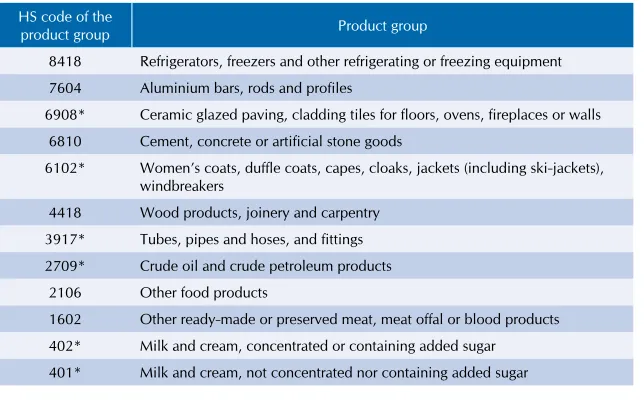
table 3.1. Most high-yield products for tajikistan export 57 table 3.2. average and weighted average tariff of the Customs
union and the republic of tajikistan 58 table 3.3. the change of basic macroeconomic indicators
in the key countries after accession of Xsu region
to the Cu without changing factor productivity 61 table 3.4. the change of basic macroeconomic indicators
in the key countries after accession of Xsu region
to the Cu without changing factor productivity 62 table 3.5. the growth in remittances of migrant workers 63 table 4.1. remittances received by the country in 2010 82 table 4.2. growth in volume of cash remittances from tajik
migrant workers 84
table 4.3. Consequences of the possible accession of tajikistan
to the sEs 86
table 5.1. Foreign exchange transactions at iaE Cis exchanges 92 table 6.1. trade between russia and kazakhstan in Q1 of 2012
against Q1 of 2011 106
table 6.2. results of the correlation analysis 121 table 8.1. List of sectors and industries used in the Cis
mutual investments monitoring database 150-151 table 8.2. Projects with largest FDi in 2009-2012 in the Cis
mutual investments monitoring database 155 table 9.1. CDn agents in russia using ‘Belarusian’
in their names 164
table 10.1. structure of Ca power plants’ installed capacity 169 table 10.2. Central asian hydropower resources 172 table 10.3. results of the sWОТ analysis for the united energy
system 177
table 12.1. Elements of commodity exchange regulation 199-200 table 12.2. Dynamics of global futures and options volume 204 table 12.3. global futures and options volume by region 204 table 12.4. the top ten derivatives exchanges ranked by number
List oF FigurEs anD taBLEs
table 12.6. Volume of commodity futures by
selected commodity exchanges 211 table 12.7. Main phases of commodity exchange
development in russia 214-216
table 12.8. Main events in the development of exchange
trading in kazakhstan 219-220
table 12.9. Performance of commodity exchanges
in kazakhstan, russia and ukraine 223 table 13.1. Mechanical engineering gross value added 234 table 13.2. the structure of russian mechanical engineering
output by type of economic activity 235 table 13.3. russian mechanical engineering value balances
for 2011 237-238
table 13.4. Mechanical engineering market balances in
Belarus 238
table 13.5. Mechanical engineering in kazakhstan 239 table 13.6. Mechanical engineering exports and imports
in the sEs countries in 2011 240 table 13.7. Mechanical engineering exports and imports
(by type) in russia, Belarus and kazakhstan
in 2011 244-245
table 13.8. Flow of mechanical engineering production between the sEs countries and the rest
of the world in 2011 246
table 13.9. Major mechanical engineering export flows
between the sEs countries in 2011 248-249 table 16.1. the structure of approved 2012 investment
project financing by countries 344 table 16.2. the structure of approved 2012 sovereign loans
List of Abbreviations
aCF – EurasEC anti-Crisis Fund
aCP – african, Caribbean and Pacific countries aDB – asian Development Bank
aPEC – asian-Pacific Economic Cooperation asEan – association of southeast asian nations BstDB – Black sea trade and Development Bank Ca – Central asia
CaP – common agricultural and food policy of the sEs Ca uEs – Central asian unified Energy system CDC – Coordination Dispatch Centre
CDn – commodity distribution network CiF – Climate investment Funds
Cis – Commonwealth of independent states CrrF – Csto Collective rapid reaction Force Csto – Collective security treaty organisation Cu – Customs union of russia, Belarus and kazakhstan Cu sCt – single customs tariff of the Customs union DCFta – deep and comprehensive free trade area DMa – Direct Market access
Eau – Eurasian Economic union
EBrD – European Bank for reconstruction and Development EDB – Eurasian Development Bank
EEa – European Economic area EEC – European Economic Community EiB – European investment Bank EnP – European neighbourhood Policy
EnrC – Eurasian natural resources Corporation Ets – Eurasian trading system
Eu – European union
EurasEC – Eurasian Economic Community FDi – foreign direct investment
FEaCn – Foreign Economic activity Commodity nomenclature FMs – russian Federal Migration service
Fta – free trade agreement gDP – gross domestic product grP – gross regional product gts – gas transportation system HPP – hydropower plant
iaE Cis – international association of Exchanges of the Cis Countries iFC – international Finance Corporation
iFEM – integrated foreign exchange market iMF – international Monetary Fund isDB – islamic Development Bank ktZh – kazakhstan temir Zholy MDBs – multilateral development banks Mercosur – Common Market of south america MiCEX – Moscow interbank Currency Exchange naFta – north american Free trade agreement nFa – national Futures association
niB – nordic investment Bank nPP – nuclear power plant
oECD – organisation for Economic Cooperation and Development okVED – all-russian Classifier of types of Economic activity PPP – Public Private Partnership
r&D – research and development rts – russian trading system rZD – russian railways
sCFP – supply Chain Finance Programme sCo – shanghai Cooperation organisation
sEs – single Economic space of russia, Belarus and kazakhstan sMEs – small and medium-sized enterprises
tFP – trade Finance Programme tPP – thermal power plant
unCtaD – un Conference on trade and Development un – united nations
VEB – Vnesheconombank WB – World Bank
Wto – World trade organisation
FoREWoRD
the Eurasian Development Bank is seven years old this year. it is considered a truly successful Eurasian integration project. With a cumulative investment portfolio of $4.7 billion, comprising projects in all six member states, and $1.7 billion equity, the Bank is a well-established financial institution with a mandate to promote investment and trade. EDB also serves regional integration by managing the EurasEC anti-Crisis Fund, which is endowed with $8.5 billion.
the EDB’s activities in the region are not limited to financial investments in development and integration. as a true development bank, EDB invests in rigorous and vibrant research with a focus on regional integration. We pay particular attention to providing the global audience with an overview of the quality research done by the EDB experts and our partner institutions. Hence the Eurasian integration Yearbook, an authoritative volume which has been published by the Bank annually since 2008.
this sixth edition of the Yearbook is edited by the EDB Centre for integration studies, our in-house centre of excellence on regional integration issues. the Yearbook is an unprecedented source of information on both deepening and widening of Eurasian integration. in its 16 contributions this volume covers issues from the enlargement of the Customs union to integrated commodity exchanges to labour migration. i am happy to confirm the EDB’s continued commitment to research on regional integration.
Igor Finogenov
Eurasian EConoMiC union-2015: DEEPEning anD WiDEning rEgionaL intEgration
pragmatic Integration
Evgeny Vinokurov – PhD, Director of the EDB Centre for integration studies. He authored a theory of Enclaves (2007), the Cis, the Eu, and russia: Challenges of integration (2007, with k. Malfliet and L. Verpoest), Eurasian integration: Challenges of transcontinental regionalism (2012, with a. Libman), Holding-together regionalism: 20 Years of Post-soviet integration (2012, with a. Libman). Editor in Chief of the Journal of Eurasian Economic integration and the annual EDB Eurasian integration Yearbook (six issues, 2008-2013). He published in such journals as the Journal of Common Market studies, review of international Political Economy, Post-Communist Economies, European urban and regional studies, Voprosy Ekonomiki, and russia in global affairs.
E-mail: [email protected] Evgeny Vinokurov
this article systematises and defends a pragmatic approach to Eurasian integration1.
the terms ‘Eurasia’ and ‘Eurasianism’ are very often used in russia, kazakhstan and other Cis countries. as a rule, they are used as a synonym for the post-soviet space. in russia they are also often used to emphasise an anti-Western ideology and russia’s ‘exclusive’ way (there is no such phenomenon in kazakhstan) (Vinokurov and Libman, 2012; Laruelle, 2008).
these approaches have a number of alternatives. Eurasia can be deemed a space for interaction between a wide range of countries on the continent, including both Europe and asia. russia, kazakhstan and the Cis region as a whole could be considered to benefit most from the continental scope of integration. it would be useful to distinguish two processes in Eurasian integration up front. the first is post-soviet Eurasian integration – a process that has become increasingly intensive within the post-soviet ‘regional integration core’ in recent
1 An earlier shorter version of this paper was published in Russian in Russia in Global Affairs, 2013, 2(13): 49-58. The paper was substantially reworked and enlarged for the Yearbook. I am thankful to many colleagues for their comments, in particular to Vladimir Yasinskiy, Fyedor Lukyanov, Johannes Linn, and Marlene Laruelle. The author is solely responsible for the views expressed.
years. the second one concerns the processes of convergence on the continent that have become a reality in the past decades. in our understanding, Eurasian continental integration means the qualitative growth of economic, political and social ties between the regions of the Eurasian supercontinent – Europe, northern and Central Eurasia (post-soviet world) and Eastern, southern and Western asia (Linn and tiomkin, 2006; Vinokurov and Libman, 2012 and 2013).
in this paper, i refer to both processes, first to the ‘post-soviet’ and then to the ‘continental’ form. the particular focus is consistently placed on the interests and objectives of the current members of the single Economic space (sEs) in properly structuring their economic and institutional integration with each other and within the Eurasian continent as a whole.
Pragmatic Eurasianism (as an overarching approach to integration to be employed by the sEs members) is based on the understanding that integration is not an end in itself, but a tool for resolving the pressing problems of the states involved, whose first priority today is economic modernisation.
it is aimed at ensuring successful bottom-up integration – the free flow of goods, services, labour and capital – to guarantee the long-term stability and success of this integration project. this is a project and ideology of open regionalism, with regional governments eschewing insularity for an understanding of the necessity of integration with continental partners, both to the East and the West. there should be no place for a tendency to recreate the soviet economic space under a different name.
Pragmatism in politics does not override the inherent ideological content. Eurasianism is an ideology. What matter is what is inside: its technocratic approach to political and managerial processes, the priority given to the economic component, and a serious approach to determining the balance of long-term benefits and losses?
as a whole, pragmatic Eurasianism comprises the following components: the understanding of integration as a tool, but not a purpose; open regionalism; the principle of subsidiarity; several states leading the process integration; the priority of economic integration; and the focus on bottom-up integration. INtEGRAtIoN IS Not AN END IN ItSELF
integration professionals such as politicians, experts and technical specialists often fall victim to an occupational hazard: they start to see integration as an end in itself.
Evgeny Vinokurov. “Pragmatic integration”
area or a customs union results in consumption shifting from a foreign producer with a lower cost to a domestic producer with a higher cost. in any event, the effects of integration are not necessarily intrinsically positive.
Economic and institutional integration is therefore not an end in itself, but a tool for achieving specific objectives. the entire process must be planned and managed as part of a targeted approach. For the single Economic space of Belarus, kazakhstan, and russia2 as well as the entire Cis region, the objective
is economic development through modernisation, spanning such aspects as attaining a more advantageous position in the international division of labour, overcoming dependency on oil and gas, and increasing industrial capacity through mutual economically beneficial cooperation. this objective governs cooperation in the area of research and engineering and, to a significant extent, in the area of education. in the social sphere, the key objective of integration is to promote stable international and interreligious peace, and a comfortable environment to support the millions of relationships between the citizens of the countries involved.
BottoM-up INtEGRAtIoN: EuRASIAN INtEGRAtIoN NEEDS to BE ABLE to WItHStAND LoW oIL pRICES
the current oil prices ($100-110 per barrel of Brent) are anomalously high in a historical perspective, even if they are recalculated in real terms. they will not remain this high forever. For this reason, developing long-term economic policies that rely on a favourable external environment is irresponsible at best and doomed to failure at worst. Planning should instead be based on the presumption that there is a probability that oil prices will fall for a prolonged period of time.
the post-soviet economies may be divided into three groups. group 1 comprises energy exporters: russia, kazakhstan, azerbaijan and turkmenistan. group 2 comprises the relatively small economies of armenia, Moldova, kyrgyzstan and tajikistan, which are major exporters of labour. group 3 comprises the economies of Belarus, uzbekistan and ukraine, whose exports contain a significant proportion of products with a relatively high level of processing. these differences determine the adverse impact of foreign shocks on the economies in a certain group. the next global cyclical recession will affect all Eurasian countries, without exception, although there will be primary and secondary channels of influence. the oil exporters – russia and kazakhstan – will be the first to face the challenge of decreasing export revenues and
2 A methodological note. The Custom Union (CU) forms a central part of the Single Economic Space, which also includes dozens of agreements on such issues as coordination of macroeconomic policies, access to infrastructure, common anti-trust rules, free movement of labour, etc. The SES member-states envisage moving to the Eurasian Economic Union (EAU) in 2015.
poorer access to foreign finance, which is vital for the banking system and the real sector. the exporters of labour will face a decrease in money transferred by labour migrants working in russia and kazakhstan. the countries in the third group will suffer from both an external demand shock and prohibitively expensive foreign borrowings. therefore, everyone will be affected (EDB Centre for integration studies, 2012b).
a fall in oil prices would destabilise the region’s leading countries and would result, at best, in their loss of interest in integration. it has to do with at least three reasons: first, the diminishing attractiveness of the russian market, second, rising protectionism, and, third, the level of transfers in the union. if protectionism evolves in response to a crisis, will it be possible to mitigate it within the framework of the Customs union? Will it be possible to preserve the level of integration achieved without a system of transfers between more or less successful members? When export revenues and economic activity decrease sharply, the countries involved will lack resources to provide external assistance to others. in addition, offering financial assistance for foreign partners will be very unpopular from a political point of view.
With respect to Eurasian integration, the question takes the form of a conventional stress test: Could Eurasian integration withstand a price of $80 per barrel for an extended period of time? What about $60?
there is no panacea. However, it is clear that the long-term sustainability of integration processes could be ensured by lively and successful bottom-up integration – the mutually beneficial flows of goods, services, labour and capital. in the first place, these are investment flows and labour migration. trans-border companies and holdings that own intertwined assets in a number of countries of the future Eurasian union would become an important stability factor. such projects have the potential to be problematic (consider the regular Franco-german squabbles around the EaDs), but they form the skeleton of long-term economic integration capable of surviving a crisis.
GENERAL INDuStRIAL, RESEARCH AND tECHNoLoGICAL poLICIES Long-term economic growth depends on the technological leadership, at least in some important areas. if a country has failed to find its technological niche, it will be at a disadvantage when mastering new technologies and will have to content itself with lower added value. the integration of markets, resources and assets has two advantages in this regard: first, a broader domestic market creates favourable conditions for achieving economies of scale; and, second, closer technological ties provide additional capabilities necessary to succeed in the technological race.
integration of the Cis countries. this is logical. in the context of the exuberant scientific and technological progress and a tough fight for markets, survival is only possible through integration. Consider Western European countries with their centuries-long nationhood, which are moving towards integration. they understand perfectly that the global market is becoming strongly polarised [...]” (nazarbayev, 1994).
the objective economic needs of the sEs attach an increasingly important role to the advancement of the industrial sector in the member economies of the integrated union. industry needs to be revived as the driver of the economy. the respective policy should factor in not only the demand of separate countries for cutting-edge, quality industrial products, but the needs of the member countries of the integrated union and their export potential (EDB Centre for integration studies, 2013a). this means not the conventional industrial policy of indicative planning, but the promotion of growth, support for competition and the establishment of rules that would attract both domestic and foreign investment.
at present, for the first time in the past twenty years, there are favourable preconditions in place to devise a comprehensive and coordinated programme for long-term economic development and improved competitiveness, both on the national level and for the sEs as a whole. in this context we should speak of a combination of “a single trade policy + a coordinated industrial policy + a coordinated scientific and technological policy” for the member states.
tRANSBoRDER CoMpANIES AND HoLDINGS
Mutual investment by and into transborder companies and holdings in particular should be one of the key drivers of stable and successful Eurasian integration. an expedient approach seems to be the promotion of cooperation, including mergers and acquisitions, with sEs producers making a consolidated entrance onto the global market. transnational companies and holdings generally develop in sectors in which member states have real potential for global leadership, and the combination of strengths has a synergy effect, furthering their potential. transnational companies are usually established in technologically advanced sectors. accordingly, they become an instrument of technological convergence and modernisation.
transnational companies (jointly owned either by government or, preferably, by private parties from the member states) should be set up in areas that already offer comparative and/or competitive advantages or have serious potential for developing them. the post-soviet space has some ten to twelve such sectors, which are, in essence, breakthrough points, apart from the oil and gas sector (a definitive list may be disputable). these include ferrous and non-ferrous metallurgy, coke chemistry, fertilisers, power engineering, rail engineering, heavy automobile construction, aircraft and helicopter engineering, the space industry
Evgeny Vinokurov. “Pragmatic integration” Eurasian EConoMiC union-2015:
and agriculture, in particular the grain sector. in particular, the development of ‘Eurasian champions’ needs to be supported in those breakthrough industries where the structure of the global market does not permit them to evolve without the state support.
a joint ‘Eurasian champion’ should have ambitious objectives such as, for example, those for the potential russian-ukrainian helicopter holding – “deep modernisation, new niches and an increase in global market share from 17% to 30% by 2030” or, those of the kazakh-russian nuclear power holding – “to be represented at all stages of the nuclear fuel cycle, to outpace areva, Cameco and toshiba and to become no. 1 supplier of goods and services of the nuclear fuel cycle on the global market by 2030.” these grand objectives should be accompanied by additional capitalisation, r&D financing, and (possibly, most important) the financing of relevant professional education.
tHE pRINCIpLE oF SuBSIDIARItY
the principle of subsidiarity, which underlies american federalism and European integration, is applicable to Eurasian integration as well.
according to this principle, tasks should be resolved at the lowest level where they can be dealt with effectively. authority and financial resources are distributed in the same fashion. a set of criteria is used to prove the compliance of the proposed measures with the principle of subsidiarity. the first criterion is the proximity of the government to citizens. the second criterion is sufficiency. Can objectives be achieved to a sufficient extent at lower levels? the third is benefit. Will the resolution of a task at a higher level be more effective or beneficial?
in accordance with the principle of subsidiarity, the only tasks that should be raised to the supranational level are those that either need to be resolved at this level by definition (for example, a single foreign trade policy or single technical regulations for a common market) or whose solution at this level would be significantly more efficient. the principle of subsidiarity is particularly relevant to institutional integration.
this principle is not easy to apply in a consistent and convincing manner (there is a constant battle in the Eu about this). nevertheless, it serves well as a general guideline in how competencies should be allocated.
IMpoRtANCE oF SoCIAL AND CuLtuRAL INtEGRAtIoN
tourism, the exchange of values and many other positive cultural aspects. integration strengthens international and interreligious peace, not only in international relationships but within the countries involved as well.
the effects of social integration are, to a significant extent, intangible and so are difficult (or even impossible) to quantify. However, their importance must not be underestimated. For example, the recent launch of the astana–omsk flight could be more important in practice to the people living in the omsk and akmola regions than an abstract growth of trade flows. Whereas, previously, one had to take an eleven-hour train ride, now it is possible to get to the other city in slightly more than an hour. such measures simplify trade and investment cooperation, family ties, tourism, and educational exchanges.
the russian language plays a huge role as a means of integration. research shows that the use of a common language has a positive effect on the intensity of trade and investment relationships. the russian language as a lingua franca is currently under threat in many part of the post-soviet space. Even despite a hugely beneficial impact of labour migration, there is a serious risk that the next generation will not be able to communicate with each other in russian. thus, the measures to preserve the russian language as a medium of international communication in the region will be highly profitable in a comprehensive sense of the word. Language and cultural networks such as the Pushkin institute are a good investment in the future.
strengthening educational ties – from school, student, postgraduate and academic exchanges, to the harmonisation of curricula and the mutual recognition of graduation certificates – is a key instrument of long-term integration. a programme of mass school, university, postgraduate and academic exchanges, which would be similar to, for example, Europe’s Erasmus Mundus programme, still needs to be developed and launched. such a programme could be named after shoqan Walikhanov, a kazakh researcher, historian, and ethnographer who studied in omsk. it could be structured as a system of grants which would cover, in full or in part, the expenses for studying abroad for one or two semesters. the primary task is to make the programme a large-scale one, with an annual intake of tens of thousands of students.
EuRASIANISM AS A pRoJECt AND IDEoLoGY oF opEN REGIoNALISM
Pragmatic Eurasianism requires that a long-term balance of costs and benefits be taken into account during discussion and implementation of integration measures. Both components of the balance are extensive and the long-run planning horizon makes it possible to factor in multiple effects, not necessarily those of a purely economic nature. that does not mean, however, that Eurasian integration should be a purely ‘accounting’ process. Even if the discussion of the future of Eurasian integration is consciously framed in a pragmatic and
Evgeny Vinokurov. “Pragmatic integration” Eurasian EConoMiC union-2015:
technocratic context, Eurasianism remains an ideology. the question is what kind of ideology it is.
the Eurasian idea is often understood as an alternative to, as a minimum, russia and other post-soviet countries’ European orientation or, as a maximum, a synonym of russia’s ‘unique way’. as it is known, the ideas of Eurasianism were born in the 1920s, although their roots can be traced to 19th-century
russian intellectuals’ search for identity. this kind of Eurasian ideology was elaborated by russian emigrants – unfortunate, suffering people who believed in the grandeur of their homeland but were forced to depart and watch its agony from exile. Eurasianism’s evolution still remains complicated, its development hindered by both real and contrived nostalgia for the soviet past.
the formation of a constructive and productive Eurasian ideology for the sEs member states could be based on a number of aspects.
First, post-soviet Eurasian integration should remain focused on the economy. the combination of the Customs union (the common customs area) and the sEs (dozens of agreements that set forth the basics of the common economic rules or, in essence, the common Eurasian market) is a healthy foundation.
second, it is very desirable that russia should not become the only driver of integration. “Eurasia is not a synonym for russia” (nysanbayev, kurmanbayev, 1999). Despite russia’s apparent weight as the region’s largest economy, the Eurasian project or, at least, its political dimension, should not be a russian-centric phenomenon. other drivers and active players are needed. in this context, the maintenance of kazakhstan’s proactive position is of critical importance.
these principles in the aggregate are aimed at developing open regionalism in Eurasia, where the post-soviet countries will become simultaneously the drivers, the backbone and the key beneficiaries of the process.
this paradigm makes it possible to apply another approach to some important aspects of integration, in particular the role of ukraine.
tHE uKRAINIAN ISSuE
there is hardly another issue that involves as many clich
é
s and such a degree ofpoliticisation as ‘ukraine’s civilisational choice.’ unfortunately, the discussions of ukraine’s future usually take an ‘either/or’ format and are in danger of descending into emotional back-and-forth arguments of the relative merits of identity with Europe or with russia3. it does not have to be like this: the
paradigm of continental integration makes it possible to apply a ‘both/and’ approach.
the post-soviet space and the Eu often demonstrate a deep misunderstanding of the essence of each other’s integration processes. on the whole, Europe and the West tend to perceive the Cis and, recently, the sEs as products of ‘russian imperialism.’ However, the post-soviet integration project has a vital economic dimension which is expected to produce considerable benefits for the member states. it seems to be difficult for Europeans to understand the depth of cooperation ties that have been inherited by post-soviet countries from the soviet union, and the vital importance of these ties for the modernisation of the economies of russia, ukraine, kazakhstan and Belarus. there has been no precedent for a similar breakdown in the world, except, possibly, the breakdown of austria-Hungary. it is not difficult to model, though. imagine a breakdown of the European union (not only the currency zone but the entire common market). now imagine all the incentives for Europe’s reintegration in this case. and now triple the result, because the soviet economy was much more intertwined than the economy of today’s European union is (for a comprehensive economic analysis of the costs of disintegration of the soviet union, see Linn 2004; based on his analysis, Linn concludes that the principal focus of reintegration should be on lowering barriers to internal trade and transit and to internal mobility of labour, capital and knowledge within the region, while at the same time aiming at integration of the region with the rest of the world)4.
3 We should also state quite clearly: the EU membership is not on the table as a viable alternative nor will it be in the long-term future. Turkey can readily provide a lesson or two in this regard. The choice is currently framed as ‘Association agreement with the EU vs. the full membership in the Eurasian Economic Union’.
4 For a comprehensive economic analysis of the costs of disintegration of the Soviet Union, see Linn 2004. Linn concludes that the principal focus of reintegration should be on lowering barriers to internal trade and transit and to internal mobility of labour, capital and knowledge within the region, while at the same time aiming at integration of the region with the rest of the world.
Evgeny Vinokurov. “Pragmatic integration” Eurasian EConoMiC union-2015:
the most important point is that European and post-soviet integration should not be deemed mutually exclusive. on the contrary, Cis regionalism could become a step towards integration with the European union. the Customs union of Belarus, kazakhstan and russia could be a more effective and strong partner for the Eu than separate countries. in particular, this would give additional incentives for extending dialogue on mutual infrastructure and partial adaptation of European norms and standards.
at present, ukraine – located between the European union and the Customs union – is overwhelmed with discussion on its possible entry to one of these communities. However, let us ask ourselves: would ukraine’s European orientation make integration with russia and its partners impossible? russia gravitates towards Europe as concerns trade and investment flows, the distribution of population, and cultural preferences. kazakhstan is also a ‘European’ country: the Eu is its largest trade partner (37.7% of exports and 32.3% of foreign trade in 2010, according to the iMF); kazakh companies are listed on the London stock Exchange. the winners of the Bolashak governmental programme for students prefer to study in Europe. up to 50% of the Bolashak winners studied in Europe, compared with 5% in East and southeast asia (plus 28% in the united states and 9% in russia)5.
it seems that the optimal long-term solution to the ‘ukrainian issue’ can be found in economic integration both with the Eu and the Eau in various forms. a strong option would be to include ukraine in the Cu and then sign a deep and comprehensive free trade agreement (DCFta) between the post-soviet trade bloc (with a population of approximately 220 million and gDP of $2.2 trillion) and the European union. in this scenario, ukraine would achieve all its objectives by ensuring favourable relationships with russia and other partners in northern and Central Eurasia, and at the same time strengthening its own European choice. such an agreement would become a universal basis for legislative convergence and, ultimately, the adoption of a visa-free regime. another option is to make a DCFta (or a set of agreements) between the triangle of the Eu, ukraine and the Cu. in any case, the agreement should obviously be a comprehensive solution governing not only trade, but the free movement of people (visa-free regime) and capital, the gradual unification of technical standards and the integration of infrastructure as well.
one way or another, an optimal solution to including ukraine in greater Eurasia is possible only with the participation of both the Eu and the Cu. the European union does not deny in principle the possibility of cooperation with economic blocs: in 2010 it renewed negotiations on free trade with Mercosur (the southern american common market). the very modest results of the Eu’s
current Eastern neighbourhood policy should also be considered. it is time to think about deep changes in conceptual approaches on both sides.
EuRASIAN pARtNERSHIp pRoGRAMME: FLExIBILItY AND DIVERSItY oF tooLS
Eurasia is not limited to the post-soviet space. the geographical boundaries of the integration project should not be deemed to have been finally determined by its soviet past. if in some respects the post-soviet space could really be the optimal region for integration, in other instances other combinations of countries would be more advantageous.
the new reality calls for new tools of constructive cooperation with neighbouring partners in the Cis and the Eurasian continent as a whole. to develop multilateral cooperation, the sEs and the future Eurasian Economic union could launch a programme with a working title of Eurasian Partnership, which would promote deeper integration with neighbouring countries (EDB Centre for integration studies, 2013b). the Eurasian Partnership could encompass both bilateral and multilateral cooperation. However, it should focus on bilateral arrangements that would factor in the specifics of each of the partners. this cooperation could be governed not only by agreements, but by joint plans of action (as in the European neighbourhood Policy) and participation in joint programmes. the objective of the Eurasian Partnership Programme will be to ensure deeper trade and economic cooperation between the countries of northern and Central Eurasia and, in the future, with other strategic partners in Eurasia without obligatory membership to the sEs. the format could be similar to that of the Euro-Mediterranean Partnership: the sEs could interact with a partner country with the objective of both including it as a member of the sEs and establishing the shortest possible distance in cooperation. the “Eurasian partnership” could become a fundamental basis for cooperation between various countries and the sEs, with the interests of all parties taken into account.
CoNCLuSIoN
in conclusion, let us summarise some points about pragmatic Eurasianism described in this article:
• Economic integration is not an end in itself, but a tool for resolving fundamental tasks faced by the member countries: economic modernisation, the achievement of an optimal position in the international division of labour, and the achievement of international and interreligious peace in the region. in doing so, there should be no place for a tendency to recreate the soviet economic space under a different name.
• For the post-soviet Eurasian integration to have a future, it should be able to withstand crises and, in the first place, a possible long-term decrease in oil prices. Long-term stability could be ensured by lively and successful
Evgeny Vinokurov. “Pragmatic integration” Eurasian EConoMiC union-2015:
bottom-up integration: intensive and mutually beneficial flows of goods, services, labour and capital (investment flows and labour migration in the first place). transborder companies and holdings that own intertwined assets in a number of countries of the future Eurasian Economic union could become one of the most important guarantees of stability.
• the objectives of economic modernisation and the improvement of competitiveness of the sEs countries require that a number of common policies be adopted, including a combination of “a single trade policy + a coordinated industrial policy + a coordinated scientific and technological policy.”
• the principle of subsidiarity is part of the overall pragmatic approach to building regional integration institutes.
• integration and international cooperation embrace at least three very important areas of interstate and international cooperation: economy, security and social and cultural ties. investments in the social and cultural sphere, such as educational cooperation or support of the russian language, are necessary and could be very profitable in the long run. However, a pragmatic approach emphasises the priority of economy as the foundation of integration.
• the geographical boundaries of the post-soviet integration project should not be deemed to have been determined by the soviet past forever. Eurasian continental integration is a flexible and pragmatic approach to uniting in western and eastern directions, in which post-soviet countries can become simultaneously the driver, the backbone element and key beneficiaries. REFERENCES
EDB Centre for integration studies (2012a) Ukraine and the Customs Union. Centre for integration studies’ report 1. EDB: st. Petersburg.
EDB Centre for integration studies (2012b) Risks for the Government Finances of the CIS. Centre for integration studies’ report 5. EDB: st. Petersburg. in russian.
EDB Centre for integration studies (2013a) Technological Coordination and Improving Competitiveness within the SES. report 10. EDB: st. Petersburg. in russian.
Linn J. (2004) Economic (Dis)Integration Matters: The Soviet Collapse Revisited. Paper prepared for a conference on “transition in the Cis: achievements and Challenges” at the academy for national Economy. Moscow. september 13-14.
Linn J. and tiomkin D. (2006) the new impetus towards Economic integration Between Europe and asia. Asia Europe Journal. 4(1): 31-41.
nazarbayev n. (1994) speech at the Lomonosov Moscow state university on March 29. available at: www.akorda.kz.
nyssanbayev a., kurmanbayev Y. (1999) shoqan Walikhanov’s Eurasian idea. Eurasian Community (26). pp. 26-31. in russian.
Vinokurov E., Libman a. (2013) two integration Processes in Eurasia. Voprosy Economiki. no. 2. in russian.
Vinokurov E., Libman a. (2012) Eurasian Integration: Challenges of Transcontinental Regionalism. Basingtoke: Palgrave Macmillan.
Evgeny Vinokurov. “Pragmatic integration” Eurasian EConoMiC union-2015:
Eurasian partnership:
potential Instruments
for External Relations of the
Eurasian Economic union
Alexander Knobel – PhD, Head of international trade Laboratory, Centre for real sector in gaidar institute for Economic Policies. graduated from the Moscow institute of Physics and technology, Master’s degree in applied Mathematics and Physics. in December 2010, graduated from the postgraduate school of gaidar institute of Economic Policies and defended thesis on ‘theoretical aspects of tariff Barriers to international trade’.
E-mail: [email protected]
Vladimir pereboyev – PhD, Head of projects, Centre for integration studies, Eurasian Development Bank.
E-mail: [email protected] Alexander Knobel,
Vladimir pereboyev
2
this article reviews opportunities for furthering integrative cooperation between Eurasian economies, specifically armenia, Moldova and tajikistan, and the Customs union (Cu), single Economic space (sEs) and future Eurasian Economic union (Eau). such cooperation should not be based only on a necessary membership of these countries in the union, but must be flexible1.
We analyse global practice of cooperation between remote economies and major integrative alliances, and identify several major types of cooperation. We also review opportunities to improve the competitiveness of armenia, Moldova and tajikistan regarding the Cu and sEs based on analysis of their comparative advantages and their profile in the context of trade and economic cooperation with the Cu.
in 2010, russia, Belarus and kazakhstan set up the Customs union, based on which the single Economic space, has been under development since 2012.
Alexander Knobel, Vladimir pereboyev.
“Eurasian Partnership: Potential instruments for External relations of the Eurasian Economic union”
the Eurasian Economic union (Eau, based on the Cu and sEs legal framework), is expected to be established by 2015, and the relevant international treaty signed. it is essential for the sEs and other organisations to elaborate methods and instruments for effective economic interaction with partner states, both within and outside the Cis region.
the opportunities provided by the common market of the Cu-sEs and emerging Eau will affect the key interests of some countries which are not members of the above alliances, including some with no common borders with the common customs area, and some comparable in economic size and/or structure to the member states. armenia, Moldova and tajikistan therefore stand out as the most salient examples. they are all involved in the Eurasian Economic Community (EurasEС), armenia and Moldova being associated members; however, due to their physical remoteness from the Cu-sEs there are no short- or medium-term plans for them to fully join these alliances.
the importance for these three countries of devising ways to cooperate with the Cu-sEs and Eau is dictated by their close economic ties with russia, kazakhstan and Belarus, and their need to increase economic competitiveness. the creation of the Cu and sEs has imposed new conditions on these countries: they face increasingly challenging and intense competition on their conventional separate external markets of russia, Belarus and kazakhstan. armenia, Moldova and tajikistan need to find efficient ways to deepen regional cooperation and hence to improve their economic competitiveness under these new conditions.
in this day and age, the issue of cooperation between major integrative alliances and their neighbouring countries is not limited to a binary choice between accession and non-accession to existing economic unions. Different countries may be offered differing cooperation formats depending upon their economic structure, taking into account the comparative advantages and interests of the parties. the integration of the Cu of Belarus, kazakhstan and russia and the sEs with armenia, Moldova and tajikistan is no exception to this rule. Each of the above economies has its own characteristics, and represents different business interests to the Cu member states, and so different cooperation models may therefore be offered to each. this article identifies potential options for cooperation with the Cu and sEs based on analysis of the current situation, the trade and economic interests of armenia, Moldova, tajikistan and the member states of the Cu-sEs, and world practice.
the three countries above share some key features: a limited domestic market, land-locked location, low density economic activity, long distance to major markets and significant economic disconnection between trade partners and major markets. stable cooperation with the Cu-sEs would facilitate market expansion and economic modernisation.
a meaningful review of potential cooperation between armenia, Moldova and tajikistan and the Cu-sEs requires account of both the salient trade and economic characteristics of these countries and common international practice of cooperation between major integrative alliances and neighbouring economies. all this, together with the stated objective, determines the structure of the present article, based on the corresponding report, Customs union and neighbouring Countries: Models and instruments of Mutually Beneficial Partnership, by the Centre for integration studies of the Eurasian Development Bank (EDB) and the gaidar institute for Economic Policies (EDB, 2013a). the complete russian version of the report contains a full description of the methodology and references2.
Firstly, this article provides an analysis of global experience relating to forms of cooperation between remote economies and major integrative alliances, and identifies several major types of cooperation. secondly, trade and economic characteristics of armenia, Moldova and tajikistan are reviewed, and their economic competitiveness regarding the countries of the Cu is analysed using various quantitative characteristics. We identify the comparative advantages of different economic sectors, and analyse the investment opportunities and business climate of these countries. thirdly, potential areas and ways for furthering cooperation and integrative interaction between armenia, Moldova and tajikistan and the Cu-sEs are outlined with due consideration of the specifics of each country. in addition, this article outlines proposals for developing the Eurasian Partnership, a sEs and future Eau programme. the main findings and recommendations arising from that study are outlined in the conclusions.
it is important to agree on the terminology used in this article as there are multiple approaches to it (Beeson (2007); Hettne, soederbaum (2000); Hurrell (1995); kaplan (1957); Zhuravskaya (1990). in the second half of the 20th century,
the term ‘integration’ started to be used to mean different forms of interstate regional and sub-regional cooperation dictated by common interests in specific areas. We believe it necessary to differentiate between the concept of bilateral and multinational cooperation which implies and requires no supranational and regional administration, and therefore is unsustainable and unpredictable, and the concept of integration which can evolve effectively through setting up relevant supranational administration centres and programmes implemented by such centres. the states involved in such integration interact under programmes based on clear phases, forms and tactical and strategic objectives. it is necessary to mention the term regionalism, which is often understood as a set of deliberate actions of states in a region aiming to coordinate their policies and build relevant
common institutions. this term is synonymous with the concept of integration, i.e. a process of convergence across states through intensive interaction, also defined as the objective of this process.
this study treats integration primarily as a process of market integration within a specific group of countries of the former soviet union (Fsu), although, in the mid- and long-term the process is not necessarily limited to this region, as other countries of the Eurasian continent may also be interested in participating in Eurasian integration processes (Vinokurov, Libman, 2012а). geographically, Fsu countries are located in northern and Central Eurasia; therefore, there is an established practice in academic discourse of referring to integrative interaction among Fsu countries as ‘Eurasian integration’. this principle is also retained in this article.
Here the Fsu is understood as the entire area of the former soviet union, excluding the Baltic countries, which are European union member states. this term is the most frequently used for this concept, including by international expert communities. in addition, a clarifying term of ‘Cis region’ is also used in this study, although it is not linked to the Commonwealth of independent states as an interstate institution, because georgia, for instance, is no longer part of this organisation although it geographically belongs to the region. this region is also often referred to as the ‘Eurasian (Economic) space’.
Finally, a word about the acronym for the Eurasian Economic union: current discussions on establishing a consistent abbreviation mostly use three alternative acronyms: EEu, EaEu, and Eau. the point is that in russian the first variant (ЕЭС or EEu) sounds similar to the acronyms of the corresponding institutions of European integration, in particular, the European Economic Community (EEC) or European Economic area (EEa). the second variant (ЕАEu) is difficult to pronounce and is not appealing in English, also resembling the acronym for the European union (Eu).
in our view, the acronym of ЕАu is the best option (EDB, 2013b), both in russian (ЕЭС) and English (Eau), from the standpoint of originality and also positioning in the world. the acronym of Eau is aligned with the future potential transformation of the Eurasian Economic union into the Eurasian union, especially given that that the word ‘economic’ is sometimes dropped from the name in discourse, and inconsistencies and the possible need for rebranding are best avoided from the start.
tRADE AND ECoNoMIC CoopERAtIoN BEtWEEN MAJoR INtEGRAtIVE ASSoCIAtIoNS AND REMotE ECoNoMIES: INtERNAtIoNAL pRACtICE
as integration processes expand across the world, it is increasingly important for remote economies to improve their competitiveness through cooperation with major integrative alliances.
Alexander Knobel, Vladimir pereboyev.
“Eurasian Partnership: Potential instruments for External relations of the Eurasian Economic union”
there are many examples of cooperation between countries and major regional integrative alliances that do not involve formal membership, which can be explained by the specific interests of the countries involved. in this section we focus on the European union’s cooperation with other countries. For convenience, we have identified six basic models of cooperation between the Eu and remote non-member economies:
1) the model of cooperation between the Eu, norway and iceland as part of the European Economic Zone;
2) the model of cooperation between the Eu and switzerland;
3) the model of cooperation between the Eu and countries of Eastern Europe and the south Caucasus;
4) the model of cooperation between the Eu and Mediterranean countries; 5) the model of cooperation between the Eu and Balkan countries;
6) the model of cooperation between the Eu and african, Caribbean and Pacific countries (aCP).
• the model of cooperation between the Eu, norway and iceland implies signature of a comprehensive EEa agreement given norway and iceland’s specific interests in fisheries and agriculture (Emerson et al., 2002; ghouas, 2004; Babybina, 2010).
• the model of cooperation between the Eu and switzerland implies signature of a number of bilateral sector agreements given switzerland’s specific interests in the banking sector, with no overarching framework agreement (grolimund, Vahl, 2006; Buehler et al., 2011; Petrov, 2011). • the model of cooperation between the Eu and countries of Eastern Europe
and south Caucasus implies signature of partnership and cooperation agreements that are subsequently transformed into European neighbourhood Policy (EnP) action Plans (noutcheva, Emerson, 2005; Vahl, 2005), supplemented by the Eu Eastern Partnership Programme focusing on the countries of the Cis region (arutyunyan, sergunin, 2012). the establishment of deep and comprehensive free trade areas (DCFta) under bilateral association agreements between the Eu and partner countries is under consideration, with negotiations with some countries currently underway (Messerlin et al., 2011). this network of bilateral agreements may morph into the European neighbourhood Economic Community; however, there is no guarantee that these countries will be integrated into the Eu.