The Research on Nash Negotiation Model of Risk Sharing
for ERP Project Implementation
Zongqian Zhu, Mei Zhang, Xiaodou Liang, Yan Huang
School of Economics & Management, Xi’an University of Technology, Xi’an, China. Email: [email protected], [email protected], [email protected]
Received January 29th, 2013; revised March 8th, 2013; accepted March 15th, 2013
ABSTRACT
In the ERP project implementation, it is an important mean to control the implementing risk effectively that distin- guishing and fulfilling ERP project risk sharing responsibilities between the enterprise and the partners. Starting from the three-stage of decision and three-layer structure of main participants, this paper constructs risk sharing index system and constructs model to obtain risk sharing initial proportion for ERP project using AHP, then using the balance of re- sponsibility, right and benefit to convert risk allocation to profits allocation problem. Starting from the goal of maxi- mizing the overall satisfaction of all partners, the paper constructs the second stage model based on Nash negotiation.
Keywords: ERP Project; Sharing Model; Nash Negotiation; AHP
1. Introduction
Because ERP project is a complex enterprise information engineering which includes multi-stage, multi-activity and multi-partner, so many enterprises and scholars focus on risk controlling [1]. As an enterprise level application system, its application technology become more and more complex, and the scale of the system is also larger, the right external partners must be introduced, and by using all kinds of resources and expertise of the external part- ners, many kinds of ERP implementation risks will be re- duced. But if there is no clear risk sharing responsibility partition between partners after introducing the external partners, the original risk may not be reduced, on the contrary, new cooperation risk will appear, which will damage the interests of all partners ultimately. Therefore, only by constructing reasonable risk sharing model and using the model to express the responsibilities and rights between partners clearly and to mobilize all partners’ po- sitivity and initiative of risk control, finally the purpose of risk control will be achieved.
At present, researches on risk sharing are mainly fo- cused on the field of engineering project cooperation, supply chain cooperation, finance and risk investment cooperation et al. For example, for PPP project Yongjian Ke, Albert [2] et al. distributed the identified 14 species risk into government and private sector by using the Del- phi method; Yelin Xu, Albert [3] et al. took the risk bear- ing ability as the core factor to establish the risk sharing model with the fuzzy comprehensive evaluation method for PPP project; Yuelong Fu [4] et al. discussed risk
sharing problem of subcontract in supply chain, and pro- posed a general analysis formation of subcontract risk sharing and risk sharing model based on principal-agent theory; as to sharing risk for government and project sponsors about infrastructure projects financing risk, Xiaojun Fan [5] et al. constructed decision model of risk sharing proportion from view of influencing project cost and influencing project profits. ERP implementation pro- cess has a typical nature of multi-partners, the author [6] once conducted research on key factors which influence the ERP project risk sharing through the empirical study and put forward the risk allocation proportion model bas- ed on fuzzy analytic hierarchy process.
Through analyzing, we find that prior studies still have some deficiencies: 1) Only pursuing rationality and ob- jectivity of allocation results, but not paying enough at- tention to whether the partners are satisfied with the re- sults and are willing to accept them, so the responsibility of risk sharing can’t be put into effect easily; 2) It did not take responsibility, right and profit into consideration in risk allocation, and lacked attention on benefits driven of risk sharing; 3) The target of risk allocation failed to re- flect direct requirements of risk control.
Therefore, other ways are needed to be further ex- plored so that the results of risk allocation can be more reasonable and accepted by partners easily.
ward the method of two-stage interest distribution me- thod based on Nash negotiation for dynamic logistics al- liance in output share mode. However, related literature on Nash negotiation model for ERP project risk alloca- tion has not appeared yet. In addition, with the lacking of a reasonable referenced standard, the result of using Nash negotiation is often optional, which can influence the ra- tionality of conclusion.
2. Idea of ERP Project Implementation Risk
Sharing Modeling
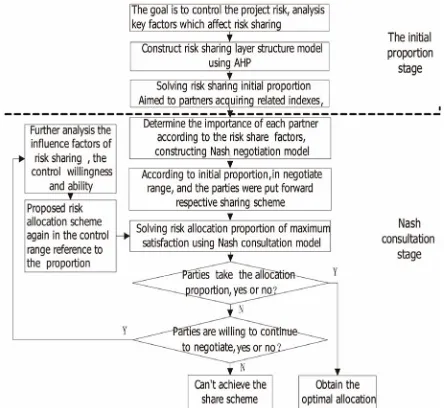
As to existing problems in the prior research, the basic thinking of building the risk sharing model is put forward (shown in Figure 1).
2.1. The Model Construction of Risk Sharing Based on the Idea of Two-Stage
Optimization
The risk sharing proportion reflects responsibility pro- portion of risk control and bearing proportion of risk re- sults, Therefore, the construction of ERP project risk shar- ing model should not only focus on total goal of effective risk control, but also should reflect the willingness of each partner, which can make the partners have a higher identification and satisfaction and make the decision pro- cess embody democracy and consultation fully. Then real responsibility risk allocation will be accomplished expli- citly, the process will be open and the risk control can be put into practical. For this, this paper will achieve the optimization goal of risk sharing by constructing two- stage model below.
2.2. AHP Model Construction of Risk Sharing Based on the Goal of Risk Control
Starting from target of risk control, based on risk alloca- tion decisions to consider the main influence factors, ac- cording to the principle of “the influence degree of risk control decide the proportion of the risk”, with the role of all levels weights of analytic hierarchy process, we cal- culate the total influence degree of all the partners of risk control which is the degree of importance of the partner in the risk control, and transfer them to the partner risk proportion and get the initial sharing proportion plan of risk allocation.
2.3. Nash Negotiation Model Construction Based on Maximum Satisfaction
[image:2.595.313.535.84.288.2]According to the balance principle of responsibility, right and profit, the ERP project risk allocation problem is not only a risk liability distribution and practicable problem, but also a profit allocation problem of practical equiva- lence of risk liability, so the risk allocation problem can
Figure 1. The basic thought of risk sharing model structure of ERP project.
be converted into interest distribution problem when con- sidering risk sharing synchronously, which can be settled by Nash.
Therefore, the second stage starts from the initial plan of the first stage, targets with the overall satisfaction of each partner, and then constructs Nash negotiation model and makes full use of democratic consultation mecha- nism. All partners can refer to the calculation results for decision-making, if they accept, then the solution will be the optimal share scheme. If there is one or more partners does not accept the scheme but will be willing to con- tinue to negotiate, then each partner can again give con- sultation proportion in the condition that the whole satis- faction will not reduce according to the consultation pro- portion, recalculating the allocation proportion. The ne- gotiation process has been continuing till all partners can accept the distribution proportion. Therefore, through Nash negotiation model, we can obtain risk allocation scheme with the highest overall satisfaction.
3. The Determination of ERP Project Risk
Sharing Initial Proportion Based on the
AHP
3.1. The Influence Factors Analysis of ERP Project Implementation Risk Sharing
in Table 1) can be set up. the team as the main participants and using the project
manager responsibility system. So according to different role of each participant playing in the risk control, the main participants are divided into three levels: enterprise, implementation team and project manager. The enter- prise mainly provides the various related resources for risk management and control; implementation team en- sures all kinds of effective methods and technical support for risk management and control; managers need to have management skills for risk management and control, which are of the three levels of main body structure of risk control. Starting From two dimensions of three-layer structure of main participants and three-phase risk con- trol decision-making process, the risk sharing influencing factors analysis matrix of ERP implementation (shown
3.2. Model Construction and Solution of Risks Sharing of ERP Project Implementation
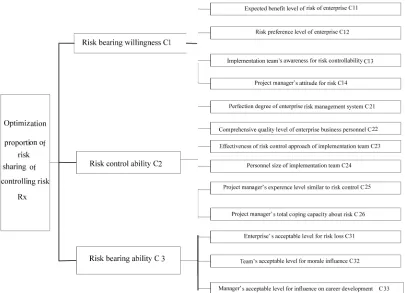
According to the independence and quantifiable of index system, based on advice from interview with senior ex- perts, we modified and refined indexes, finally obtained a set of risk sharing hierarchy model (shown in Figure 2).
1) Model Construction
This model includes four sections: the goal layer, cri- terion layer, sub-criteria layer and scheme layer.
[image:3.595.96.501.275.568.2]The first layer is the goal layer, which is the optimal risk allocation proportion for controlling risk Rx, which means to the purpose of solving problem.
Figure 2. Hierarchical structure model of risk sharing in ERP project.
Table 1. Influencing factor analysis matrix of ERP project risk allocation.
Decision stage Participation body
Risk bear willing Risk control ability Risk bear ability
Enterprise organization
Take risks’ expected returns; The risk preference of enterprise organization
The perfect degree of risk management system; The comprehensive quality of
business personnel
The acceptable level of risk of loss
Implementation team Understanding to the risk control
The means, method and measure of risk control; Implementation team personnel
scale
The acceptable level for team morale, stability, and shadow
Project manager The manager’s attitude to risk Similar risk control experience; Risk
comprehensive coping ability
[image:3.595.58.535.615.737.2]
The second layer is criterion layer, that is, determining the main index of risk sharing, including risk bearing intention, risk control ability and risk bearing ability. It is
expressed by the corresponding weights
set is Wi W . Where Wi means relative im- portance level of main index Ci among controlling risk Rx.
, 1, 2, 3 i
C i
1,W W2, 3
The third layer is sub-criteria layer, which determines secondary index layer of risk sharing proportion ex- pressed by Cij, the corresponding weights sets is
1, 2, ,
1 6ij i i ij
W W W W j , where Wij means the
relative importance level of secondary index Cij to the main index Ci.
The fourth layer is scheme layer, that is, the layer of project risk sharing scheme, that is, potential risk bearing partner of project implementation (project implementa-
tion partners), expressed by P, , the
corresponding weights sets is ijn ,
where Xijn means the relative influence level of the part- ner n for the risk sharing factors Cij.
1, 2, , 4P P P P
1, 2, ,ijn ij ij
X X X X
2) Parameters Determination
The parameters of the model are mainly the weight of the criterion layer and the sub-criteria layer. We can get the corresponding weights according to pairwise com-parisons of two indexes in the analytical hierarchy proc-ess.
Through surveying 10 typical ERP implementation en- terprises in China and making interview purposefully with ERP implementation project manager, informatiza- tion manager and ERP implementation consulting senior experts participated in ERP implementation et al., they gave the estimate matrix, then we calculated the weight using the arithmetic average method, the specific score and the weight are shown in Table 2.
Similarly, through the same grading and calculation method used in first-class index, the weights of second- class index are as follows:
1 2 30.301, 0.278, 0.243, 0.178
0.124, 0.138, 0.172, 0.096, 0.214, 0.256
0.378, 0.354, 0.268 i i i W W W
3) Model Solution
After determining the weight of each layer, the key to solve the model lies in how to obtain the relative impor- tance value of each partner for the sub-criteria layer index,
namely the measuring variables of the model. For one index of sub-criteria layer, by comparing the correspon- ding weights Xijk of partner k to this index, then we can determine partner k’s risk bearing ratio according to For- mula (1).
k i ij ijk ij
W
w w x (1)4. Determination of ERP Project Risk
Allocation Optimization Proportion Based
on Nash Negotiation
The ERP project is a complex engineering which has more participants in implementation process. It’s good to improve all partners’ satisfaction to adopt the negotiation way to determine the risk allocation scheme. Therefore, on the basis of risk allocation initial proportion, further to determine risk sharing proportion scheme with the largest overall satisfaction through the democratic negotiation.
4.1. Model Construction
For more negotiation problem, Nash had put forward ne- gotiations model of multi-people negotiation countermea- sure [9]. Let’s assume n partners participating in ERP project implementation risk sharing, each partner raises a risks bearing scheme with other partners according to the level of his role played in the implementation and risk allocation principle.
Supposing partner i puts forward a risk allocation
scheme, that is .
where qij means the partner j’s risks allocation proportion presented by the partner i in risk sharing coordinate pro-
T1, 2, , , 1, 2, ,
i i i ni
q q q q i n
jects, 0qij 1. and . So n partners will put
1 1 n ij i q
forward n risk sharing coordinate projects, which will
n n order matrix:
11 12 1
21 22 2
1 2
n
n
n n nn
q q q
q q q
q
q q q
. a
Supposing highest expected risk sharing ratio of part- ner i is
1
, max ji
j n
q i q i q
, so highest potential
risk sharing scheme set of ERP implementation partner is
1 , 2 , ,
Q q q q n . But
, it1
1 n
i
q i
[image:4.595.59.540.683.737.2]
Table 2. The grades and weight of first-class index.
Second development risk Risk bearing willing C1 Risk control ability C2 Risk bearing ability C3 Factors weights (Wi)
Risk bearing willing C1 1 0.513 3.208 0.334
Risk control ability C2 1.949 1 4.957 0.559
Can’t satisfy the constraint conditions of all risk bearing proportion is 1, so negotiation is needed between all partners. Setting the lowest expected risk share ratio of
partner i is
1
, min ji
j n
q i q i q
, So ERP imple-
mentation partner lowest risk sharing scheme set is
1 , 2 , ,
Q q q q n
Supposing ri is the risk bearing proportion of partner i. For partner i, bearing risk and benefits are symmetrical. So the satisfaction of risk allocation scheme of partner i can be expressed as:
i ir f
q i
(2)
where riq
i , q
i is the starting point of the ne- gotiations to partner i, the lowest satisfaction of partner i is:
i q i f q i (3)
According to Nash negotiate model: Objective function:
1 Max i w n i i q i r Zq i q i
(4)Constraint conditions:
1 . . 1 i n i iq i r q i
s t r
(5)Using Kuhn-Tucker conditions [25] to solve (4), (5):
1 1 1 n i i i n i iw q i
r q i q i
w q i
(6)Formula (6) is the solution to Nash negotiation model based on the satisfaction, q
i represents reserved risk ratio of partner i, namely the negotiation basis points,
1 1 1 n i i n i iw q i
q i
w q i
represents risk allocation com-pensation proportion of partner i.
4.2. Determination and Solution of Model Parameters
1) Determination of Parameters i
The parameter i reflects the importance level of role which partner i play for controlling some risks in ERP implementation.
w
w
In order to construct the Nash negotiation model, it needs to determine the value of the parameter i. Be- cause the degree of each partner’s role in risk control can be influenced by its bearing willing, control ability and
bearing ability, while the construction of the first-stage model is the index system established on the basis of considering these factors. Therefore, risk allocation pro- portion i obtained from the analytic hierarchy process can also reflect the importance level iof role which all partners play for controlling risks in ERP implementation. Let
w
w
k
w
i , then
,n
n
4,
, , 1, 2,
w W i k
i w
1
, 1, 1, 2, 3, n
n i
i
r r i
i i
As long as determining the value of , the next step is to solve the model.
.
2) Model Solution
After determining the model parameters, each partner needs to put forward their risk sharing scheme in negoti- ate range according to the risk allocation initial propor- tion of the first phase, we can get a order risk al- location coordinate projects set.
n
According to the value of the parameter i and com- bining formula (6), we will get the solution of the Nash negotiation model, that is,
w
1,r2,
,
R r 4, where ri
is
the risk allocation proportion when partner i has biggest satisfaction.
If the risk allocation proportion is accepted by all partners, that is, we get the final risk allocation propor- tion. Otherwise, keeping the overall satisfaction nonde- creasing, through continuous negotiations the partners put forward risk sharing coordination projects and coming into the next round of Nash negotiations model solution until the partners get risk allocation proportion which all partners are satisfied with.
5. Conclusion
The paper explored the best sharing plan by constructing the ERP project implementation risk sharing two-stage model, which provides a new idea for rational sharing of ERP project implementation risks. The two-stage model of risk sharing not only reflects the objective require- ments of risk sharing, but also the characteristic of de- mocracy and friendly negotiation, it has strong maneu- verability and its results will also be accepted by each partner easily. In the future, research need to combine risk sharing problems with each partner contract formu- lation process to provide legal safe guard for the effective implementation project risk sharing results.
6. Acknowledgements
REFERENCES
[1] D. Aloini, R. Dulmin and V. Mininno, “Risk Manage- ment in ERP Project Introduction: Review of the Litera- ture,” Information & Management, Vol. 44, 2007, pp. 547-567.
[2] Y. J. Ke, S. Q. Wang, A. P. C. Chan and P. T. I. Lam, “Preferred Risk Allocation in China’s Public-Private Part- nership (PPP) Projects,” International Journal of Project Management, Vol. 28, No. 5, 2010, pp. 482-492.
doi:10.1016/j.ijproman.2009.08.007
[3] Y. L. Xu, A. P. C. Chan and J. F. Y. Yeung, “Developing a Risk Assessment Model for PPP Projects in China—A Fuzzy Synthetic Evaluation Approach,” Journal of Con- struction Engeering and Management, Vol. 19, No. 7, 2010, pp. 929-943.
[4] Y. L. Fu, D. S. Xiao and L. H. Guo, “The Research on Risk Sharing of Subcontract in Supply Chain,” Systems Engineering, Vol. 2, 2005, pp. 123-126.
[5] X. J. Fan, Y. Zhao and G. Y. Zhong, “Study on Alloca- tion Proportion of Infrastructure Project Financing Risk,” Journal of Industrial Engineering and Engineering Man- agement, Vol. 21, No. 1, 2007, pp. 98-101.
[6] Z. Q. Zhu, Y. X. Li and A. Luo, “An Empirical Study on Influencing Factors of Risk Sharing in ERP Project,” In- dustrial Engineering and Management, Vol. 15, No. 2, 2010, pp. 98-102.
[7] W. D. Feng and J. Chen, “The Determination of Partners’ Benefit Allocation Proportion in Virtual Enterprise,” Sys- tems Engineering Theory and Practice, Vol. 4, 2004, pp. 45-49.
[8] L. Wu, “Interest Distribution Method of Dynamic Logis- tics Alliance in Output Share Mode,” Systems Engineer- ing, Vol. 27, No. 5, 2009, pp. 25-30.