ISSN Online: 2161-4725 ISSN Print: 2161-4717
DOI: 10.4236/ijaa.2017.73012 Jul. 26, 2017 154 International Journal of Astronomy and Astrophysics
Erratum to “The Cause of the Allais Effect
Solved”
Bjarne Lorenzen
VUC, Kolding, Denmark
The original online version of this article (Bjarne Lorenzen (2017) The Cause of the Allais Effect Solved. Volume 7, 69-90 doi: 10.4236/ijaa.2017.72007) un-fortunately contains several mistakes.
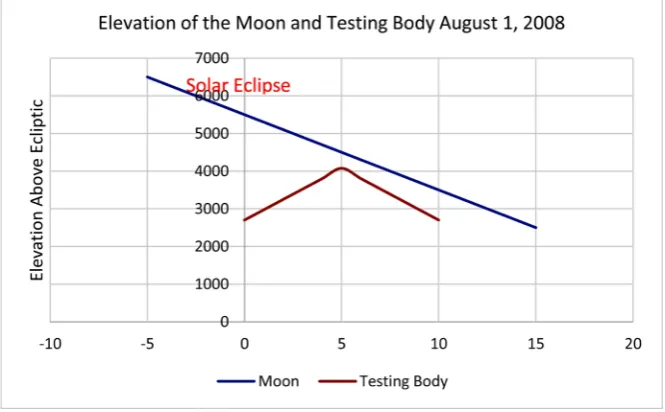
1) Figure 3 must be replaced, with the one below, the previous Figure 3 did not show a correct solar eclipse.
[image:1.595.199.538.395.539.2]Testing bodies in different accleration reference frames
Figure 3. The Earth & testing bodies in different acceleration reference frames EX-DFA = Exposed Dark Flow Acceleration. UA = Upwards Acceleration of Earth.
2) The way to calculate the magnitude of the Allais Effect was wrong. Vector addition must be used instead. However the magnitude of the Allais Effect is the same as mentioned in the article, only the method of calculation has changed.
3) The solar eclipse the 21 of August is not one of the best options to measure Allais Effect. The Lunar Eclipse 7 of August is better. This is based on the fact that the Moon is only 0.4˚ above ecliptic at lunar eclipse the 7 of August, howev-er 0.8˚ above ecliptic at solar eclipse the 21 of August.
4) It is incorrect that pendulum is the best device to measure the Allais Effect. Received: July 14, 2017
Accepted: July 23, 2017 Published: July 26, 2017
Copyright © 2017 by author and Scientific Research Publishing Inc. This work is licensed under the Creative Commons Attribution International License (CC BY 4.0).
DOI: 10.4236/ijaa.2017.73012 155 International Journal of Astronomy and Astrophysics
Measurement with modern gravimeter (if done at the correct position) is a much better option. The theory is not changed, however in the main article it was overlooked that measurement with two different gravimeters near arctic, (by some solar and lunar eclipse) is a much better option. Prediction: A relative and an absolute gravimeter (situated at the same place) between the 60˚and 70˚ lati-tude will by (some) solar (and lunar) eclipse measure different acceleration due to gravity. The relative gravimeter will only measure the acceleration due to gravity of the earth; however, in addition to that, the absolute gravimeter will also measure DFA. The difference will be that the absolute gravimeter will measure plus 35 μGal (±10 μGal) (Figures 7-9). The variation depends on where the measurement takes place and on the rotation of Earth. Which solar and lu-nar eclipse are options can also easily be predicted.
THE RESULTING ACCELERATION AFFECTING THE EARTH Force Vectors
Figure 1. F1 = Force Factor 174, F2 = Force Factor 1. The Resulting Force calculated to 0.0034˚.
Calculation of the Upward Acceleration of the Earth by an Eclipse
a (km) C Resulting Acceleration Upwards Acceleration Result
3000 0.45 0.0026˚ sin(0.0026)0.006 = 0.00000027 m/s2
4000 0.6 0.0034˚ sin(0.0034)0.006 = 0.00000035 m/s2
5000 0.75 0.0043˚ sin(0.0043)0.006 = 0.00000045 m/s2 The resulting acceleration due to gravity of the Sun + the Moon (affecting Earth) = 0.006 m/s2
THE ANGLE OF THE RESULTING FORCE
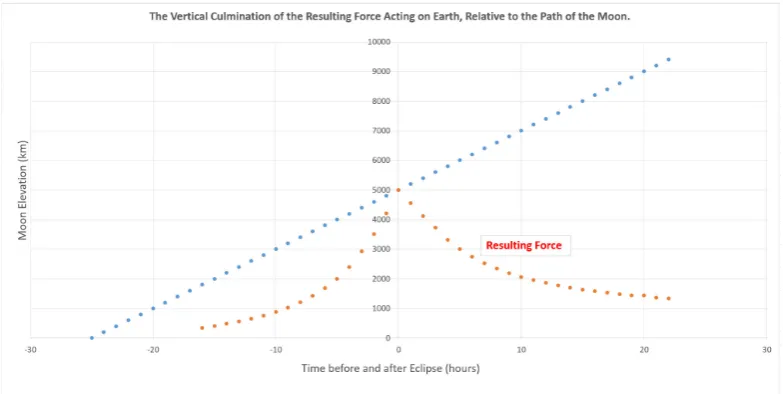
Figure 2. Vertical culmination of the Resulting
Force. Figure 3. The Resulting Force pointing 45˚.
The Resulting Force (RF) (of the Sun and Moon) acting on Earth must point as vertical as possible (Figure 1 and Figure 2) to be able to accelerate the Earth upwards fast enough in order to expose DFA.
[image:2.595.204.540.399.632.2]DOI: 10.4236/ijaa.2017.73012 156 International Journal of Astronomy and Astrophysics THE ANGLE OF THE RESULTING FORCE
Imaging a circle (radius 8 km) at the center of the Sun (Figure 4 and Figure 6)
[image:3.595.148.540.288.476.2]• 8 hours before eclipse, the RF is pointing 22.5˚ vertical. • 4 hours before eclipse, the RF is pointing 45˚ vertical • 4 hours after eclipse, the RF is pointing 45˚ vertical • 8 hours after eclipse, the RF is pointing 22.5˚ vertical The required vertical upwards acceleration of the Earth is unique only by solar and lunar eclipse. The 8000 km radius of the abstract circle (on the Sun) is based on the angle between the Moon and Earth at 0.6˚, (which is perfect for pendulum measurement).
Figure 4. Angle of the Resulting Force.
[image:3.595.148.540.508.705.2]The gravimeter measurement test is preferable because the measuring equip-ment can measure the entire range of Allais Effect from one and the same posi-tion (Figure 5).
Figure 5. This images show how the elevation of the Moon correspond to a certain exposed DFA.
DOI: 10.4236/ijaa.2017.73012 157 International Journal of Astronomy and Astrophysics
THE ULTIMATED ALLAIS EFFECT MEASSUREMENT METHOD By (some) solar (and lunar) eclipses, the Moon pulls/accelerates the Earth slightly upwards (north) (Figure 2), however (for a short period) this doesn’t directly effect a testing body situated in the artic area (given that the testing body is not connected with Earth).
This means that for a short period, (by some solar and lunar eclipse) the moon will therefore prevent the Earth from following the Dark Flow Accelera-tion (DFA) (towards south), but a testing body that is not connected with Earth is free to follow the DFA (south).
This can be measured because a testing body inside an absolute free fall gra-vimeter (Figure 7) is free to follow DFA. But a testing body inside a relative gravimeter is connected to the gravimeter and therefore also connected to the upward accelerating Earth via the spring connecting the testing body to the gra-vimeter.
The testing body of the relative gravimeter must therefore follow the up-wards acceleration of the Earth and is thus not able to measure any DFA effect. • The relative gravimeter will measure the acceleration due to the gravity of
Earth.
• The absolute gravimeter will measure the acceleration due to the gravity of Earth + DFA.
The disagreement between the 2 different kinds of gravimeters is expected to be around maximum 40 μGal
[image:4.595.208.536.413.559.2]A Perfect Experiment of Measurement
Figure 7. The ultimate Allais Effect measurement method.
P1. Illustrates the Moon 1000 km above the Earth (Figure 7)—this is not the perfect position because the testing bodies (inside the 2 gravimeters) is also pulled upwards by the Moon and hence is not totally free to interact with DFA. However, the Allais Effect can still be measured, but not the full force of it.
P2. Illustrates the Moon at the same level/altitude as the 2 gravimeters (2 testing bodies)— this is the perfect position (P2), because the testing body inside the 2 gravimeters is at the same level and hence is totally free to interact with DFA. The full effect of the Allais Effect can be measured.
DOI: 10.4236/ijaa.2017.73012 158 International Journal of Astronomy and Astrophysics P6. Illustrates the Moon lower than PP. The testing bodies are pulled slightly downwards by
the lower Moon. At this position, the Moon cannot accelerate the Earth enough upwards to fully expose DFA. Therefore, the anomaly is weaker at this point.
P7. And P8—The Moon is too low; no effect will be measured.
Anomalies/deviations between the absolute gravimeter and relative
gravimeter measurements must be expected, in fact increasing to about
35 μGal, and very likely more than that. This is a significant anomaly that
no one will expect.
As already mentioned, a free fall testing body is free to interact with
DFA from that experimental position, but a relative gravimeter (or a
pendulum) will not because the testing bodies in these cases are
con-nected with Earth where by kinetic energy/upwards accelerating of the
Earth will affect these suspended testing bodies.
The anomaly can be detected 24 hours starting by a gradually
increas-ing anomaly, culminatincreas-ing by maximum solar eclipse and decreasincreas-ing and
gradually vanishing 12 hours after the solar eclipse.
THE ALLAIS EFFECT IS A LONG-LIVED ANOMALY.
The perfect position (P2) for measuring the Allais Effect with a pendulum is off course also when the Moon accelerates the Earth slightly upwards without also directly pulling/accelerating a test pendulum upwards.
This means that the Moon prevents the Earth from following the Dark Flow Acceleration, but the Moon cannot prevent a testing body from following Dark Flow (at least not for a short period of time).
[image:5.595.208.538.435.568.2]The Position of the Moon and Pendulum Measurement
Figure 8.P5 = Perfect position of the Moon, T=Perfect position of the testing body.
P1. If the Moon is at position P1, P2 and P3 (Figure 8), it will pull/accelerate the Moon up-wards too fast. Testing body “T” will therefore not be able to follow the DFA, and no Allais Effect can be measured.
P4. At position P4, the Moon will still accelerate the testing body upwards, but not enough to cancel out the exposed DFA. The Allais Effect can be measured, but not the full potential. P5. The Moon at position P5 is the Perfect Position (PP) to allow a pendulum to measure the Allais Effect. Because the Moon doesn’t pull the testing body upwards and because the DFA interaction Axis is (almost) parallel to the DFA axis.
DOI: 10.4236/ijaa.2017.73012 159 International Journal of Astronomy and Astrophysics upwards to be able to fully expose DFA. Therefore, the anomaly is weaker than when the Moon is at this position.
P7. Position P8 is bad because the Earth is not accelerating upwards, and therefore DFA is not exposed.
Both experiences and calculation show that the period during which the Allais Effect can be measured is not only few hours but rather 20 hours.
Also notice that it takes the Moon 24 hours to reach a 0.72˚ higher or lower altitude. When the Moon is lower or higher relative to P5 (the Perfect Position), this will naturally affect the magnitude of the anomaly as well.
Several pendulum measurements show that the Moon must be about 4000 km above the horizontal ecliptic in order to have maximum strength to accelerate the Earth enough upwards so that a significant Allais Effect can be measured.
The perfect position (P5) is where the maximum gravity anomaly is possible to measure. Any position lower or higher than this will weaken the anomaly. Because the Moon inclines or declines 0.72˚ (within 24 hours) relative to the perfect position, this can naturally seriously weaken the anomaly. Based on all the measurement experience we have, there is reason to conclude that it must be possible to trace a tiny rest of the anomaly even within a range of 24 hours.
The reason why we believe the anomaly is short-lived is that this is only true seen from a local perspective, not seen from an overall perspective. This claim is already supported by evidence.
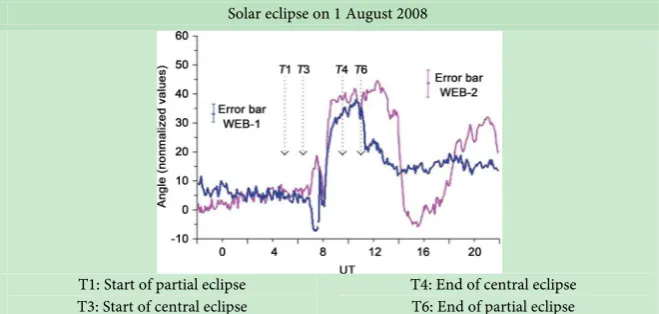
The measurement 1 of August 2008 that took place in Ukraine and Romania (Figures 9-12) was far away from the shadow of the Moon. The onset of the Al-lais Effect anomaly was several hours delayed.
The anomaly was measured several hours after the Solar Eclipse was over. The cause of this delay is that testing bodies A1 and B1 (in Romania and Ukraine) should first be brought to the perfect position (to position A2 and B2) by the ro-tation. The effect on testing body B1 was more delayed than the effect on testing body A, simply because the distance to travel from B1 to B2 was larger than the distance between A1 and A2.
Solar eclipse on 1 August 2008
T1: Start of partial eclipse
[image:6.595.209.539.531.688.2]T3: Start of central eclipse T4: End of central eclipse T6: End of partial eclipse
DOI: 10.4236/ijaa.2017.73012 160 International Journal of Astronomy and Astrophysics Precession of two pendulums compared over 14 hours spanning the solar eclipse 1/8 2008
Figure 10. Behavior of automatic and manual ball-borne pendulums during the eclipse. Source [2].
Also this measurement shows several hours of delay compared to many other anomalies.
Measurement 1 of August 2008 took place in Ukraine and Romania
Figure 11. The Allais Effect is a long-lived anomaly.
There is no doubt that if there would have been a measurement taken be-tween A1 and A2 (Figure 11), these too would have revealed the anomaly— however, not as delayed as in Ukraine and Romania.
Due to the fact that no worldwide coordinated research has ever been ex-ecuted, we can only guess what would have happened if measurements had also been taken further west—in Northern Italy, France, a few places in the Atlantic sea and in America.
[image:7.595.208.540.358.567.2]DOI: 10.4236/ijaa.2017.73012 161 International Journal of Astronomy and Astrophysics
[image:8.595.208.541.145.351.2]The answer is yes—but the answer is also that the maximum effect would only have been measured one place on earth. If worldwide measurement would have taken place, it would have revealed an anomaly increasing a half day before a so-lar eclipse, and gradually fading out a half day.
Figure 12. This graph shows that the vertical pull in the testing body was larger than the exposed DFA, when the solar eclipse took place. First few hours later the opposite began to happen and the anomaly could be measured. This explains the delayed anomaly meas-urement August 1. 2008. The gravimeter measmeas-urement experiment will not experience similar problems, because of the constant higher elevation of the testing body.
[1] Goodey, T.J., Pugach, A.F., Olenici, D. (2010) Correlated Anomalous Effects Ob-served during the August 1st 2008 Solar Eclipse. Journal of Advanced Research in Physics, 1, Article ID: 021007.
[2] Pugach, A.F. and Olenici, D. (2009) Observations of Correlated Behavior of Two Light Torsion Balances and a Paraconical Pendulum in Separate Locations during the Solar Eclipse of January 26th, 2009.Advances in Astronomy, 2012, Article ID 263818.
Submit or recommend next manuscript to SCIRP and we will provide best service for you:
Accepting pre-submission inquiries through Email, Facebook, LinkedIn, Twitter, etc. A wide selection of journals (inclusive of 9 subjects, more than 200 journals)
Providing 24-hour high-quality service User-friendly online submission system Fair and swift peer-review system
Efficient typesetting and proofreading procedure
Display of the result of downloads and visits, as well as the number of cited articles Maximum dissemination of your research work




![Figure 10. Behavior of automatic and manual ball-borne pendulums during the eclipse. Source [2]](https://thumb-us.123doks.com/thumbv2/123dok_us/7736111.706819/7.595.208.540.358.567/figure-behavior-automatic-manual-borne-pendulums-eclipse-source.webp)