BaCo
2(AsO
4)
2Tamara Ðordevic´
Institut fu¨r Mineralogie und Kristallographie, Universita¨t Wien-Geozentrum, Althanstrasse 14, A-1090 Vienna, Austria
Correspondence e-mail: [email protected]
Received 6 August 2008; accepted 11 August 2008
Key indicators: single-crystal X-ray study;T= 293 K; mean(As–O) = 0.002 A˚; Rfactor = 0.015;wRfactor = 0.038; data-to-parameter ratio = 15.5.
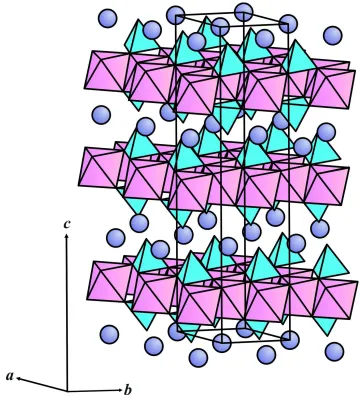
Suitable single crystals of the title compound, barium dicobalt(II) bis[orthoarsenate(V)], were prepared under hydrothermal conditions. This phase belongs to a series of compounds with general formula AM2(XO4)2, where A = alkaline earth metal,M= Mg or a divalent first-row transition element, and X= P, As or V. BaCo2(AsO4)2is isotypic with BaNi2(XO4)2(X= P, V or As) and is characterized by brucite-like sheets of edge-sharing CoO6 octahedra (3 symmetry) parallel to (001), with one-third of the octahedral positions being vacant. The sheets are capped above and below by AsO4 tetrahedra (3 symmetry) and are interconnected by distorted BaO12cuboctahedra (3 symmetry).
Related literature
For isostructural compounds, see: Eymond et al. (1969a,b); Bircsak & Harrison (1998); El-Bali et al. (1999); Faza et al.
(2001); Rogadoet al.(2002); Wichmann, & Mu¨ller-Buschbaum (1984). For magnetic properties of BaCo2(AsO4)2, see: Dojcˇilovic´ et al. (1994); Regnault et al. (2006). For related compounds, see: Effenberger & Pertlik (1993); El-Bali et al.
(1993a,b); Hemon & Courbion (1990); Kreidler & Hummel (1961); Lucaset al.(1998); Mihajlovic´et al.(2004); Moquineet al.(1993); Osterloh & Mu¨ller-Buschbaum (1994). For general background, see: Brese & O’Keeffe (1991).
Experimental
Crystal data
BaCo2(AsO4)2 Mr= 533.04
Hexagonal,R3
a= 5.007 (1) A˚
c= 23.491 (5) A˚
V= 510.02 (18) A˚3
Z= 3
MoKradiation
= 20.22 mm1
T= 293 (2) K 0.090.050.05 mm
Data collection
Nonius KappaCCD diffractometer Absorption correction: multi-scan
(Otwinowski & Minor, 1997; Otwinowskiet al., 2003)
Tmin= 0.221,Tmax= 0.362
681 measured reflections 341 independent reflections 336 reflections withI> 2(I)
Rint= 0.009
Refinement
R[F2> 2(F2)] = 0.014
wR(F2) = 0.038 S= 1.30 341 reflections
22 parameters
max= 0.96 e A˚3 min=1.09 e A˚3
Table 1
Selected bond lengths (A˚ ).
Ba1—O1 2.9344 (8) Ba1—O2 3.1611 (17) Co1—O2i 2.0791 (17)
Co1—O2 2.1017 (17) As1—O1 1.656 (3) As1—O2 1.7050 (17)
Symmetry code: (i)xyþ2 3;xþ
1 3;zþ
1 3.
Data collection: COLLECT (Nonius, 2002); cell refinement:
SCALEPACK (Otwinowski & Minor, 1997); data reduction:
DENZO-SMN (Otwinowski et al., 2003); method used to solve structure: starting parameters from an isostructural compound (Eymond et al., 1969a); program(s) used to refine structure:
SHELXL97(Sheldrick, 2008) and WinGX (Farrugia, 1999); mole-cular graphics: ATOMS (Dowty, 2000); software used to prepare material for publication:publCIF(Westrip, 2008).
The author gratefully acknowledges financial support by the Austrian Science Foundation (FWF) (grant No. T300-N19).
Supplementary data and figures for this paper are available from the IUCr electronic archives (Reference: WM2189).
References
Bircsak, Z. & Harrison, W. T. A. (1998).Acta Cryst.C54, 1554–1556. Brese, N. E. & O’Keeffe, M. (1991).Acta Cryst.B47, 192–197.
Dojcˇilovic´, J., Novakovic´, L., Napijalo, M. & Napijalo, M. (1994).Proc. Nat. Sci. Matica Srpska85, 269–273.
Dowty, E. (2000). ATOMS for Windows. Shape Software, Kingsport, Tennessee, USA.
Effenberger, H. & Pertlik, F. (1993).Monatsch. Chem.124, 381–389. El-Bali, B., Bolte, M., Boukhari, A., Aride, J. & Taibe, M. (1999).Acta Cryst.
C55, 701–702.
El-Bali, B., Boukhari, A., Aride, J. & Abraham, F. (1993a).J. Solid State Chem. 104, 453–459.
El-Bali, B., Boukhari, A., Holt, E. M. & Aride, J. (1993b).J. Crystallogr. Spectrosc. Res.23, 1001–1004.
Eymond, S., Martin, M. C. & Durif, A. (1969a).C. R. Acad. Sci. Ser. C,286, 1694–1696.
Eymond, S., Martin, M. C. & Durif, A. (1969b).Mater. Res. Bull.4, 595–600. Farrugia, L. J. (1999).J. Appl. Cryst.32, 837–838.
Faza, N., Treutmann, W. & Babel, D. (2001).Z. Anorg. Allg. Chem.627, 687– 692.
Hemon, A. & Courbion, G. (1990).J. Solid State Chem.85, 164–148. Kreidler, E. R. & Hummel, F. A. (1961).Inorg. Chem.6, 524–528.
Lucas, F., Elfakir, A., Wallez, G. & Quarton, M. (1998).Can. Mineral.36, 1045– 1051.
Mihajlovic´, T., Kolitsch, U. & Effenberger, H. (2004).J. Alloys Compd,379, 103–109.
Moquine, A., Boukhari, A. & Darriet, J. (1993).J. Solid State Chem.107, 362– 367.
Nonius (2002).COLLECT. Nonius BV, Delft, The Netherlands.
Osterloh, D. & Mu¨ller-Buschbaum, Hk. (1994).Z. Anorg. Allg. Chem.620, 651–654.
Otwinowski, Z., Borek, D., Majewski, W. & Minor, W. (2003).Acta Cryst.A59, 228–234.
Otwinowski, Z. & Minor, W. (1997). Methods in Enzymology, Vol. 276,
Macromolecular Crystallography, Part A, edited by C. W. Carter Jr & R. M. Sweet, pp. 307–326. New York: Academic Press.
Regnault, L. P., Boullier, C. & Henry, J. Y. (2006).Physica B,385–386, 425–427.
inorganic compounds
i58
Tamara Ðordevic´ doi:10.1107/S1600536808025865 Acta Cryst.(2008). E64, i58–i59Acta Crystallographica Section E
Structure Reports
Online
(2002).Phys. Rev. B,65, 144443.
Sheldrick, G. M. (2008).Acta Cryst.A64, 112–122.
supporting information
sup-1
Acta Cryst. (2008). E64, i58–i59
supporting information
Acta Cryst. (2008). E64, i58–i59 [doi:10.1107/S1600536808025865]
BaCo
2(AsO
4)
2Tamara
Đ
ordevi
ć
S1. Comment
The crystal structures of phosphates, arsenates and vanadates with the general formula AM2(XO4)2 where A = alkaline
earth metal, M = Mg or divalent first row transition elements and X = P, As or V, are relatively well known (Bircsak &
Harrison, 1998; El-Bali et al., 1993a,b, 1999; Eymond et al., 1969a,b; Hemon & Courbion, 1990; Kreidler & Hummel,
1961; Lucas et al., 1998; Moquine et al., 1993; Osterloh & Müller-Buschbaum, 1994; Wichmann & Müller-Buschbaum,
1984, and references therein). These phases adopt different structure types and exhibit interesting physical properties
(phase transitions, magnetism). Six compounds, viz. BaMg2(AsO4)2, BaCo2(AsO4)2 (Eymond et al., 1969b), BaNi2(AsO4)2
(Eymond et al., 1969a,b), BaCo2(PO4)2 (Bircsak & Harrison, 1998), BaNi2(PO4)2 (El-Bali et al., 1999; Faza et al., 2001)
and BaNi2(VO4)2 (Wichmann & Müller-Buschbaum, 1984; Rogado et al., 2002) are isostructural with the title compound,
BaCo2(AsO4)2. The underlying crystal structure was described for the first time for BaNi2(AsO4)2 by Eymond et al.
(1969a). Although two-dimensional magnetic properties of these compounds have been widely studied (Dojčilović et al.,
1994; Regnault et al., 2006, and references therein), a full determination of their crystal structures was not given for all
members of this structural family. Hydrothermal synthesis and the crystal structure of BaCo2(AsO4)2 are presented in this
communication.
Besides BaCoAs2O7 (Mihajlović et al., 2004), BaCo2(AsO4)2 represents the second compound structurally characterised
in the system BaO–CoO–As2O5. Its crystal structure is made up of brucite-like sheets of edge-sharing CoO6 octahedra
parallel to (001), with one-thirds of the octahedral positions being vacant. AsO4 tetrahedra are situated above and below
the sheets. The resulting anionic [Co2(AsO4)2]2- layers are stacked with a sequence ABCABC along [001] and are laterally
displaced by Δx = 2/3a, with Δx = 1/3b between the layers. Adjacent layers are interconnected by BaO12 polyhedra to
form a three-dimensional framework (Fig. 1).
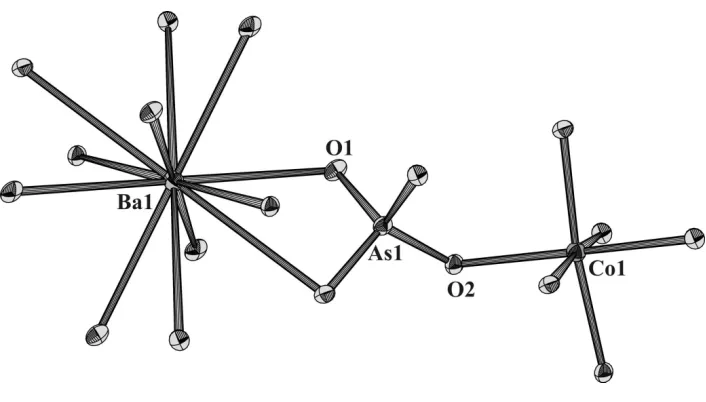
The Ba1 atom has site symmetry 3 and is coordinated by twelve oxygen atoms (Fig. 2) with an average Ba1—O bond
length of 3.048 Å. This bond length compares well with the average bond length for Ba—O distances of 3.015 Å in the
isostructural Ni compound BaNi2(AsO4)2 (Eymond et al., 1969a,b). The Ba1 atom is bonded to six O1 and six O2 atoms,
resulting in a distorted cuboctahedral coordination polyhedron. The Co1 atom has site-symmetry 3 and is octahedrally
coordinated to O1 atoms with a mean Co1—O1 distance of 2.091 Å. The As1O4 tetrahedron (3 symmetry) exhibits an
average bond length of 1.692 Å, with two symmetrically independent As1—O bonds of 1.656 (3) Å (O1) and of
1.7050 (17) Å (O2, 3×) due to the different other coordination partners of the two oxygen atoms. O1, which bridges the
barium ions, shows a shorter As1—O bond than O2, which bridges the cobalt ions (Fig. 2).
Bond-valence calculations for all atoms, using the parameters of Brese & O′Keeffe (1991), give 1.63 v.u. (valence units)
for Ba1, 2.04 v.u. for Co1, 4.89 v.u. for As1, and 1.53 v.u and 1.96 v.u for O1 and O2, respectively. If one takes into
account that the O2 atom is bonded to two Co1, one As1, and one Ba1 atom, and the O1 atom is bonded to one As1 and
three Ba1 neighbours, the calculated values are close to the theoretical valences. However, it is worth mentioning that in
Single crystals of BaCo2(AsO4)2 were obtained as reaction products from mixtures of Ba(OH)2.8H2O (Merck, >97%),
Co(OH)2 (Alfa Products) and As2O5 (Alfa Products, >99.9%) under hydrothermal conditions. The mixture was transferred
into a Teflon vessel and filled to approximately 70% of its inner volume with distilled water (pH of the resulting solution
was ≈ 2.5). Finally, the vessel was enclosed into a stainless steel autoclave and was heated from room temperature to 493
K (2 h), held at 493 K for 24 h, then cooled to 393 K within 14 h, kept at this temperature for 24 h, and finally cooled to
room temperature within 4 h. At the end of the reaction the pH was ≈ 6. The solid reaction products were filtered and
washed thoroughly with distilled water. BaCo2(AsO4)2 (yield ca 50%) crystallized as transparent pink crystals and was
accompanied with prismatic blue–green crystals of BaCoAs2O7 (Mihajlović et al., 2004) (yield ca 30%) and
Co2As2O7(H2O)2 (Effenberger & Pertlik, 1993) (yield ca 15%), besides very few prismatic blue crystals of an yet
unidentified compound (yield ca 5%). All crystals were up to 0.2 mm in length.
S3. Refinement
The crystal structure was refined with the atomic coordinates of BaNi2(AsO4)2 (Eymond et al., 1969a) as starting
supporting information
sup-3
[image:5.610.123.483.70.472.2]Acta Cryst. (2008). E64, i58–i59
Figure 1
The crystal structure of BaCo2(AsO4)2 with sheets consisting of CoO6 octahedra and AsO4 tetrahedra (both in polyhedral
Figure 2
Coordination of Ba and Co with atoms displayed as ellipsoids at the 50% probability level.
Barium dicobalt(II) bis-arsenate(V)
Crystal data BaCo2(AsO4)2 Mr = 533.04 Hexagonal, R3 Hall symbol: -R 3 a = 5.007 (1) Å c = 23.491 (5) Å V = 510.02 (18) Å3 Z = 3
F(000) = 720
Dx = 5.206 Mg m−3
Mo Kα radiation, λ = 0.71073 Å Cell parameters from 675 reflections θ = 1.0–30.0°
µ = 20.22 mm−1 T = 293 K
Pseudo-hexagonal plate, pink 0.09 × 0.05 × 0.05 mm
Data collection Nonius KappaCCD
diffractometer
Radiation source: fine-focus sealed tube Graphite monochromator
φ and ω scans
Absorption correction: multi-scan
(Otwinowski & Minor, 1997; Otwinowski et al., 2003)
Tmin = 0.221, Tmax = 0.362
681 measured reflections 341 independent reflections 336 reflections with I > 2σ(I) Rint = 0.009
θmax = 30.0°, θmin = 2.6° h = −7→7
k = −5→5 l = −33→33
Refinement Refinement on F2 Least-squares matrix: full R[F2 > 2σ(F2)] = 0.014 wR(F2) = 0.038 S = 1.30 341 reflections 22 parameters 0 restraints
Primary atom site location: isomorphous structure methods
w = 1/[σ2(F
o2) + (0.0133P)2 + 3.104P] where P = (Fo2 + 2Fc2)/3
(Δ/σ)max < 0.001 Δρmax = 0.96 e Å−3 Δρmin = −1.09 e Å−3
supporting information
sup-5
Acta Cryst. (2008). E64, i58–i59 Special details
Geometry. All esds (except the esd in the dihedral angle between two l.s. planes) are estimated using the full covariance matrix. The cell esds are taken into account individually in the estimation of esds in distances, angles and torsion angles; correlations between esds in cell parameters are only used when they are defined by crystal symmetry. An approximate (isotropic) treatment of cell esds is used for estimating esds involving l.s. planes.
Refinement. Refinement of F2 against ALL reflections. The weighted R-factor wR and goodness of fit S are based on F2, conventional R-factors R are based on F, with F set to zero for negative F2. The threshold expression of F2 > 2sigma(F2) is used only for calculating R-factors(gt) etc. and is not relevant to the choice of reflections for refinement. R-factors based on F2 are statistically about twice as large as those based on F, and R- factors based on ALL data will be even larger.
Fractional atomic coordinates and isotropic or equivalent isotropic displacement parameters (Å2)
x y z Uiso*/Ueq
Ba1 0.0000 0.0000 0.0000 0.01170 (15) Co1 0.0000 0.0000 0.17014 (2) 0.00614 (16) As1 0.3333 0.6667 0.091941 (18) 0.00473 (15) O1 0.3333 0.6667 0.02145 (13) 0.0118 (6) O2 0.0163 (4) 0.3375 (4) 0.11476 (7) 0.0077 (3)
Atomic displacement parameters (Å2)
U11 U22 U33 U12 U13 U23
Ba1 0.01138 (17) 0.01138 (17) 0.0124 (2) 0.00569 (8) 0.000 0.000 Co1 0.00474 (19) 0.00474 (19) 0.0089 (3) 0.00237 (9) 0.000 0.000 As1 0.00414 (16) 0.00414 (16) 0.0059 (2) 0.00207 (8) 0.000 0.000 O1 0.0149 (9) 0.0149 (9) 0.0055 (13) 0.0075 (5) 0.000 0.000 O2 0.0055 (7) 0.0050 (7) 0.0116 (8) 0.0019 (6) 0.0017 (6) 0.0020 (6)
Geometric parameters (Å, º)
Ba1—O1i 2.9344 (8) Ba1—O2ix 3.1611 (17) Ba1—O1ii 2.9344 (8) Co1—O2x 2.0791 (17) Ba1—O1iii 2.9344 (8) Co1—O2xi 2.0791 (17) Ba1—O1 2.9344 (8) Co1—O2xii 2.0792 (17) Ba1—O1iv 2.9344 (8) Co1—O2vii 2.1017 (17) Ba1—O1v 2.9344 (8) Co1—O2 2.1017 (17) Ba1—O2vi 3.1611 (17) Co1—O2vi 2.1017 (17) Ba1—O2 3.1611 (17) As1—O1 1.656 (3) Ba1—O2vii 3.1611 (17) As1—O2xiii 1.7050 (17) Ba1—O2iii 3.1611 (17) As1—O2 1.7050 (17) Ba1—O2viii 3.1611 (17) As1—O2xiv 1.7050 (17)
O1iii—Ba1—O1iv 117.11 (3) O2—Ba1—O2viii 126.22 (5) O1—Ba1—O1iv 62.89 (3) O2vii—Ba1—O2viii 126.22 (5) O1i—Ba1—O1v 62.89 (3) O2iii—Ba1—O2viii 53.78 (5) O1ii—Ba1—O1v 117.11 (3) O1i—Ba1—O2ix 82.85 (6) O1iii—Ba1—O1v 62.89 (3) O1ii—Ba1—O2ix 97.15 (6) O1—Ba1—O1v 117.11 (3) O1iii—Ba1—O2ix 106.72 (6) O1iv—Ba1—O1v 180.00 (12) O1—Ba1—O2ix 73.28 (6) O1i—Ba1—O2vi 127.06 (6) O1iv—Ba1—O2ix 52.94 (6) O1ii—Ba1—O2vi 52.94 (6) O1v—Ba1—O2ix 127.06 (6) O1iii—Ba1—O2vi 97.15 (6) O2vi—Ba1—O2ix 126.22 (5) O1—Ba1—O2vi 82.85 (6) O2—Ba1—O2ix 126.22 (5) O1iv—Ba1—O2vi 73.28 (6) O2vii—Ba1—O2ix 180.00 (3) O1v—Ba1—O2vi 106.72 (6) O2iii—Ba1—O2ix 53.78 (5) O1i—Ba1—O2 73.28 (6) O2viii—Ba1—O2ix 53.78 (5) O1ii—Ba1—O2 106.72 (6) O2x—Co1—O2xi 92.91 (7) O1iii—Ba1—O2 127.06 (6) O2x—Co1—O2xii 92.91 (7) O1—Ba1—O2 52.94 (6) O2xi—Co1—O2xii 92.91 (7) O1iv—Ba1—O2 97.15 (6) O2x—Co1—O2vii 92.34 (6) O1v—Ba1—O2 82.85 (6) O2xi—Co1—O2vii 174.36 (6) O2vi—Ba1—O2 53.78 (5) O2xii—Co1—O2vii 88.86 (9) O1i—Ba1—O2vii 97.15 (6) O2x—Co1—O2 174.36 (6) O1ii—Ba1—O2vii 82.85 (6) O2xi—Co1—O2 88.86 (9) O1iii—Ba1—O2vii 73.28 (6) O2xii—Co1—O2 92.34 (6) O1—Ba1—O2vii 106.72 (6) O2vii—Co1—O2 85.72 (7) O1iv—Ba1—O2vii 127.06 (6) O2x—Co1—O2vi 88.86 (9) O1v—Ba1—O2vii 52.94 (6) O2xi—Co1—O2vi 92.34 (6) O2vi—Ba1—O2vii 53.78 (5) O2xii—Co1—O2vi 174.36 (6) O2—Ba1—O2vii 53.78 (5) O2vii—Co1—O2vi 85.72 (7) O1i—Ba1—O2iii 106.72 (6) O2—Co1—O2vi 85.72 (7) O1ii—Ba1—O2iii 73.28 (6) O1—As1—O2xiii 108.33 (6) O1iii—Ba1—O2iii 52.94 (6) O1—As1—O2 108.33 (6) O1—Ba1—O2iii 127.06 (6) O2xiii—As1—O2 110.59 (5) O1iv—Ba1—O2iii 82.85 (6) O1—As1—O2xiv 108.33 (6) O1v—Ba1—O2iii 97.15 (6) O2xiii—As1—O2xiv 110.59 (5) O2vi—Ba1—O2iii 126.22 (5) O2—As1—O2xiv 110.59 (5) O2—Ba1—O2iii 180.00 (7)
Symmetry codes: (i) −x, −y+1, −z; (ii) x, y−1, z; (iii) −x, −y, −z; (iv) −x+1, −y+1, −z; (v) x−1, y−1, z; (vi) −x+y, −x, z; (vii) −y, x−y, z; (viii) x−y, x, −z; (ix)