Evaluation Report
Science for Environment Policy
Contract: ENV.G.3/SER/2007/0049
January 2009
Science Communication Unit
Table of Contents
1.0
Executive Summary
4
1.1
Key Conclusions
4
1.2
Key Recommendations
5
2.0
Background to Science for Environment Policy
6
2.1
Previous Evaluation
7
3.0
Evaluation Methods
9
4.0
Results
12
4.1
Researchers
12
4.2
Subscribers
16
5.0
Key Conclusions and Recommendations
23
5.1 Relevance of the News Service
23
5.2 Breadth of Coverage, Accuracy and
Newsworthiness of the News Service
23
5.3 Other Sources
5.4 Satisfaction with the News Service
24
List of Tables and Figures
Table One. Subscriber Organisations
17
Figure One. Timeliness of Research Reported
19
Figure Two. Language Preference
21
Figure Three. Overall Satisfaction
22
Acronyms
DG Environment
Directorate General Environment
EC
European Commission
EU
European Union
1.0
Executive Summary
The Science for Environment Policy news service aims to promote new, timely
and relevant scientific information for environmental policy making in a
user-friendly form and in comprehensive non-technical language. The Science
Communication Unit, UWE Bristol manages the service, which is delivered to
over 9,500 subscribers. The following document details the key findings of an
evaluation carried out by The Science Communication Unit assessing current
levels of satisfaction, competition, the relevance of the news service and its
breadth of coverage, accuracy and newsworthiness. Semi-structured interviews
were carried out with five researchers whose work had featured in the news
service and six subscribers. In addition, 48 subscribers participated in a short
questionnaire.
1.1 Key Conclusions
• Subscribers and researchers are satisfied with the relevance of the news
service coverage. Thematic issues are helpful when of relevance but could
be made more distinctive.
• The ability to see an overview of research which is up-to-date, of good
quality, international and relevant to environmental policy is a key benefit
of the service.
• Limited direct competition appears to exist. The majority of subscribes
identify the service via European Union or European Commission websites.
The ability to access policy makers is a key benefit for researchers
featuring in the service. Subscribers commonly circulate information of
relevance to additional colleagues.
• Levels of satisfaction with the service are high. 37% (n=18) of subscribers
strongly agree and 58% (n=28) agree they are satisfied with the news
service. Generally subscribers are satisfied with the production of the
1.2 Key Recommendations
• The email format and website continue to present issues of convenience
and usability for some subscribers. Improving these limitations would
reduce distractions from the quality of the written content.
• Thematic issues should be more distinctive for subscribers.
• The English language format of the News Service may warrant
investigation with a larger sample size of subscribers to establish
statistical correlations with specific countries, such as new member states.
• Evaluation monitoring data could routinely be established at the point of
subscription. Semi-structured interviews are warranted with researchers
but are not an efficient method to capture subscriber views.
• The relevance, accuracy and quality of the service has led to high levels of
satisfaction amongst subscribers and researchers suggesting that writing
and editorial procedures are highly appropriate.
The Science Communication Unit would like to thank all subscribers and
2.0
Background: Science for Environment Policy
This report provides details of the evaluation undertaken by the Science
Communication Unit at The University of the West of England, Bristol in
fulfilment of the contract: ENV.G.3/SER/2007/0049 Science for Environmental
Policy.
The overall aim of Science for Environment Policy is to promote new, timely and
relevant scientific information for environmental policy making in a user-friendly
form and in comprehensive non-technical language.
The main objectives are to:
• Provide news information in the form of flash articles by policy theme (six
per issue).
• Make flash articles available on the DG Environment web pages by storing
them chronologically and by theme.
• Develop and launch new thematic issues on important topics of on-going
policy development.
• Promote the service by various means to ensure high visibility, increasing
the number of subscriptions and engagement of stakeholders for further
uptake of the service.
Specific targets under the contract are to:
1. Develop a robust content collection strategy that covers the themes
identified for the service.
2. Develop, design and deliver 10 thematic issues during the course of the
contract.
3. Deliver marketing activities that will increase subscriptions with a view to
achieving a total of 12,000 subscribers by 2010.
4. Evaluate the service with 15-20 subscribers and/or researchers.
This evaluation report specifically addresses target 4, the evaluation of the
service.
The Science Communication Unit, UWE Bristol was awarded the contract for this
service from 22nd November 2007 – 22nd November 2008. The service is
managed by an editorial team, based at the Science Communication Unit at the
University of the West of England, Bristol in conjunction with a Scientific Content
Advisory Board, Researchers and Guest Editors for the thematic issues as
required.
Key outcomes of Science for Environment Policy during the period at which it has
been based at the Science Communication Unit include:
• A 50% increase in subscriber numbers from 6,000 at the project outset to
over 9,500.
• The development and launch on new monthly thematic issues.
• A re-designed website, incorporating a new archive facility.
• The revision of the marketing strategy to increase the subscriber base.
2.1 Previous Evaluation
The DG Environment News Alert Service was previously evaluated by external
contractors The Evaluation Partnership in March 2007. The key conclusions
are listed here for information purposes:
• The service was successful in reaching its target audience, providing
relevant, readable and interesting information to the extent that
subscribers would recommend it to others.
• The service was providing news that was new, timely and up-to-date.
• The service was the main source for new scientific information for over
half of readers and was reaching a broad readership (policy makers,
NGO’s, researchers etc.)
• The website, emails and word of mouth were the most successful
marketing tools but the services existence needed to be broadened to
• The service had a distinct visual identity but archive facilities were not
well utilised on the website.
The evaluation of the service in 2007 made a series of recommendations
including maintaining existing key features, creating summary thematic issues,
continuing to meet the needs of the target audience, increasing marketing
3.0
Evaluation Methods
The following evaluation supplements that carried out by The Evaluation
Partnership in 2007, by providing additional qualitative and quantitative data
regarding the effectiveness of the service in the intervening period. DG
Environment were keen to incorporate qualitative insight and thus an approach
was taken which would fulfil this requirement.
The objectives of this evaluation were as follows:
• To assess the relevance of the news service to environmental policy.
• To examine the perceived breadth of coverage, accuracy and
newsworthiness provided by the news service.
• To explore other sources consulted by participants in this field.
• To gauge general levels of satisfaction with the service.
The evaluation comprised a semi-structured interview approach intended to
include a minimum of 5 researchers whose material had featured in the news
service and a minimum of 10 subscribers. In addition this was supplemented by
a short questionnaire for subscribers due to an initially low response rate for
interviews.
16 researchers were contacted to participate in semi-structured interviews. The
researchers were selected via a stratified sampling method based on their
subject area, country and date of contact with the news service. Requests to
participate were sent on two occasions. Five agreed to be interviewed, a
response rate of 31%. Seven further researchers responded but declined to be
interviewed.
446 subscribers were contacted to participate in semi-structured interviews,
approximately 5% of the total subscribers to the service at the time of contact.
Subscribers were also selected via a stratified sampling method based on
country and length of subscription to the service. Requests to participate were
were no longer at the email address or had changed jobs. Given the low
response rate a short questionnaire was additionally sent to 400 subscribers,
this generated a response from 48 subscribers, a response rate of 10%.
The semi-structured interviews with researchers included a series of key
questions around:
• Prior awareness of the news service.
• Perception of benefits and constraints regarding inclusion in the news
service.
• How they became aware that their work was to be included in the news
service.
• Perception of the accuracy, balance and level of satisfaction with regards
to the news service coverage.
• Views on any contact with the editorial team.
• Follow up from policy makers or fellow researchers.
The semi-structured interviews with subscribers included a series of key
questions around:
• How they became aware of the news service before subscription.
• Relevance and newsworthiness of the content of the news service.
• Quality and breadth of the research included.
• Perception of the thematic issues.
• Format and language of the email and website.
• Follow up, including recommending the service to others and contacting
researchers.
Semi-structured interviews are a beneficial format for addressing open questions
and exploring and elaborating on issues raised by the interviewee. It therefore
provided a range of insightful and detailed information explored in the next
section. However, semi-structured interviews require a level of commitment
from the interviewee. In the case of this evaluation this method proved
problematic with regard to subscribers for a number of reasons. Firstly, many
participate in an interview. Secondly, their investment in the subject matter did
not justify a commitment to be interviewed. Thirdly, many expressed a lack of
confidence to verbally conduct an interview in English but were happy to
complete a questionnaire.
Due to time and financial constraints it was not practical to offer multi-lingual
interviewers but to overcome issues in recruitment for the subscriber interviews,
we supplemented this method with a short questionnaire. This was imbedded
within an interview request and sent to 400 additional subscribers. This asked
subscribers a series of questions regarding their use, the relevance,
newsworthiness and quality of the research included, the format of the service
4.0
Results
The following sections detail the results from the semi-structured interviews with
researchers and subscribers. In addition information is provided from the
subscriber questionnaire.
4.1 Researchers
Five researchers participated in semi-structured interviews. Their research
interests included biodiversity, sustainability, mechanical engineering, energy
and food security. The researchers were based in Israel, Germany, Australia, the
UK and USA. Despite efforts to stratify the time at which researchers had been
in contact with the service, all had featured in coverage between March and
August 2008.
Initial findings from the interview data suggest that researchers had not
necessarily heard of the News Alert Service before the inclusion of their work.
Four of the researchers had not come across it before, but mentioned now using
it. The fifth, researcher 5, a research associate in energy and food security, was
an existing subscriber. In this capacity, seeking contact with researchers before
the publication of an article based on their work, potentially extends the reach of
the service to a secondary audience as a number had suggested subsequent
subscription or use of the website.
A number of the interviewees described how the opportunity to publish their
work in the news service had allowed them to target a different or broader
audience than that which they had reached via their original publication:
‘I had quite a lot of interest in the research from people throughout Europe, who have asked to see my paper and I assume have read some of the results, who probably wouldn’t have read them otherwise. Wider dissemination, I think [was a benefit].’ (Researcher 4 interview, Research Fellow, Mechanical Engineering, UK)
‘I mean, certainly there were people who picked up on the article that emailed me afterwards. So I certainly got to reach different people that obviously hadn’t spotted the fact that it had been published at that time, so it certainly, it did help, absolutely.’ (Researcher 1 interview, Lecturer, Engineering, Australia)
Researcher 1 went on to elaborate on the types of people this appeared to have
generated interest from:
‘Well there’s been a paper, a sort of little news story published in Nature recently. Now whether they picked that up from there [the news service] or from, you know, another source, I’m not really sure, but it certainly, you know, that probably did help. I know I’ve also – some of the people that contacted me from Europe that heard about it from the news service were from the, I think it’s the European Geological Survey, I think it is. So there’s certainly people within Europe that saw that particular news piece and then, yeah, contacted me and so on, so there’s certainly – and that then led to other, you know, people sort of, you know, letting other colleagues and things like that. So it certainly did help, yeah…’ (Researcher 1 interview, Lecturer, Engineering, Australia)
For researcher 5, the interest generated had unusually and in reverse drawn
their attention to its inclusion in the service:
‘This summer I was away from my email for a few weeks and it came out during that time, but when I got back I had requests for the articles and I thought, “Huh, I wonder why all these people are requesting the article.” And then as I moved back through my email I saw that it was in the news service.’ (Researcher 5 interview, Research Associate, Energy and Food Security, USA)
Researcher 2, working in biodiversity reflected that whilst it had not resulted in
specific contact from other scientists it was likely to form part of the small,
incremental relationships and networks which are continually formed throughout
the scientific community. Researcher 4 described checking the news service
website before their work was included as a gauge of its quality and found it was
a ‘good summary of key research’, suggesting it provided a route into a
had given, had already resulted in a meeting with a large National organisation
and he described it adding to new contacts with an eye to future collaboration.
And for these researchers at least, the policymaker was one which they
recognised a need to engage with:
‘Working at the, you know, the, I suppose the edge of these debates surrounding the environmental things it’s, you know, I’m fully aware of the need to actually integrate a lot of policy, and that connection between the researcher and the policymaker… I mean I’m not too worried about my work – I’m not too worried about that. But, just, you know, the recognition that there is a need to get that awareness between the policymakers and what the research is saying.’ (Researcher 1 interview, Lecturer, Engineering, Australia)
‘Our article was very much meant to speak to a larger audience about agriculture and trade so I got requests from a number of scholars as well as the UN and SAO and a couple like international agricultural organisations.’ (Researcher 5 interview, Research Associate, Energy and Food Security, USA)
The benefits [of featuring in the news service] are less to us than the people that need it. We don’t gain that much from that, we do gain recognition but in the scientific world nobody cares about practice anyway. People just care about impact factors of journals, but it was a good feeling to be a bit useful to the rest of the world and not in an ivory
tower, disconnected from everyone. So even a journal like Conservation
Biology is not really read by the conservation practitioners, mostly by scientists, so I think it’s a good link between the science world and the practical world. (Researcher 2 interview, Senior Lecturer, Biodiversity, Israel)
Researcher 2 went on to elaborate that since the piece she had received ‘quite a
few’ emails from policy makers and people working in more practical settings.
Whilst she recognised constraints here, in adding this type of communication to
workloads, the researcher was open to creating these types of opportunities.
Researcher 3 suggested it was difficult to disentangle the interest which had
been generated by News Alert coverage and other publicity:
‘I don’t know because we got some requests and we also did other publications and I don’t know which publications were the reason for the contacts to us… we got some requests, yes. But at the same time – at
for Environment Management. So it may be that some of these requests came from that other publication.’ (Researcher 3 interview, Senior Scientist, Sustainability, Germany)
Their reaction to the write up their work had received was also positive in most
cases:
‘It was very accurate. I mean obviously it was a very short summary of a large amount of work, so it was quite generalised but, yeah, it was as
accurately generalised as it can be.’ (Researcher 4 interview, Research
Fellow, Mechanical Engineering, UK)
‘I mean I did read it and I just said, “Yeah, that reads fine.” I mean I didn’t spot anything – there was no errors, it was accurate. It was neutrally written, it wasn’t trying to take a – it wasn’t trying to twist or warp the actual paper. It was just a good neutral, clear articulation of the paper. So it was fine, yes.’ (Researcher 1 interview, Lecturer, Engineering, Australia)
The researcher elaborated to discuss the relatively unique role the News Service
was able to provide in this context:
‘One of the difficult things with a lot of environmental things, especially stuff that raises so much controversy, like uranium nuclear power, is the ability to get things neutral, you know, and actually present the facts without actually trying to appear to take sides and to me, I thought that article articulated that very well. I mean I tried to write the paper and I come from a particular side of that debate and I tried to write the paper as neutrally as I could and let the facts and the figures really speak for themselves and I ended up and what a lot of people picked up on it seems is that it is written in that way. So, and I think the news service was certainly, you know, following that. It was done very well.’ (Researcher 1 interview, Lecturer, Engineering, Australia)
All but one of the researchers suggested that they had an opportunity to review
drafts of the articles in which their article was included. For the researcher that
had not had this, researcher 5, this was put down to a mistake on their part
when checking emails. Most described this as a positive opportunity to check and
correct issues with the editorial team appearing very professional. This formed
part of a process of reassurance researchers appeared to go through before
complying with the request. Researcher 2 referred to a colleague’s work being
covered by the news service and suggested they had shared notes on the
a draft a considerable reassurance. However, one researcher suggested not all
points they had made on an earlier draft were taken on board though this did
not seem to dampen his overall attitude to the quality of the piece:
‘I got a draft of a text – a text draft – and I made some suggestions to correct it…And I sent it back and I saw something’s hadn’t transmitted to the final version which was then published. And our colleagues at [named organisation] one day asked us why we didn’t mention them because they are also part of this project and so on so it gave some irritations, but it’s not very important. I think it’s not a very important thing.’ (Researcher 3 interview, Senior Scientist, Sustainability, Germany)
This illustrates a difficulty in opening up the writing process in this way and the
potential to create a continuous but unsustainable dialogue between the
researcher and writer on the route to publication.
For these researchers their inclusion in the news service had been a positive
one, and the researchers described having very few concerns about their work
being included, felt the process was professional and transparent and recognised
a need to communicate their findings via this platform.
4.2 Subscribers
Six subscribers participated in interviews. In addition, two subscribers sent
written comments in response to the request for interview and 48 responded to
the questionnaire, which accompanied additional attempts to recruit
interviewees. The subscriber’s professional interests included environmental
education, spatial planning, energy research, innovation and policy for space,
nature and the environment. The subscribers who participated in interviews were
located in the Netherlands, Spain, Norway, Portugal, Austria and the Czech
Republic.
48 subscribers responded to the embedded questionnaire. 15% (n=7) were
located in the UK, closely followed by Belgium at 13% (n=6), and the
Netherlands at 10% (n=5). 6% or three subscribers were based in Italy, and two
each in Portugal, Austria, Ireland, Germany and Norway. Single responses were
were also received from the more recent EU member states of Romania,
Hungary, Poland, Estonia and The Czech Republic. Single subscribers also
responded from the non-EU member states of Croatia, Bosnia and Herzegovina,
and Canada.
Subscribers worked in a variety of roles and fields including Environmental
Science (n=5), Environmental Protection (n=4), Engineering (n=3),
Environmental Sustainability, Quality and Management (n=3), Investment and
Funding (n=3), Water Protection (n=2), Environmental Economics and
Accounting (n=2), Spatial Planning (n=2), and Environmental Policy (n=2).
Other fields included land use and biosafety (n=1), auto manufacturing (n=1),
forest protection (n=1), plant science (n=1), natural resources (n=1),
biodiversity (n=1), air pollution (n=1) and geography. Subscribers worked for a
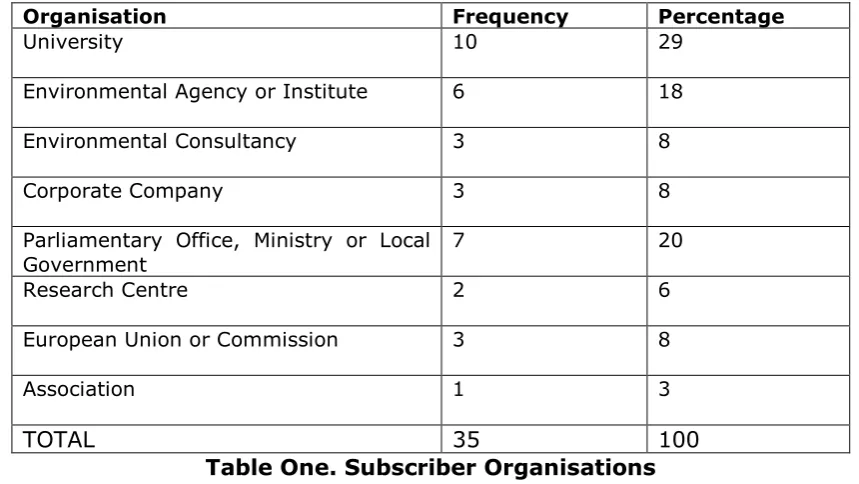
variety of organisations as illustrated in Table One.
Organisation Frequency Percentage
University 10 29
Environmental Agency or Institute 6 18
Environmental Consultancy 3 8
Corporate Company 3 8
Parliamentary Office, Ministry or Local Government
7 20
Research Centre 2 6
European Union or Commission 3 8
Association 1 3
[image:17.595.82.512.365.607.2]TOTAL 35 100
Table One. Subscriber Organisations
Despite declining in many cases to participate in an interview a number of
subscribers stated that they are happy with the current service or added
additional comments, for example:
For subscribers who participated in interviews the ability to see a brief overview
within the email, to use it as ‘their spectacles’ as described by one respondent,
and then continue to explore stories in more detail was cited as beneficial and
most described scanning the email alerts every week before reading the stories
of relevance:
‘I look at it kind of like reading the headlines. Every now and then there is the one or the other that I’m interested in so I read that in more detail… I mean nothing is kind of relevant in the sense that I need it the next day for directly in my job, but I think it’s very relevant to keep an eye on things that are going on, so for me it’s a good way to stay updated with things that are going on in that context at a European level.’ (Subscriber 3 interview, Environmental Education and Conservation, Austria)
‘I was enthusiastic about it because I think it’s a short way to communicate the main findings of research to policy makers and those like us who are intermediaries in that field.’ (Subscriber 6 interview, Spatial Planning, Nature and the Environment, The Netherlands)
Interviewee Five suggested they read the email most regularly when located in
the office and that they were unlikely to go back through the news alert at a
later date, suggesting the immediacy of the service is of considerable value.
In the questionnaire open comments the HTML format of the email was
mentioned by one respondent. They found images contained within the email
could disrupt its format, and suggested a simple link to the website for the most
recent edition would resolve the problem. In terms of negative comments about
the format, it was the relationship between the email and the website that was
most commonly referred to. For example, some links in emails returned you to
the website, where as others sent you externally and so on. Overall, this
suggested the website and email format could be more coordinated for usability,
in order that those who regularly use it have their expectations fulfilled and
users who have a preference for the website can link directly from the email to
its contents.
There was general agreement that the service covered good quality and
‘I think it has quite a broad range. I’m not interested in everything, so for example if there’s something about, I don’t know, about waste – new guidelines about waste disposal or whatever then I think I’m not very interested, I would hardly read that. But no, I think it’s okay to read. It’s good to see that things like that are going on, not that I’m particularly interested in but that’s okay.’ (Subscriber 3 interview, Environmental Education and Conservation, Austria)
‘It’s very useful to have that information [to use later] because in the Netherlands, but I think in the UK also, people are more or less inclined to look at the national situation and forget what happens elsewhere.’ (Subscriber 6 interview, Spatial Planning, Nature and the Environment, The Netherlands)
‘For our work it’s very important to be aware of the things that are going around. If we are thinking on a project idea we need to validate whether our idea’s really novel or not or it has already been done or nearly done, or not, or whatever. And these kind of newsletters are very, very useful for that purpose.’ (Subscriber 4 interview, Research and Innovation Management, Spain)
Subscriber 4 suggested that a good deal of what was covered in the news
service she would not describe as long-term research but innovation, and this
left her hesitant as to its quality at this stage of the trajectory. Nevertheless,
96% (n=45) of the questionnaire respondents strongly agreed or agreed that
the research reported is of good quality. 94% (n=45) of the questionnaire
respondents stated they strongly agreed or agreed the content of the news
service was relevant to their work, with a similar number (n=44) agreeing it was
up-to-date as is illustrated in figure one.
Strongly Disagree Disagree
Agree Strongly Agree
The research reported is up-to-date
25 20 15 10 5 0 F re q u e n c y
Interviewee 6 had confidence in the peer-review measures in place, and the
prior publication of the work in reputable journals, although they suggested this
was not something they particularly noted for credibility. This interviewee was
also the only interviewee to suggest a specific field (in addition to their own)
they would appreciate more coverage of, in their case the social sciences.
Similarly, Interviewee 7 suggested that as they were not researchers themselves
they trusted the editorial and writers judgement on the quality of the journals
from which the research was drawn.
In terms of format, for at least two subscribers the special issues were not
visually distinctive, however Interviewee Five described the advantages they saw
in the special issues particularly for controversial areas of science and
technology:
‘I think they are useful, because there is concentrated information on a topic in one issue…especially what is interesting for me is that if there is more sources, there is not only one view, if there are different views, because especially relating to GM, it is very, very difficult topic and there are a lot of opinions, not only one, but it relates also to global warming, for example, where the views are different.’ (Subscriber 5 interview, Science and Research Department, Czech Republic)
In general, subscribers liked the writing style, found the language used clear and
did not find the use of English problematic.
‘I mean the summaries are good. What I’ve been thinking about is you have the short summary at the top of the newsletter and then you get to click on the ‘Read more about it’ button and you feel, when you click on it, you’re still in that newsletter, it doesn’t lead you to the website directly, which sometimes is probably better. I would, whenever I have that ‘Read more about it’ button, I normally expect to get a link to the website and there you just pull down on the email… I mainly look at the emails, but I have been to – when there was a link in one of the articles I did go to the website to – yes. So some of them seem to be, sometimes they have a link within an article that sends you to an external website.’ (Subscriber 3 interview, Environmental Education and Conservation, Austria)
Amongst the interviewees very little preference was shown for the newsletter
being produced in any language other than English, as they frequently stated
that they were used to reading and working in English. Only two interviewees
felt this would be useful, not for themselves but for other policymakers who
were less likely to be familiar with working in English than a scientist. In terms
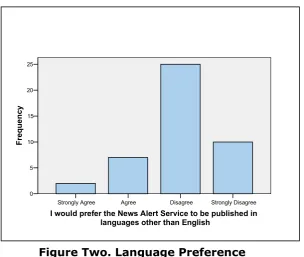
of the questionnaire respondents, attitudes were similar. 73% (n=35) strongly
disagreed or disagreed that they would prefer the news alert to be published in
additional languages illustrated in figure two. Nine participants stated that this
would be preferable. Two subscribers located in Spain and Switzerland indicated
a strong preference, the remaining six subscribers who agreed they would prefer
it in a different language were located in Austria, The Netherlands, Romania,
Croatia, Italy and Canada. It should be noted, though, that simply participating
in either an interview or responding to the questionnaire indicates some level of
confidence in English.
Strongly Disagree Disagree
Agree Strongly Agree
I would prefer the News Alert Service to be published in languages other than English
[image:21.595.155.460.357.614.2]25 20 15 10 5 0 F re q u e n c y
Figure Two. Language Preference
When asked how they had found out about the news service a number described
‘stumbling over it’ whilst on other EU websites and subscribing.
Most agreed they would recommend it to others, and planned to continue
subscribing. However, in terms of any follow-up they suggested they might
make it was relatively limited, possibly following up the research included or
contacting researchers if necessary. In terms of the questionnaire data
responses to questions here were relatively evenly split. 44% (n=21) said they
were likely to contact specific researchers following publication of their work,
compared to 52% (n=25) who described this as unlikely. At least two
interviewees suggested they passed information from the news alert to other
colleagues or researchers of relevance, suggesting a secondary audience in
addition to subscribers: ‘I also [look] for other people in the office who are
working on a lot of projects, might be interested to send the information to them
too’ (Subscriber 6, Spatial Planning, Nature and the Environment, The
Netherlands). Interviewees mentioned using other EU websites and newsletters
and daily internet use but did not identify any direct competitors.
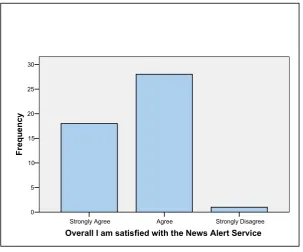
Strongly Disagree Agree
Strongly Agree
Overall I am satisfied with the News Alert Service
30
25
20
15
10
5
0
F
re
q
u
e
n
c
[image:22.595.146.450.374.626.2]y
Figure Three. Overall Satisfaction
In general, overall satisfaction levels were very high amongst this group of
self-selecting respondents, illustrated in figure three. One subscriber said they were
dissatisfied with the service via the questionnaire, compared to 37% (n=18) who
5.0
Key Conclusions and Recommendations
5.1 Relevance of theNews Service
Subscribers are satisfied with the relevance of the news service coverage,
despite only a percentage of articles frequently being of direct relevance to their
specific fields of work. For researchers whose work had featured in the news
service, its relevance had been illustrated to them to the extent that they now
formed a secondary group of subscribers. Thematic issues are helpful when of
relevance but perhaps are not sufficiently distinctive.
5.2 Breadth of Coverage, Accuracy and Newsworthiness of the News
Service
For subscribers the breadth of coverage remains a key feature of importance.
The ability to see an overview of research which is up-to-date, international and
relevant to environmental policy and focus on the specific areas of relevance to
them was repeatedly referred to as a benefit. Amongst subscribers there is a
high level of confidence in the quality of the research reported, frequently based
on a level of trust in the editorial decision making process and peer review
opportunities. Researchers, who tended to check the content of the News
Service before the inclusion of their work, suggested a similarly positive
perception of its quality. They appreciate the opportunity to check drafts of
articles, although this can present difficulties, and had a positive opinion of the
neutrality and accuracy of the writing style.
5.3 Other Sources
Very few comparable sources were identified by subscribers. The majority had
subscribed to the service via European Union or European Commission websites.
Although subscribers suggested they were unlikely to directly contact
researchers in response to coverage, researchers suggested there had been
some contact of this type. Subscribers were though likely to pass information to
featured in the news service provides access to a broader international audience,
with a greater variety of professional interests. In addition, the potential to
reach policy makers, with whom they are likely to be less familiar with working,
is seen as a considerable advantage of the service.
5.4 Satisfaction with the News Service
Levels of satisfaction with the service remain high amongst this relatively small
sample size. Generally subscribers are satisfied with the production of the News
Service in English for them personally. A small number of subscribers recognise
it may be helpful to publish in an additional language for other subscribers, but
this was not correlated to a specific country or countries in this limited sample.
5.5 Key Recommendations
• The email format and website continue to present issues of convenience
and usability for some subscribers. Improving these limitations would
reduce distractions from the quality of the written content.
• Thematic issues should be more distinctive for subscribers.
• The English language format of the News Service may warrant
investigation with a larger sample size of subscribers to establish
statistical correlations with specific countries, such as new member states.
• Evaluation monitoring data could routinely be established at the point of
subscription. Semi-structured interviews are warranted with researchers
but are not an efficient method to capture subscriber views.
• The relevance, accuracy and quality of the service have led to high levels
of satisfaction amongst subscribers and researchers suggesting that
Science Communication Unit
The University of the West of England, Bristol
UK
Frenchay Campus
Coldharbour Lane
University of the West of England
Bristol BS16 1QY