80
Automatic Token and Turn Level Language Identification for
Code-Switched Text Dialog: An Analysis Across Language Pairs and
Corpora
Vikram Ramanarayanan Educational Testing Service R&D
90 New Montgomery St, #1500 San Francisco, CA
Robert Pugh
Educational Testing Service R&D 90 New Montgomery St, #1500
San Francisco, CA [email protected]
Abstract
We examine the efficacy of various feature–learner combinations for lan-guage identification in different types of text-based code-switched interactions – human-human dialog, human-machine dialog, as well as monolog – at both the token and turn levels. In order to examine the generalization of such methods across language pairs and datasets, we analyze ten different datasets of code-switched text. We extract a variety of character- and word-based text features and pass them into multiple learners, including condi-tional random fields, logistic regressors, and recurrent neural networks. We further examine the efficacy of character-level embedding and GloVe features in im-proving performance and observe that our best-performing text system significantly outperforms the majority vote baseline across language pairs and datasets.
1 Introduction
Code-switching refers to multilingual speakers’ alternating use of two or more languages or lan-guage varieties within the context of a single con-versation or discourse in a manner consistent with the syntax and phonology of each variety ( Mil-roy and Muysken, 1995; Wei, 2000; MacSwan, 2004; Myers-Scotton, 2006). Increasing global-ization and the continued rise of multilingual so-cieties around the world makes research and de-velopment of automated tools for the processing of code-switched speech a very relevant and in-teresting problem for the scientific community. In our case, an important additional motivating factor for studying and developing tools to elicit
and process code-switched or crutched1language comes from the education domain, specifically language learning. Recent findings in the litera-ture suggest that strategic use of code-switching of bilinguals’ L1 and L2 in instruction serves mul-tiple pedagogic functions across lexical, cultural, and cross-linguistic dimensions, and could en-hance students’ bilingual development and maxi-mize their learning efficacy (Wheeler,2008;Jiang et al.,2014). This seems to be a particularly effec-tive strategy especially when instructing low profi-cient language learners (Ahmad and Jusoff,2009). Therefore, the understanding of code-switched di-alog and development of computational tools for automatically processing code-switched conversa-tions would provide an important pedagogic aid for teachers and learners in classrooms, and po-tentially even enhance learning at scale and per-sonalized learning.
Automated processing of code-switched text di-alog poses an interesting, albeit challenging prob-lem for the scientific community. This is be-cause the hurdles observed during traditional di-alog processing tasks such as spoken language understanding (SLU), natural language generation (NLG) and dialog management (DM) are exacer-bated in the case of code-switched text where the language the speaker is using at any given instant is not known apriori. Integrating an explicit lan-guage identification(or LID) step into the process-ing pipeline can potentially alleviate these issues. Take for example a use case of designing conver-sational applications for non-native English guage learners (ELLs) from multiple native lan-guage (or L1) backgrounds. Many such learners tend to “crutch” on their L1 while speaking in the target language (or L2) that they are learning,
es-1Crutching refers to language learners relying on one
pecially if they are low proficiency learners ( Little-wood and Yu,2011), resulting in mixed-language speech. In such a case, LID becomes particu-larly important for SLU and DM, where the dialog designer/language expert may want the conversa-tional agent to perform different dialog actions de-pending on whether the speaker used his/her L1 alone, the L2 alone, or a mixture of both during the previous turn.
Researchers have made significant progress in the automated processing of code-switched text in recent years (Solorio et al., 2014; Bali et al., 2014; Molina et al., 2016). While Joshi (Joshi, 1982) had already proposed a formal computa-tional linguistics framework to analyze and parse code-switched text in the early eighties, it was not until recently that significant strides were made in the large-scale analysis of code-switched text. These have been facilitated by burgeoning mul-tilingual text corpora (thanks largely to the rise of social media) and corpus analysis studies (see for exampleSolorio et al.,2014;Bali et al.,2014; Molina et al., 2016), which have in turn facili-tated advances in automated processing. Particu-larly relevant to our work is prior art on predicting code-switch points (Solorio and Liu, 2008) and language identification (Barman et al.,2014;King and Abney,2013). Researchers have made much progress on LID in code-switched text (tweets, in particular) thanks to recent workshops dedicated to the topic (Solorio et al., 2014; Molina et al., 2016). One of the top-performing systems used character n-gram, prefix and suffix features, letter case and special character features and explored logistic regression and conditional random field (CRF) learners to achieve the best performance for Spanish-English codeswitched text (Shirvani et al.,2016). Yet another successful system lever-aged bi-directional long short term memory net-works (BLSTMs) and CRFs (along with word and character embedding features) on both Spanish-English and Standard Arabic-Egyptian language pairs (Samih et al.,2016).
While there is comparatively less work in the literature on automated analysis of code-switched speech and dialog, the number of cor-pora and studies is steadily growing in sev-eral language pairs – for instance, Mandarin– English (Li et al., 2012; Lyu et al., 2015), Cantonese–English (Chan et al.,2005) and Hindi– English (Dey and Fung, 2014). As far as
dialog is concerned, the Bangor Corpus con-sists of human-human dialog conversations in Spanish–English, Welsh–English and Spanish– Welsh (Donnelly and Deuchar, 2011). More recently, Ramanarayanan and Suendermann-Oeft (2017) also proposed a multimodal dialog corpus of human-machine Hindi–English and Spanish– English code-switched data. In order to under-stand how turn-level LID systems for dialog per-form across different languages and corpora, this paper explores the efficacy of differenttext-based features on multiple human–human and human– machine dialog corpora of code-switched data in multiple language pairs. To that end, this pa-per builds on other recent work that examined this phenomenon for the Bangor Miami Corpus of English–Spanish human–human dialog ( Rama-narayanan et al.,2018) and expands it significantly (note however, that this study does not examine speech data). To our knowledge, this is the first such comprehensive exploration of turn-level LID performance in human-human code-switched text dialog. With that in mind, the specific contribu-tions of this paper are to examine:
1. The performance of: (i) a range of text fea-tures (including word- and character-level embedding features) for (ii) both word-level and turn-level LID;
2. How generalizable these features are across different datasets comprising different lan-guage pairs and styles of codeswitched text – human-human dialog, human-machine dia-log and monodia-log (tweets);
3. Turn-level LID performance by (i) using word-level LID followed by aggregation over the entire turn v.s. (ii) directly training clas-sifiers at the turn-level.
2 Data
We used a total of ten code-switched corpora for our experiments across language pairs and inter-action type, summarized briefly below. Note that although some of these corpora contain speech as well, we only consider the text transcripts for the purposes of this paper.
• Bangor University in Wales has assem-bled three corpora of human-human code-switched dialog2: (i) The Miami corpus of code-switched English and Spanish, (ii) the Siarad corpus of English and Welsh, and (iii) the Patagonia corpus of Spanish and Welsh.
• The SEAME corpus3 comprises approxi-mately 192 hours of Mandarin-English code-switching human-human dialog from 156 speakers with associated transcripts (Lyu et al., 2015). The speakers were gender-balanced (49.7% female, 50.3% male) and between 19 and 33 years of age. Over 60% of the speakers were Singaporean; the rest were Malaysian.
• The HALEF corpora of code-switched
human-machine dialog comprise English– Hindi and English–Spanish language pairs. In each language pair, bilingual human participants were encouraged to use code-switched speech as they interacted with a cloud-based multimodal dialog system to or-der food and drink from a virtual coffee shop barista. For more details, seeRamanarayanan and Suendermann-Oeft(2017).
• Finally, in addition to these dialog corpora, we also used monolog corpora for compar-ison – four Twitter datasets used in the 1st
shared task on language identification held at EMNLP 2016 (Solorio et al., 2014). These consisted of code-switched tweets in the following language pairs: English–Spanish, English–Mandarin, English–Nepalese, and Modern Standard Arabic–Egyptian Arabic.
The transcripts were processed by performing whitespace tokenization on each turn, and remov-ing event descriptions (such as “&=laugh”) and
2
http://bangortalk.org.uk/
3https://catalog.ldc.upenn.edu/ldc2015s04 Table
unintelligible tokens. For the Twitter datasets, in order to enable cross-dataset comparison, we nor-malized the tag sets by creating an “other” class that included all tokens not belonging to either of the two relevant languages (NEs, ambiguous to-kens, etc).
3 Feature Extraction
3.1 Low-Level Text Features
Following earlier work (Shirvani et al., 2016; Samih et al.,2016), we experimented with the fol-lowing low-level binary text features that capture the presence or absence of the following:
• Word n-grams: We used a bag-of-words representation, trying uni- and bi-grams.
• Character n-grams: The set of unique char-acter n-grams (1≤n≤4), without crossing word-boundaries. For example, the word se-quence “la sal” would produce the following character n-grams{‘l’, ‘a’, ‘s’, ‘al’, ‘la’, ‘sa’, ‘sal’}.
• Character Prefixes/Suffixes: All affixes with length ≤ 3. For example, the word “intricate” would have prefixes {”i”, ”in”, ”int”}, and suffixes{”ate”, ”te”, and ”e”}.
• Dictionary Lookup: We examine whether each word exists in a dictionary for either one of the code-switched languages. Dic-tionaries for English, Spanish, and Welsh, were sourced from GNU Aspell4. Dictionar-ies from other languages were not used either because they were not available or the dictio-nary’s orthography differed from that used in our data.
We also extracted turn length (in number of words) and used that as an additional feature.
3.2 Embedding Features
We also examined the utility of different combina-tions of the following embedding features:
• word2vec based pre-trained word embed-dings (Mikolov et al., 2013). These models are shallow, two-layer neural networks that represent (embed) words in a continuous vec-tor space where semantically similar words are embedded close to each other. In order
4http://aspell.net/
to pre-train word2vec models while analyz-ing the code-switched corpus of a particular language pair, we utilized other corpora (if they existed) for that same language pair (in other words, we were not able to analyze the effect of these features for language pairs that had just one exemplar corpus, like English– Welsh).
• char2vec based pre-trained character em-beddings. These features are similar to word2vec, but are applied at the character level. In order to generate these embeddings, we run standard Word2Vec with skip-grams, except characters take the place of words and words take the place of sentences, enabling us to learn character contexts within words. Jaech et al.(2016) used a similar feature they termed “char2vec”, which is however dif-ferent from our implementation; it involves learning a character-based word vector using a convolutional neural network.
• GloVe based pre-trained word embeddings (Pennington et al., 2014). GloVe is an un-supervised learning algorithm for obtaining vector representations for words, which cap-ture linear substruccap-tures of interest in the word vector space. It is a global log bilin-ear regression model that combines the ad-vantages of the two major methods: matrix factorization of global corpus co-occurence statistics and local context window methods. As in theword2veccase, to obtain pre-trained vectors for a corpus in a given language pair, we used the other corpora for that pair to train aggregated global word-word co-occurrence statistics.
• GloVe based pre-trained character embed-dings. This is the GloVe algorithm applied at the character level. To our knowledge, our paper is the first such application of these fea-tures for language identification.
4 Machine Learning Methods
Following previous work in this area, we exam-ined the utility of the following learners:
• Logistic Regression: The simplest method we investigated was just logistic regression with L2-regularization to generate language label probabilities using the various combi-nations of the features described in Section 3.1.
• CRFs: In this case, instead of modeling lan-guage tagging decisions for each word in-dependently, we model them jointly using a conditional random field or CRF (Lafferty et al.,2001).
• Bidirectional LSTMs: Long short term memory networks or LSTMS are a special kind of recurrent neural network that is ca-pable of learning long-term dependencies (Hochreiter and Schmidhuber, 1997). They do so using several gates that control the proportion of the input to give to the mem-ory cell, and the proportion from the previ-ous state to forget5. We implemented the Stack LSTM architecture first proposed by Dyer et al. (2015), in which the LSTM is augmented with a “stack pointer.” While se-quential LSTMs model sequences from left to right, Stack LSTMs permit embedding of a stack of objects that are both added to ing a push operation) and removed from (us-ing a pop operation). This allows the Stack LSTM to work like a stack that maintains a “summary embedding” of its contents. In our case, we use this architecture to model a summary embedding of characters within an model of word embedding sequences. In ad-dition to this Stack BiLSTM, following Lam-ple et al. (2016), we used a combination of a Stack BiLSTM with a CRF, where instead of directly using the softmax output from the Stack BiLSTM, we use a CRF to predict the final language tag for each word by taking into account neighboring tags.
An novel feature of our experiments is the ex-amination of the utility of pre-trainedGloVe
and char2vec in improving performance of the system proposed for named entity recog-nition inLample et al.(2016).
5Also see
http://colah.github.io/posts/2015-08-Understanding-LSTMs
5 Experiments
We conducted 10-fold cross-validation experi-ments for all datasets. For each dataset, we first extracted the word and character level features de-scribed in Section 3. We then tried the follow-ing approaches to predictfollow-ing one of 3 classes – English, Spanish or Code-switched – at the turn-level: (i) Used a CRF to make word-level pre-dictions, and aggregated them to form a turn-level prediction; (ii) aggregated the features at the turn level and try a variety of learners, including logistic regression and deep neural networks to make language predictions at the turn level; (iii) fed word- and character-embedding combinations (both with and without pre-training) to a Stacked-BiLSTM-CRF system and made an LID predic-tion for each turn. We experimented with differ-ent learner configurations and parameter settings and summarize the best performing featureset and learner combination in the Results section. We used a grid search method to find optimal char-acter embedding size for each dataset (among val-ues of 25, 50 and 100). For the Stack-BiLSTM system, given the large number of architectural parameters to optimize (number of LSTM layers and recurrent units, type of optimizer, dropout, gradient clipping/normalization, minibatch size, to name a few), we chose to use the choices recom-mended by Reimers and Gurevych (2017), who evaluated over 50,000 different setups and found that some parameters, like pre-trained embeddings or the last layer of the network, have a large im-pact on the performance, while other parameters, like the number of LSTM layers or the number of recurrent units, are of relatively minor importance. We set the word-embedding size to 100 and used 25 and 100 recurrent units in the character-level and word-level BiLSTMs, respectively, following Lample et al.(2016).
6 Observations and Analysis
System Weighted Average F1 Scores for Each Dataset
Featureset Machine ENG-SPA ENG-CHI ENG-WEL WEL-SPA ENG-HIN ENG–NEP MSA–EGY
Learner Bangor HALEF Twitter SEAME Twitter Bangor Bangor HALEF Twitter Twitter Word n-grams, Char n-grams,
Affixes, Length & Dictionary lookup
Logistic Regression
0.9525 0.9324 0.8143 0.9931 0.5786 0.9647 0.9706 0.8765 0.8442 0.7556
(0.6820) (0.7576) (0.6839) (0.9937) (0.6272) (0.8531) (0.6762) (0.8235) (0.9023) (0.4511) Word n-grams, Char n-grams,
Affixes, Length & Dictionary lookup
CRF ag-gregated to turn
0.9696 0.9584 0.8912 0.9977 0.7393 0.9676 0.9800 0.9022 0.9367 0.7280
(0.8381) (0.8874) (0.8247) (0.9979) (0.7457) (0.8639) (0.7982) (0.8553) (0.9568) (0.3216) Word and Char Embeddings
(both from scratch)
Stacked Bi-LSTM + CRF
0.966 0.9759 0.884 0.999 0.742 0.9606 0.977 0.894 0.932 0.747
(0.8345) (0.9560) (0.8256) (0.9991) (0.7268) (0.8469) (0.7828) (0.8536) (0.9525) (0.4227) Pre-trained Word Embeddings
(’word2vec’ in blue, otherwise ’GloVe’) and Char Embeddings (from scratch)
Stacked Bi-LSTM + CRF
0.9671 0.9708 0.8950 0.999 0.7270 — — — — —
(0.8438) (0.9308) (0.8421) (0.9987) (0.7104) — — — — —
2 Pre-trained Word and Char Embeddings (’word2vec’ in blue, otherwise ’GloVe’)
Stacked Bi-LSTM + CRF
0.9692 0.976 0.8953 0.999 0.7332 — — — — —
(0.8506) (0.9560) (0.8424) (0.9992) (0.7173) — — — — — Best-performing turn
predic-tions
Stacked Bi-LSTM
0.9621 0.9394 0.8587 — 0.6089 0.9485 0.9501 0.8514 0.7906 0.7564
(0.7962) (0.8235) (0.7770) — (0.6821) (0.7869) (0.7277) (0.7889) (0.8710) (0.5280)
Majority Baseline 0.49 0.34 0.38 0.38 0.37 0.79 0.67 0.18 0.61 0.63
Random Baseline 0.38 0.34 0.35 0.35 0.37 0.43 0.41 0.34 0.39 0.40
Best performance on1stcodeswitching challenge — — 0.822 — 0.894 — — — 0.977 0.417
[image:6.595.75.541.66.346.2]Best performance on2ndcodeswitching challenge — — 0.913 — — — — — — 0.83
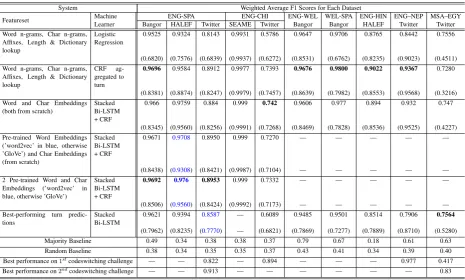
Table 2: Weighted average F1 scores obtained by different featureset–learner combinations on each codeswitching dataset. Notice that datasets are organized first by language pair, and then according to type of interaction (human-human vs. human-machine vs. Twitter). Each cell of the table contains two numbers: the overall weighted F1 score on top and the F1 score of the code-switched class in paren-theses at the bottom. Note that we obtained performance numbers for pre-trained word and character embeddings only for language pairs with more than one dataset, i.e., ENG-SPA and ENG–CHI. Also shown for benchmarking purposes are the best tweet-level performance numbers from the1st and2nd
codeswitching challenges for some of the Twitter datasets. However, note that this isnota completely fair comparison, because the train-test partitions in our case are different: we used only the train data from the1st code-switching challenge in order to perform 10-fold cross-validation experiments. Also see the text for more details.
System Weighted Average Token-Level F1 Scores for Each Dataset
Featureset Machine ENG-SPA ENG-CHI ENG-WEL WEL-SPA ENG-HIN ENG–NEP MSA–EGY
Learner Bangor HALEF Twitter SEAME Twitter Bangor Bangor HALEF Twitter Twitter Word n-grams, Char n-grams,
Affixes, Length & Dictionary lookup
CRF 0.9774 0.9772 0.9111 0.9989 0.9513 0.9824 0.9774 0.9343 0.9601 0.5804
Word and Char Embeddings (both from scratch)
Stacked Bi-LSTM + CRF
0.9883 0.9721 0.9394 0.9993 0.9476 0.9820 0.9922 0.9290 0.9579 0.5791
Pre-trained Word Embeddings (’word2vec’ in blue, otherwise ’GloVe’) and Char Embeddings (from scratch)
Stacked Bi-LSTM + CRF
0.9814 0.9784 0.9437 0.9992 0.9429 — — — — —
Pre-trained Word and Char Em-beddings (’word2vec’ in blue, otherwise ’GloVe’)
Stacked Bi-LSTM + CRF
0.9819 0.9788 0.9370 0.9993 0.9478 — — — — —
Best performance on1stcodeswitching challenge — — 0.94 — 0.892 — — — 0.959 0.936
Best performance on2ndcodeswitching challenge — — 0.973 — — — — — — 0.876
Table 3: Weighted average F1 scores for token-level predictions after 10-fold crossvalidation. Also shown for benchmarking purposes are the best token-level performance numbers from the1st and2nd
[image:6.595.75.528.522.681.2]of this class. At the outset, we observe that all text systems significantly outperform the majority vote baseline (where we assign the language labels of all turns in the test set to the majority class) and the random baseline (where the language labels of all test set turns are assigned at random) by a huge margin.
One of the primary research questions we wanted to study (see the penultimate paragraph of Section1) was how different featureset-learner combinations performed across different language pairs. We see that no particular featureset-learner combination dominated overall performance-wise, with results varying depending on the dataset and language pair in question. Interestingly, in the case of English–Spanish, where there were 3 dif-ferent datasets of code-switched text, using pre-trained word and character embeddings performed at or above par all other systems. In other words, in the presence of sufficient amounts of data for pre-training, using pre-trained embedding-based systems yields the best results. Even though the overall F1 score of all embedding-based Stack Bi-LSTM systems is similar, notice that the F1 score of the code-switched class improves when we use both pre-trained word and character em-beddings. This suggests that pretrained charac-ter embeddings are particularly useful in captur-ing the characteristics of code-switched language. While GloVe-based character embeddings were more useful for the human-human (Bangor) and monolog (Twitter) datasets, word2vec was better for the HALEF dataset of human-machine dialog. For English–Mandarin corpora, on the other hand, while the embedding–Stack BiLSTM–CRF com-bination still performed best, using pre-trained embeddings did not seem to make any significant additional impact.
Another research question of interest dealt with whether we obtained a better turn-level LID per-formance by (i) using word-level LID followed by aggregation over the entire turn, or (ii) directly training classifiers at the turn-level. Our results seem to suggest that the former is better than the latter across all code-switched text datasets with one notable exception. In the case of the Modern Standard Arabic–Egyptian Arabic Twitter dataset, using a Stacked BiLSTM with embedding features and a direct softmax layer for turn-level predic-tions (i.e., without an additional CRF aggregation step) performed best.
For all other remaining language pairs (each of which had just one dataset), the simpler CRF classifier (where predictions were aggregated to a turn) with a more standard featureset (word and character n-grams, affixes, turn length and dictio-nary lookup) yielded the best results. That this simpler CRF system performed competently even in the other cases relative to the Stack-BiLSTM systems suggests that the former is perhaps a bet-ter choice when one does not have large amounts of training data, particularly for pre-training. On a related note, it is also worth pointing out that unsurprisingly, performance numbers across the board are influenced by the amount of data in each dataset, i.e., more data leads to higher F1 scores.
Yet another research question dealt with the per-formance across datasets for human–human di-alog vs. human–machine dialog vs. monolog tweets. We observe, in general, a decrease in overall weighted F1 score as one moves from human–human dialog to human–machine dialog to monolog tweet data. One possible reason for this is that Twitter data in particular consists of many “other” non-language tokens (such as named entities, ambiguous tokens, etc.), which, on re-moval or non-consideration, might lead to differ-ent phrase structures in the resulting data6.
The final question we asked was to examine token-level prediction performance, in order to benchmark ourselves against prior art in this area. Table 3 lists these results. We find that perfor-mance trends in this case roughly mirror those ob-served at the turn-level.
Performances from the 1st and 2nd Code-switching Workshop Challenge results are pro-vided in each table to provide some comparison with our systems. However, it should be noted that these comparisons are not exact. Our results are from 10-fold cross-validation on the training data used in the Workshop challenge, not on the held-out test sets. Additionally, because we pulled the data from Twitter years after the 1st Work-shop, some of the tweets initially intended for the dataset were no longer available. For the tweet-level performance, we report results on three-class
6
classification (language 1 vs. language 2 vs. code-switched), whereas the Code-switching Workshop performances are based on binary classification (monolingual vs. code-switched). Furthermore, as mentioned earlier, in order to enable cross-dataset comparison, we normalized the tag sets by creating an ”other” class that included all to-kens not belonging to either of the two relevant languages (NEs, ambiguous tokens, etc). Taking these points into consideration, our systems per-form competitively with the submissions to the Code-switching Workshop Challenges. The only exception is in the case of the MSA-EGY dataset, where while our tweet-level performance is com-petitive, our token-level performance far underper-forms the state-of-the-art. We suspect that dataset imbalance could play a role, as well as the fact that we didn’t use any external resources for this lan-guage pair.
7 Discussion and Outlook
We have presented an experimental evaluation of different text-based featuresets in performing lan-guage identification (LID) at both the turn and token levels in code-switched text interactions. We studied the generalizability of various sys-tems both across language pair and dataset type— human–human, human–machine and monolog— by examining 10 different datasets of code-switched text. While our best text-based sys-tems performed either at or above par with the state of the art in the field, we found that the use of both pre-trained word and character-based embedding features, and the latter in particular (either through char2vecor GloVe), were partic-ularly useful at capturing the characteristics of code-switched speech (with the caveat that the fea-ture extraction process requires sufficient data for pre-training). We further observed that a perfor-mance drop depending on the style of interaction, as we move from human–human dialog to human– machine dialog to monolog tweets.
Going forward, we will explore a number of po-tential avenues for improving the performance of the text-based LID systems. Chief among these is to investigate strategies for dealing with little or no code-switched data (or indeed, overall train-ing data) for a given language pair, and how to improve the performance of deep learning algo-rithms for such datasets. In addition, we would like to perform a deeper error analysis of the
al-gorithms on different featuresets to obtain a bet-ter understanding of how best to select a feature-learner combination for the LID task.
Finally, as mentioned earlier, one of the key ex-citing R&D directions that this work informs is in building code-switching dialog systems. For in-stance, integrating an explicit language identifi-cation step into the spoken language understand-ing (SLU) could help enhance the system perfor-mance. Over and above such applications, such an LID module might also help inform pragmatic considerations during dialog management and the language generation module for the generation of appropriate mixed-language output.
8 Acknowledgements
We would like to thank Julia Hirschberg and other attendees at the Interspeech 2018 Special Ses-sion on Speech Techologies for Code-switching in Multilingual Communities for useful discussions and illuminating ideas on the processing of code-switched speech, including available datasets.
References
Badrul Hisham Ahmad and Kamaruzaman Jusoff. 2009. Teachers code-switching in classroom in-structions for low english proficient learners. En-glish Language Teaching2(2):49.
Kalika Bali, Yogarshi Vyas, Jatin Sharma, and Mono-jit Choudhury. 2014. i am borrowing ya mixing? an analysis of english-hindi code mixing in face-book. Proceedings of the First Workshop on Com-putational Approaches to Code Switching, EMNLP 2014page 116.
Utsab Barman, Amitava Das, Joachim Wagner, and Jennifer Foster. 2014. Code mixing: A challenge for language identification in the language of social media. EMNLP 201413.
Joyce YC Chan, PC Ching, and Tan Lee. 2005. Devel-opment of a cantonese-english code-mixing speech corpus. InINTERSPEECH. pages 1533–1536.
Anik Dey and Pascale Fung. 2014. A hindi-english code-switching corpus. InLREC. pages 2410–2413.
Kevin Donnelly and Margaret Deuchar. 2011. The ban-gor autoglosser: a multilingual tagger for conversa-tional text.ITA11, Wrexham, Wales.
Sepp Hochreiter and J¨urgen Schmidhuber. 1997. Long short-term memory. Neural computation
9(8):1735–1780.
Aaron Jaech, George Mulcaire, Mari Ostendorf, and Noah A Smith. 2016. A neural model for language identification in code-switched tweets. In Proceed-ings of The Second Workshop on Computational Ap-proaches to Code Switching. pages 60–64.
Yih-Lin Belinda Jiang, Georgia Earnest Garc´ıa, and Arlette Ingram Willis. 2014. Code-mixing as a bilin-gual instructional strategy. Bilingual Research Jour-nal37(3):311–326.
Aravind K Joshi. 1982. Processing of sentences with intra-sentential code-switching. In Proceedings of the 9th conference on Computational linguistics-Volume 1. Academia Praha, pages 145–150.
Ben King and Steven P Abney. 2013. Labeling the lan-guages of words in mixed-language documents us-ing weakly supervised methods. In HLT-NAACL. pages 1110–1119.
John D Lafferty, Andrew McCallum, and Fernando CN Pereira. 2001. Conditional random fields: Prob-abilistic models for segmenting and labeling se-quence data. InProceedings of the Eighteenth Inter-national Conference on Machine Learning. Morgan Kaufmann Publishers Inc., pages 282–289.
Guillaume Lample, Miguel Ballesteros, Sandeep Sub-ramanian, Kazuya Kawakami, and Chris Dyer. 2016. Neural architectures for named entity recognition. InProceedings of NAACL-HLT. pages 260–270.
Ying Li, Yue Yu, and Pascale Fung. 2012. A mandarin-english code-switching corpus. In LREC. pages 2515–2519.
William Littlewood and Baohua Yu. 2011. First lan-guage and target lanlan-guage in the foreign lanlan-guage classroom. Language Teaching44(1):64–77.
Dau-Cheng Lyu, Tien-Ping Tan, Eng-Siong Chng, and Haizhou Li. 2015. Mandarin–english code-switching speech corpus in south-east asia: Seame.
Language Resources and Evaluation 49(3):581– 600.
Jeff MacSwan. 2004. Code switching and grammatical theory. The handbook of bilingualism46:283.
Tomas Mikolov, Kai Chen, Greg Corrado, and Jef-frey Dean. 2013. Efficient estimation of word representations in vector space. arXiv preprint arXiv:1301.3781.
Lesley Milroy and Pieter Muysken. 1995.One speaker, two languages: Cross-disciplinary perspectives on code-switching. Cambridge University Press.
Giovanni Molina, Nicolas Rey-Villamizar, Thamar Solorio, Fahad AlGhamdi, Mahmoud Ghoneim, Ab-delati Hawwari, and Mona Diab. 2016. Overview for the second shared task on language identification
Carol Myers-Scotton. 2006. Codeswitching with en-glish: types of switching, types of communities.
World Englishes: Critical Concepts in Linguistics
4(3):214.
Brendan H OConnor and Layne J Crawford. 2015. An art of being in between: The promise of hybrid lan-guage practices. InResearch on Preparing Inservice Teachers to Work Effectively with Emergent Bilin-guals, Emerald Group Publishing Limited, pages 149–173.
Jeffrey Pennington, Richard Socher, and Christopher Manning. 2014. Glove: Global vectors for word representation. InProceedings of the 2014 confer-ence on empirical methods in natural language pro-cessing (EMNLP). pages 1532–1543.
Vikram Ramanarayanan, Robert Pugh, Yao Qian, and David Suendermann-Oeft. 2018. Automatic Turn-Level Language Identification for Code-Switched Spanish-English Dialog. In Proc. of the IWSDS Workshop 2018, Singapore.
Vikram Ramanarayanan and David Suendermann-Oeft. 2017. Jee haan, I’d like both, por favor: Elicitation of a Code-Switched Corpus of Hindi– English and Spanish–English Human–Machine Di-alog. Proc. Interspeech 2017pages 47–51.
Nils Reimers and Iryna Gurevych. 2017. Optimal hy-perparameters for deep lstm-networks for sequence labeling tasks.arXiv preprint arXiv:1707.06799.
Younes Samih, Suraj Maharjan, Mohammed Attia, Laura Kallmeyer, and Thamar Solorio. 2016. Multi-lingual code-switching identification via lstm recur-rent neural networks. EMNLP 2016page 50.
Rouzbeh Shirvani, Mario Piergallini, Gauri Shankar
Gautam, and Mohamed Chouikha. 2016. The
howard university system submission for the shared task in language identification in spanish-english codeswitching. InProceedings of The Second Work-shop on Computational Approaches to Code Switch-ing. pages 116–120.
Thamar Solorio, Elizabeth Blair, Suraj
Mahar-jan, Steven Bethard, Mona Diab, Mahmoud
Gohneim, Abdelati Hawwari, Fahad AlGhamdi, Ju-lia Hirschberg, Alison Chang, et al. 2014. Overview for the first shared task on language identification in code-switched data. InProceedings of the First Workshop on Computational Approaches to Code Switching. Citeseer, pages 62–72.
Thamar Solorio and Yang Liu. 2008. Learning to pre-dict code-switching points. In Proceedings of the Conference on Empirical Methods in Natural Lan-guage Processing. Association for Computational Linguistics, pages 973–981.
Li Wei. 2000. The bilingualism reader. Psychology Press.