Proceedings of NAACL-HLT 2019: Demonstrations, pages 98–104 98
LT Expertfinder: An Evaluation Framework
for Expert Finding Methods
Tim Fischer Steffen Remus Chris Biemann
Language Technology Group
Department of Informatics Universit¨at Hamburg, Germany
{5fischer,lastname}@informatik.uni-hamburg.de
Abstract
Expert finding is the task of ranking persons for a predefined topic or search query. Most approaches to this task are evaluated in a su-pervised fashion, which depends on predefined topics of interest as well as gold standard pert rankings. However, manually ranking ex-perts can be considered highly subjective and small variants in rankings are hardly distin-guishable. Particularly for dynamic systems, where topics are not predefined but formu-lated as a search query, we believe a more in-formative approach is to perform user stud-ies for directly comparing different methods in the same view. In order to accomplish this in a user-friendly way, we present the LT Ex-pertfinder web application, which is equipped with various query-based expert finding meth-ods that can be easily extended, a detailed ex-pert profile view, detailed evidence in form of relevant documents and statistics, and an evaluation component that allows a qualitative comparison between different rankings.
1 Introduction
Human expertise is one of the noteworthy re-sources in the world. However, true experts may be rare and their expertise difficult to quantify due to multiple continuously changing factors. The goal of expert finding is to rank people regard-ing their knowledge about a certain topic, which is a challenging, yet rewarding task with many real-world applications. Just to name a few, some applications might be: Companies may require highly trained specialists whose consultancies can be requested for specific problems (Balog et al.,
2006), conference organizers may need to assign submissions to reviewers which best match their expertise (Fang and Zhai, 2007), recruiters may search for talented employees and emerging ex-perts in a particular field (Serdyukov et al.,2008).
1.1 Problem statement
While it is common to cast approaches to expert finding in a supervised learning framework, this requires respective datasets, necessarily limited to a narrow set of topics. Some of such datasets are: the enriched versions of DBLP1 provided by the ArnetMiner project (Tang et al., 2008), used by e.g. Deng et al.(2008);Yang et al.(2009); Mor-eira et al.(2011), or the W3C Corpus2of TREC3, used by e.g.Balog et al.(2006). Obviously, how-ever, the subjective nature of attributed expertise makes expert ranking quality hard to quantify. A certain value of an evaluation measure based on gold standard dataset comparison with respect to supervised or unsupervised system outputs does not necessarily guarantee a better or worse perfor-mance of one system compared to another. Also, depending on the targeted domain, a supervised setting might not be a viable option for evalua-tion. In real-world settings, where underlying data changes dynamically and expert finding is rather an interactive approach than a one-shot query eval-uation, we find it more adequate to facilitate an evaluation procedure based on user studies, where alternative approaches are comparatively judged.
1.2 Motivation & Contribution
In this paper, we address this issue and present the LT Expertfinder web application, which is equipped with several query-based expert finding methods and can be easily extended. A detailed expert profile helps users to eventually select one expert in favor of another. Methodological evi-dence, in form of relevant documents and various
1
https://aminer.org/lab-datasets/ expertfinding/
2
https://tides.umiacs.umd.edu/webtrec/ trecent/parsed_w3c_corpus.html
3TextREtrieval Conference: https://trec.nist.
statistics, as well as a view of the query-dependent citation graph, is provided. Finally, we added an evaluation component that allows the qualitative comparison between different rankings. To the best of our knowledge, this is the first tool that pro-vides evidences and a direct comparison to multi-ple expert rankings. We apply our system to the
ACL Anthology Network4in order to find experts on various computational linguistics topics.
2 Related Work
Early expert finding systems relied on manually crafted, and manually queried, databases. Main-taining these databases is obviously a time con-suming and complex task on the administrative and user side. Early automatic expert finding systems usually focused on specific domains like email (Campbell et al., 2003) or software doc-umentation (Mockus and Herbsleb, 2002). One of the first approaches that automatically extracts expertise from any kind of document was the P@NOPTIC system byCraswell et al.(2001).
Shared tasks, such as the Enterprise Track of TREC (Craswell et al.,2005;Soboroff et al.,2006;
Bailey et al., 2007; Balog et al., 2008) resulted in many automatic methods for predefined top-ics. Those systems can be grouped into four ma-jor categories: a) generative models (Balog et al.,
2006; Fang and Zhai, 2007; Deng et al., 2008),
b) voting models (Macdonald and Ounis, 2006),
c) graph-based models (Serdyukov et al., 2008;
Campbell et al., 2003; Jurczyk and Agichtein,
2007;Zhang et al., 2007), and d) discriminative models (Hashemi et al.,2013). For an extensive survey on expert finding methods, we refer toLin et al.(2017).
Hawking (2004) highlights the importance of expert profiling mainly because the results should provide more information than simply a ranked list of person names. Balog and De Rijke(2007) em-phasizes the importance of the social network, i.e. colleagues and collaborators contribute greatly to the value of an expert.
Thus, systems, such as the ArnetMiner5 tool (Tang et al., 2008), aim at modeling entire aca-demic social networks by automatically extract-ing researcher profiles from the Web. Moreover, ArnetMiner models topical aspects of papers,
au-4
http://tangra.cs.yale.edu/newaan/ 5https://aminer.org/
thors, and publication venues. The CareerMap6 (Wu et al.,2018), which is now a component of ArnetMiner, visualizes a scholar’s career trajec-tory, which is extracted from ArnetMiner’s pub-lication database. The CL Scholar7system (Singh et al., 2018) mines textual and network informa-tion for knowledge graph construcinforma-tion and ques-tion answering using natural language or key-words. CSSeer8(Chen et al.,2013) is a keyphrase-based recommendation system for expert find-ing based on the CiteSeerX9 digital library and Wikipedia. It extracts keyphrases from the title and abstract of documents in CiteSeerX and uti-lizes this information to infer the author’s exper-tise. The Expert2B´ol`e system (Yang et al.,2009) features generic expert finding as well as b´ol`e search, which aims at identifying the top supervi-sors in a given field. The authors argue that generic expert finding methods are insufficient for finding specific experts for different purposes. In their ap-plication, b´ol`e search, it is for example more im-portant to find persons who are able to judge and nuture other experts than to assess their own exper-tise. Hence, generic expert finding methods can-not be applied to this problem.
3 LT Expertfinder
The LT Expertfinder features detailed expert pro-files and various expert finding methods in an ex-tendible framework. Moreover, it provides user-friendly evaluation methods: a view of the query-dependent citation graph, an evaluation view com-bining different results and provenances in form of relevant documents and related statistics.
3.1 Dataset
For the purpose of this paper, we use theACL An-thology Network(AAN,Radev et al.,2013) as our underlying corpus, but note that it can be easily ex-changed. The application is not limited to this par-ticular data source. The AAN is based on papers in
ACL10 Anthology– a digital archive of conference and journal papers about natural language process-ing and computational lprocess-inguistics – and provides citation and collaboration information. In its cur-rent version from December 2016, the AAN
in-6https://aminer.org/ mostinfluentialscholar/ml
7https://github.com/CLScholar 8http://csseer.ist.psu.edu/ 9
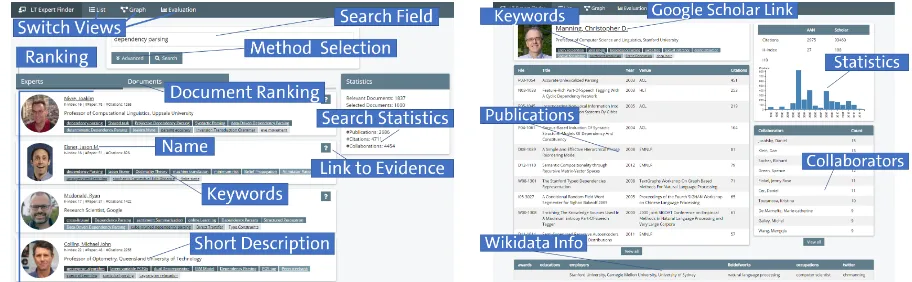
(a)Listview:selectarankingmethodinthe‘Advanced’tab, is-sueasearchquery,andgettheresultsinalistviewwith concise author information as well as detailed result set statistics.
[image:3.595.69.525.62.203.2](b)Profile view:list all publicationsrankedby numberof cita-tions, view collaboration information and external information from Wikidata as well as Google Scholar (if available)andlinktotherespectivesourcepages.
Figure 1: LT Expertfinder Application
cludes more than23K papers including their full text, 18K authors, 124K citations and 142K dis-tinct co-authorship relations.
We further enriched the data with more de-tailed author information by heuristic Wikidata and Google Scholar entity page look-ups that match an author’s name. Note that not every au-thor has a Wikidata or Google Scholar entry, and some authors have multiple entries. In total we count approximately 9K authors with a match-ing Google Scholar entity, and 14K authors with matching Wikidata entities, of which1.5K authors can be linked to exactly one Wikidata entity. Our heuristic does not distinguish between Wikidata entities and shows them all, whereas only the first Google Scholar entity is selected.
3.2 Application
The main contributions of this tool are to provide different expert search methods, detailed expert profiles and evidence features, which support a user’s decision making process. The application’s main page is shown in Figure1a, which contains a simple search field for query input and a list of the retrieved ranked list of experts. The ranked expert list consists of condensed expert profiles showing the name, an image, a description, statistics and keywords representing expertise areas. The result is obtained by the particular method that is se-lected beforehand from a range of different expert finding methods.
The profile view (cf. Figure1b) can be accessed by clicking on an expert’s name (anywhere in the application). It shows publications as well as col-laborators, various statistics like citations,
cita-tions over time, h-index and i10-index, and more. Keywords are extracted for each document in the corpus using a keyword extractor tool ( Wiede-mann et al., 2018)11, which provides results as a ranked list of keywords12. In order to provide key-words for each author, the keykey-words of each docu-ment that an author has written are aggregated and ranked by document frequency. Lastly, the pro-file view shows information such as awards, edu-cational degrees, employers (current and previous) as extracted from Wikidata.
3.3 Expert Finding Methods
We implemented three initial expert finding meth-ods for the LT Expertfinder.
3.3.1 Model2
The document generation model by Balog et al.
(2012) is widely used as a baseline to compare ex-pert finding methods. In their original paper, Ba-log et al.(2012) present two models: Model1, the candidate generation model and Model2, the doc-ument generation model. Their experiments reveal that Model2 performs better.
The main challenge of the expert finding task is the accurate estimation of p(q|ci) as a rank-ing function of a candidate expert ci ∈ C and query termsq (Balog et al.,2012). The probabil-ityp(q|ci) is estimated by using a simple genera-tive process: Given a candidateci, select a docu-mentdassociated withci and generate the query
qwith the probabilityp(q|d, ci), which is obtained
11
https://github.com/uhh-lt/lt-keyterms 12We only keep the top ten multi-term keywords per
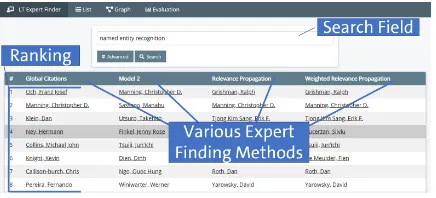
(a) Evaluation view: in this example, four different methods rank experts for the query ”Named Entity Recognition”. Click-ingauthorsopenstheevidenceview (cf.Figure2b).
[image:4.595.74.292.62.161.2](b)Evidenceview:thisviewisopenedfromtheevaluation view(cf.Figure2a).Itshowstheauthor,whichislinkedto the au-thor profile, several querydependent statistics and, andrelevantdocuments(whichopenviaaclick).
Figure 2: Evaluation with LT Expertfinder
using a language modeling approachp(q|d, ci) ≈
p(q|d).
3.3.2 Relevance Propagation (RP)
Serdyukov et al.(2008) proposed graph-based ap-proaches to expert finding. They introduced so-called expertise graphs, which consist of candidate experts and documents connected by authorship relations. Expertise graphs are query-dependent, as they are constructed from the relevant docu-ments that are retrieved by a standard document retrieval for a given query.Serdyukov et al.model expert finding as a random walk through the ex-pertise graph where authors are ranked by the ‘number of visits‘ of the random walker. In their paper, they present different random walk tech-niques, with incremental improvements. We re-implemented the k-step random walk as well as the infinite random walk. The infinite random walk is based on the assumption that the walk to find experts is a non-stop process. This technique is run iteratively until the expert rankings converge as opposed to the k-step random walk, which ap-plies the calculations a fixed number of times.
3.3.3 Weighted Relevance Propagation
We further improve RP by introducing additional edges and edge weights. We include docu-ment citations, co-authorship relations and various weighting schemes for every edge type. Document citations are weighted by recency since we argue that a random user will most likely decide to read the most recent paper. Co-authorship relations are weighted by the number of total co-authorships, i.e. all outgoing edges to other author nodes. Au-thorships are weighted by a combination of the local and and the global h-index, where the local h-index refers to the h-index that is computed on
the current result set of documents, and the global h-index refers to the to corpus wide h-index. As the h-index represents both the number of publi-cations as well as the number of citations per pub-lication, it is a suitable choice for determining the query-independent relevance of an author. Finally, the expert ranking is obtained by an infinite ran-dom walk through the weighted expertise graph. The main difference to RP is, that this method’s infinite random walk is applied with respect to the calculated weightings of the expertise graph.
3.3.4 Other methods
The tool also supports several other methods. It includes basic ranking methods based on simple statistics like h-index and citation count. These methods basically find all authors that dealt with the query topic and then rank the authors by their global or local h-index or citation count. In ad-dition to that, the tool includes PageRank (Page et al., 1999), which ranks authors based on their incoming citations and co-authorships. Lastly, the tool contains a ranking method based on relevance scores obtained from a document retrieval on the query topic. Simply put, this method utilizes the sum of the relevance scores of an author’s docu-ments to create an expert ranking.
3.4 Comparison & Evidence
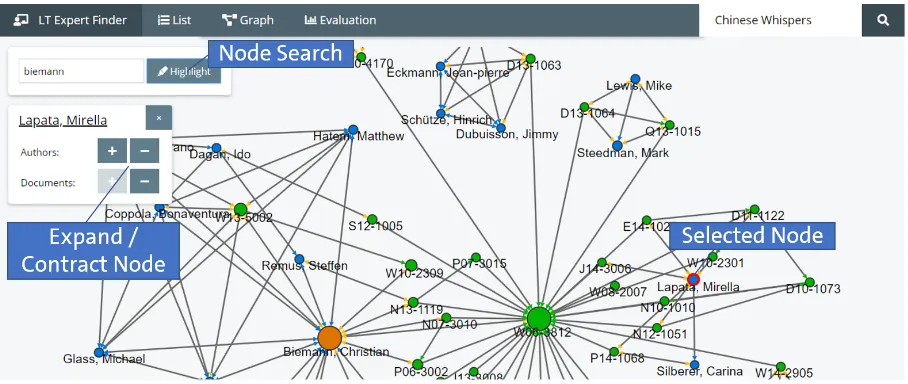
Figure 3: Graph view: authors are rendered as blue nodes, documents are rendered as green nodes, the highlighted node is rendered in red. The size of a node reflects its relevance. The graph is initially filtered by relevance to reduce cognitive overload and can be expanded or reduced for particular nodes.
that are relevant to the query and written by the candidate expert including their document rele-vance score calculated by the respective method, and several query dependent statistics such as h-index, number of citations, etc.
The graph view, which is shown in Figure 3
visualizes the query-based citation network for a particular method. Documents and authors are rendered as nodes whereas citations, authorship relations and co-authorship relations are repre-sented as edges. Thus, it allows a quick peek into the data and an even better understanding of the results.
4 Conclusion
We presented the LT Expertfinder, a user-friendly tool for expert search, expert profiling, and most of all it enables the qualitative comparison of dif-ferent ranking approaches and provides evidence for the ranking process. We implemented several ranking methods that can be easily extended with more methods. Also, it provides detailed expert profiles, which are linked to Wikidata and Google Scholar. Additionally, an explorable graph view is provided, which helps for further analysis of the results. This combination of features in a sin-gle tool is, to the best of our knowledge, still un-explored and helpful for the community for fur-ther development and evaluation of expert find-ing methods. For the future, we plan to expand our corpus using automatic crawling methods of scientific papers, which are analyzed and indexed
on a daily basis. Crawling the ACL Anthology has already been successfully performed bySingh et al. (2018) with the help of their PDF Extrac-tion tool OCR++ (Singh et al., 2016), which we also intend to use. Further, we plan to utilize the LT Expertfinder to develop methods for finding emerging experts in a field. We release the LT Expertfinder as freely available, open source ap-plication, under a permissive license.13,14,15,16 A short demonstration video is also available17.
References
Peter Bailey, Arjen P. De Vries, Nick Craswell, and Ian Soboroff. 2007. Overview of the TREC 2007
En-terprise Track. InProceedings of the Sixteenth Text
REtrieval Conference, Gaithersburg, MD, USA.
Krisztian Balog, Leif Azzopardi, and Maarten de
Ri-jke. 2006. Formal Models for Expert Finding in
Enterprise Corpora. InProceedings of the 29th An-nual International ACM SIGIR Conference on Re-search and Development in Information Retrieval, pages 43–50, Seattle, WA, USA.
Krisztian Balog and Maarten De Rijke. 2007. Deter-mining Expert Profiles (with an Application to
Ex-pert Finding). In Proceedings of the 20th
Inter-13Demo:http://ltdemos.informatik.
uni-hamburg.de/lt-expertfinder/ui/ 14
Docker:
https://cloud.docker.com/u/uhhlt/ repository/docker/uhhlt/xpertfinder
15
Source Code:https:
//github.com/uhh-lt/lt-expertfinder 16
License: Apache License, Version 2.0
national Joint Conference on Artifical Intelligence, pages 2657–2662, Hyderabad, India.
Krisztian Balog, Yi Fang, Maarten de Rijke, Pavel
Serdyukov, and Luo Si. 2012. Expertise Retrieval.
Foundations and Trends in Information Retrieval, 6(2):127–256.
Krisztian Balog, Paul Thomas, Nick Craswell, Ian Soboroff, Peter Bailey, and Arjen P. De Vries. 2008. Overview of the TREC 2008 Enterprise Track. In
Proceedings of the Eighteenth Text REtrieval Con-ference, Gaithersburg, MD, USA.
Christopher S. Campbell, Paul P. Maglio, Alex Cozzi,
and Byron Dom. 2003. Expertise Identification
Us-ing Email Communications. In Proceedings of the 12th ACM International Conference on Information and Knowledge Management, pages 528–531, New Orleans, LA, USA.
Hung-Hsuan Chen, Pucktada Treeratpituk, Prasenjit
Mitra, and C. Lee Giles. 2013. CSSeer: An Expert
Recommendation System Based on CiteseerX. In
Proceedings of the 13th ACM/IEEE-CS Joint Con-ference on Digital Libraries, pages 381–382, Indi-anapolis, IN, USA.
Nick Craswell, Arjen P. De Vries, and Ian Soboroff.
2005. Overview of the TREC 2005 Enterprise
Track. In Proceedings of the Fourteenth Text
RE-trieval Conference, pages 199–205, Gaithersburg, MD, USA.
Nick Craswell, David Hawking, Anne-Marie Vercous-tre, and Peter Wilkins. 2001. P@NOPTIC expert:
Searching for experts not just for documents. In
Ausweb Poster Proceedings, pages 21–25, Coffs Harbour, Queensland, Australia.
H. Deng, I. King, and M. R. Lyu. 2008. Formal Models
for Expert Finding on DBLP Bibliography Data. In
Proceedings of the Eighth International Conference on Data Mining, pages 163–172, Pisa, Italy.
Hui Fang and ChengXiang Zhai. 2007. Probabilistic
models for expert finding. In Proceedings of the
29th European Conference on Information Retrieval Research, pages 418–430, Rome, Italy.
Seyyed Hadi Hashemi, Mahmood Neshati, and Hamid
Beigy. 2013. Expertise retrieval in bibliographic
network: A topic dominance learning approach. In
Proceedings of the 22nd ACM International Con-ference on Information & Knowledge Management, pages 1117–1126, San Francisco, CA, USA.
David Hawking. 2004. Challenges in Enterprise
Search. In Proceedings of the 15th Australasian
Database Conference, pages 15–24, Dunedin, New Zealand.
Pawel Jurczyk and Eugene Agichtein. 2007.
Discov-ering Authorities in Question Answer Communities by Using Link Analysis. InProceedings of the 16th ACM International Conference on Information and
Knowledge Management, pages 919–922, Lisbon, Portugal.
Shuyi Lin, Wenxing Hong, Dingding Wang, and
Tao Li. 2017. A survey on expert finding
tech-niques. Journal of Intelligent Information Systems,
49(2):255–279.
Craig Macdonald and Iadh Ounis. 2006. Voting for
Candidates: Adapting Data Fusion Techniques for an Expert Search Task. InProceedings of the 15th ACM International Conference on Information and Knowledge Management, pages 387–396, Arling-ton, VA, USA.
Audris Mockus and James D. Herbsleb. 2002.
Exper-tise Browser: A Quantitative Approach to Identify-ing Expertise. InProceedings of the 24th Interna-tional Conference on Software Engineering, pages 503–512, Orlando, FL, USA.
Catarina Moreira, Bruno Martins, and P´avel Calado.
2011. Using Rank Aggregation for Expert Search
in Academic Digital Libraries. In Simp´osio de In-form´atica, INForum, Portugal.
Lawrence Page, Sergey Brin, Rajeev Motwani, and Terry Winograd. 1999. The PageRank citation rank-ing: Bringing order to the web. Technical report, Stanford InfoLab.
Dragomir R. Radev, Pradeep Muthukrishnan, Vahed
Qazvinian, and Amjad Abu-Jbara. 2013. The ACL
Anthology Network corpus. Language Resources and Evaluation, 47(4):919–944.
Pavel Serdyukov, Henning Rode, and Djoerd Hiemstra.
2008. Modeling Multi-step Relevance Propagation
for Expert Finding. In Proceedings of the 17th ACM International Conference on Information and Knowledge Management, pages 1133–1142, Napa Valley, CA, USA.
Mayank Singh, Barnopriyo Barua, Priyank Palod, Manvi Garg, Sidhartha Satapathy, Samuel Bushi, Kumar Ayush, Krishna Sai Rohith, Tulasi Gamidi, Pawan Goyal, and Animesh Mukherjee. 2016. OCR++: A Robust Framework For Information
Ex-traction from Scholarly Articles. In Proceedings
of COLING 2016, the 26th International Confer-ence on Computational Linguistics: Technical
Pa-pers, pages 3390–3400, Osaka, Japan.
Mayank Singh, Pradeep Dogga, Sohan Patro, Dhi-raj Barnwal, Ritam Dutt, Rajarshi Haldar, Pawan
Goyal, and Animesh Mukherjee. 2018. CL Scholar:
The ACL Anthology Knowledge Graph Miner. In
Proceedings of the 2018 Conference of the North American Chapter of the Association for Compu-tational Linguistics: Demonstrations, pages 16–20, New Orleans, LA, USA.
Ian Soboroff, Arjen P. De Vries, and Nick Craswell.
2006. Overview of the TREC 2006 Enterprise
Track. In Proceedings of the Fifteenth Text
Jie Tang, Jing Zhang, Limin Yao, Juanzi Li, Li Zhang,
and Zhong Su. 2008. ArnetMiner: Extraction and
Mining of Academic Social Networks. In Proceed-ings of the 14th International Conference on Knowl-edge Discovery and Data Mining, pages 990–998, Las Vegas, NV, USA.
Gregor Wiedemann, Seid Muhie Yimam, and Chris
Biemann. 2018. A Multilingual Information
Ex-traction Pipeline for Investigative Journalism. In
Proceedings of the 2018 Conference on Empirical Methods in Natural Language Processing: System Demonstrations, pages 78–83, Brussels, Belgium.
Kan Wu, Jie Tang, Zhou Shao, Xinyi Xu, Bing Gao, and Shu Zhao. 2018. CareerMap: Visualizing
ca-reer trajectory.Science China Information Sciences,
61:1–3.
Zi Yang, Jie Tang, Bo Wang, Jingyi Guo, Juanzi Li, and Songcan Chen. 2009. Expert2B´ol`e : From Expert
Finding to B´ol`e Search. InProceedings of the 15th
International Conference on Knowledge Discovery and Data Mining, Paris, France.
Jun Zhang, Mark S. Ackerman, and Lada Adamic.
2007. Expertise Networks in Online Communities: