Top a Splitter:
Using Distributional Semantics for Improving Compound Splitting
Patrick Ziering Stefan M¨uller Institute for Natural Language Processing
University of Stuttgart, Germany
{zierinpk,muellesn} @ims.uni-stuttgart.de
Lonneke van der Plas Institute of Linguistics University of Malta, Malta
Abstract
We present a flexible method that re-arranges the ranked output of compound splitters (i.e., decomposers of one-word compounds such as the German Kinder-lied ‘children’s song’) using a distribu-tional semantics model. In an experiment, we show that our re-ranker improves the quality of various compound splitters.
1 Introduction
Closed nominal compounds (i.e., one-word com-pounds such as the German Eidotter ‘egg yolk’) are one of the most productive word formation types in Germanic languages such as German, Dutch or Swedish, and constitute a major class of multi-word expressions (MWEs). Baroni (2002) presents a German corpus study showing that al-most half of the corpus types are compounds, while the token frequency of individual com-pounds is low. This makes it hard to process closed compounds with general-purpose statisti-cal methods and necessitates automatic compound analysis as a principal part of many natural lan-guage processing tasks such as statistical machine translation (SMT).
Therefore, previous work has tried to tackle the task of compound splitting (e.g., decomposing Ei-dottertoEi‘egg’ andDotter‘yolk’). Most com-pound splitters follow a generate-and-rank pro-cedure. Firstly, all possible candidate splits are generated, e.g.,Ei|dotter,Eid|otter, . . . ,Eidott|er
(Koehn and Knight, 2003) or a knowledge-rich morphological analyzer provides a set of plausi-ble candidate splits (Fritzinger and Fraser, 2010). In a second step, the list of candidate splits is ranked according to statistical features such as constituent frequency (Stymne, 2008; Macherey et al., 2011; Weller and Heid, 2012) or frequency
of morphological operations (Ziering and Van der Plas, 2016). By considering each constituent in isolation, approaches limited to frequency neglect the semantic compatibility between a compound and its constituents. For example, while Eidot-ter is usually understood as the yolk of an egg (i.e.,Ei|dotter), the low frequency ofDotteroften makes frequency-based splitters rank a less plau-sible interpretation higher:Eid|otter‘oath otter’.
We try to tackle this pitfall by enriching the ranked output of various splitters with a semantic compatibility score. Our method is inspired by re-cent work on the prediction of compound compo-sitionality using distributional semantics (Reddy et al., 2011; Schulte im Walde et al., 2013). The distributional measures that are used to predict the compositionality of compounds are in fact mea-suring the semantic similarity between the com-pound and its constituents. Our assumption is that they can therefore be used readily to rank the can-didate constituents a splitter proposes and help to promote more plausible candidate splits (e.g., Ei-dotter is distributionally more similar to Dotter
than to Otter). Previously, Weller et al., (2014) applied compositionality measures to compound splitting as a pre-processing step in SMT. Their in-tuition is that non-compositional compounds ben-efit less from splitting prior to SMT. However, they found no improvements in the extrinsic evaluation. Neither did they find improvements from applying distributional semantics directly to the unordered list of candidate splits. We will show in an intrin-sic evaluation that distributional semantics, when combined with the initial ranked output of various splitters does lead to a statistically significant im-provement in compound splitting.
Other works that used semantic information for compound splitting include Bretschneider and Zillner (2015), who developed a splitting approach relying on a semantic ontology of the medical
main. They disambiguated candidate splits using semantic relations from the ontology (e.g., Beck-enbodenmuskel ‘pelvic floor muscle’ is binary split toBeckenboden|muskelusing thepart of
relation). As back-off strategy, if the ontology lookup fails, they used constituent frequency. We do not restrict to a certain domain and related on-tology but use distributional semantics in combi-nation with frequency-based split features for the disambiguation.
Daiber et al., (2015) developed a compound splitter based on semantic analogy (e.g., book-shop is to shop as bookshelf is to shelf). From word embeddings of compound and head word, they learned prototypical vectors representing the modification. During splitting, they determined the most suitable modifier by comparing the anal-ogy to the prototypes. While Daiber et al., (2015) developed an autonomous splitter and focused on semantic analogy, we present a re-ranker that combines distributional similarity with additional splitting features.
Very recently, Riedl and Biemann (2016) de-veloped a semantic compound splitter that uses a pre-compiled distributional thesaurus for search-ing semantically similar substrsearch-ings of a compound subject to decomposition. While their stand-alone method focuses on knowledge-lean split point de-termination, our approach improves splitters in-cluding the task of constituent normalization.
Our contributions are as follows. We are the first to show that distributional semantics informa-tion as an addiinforma-tional feature helps in determining the best split among the candidate splits proposed by various compound splitters in an intrinsic eval-uation. Moreover, we present an architecture that allows for the addition of distributional similarity scores to any compound splitter by re-ranking a system’s output.
2 Re-ranking based on distributional semantics
2.1 Initial split ranking
Our method is applicable to any compound split-ter that produces a ranked output of split options1
with their corresponding ranking score.
For example, the target compound Fischerzeug-nis ‘fish product’ is processed by a compound splitter yielding the output as given in Table 1.
1Following Weller et al., (2014), we focus on true com-pounds and ignore non-split options.
The top-ranked candidate split is the result from a falsely triggered normalization rule (i.e.,+eris not a valid linking element forFisch).
Ranking score Candidate split Correct? 14264 Fisch‘fish certificate’+Zeugnis 7
9390 Fisch‘fish product’+Erzeugnis 3
[image:2.595.307.540.119.221.2]5387 ‘fisherman certificate’Fischer+Zeugnis 7
Table 1: Initial split ranking
2.2 Determination of distributional similarity
For each candidate split of a target compound (e.g.,Fisch|erzeugnisgivenFischerzeugnis), the cosine similarity between the target compound and each candidate constituent is determined as a standard measure that is used for computing the distributional similarity (DS). In a
follow-ing step, these cosine values are used to pre-dict the degree of semantic relatedness between the target compound and the candidate modi-fier (MOD) or head (HEAD), respectively. As
proposed by Weller et al., (2014), a possible combination of the candidate constituents’ co-sine values is the geometric mean (GEO). For
example, let cos(−−−−−−−−−→Fischerzeugnis,−−−→Fisch) be 0.455
andcos(−−−−−−−−−→Fischerzeugnis,−−−−−−→Erzeugnis)be 0.10. The
GEO DS score for the lexemes derived from Fisch|erzeugnisis√0.455·0.10≈0.22.
2.3 Combination and re-ranking
In the next step, we multiply the DS scores with
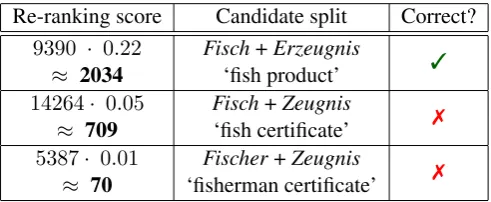
the initial split ranking scores and finally re-rank the splits according to the resulting product. Ta-ble 2 shows the result from re-ranking the output presented in Table 1 withGEO DSscores.
Re-ranking score Candidate split Correct?
9390 · 0.22 Fisch+Erzeugnis 3 ≈ 2034 ‘fish product’
14264· 0.05 Fisch+Zeugnis 7
≈ 709 ‘fish certificate’
5387· 0.01 Fischer+Zeugnis 7 ≈ 70 ‘fisherman certificate’
[image:2.595.307.553.634.735.2]3 Experiments
3.1 Data
We use the German Wikipedia2corpus comprising
665M words. We tokenize, lemmatize and PoS-tag using TreeTagger (Schmid, 1995). While we are aware of the fact that there are German cor-pora larger than Wikipedia which can boost the perfomance of distributional semantics methods, we decided to use the same corpora as used in pre-vious work for the inspected compound splitters (Ziering and Van der Plas, 2016). By controlling for corpus size, we can contrast the differences in splitting performance with respect to information type (i.e., distributional similarity vs. frequency information) irrespective of corpus size.
3.2 Distributional model
In analogy to the distributional model of Weller et al., (2014), we adopt a setting whose parameters are tuned on a development set and prove best for compositionality (Schulte im Walde et al., 2013). It employs corpus-based co-occurrence informa-tion extracted from a window of 20 words to the left and 20 to the right of a target word. We restrict to the 20K most frequent nominal co-occurrents.
3.3 Distributional similarity modes
Inspired by Weller et al., (2014), the distributional similarity mode (DS MODE) refers to the selected
cosine values, determined with our distributional model. We compare the distributional similarity of both individual constituents (i.e., modifier (MOD)
and head (HEAD)) with the geometric mean of
them (GEO). Moreover, we used standard
arith-metic operations (Widdows, 2008; Mitchell and Lapata, 2010) and combine the vectors of modifier and head by vector addition (ADD), and
multipli-cation (MULT) as shown to be beneficial in Schulte
im Walde et al., (2013).
3.4 Rankings in comparison
We compare the performance of the initial rank-ing (INITIAL) of a compound splitter, based on
all individual features, with the splitting perfor-mance after re-ranking by multiplying the selected
DS value with the initial ranking score (RRALL).
Our baseline (RRDS) is inspired by the aggressive
splitting mode (DIST) of Weller et al., (2014): we
re-rank the unordered list of candidate splits pro-posed by a splitter according to theDSscores only.
2de.wikipedia.org
3.5 Inspected compound splitters
We inspect three different types of German com-pound splitters, ranging from knowledge-lean to knowledge-rich. Ziering and Van der Plas (2016)developed a corpus-based approach, where morphological operations are learned automati-cally from word inflection. Weller and Heid (2012) used a frequency-based approach with a list of PoS-tagged lemmas and an extensive hand-crafted set of normalization rules.Fritzinger and Fraser (2010) combined the splitting output of the morphological analyzerSMOR(Schmid et al.,
2004) with corpus frequencies.
3.6 Evaluation setup
While Weller at al., (2014) did not observe a difference in SMT performance between ranking candidate splits according to frequency and com-positionality, we use an intrinsic evaluation mea-sure actually revealing significant differences. We follow the evaluation approach of Ziering and Van der Plas (2016), who defined splitting ac-curacy3 in terms of determining the correct split
point (SPAcc) and correctly normalizing the re-sulting constituents (NormAcc), and use the Ger-maNet4 gold standard developed by Henrich and
Hinrichs (2011). We remove hyphenated com-pounds, which should be trivial splitting cases that do not need improvement by re-ranking. The final set comprises 51,230 compounds.
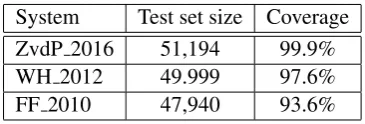
[image:3.595.325.508.481.543.2]System Test set size Coverage ZvdP 2016 51,194 99.9% WH 2012 49.999 97.6% FF 2010 47,940 93.6% Table 3: Coverage of compound splitters
Some of the compound splitters described in Section 3.5 can only process a subset of the gold standard. For example, the approach of Fritzinger and Fraser (2010) is limited to a hand-crafted lex-icon (i.e., it misses compounds with unknown constituents such as Barbiepuppe‘Barbie doll’). Moreover, it uses the analyzer SMOR, which
con-siders some gold standard compounds as cases of derivation which are not subject to decomposi-tion (e.g., Unterbesetzung ‘understaffing’ is pri-marily derived from the verbunterbesetzen‘to un-derstaff’). Besides, for some compounds, there are
Accuracy SPAcc NormAcc
DS MODE MOD HEAD GEO MULT ADD MOD HEAD GEO MULT ADD
ZIERING AND VAN DER PLAS (2016)
INITIAL 97.5% 87.4%
RRDS 93.6% 94.6% 95.4% 92.7% 92.0% 75.9% 84.7% 77.8% 69.6% 61.2% RRALL 97.5% 97.9%† 98.0%† 97.8%† 98.0%† 88.6%† 87.7%† 89.0%† 88.5%† 88.7%†
WELLER ANDHEID(2012)
INITIAL 98.1% 90.4%
RRDS 96.9% 97.0% 97.7% 96.9% 95.8% 86.5% 89.3% 87.1% 81.8% 75.3% RRALL 98.2%† 98.2%† 98.3%† 98.2%† 98.3%† 91.3%† 90.5%† 91.1%† 90.9%† 90.9%†
FRITZINGER ANDFRASER(2010)
INITIAL 98.4% 94.9%
[image:4.595.40.560.60.273.2]RRDS 97.9% 97.9% 98.4% 98.3% 98.2% 94.3% 94.3% 94.7% 94.5% 94.3% RRALL 98.4% 98.3% 98.5% 98.4% 98.4% 94.8% 94.7% 95.0% 94.8% 94.7%
Table 4: Results of split re-ranking;†indicates significantly better thanINITIAL
no binary splits in a system’s ranking. These com-pounds are excluded from the respective splitter’s test set. Table 3 shows the test set sizes and cover-age of the inspected compound splitters.
4 Results and discussion
In the following section, we show results on split-ting performance of various compound splitters before and after adding our re-ranking method. As shown in Table 3, the systems are evaluated on ferent test sets. It is not our goal to compare dif-ferent splitting methods against each other, but to show the universal applicability of our re-ranker for different types of splitters.
4.1 General trends
Table 4 shows the performance numbers for all inspected compound splitters and all DS modes.
A first resultis that the INITIAL accuracy (both
SPAcc and NormAcc) is always outperformed by re-ranking with DS scores as additional feature
(RRALL) for at least oneDS MODE.
The baseline of using pure DS scores (RRDS)
worsens the INITIALperformance. This is in line
with previous work (Weller et al., 2014) and shows that isolated semantic information does not suffice but needs to be introduced as an additional fea-ture. In an error analysis, we observed that the corpus frequency, which is missing for RRDS, is a
crucial feature for compound splitting and helps to demote analyses based on typographical errors or unlikely modifier normalization. For example, while RRALL analyzes the compoundHaarwasser
‘hair tonic’ with the correct and highly frequent modifierHaar‘hair’,RRDSselects the
morphologi-cally plausible but yet unlikely and infrequent ver-bal modifier haaren ‘to molt’, which happens to have the higher cosine similarity toHaarwasser.
Another type of compound analysis that bene-fits from corpus frequency is binary splitting of left-branched tripartite compounds (i.e., bracket-ing). For example, the compound Blinddarmop-eration ‘appendix operation’ (lit.: ‘blind intes-tine operation’) is frequency-based correctly split intoBlinddarm|operation‘[appendix] operation’, whereasRRDS prefers the right-branched splitting
into Blind | darmoperation ‘blind [intestine op-eration]’. Since the rightmost constituent Oper-ation ‘surgery/operation’ is more ambiguous, it has a smaller cosine similarity to the entire com-pound than the right-branched comcom-pound Darm-operation ‘intestinal operation’. In contrast, the high corpus frequency of the non-compositional
Blinddarm ‘appendix’ and the head Operation, make a frequency-based splitter choose the cor-rect structure. However, bracketing also bene-fits from cosine similarity. For example, using re-ranking by RRALL, the wrong compound split Arbeits|platzmangel‘labor [lack of space]’ is cor-rected to Arbeitsplatz|mangel ‘job scarcity’. As conclusion, we argue that the combination of cor-pus frequency and semantic plausibility (in terms of cosine similarity) is working best for splitting.
(GEO@RRALL for Fritzinger and Fraser’s (2010)
splitter). However, there is only a small benefit for SPAcc when adding semantic support. In con-trast, constituent normalization (measured as Nor-mAcc) can be improved by +1.6% (GEO@RRALL
for Ziering and Van der Plas’ (2016) splitter).
Comparing the DS modes, we see that for
NormAcc, the more demanding task that leads to the largest differences in performance between the different modes, the MOD mode outperforms the HEADmode (forRRALL). However, the modes that
combine head and modifier scores mostly outper-form those based on heads or modifiers in iso-lation. This is in line with tendencies found in previous work on compositionality of compounds (Schulte im Walde et al., 2013). In addition, we find that for NormAcc, theGEOmode outperforms
the modes based on vector arithmetic, whereas for SPAcc, the performance ofGEOand the vector
ad-dition (ADD) is comparable.
4.2 Individual splitter improvement
Ziering and Van der Plas (2016) automati-cally learned constituent transformations taking place during compounding (e.g., s-suffixation) from word inflection. Based on corpus frequency and transformation plausibility, they produced a ranked list of candidate splits. However, mis-leading inflections can rank false splits high. For example, +ge, as in the participle aufgewachsen
‘grown up’ (aufwachsen ‘grow up’), leads to the falsely top-ranked candidate split Fu(ge)nk | elle ‘radio ulna’ instead of Fugen | kelle ‘filling trowel’. Re-ranking withRRALLpromotes the
cor-rect candidate split. We achieve significant5
im-provements for almost allDS MODEs.
Weller and Heid (2012)extended a frequency-based approach (Koehn and Knight, 2003) with a hand-crafted set of morphological rules. Even re-stricted to only valid constituent transformations, some rules are falsely triggered and lead to wrong splits. For example, the er-suffix (as in Kinder | buch‘children’s book’) is used for the compound
Text |erkennung‘text recognition’ and results in the false splitText(er)|kennung‘text ID’. Our re-ranking method (RRALL) again helps to promote the
correct candidate split. In allDS MODES, the
per-formance is improved significantly.
For the system of Fritzinger and Fraser (2010), theGEOmode improves theINITIAL split-5Approximate randomization test (Yeh, 2000),p <0.05
ting accuracy (+0.1%), but we do not achieve sta-tistically significant results. The main reason for this is due to the lexicon-based morphological an-alyzer SMOR. While having the smallest
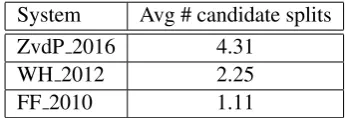
cover-age on the gold standard, utilizing a hand-crafted lexicon results in only correctly triggered transfor-mation rules. This leads to a smaller list of candi-date splits. In fact, the average number of analyses provided by Fritzinger and Fraser (2010) is much smaller than for Ziering and Van der Plas (2016) as shown in Table 5.
System Avg # candidate splits ZvdP 2016 4.31
[image:5.595.329.502.220.279.2]WH 2012 2.25 FF 2010 1.11
Table 5: Average number of candidate splits As a consequence, re-ranking has only a lim-ited impact on the splitting performance. We can conclude that a knowledge-rich morphological re-source can mitigate the need for semantic support, however, at the expense of coverage.
5 Conclusion
We presented a flexible method for re-arranging the ranked output of a compound splitter, by adding a feature for the semantic compatibility between compound and potential constituents de-rived from a distributional semantics model. We showed that the addition of distributional similar-ity significantly improves different types of com-pound splitters.
Acknowledgments
We thank the anonymous reviewers for their help-ful feedback. We also thank Marion Di Marco and Fabienne Cap for providing their splitting meth-ods. This research was funded by the German Re-search Foundation (Collaborative ReRe-search Centre 732, Project D11).
References
Marco Baroni, Johannes Matiasek, and Harald Trost. 2002. Predicting the Components of German Nom-inal Compounds. In ECAI, pages 470–474. IOS Press.
Claudia Bretschneider and Sonja Zillner. 2015. Se-mantic Splitting of German Medical Compounds. In
Joachim Daiber, Lautaro Quiroz, Roger Wechsler, and Stella Frank. 2015. Splitting Compounds by Se-mantic Analogy.CoRR.
Fabienne Fritzinger and Alexander Fraser. 2010. How to Avoid Burning Ducks: Combining Linguistic Analysis and Corpus Statistics for German Com-pound Processing. InProceedings of the ACL 2010 Joint 5th Workshop on Statistical Machine Transla-tion and Metrics MATR, pages 224–234.
Verena Henrich and Erhard W. Hinrichs. 2011. De-termining Immediate Constituents of Compounds in GermaNet. InRANLP 2011, pages 420–426. Philipp Koehn and Kevin Knight. 2003. Empirical
methods for compound splitting. InEACL.
Klaus Macherey, Andrew M. Dai, David Talbot, Ashok C. Popat, and Franz Och. 2011. Language-independent Compound Splitting with Morphologi-cal Operations. InACL HLT 2011.
Jeff Mitchell and Mirella Lapata. 2010. Composition in distributional models of semantics. Cognitive Sci-ence, 34:1388–1429.
Siva Reddy, Diana McCarthy, and Suresh Manandhar. 2011. An Empirical Study on Compositionality in Compound Nouns. InIJCNLP 2011.
Martin Riedl and Chris Biemann. 2016. Unsupervised Compound Splitting With Distributional Semantics Rivals Supervised Methods. InNAACL-HTL 2016. Helmut Schmid, Arne Fitschen, and Ulrich Heid.
2004. SMOR: A German Computational Morphol-ogy Covering Derivation, Composition, and Inflec-tion. InLREC 2004, pages 1263–1266.
Helmut Schmid. 1995. Improvements in Part-of-Speech Tagging with an Application to German. In
ACL SIGDAT-Workshop.
Sabine Schulte im Walde, Stefan M¨uller, and Stephen Roller. 2013. Exploring Vector Space Models to Predict the Compositionality of German Noun-Noun Compounds. InSecond Joint Conference on Lexical and Computational Semantics (*SEM), Volume 1: Proceedings of the Main Conference and the Shared Task: Semantic Textual Similarity.
Sara Stymne. 2008. German Compounds in Factored Statistical Machine Translation. InGoTAL.
Marion Weller and Ulrich Heid. 2012. Analyzing and Aligning German compound nouns. InLREC 2012. Marion Weller, Fabienne Cap, Stefan M¨uller, Sabine Schulte im Walde, and Alexander Fraser. 2014. Dis-tinguishing Degrees of Compositionality in Com-pound Splitting for Statistical Machine Translation. InComAComA 2014.
Dominic Widdows. 2008. Semantic Vector Products: Some Initial Investigations. In Proceedings of the Second AAAI Symposium on Quantum Interaction.
Alexander Yeh. 2000. More Accurate Tests for the Statistical Significance of Result Differences. In
COLING 2000.