82
Accommodation of Conversational Code-Choice
Anshul Bawa Monojit Choudhury Kalika Bali Microsoft Research
Bangalore, India
{t-anbaw,monojitc,kalikab}@microsoft.com
Abstract
Bilingual speakers often freely mix lan-guages. However, in such bilingual con-versations, are the language choices of the speakers coordinated? How much does one speaker’s choice of language affect other speakers? In this paper, we formulate code-choice as a linguis-tic style, and show that speakers are in-deed sensitive to and accommodating of each other’s code-choice. We find that the salience or markedness of a language in context directly affects the degree of accommodation observed. More impor-tantly, we discover that accommodation of code-choices persists over several conver-sational turns. We also propose an alter-native interpretation of conversational ac-commodation as a retrieval problem, and show that the differences in accommo-dation characteristics of code-choices are based on their markedness in context.
1 Introduction
Code-switching (CS) refers to the fluid alter-ation between two or more languages within a conversation, and is a common feature of all multilingual societies. (Auer, 2013). Multilin-gual speakers are known to code-switch in spo-ken conversations for a variety of reasons, moti-vated by information-theoretic and cognitive prin-ciples, and also as a result of numerous social, communicative and pragmatic functions (Scotton and Ury,1977;S¨oderberg Arnfast and Jørgensen,
2003;Gumperz,1982).
Code-choice refers to a speaker’s decision of which code to use in a given utterance, and in case of a CS utterance, to what extent the differ-ent codes are to be used. Depending on the soci-olinguistic and conversational context, a speaker’s
code-choice may be unexpected and noticed by other speakers, and is likely to affect other speak-ers’ subsequent code-choice. In other words, speakers mayaccommodateto each other’s code-choice, positively or negatively (Genesee,1982).
In this work, we propose a set of metrics to study the social accommodation of code-choice as a sociolinguistic style marker. We build upon the existing framework on accommodation by
Danescu-Niculescu-Mizil et al. (2011) and adapt that for code-choice by introducing relevant fea-tures for code-choice. We then motivate and illus-trate the effect of code markedness on the degree of accommodation - the more salient code is more strongly accommodated for. We further generalize the framework to also account fordelayed accom-modation, instead of only next-turn orimmediate
accommodation.
In addition, we introduce an alternative view of accommodation as a query-response task, and em-ploy mean reciprocal rank, a well-understood met-ric from the domain of Information Retrieval, as a metric for latency of accommodation. We mea-sure how quickly a style marker (code-choice in our case) introduced by a speaker is retrieved by the other speaker during the conversation. Our approach is developed for analyzing code-choice but is applicable to other dimensions of linguis-tic style as well (Tausczik and Pennebaker,2010). This presents an alternative view of conversational style accommodation and offers a simple but ef-fective way of measuring, characterizing and even predicting elements of conversational style.
the marked code is accommodated within the first three to four conversational turns, beyond which the effect of accommodation on cochoice de-cays gradually. Contextually-unmarked code is less strongly accommodated for, even when it oc-curs relatively infrequently within a conversation. As far as we know, this is the first computa-tional study of code-choice accommodation, and first work that introduces and formalizes the con-cept of delayed accommodation, that can be ap-plied to other style dimensions as well.
The rest of the paper is organized as follows. We describe the background and related work in Section2, which motivates the first formulation of code-choice accommodation in Section3. We im-prove this by formulation by modifying the fea-tures in Section4. We generalize the formulation to multiple turns and introduce the analogy to re-trieval in Section 5, along with the results. We wrap up with a discussion in Section 6 that we conclude in Section7.
2 Related Work
CS is employed by speakers to signal a common multilingual identity(Auer,2005), and can be ef-fectively used to reduce (or increase) the perceived social distance between the speakers (Camilleri,
1996). As a marker of informality, it has been shown to lower interpersonal distance ( Myers-Scotton,1995;Genesee,1982).
Common structural patterns in CS as well as the choice to switch between languages have been the focus of many linguistic studies(Poplack,
1988)(Auer, 1995). As CS is typically used as a conversation strategy by bilinguals who are profi-cient in both languages (Auer,2013), it is not sur-prising that certain pragmatic and socio-linguistic factors, such as formality of context (Fishman,
1970), age (Ervin-Tripp and Reyes,2005), expres-sion of emotion (Dewaele, 2010) and sentiment (Rudra et al.,2016), are found to signal language preference in CS conversations. A Twitter study of CS patterns across several geographies ( Rijh-wani et al.,2017), also suggests that there might be complex sociolinguistic reasons for code-choice. Thus, CS, and the choice of language or code
in which one communicates during a multilingual conversation, could be considered a marker of lin-guistic style.
Communication accommodation theory (Giles et al.,1973;Giles,2007) states that speakers shift
their linguistic styles towards (or away from) each other in a conversation for social effect. In the CAT framework, the interlocutors’ desire for ‘so-cial approval’ results in an attempt to match each other’s linguistic style. Accommodation has been studied for many markers of linguistic style like tense, negations, articles, prepositions, pronouns and sentiment (Taylor and Thomas,2008; Nieder-hoffer and Pennebaker,2002).
Since it is possible to convey the same semantic content while widely varying the extent of CS, we also consider code-choice as a linguistic style di-mension. Therefore, we expect to observe accom-modation in terms of code-choice in similar man-ner to that of variables for other linguistic styles. While there have been linguistic and small-scale studies (Sachdev and Giles,2004;Bourhis,2008;
Bissoonauth and Offord, 2001; y Bourhis et al.,
2007) that argue for prevalence of code-choice ac-commodation, there are no large-scale quantitative or computational studies that corroborate this and shed light on the various patterns of code-choice accommodation. Further, these studies rely on simple correlation-based measures.
The first computational study of linguistic style accommodation (Danescu-Niculescu-Mizil et al.,
2011) shows that it is highly prevalent in Twit-ter conversations. They use binary features for the presence of various psychologically meaning-ful word categories as described by the LIWC method(Tausczik and Pennebaker,2010) to iden-tify stylistic variations in tweets. They then de-fine a probabilistic framework that mathematically models style accommodation in terms of the like-lihood of an addressee to respond in the same style as the speaker.
Though CS is similar enough to other kinds of linguistic style to allow analysis using the same framework, it also differs from them in being a strong sociological indicator of identity (Auer,
2005) and in not being processed nonconsciously (Levelt and Kelter,1982). We demonstrate that a model that does not account for these crucial dif-ferences fails to capture the accommodative pat-terns of code-choice. Because of being processed consciously, code-choice also exhibits accommo-dation over several conversational turns, an ef-fect which is not observed as strongly for other style dimensions (Danescu-Niculescu-Mizil et al.,
studied based on crude conversation-level correla-tion values (Niederhoffer and Pennebaker,2002).
3 Accommodation of Code-Choice as Linguistic Style
As a first step, we adapt an existing framework (Danescu-Niculescu-Mizil et al.,2011) that quan-tifies accommodation of a given linguistic style. Any linguistic feature is said to exhibit accommo-dation if it is more likely to be expressed in re-sponse to a dialog that also expresses it, than oth-erwise. In other words, an accommodative feature in a dialog begets the same feature in the next dia-log. We use the term ‘dialog’ or ‘turn’ to refer to a single spoken utterance or dialog within a conver-sation, and the term ‘speaker’ to refer to conversa-tion participants. This framework thus restricts the definition of accommodation to only single-turn effects.
3.1 Measuring Accommodation
Mathematically, letF denote some binary feature over a dialog (we describe the features themselves in Section3.2below). F is said to exhibit accom-modation if the likelihood of a user expressingF
increases whenF has been expressed in the previ-ous dialog. We define the degree of accommoda-tion as follows
Acm(F) =P δdF i
δdF
i−1
−P(δdF
i ) (1)
Here, dialogdi−1 immediately precedes dialog
di, andδdF is theeventthat the dialogdexhibitsF. The first term can be thought of as thereciprocity
overF. The second term is the fraction of dialogs in the corpus for whichF = 1, which is also the empirical probability of observingF in a dialogd. Instead of computing these likelihoods over the entire corpus, we could also compute them in-dividually for each speaker, and doing so yields a fairer condition for accommodation. Different speakers can have widely different base likeli-hoods. This metric requires an average speaker to reciprocate more than their own (individual) base-line likelihood of expressingF, rather than sim-ply more than the population baseline. Denoting the event that a dialogdis spoken by a speakers
asδS(d)=s, we redefine accommodation as follows
(Esdenotes an expectation over all speakerss)
Acm∗(F) =Es Acms(F)
=Es
P δdF
i δS(d)=s
δdF
i−1
−P(δdF
i δS(d)=s)
(2)
3.2 Measuring Code-Choice
Our general hypothesis is that code-choice is re-ciprocated in a bilingual conversation. To mea-sure this, we introduce simple binary features for presence of each code, along the lines of the bi-nary features in (Danescu-Niculescu-Mizil et al.,
2011), with individual language expression substi-tuting for the style dimensions. For each language
L, we define a featureFLindicating, for a dialog d, if the dialog contains words in the languageL. The event that dialog dis at least partially in L, is denoted byδdFL. In other words,δFdL is true if the languageLis expressed in dialogd, and false otherwise.
3.3 Data
We employ two datasets of bilingual conversa-tions, each in a different conversational context and a different pair of languages, to test the oc-currence of code-choice accommodation. Table1
reports the number of dialogs and words for the two datasets, and the fraction of words that are in English.
Dataset Dialogs Words %En
Movies (En-Hi) 20.1K 240K 24.1 Bangor (Es-En) 18.5K 216K 62.9
Table 1: Conversational dataset overview
Hindi Movies
The data comprises of scripts of 32 Hindi movies released between 2012 and 2017. 17 of these scripts were collected byPratapa and Choudhury
(2017) from scripts posted online1. We collected 15 scripts of our own from a similar online source2 and parsed them replicating the methodology of
Pratapa and Choudhury(2017).
All the scripts have word-level language tags as created by the language identification system from (Gella et al.,2013). The language labels on manual inspection were found to have significant
1
https: //moifightclub.com/category/scripts
amount of noise, we corrected frequently observed errors with manual supervision.
Each dialog is assumed to be in response to the immediately preceding dialog within a scene. We restrict our analysis to dialogs that are between no more than two speakers, to avoid confounding ef-fects of multi-party conversations on accommoda-tion. This also filters out most dialogs in the scripts which are not conversational in nature.
Movie conversations, even though imagined, are designed to sound natural, and therefore, are suitable for studying style accommodation, as is argued in Danescu-Niculescu-Mizil and Lee
(2011), and also multilingualism (Bleichenbacher,
2008) and code-choice (Vaish, 2011). It is true that movie dialogs promote stereotypes that may affect characters’ expression of code-choice, how-everaccommodative effectscan still be expected to play out largely independent of such stereotypes. There have been several linguistic and quantitative studies on Hindi-English CS in Hindi movies ( Par-shad et al.,2016;L¨osch,2007;Pratapa and Choud-hury,2017).
Bangor Corpus
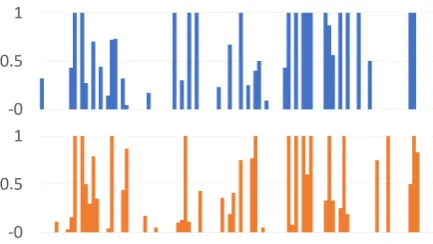
We use the Bangor Miami corpus3 of word-level language labeled transcripts of spoken con-versations between Spanish-English bilinguals in Florida, US. The original dataset contains 56 con-versations, from which we selected 40 conversa-tions that have non-trivial amount of English and Spanish, and sufficient dialogs from each speaker. Figure1shows the fraction of Spanish used by a dyad of speakers in a sample conversation from this dataset (the complement fraction being En-glish). Intuitively, we expect our metrics to cap-ture how coordinated two speakers are.
3.4 Results
Table2shows the metrics from Section3.1 com-puted over the features in Section3.2 on the two datasets.
While these numbers do suggest that accom-modative effects are present, they seem to be fairly weak. The rate of reciprocation is only slightly higher than the base rate, and in some cases the difference isn’t statistically significant.
However, looking at individual differences in these values reveals an interesting observation. For each speaker s in the Movies dataset, we
[image:4.595.308.525.62.184.2]3http://bangortalk.org.uk/speakers.php?c=miami
Figure 1: Fraction of Spanish over time in a con-versation. The x-axis denotes consecutive dia-log pairs, with diadia-logiabove aligned with dialog
i+ 1below, so two aligned bars denote two con-secutive dialogs.
Dataset Code(L) Acm(FL) Acm∗(FL)
Bangor En 0.06† 0.04
Es 0.12 0.09
Movies En 0.10 0.06
Hi 0.02† -0.02†
Table 2: Accommodation values for different codes. Values with a (†) are not significant. Sig-nificance forAcm(F)is computed using Fisher’s exact test, and significance forAcm∗(F)is com-puted using one-tailed paired t-test.
plot in Figure2, the rate of accommodation by s,
Acms(F), against the respective base rateP(dFs), forF ∈ {FEn, FHi}.
Clearly, we see that a high base rate of expres-sion corresponds to far less accommodation. In other words, the instances of code-choice that are uncommon and therefore unexpected within the conversational context are likely to be accommo-dated for. In a conversation that is predominantly in Hindi, a dialog uttered in Hindi carries little salience and doesn’t stand out. This code-choice is unlikely to be registered as a communicative sig-nal or a marked expression of any linguistic style, and therefore wouldn’t elicit accommodation. En-glish and Spanish are respectively less common in Movies and Bangor, and indeed their rates of ac-commodation are higher than the rates for the cor-responding dominant languages.
Since the metrics in Section 3.1 compute like-lihoods over all instances of code-choice irrespec-tive of salience, the observed rates of accommoda-tion are low. We borrow the noaccommoda-tion ofmarkedness
of code-choice, as described in Myers-Scotton
[image:4.595.306.528.272.343.2]Figure 2: Variation of accommodation rate against base rate. Observed rate (x + y) can vary between 0 and 1. The highlighted region denotes positive accommodation and a low base rate (x <0.5andy >0). In contrast, all other re-gions, as demarcated by dashed lines, are sparser.
described in the next section.
4 Marked Code-Choice Features
4.1 Code Salience
As shown earlier, measuring accommodation makes sense only over marked instances of code-choice. Thus, for every conversation in our dataset, we identify the marked language, and measure accommodation only over that language. We choose a conversation as the unit for decid-ing if a code is marked because the set of speak-ers and the convspeak-ersation context typically dictates code-choice in multilingual societies.
A language is considered marked if it is the non-dominant language - we keep the threshold of markedness at no more than 40% of total words in the entire conversation. We discard highly mixed conversations where none of the languages meets the threshold. This consideration also makes the calculation of accommodation more robust, as for a high fraction of incidence of a code, the effect of the previous turn would be harder to isolate.
4.2 Threshold of Occurrence
Another limitation of the formulation in Section
3is that it doesn’t incorporate the extentof pres-ence of each code in a dialog. Consequently, even named entities, frequently borrowed words and frozen expressions from the marked language, would be considered as candidates for
accommo-dation. The Bangor corpus came with named-entity tags, and in the Movies corpus we removed all character names from the dialogs, but we were not aware of any NER system for Hindi-English CS data that we could have used to remove other named entities. Ideally, we would like to exclude all such words from the triggers expected to elicit accommodation, as their usage isn’t stylistically marked (Auer, 1999). The word-level language tags also have some amount of noise, and it is de-sirable to use features that are resilient to it.
Besides, it is possible that a relatively high in-cidence of marked code in a dialog is perceived as a stronger style marker, and is perhaps accom-modated for more strongly than a lower incidence. We introduce a simple fraction-based thresholding that allows us to test the same.
For every dialogd, we define featureFL,τ such thatdFL,τ = 1 if and only if (a)dis sufficiently long and (b) fraction of words ofdin the marked language L is more than τ. We consider an ut-terance to be sufficiently long if it contains more than 4 words, as this is expected to filter out most frozen expressions and named entities that may be borrowed from one language to another. We show results for accommodation of Fτ for τ ∈ {0,0.2,0.5}. WhileF0 would capture presence of
even one word in a marked code,F0.2represents a
non-trivial occurrence andF0.5 represents
major-ity occurrence of the marked code in context.
5 Beyond Immediate Accommodation
The metrics in Section 3 and those in Danescu-Niculescu-Mizil et al.(2011) only consider the im-mediate next turn as a candidate for reciprocation. However, it is possible for accommodative effects to span a few conversation turns. Consider the fol-lowing snippet from one of the conversations in Bangor (Spanish code is in bold and its translation is in italics).
In cases like this, the content of the conversa-tion prevents a possibility of accommodating im-mediately, but the speakerSarahstill reciprocates
Paige i wanna see them.
Sarah pick. pick like (name) flowers or ...
Paige ¡ay qu´e lindo est´a ese!
oh, how pretty that is!
ok, enter the date. it will be ...
Sarah may.
Paige may. ninth?
Sarah ninth.
Paige two thousand and eight. and then you put what you want. (name) trip?
Sarah no te cabe.
it doesn’t fit you.
just (name).
5.1 Generalization of Immediate Accommodation
The baseline rate of a speakersusing a featureF
acrossn(consecutive) turns is the likelihood that at least one thenturns expressesF, and is given by1−(1−ps)n, wherepsis simplyP(dFs). For a speakers, the rate ofn-turn accommodation is the increase in likelihood of occurrence ofF in either of the n dialogs ds,1 to ds,n, conditioned on the event that the preceding dialogd0expressesF.
Acmn,s(F) =P _n
i=1
dFs,i d
F
0
− 1−(1−ps)n
(3)
Acm∗n(F) =Es Acmn,s(F)
(4)
Whenn= 1, this resolves to Equation (2). Note thatd1 to dn are the first ndialogs spoken by s immediately after the dialog d0. As before, Es denotes expected value over all speakers.
5.2 Accommodation as Retrieval
Responding to marked code-choice with marked code-choice can be thought of or reformulated as a retrieval task. For a speakers, each instance of a dialog addressed to s with a feature F would be a query posed to s. The next n dialogs spo-ken bys would be the top-nretrievedresponses
to the query. We are interested in the retrieval of responses that also have featureF, so we call a re-sponse with featureF to berelevantresponse and
irrelevantotherwise, in keeping with the standard terminology in information retrieval. We consider
sto have retrieved a relevant response inn-turns if at least one of the firstnresponses is relevant.
When formulated this way, the recallofs, the probability of retrieving a relevant response, is
precisely equal to the first term in Equation3, the probability usingF in responding to a dialogcF. The second term in Equation 3 is the expected value of recall under the independence assump-tion, i.e., if s randomly introduces marked code at every turn with probability ps. Therefore, a speaker is accommodative if their recall is higher than that of this random baseline.
A popular metric to evaluate retrieval systems is the mean reciprocal rank (MRR). The recipro-cal rank of a query response is the multiplicative inverse of the rank of the first relevant response. The MRR of a system is simply the mean of the re-ciprocal ranks of all its responses. Since we expect the accommodative speaker to have a higher recall than the random baseline, we also expect the ac-commodative speaker to have a higher MRR, with the difference from baseline MRR being propor-tional to its accommodativeness.
Not only does this present an alternative view of accommodation and exposes well-studied for-malisms and concepts from information retrieval, but the ability to capture speakers’ styles as re-sponse characteristics also facilitates predictive conversational modelling.
Mean reciprocal ranks for the random baselines can be computed analytically as follows. We first compute the expected reciprocal rank r for any given query as a function of the correctness prob-abilityps. For the first relevant response to be at rank i, all previous responses must be irrelevant. Since each response is relevant with a probability
ps, the probability of thei-th response being the first relevant response is given by :
P rps =
1
i
= (1−ps)i−1∗ps (5)
The baseline MRR of a speaker s, denoted by
Bases, is then the expected value of r, also as function ofps:
Bases=E rps
=
∞
X
i=1
(1−ps)i−1∗ps/i
=− ps
1−ps
lnps
(6)
The overall baseline MRR,Baseis then simply
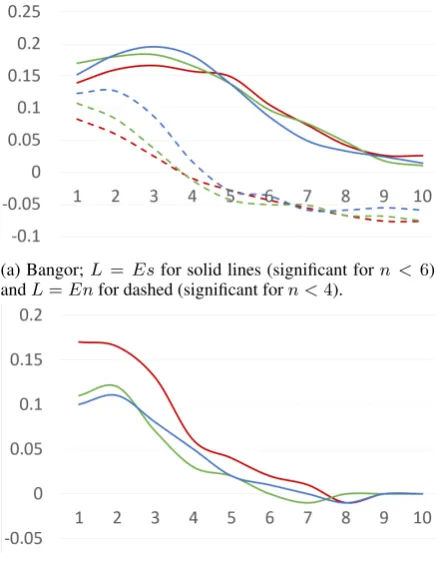
(a) Bangor;L =Esfor solid lines (significant forn < 6) andL=Enfor dashed (significant forn <4).
[image:7.595.321.513.62.175.2](b) Movies;L=En. Significant forn <4.
Figure 3: Accommodation rates (Acm∗n(FL,τ)) versusn. Red, green and blue lines indicateτ = 0, 0.2 and 0.5 respectively. Accommodation of Hindi is not significant.
5.3 Results and Observations
Figure3shows the trends inAcm∗n(FL,τ)for dif-ferent values ofn, L and τ. Significance scores are computed in the same way as for Table2.
Table3shows the real and baseline MRR values for each corpus over different values ofτ.
It is evident that accommodation of code-choice is a prevalent and robust phenomenon. The values of accommodation are consistently positive for all the different marked-code features, languages and datasets, and for low values ofn.
In Table 3, the less common codes in each dataset, Es and En respectively, have a lower baseline while having comparable or even higher observed MRRs as their more common counter-part. This reiterates that accommodation is more pronounced for more marked codes.
From Figure3, a higher fraction of marked code (τ = 0.5) does not seem to elicit stronger accom-modation thanτ = 0. However, it is important to note that the base rate forF0 is much higher than
that ofF0.5, so in relative terms, the latter exhibits
MRR τ Bangor Movies
Es En En Hi
Obs
0 0.48 0.52 0.67 0.62
Base 0.18 0.34 0.32 0.40
Obs
0.2 0.46 0.54 0.57 0.45
Base 0.15 0.26 0.25 0.35
Obs
0.5 0.46 0.49 0.54 0.4
Base 0.12 0.22 0.15 0.25
Table 3: Mean Reciprocal Ranks of the observed responses (Obs) and the random baseline (Base) for different featuresFτ and different corpora.
a stronger tendency to accommodate (since the in-crease over respective base rate is identical). The difference between the retrieval characteristics for the different thresholds is more salient in Table3
- higher thresholds correspond to a smaller aver-age likelihood, and lower baseline MRRs. The dif-ference between observed and baseline MRR does slightly increase withτ, making higher fraction of marked code somewhat more accommodated for.
In contrast to English, the accommodation for Hindi code-choice in conversations dominated by English is not significant. This suggests that Hindi code isn’t marked even when it is the minority code in a scene, an inference that aligns with the claim fromMyers-Scotton(2005) that Hindi is not marked in Hindi movies, even when it is the non-dominant language in context.
Hindi in Movies and English in Bangor have a lower strength of accommodation than their re-spective counterparts, even when measured over conversations where they are uncommon. Not only is accommodation stronger for Spanish, it also persists for more number of turns as com-pared to English. This suggests that the context of markedness is larger than the immediate con-versation, and the being the dominant language of the corpus as a whole reduces markedness.
In most cases, accommodation is salient and significant even after a few turns. Delayed accom-modation is as prevalent as immediate accommo-dation. And the likelihood of a given speaker re-ciprocating code-choice in kind, remains signifi-cant for several turns in a conversation.
6 Discussion
[image:7.595.72.292.64.345.2] [image:7.595.72.291.64.180.2]pairs, there is significant variation among speakers within a dataset. As many as 18% of the speakers exhibit what may be considered negative accom-modation, or non-accommodation. Half of these do so with a value ofAcm∗1(F0)less than−0.10.
It is in fact known that accommodation or con-vergence is neither a universal nor a positive in-terpersonal strategy (Genesee and Bourhis,1988;
Giles et al.,1991;Burt,1994). In-group/out-group identity as well as attitudes towards CS and the languages involved can cause negative accommo-dation as well as a negative perception of accom-modation. Burt (1994) show that while conver-gence is largely viewed positively, some multilin-gual speakers may oppose it as either misplaced solidarity with an in-group, or a slur on the lan-guage capability of an interlocutor.
While we work under the assumption that code-choice is a style dimension, largely independent of content, it is in fact influenced by factors like topic (Sert, 2005) and sentiment (Rudra et al., 2016). These influences could either align or compete with the socially accommodative code-choice, and this explains several-turn accommodation - it is not always possible to accommodate immediately. The difference between code-choice and other lin-guistic style markers is also indicated by the poor results of Section 3, which naively applies the style accommodation framework to code-choice.
It is worth noting that the baselines throughout the paper assume that speakers do not adjust their overall rate of employing a particular code, in or-der to accommodate. This is in fact a fairly strict assumption. In fact, the same speaker typically has widely varying base rates in conversations with multiple other speakers. The extent of marked code to be used is itself often negotiated within a conversation, and adjusting one’s base rate can be construed as accommodation, and harder to an-alyze. Nevertheless, this assumption gives us a strong and realistic baseline to judge the observa-tions against.
One limitation of our formulation is that we do not look at individual words. Word or code saliency in context is actually more complex that just language saliency in current conversation. Some words are more marked than others, with borrowed words carrying very little salience. It would be nice to have more complex features, aware of the syntactic structure of dialogs. It would also be worthwhile to apply this
formula-tion to study conversaformula-tion-wide accommodaformula-tion effects and convergence of code-choice at scale.
7 Conclusion
We demonstrate that code-choice is a marker of linguistic style, and when it is marked in context, it is interpersonally accommodated for. We extend the probabilistic formulation to multiple conversa-tion turns, and show equivalence with a retrieval task, both facilitating better conversational analy-sis of code-choice in particular and style interac-tions in general.
In the future, we would like to use richer and linguistically motivated features for code-choice, including parts-of-speech, and indicators of bor-rowing across languages. Another generalization would be to also study LIWC words and markers of sociolinguistic style in this framework. Finally, longer-term accommodation effects, like conver-gence being succeeded by diverconver-gence, or topical effects on convergence, remain to be explored us-ing a quantitative method like ours.
References
Peter Auer. 1995. The pragmatics of code-switching: a sequential approach. In Lesley Milroy and Pieter Muysken, editors, One speaker, two languages, pages 115–135. Cambridge University Press.
Peter Auer. 1999. From codeswitching via language mixing to fused lects: Toward a dynamic typology of bilingual speech. International journal of bilin-gualism, 3(4):309–332.
Peter Auer. 2005. A postscript: Code-switching and social identity. Journal of pragmatics, 37(3):403– 410.
Peter Auer. 2013. Code-switching in conversation: Language, interaction and identity. Routledge.
Anu Bissoonauth and Malcolm Offord. 2001. Lan-guage use of mauritian adolescents in education.
Journal of Multilingual and Multicultural Develop-ment, 22(5):381–400.
Lukas Bleichenbacher. 2008. Multilingualism in the movies: Hollywood characters and their language choices, volume 135. BoD–Books on Demand.
Richard y Bourhis, Shaha El-Geledi, and Itesh Sachdev. 2007. Language, ethnicity and intergroup relations. In Language, discourse and social psy-chology, pages 15–50. Springer.
Communities of Quebec: From Community Decline to Revival, Montr´eal, Centre d´etudes ethniques des universit´es montr´ealaises, Universit´e de Montr´eal.
Susan Meredith Burt. 1994. Code choice in intercul-tural conversation. Pragmatics. Quarterly Publi-cation of the International Pragmatics Association (IPrA), 4(4):535–559.
Antoinette Camilleri. 1996. Language values and iden-tities: Code switching in secondary classrooms in malta. Linguistics and education, 8(1):85–103.
Cristian Danescu-Niculescu-Mizil, Michael Gamon, and Susan Dumais. 2011. Mark my words!: lin-guistic style accommodation in social media. In
Proceedings of the 20th international conference on World wide web, pages 745–754. ACM.
Cristian Danescu-Niculescu-Mizil and Lillian Lee. 2011. Chameleons in imagined conversations: A new approach to understanding coordination of lin-guistic style in dialogs. In Proceedings of the 2nd Workshop on Cognitive Modeling and Compu-tational Linguistics, pages 76–87. Association for Computational Linguistics.
Jean-Marc Dewaele. 2010. Emotions in multiple lan-guages. Palgrave Macmillan, Basingstoke, UK.
Susan Ervin-Tripp and Iliana Reyes. 2005. Child codeswitching and adult content contrasts. Interna-tional Journal of Bilingualism, 9(1):85–102.
J.A. Fishman. 1970. Sociolinguistics: a brief intro-duction. Newbury House language series. Newbury House.
Spandana Gella, Jatin Sharma, and Kalika Bali. 2013. Query word labeling and back transliteration for indian languages: Shared task system description.
FIRE Working Notes, 3.
Fred Genesee. 1982. The social psychological signifi-cance of code switching in cross-cultural communi-cation. Journal of language and social psychology, 1(1):1–27.
Fred Genesee and Richard Y Bourhis. 1988. Evalua-tive reactions to language choice strategies: The role of sociostructural factors. Language & Communica-tion, 8(3-4):229–250.
Howard Giles. 2007. Communication accommodation theory. Wiley Online Library.
Howard Giles, Nikolas Coupland, and IUSTINE Cou-pland. 1991. 1. accommodation theory: Communi-cation, context, and. Contexts of accommodation: Developments in applied sociolinguistics, 1.
Howard Giles, Donald M Taylor, and Richard Bourhis. 1973. Towards a theory of interpersonal accommo-dation through language: Some canadian data. Lan-guage in society, 2(2):177–192.
John J Gumperz. 1982.Discourse strategies, volume 1. Cambridge University Press.
Willem JM Levelt and Stephanie Kelter. 1982. Surface form and memory in question answering. Cognitive psychology, 14(1):78–106.
Eva L¨osch. 2007. The construction of social distance through code-switching: an exemplary analysis for popular indian cinema. Department of Linguistics, Technical University of Chemnitz.
Carol Myers-Scotton. 1995. Social motivations for codeswitching: Evidence from Africa. Oxford Uni-versity Press.
Carol Myers-Scotton. 2005.Multiple voices: An intro-duction to bilingualism. Wiley-Blackwell.
Kate G Niederhoffer and James W Pennebaker. 2002. Linguistic style matching in social interaction. Jour-nal of Language and Social Psychology, 21(4):337– 360.
Rana D. Parshad, Suman Bhowmick, Vineeta Chand, Nitu Kumari, and Neha Sinha. 2016. What is India speaking? Exploring the “Hinglish” invasion. Phys-ica A, 449:375–389.
Shana Poplack. 1988. Contrasting patterns of code-switching in two communities. Codeswitching: Anthropological and sociolinguistic perspectives, 215:44.
Adithya Pratapa and Monojit Choudhury. 2017. Quan-titative characterization of code switching patterns in complex multi-party conversations: A case study on hindi movie scripts. InProceedings of the 14th International Conference on Natural Language Pro-cessing, pages 75–84.
Shruti Rijhwani, Royal Sequiera, Monojit Choudhury, Kalika Bali, and Chandra Sekhar Maddila. 2017. Estimating code-switching on Twitter with a novel generalized word-level language identification tech-nique. InProceedings of the Annual Meeting of the ACL.
Koustav Rudra, Shruti Rijhwani, Rafiya Begum, Ka-lika Bali, Monojit Choudhury, and Niloy Ganguly. 2016. Understanding language preference for ex-pression of opinion and sentiment: What do Hindi-English speakers do on Twitter? InEMNLP, pages 1131–1141.
Itesh Sachdev and Howard Giles. 2004. Bilingual ac-commodation. The handbook of bilingualism, pages 353–378.
Carol Myers Scotton and William Ury. 1977. Bilingual strategies: The social functions of code-switching.
International Journal of the sociology of language, 1977(13):5–20.
Juni S¨oderberg Arnfast and J Normann Jørgensen. 2003. Code-switching as a communication, learn-ing, and social negotiation strategy in first-year learners of danish. International journal of applied linguistics, 13(1):23–53.
Yla R Tausczik and James W Pennebaker. 2010. The psychological meaning of words: Liwc and comput-erized text analysis methods. Journal of language and social psychology, 29(1):24–54.
Paul J Taylor and Sally Thomas. 2008. Linguistic style matching and negotiation outcome. Negotiation and Conflict Management Research, 1(3):263–281.