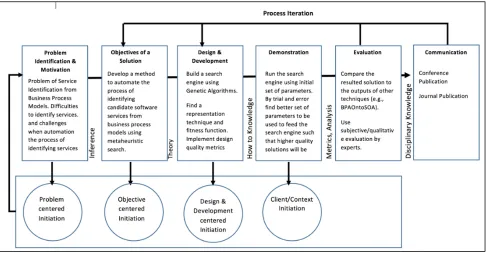
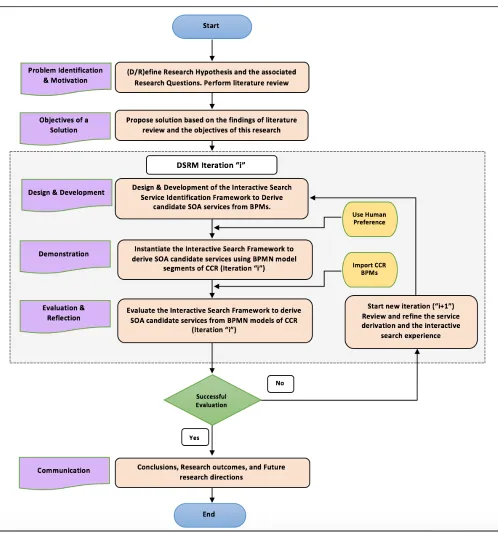
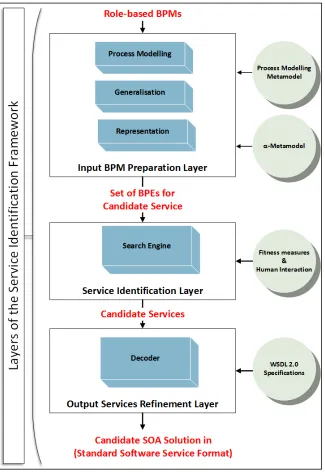
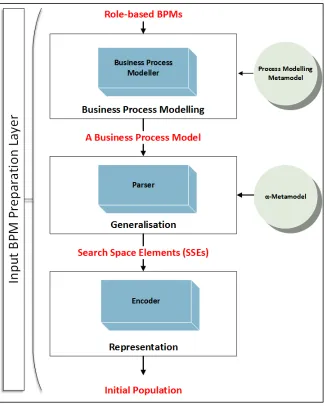
Framework for Software Service
Identification from Business Process Models
Hamzeh Jamil Aljawawdeh
The University of the West of England
Faculty of Environment and Technology
This thesis is submitted as partial fulfilment of the requirements for the
degree of
DOCTOR OF PHILOSOPHY
Software Engineering Research Group (SERG)
Abstract
In recent years, the Service-‐Oriented Architecture (SOA) model of computing has become widely used and has provided efficient and agile business solutions in response to inevitable and rapid changes in business requirements. Software service identification is a crucial component in the production of a service-‐
oriented architecture and subsequent successful software development, yet current top-‐down service identification methods have limitations. For example, service identification methods are either not sufficiently comprehensive to handle the totality of service identification activities, or they lack for automation and rely heavily on the software engineer to do some activities, or they pay insufficient
attention to quality checks of the service identification method or the resulting services. To address these limitations, comprehensive computationally intelligent support for software engineers when deriving software services from an organisation’s business process models shows great potential, especially when the impact of human preference on the quality of the resulting solutions can be incorporated. Accordingly,
this research attempts to apply interactive metaheuristic search to effectively bridge the gap between business and SOA technology and so increase business agility.
A novel, comprehensive framework is introduced that is driven by domain independent role-‐based business process models, and uses an interactive metaheuristic search-‐based software service
identification approach based on a genetic algorithm, while adhering to SOA principles. Termed BPMiSearch, the framework is composed of three main layers. The first layer is concerned with processing inputs from business process models into search space elements by modelling input data and presenting
King Hussein Cancer Centre, Amman, Jordan. The impact of software engineer interaction on the quality
of the outcomes in terms of search effectiveness, efficiency, and level of user satisfaction, is assessed. Results show that BPMiSearch has rapid search performance to positively support software engineers in the identification of services from role-‐based business process models while adhering to SOA principles. High-‐quality software services are identified that might not have been arrived at manually by software
engineers. Furthermore, it is found that BPMiSearch is sensitive and responsive to software engineer interaction resulting in a positive level of user trust, acceptance, and satisfaction with the candidate software services.
Acknowledgement
I would like to sincerely thank my supervisors Dr Mohammed Odeh and Dr Chris Simons for their support and guidance during this PhD journey. Thank you, Mohammed and Chris, for taking me on a wonderful journey of exploring research ideas. Your advice on research has been very enlightening, inspiring, and
always motivating.
I am grateful to thank Dr Asem Mansour, Dr Abdelghani Tbakhi, Dr Imad Traish, Mr Nawras Lebzo, Mrs Enas Jazairy, Mr Mohannad Abdulmalik from the King Hussein Cancer Centre (KHCC), Jordan, who supported and facilitated the research case study and data analysis.
I am also grateful to my other PhD colleagues and friends with whom I shared the office and some of the difficulties in the way. Rawad, Ahmad Samhan, Mohammad Sabri, Sami, Shadan, Suhair, Eman, Noura, Abdullah Al-‐Khateeb, Abdullah Jalabneh, Gaith, Mais, Bushra, Dalia, Daniel, Barkha, and Kayode. Furthermore, I would like to thank all colleagues at UWE Graduate School for the continues support and
encouragement, Marisa, Helen, Patricia, Samantha, Bridgett, Caterina, Victoria and Yasmine.
I wish to thank my parents who have provided me with the ideal environment to grow up in, and from whom I have inherited my determination and strength. I would like also to thank my brothers Ahmad, Jawad, Yazan and Mohammad and sisters Alaa and Deema for all their belief that I was capable of taking
on the PhD. Thank you all for the constant and unconditional love and support.
Finally, I wish to thank my wife, Walaa has been extremely supportive of me throughout this entire process and has made countless sacrifices to help me get to this point. She gave me constant support and help.
Table of Contents
Abstract III
Acknowledgement V
Table of Contents VI
List of Figures VIII
List of Tables IX
Abbreviations XI
Chapter 1 Introduction 1
1.1.
Background 3
1.2.
The Research Problem 6
1.3.
Research Motivation 10
1.4.
Research Aim and Objectives 12
1.5.
The Research Hypothesis and Associated Questions 13
1.6.
Summary of Research Contributions 14
1.7.
Thesis Roadmap and Structure 15
1.8.
List of Publications 18
Chapter 2 Background and Literature Review 19
2.1.
Background 19
2.2.
Service Identification Problem 27
2.2.1.
Selection of Relevant SIMs 28
2.2.2.
Techniques of Service Identification 30
2.2.3.
The Automation 37
2.2.4.
Service Quality Assessment 40
2.3.
Conclusions 44
Chapter 3 Research Design 47
3.1.
Introduction 47
3.2.
Overview of Research Methods 48
3.3.
The Research Design and the Adoption of DSRM 52
3.4.
The Research Case Study 70
3.5.
Summary 79
Chapter 4 The Service Identification Framework 81
4.1.
Introduction 81
4.2.
DSRM Design and Development Phase 83
4.3.
DSRM Demonstration Phase 103
4.4.
DSRM Evaluation Phase 112
4.5.
Summary 120
Chapter 5 The Search-‐based Framework 122
5.1.
Introduction 122
5.2.
The DSRM Design and Development Phase 124
5.3.
The DSRM Demonstration Phase 130
5.4.
Evaluation 153
5.5.
Summary 161
6.3.
DSRM Demonstration Phase 173
6.4.
DSRM Evaluation Phase 194
6.5.
Threats to Validity 204
6.6.
Summary 206
Chapter 7 Conclusions 208
7.1.
Fulfilment of the Research Questions and the Research Hypothesis and Summary of
Research Outcomes 209
7.2.
Future Directions 219
References 221
Appendix A
BPMN Models of KHCC 234
Appendix B
Derived Search Space Elements CCR 251
Appendix C
Results of the First Experiment 257
Appendix D
Material for the First Experiment 263
Appendix E
Plan for the Interactive Search Experiment 274
Appendix F
Participant Material for the Interactive Experiment 282
List of Figures
FIGURE 1.1: SERVICE ORIENTED ARCHITECTURE ... 5
FIGURE 1.2: THESIS ROADMAP ... 17
FIGURE 3.1: DESIGN SCIENCE RESEARCH METHODOLOGY (DSRM) PROCESS MODEL ... 50
FIGURE 3.2: RESEARCH METHODOLOGY IN DSRM PHASES ... 53
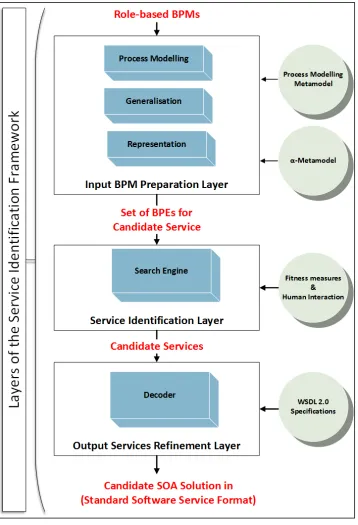
FIGURE 3.3: THE ARCHITECTURAL DESIGN OF BPMISEARCH FRAMEWORK ... 54
FIGURE 3.4: INPUT BPM PREPARATION LAYER ... 57
FIGURE 3.5: MANAGE PATIENT ADMISSION MODEL OF CCR CASE STUDY. ... 75
FIGURE 4.1: THE ARCHITECTURAL DESIGN OF THE BPMISEARCH FRAMEWORK ... 84
FIGURE 4.2: MODELLING THE BUSINESS PROCESS ELEMENTS ... 87
FIGURE 4.3: ALGORITHM I DERIVING BPMN ELEMENTS ... 90
FIGURE 4.4: ALGORITHM II CREATE SEARCH SPACE ELEMENTS ... 90
FIGURE 4.5: DERIVING SEARCH SPACE ELEMENTS (SSES) FROM THE GENERIC BPMS. THE GENERIC BPMS, AND THE RESULTING SSES. .. 91
FIGURE 4.6: MAPPING TO SERVICE COMPONENTS EXAMPLE ... 102
FIGURE 4.7: RELATIONSHIPS BETWEEN SSES OF CCR CASE STUDY ... 106
FIGURE 4.8: FITNESS VALUES OF MANUAL SOLUTIONS AND RANDOM SOLUTIONS ... 109
FIGURE 5.1: GA ACTIVITY DIAGRAM. ... 126
FIGURE 5.2: SINGLE POINT CROSSOVER ... 129
FIGURE 5.3: MUTATION ... 129
FIGURE 5.4: POPULATION AVERAGE FITNESS CURVES ... 133
FIGURE 5.5: POPULATION AVERAGE FITNESS AND STANDARD DEVIATION, COUPLING AND COHESION MEASURES FOR GA(0.7, 0.1) ... 134
FIGURE 5.6: POPULATION AVERAGE FITNESS AND STANDARD DEVIATION FOR GA (0.8,0.03) ... 136
FIGURE 5.7: CONNECTIVITY VISUALISATION DIAGRAM FOR A SAMPLE CANDIDATE SOLUTION ... 141
FIGURE 5.8: SAMPLE WSDL FILE FOR A CANDIDATE SERVICE ... 142
FIGURE 5.9: POPULATION AVERAGE FITNESS CURVES FOR THE SEARCH-‐BASED ALGORITHM AND THE BASELINE RANDOM ALGORITHM .... 145
FIGURE 5.10: TIME TO FINISH THE SEARCH ... 146
FIGURE 5.11: POPULATION FITNESS PLATEAU AVERAGE FITNESS VALUES FOR SEARCH AND MANUAL SAMPLES ... 150
FIGURE 6.1: SERVICE EVALUATION SCREEN ... 169
FIGURE 6.2: SERVICE DETAILS GUI ... 169
FIGURE 6.3: CONNECTIONS-‐VIEW ... 170
FIGURE 6.4: WSDL FILE FOR THE HEADER OF A SAMPLE SERVICE ... 183
FIGURE 6.5: WSDL BINDING SAMPLE ... 184
FIGURE 6.6: POPULATION AVERAGE FITNESS CURVES WITH STANDARD DEVIATION FOR A BPMISEARCH VS. SEARCH SAMPLE ... 185
FIGURE 6.7: POPULATION AVERAGE FITNESS VALUES AND STANDARD DEVIATION WHEN ARRIVING AT A FITNESS PLATEAU ... 187
FIGURE 6.8: AVERAGE REQUIRED GENERATIONS TO ARRIVE AT A FITNESS PLATEAU WITH THE STANDARD DEVIATION ... 188
FIGURE 6.9: LEVEL OF SATISFACTION ABOUT BPMISEARCH AND SEARCH SOLUTIONS ... 197
FIGURE 6.10: GRANULARITY LEVEL OF RESULTING CANDIDATE SERVICES USING BPMISEARCH AND BPAONTOSOA ... 202
FIGURE 7.1: BOTTOM-‐UP ANSWERING OF RESEARCH QUESTIONS AND RESEARCH HYPOTHESIS ... 210
List of Tables
TABLE 2.1: BASIC BPMN ELEMENTS (OBJECT MANAGEMENT GROUP, 2011) ... 23
TABLE 2.2: LIST OF RELEVANT STUDIES IN THE SERVICE IDENTIFICATION SORTED BY PUBLICATION YEAR ... 28
TABLE 2.3: TECHNIQUES FOR SERVICE IDENTIFICATION ... 32
TABLE 2.4: LEVEL OF AUTOMATION IN SIMS ... 38
TABLE 2.5: QUALITY ASSESSMENT ... 41
TABLE 3.1: LIKERT-‐TYPE SATISFACTION SCALE ... 66
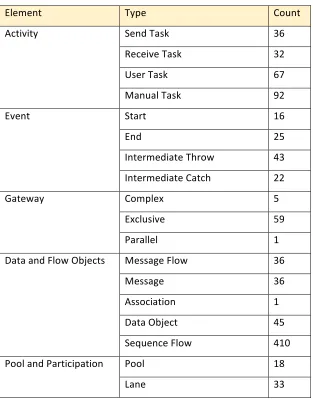
TABLE 3.2: BUSINESS PROCESS ELEMENTS OF HANDLE PATIENT ADMISSION MODEL ... 75
TABLE 3.3: STATISTICS OF CCR CASE STUDY ... 77
TABLE 3.4: SCALE AND COMPLEXITY OF CCR CASE STUDY ... 78
TABLE 4.1: a-‐METAMODEL KEY ELEMENTS WITH THE INCLUDED TYPES AND TAGS ... 86
TABLE 4.2: REPRESENTATION EXAMPLE ... 94
TABLE 4.3: MAPPING THE BPMN ELEMENTS TO WSDL FILE COMPONENTS ... 101
TABLE 4.4: PARAMETERS OF THE SERVICE IDENTIFICATION EXPERIMENT ... 104
TABLE 4.5: SAMPLE SSES PRODUCED IN INPUT DATA PREPARATION PHASE ... 105
TABLE 4.6: A CANDIDATE SOA SOLUTION CREATED BY KHCC DOMAIN EXPERT ... 107
TABLE 4.7: SUMMARY OF FITNESS VALUES FOR MANUAL SOLUTIONS BY KHCC DOMAIN EXPERTS ... 108
TABLE 4.8: FITNESS MEASURES FOR BASELINE SOLUTION SAMPLES PRODUCED RANDOMLY ... 108
TABLE 4.9: SHAPIRO-‐WILK NORMAL DISTRIBUTION TEST ... 111
TABLE 4.10: INDEPENDENT SAMPLES T-‐TEST RESULTS ... 111
TABLE 4.11: SEARCH-‐BASED SIM EVALUATION ACTIVITIES ... 113
TABLE 4.12: COMPARISON BETWEEN BPAONTOSOA AND THE PROPOSED SERVICE IDENTIFICATION FRAMEWORK ... 116
TABLE 4.13: INSPECTING THE INPUTS AND OUTPUTS OF BPMISEARCH FRAMEWORK ... 118
TABLE 5.1: PARAMETERS OF THE SEARCH EXPERIMENTS ... 132
TABLE 5.2: POPULATION AVERAGE FITNESS RESULTS AT THE FITNESS PLATEAU ... 134
TABLE 5.3: PARAMETER COMBINATION OBTAINED USING TRIAL-‐AND-‐ERROR EXPERIMENTS ... 135
TABLE 5.4: SAMPLE CANDIDATE SERVICES PRODUCED USING THE SEARCH ALGORITHM ... 137
TABLE 5.5: INDEPENDENT SAMPLES T-‐TEST ... 147
TABLE 5.6: INDEPENDENT SAMPLES T-‐TEST FOR COMPUTATIONAL SPEED ... 148
TABLE 5.7: POPULATION AVERAGE FITNESS VALUES AT A FITNESS PLATEAU USING THE SEARCH METHOD ... 149
TABLE 5.8: FITNESS VALUES FOR MANUAL SOLUTIONS ... 150
TABLE 5.9: NORMALITY TEST RESULTS ... 152
TABLE 5.10: INDEPENDENT SAMPLES T-‐TEST ... 152
TABLE 5.11: LIKERT-‐TYPE SATISFACTION SCALE ... 155
TABLE 5.12: EVALUATION VALUES BY THE FIRST GROUP OF DOMAIN EXPERTS AT KHCC ... 156
TABLE 5.13: EVALUATION VALUES BY THE SECOND GROUP OF DOMAIN EXPERTS AT KHCC ... 157
TABLE 5.14: COMPARISON BETWEEN BPAONTOSOA AND METAHEURISTIC SEARCH FRAMEWORKS WHEN IDENTIFYING SERVICES FROM BPMS ... 159
TABLE 6.1: LIKERT SATISFACTION SCALE ... 168
TABLE 6.2: PARAMETERS OF THE SEARCH EXPERIMENTS ... 174
TABLE 6.3: GENETIC PARAMETERS ... 176
TABLE 6.4: CANDIDATE SERVICE SOLUTION PRODUCED USING THE INTERACTIVE BPMISEARCH METHOD ... 178
TABLE 6.5: POPULATION AVERAGE FITNESS VALUE AT FITNESS PLATEAU USING BPMISEARCH ... 186
TABLE 6.6: POPULATING AVERAGE FITNESS VALUES AT THE FITNESS PLATEAU USING THE NON-‐INTERACTIVE SEARCH ... 187
TABLE 6.7: TEST OF NORMALITY OF FITNESS VALUES OF THE SEARCH AND BPMISEARCH METHODS ... 189
TABLE 6.8: INDEPENDENT SAMPLES T-‐TEST TO COMPARE BPMISEARCH TO THE SEARCH POPULATION AVERAGE FITNESS ... 190
TABLE 6.13: LEVEL OF SATISFACTION STATISTICS ... 198
TABLE 6.14: THE BPMISEARCH SIM VS. BPAONTOSOA ... 199
TABLE 6.15: FITNESS STATISTICS FOR BPAONTOSOA ... 200
TABLE 6.16: INDEPENDENT SAMPLES T-‐TEST TO COMPARE BPMISEARCH SAMPLES WITH BPAONTOSOA SAMPLES ... 201
Abbreviations
ACO: Ant Colony Optimisation.
BPA: Business Process Architecture.
BPEL: Business Process Execution Language.
BPE: Business Process Element.
BPM: Business Process Model.
BPMiSearch: A comprehensive framework for service identification from business process models using interactive metaheuristic search. This framework is the main contribution of this research.
BPMN: Business Process Modelling and Notation.
BS: Business Services.
CCR: Cancer Care and Registration.
CRUD: Create Read Update Delete.
DSRM: Design Science Research Methodology.
EA: Evolutionary Algorithm.
EC: Evolutionary Computing.
GA: Genetic Algorithm.
iSBSE: Interactive Search Based Software Engineering.
IS: Information Systems.
IT: Information Technology.
KHCC: King Hussein Cancer Centre.
MOEA: Multi-‐Objective Evolutionary Algorithm.
OMG: Object Management Group.
SOA: Service Oriented Architecture.
SOEA: Single Objective Evolutionary Algorithm.
SSE: Search Space Element.
srBPA: Semantic-‐Enriched Riva Business Process Architecture.
UDDI: The Universal Description, Discovery and Integration (UDDI)
WSDL: Web Service Description Language.
Chapter 1
Introduction
Service Oriented Architecture (SOA) has been widely utilised in an attempt to provide effective business-‐ IT alignment (Zadeh et al., 2016). Utilising SOA systems helps software engineers to keep abreast of the inevitable and rapid changes in business environments (Yousef et al., 2014). Identifying software services
that satisfy the business demand is one of the key activities of developing SOA solutions (Papazoglou, 2007). However, there is a body of evidence to suggest that identifying the right software services is a challenging, non-‐trivial, and cognitively demanding task to perform because the nature of SOA projects is
inherently complex while at the same time SOA as an architectural style promises to preserve the software quality (Shahrbanoo, Ali, and Mehran, 2012). Identifying incorrect services at this stage causes deleterious consequences for downstream development (Jamshidi et al., 2012), as errors made at this stage can be
propagated through to the next stages of design, implementation, and verification (Kazemi et al., 2011).
Existing service identification methods (SIMs) can suffer from serious shortcomings. For example, the majority of SIMs are not fully comprehensive as they do not cover all the phases of service identification (i.e., the majority of SIMs focus on the service identification phase alone); therefore, some critical aspects
of service identification may be ignored (Zadeh et al., 2016). In addition, there is a lack of computational support such that SIMs rely heavily on the software engineer to fulfil the service identification activities manually (Azevedo et al., 2009). Furthermore, quality assessment procedures utilised by the majority of
contemporary SIMs are not sufficient to fully examine the resulting candidate services as well as the service identification approach itself using both quantitative and qualitative evaluation methods (Zadeh et al., 2016; Huergo et al., 2014; Gu and Lago, 2010; Bianchini et al., 2014). Insufficient service assessment
abstraction of the underlying business), and also that they do not guarantee the feasibility of the resulting solutions (Papazoglou, 2007).
Computational intelligence has been previously applied to address a variety of development problems in software engineering. For example, Search-‐Based Software Engineering (SBSE) uses a range of bio-‐ inspired metaheuristic search and optimisation techniques such as genetic algorithms or ant colony optimisation to solve software systems engineering problems (Harman and Jones 2001; Simons et al.,
2012). Finding the optimum solution using dynamic programming or linear programming may not be feasible for large-‐scale software engineering problems because of computational scale and complexity. Thus, researchers and practitioners have used metaheuristic search techniques to find near-‐optimal or
good-‐enough solutions (Harman, 2011).
Incorporating the software engineer ‘in-‐the-‐loop’ of optimisation algorithms, interactive search-‐based methods have been used to address different software development activities such as software design
(Simons and Parmee, 2012), testing (Afzal, Torkar and Feldt, et al., 2009), requirements management (Pitangueira et al., 1999), refactoring (Mariani and Vergilio, 2017), and maintenance (Bavota, Penta and Oliveto, 2014). Where research problems require both objective and subjective evaluation methods to evaluate the quality of the resulting candidate services, an interactive search method appears well suited. Indeed, interactive search methods help to create a common ground and mutual learning between the
computationally intelligent algorithm and the software engineer, such that the resulting solutions are reasonable and predictable (Ramirez et al., 2018). Furthermore, Ramirez et al. (2018) point out that interactive search can foster a level of comfort, acceptance and trust in the candidate solutions obtained.
The application of iSBSE to address problems in software engineering such as the service identification problem presents challenges, however. One key challenge is formulating a suitable solution
representation and corresponding fitness measures to completely reflect the reality of the software engineer development activities (Ramirez et al., 2018). In this research, we formulate a solution representation that maps business process models to the corresponding candidate services. With respect to fitness measures, the use of iSBSE strikes a balance between the subjective and objective measures to
allow software engineers to drive the trajectory of the search, while at the same time ensuring the feasibility and quality of the resulting SOA solutions. Furthermore, it is important that the implementation of the underlying search algorithm is sufficiently performant to prevent user fatigue as the software
engineer interacts with the search offering qualitative preferences and evaluating candidate services.
This research investigates the potential of interactive metaheuristic search to enable the exploration and discovery of feasible and high-‐quality SOA solutions that satisfy the organisation’s business process, such
that any business-‐IT gap is reduced.
1.1. Background
A Business Service is a service that is delivered to business customers by business constituents. For example, banks provide financial services to their customers or retail stores deliver goods to the
customers. On the other hand, in the context of service-‐oriented architecture (SOA), the IT service (i.e., can be called software service) is a term refers to software functionality or multiple functionalities that can be used by different customers for different purposes. The IT service has a mechanism to enable
aim is to identify the needed software services that are needed to build an IT system that satisfies the business services. The software services help to automate the business functionalities fully or partially.
The process of finding these IT services from the business services is called “Software Service Identification” or in short “Service Identification”. The short term “Service” in this thesis point to the software services, therefore, deriving services or identifying services means software services.
Service Oriented Architecture (SOA) is an approach that is used to build IT system based upon the use of
software services. SOA makes building and changing IT systems easier. Traditionally, an IT system meant piecing together a collection of hardware, software and networking, all these components were rigidly integrated, so implementing a change was difficult. With SOA, an IT system is built using easy to assemble,
easily reconfigurable components, like building blocks. Each building block represents a business service that the business performs. So to implement a change, these building blocks (i.e., candidate software services) can be assembled in a different way to make something new.
A key component of the web services model is service discovery; which defines a process for finding service providers and retrieving service description documents. The concept of service discovery has been addressed by different solutions, for example, the Universal Description, Discovery and Integration (UDDI) specification. UDDI aims to address a subset of the service discovery requirements by using centralised service discovery model. Another example is the Web Service Inspection Language (WS-‐Inspection) which
provides another related service discovery mechanism.
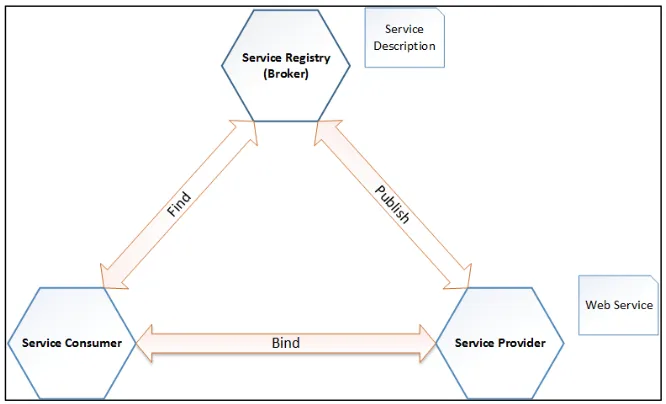
SOA is based upon the interaction between three key roles: service provider, service registry (i.e., or broker), and service consumer (i.e., or requestor). These roles interact using three main operations:
and bind to a service using the information in the description. Figure 1.1 presents a logical view of the SOA. In this conceptual view of web services architecture, a centralized location for storing service
descriptions is provided by the web service architecture. UDDI registry is an example of this type of service registry.
Figure 1.1: Service Oriented Architecture Adapted from (Voormann 2006), Licensed under CC-‐BY-‐SA 3.0
An example of using SOA for an organisation is the online banking. In which the bank (i.e., a provider of business banking service) can provide software services for online banking (e.g., make an online check for account balance). The online banking service can be published and used by bank clients (i.e., consumers).
The software services for online banking represent a set of corresponding business services provided by the banking business. One web service may contain a set of functionalities, for example, online banking service can comprise different sub-‐services (e.g., check for balance, make a money transfer, and make a
[image:17.612.139.472.184.386.2]1.2. The Research Problem
Modelling the business context as a basis for software systems development has been widely investigated to reduce any gap between business and software systems (Vale et al., 2012). This business-‐IT alignment
helps to mirror, support and automate the business (Odeh and Kamm, 2003). Agility of SOA development underpins business-‐IT alignment as it represents a product of the SOA flexibility (Zadeh et al., 2016). Owing to SOA’s remarkable features such as flexibility, agility and modularity, SOA has received growing
attention (Papazoglou et al., 2008; Yousef, 2011; Gu and Lago, 2010; Bianchini et al., 2013). SOA includes two key components: business and technology. Firstly, the business component focuses on business-‐ aligned services to support the business-‐IT alignment. Secondly, the software aspect manages only the
pre-‐existing technology in relation to services. Ignoring any aspect of the comprehensive guidelines leads to the creation of implementation difficulties that can weaken the realisation of its benefits (Kohlborn et al., 2009).
Software service identification is one of the most significant activities of the design and development of
SOA solutions (Jamshidi et al., 2012). Although the identification of key abstractions (i.e., services) is one of the initial tasks in the modelling of an enterprise solution, software engineers can struggle to identify key abstractions to represent appropriate domain elements in a non-‐arbitrary (i.e., subjective or random)
manner (Levi and Arsanjani, 2002). Nevertheless, it is very important to identify correct services, as errors at this stage are expensive and difficult to resolve, which reflects on the need for a robust SIM that derives feasible service solutions (Börner et al., 2012; Boerner and Goeken, 2009; Dijkman et al., 2008). Moreover,
in business entities are not readily available in the research literature (Shashwat and Kumar, 2017; Zadeh et al., 2016; Alkkiomäki and Smolander, 2015).
A further key aspect that distinguishes existing SIMs is the delivery strategy. According to Huergo et al., 2014, Vale et al., 2012, and Gu and Lago, 2010, the delivery strategy can be a business-‐oriented (top-‐ down), technical-‐oriented (bottom-‐up), or goal-‐service modelling (meet-‐in-‐the-‐middle) strategy. Top-‐ down approaches focus on domain decomposition, whereas bottom-‐up approaches focus on analysing
existing software and technology assets (Zadeh et al., 2016). The delivery strategy is identified according to the available input artefacts. For example, a SIMs that adopts a high-‐level artefact from the business domain as input (e.g., business processes or business goals) is considered as a top-‐down approach.
Whereas, if the SIM has IT assets (e.g., databases, interfaces and legacy software systems) as input, it can be considered as a bottom-‐up approach. One of the key challenges to be considered is to identify the right services that not only satisfy current business needs, but also deal with anticipated changes (Frey et al.,
2013). Huergo et al. (2014) observe that the majority of SIMs are technically-‐oriented and they focus on the technical domain. However, to ensure the business-‐IT alignment, mapping of the business process to the corresponding web services should be established (Cherbakov et al., 2005).
Although the adoption of a business-‐oriented method is more effective when performing a business-‐IT alignment, it is more challenging in terms of interactive search and automation. The descriptive and fuzzy
nature of business models constrains SIMs, and as a consequence, just a few top-‐down SIMs aim to propose an interactive semi-‐automated method, whereas the majority of the existing top-‐down SIMs lack computational support (Zadeh et al., 2016). In contrast, it has been observed that most of the automated
A significant consideration to be taken while developing a SIM is the quality assessment of both the resulting services and the service identification approach itself. Many SIMs lack comprehensive evaluation
using empirical methods (e.g., case studies) (Huergo et al., 2014; Vale et al., 2012). In this case, according to Bianchini et al. (2009), the resulting SIM can be more theoretical as it does not show sufficient evidence to confirm the feasibility of the resulting services. In addition, there is no guarantee that high-‐quality services that adhere to SOA principles such as low coupling and high cohesion will be produced (Bianchini
et al., 2014; Jamshidi et al., 2008). A comprehensive framework that comprises all the phases of service identification with detailed guidelines that are also validated using a robust empirical method remains to be developed (Shashwat and Kumar, 2017; Zadeh et al., 2016).
Applying an interactive SBSE (iSBSE) technique to address the service identification problem offers a promising solution, because the resulting solutions can engender genuine acceptance by the software engineer, and the software engineer and the computationally intelligent framework can collaborate with
common purpose to achieve a set of agreed goals (Klien et al., 2004). The responsive nature of the interactive search allows the participant to evaluate the results during the search process (i.e., not before nor after) such that the search algorithm can use the human preference to learn from the feedback and enhance the outcomes (Aljawawdeh, Simons and Odeh, 2015). Using an interactive search technique is a challenging task because it is difficult to create an optimisation model for the service identification to
reflect all aspects required by the real decision makers (Meignan et al., 2015). This requires the discovery of an appropriate representation technique along with the right fitness measures to provide an effective and efficient search experience (Meignan et al., 2015). Furthermore, formulating an appropriate
representation and fitness function can be more challenging if the criterion of accepting solutions cannot be expressed explicitly (Guindon, 1990). Hence the use of an interactive search technique is anticipated to bring together computationally intelligent search and software engineer preference in order to raise
understanding between the software engineer and the search approach is emphasised in order to be able to deliver a reliable interactive search method (Klien et al., 2004).
Finally, ensuring satisfactory performance of the search process (i.e., in terms of time required to derive candidate services) is another challenge. This requires ensuring the efficiency and performance of the search, especially with increasing scale and complexity of problem instances (Eiben and Smith, 2015). Unsatisfactory search performance can lead to user fatigue and so ineffective interaction between the
software engineer and the search algorithm, which may negatively affect the trajectory of search.
To summarise the key challenges that face the existing SIMs:
• SIMs should cover all the phases and activities of service identification process. For example, a comprehensive SIM covers all the phases of input preparation, service identification, and output refinement rather than managing the service identification phase alone.
• Automation with the metaheuristic search should support the software engineer to reduce the heavy reliance on the software engineer in manual service identification and reduce the cognitive
load on the software engineer. Providing automated computationally-‐intelligent support is challenging because managing top-‐down input artefacts is complex as these input artefacts have a descriptive nature.
• Interactive search should enrich the quality of the SIM as well as the resulting services. In addition, having the software engineer ‘in-‐the-‐loop’ adds another challenge in the incorporation of human evaluation of candidate solutions, and capturing human qualitative preferences, both explicit and implicit.
This research investigates iSBSE to address these challenges. The main goal of this research is to introduce a novel comprehensive interactive framework for service identification. This framework should cover all
the phases of service identification and utilises the human implicit knowledge and explicit experience to enrich the quality of the resulting services. The feasibility of the resulting solutions and conformance to SOA principles are important aspects that also should be satisfied. Significantly, quantification of service identification metrics should enable the evaluation of the proposed framework as well as the resulting
candidate SOA solutions. Finally, sufficient evidence of the successful design and implementation of this sophisticated method should be provided and validated using a representative real-‐life case study.
1.3. Research Motivation
The motivation of this research stems from the importance of producing a comprehensive framework that derives effective candidate services from role-‐based BPMs. We are firstly motivated to develop this framework to provide a practical example of using the interactive search to address and resolve a practical problem in software engineering that contributes to the field of SOA and Healthcare. Secondly, the
requirements of this problem endorse using a triangulation of evaluation methods (i.e., a combination of objective and subjective techniques) to examine the quality of the resulting services as well as the service identification approach itself. Thus, we are motivated to investigate the extent to which interactive
metaheuristic search can satisfy this objective. The interactive search means that there is a responsive process between the software engineer and an intelligent search algorithm during the search process (i.e., not before or after), which helps the software engineer to drive the trajectory of the search
(Aljawawdeh, Simons and Odeh, 2015).
and reducing the development costs (i.e., time and money). The key characteristics of the required SIM include the following aspects:
a. Comprehensive: Needs to include all the phases of service identification not just the mapping between the business elements and the corresponding service components.
b. Interactive: It utilises the human interactive preference (Aljawawdeh, Simons and Odeh, 2015) to enrich the quality of the resulting services. Moreover, interaction with computational intelligence
creates a mutual ground between the human and computationally intelligent tool.
c. Appropriate Level of Automation: utilising automated computational intelligent tools is one of the main characteristics that support bridging the gap between the business and software systems
(Odeh and Kamm, 2003). Computational intelligence can be used to support human to satisfy difficult tasks by automating and managing complicated activities, is useful and has many advantages. For example, automating the complicated activities minimises the heavy reliance on
software engineers, reduces the cost (i.e., time, money, errors, etc.) of constructing software systems. However, this research aims to utilise the human knowledge and experience to enrich the quality of the outcomes, but not to exclude the human from the loop. In contrast, one of the limitations of many top-‐down SIMs is to automate the data preparation phase that works directly with the input business artefacts. These activities of the service identification, including the data
preparation and the resulting service refinement phases, can be fully automated. The automation of these phases helps to accelerate the development to keep up with the quick changes in business requirements.
1.4. Research Aim and Objectives
This research aims to contribute to the SOA paradigm by using an interactive metaheuristic search to derive SOA services from BPMN, to automate, simplify, and enrich the service identification process. To
address this aim in light of the gap analysis presented in Chapter 2, the following four objectives have been identified:
1) Investigate for an appropriate framework to derive services from business process models that smoothly map business processes to software services and to enable the generalisation of the mapping approach.
2) Investigate the appropriateness of various representations for effective metaheuristic search and the corresponding objective quality fitness measures for SOA. This objective necessitates the development of a suitable representation that is a natural fit for the mapping context from the business process to services. Moreover, this objective needs to define a set of fitness measures to quantify and evaluate the resulting services in order to evaluate their quality.
3) Investigate novel ways of adopting appropriate metaheuristic search algorithms. This requires evaluating and selecting an appropriate search algorithm and then conducting a set of experiments to explore and exploit the search space to find effective and efficient candidate SOA
solutions.
4) Explore novel mechanisms in which the software engineer preferences and implicit knowledge and experience can be exploited within an interactive, human ‘in-‐the-‐loop’ search.
1.5. The Research Hypothesis and Associated Questions
This research hypothesises that:
“Using interactive metaheuristic search facilitates the derivation of candidate software services from
role-‐based business process models (BPMs), and in particular BPMN process models”.
Using BPMN in this research to identify the organisation’s business workflow has many advantages. For example, it provides an intuitive and easy way for non-‐expert users in BPM to understand the notation
(Object Management Group, 2011). Furthermore, it represents the semantics of complex processes in a graphical form. More importantly, it has good tool support, e.g., BPMN-‐Modeller (Object Management Group, 2013) and Camunda (Fernandez, 2013). The BPMN reflects the way in which business processes
take place in the organisation and shows the chronological sequence of these activities. This means that building an IT-‐system for the organisation should reflect the business functionalities as services. Therefore, BPMN is used as the starting point to derive SOA software services to achieve the business-‐IT alignment by mapping BPMN activities to the corresponding service components.
Human preference will be utilised with a combination of quantitative measures to assess the quality of the services such that good-‐enough (i.e., with low coupling and high cohesion values) solutions will be constructed. This research makes a novel contribution to deriving participants’ preference values and
combine these values with other quantitative fitness measures in order to evaluate the derived candidate SOA solutions; this will help to enrich the quality of the outcomes.
Based on the above hypothesis and discussion, the following research questions have been formulated
with the aim of supporting the development of a methodological approach to assist in proving or refute the above hypothesis:
• RQ2: In what way can SOA services be best implemented for metaheuristic search?
• RQ3: Can the services solution space be effectively and efficiently explored and exploited in order to derive candidate SOA solutions from BPMN 2.0 models?
• RQ4: What is the impact of the human interactive preference on the search outcomes?
1.6. Summary of Research Contributions
The contributions to the knowledge of this research can be summarised as follows:
1. The development of a comprehensive layered interactive framework that is named BPMiSearch, that derives software candidate services from business process models.
2. The formulation of service identification problem to be implemented in an appropriate format to enable the metaheuristic search using a genetic algorithm. This includes preparing the input BPMN models in the right level of granularity to create Search Space Elements (i.e., the basic building blocks of the search space). Then encode these elements in an appropriate way to produce the initial population that is used by the search engine. The novel work in this part is the
utilisation of the systematic approach to represent elements derived from BPMN and prepare them to be evolved using an evolutionary computing technique.
3. Arriving at a good-‐enough combination of genetic parameters (e.g., crossover and mutation probabilities) that enable the exploration and exploitation of the problem search space to arrive at effective and efficient candidate solutions.
5. The adoption of Design Science Research Methodology (DSRM) to satisfy the objectives of this research. In addition, applying the framework to derive candidate software services for the Cancer
Care using a case study.
1.7. Thesis Roadmap and Structure
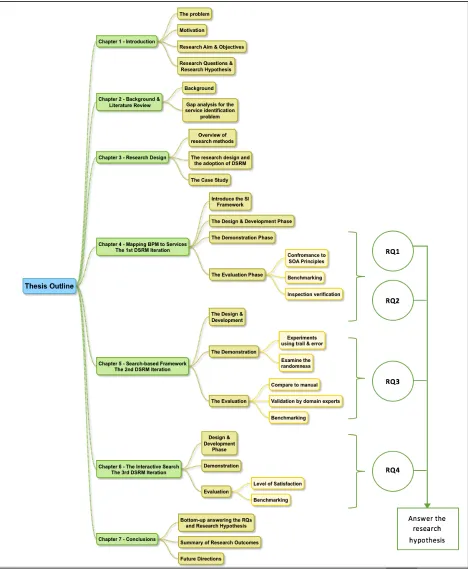
This thesis consists of seven chapters. Figure 1.2 presents a roadmap for the thesis that shows how the research questions are answered, and how the research hypothesis is addressed. The diagram summarises
the main sections of the thesis chapters. Chapter One introduces the research problem, identifies the rationale behind this research, and highlights motivations for deriving services from business processes. In addition, this chapter discloses the research aim and objectives, and accordingly, the research
hypothesis and the associated questions are presented. This is followed by Chapter Two which provides a state-‐of-‐the-‐art literature review in the domain of service identification. This is followed by a thorough analysis of the relevant studies in the service identification to identify the gaps in the literature. In addition, the chapter presents the use of metaheuristic search to derive services from business process,
and the potential of using interactive search-‐based method for service identification. The chapter concludes by summarising the gaps and the need to develop a research design methodology that supports covering these gaps with reference to the interactive search. Chapter Three provides a full overview of
the research methodology adopted in this research as well as the iterative research design and the case study. Chapter Four presents the first DSRM iteration, in which the basis of the layered service identification framework is introduced. In addition, this chapter presents the representation of the SOA
and effectiveness of the search-‐based method and paves the way for using the interactive search method.
Chapter Six presents the novel interactive search-‐based framework for service identification (i.e.,
BPMiSearch). In this chapter, the interactive technique is discussed, followed by an experimental demonstration using domain experts. This chapter illustrates a triangulation of evaluation methods with a comprehensive analysis of the interactive search-‐based framework in comparison with other techniques. It concludes by presenting the influence of using the human interactive preference on the
1.8. List of Publications
1. Aljawawdeh, H. J., Simons, C. L., & Odeh, M. (2015, July). Metaheuristic design pattern: Preference. In Proceedings of the Companion Publication of the 2015 Annual Conference on Genetic and Evolutionary Computation (pp. 1257-‐1260). ACM.
2. Aljawawdeh, H. J., Odeh, M., Simons, C. L., Lebzo, N. (2018 November). A Metaheuristic Search Framework to Derive Cancer Care Services from Business Process Models. Cancer Care Informatics 2018. [Submitted, in review]
3. Aljawawdeh, H. J., Odeh, Y., Odeh, M., Simons, C. L., Tbakhi, A. (2018 November). A Metaheuristic Framework to Derive Services for Cell Therapy and Applied Genomics from Business Process, A Case Study. Cancer Care Informatics 2018. [In
preparation]
4. Aljawawdeh, H.J., Odeh, M., Simons, C. (2018). An Interactive Search-‐based Framework to Identify SOA Services from Business Process Models. Business Process Architectures and Service-‐Oriented Environment. Information Software
Technology Journal. [In preparation].
Chapter 2
Background and Literature Review
2.1.
Background
Service Oriented Architecture (SOA) has gained considerable attention in facing today’s business and
software challenges resulting from rapid changes in business environments and user expectations. These challenges include business challenges such as agility and flexibility, and software challenges such as reusability and integration (Zadeh et al., 2016). Therefore, transformation to SOA is a goal for most
enterprises (Yousef, 2010).
Service identification is one of the key activities and an example of best practice in research that aims to investigate the SOA development lifecycle. The contemporary Service Identification Methods (SIMs) can suffer from critical limitations; for example, are not able to handle all the activities of service identification, so some important aspects are neglect (e.g., input data preparation). Other approaches adopt a very
complicated identification criterion, which requires deep analysis of all sets of business process models in order to construct feasible solutions that adhere to SOA principles (Yousef, 2010). In contrast, some SIMs are too simple to fulfil the key principles of SOA development (Papazoglou et al., 2007). The possibility to
automate the activities of service identification and reduce human fatigue is another important issue. Failing to automate the activities of service identification is another shortcoming exhibited in the contemporary SIMs.
In addition to the above limitations, it appears that there is a lack of a SIM that fully evaluates the quality
The Business Process (BP) is important to capture several aspects, such as business functions, inventory of existing software systems, identification of business needs, and objectives and quality attributes
(Yousef, 2010). BP can be classified into Business Process Architecture (i.e., BPA) and Business Process Modelling (i.e., BPM). Both BPA and BPM provide a good comprehension of the “as-‐is” environment. In order to achieve business-‐IT alignment, it is important to take into consideration the “as-‐is” situations, such that candidate services correspond to the business domain entities (Zadeh et al., 2016).
To explicitly distinguish between the two types of business process, BPMs represent the detailed step-‐by-‐ step activities used to satisfy business goals and objectives (Havey, 2005). However, BPAs identify all the processes in an organisation and show the relationships between them at a higher level of abstraction
(Ould, 1995). In order to derive candidate services that correspond to the organisation’s business, it is required to have a detailed representation of the organisation’s business processes. Although it is focused on maintaining the process architecture prior to developing a software system to support the
organisations’ needs (Harmon, 2003), mapping the business activities to the corresponding service components requires maintaining the BPM rather than BPA. Using only BPAs is not sufficient to perform the mapping between the business to SOA candidate services because the detailed activities and business elements are not presented in these models. Based on this discussion, this research adopts BPM to perform the mapping.
The existence of different business process modelling approaches and a set of associated process modelling languages (Khan et al., 2011) makes it challenging to select the appropriate BPM to perform the mapping between the business context and the software services. BPM approaches can be classified
(i) Role-‐based modelling approaches: the main constructs involve a set of roles, where each role comprises a set of related roles and activities that interact with each other (Cho, Kim and Hie,
1998). A role can interact with other roles using different techniques such as messages or events (Khan, 2009). The role-‐based approach presents the organisation’s detailed activities connected and ordered in a chronological sequence. Examples of the role-‐based approaches are Role Activity Diagrams (RAD) (Badica et al., 2003), Business Process Modelling and Notation (BPMN) (Dijkman
et al., 2011), and the Unified Modelling Language (UML) (Pooley and King, 1999).
(ii) Functional-‐based modelling approaches: using a functional business orientation, the whole system performs as a set of ‘sub-‐systems’ each performing a specific function (e.g., sales and
production). This approach helps each small sub-‐system to specialise in a specific functionality and makes it easier to manage as it is less complex. However, the main drawback is that producing a common outcome requires collaboration between the small sub-‐systems in the organisation,
which is difficult since the functionalities are not transparently divided amongst the different functional units (Reijers, 2003). An example of a function-‐based approach is the Integration Definition (IDEF) which represents a family of modelling languages (Kim et al., 2003).
(iii) Activity-‐based modelling approaches: the main entity in this approach are the activities that construct the approach. Typically, these activities are connected sequentially and conditional
gateways control the flow. Examples of the activity-‐based approaches include Business Process Execution Language (BPEL) and Unified Modelling Language Activity Diagrams (UML